Find relief with expert-guided neck pain exercises at home. Covers stretches, strengthening & when to see a specialist for lasting results.



You wake up with that familiar pull at the base of your skull. By mid-morning, sitting at a laptop makes it worse. By afternoon, turning your head to check traffic or glance at a second screen feels tight, stiff, or sharply annoying. The common reaction in that spot is to try the same cycle: rub the area, stretch it hard for a few seconds, maybe use heat, then hope it settles down.
Sometimes that helps for the day. It usually doesn't fix why the pain keeps returning.
A better home plan starts with the right sequence. Move first. Stretch second. Strengthen third. That's what gives your neck a chance to calm down now and hold up better later. If you also use topical relief while symptoms are flared, Hemp Well Ireland's pain cream guide gives a practical overview of what those products can and can't do. If your symptoms are centered in the neck itself, this overview of common neck pain patterns can also help you place what you're feeling.
Neck pain usually doesn't begin with one dramatic event. More often, it builds from ordinary habits. Hours of forward head posture at a desk. Shoulders lifted while working under stress. Sleeping in an awkward position. A mild strain that never fully settles because the same joints and muscles keep getting irritated.
That's why quick fixes are so frustrating. A hard stretch may feel good for a minute. Massage can loosen tissue temporarily. Rest can take the edge off. But if the neck can't move well and the surrounding muscles can't support it, the same pain pattern often comes back when daily life loads the area again.
Many people assume the neck only needs stretching. In practice, recurring symptoms usually involve a mix of stiff joints, guarded muscles, poor endurance, and posture-related overload. The upper trapezius and the muscles around the shoulder blades often work too hard while the deeper stabilizers contribute too little.
Clinical reality: Relief that lasts usually comes from improving movement quality and rebuilding support, not from repeatedly chasing the sore spot.
That's why a smart plan for neck pain exercises at home follows a progression. First, restore comfortable motion so you're not forcing a stiff neck. Then add gentle stretching to reduce protective tension. Then build endurance so the neck doesn't fatigue as quickly during work, driving, reading, or sleep.
Early progress is often subtle. You may notice less morning stiffness, easier head turns, or fewer sharp catches when changing position. Those are useful signs. They tell you the tissues are tolerating load better.
What doesn't work well is jumping straight into aggressive stretching or high-effort strengthening on an irritated neck. That usually makes the area guard harder. The most effective home programs are calm, repeatable, and boring in the best way. They're built around clean form and consistency.
If your neck is irritated, forcing a stretch is usually the wrong starting point. The first job is to get the joints and soft tissues moving again without provoking them. Once motion improves, stretches become more productive and less reactive.

Mobility drills are small, controlled movements. They don't ask the neck to tolerate a big pull. They tell the nervous system that movement is safe again. That reduces guarding and gives you a better starting point for the rest of the session.
A useful evidence-based combination is already clear. GoodRx's summary of clinical meta-analyses notes that structured home programs combining chin tucks with a 2 to 3 second retraction for 10 to 15 repetitions and rotational stretches with 45-degree turns, 5-second holds, and 5 repetitions per side achieved 68 to 75% success rates within 6 weeks for non-specific neck pain. The same source points out an important mistake: rotating more than 45 degrees can raise the risk of transient dizziness in people with cervical joint dysfunction.
Start seated or standing tall. Keep your shoulders relaxed and your jaw unclenched.
Gentle nods
Think of a tiny “yes” motion. Tip the head forward slightly, then return to neutral. Don't drop into a deep bend. Perform slow, comfortable repetitions.
Ear-to-shoulder tilts
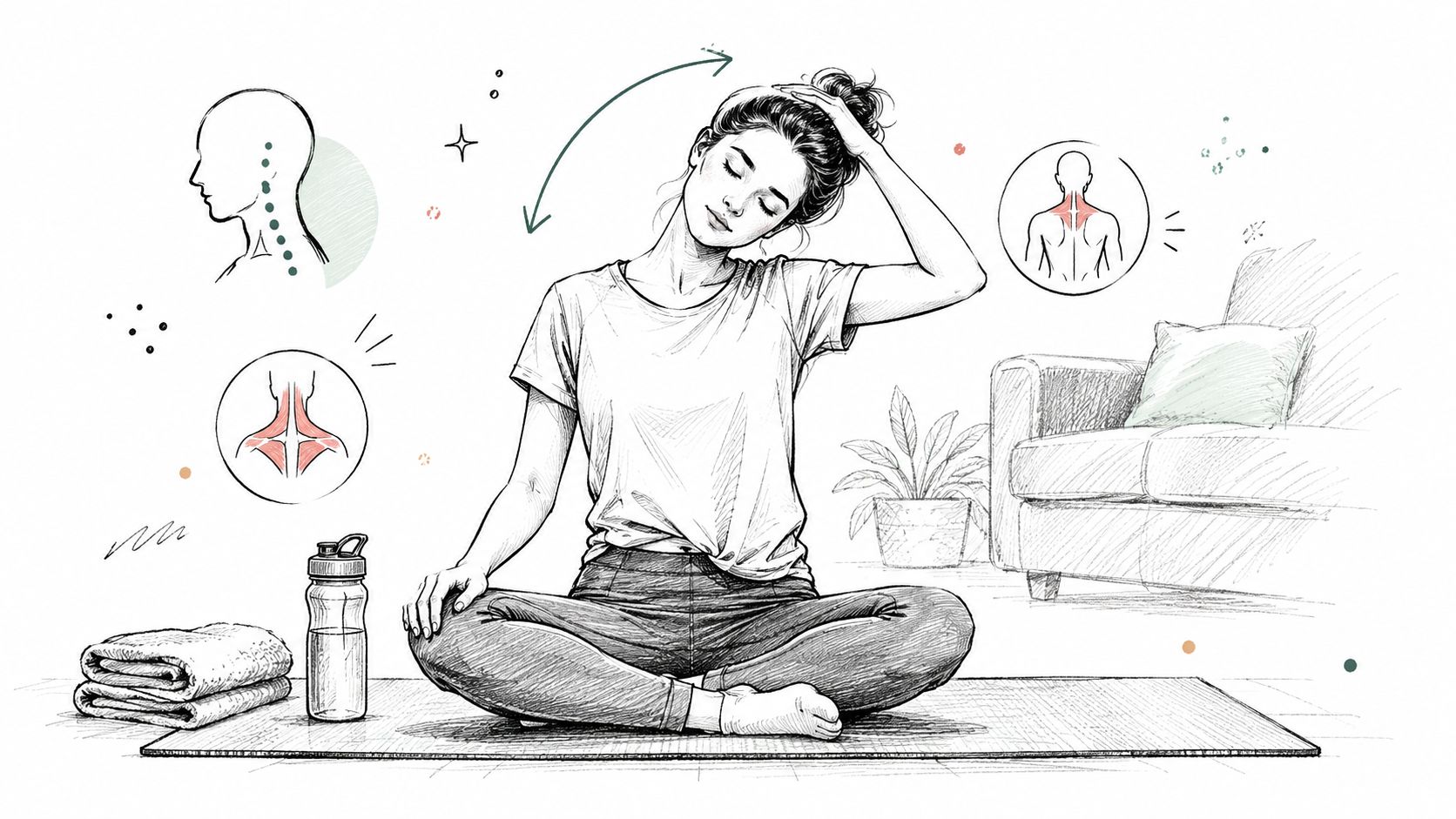
Bring one ear toward the same-side shoulder without lifting the shoulder to meet it. Return to center, then switch sides. You should feel motion, not a sharp pull.
Short-range rotations
Turn the head only within a calm range. For many people, that means a modest turn rather than trying to look fully over the shoulder in the first session.
Chin tucks
Draw the chin straight back as if making a double chin. Hold the retraction for 2 to 3 seconds and repeat 10 to 15 times.
After mobility work, add stretching.
Upper trapezius stretch
Sit tall. Gently tilt your head to one side until you feel a light stretch along the opposite side of the neck.
Levator scapulae stretch
Turn your head slightly, then angle your nose downward toward the armpit. This often reaches that stubborn ache along the top-inner shoulder blade.
Don't chase intensity. A stretch that feels “deep” isn't automatically better. For irritated necks, lighter and repeatable beats forceful and memorable.
A few form rules matter more than is commonly understood:
For many people, this stage creates the first real sense of control. The neck stops feeling fragile and starts feeling movable again.
Stretching is popular because it feels immediate. Strengthening matters because it changes what the neck can tolerate tomorrow. That's the missing piece in many home programs.

A neck that hurts repeatedly is often a neck that fatigues quickly. The deeper cervical muscles lose endurance. Shoulder stabilizers stop doing enough. The upper traps and surrounding tissues pick up the slack and stay tense all day.
That's why resistance work deserves a place in most long-term plans. Harvard Health's review of strengthening for chronic neck pain reports that strength training for the upper trapezius and shoulder stabilizers can reduce chronic neck pain, with effective programs using 8 to 12 repetitions per set. It also gives practical starting loads of 4 to 11 pounds for shrugging exercises and 2 to 6 pounds for lateral raises.
If you already think in terms of supporting the whole spine, these science-backed back exercises are a useful companion read because neck function and shoulder-blade control rarely improve in isolation.
Start with the least provocative option. A common first step involves isometrics. You create tension without visible neck movement.
Step 1: Isometric neck holds
Place your hand against your forehead. Press your head gently into your hand while your hand resists. The neck shouldn't move. Repeat with the hand on the back of the head, then each side.
Use these cues:
A more formal endurance protocol has people hold moderate-force contractions for 20 seconds in four directions and repeat 3 times per direction, then add a 1-minute static hold in each direction as endurance improves, described in this demonstration of isometric neck stabilization.
Step 2: Scapular squeezes
Stand or sit tall. Draw the shoulder blades back and slightly down. Don't puff the ribs or jam the shoulders downward. This helps shift work away from an overactive neck.
Step 3: Chin tuck with control
Now the chin tuck becomes a strengthening drill, not just a mobility reset. Hold the retracted position a little longer, keep the back of the neck long, and avoid jamming the chin down.
Step 4: Light shoulder support work
Once the neck tolerates the earlier steps, add simple resistance work for the muscles that support cervical posture:
A strong neck program doesn't look dramatic. It looks controlled, repeatable, and a little underwhelming. That's usually a good sign.
For people who need guided progression beyond a basic home routine, structured rehabilitation exercise support can help refine technique and dosage. The main point is simple: if you only stretch, symptoms often cycle. If you improve endurance, posture becomes easier to maintain and flare-ups tend to become less frequent.
What's often needed isn't more exercise ideas. Instead, a plan is required that can be followed when symptoms flare, alongside a separate plan for staying ahead of recurrence. Those are different jobs.
An acute flare-up routine should calm the area without challenging it much. Chronic or recurring pain needs a steadier mix of mobility and strengthening. Clinical guidance supports that split. Arthritis UK's exercise guidance recommends therapeutic strengthening 3 to 4 times per week, while some stretching work can be done 1 to 2 times daily. The same guidance notes that stabilization drills such as chin tucks are commonly held for 5 to 10 seconds and repeated 5 times, with progression as strength improves.
| Focus | Acute Flare-Up Routine (First 2-3 Days) | Chronic Pain / Prevention Routine |
|---|---|---|
| Mobility | Gentle nods, ear-to-shoulder tilts, and short-range rotations once or twice daily | Brief mobility warm-up before strengthening sessions |
| Chin tucks | Hold 5 to 10 seconds, repeat 5 times, stay well below pain | Hold 5 to 10 seconds, repeat 5 times, focus on clean alignment |
| Stretching | Light stretching 1 to 2 times daily if it feels relieving, not provocative | Light stretching 1 to 2 times daily on tighter days or after work |
| Strengthening | Usually delayed until symptoms calm and movement is easier | Perform strengthening 3 to 4 times per week |
| Session goal | Settle irritation, restore confidence in motion, avoid flare-up spikes | Build endurance, improve support, reduce future recurrence |
A few practical rules make these routines safer and more useful:
If an exercise leaves you feeling looser for a while and then normal, that's usually acceptable. If it leaves you worse for hours, it was too much or the wrong choice.
These sample routines aren't meant to be rigid. They're meant to remove guesswork. Start with the level your neck can tolerate, then progress when the movements feel easier and your day-to-day symptoms become less reactive.
The usual advice is “stop if it hurts.” That isn't enough. Many safe exercises create mild local muscle fatigue or temporary soreness. The primary concern is not whether you feel something. It's what kind of symptom appears, where it goes, and whether it's getting worse.

Normal soreness stays local. You may feel mild fatigue in the neck or around the shoulder blades. It settles with rest, improved posture, or a lighter next session. It doesn't spread down the arm or create neurologic symptoms.
Specific warning signs deserve more caution than most online exercise lists mention. The North American Spine Society's cervical exercise guidance emphasizes that people with radiating arm pain, numbness, or weakness should avoid certain home mobilization approaches and seek professional evaluation instead, especially when disc herniation or nerve compression may be involved.
Pay close attention to these:
Home exercise is for mechanical, stable problems. New neurologic symptoms move the issue out of the self-care category.
If any of these signs are present, stop experimenting with more mobility drills or stronger stretches. Get assessed.
Some neck pain responds well to a disciplined home plan. Some doesn't. When symptoms persist, keep returning, or clearly involve a disc or nerve, it's reasonable to move beyond self-management.

Persistent stiffness with limited motion may respond to a combination of Mobility Therapy, Adjustment, Realignment, and Rehabilitation Exercise. When muscle guarding is a major part of the picture, Massage Therapy, Muscle Stimulation, Acupuncture, and a Personal Exercise Plan can make the home work easier to tolerate and easier to progress.
Inflamed or slow-healing soft tissue can also benefit from SoftWave Therapy or MLS Laser Therapy. Those approaches are often used to support recovery while you continue active rehab, not instead of it. For some patients, Nutrition and Nutrition Counseling also matters because recovery capacity, inflammation, and tissue healing don't happen in a vacuum.
A broader musculoskeletal practice may also evaluate related contributors that patients overlook, such as shoulder restriction, thoracic stiffness, workstation habits, or post-collision mechanics after Car Accident Treatment. In active adults, even movement-specific issues can matter, which is where services like Golf Movement Screening and targeted Mobility Therapy become useful.
If neck symptoms are accompanied by radiating arm pain, numbness, or weakness, the issue may be more than local tightness. In those cases, people sometimes need imaging referral, manual care with tighter guardrails, or decompression-based treatment rather than another round of stretching.
For disc-related spinal problems more broadly, Spinal Decompression can be an important conservative option. A clinical study on the DRX 9000 reported 80% improvement in pain levels and 50% improvement in disability after 20 treatments for disc-related lesions, as summarized in this DRX9000 clinical study overview. That doesn't mean every neck pain case needs decompression. It means there's a place for it when disc pathology is driving symptoms and a home program alone isn't enough.
If restoring movement is the main obstacle, guided mobility therapy care can also help determine whether you're dealing with stiffness, irritation, nerve involvement, or a combination of all three. The key is matching the treatment to the problem instead of repeating the same exercises longer and hoping they eventually work.
If your neck pain keeps returning, feels more complicated than simple stiffness, or includes symptoms that travel into the arm, Aspen Falls Wellness offers evidence-based, non-surgical care in Salt Lake City and Sandy. Their team provides chiropractic care, spinal decompression with the DRX 9000, mobility therapy, massage therapy, acupuncture, MLS Laser Therapy, SoftWave Therapy, rehabilitation exercise, and personalized care plans to help patients move from short-term pain relief to more durable recovery.

Stay updated with the latest chiropractic news and exclusive offers.