Can a chiropractor help sciatic nerve pain? Get lasting relief with evidence-based chiropractic care, spinal decompression, & advanced therapies in SLC & Sandy.
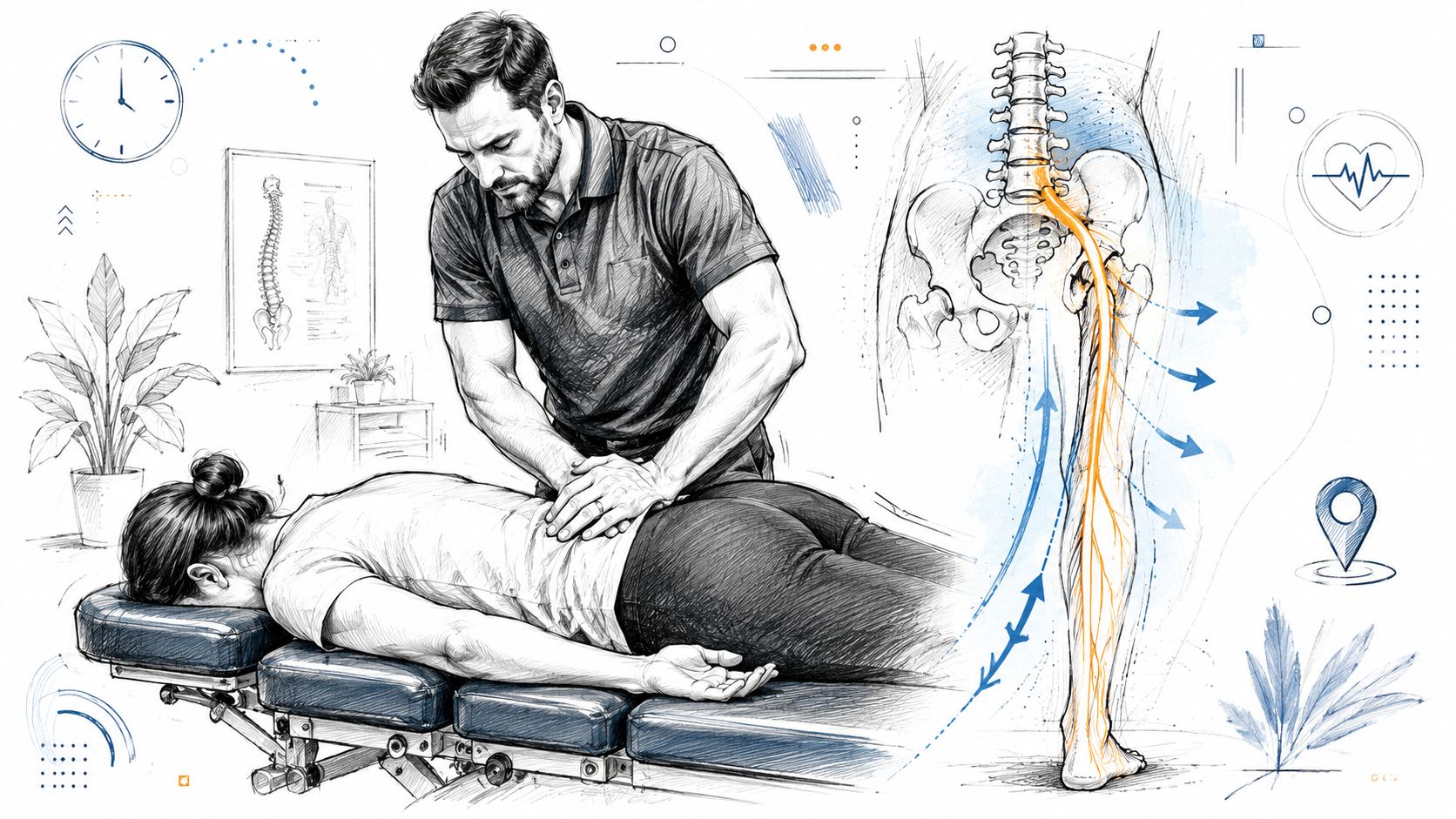



If you're reading this while shifting in your chair, rubbing the back of your thigh, or wondering why a pain that started in your low back now shoots into your leg, you're in familiar territory. Sciatica has a very distinct feel. People describe it as burning, electric, stabbing, or deep aching pain that travels from the low back into the buttock and down the leg. Sometimes the pain is joined by tingling, numbness, or weakness. Sleep gets harder. Driving gets harder. Even putting on socks can turn into a project.
The good news is that sciatica doesn't automatically mean surgery. In many cases, a chiropractor can help sciatic nerve pain by identifying what's pressing or irritating the nerve, then using a non-surgical plan to reduce that pressure, calm the surrounding tissues, and restore movement. The key is finding the actual cause instead of chasing the symptom.
A common story goes like this. Your back feels tight after lifting something awkward, a long commute, or even a normal day at work. Then the pain changes character. It starts traveling. Now it's in the buttock, the back of the thigh, maybe the calf, and sometimes all the way into the foot. Standing too long hurts. Sitting too long hurts. You keep changing positions because no position feels good for long.
That pattern matters because sciatica isn't a diagnosis by itself. It's a symptom. It means the sciatic nerve, or one of the nerve roots that feeds it, is irritated or compressed.
The sciatic nerve can get irritated for different reasons:
If you want a deeper overview of the condition itself, this guide on what sciatic pain is and what causes it is a useful starting point.
Sciatica is less about where you feel the pain and more about why the nerve is being bothered.
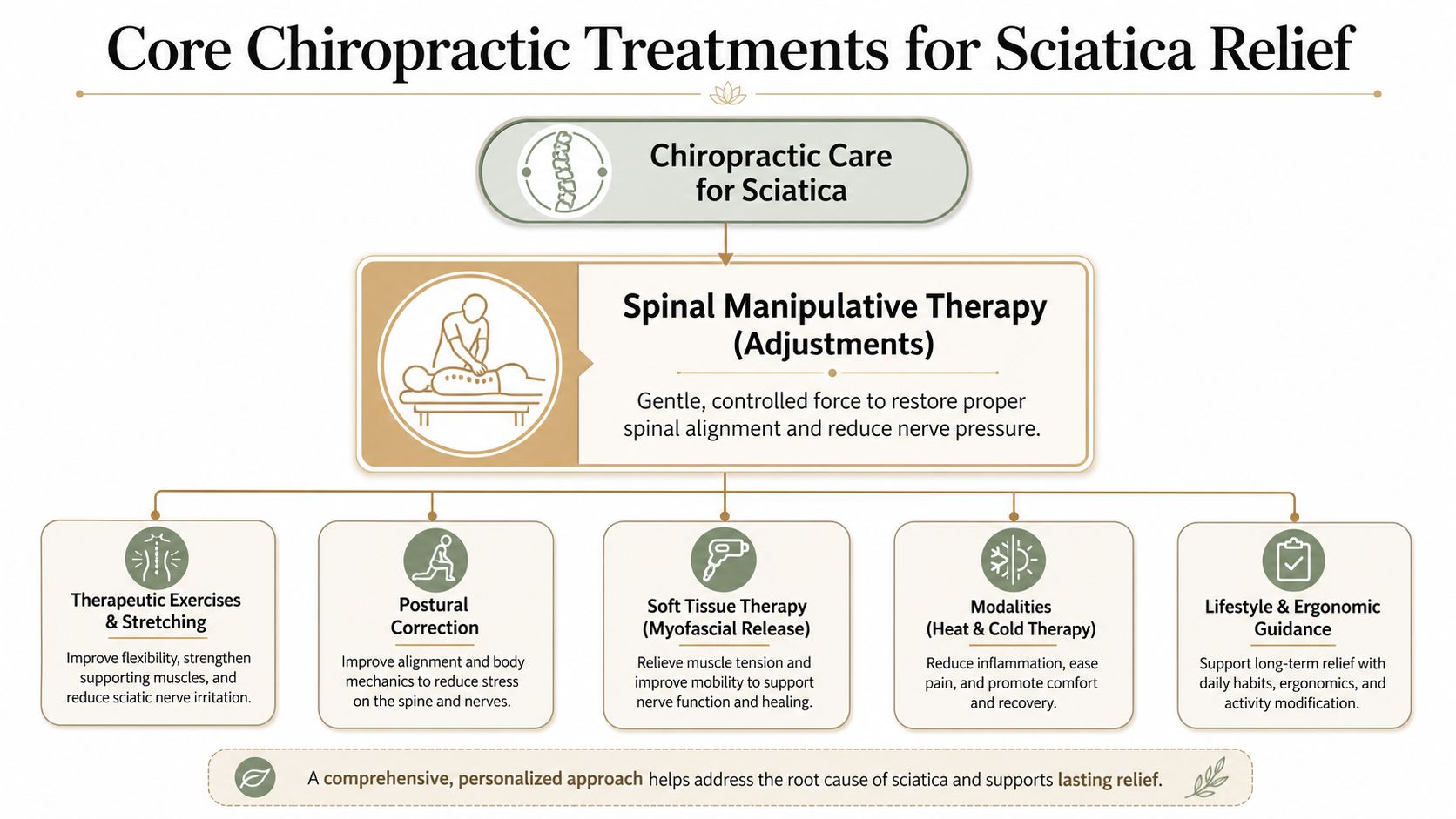
A good non-surgical plan doesn't just try to mute pain. It works to improve movement, reduce mechanical stress, and support healing in the tissues around the nerve. That can include chiropractic adjustment, decompression, massage therapy, rehabilitation exercise, mobility therapy, and other supportive treatments depending on what the exam shows.
What doesn't work well is guessing. Generic stretching from the internet, pushing through severe nerve pain, or relying only on temporary pain relief can keep the cycle going if the underlying problem hasn't been identified. The first step is always figuring out which structure is driving the symptoms.
A sciatica evaluation should feel thorough. If someone looks at you for two minutes and jumps straight to an adjustment, that's not enough. The diagnosis comes first.
The visit usually starts with questions that seem simple but matter a lot:
Those details help narrow the source. Disc-related sciatica often behaves differently than stenosis or piriformis-related irritation.
The next step is a hands-on orthopedic and neurological exam. That often includes movement testing, palpation, reflexes, muscle strength, and sensation checks. A straight leg raise or similar nerve tension test may be used to see whether the sciatic nerve is being mechanically provoked.
The reason for these tests is simple. We need to know whether the issue is coming from a disc, a joint, a muscle, a narrowed canal, or something outside routine musculoskeletal care.
Practical rule: The exam should answer two questions. Where is the nerve being irritated, and is it safe to begin conservative care?
Not every patient needs imaging on day one. But sometimes an X-ray or MRI is appropriate, especially when symptoms suggest a disc herniation, significant neurological change, trauma, or a condition that needs co-management or referral.
Early timing can matter. Early intervention within 6 weeks of symptom onset, combined with multimodal approaches including soft-tissue therapy and rehabilitative exercise, optimizes outcomes by addressing both mechanical misalignment and secondary muscle irritation according to this clinical summary on chiropractic care for sciatica.
A proper exam should produce a personalized plan, not a one-size-fits-all schedule. That plan may include chiropractic care, spinal decompression, realignment strategies, muscle stimulation, personal exercise plans, rehabilitation exercise, mobility therapy, or other services depending on the findings. If the exam points away from chiropractic treatment, that should be stated clearly too.
When people ask whether a chiropractor can help sciatic nerve pain, they're usually asking about two things. Can an adjustment reduce the nerve irritation, and can decompression help if a disc is involved. In the right case, both can play an important role.
A chiropractic adjustment is a controlled force applied to a restricted joint. In sciatica cases, the goal isn't to "crack the nerve back into place." The goal is to improve spinal mechanics, restore motion where joints are moving poorly, and reduce stress on irritated structures.
For some patients, that means using traditional manual adjustment. For others, especially those who are more sensitive, lower-force techniques make more sense. The treatment should match the person in front of you.
One evidence summary notes that spinal manipulative therapy shows modest but statistically significant improvements in pain and function for sciatica and is considered one treatment option among conservative approaches in practice guidelines, as described in this review of chiropractic evidence for sciatica.
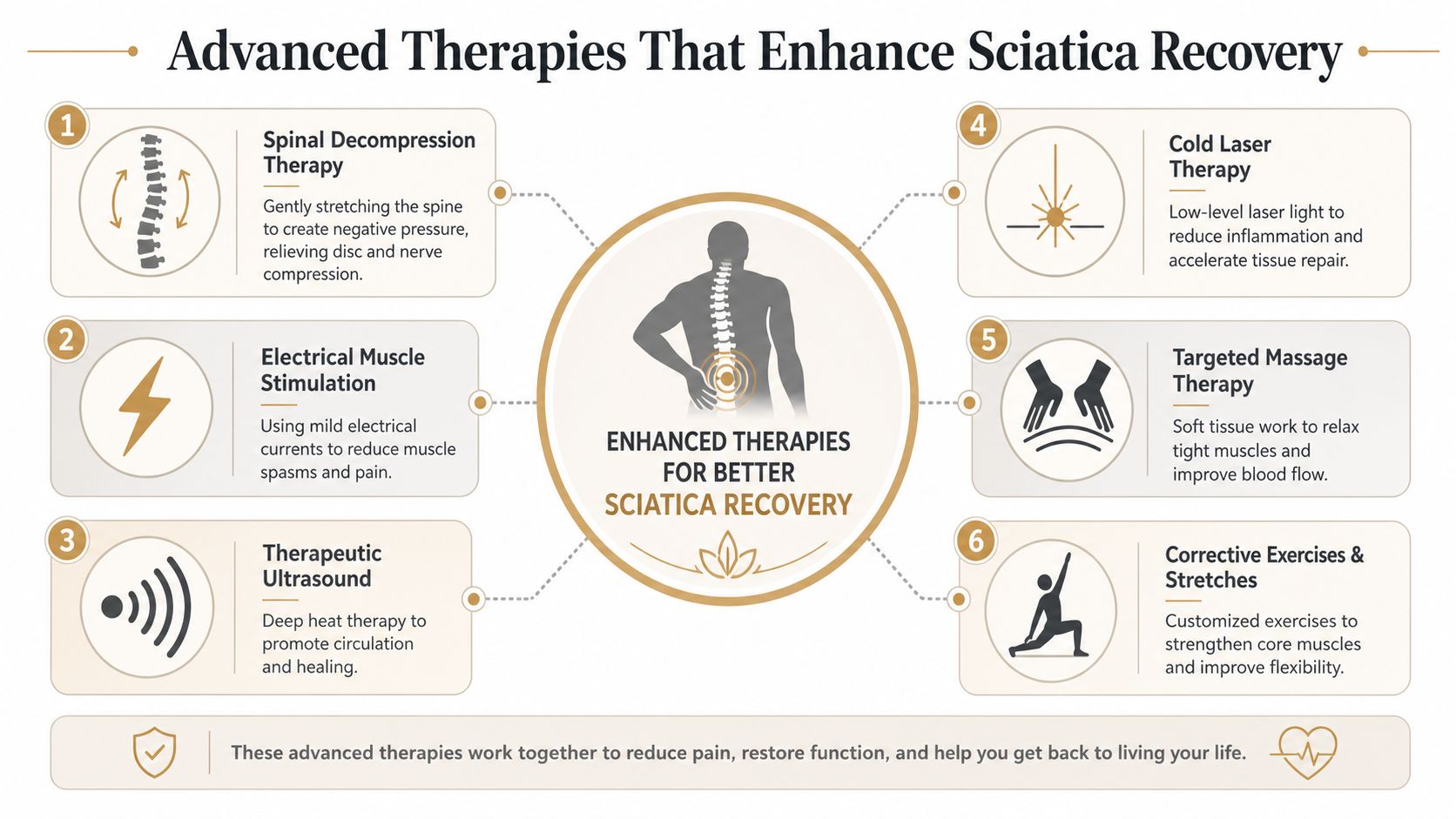
When sciatica is driven by a disc problem, spinal decompression often enters the conversation. This is different from an adjustment. Instead of delivering a quick force into a joint, decompression applies a controlled pulling force to create separation and reduce pressure in the affected area.
Think of a bulging disc like a jelly donut that's been squeezed unevenly. Decompression aims to reduce that squeeze. In practical terms, the goal is to create conditions that lessen disc pressure and reduce irritation on the nearby nerve root.
At Aspen Falls Wellness, one available option is spinal decompression therapy, including the DRX9000 for disc-related cases where that approach is appropriate.
The DRX9000 is a non-surgical spinal decompression system used for disc-related lumbar conditions, including some forms of sciatica. Sessions are structured and repeatable, which matters when you're trying to steadily reduce mechanical stress rather than chase symptoms from visit to visit.
A published summary reports that Axiom Worldwide's multi-center pilot study of the DRX9000 documented an 88.9% success rate for treating conditions including herniated discs, degenerative disc disease, and sciatica, with a 50% reduction in pain scores observed after only two weeks of treatment, according to this DRX9000 results summary.
A few approaches routinely fall short:
| Approach | Why it often misses the mark |
|---|---|
| Only resting | Too much inactivity can stiffen the area and delay functional recovery |
| Only masking pain | Temporary pain relief doesn't change the underlying mechanics |
| Aggressive self-stretching | The wrong stretch can aggravate a sensitized nerve |
| Random treatment selection | Sciatica from a disc behaves differently than sciatica from muscular entrapment |
The right treatment for sciatica depends on the pain generator. A disc case, a stenosis case, and a piriformis case shouldn't all get the same plan.
Core treatment matters most, but many sciatica cases improve faster when care also targets inflammation, muscle guarding, tissue healing, and movement retraining. That's where a multi-modal plan becomes useful.
A key reason chiropractic remains part of that plan is that the hands-on mechanical piece has measurable value. Chiropractic spinal manipulation therapy demonstrates a 72% success rate in treating sciatica-related symptoms, outperforming sham treatment at 20% and physical therapy at 20% in a clinical trial summarized in this review of chiropractic care for sciatica relief.
Different therapies do different jobs. They aren't interchangeable.
| Therapy | Primary role in a sciatica plan |
|---|---|
| MLS Laser Therapy | Helps calm irritated tissue and support recovery in inflamed areas |
| SoftWave Therapy | Supports tissue stimulation and healing response |
| Massage Therapy | Relieves muscle guarding, especially around the low back, glutes, and piriformis |
| Muscle Stimulation | Helps reduce spasm and improve comfort when muscles stay locked down |
| Acupuncture | Useful for pain modulation and tension reduction in some patients |
| Mobility Therapy and Rehabilitation Exercise | Restore movement quality and keep symptoms from recurring |
| Nutrition and nutrition counseling | Supports recovery habits and reduces friction from poor daily routines |
If a patient has intense guarding through the glute and hamstring, massage therapy and muscle stimulation may make movement possible again. If the presentation is inflamed and reactive, MLS Laser Therapy or SoftWave Therapy may be layered in to support pain relief and tissue recovery. If stiffness and poor control are driving repeat flare-ups, mobility therapy and rehabilitation exercise matter more than another passive session.
That balance is why integrated care tends to make more sense than relying on one tool. In real practice, a plan might combine adjustment, decompression, massage therapy, personal exercise plans, and acupuncture, while dropping anything that isn't moving the case forward.
Recovery usually accelerates when the plan addresses the joint, the disc, the muscle, and the patient's daily movement habits at the same time.
Home care isn't glamorous, but it matters. Heat or ice may help depending on irritability. Walking is often better tolerated than prolonged sitting. Gentle position changes throughout the day usually beat staying in one posture too long.
Some patients also like topical self-care options between visits. If you're exploring that route, this overview on understanding arnica for natural pain relief gives practical context without turning it into a cure-all.
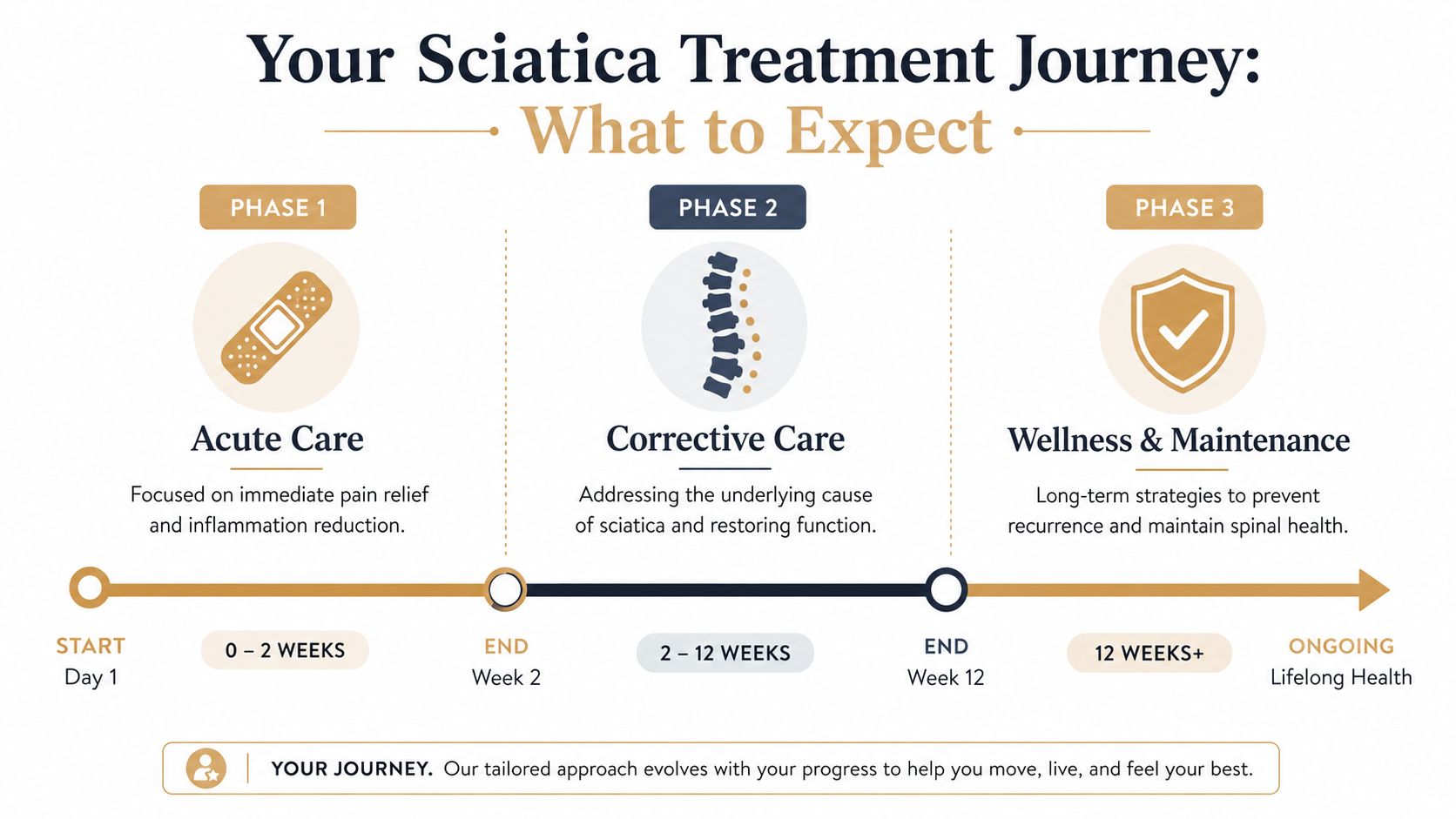
People do better when they know what the process is going to look like. Sciatica treatment usually isn't a single visit fix. It's a progression from calming things down to correcting the cause to keeping the problem from coming back.
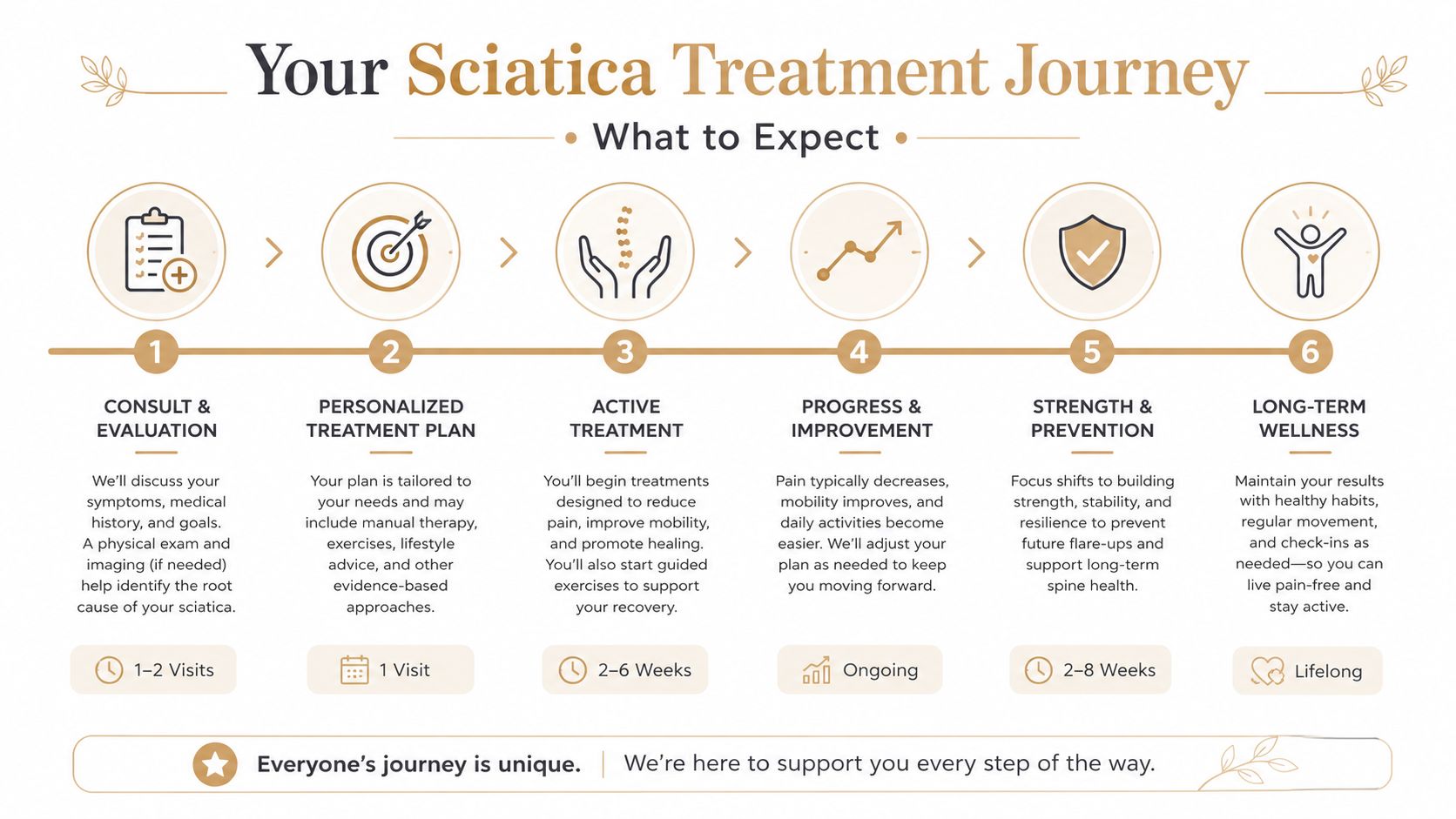
The first phase focuses on reducing pain, lowering inflammation, and improving tolerance for daily activity. Visit frequency is often higher here because symptoms are more active and your body may need consistent input to settle down.
For discogenic sciatica treated with the DRX9000, the typical protocol is 20–28 sessions over 6–8 weeks, with each visit lasting about 20–30 minutes, and some patients report reduced leg pain within 4–6 sessions, according to this overview of DRX9000 treatment timing.
Once pain is less intense, the emphasis shifts. This phase usually includes more active rehabilitation exercise, mobility therapy, and movement retraining. The purpose is to improve how you bend, sit, stand, lift, and walk so the irritated tissues stop getting re-aggravated.
This is also the phase where personal exercise plans matter most. The right home program is usually simple. A few targeted movements done consistently beat a long list you never follow.
Maintenance doesn't mean endless treatment. It means having a strategy. Some people need occasional follow-up because of recurring disc stress, repetitive work, long driving hours, or old injuries. Others mostly need self-management tools, better mobility habits, and periodic re-checks.
A few practical support habits often help:
Night pain can be especially frustrating. For patients who feel better with slight flexion through the hips and knees, this guide on how to improve sleep with knee elevation can be a useful comfort strategy.
A strong treatment plan doesn't just reduce pain. It gives you a repeatable way to keep the pain from taking over again.
Chiropractic care can be a strong option for sciatica, but not every case belongs in a chiropractic office. Knowing the difference is part of responsible care.
It usually makes sense to get evaluated when you have radiating leg pain, numbness, tingling, or back-related stiffness that isn't improving, especially if sitting, bending, or standing triggers it. Many of these cases respond well to a non-surgical plan built around chiropractic care, decompression, massage therapy, mobility work, and rehabilitation exercise.
If symptoms are persistent, recurrent, or clearly affecting work, sleep, driving, or exercise, don't wait for it to become a crisis before getting examined.
Some symptoms are red flags and shouldn't be watched at home:
Those findings can point to conditions that require emergency evaluation or specialist care.
A chiropractor should be able to recognize when a case is straightforward and when it isn't. That includes referring out when the problem falls outside conservative musculoskeletal care, or when progress isn't happening as expected.
That doesn't weaken the role of chiropractic. It strengthens it. Good spine care isn't about trying to treat everything. It's about helping the right patients, using the right tools, and moving quickly when another kind of care is needed.
If you're in Salt Lake City or Sandy and you're trying to decide what to do next, start with a real evaluation. Sciatica can come from a disc, stenosis, joint dysfunction, muscular entrapment, or a combination of factors. Until someone identifies the driver, treatment is guesswork.
A practical plan should include diagnosis first, then a personalized mix of treatments based on your tolerance and exam findings. That may include chiropractic adjustment, spinal decompression, massage therapy, SoftWave Therapy, MLS Laser Therapy, acupuncture, mobility therapy, rehabilitation exercise, nutrition counseling, and home care strategies. If your case doesn't fit conservative treatment, you should be told that directly.
For many people, trying non-surgical care before moving toward invasive options is reasonable. Research comparing chiropractic care to microdiscectomy found no significant difference in patient outcomes at the one-year mark, supporting chiropractic as a viable non-invasive alternative that avoids surgical risks, as noted in the earlier clinical discussion on diagnosis and supported qualitatively here. If you're looking for local care details, this page on chiropractic care in Salt Lake City outlines one local option.
Practical concerns matter too. Many patients want to know whether care is accessible and whether insurance can be checked before starting. In Utah, it's reasonable to ask about accepted plans such as Aetna, BCBS, and Cigna, and to have staff verify benefits before treatment begins. That helps you make a decision based on both the clinical picture and the logistics.
The main point is simple. If sciatic nerve pain is disrupting your day, don't settle for guessing, temporary fixes, or waiting indefinitely for it to disappear.
If you're ready to get clear answers about your leg pain, back pain, numbness, or tingling, schedule an evaluation with Aspen Falls Wellness. A focused exam can identify the source of the irritation and map out a personalized, non-surgical plan for relief.

Stay updated with the latest chiropractic news and exclusive offers.