Considering laser therapy for inflammation? Learn how MLS laser works to reduce pain and swelling, what to expect, and if it's right for you in Salt Lake City.


You wake up stiff after a Saturday on the mountain. Your knee is swollen again. Or maybe the problem starts at your desk, where low back tightness turns into a sharp ache every afternoon and never fully settles down. You rest, stretch, take it easy for a few days, then the same inflammation returns as soon as you hike, ski, lift, drive, or even sit too long.
That cycle wears people out. Not just physically, but mentally. Pain that lingers makes simple choices harder. You start wondering whether you should push through it, stop the activities you enjoy, or brace for something more invasive.
For many people, laser therapy for inflammation feels confusing at first. It sounds high-tech, but they want a plain answer to a simple question. Can light help calm irritated tissue and help the body recover? It can, and one of the most talked-about options is MLS Laser Therapy, a non-surgical treatment used to reduce pain and inflammation while supporting healing.
A lot of people in the Salt Lake City area tell the same story in different ways. One person notices heel pain every time they get back into hiking season. Another makes it through ski days but pays for it with a swollen knee the next morning. Someone else spends the workweek sitting, then tries to be active on weekends and ends up with a back flare that keeps repeating.
The hard part isn't always the first injury. It's the pattern that follows. The pain improves just enough to make you hopeful, then the inflammation builds again when you return to normal life. If you've ever wondered whether alignment problems can keep irritation going, this article on how being out of alignment can contribute to inflammation is a useful companion to what you're reading here.
Inflammation is part of healing, but it can also get stuck in a loop. Tissue stays irritated. Nerves stay sensitive. Movement changes to avoid pain, which can load other joints and muscles in the wrong way.
That's where people start looking for something beyond rest, ice, and waiting. They want an option that doesn't involve surgery and doesn't only mask symptoms for a few hours.
Practical rule: If swelling, stiffness, or pain keeps returning with ordinary activity, the issue usually needs more than time off. It needs a treatment plan that addresses why the tissue isn't calming down.
MLS Laser Therapy is designed to do exactly that. It uses targeted light energy to help reduce inflammation and pain while supporting the body's repair process. For patients who feel wary of injections, medication dependence, or long recovery periods, that matters.
This isn't magic, and it isn't guesswork. It's a non-invasive treatment used for musculoskeletal problems where inflammation is part of the reason you hurt, move less, and keep getting pulled back from daily life.
People often get stuck on one question. How can light affect tissue under the skin?
The easiest way to think about it is this. Injured or irritated cells can act like a job site where the crew is tired, communication is messy, and the cleanup is behind schedule. Laser therapy for inflammation works like a precise signal that helps the cells do their repair job more efficiently. It doesn't force the body to heal from the outside. It helps the body organize healing from the inside.
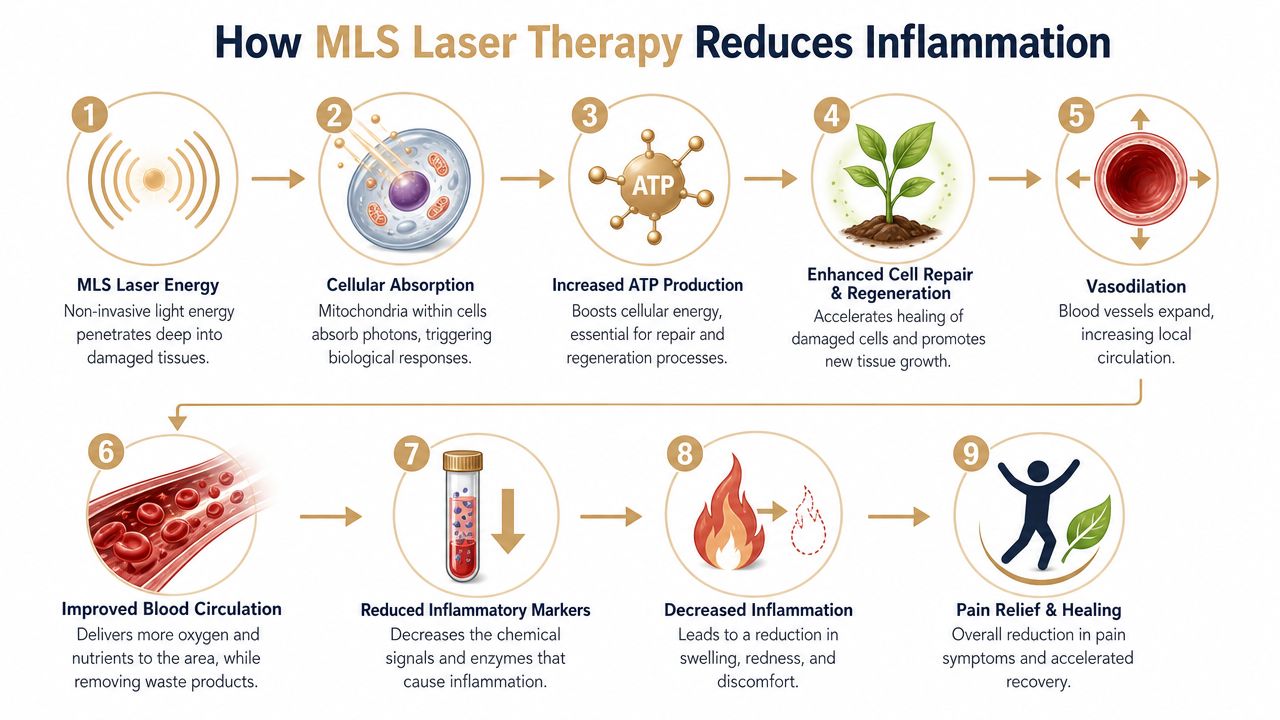
When tissue is irritated, several things tend to happen at once:
Clinical descriptions of low-level laser therapy often focus on this sequence. If you'd like a broad overview of the category itself, Omega Lasers' LLLT guide gives a helpful plain-language explanation of how light-based therapy is generally used in musculoskeletal care.
MLS stands for Multiwave Locked System. The key idea is that it doesn't rely on a single wavelength doing one job. It uses two precisely synchronized wavelengths, 808 nm and 905 nm, to create anti-inflammatory, anti-edema, and analgesic effects, as described in this MLS overview.
Here's the practical meaning of that:
That split matters because many patients need both. They want the area to feel better, but they also want the deeper inflammatory process to settle instead of bouncing back.
The short version is simple. One part of the treatment helps calm the fire. The other helps quiet the alarm.
When people hear "laser," they sometimes picture heat or tissue damage. MLS therapy isn't used that way. The goal is controlled light delivery that reaches irritated tissue and influences the biology of healing without surgery and without cutting into anything.
Patients usually understand it best when they connect the science to outcomes:
That sequence is why laser therapy for inflammation is often used for tendon irritation, joint pain, repetitive strain problems, and stubborn soft-tissue injuries. The body is still doing the healing. The treatment helps create better conditions for that healing to happen.
Most patients don't care whether a treatment sounds advanced. They care whether it matches the problem they have right now.
That's why it helps to connect MLS Laser Therapy to the kinds of conditions people in Salt Lake City and Sandy experience. Some injuries come from recreation. Some come from work posture. Some follow a car accident. In each case, inflammation can be one part of a much larger pain pattern.
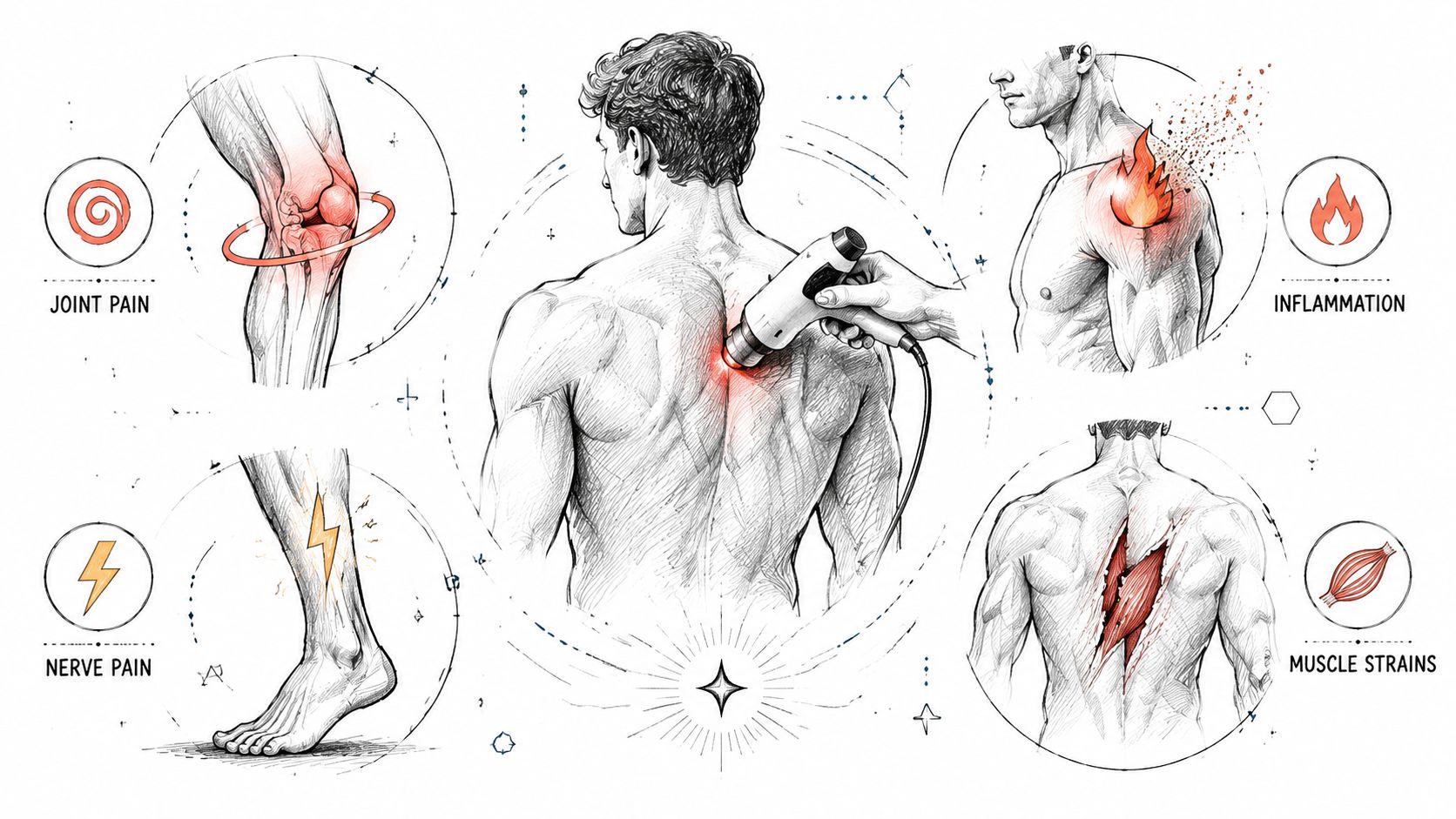
MLS Laser Therapy is often considered when irritation, swelling, or pain is limiting movement and slowing recovery. Common examples include:
The same diagnosis can look very different depending on how someone lives.
A desk worker with low back pain may need help reducing inflammation, restoring spinal motion, and retraining posture. A skier with knee pain may need pain relief, tissue recovery, and a plan for returning to activity without reloading the joint too fast. A parent with neck pain after a rear-end collision may need a combination of car accident treatment, mobility work, and soft-tissue support.
A treatment makes more sense when it matches the reason the tissue keeps getting irritated, not just the place where it hurts.
For many patients, the better question is not "Can this help my pain?" It's "Can this help me do normal things again without paying for it later?"
That's where MLS Laser Therapy often fits well. It can be used as part of a broader plan that may also include Chiropractic Care, Sciatica Treatment, Massage Therapy, Rehabilitation Exercise, Mobility Therapy, Muscle Stimulation, Personal Exercise Plans, and Nutrition and Nutrition Counseling. Some people also need Adjustment, Realignment, Acupuncture, Decompression, or Spinal Decompression with the DRX 9000 when disc or nerve issues are part of the problem.
The treatment choice depends on what's inflamed, what's overloaded, and what keeps the condition from resolving.
You wake up, take a few steps, and already know the area is irritated again. By the time you think about calling for help, a second question usually shows up right behind the pain. What happens if I start laser therapy?
For patients in Salt Lake City and Sandy, the process at Aspen Falls Wellness is usually more straightforward than expected. The goal is not to add one more isolated treatment to your week. The goal is to place MLS Laser Therapy in the right spot within a non-surgical recovery plan, so each visit has a clear purpose.
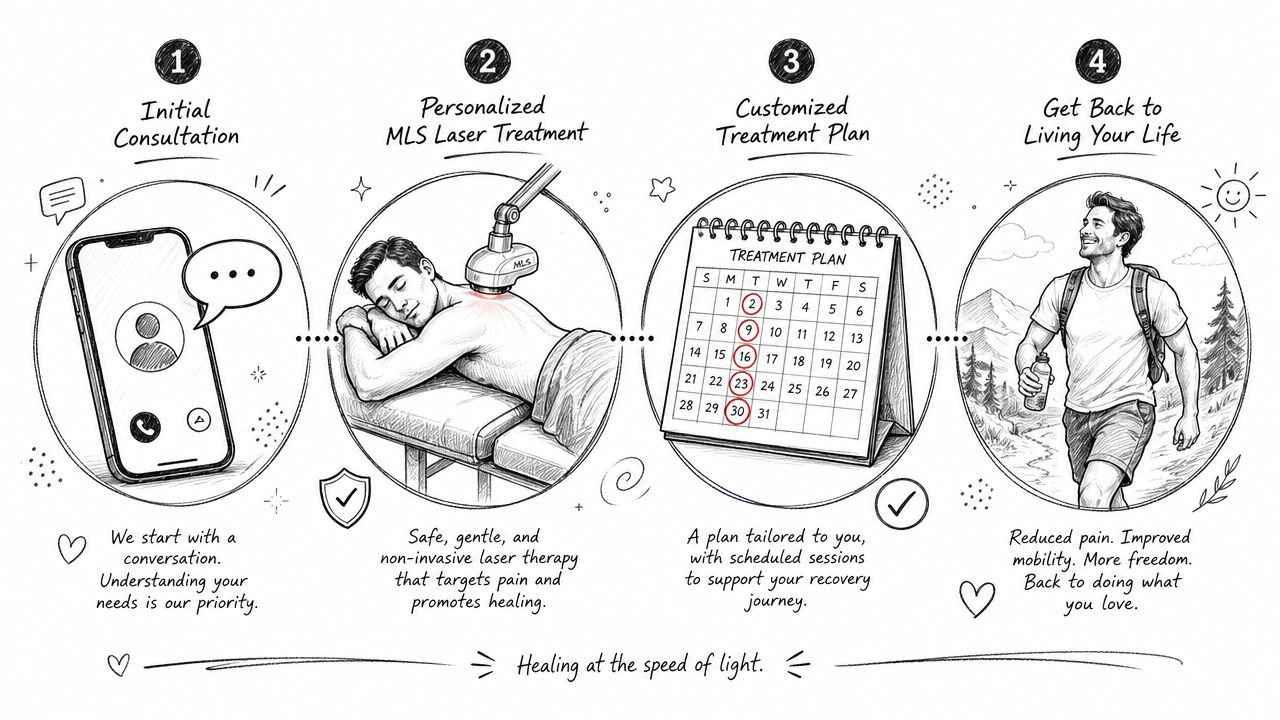
Your first visit is about sorting out why the area stays aggravated. Pain can come from several layers at once. Inflamed tissue may be one layer. Joint stiffness, disc stress, muscle guarding, or nerve irritation may be another.
That is why the exam matters.
A provider will usually ask practical questions such as:
From there, the plan becomes more precise. If inflammation is the main driver, laser therapy may take a central role. If movement restriction or disc pressure is playing a bigger part, another service may lead while laser supports tissue recovery in the background. Patients who want a closer look at the treatment itself can review MLS Laser Therapy care options at Aspen Falls Wellness.
A simple analogy helps here. Laser therapy is often like lowering the volume on an irritated alarm system. If the alarm is loud because the joint is not moving well, you may also need chiropractic care or mobility work. If the alarm is loud because weak muscles keep overloading the area, rehabilitation exercise becomes part of the plan too.
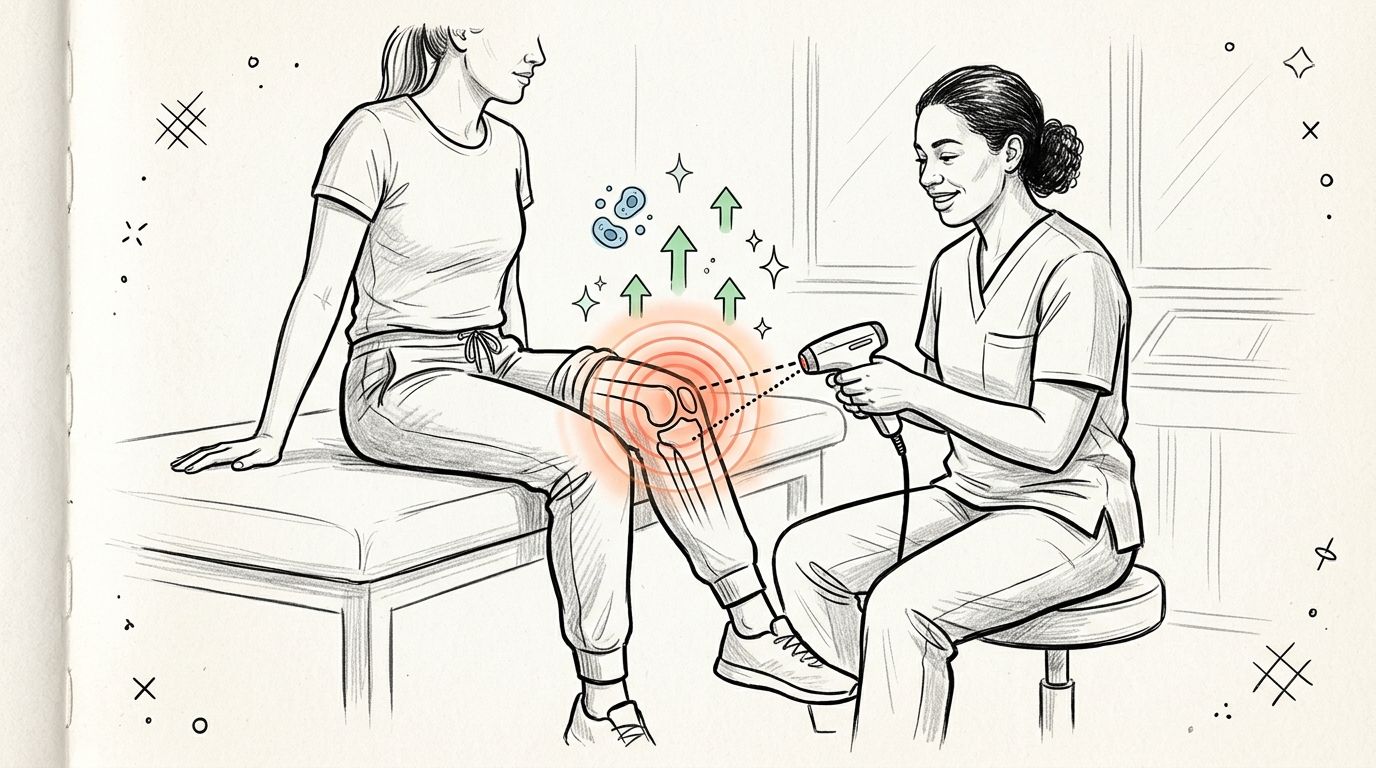
The session itself is usually calm and brief. You will sit or lie comfortably, the treatment area will be exposed, and protective eyewear will be used. The provider positions the laser over the targeted tissue and delivers the treatment for a short period.
Some patients notice mild warmth. Others feel almost nothing during the visit and only recognize the change later when walking, bending, or getting up from a chair feels easier.
That quiet experience can surprise people. Many expect a strong sensation because the word "laser" sounds intense. In practice, it is more like shining focused light on irritated tissue than undergoing a procedure. There is no incision, no injection, and no recovery room. You can get up and continue your day right away.
The number of visits depends on the problem, how long it has been there, and what else is feeding it.
A newer flare often settles faster than a problem that has been building for months. Chronic cases usually need more than symptom relief alone. They may also need hands-on care, strength work, posture retraining, or home exercises so the tissue does not get irritated again as soon as treatment stops.
At Aspen Falls Wellness, that is where the full plan matters. Laser therapy may reduce irritation so you can tolerate movement better. Then rehabilitation exercise can rebuild support. Chiropractic or mobility-based care can improve how the area moves. Massage therapy may help if surrounding muscles have tightened up to protect the painful spot. Each service has a job. Laser is one part of the recovery path, not a stand-alone promise.
Patients often ask if this fits into a normal schedule. In most cases, yes. Visits are designed to be practical, and you can usually return to work, errands, or family responsibilities right after treatment.
Consistency matters more than intensity. A short series of well-timed visits often works better than scattered appointments with long gaps between them. Healing tissue responds best when the plan is organized and reinforced between sessions.
For some patients, that also means clear recordkeeping when multiple services are used in the same phase of care. If you are curious about how hands-on treatment is categorized in clinical settings, this overview of manual therapy coding and documentation gives background on that side of care.
What you should expect, day to day, is gradual change. Less post-activity soreness. Easier movement. Fewer flare-ups. For many patients, that steady progress is what makes MLS Laser Therapy useful within a broader, non-surgical plan at Aspen Falls Wellness.
A sore shoulder, a stiff neck, or aching low back pain often has more than one cause at the same time. One layer may be irritated tissue. Another may be poor joint motion. Another may be muscle guarding, where the body tightens up to protect the area. That is why comparing treatments helps. It shows what each therapy aims to change.
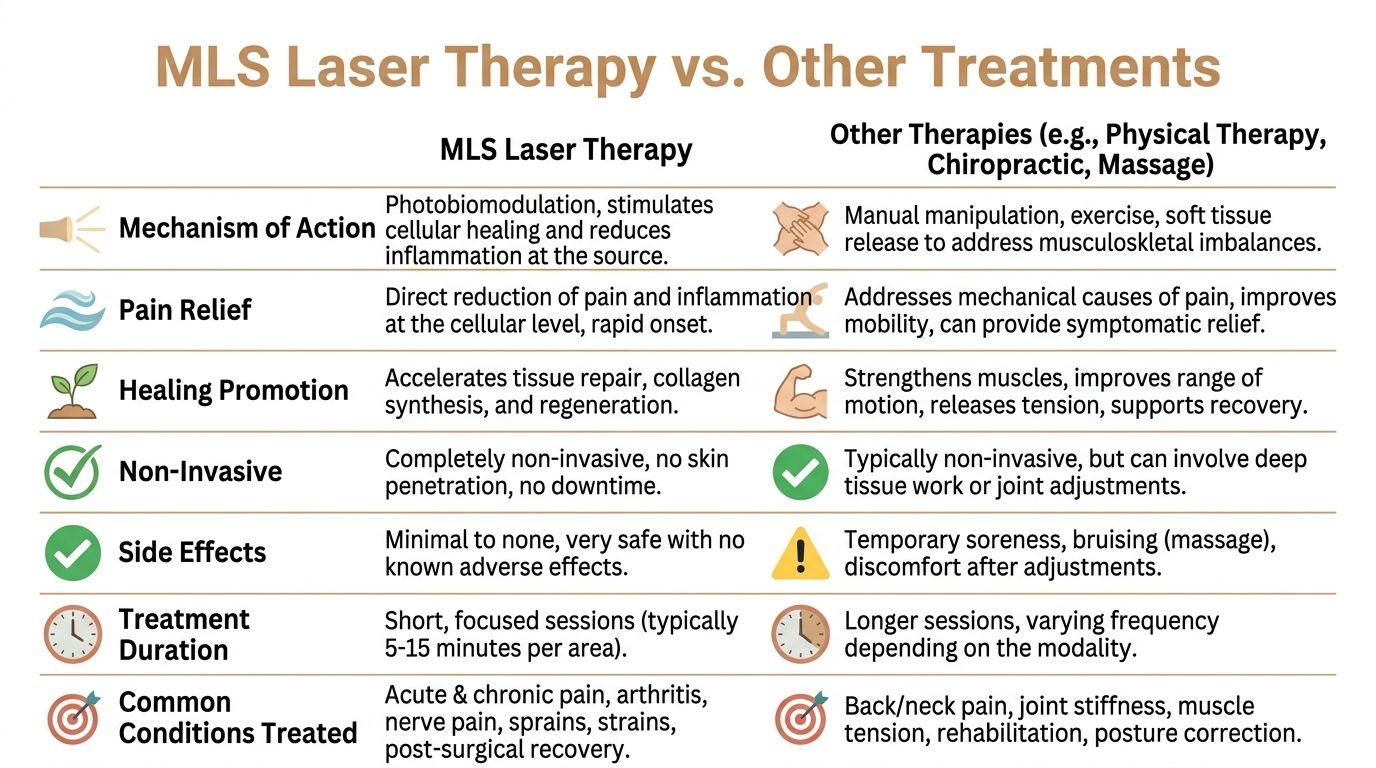
MLS Laser Therapy is often chosen when inflammation is keeping a patient stuck. The goal is to calm an irritated area enough that movement, exercise, and hands-on care become easier to tolerate. In other words, laser often helps lower the volume on the pain response, while other services address why the area became overloaded in the first place.
At Aspen Falls Wellness, that matters because care is built around a full non-surgical plan, not a single tool. A patient with disc-related symptoms may need decompression to reduce pressure. A patient with restricted spinal movement may benefit from chiropractic care that helps reduce inflammation and improve motion. A patient with tight, protective muscle tension may respond best when massage therapy is part of the plan. Rehabilitation exercise then helps the body keep those gains instead of sliding back into the same pattern.
Here is the practical difference between the main options offered in clinic:
| Therapy | Primary Target | Best For | How It Feels |
|---|---|---|---|
| MLS Laser Therapy | Cellular irritation and pain signaling | Inflamed soft tissue, chronic flare-ups, recovery support | Quiet, brief, usually little to no sensation |
| Spinal Decompression | Disc and nerve pressure | Some disc-related low back pain and radiating symptoms | Gentle pulling and release while lying down |
| Chiropractic Adjustment | Joint motion and mechanics | Stiff joints, restricted movement, motion loss | Controlled pressure or a quick adjustment |
| Massage Therapy | Muscle tension and soft-tissue restriction | Tight muscles, guarding, recovery support | Hands-on pressure and stretching |
| Acupuncture | Pain modulation | Ongoing pain patterns, muscular tension, supportive care | Usually mild sensation at needle sites |
| Mobility Therapy and Rehabilitation Exercise | Movement quality and strength | Recurring pain, weakness, return-to-activity planning | Guided exercise and movement drills |
Patients sometimes ask which option is "better." A better question is which problem needs attention first.
If the main barrier is inflammation, laser may be the first useful step. If the main barrier is joint restriction, adjustment or mobility work may matter more. If the area feels tight and protected, massage may open the door for better movement. Many people in the Salt Lake City and Sandy areas need a combination, and the order matters. The body usually responds best when the right treatment is matched to the right layer of the problem.
A simple example helps. A patient with pain shooting down the leg may need decompression for pressure, while laser supports a calmer recovery environment in the irritated tissues. A patient with overuse shoulder pain may do well with laser to settle the flare, followed by exercise to rebuild strength and control. A patient after a car accident may need massage for guarding, chiropractic care for motion, and laser to help with local irritation.
Some patients also want to understand how hands-on care is recorded in charts or insurance paperwork. This overview of manual therapy coding and documentation explains that part of treatment language more clearly.
The main takeaway is simple. MLS Laser Therapy does an important job, but it does its best work when it is placed in the right recovery plan. At Aspen Falls Wellness, the value is not just the laser itself. It is how laser is combined with other non-surgical services to help patients recover with less irritation, better movement, and a clearer path back to normal activity.
People usually come down to a short list of concerns before booking care. Most of them are practical.
Does it hurt?
Usually, no. Treatment is typically comfortable. The sensation is often mild or barely noticeable.
Is it safe?
MLS Laser Therapy uses two patented wavelengths of infrared light, 808 nm and 905 nm, to independently target inflammation and pain, a dual-mechanism approach that distinguishes it from single-wavelength lasers and contributes to its safety profile, as described in this MLS laser safety and mechanism overview.
What if I have an old injury or metal hardware?
That question should always be discussed during the exam. The provider needs your health history, injury details, and current symptoms before deciding whether laser is appropriate.
Will it replace everything else I'm doing?
Not always. Some patients do well with laser as the main treatment. Others need it as one part of a broader plan that may include decompression, chiropractic adjustment, massage, acupuncture, mobility therapy, or home exercise.
How do I know if I'm a good candidate?
If your pain has a clear inflammatory component, keeps recurring, or limits movement despite rest and basic care, it's worth getting evaluated.
What's the first step?
Schedule an initial consultation. A good exam should tell you whether laser therapy for inflammation fits your problem, or whether another non-surgical route makes more sense first.
If you're dealing with recurring swelling, stubborn back or joint pain, or an injury that never seems to fully settle down, a focused evaluation can help clarify what's driving it and which non-surgical treatments fit. Contact Aspen Falls Wellness to schedule a consultation and discuss options for inflammation, pain relief, mobility, and recovery in Salt Lake City or Sandy.

Stay updated with the latest chiropractic news and exclusive offers.