Explore sciatica treatment options, from home care to advanced relief strategies. Find effective ways to manage your pain & improve well-being in 2026.



You wake up stiff, sit on the edge of the bed, and feel that familiar line of pain run from your low back into your hip or leg. By the time you've made coffee, you're already negotiating with your body. Can you sit through work today? Drive comfortably? Sleep tonight without that burning, grabbing sensation waking you up again?
That's where many people start when they look up sciatica treatment options. They're not just asking what sciatica is. They want to know what helps, what usually doesn't, when to wait, and when to act.
Sciatica isn't a diagnosis by itself. It's a pattern of symptoms that tells you a nerve is irritated, compressed, or inflamed somewhere along its path, usually in the low back. That's why the pain often travels. You may feel it in the buttock, the back of the thigh, the calf, or even the foot.
A simple way to think about it is a garden hose with pressure on one point. The problem starts at the pinch, but the effect shows up farther down the line. In the body, that pressure often comes from a disc issue, spinal irritation, or surrounding tissue that's crowding the nerve.
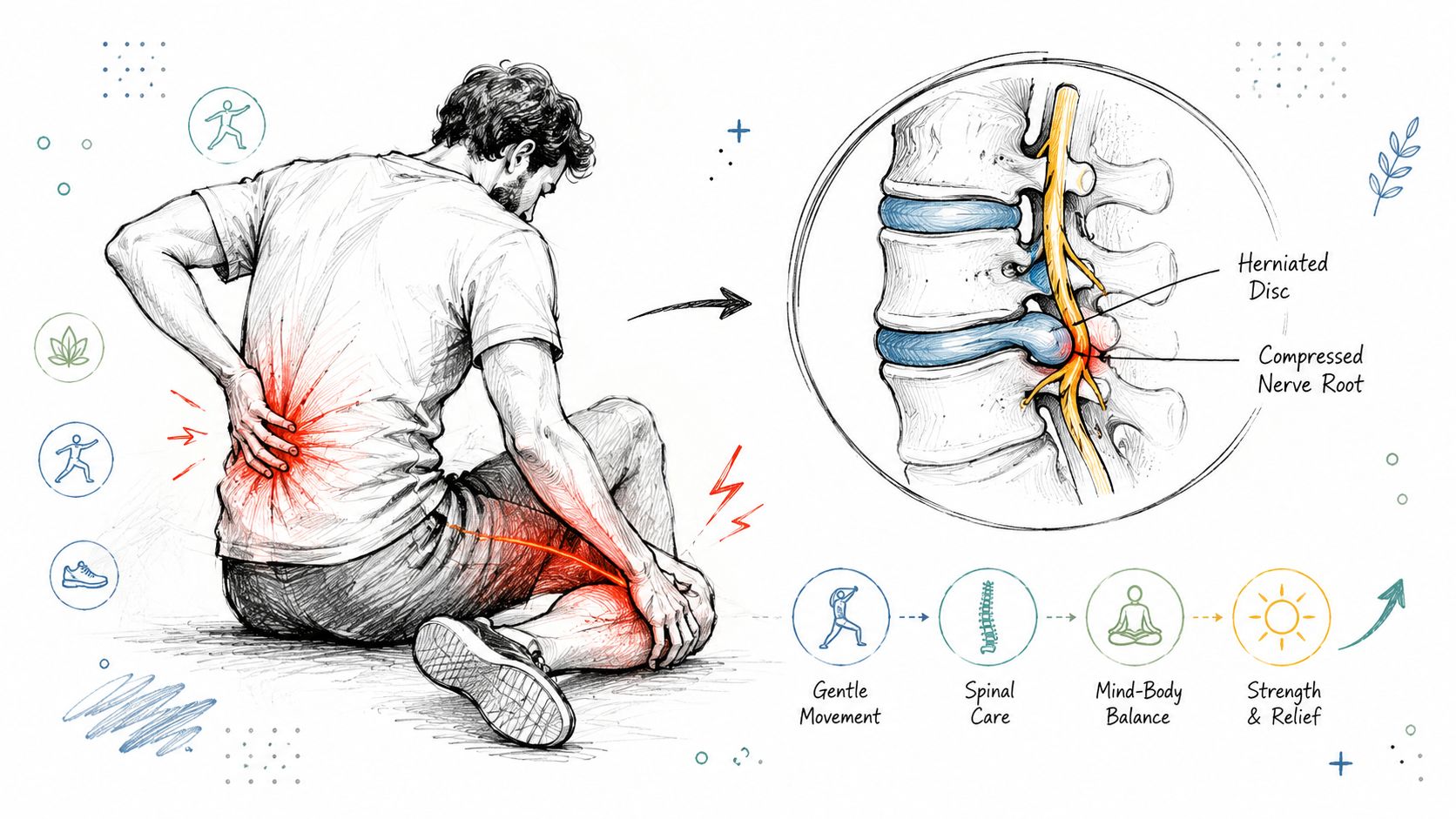
The encouraging part is that a majority of individuals don't need surgery. Approximately 80–90% of individuals with sciatica experience significant improvement without requiring surgical intervention, relying instead on conservative treatments. While surgery may offer quicker symptom relief, long-term follow-up data over one to two years reveals no substantial difference in overall success rates between the two methods, according to reported sciatica recovery statistics.
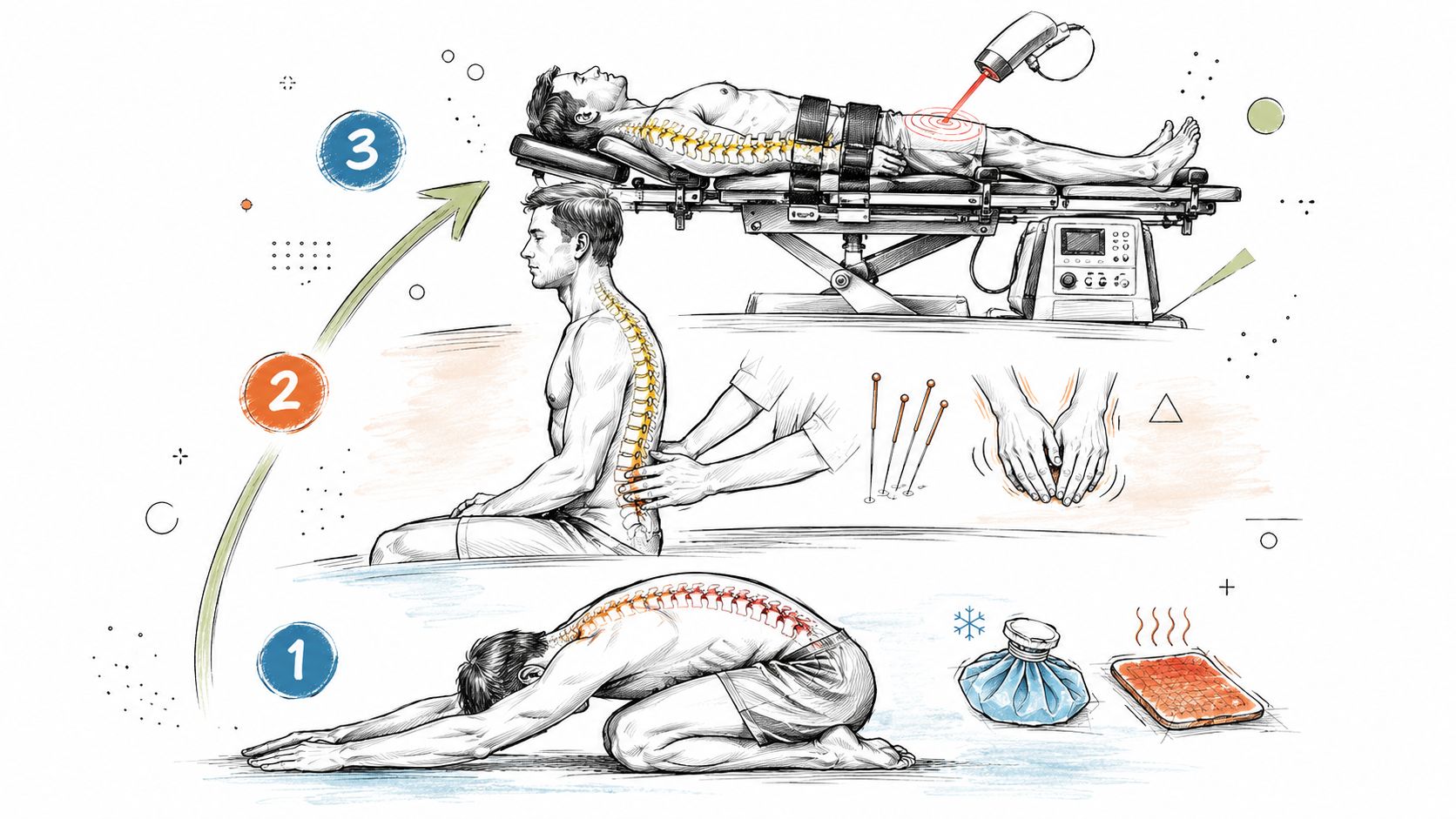
Practical rule: Sciatica usually responds best to a sequence of care, not a single trick. The right question isn't “What's the one fix?” It's “What phase of recovery am I in?”
That phased view matters. Early on, the goal is usually to calm irritation without making the area stiffer or weaker. If symptoms don't settle, treatment shifts toward restoring spinal mechanics, reducing muscle guarding, and improving movement tolerance. When pain remains stubborn or clearly disc-related, more advanced non-surgical care can become appropriate. Surgery has a place too, but it's usually a specific decision, not the default.
Some people describe a deep ache. Others report burning, electrical pain, tingling, or weakness. Symptoms may worsen with sitting, bending, coughing, or getting up from a chair. The exact pattern helps guide treatment because not all radiating leg pain behaves the same way.
People get frustrated when they bounce between random tips. A structured plan gives you something more useful. It helps you know what to try now, what to add if progress stalls, and which warning signs mean you shouldn't wait.
The first mistake many people make is shutting life down completely. That used to be common advice. It isn't anymore.
Clinical guidelines no longer recommend prolonged bed rest for acute sciatica. Instead, patients are advised to remain active while avoiding activities that worsen symptoms. Imaging should be restricted to “red flag” indications such as unrelenting pain, fever, trauma, or loss of bowel/bladder control, based on guideline review from the American Academy of Family Physicians.
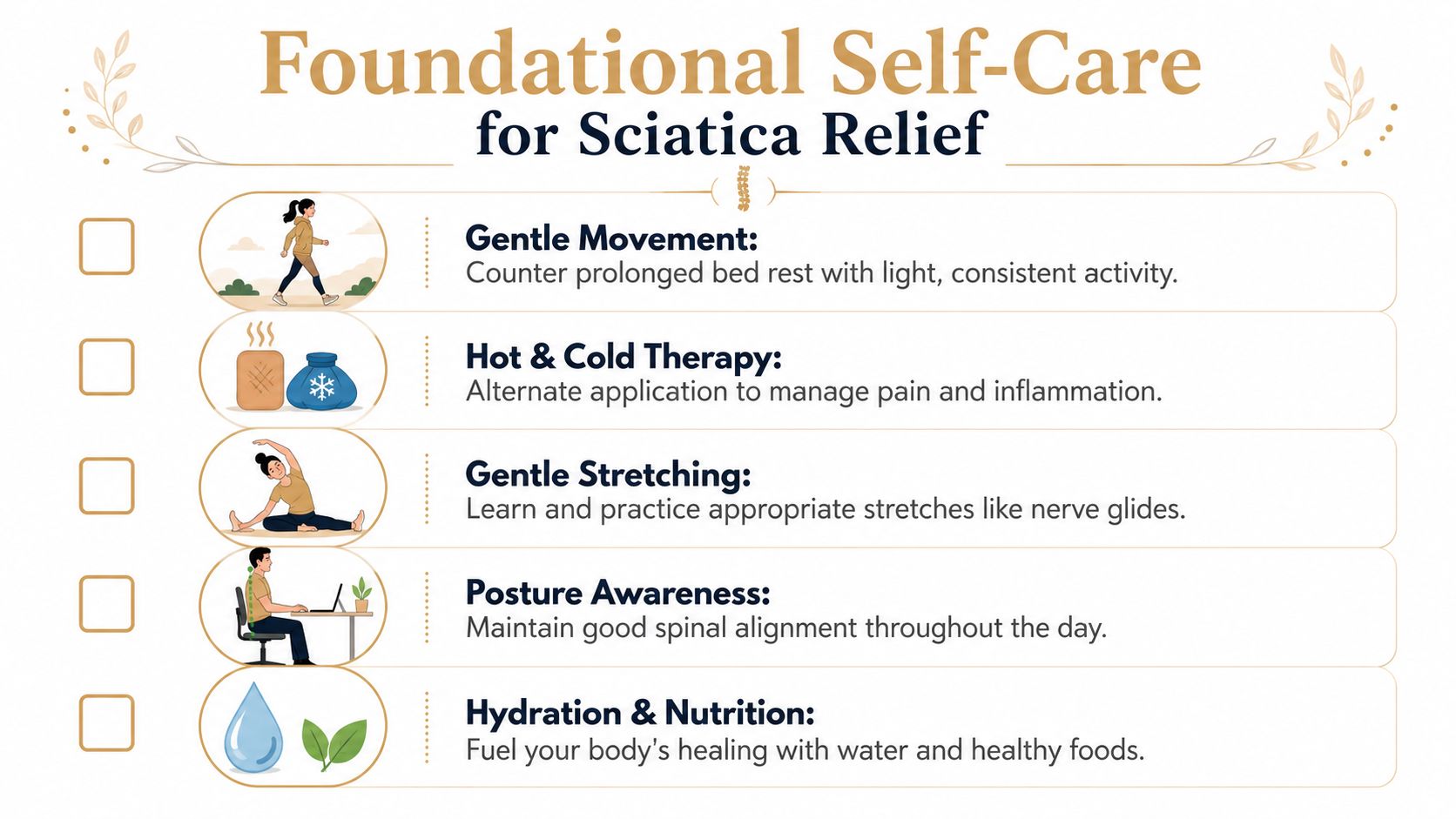
Start with movement you can tolerate. Short walks are often more helpful than long periods of sitting or lying down. The goal isn't to push through sharp leg pain. The goal is to keep your body from stiffening around the problem.
A few simple strategies usually help:
If you're wondering how long this usually takes to settle, this guide on how long the sciatic nerve may take to heal gives a useful overview of what the recovery timeline can look like.
Stay active, but make the activity smaller and smarter. Recovery usually improves when movement is frequent and tolerable, not aggressive.
Home care has limits. If the pain keeps intensifying, if the leg feels progressively weaker, or if you can't find any position that eases symptoms, it's time for an exam.
Seek prompt medical attention if you notice:
Self-care works best at the beginning when symptoms are stable and your body still responds to simple load changes. Once the pattern becomes persistent, treatment usually needs to become more specific.
The next layer of sciatica treatment options should do more than blunt pain. Good conservative care changes mechanics, tissue tension, movement quality, and your ability to tolerate daily life again.
Chiropractic adjustment and realignment work are aimed at restoring better joint motion and reducing mechanical stress through the spine and pelvis. When a segment isn't moving well, nearby tissues compensate. That often increases guarding and irritation around the structures feeding into sciatic symptoms. A well-chosen chiropractic adjustment doesn't “put a disc back in.” It improves motion where restriction is contributing to the problem.
Massage therapy helps when muscle spasm or protective tension is amplifying the pain pattern. Tight gluteal tissue, hip rotators, hamstrings, and low back musculature can all make an irritated nerve feel worse. Massage is often most useful when the body is bracing and movement feels blocked.
Acupuncture is another conservative option that can help calm pain sensitivity and reduce the sense of constant irritation. For some patients, it makes movement easier enough that exercise becomes possible again, which is often the bigger win.
A clinic that offers coordinated care may combine chiropractic care, massage therapy, mobility therapy, muscle stimulation, and pain relief strategies in the same plan so each visit builds on the last. At Aspen Falls Wellness, that integrated model may also include SoftWave Therapy, rehabilitation exercise, nutrition counseling, and personal exercise plans when the presentation calls for them.
The most effective conservative plan usually isn't the most aggressive one. It's the one that matches the driver of your symptoms.
A useful way to compare common therapies is to look at the job each one does:
| Therapy | Primary role in care | Best use case |
|---|---|---|
| Chiropractic adjustment | Improve joint mechanics and reduce segmental irritation | Stiff, movement-sensitive low back or pelvic patterns |
| Massage therapy | Reduce soft-tissue guarding and pain with movement | Tight glutes, piriformis irritation, muscular compensation |
| Acupuncture | Modulate pain and improve tolerance for recovery work | Persistent pain sensitivity or flare-prone cases |
| Mobility therapy | Restore cleaner movement through hips and spine | Poor bending, rotation, walking, or sitting tolerance |
| Muscle stimulation | Support pain relief and muscle activation | Difficulty engaging or relaxing specific muscle groups |
Passive care helps, but it isn't enough on its own. Lasting change usually depends on what your body can do between visits.
That's where a structured rehabilitation exercise program matters. The point isn't generic stretching. The point is a plan that fits your symptom pattern. One person needs extension-based movement. Another needs hip mobility and posture retraining. Another needs core control so the spine stops getting overloaded every time they bend, lift, or sit.
Personal exercise plans are what turn short-term relief into actual progress. They can include nerve glides, trunk control work, mobility drills, gait correction, and rehabilitation exercise that matches your tolerance. If posture, work setup, sport, or even golf mechanics are contributing, those factors should be addressed too.
Some cases don't resolve with basic care alone. The pain stays disc-like. Sitting is miserable. Bending, coughing, or driving lights it up. The leg symptoms keep returning even when you've done the right early steps. That's the point where advanced non-surgical care becomes a serious consideration.

Spinal Decompression with the DRX 9000 is designed for cases where disc pressure appears to be a key driver. The simplest analogy is a controlled vacuum effect. The table applies precise cycles of decompression to reduce pressure in the affected spinal segment. The goal is to create more space around the irritated nerve and reduce the disc-related load that keeps symptoms active.
This isn't for every type of back pain. It makes the most sense when the presentation looks discogenic, especially when symptoms radiate down the leg and worsen with sitting, bending, or coughing. The DRX9000 system is FDA-cleared specifically for herniated discs, bulging discs, degenerative disc disease, posterior facet syndrome, and sciatica, as described in this overview of DRX9000 indications.
There's also published outcome data for this approach. A case series reported that DRX9000 non-surgical spinal decompression produced an 80% reduction in pain and a 50% improvement in disability after 20 treatments, with 75% of patients reporting subjective improvement in overall symptoms and ability to perform daily activities, according to this clinical report on non-surgical spinal decompression. A separate report found that a 6-week course of 20 DRX9000 treatments significantly reduced chronic low back pain in 89% (16 of 18) of treated patients, with average pain scores dropping from 6.4 to 3.1 after 2 weeks and to 0.8 after the full protocol, as summarized in this discussion of DRX9000 treatment results.
For patients considering this route, a page on spinal decompression care can help clarify what the treatment process generally involves.
If you've used home electrical stimulation and want to understand where that fits in, this explanation of how TENS works for back pain is a practical reference. TENS may help modulate pain, but it doesn't do the same job as decompression.
Persistent sciatica is rarely just a pressure problem. Many people also have local inflammation, tissue sensitivity, deconditioning, and compensatory muscle patterns. That's why combined care often outperforms one device used alone.
A 2025 clinical trial showed that 74% of chronic sciatica patients achieved >50% pain reduction and maintained functional improvement for 12+ months using integrated DRX9000 + MLS laser therapy. The DRX9000 system is FDA-cleared for conditions including herniated discs, degenerative disc disease, and sciatica, based on this report discussing integrated DRX9000 and MLS laser therapy.
MLS Laser Therapy is typically used to reduce inflammation and support tissue recovery. In practice, that can pair well with decompression, chiropractic care, mobility therapy, and rehabilitation exercise. Some patients also benefit from SoftWave Therapy, acupuncture, or massage to address the soft-tissue and pain-modulation side of the problem.
The important takeaway is simple. Advanced technology is most useful when it's part of a progression, not a shortcut.
A common scenario in clinic is this: leg pain has been going on for weeks, sitting is miserable, sleep is poor, and the first question is whether an MRI or surgery is now the next step. Sometimes it is. Often, it is not yet.
In a phased treatment pathway, imaging and surgical referral sit later in the process, not because the symptoms are being dismissed, but because both decisions work best when they are tied to a clear clinical reason. The goal is to identify the people who need faster escalation while avoiding tests or procedures that do not change treatment.
MRI is usually reserved for cases where the result is likely to change management. That includes severe or progressive symptoms, signs that suggest a serious underlying condition, or pain that continues after a well-executed course of conservative care.
Clinical guidance from the American College of Radiology supports imaging for patients with low back pain and radiculopathy when red flags are present or when symptoms persist despite medical management and conservative treatment, as outlined in the ACR Appropriateness Criteria for low back pain.
Red flags need prompt attention. New bowel or bladder dysfunction, saddle numbness, fever, unexplained weight loss, major trauma, or rapidly worsening weakness change the timeline and may justify urgent imaging or specialist referral.
Good timing matters. Early MRI can be useful in the right case, but routine imaging for every episode of sciatica often finds age-related changes that are not causing the pain. That can create confusion and push treatment toward the scan instead of the patient.
Surgery has a clear role. It is most often considered when there is progressive neurological loss, a confirmed compressive lesion that matches the symptoms, or persistent leg-dominant pain that remains functionally limiting after appropriate non-surgical care.
The trade-off is straightforward. Surgery may relieve leg pain faster for carefully selected patients, but that does not mean it produces better long-term results for everyone. A systematic review in the European Spine Journal examining surgery versus conservative care for sciatica due to lumbar disc herniation found faster improvement with surgery in the short term, while longer-term differences were smaller.
Faster relief and better long-term outcome are different questions.
That distinction helps patients make better decisions. If weakness is progressing, surgery may protect function and should not be delayed. If pain is severe but stable, a patient may reasonably choose either route after discussing expected recovery time, procedural risk, and how much has already been tried. The right next step depends on symptom severity, neurological findings, imaging correlation when needed, and response to each earlier phase of care.
The provider you choose affects more than convenience. It shapes whether your treatment stays generic or becomes precise.
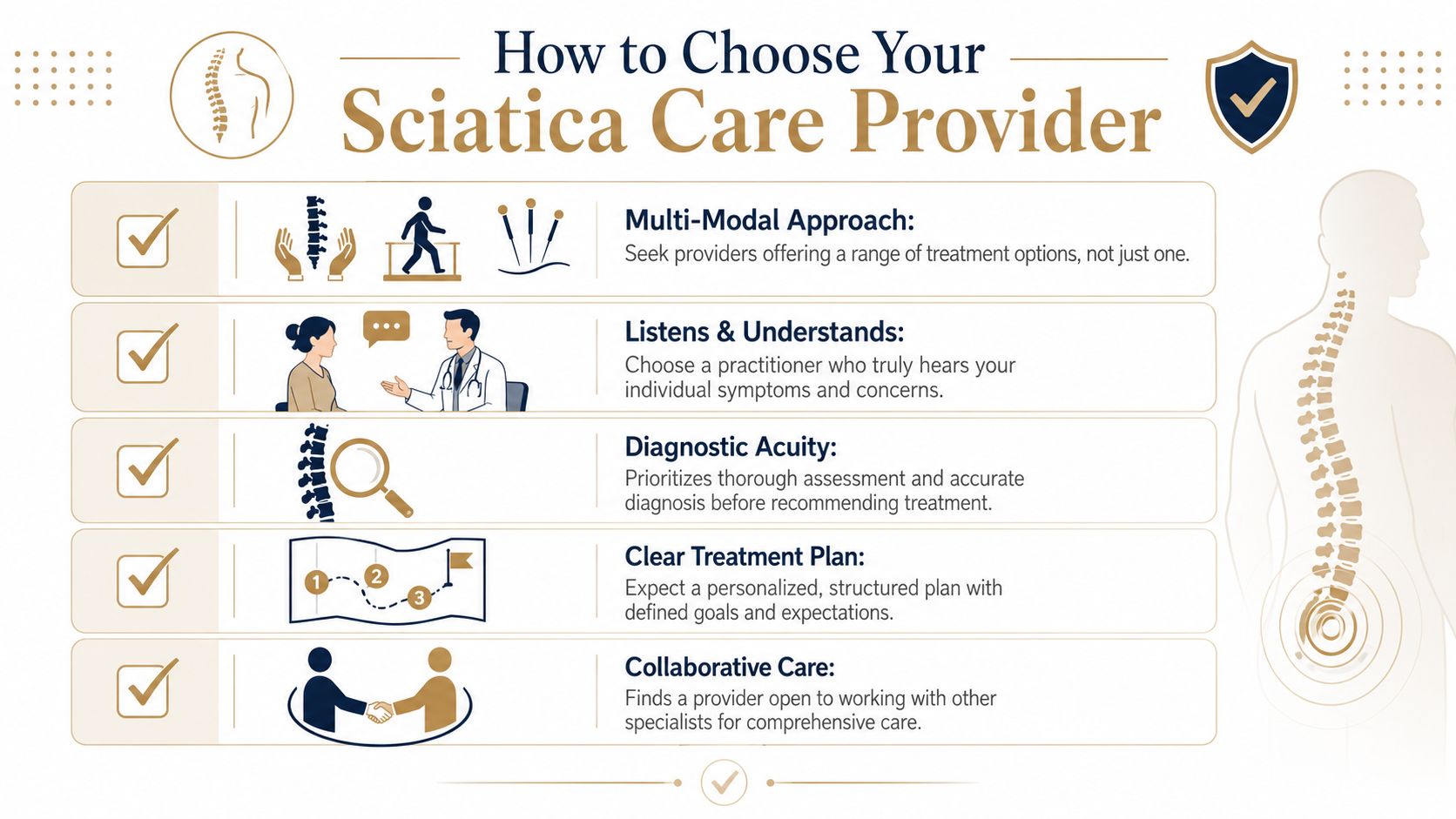
Don't just ask what treatment they offer. Ask how they decide what you need.
A useful first-visit conversation should cover:
If those answers are vague, care often becomes repetitive. Repetitive care can feel active without being effective.
Look for a provider who offers more than one lane of treatment. Sciatica rarely fits neatly into a single method. A stronger model usually combines diagnosis, manual care, exercise, and the ability to escalate when needed.
Good signs include:
Choose the clinic that can explain both why you hurt and what the next decision will be if the first treatment doesn't work.
That's especially important for recurrent sciatica. If a provider only treats the pain flare and never addresses movement patterns, tissue load, or disc tolerance, the cycle often returns.
The most useful way to think about sciatica treatment options is as a progression. Start with calm, sensible self-care. Build on that with conservative treatment that improves mechanics, reduces tissue tension, and restores function. If symptoms stay disc-driven or resistant, move toward advanced non-surgical technology such as spinal decompression and MLS Laser Therapy. Use imaging or surgical referral when the presentation justifies it.
That model gives patients something many are missing when pain first starts. It gives them a path.
In practical terms, a complete plan may include chiropractic care, adjustment, decompression, massage therapy, acupuncture, mobility therapy, rehabilitation exercise, muscle stimulation, personal exercise plans, and nutrition counseling. Some people also benefit from SoftWave Therapy, especially when tissue healing support is part of the goal. If the history includes a collision or another traumatic trigger, car accident treatment and re-evaluation become part of the process as well.
For people in Salt Lake City and Sandy, that kind of phased, coordinated care is available locally through clinicians who can examine the spine, monitor symptoms, decide when imaging is appropriate, and build treatment around the person rather than around one tool.
If your pain is traveling down the leg, interrupting sleep, or limiting basic movement, it's worth getting examined before the pattern becomes harder to reverse.
If you're looking for a structured, non-surgical plan for sciatica, Aspen Falls Wellness offers examination, diagnosis, chiropractic care, DRX9000 spinal decompression, MLS Laser Therapy, acupuncture, massage therapy, mobility work, and rehabilitation-based follow-up in Salt Lake City and Sandy. Scheduling an evaluation is the clearest next step if you want to understand what's driving your symptoms and which phase of care makes sense now.

Stay updated with the latest chiropractic news and exclusive offers.