Learn how to improve hip mobility with a step-by-step plan that combines drills, strength work, and smart progressions for lasting results.



You know the feeling. You sit too long, stand up stiff, try a few hip stretches, and nothing really changes. The front of the hip still pinches when you lunge, the squat still feels blocked, and the same tightness comes back by the next day. That pattern usually means the problem isn't just “short muscles.” It's a load-and-control problem, and that's a very different fix.
For most adults, how to improve hip mobility starts with stopping the cycle of passive stretching and starting to train the hip to accept, control, and use new range. The hip doesn't need more random effort. It needs the right mix of mobility drills, strength, and warm-up work, because the strongest early evidence favors short-term gains when mobilization is paired with exercise rather than used alone. A clinical review in Journal of Sports Rehabilitation found moderate evidence for improving hip ROM and function, plus Level 1b evidence for short-term pain, ROM, and function gains when mobilization is combined with exercise. That review also notes practical dosing examples and the shift toward treating hip motion as a load-and-control issue.
If you hike, squat, sit at a desk, or rotate through golf swings, your hips have to do more than “feel loose.” They have to produce force in useful positions. That's why a plan built around movement quality tends to hold up better than a list of stretches you do once and forget. If you want another real-world lens on why people care about better movement outside the gym, the top hiking advantages are a useful reminder that mobility shows up in everyday life, not just in exercise. For readers dealing with pain that seems to live in the hip itself, the hip pain overview at Aspen Falls' hip pain page helps frame why the source of stiffness matters.
A lot of people do the same thing for months. They sit all day, grab a seated butterfly stretch at night, maybe add a standing quad stretch, and hope the hips eventually “open up.” The problem is that the hip often isn't refusing because the tissue is stubborn. It's refusing because the system around it doesn't trust the range yet.
The hip flexors, glutes, deep rotators, and trunk all share the job of controlling where the femur goes. If the glutes aren't doing enough, or the trunk can't stay organized, the hip may never feel safe at end range. That's why limited hip motion often behaves like a control problem, not a pure flexibility problem.
Practical rule: if a stretch feels good for ten minutes but the same motion is gone by tomorrow, the range isn't being owned yet.
That's also why the reader who can sit on the floor in a butterfly stretch but still struggles to squat, run, or climb a steep trail hasn't solved the issue. The nervous system has learned that the position is okay only when it's passive. Once the body has to produce force there, everything changes.
Passive stretching can calm symptoms, but it often doesn't teach the hip how to work. A hip flexor stretch or adductor stretch may give temporary relief, but without loading the new range, the improvement rarely transfers to walking, squatting, or the golf swing. That's exactly why the modern approach mixes joint mobilization, active control, and warm-up movement.

A walker who feels stiff after long office hours, then loosens a bit after a few stretches, is usually seeing the short-term effect. The useful question is whether the hips can still move well when loaded, tired, and used in real life. That's the standard that matters.
Before choosing drills, it helps to find out whether the restriction lives in the front of the hip, the back of the hip, or in rotation. You don't need a perfect diagnosis to get started. You do need a clear pattern.
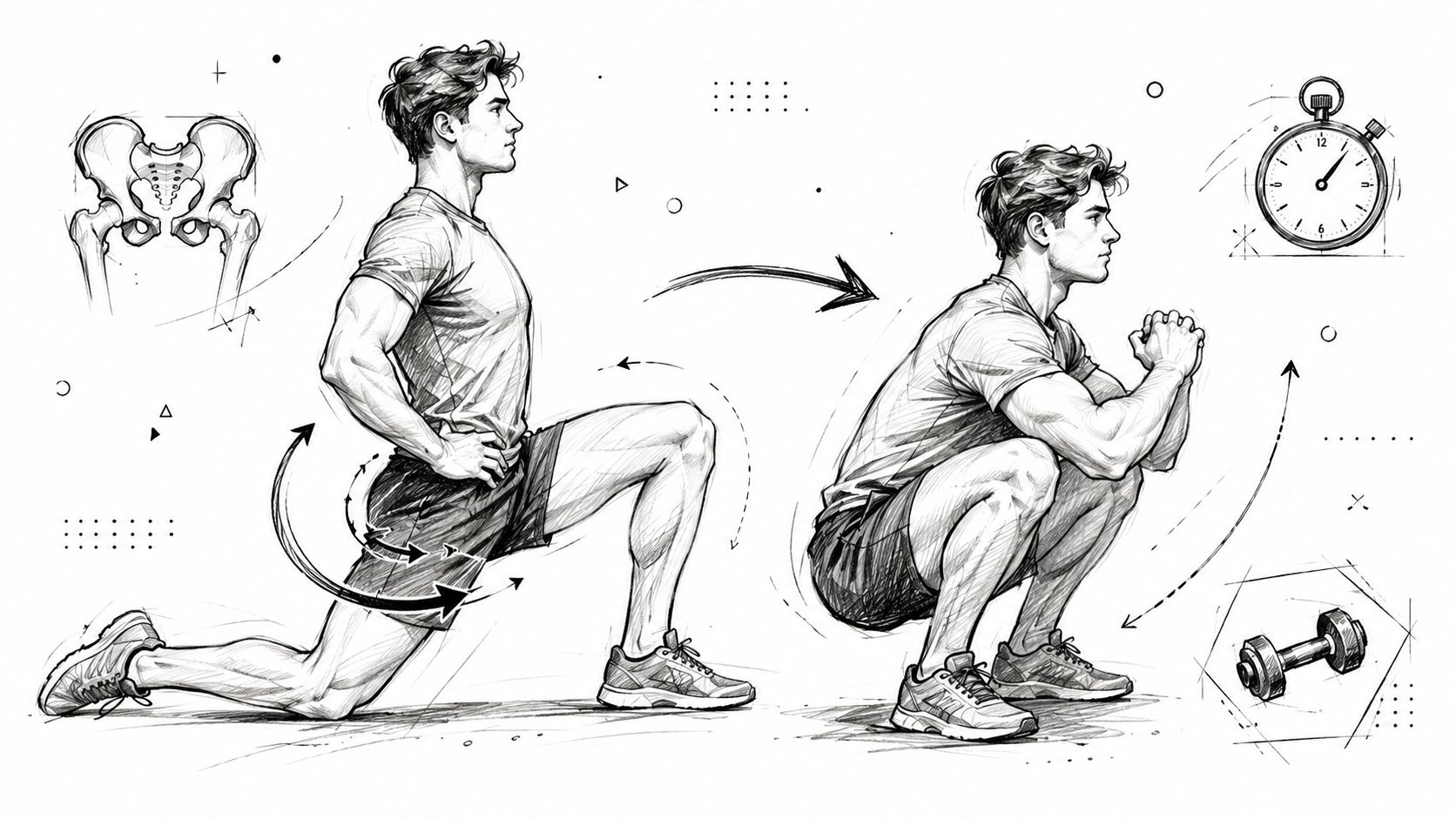
First, do a half-kneeling hip flexor hold. Put the back knee on the floor, squeeze the glute on the down-knee side, and gently push the hips forward. If the front of the hip feels pinchy or heavily guarded right away, the front line is probably involved.
Second, hold a deep squat with the elbows inside the knees and the heels flat. If your chest collapses, the heels pop up, or the hips refuse to sit low, the problem may be a mix of hip flexion limits, ankle limits, or poor control at depth.
Third, do a seated 90/90 rotation check. Sit with both knees bent at right angles and compare sides while rotating between positions. If one side feels clearly tighter or more blocked, rotation work deserves priority.
Your job isn't to label yourself with a perfect diagnosis. Your job is to notice which motion fails first, because that points you toward the right drill family.
A true tissue limit usually feels consistent and specific. Guarding feels jumpy, changes with breathing, and often gets worse when you rush the movement. If the restriction softens when you slow down, exhale, and reduce intensity, the nervous system is probably part of the story.
If the hip feels better after a few easy reps but worse the harder you push, that's a clue to start with lower intensity and shorter holds. If you want a simple decision rule, use the first motion that feels most limited as your starting point, then retest after a few days of consistent work. That keeps the plan personal instead of generic.
The best beginner plan is short, repeatable, and specific. Expert mobility guidance commonly uses 10 to 15 minutes per session with a mix of easier and harder movements, and one published clinical guide recommends 5 to 15 reps of a relaxed movement followed by 5 to 15 reps of a more active or loaded movement. The same guide also emphasizes matching self-mobilization to the correct load and then reinforcing it with dynamic and isometric work.
Set up in a half-kneeling position with the back knee down. Squeeze the glute on the kneeling side, then shift the hips forward a little while staying tall through the trunk. Hold only 2 to 3 seconds and repeat 3 to 5 reps per side. A controlled hip flexor warm-up like this is also described in the men's health mobility guide, which uses the same kneeling setup and short holds. That guide also lists related drills with 6 to 8 reps per side and 5 circles in each direction.
Feel it in the front of the hip, not the low back. If the low back arches hard, you're borrowing motion from the wrong place.
The 90/90 transition trains rotation without forcing it. Move slowly between sides, keep the spine tall, and breathe out as you rotate. Six to eight controlled reps per side is enough to start.
The deep squat shift with reach is the bridge to real life. Sink into a squat you can own, shift side to side, and reach forward or slightly overhead if it helps you stay organized. The point isn't to chase depth for its own sake, it's to teach the hips to stay active where they're most challenged. If you're building a rehab routine, a structured home program like rehabilitation exercise gives these drills a place inside a broader plan.
Side-lying hip CARs and standing leg swings round out the session. Use slow circles with intention, then switch to gentle leg swings that stay controlled instead of sloppy. A practical workflow is to spend a few minutes on the easier drills, then finish with the more active ones so the new range gets reinforced while the tissue is warm.
A simple daily template is enough for most adults, 10 minutes total, one or two front-of-hip drills, one rotation drill, and one active end-range drill. That's usually more useful than a long, exhausting routine you won't repeat.
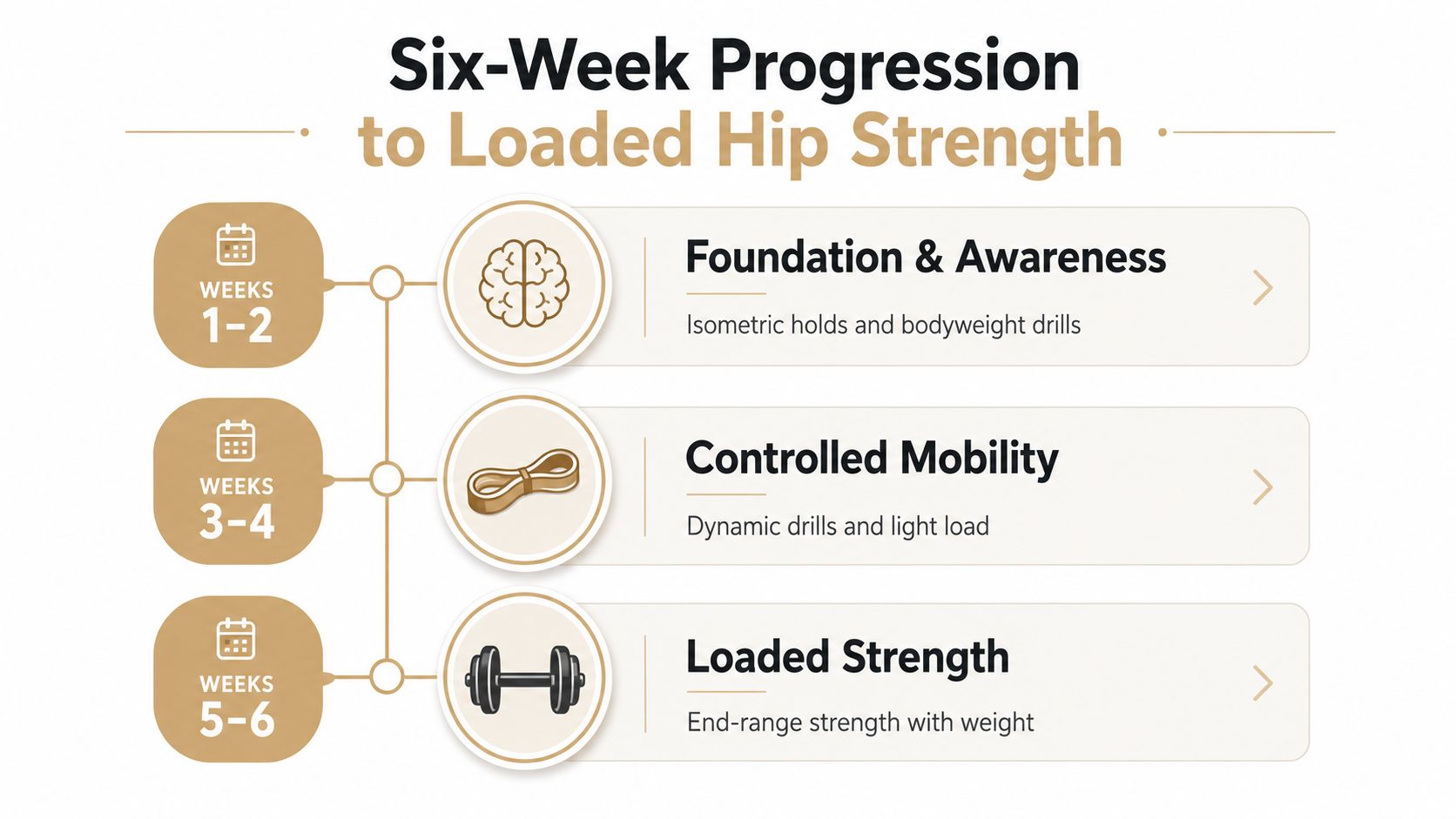
Mobility gains don't stick because the range was found once. They stick because the body learns to use the range under real load. That's why staged programming matters.
A physical-therapy progression often starts with Activation, Weeks 1 to 2, using basics like clamshells and glute bridges. The next phase is Functional Strengthening, Weeks 3 to 4, which uses standing work that looks more like walking and squatting. The final phase is Dynamic Control, Weeks 5 to 6, where movement gets integrated and more loaded.
If you're wondering when to move on, the answer is simple. Move up when the current stage feels smooth, the hip doesn't flare after the session, and you can repeat the drills without loss of control.
A hip that can sit in a deep squat for a short hold but can't stand back up from it is not mobile. The range exists, but it hasn't been converted into usable strength. That's where split squats, loaded reaches, and end-range isometric holds matter.
A useful rule is to keep the early stage boring on purpose. Don't rush into heavy loading just because the hip feels looser for a day. Build the control first, then challenge it. That approach is more durable for adults who sit a lot, train inconsistently, or keep re-irritating the same hip flexor.
You're ready to progress when the drill stops feeling like a battle. You can breathe through it, the trunk stays calm, and the hip doesn't feel worse later that day. The goal isn't to collect harder exercises, it's to earn the ability to load the new range without paying for it afterward.
People stay consistent when the work changes something they care about. A hip routine that helps you squat lower, hike farther, or rotate more cleanly in golf is a lot easier to keep than one that only promises “better mobility.”
In squats, the cue is simple, spread the floor with your feet and keep the knees tracking where the toes go. That recruits the glutes at depth and helps the pelvis stay organized instead of dumping forward. On the trail, the payoff is easier hip extension and less of that locked-up feeling when climbing or stepping up uneven ground.
Desk comfort also matters. A few minutes of active hip work after long sitting can interrupt the stiffness that settles in at the front of the hip and the low back. For golfers, hip mobility should support rotation without forcing the lumbar spine to do all the work.
The goal is not a bigger stretch sensation. The goal is a better movement result in the task you actually do.
A big part of maintenance is context. When the drill matches the activity, the body has a reason to keep the range. That's the difference between exercise that lives in a notebook and exercise that survives real life.
Many people with stiff hips aren't doing nothing. They're doing the wrong version of the right idea. That's why the frustration runs so deep.
If you hold a hip flexor stretch forever and then hammer it again tomorrow, you may just teach the nervous system to brace harder. The fix is shorter, more frequent exposure paired with active contraction. The hip should feel challenged, not bullied.
Mobility that never gets tested under body weight tends to disappear by lunchtime. A deep squat stretch is useful, but if you never rise from it, the range hasn't been integrated. Pair the drill with a squat, a step-up, or an isometric hold so the movement carries over.
Pinching in the front of the hip is not a badge of honor. It can reflect an impingement pattern or a labrum-related issue, which is a different problem than “tightness.” If a stretch creates sharp pain, back off and get the joint assessed.
For readers who like hiking and want a movement goal tied to a real place, the Soča Valley hiking routes are a good example of why hips need to handle uneven terrain, not just gym drills. The same principle applies closer to home, if the hip can't manage steps, slopes, and rotation, the body will keep protecting it.
Try this instead: cut the hold time, add a controlled contraction, then retest after the session rather than chasing a deeper stretch.
That one change solves a surprising number of stubborn cases because it shifts the focus from intensity to ownership.
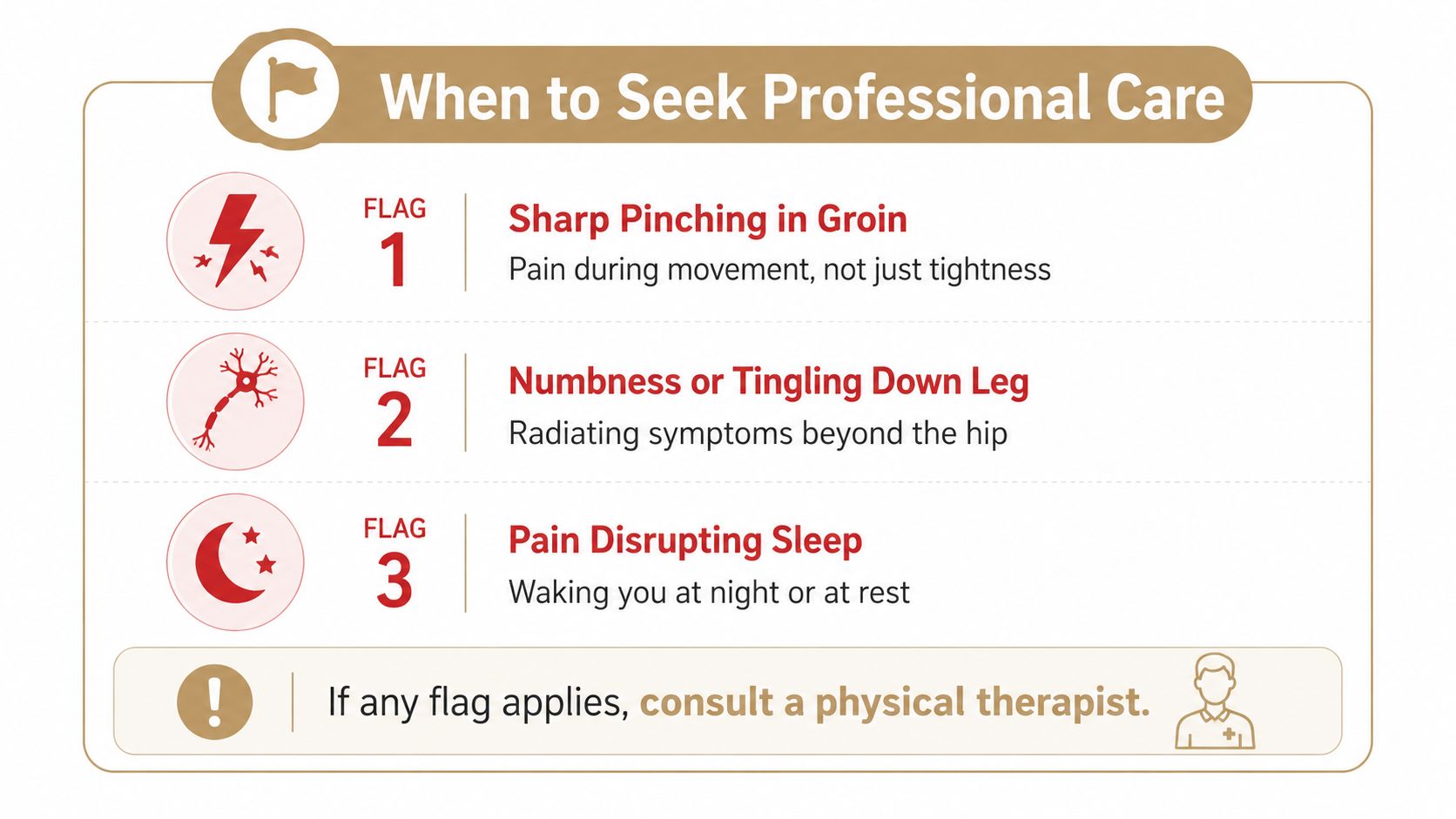
A hip that still feels tight after steady home work is usually telling you something more specific than “stretch me more.” Sharp groin pinching, numbness or tingling down the leg, and pain that wakes you at night are reasons to stop guessing and get evaluated. Those patterns often point to a load, control, or nerve issue that stretching alone will not fix.
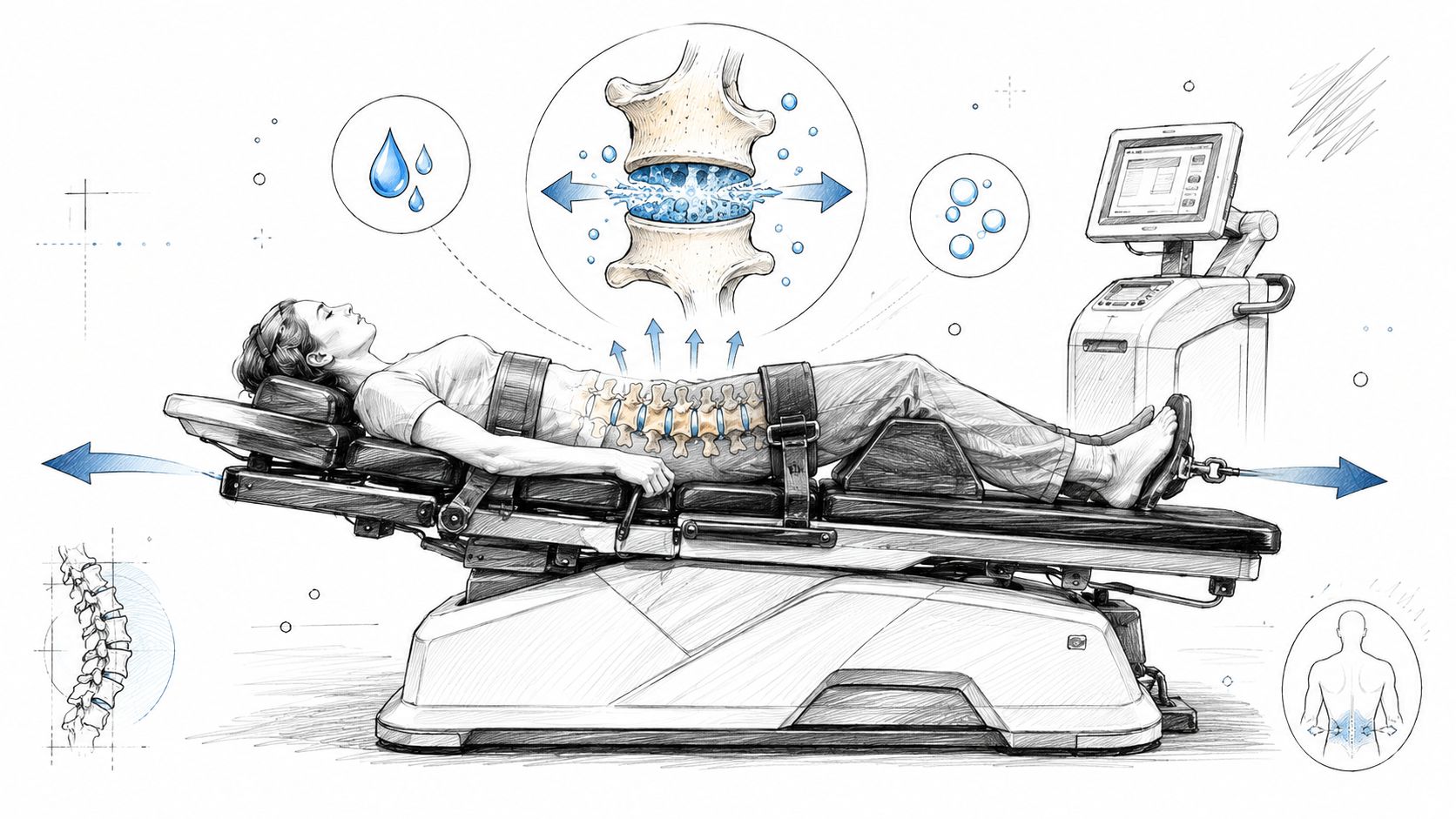
A person with chronic low-back and buttock pain that worsens with sitting may need a thorough exam. If disc involvement is suspected, spinal decompression with the DRX 9000 may fit that picture. A person with stubborn soft-tissue guarding may do better with SoftWave therapy, MLS Laser Therapy, or therapeutic massage to calm the tissue enough for mobility drills to work.
If the hip stiffness is part of a broader movement problem, more stretching is usually the wrong next step. Care may need to focus on mobility therapy, personal exercise plans, or a golf movement screening when the swing is part of the complaint. Aspen Falls Wellness also uses chiropractic care, acupuncture, muscle stimulation, pain relief approaches, rehabilitation exercise, adjustment, realignment, decompression, sciatica treatment, nutrition counseling, and car accident treatment as part of a coordinated musculoskeletal care model. For readers who want to keep moving through work, walking, or training, active lifestyle insoles for hip comfort can also be part of the discussion when foot mechanics are adding load up the chain.
If you have done six consistent weeks of honest home work and the hip still will not change, that is a sign to bring in a clinician. If you cannot tell whether the problem is joint, soft tissue, or movement control, a full exam saves time and frustration. If the issue affects work, sleep, walking, or sport, it is no longer just tightness.
The best results usually come from in-clinic care paired with a home plan that keeps the new range useful under real life demands. That may mean learning how to sit without feeding the problem, squat without pinching, hike without losing control on uneven ground, or swing with less compensation. Durable change comes from matching the treatment to the load the hip has to handle, not from chasing one more stretch video.

Stay updated with the latest chiropractic news and exclusive offers.