Does Blue Cross Blue Shield cover chiropractic? Learn how BCBS plans handle visits, referrals, and in-network rules, plus how to verify your benefits.



Yes, most Blue Cross Blue Shield plans cover chiropractic care in some form, but the number of covered visits, referral requirements, and out-of-pocket costs depend on the specific plan, state, and whether the provider is in-network. Some documented BCBS plan designs allow 12 visits, while others allow 20 visits, and certain riders provide 30 visits per calendar year.
You may be checking your BCBS card before booking an appointment for back pain, neck pain, sciatica, or a recurring headache. The card confirms that you have insurance, but it doesn't tell you whether chiropractic care falls under a dedicated benefit, how many visits remain, or whether authorization is required before continued treatment.
The practical question isn't just “Does Blue Cross Blue Shield cover chiropractic?” Ask instead: How many visits are covered, what services qualify, which rules apply, and what will I owe? That distinction prevents many avoidable billing surprises.
A patient in Salt Lake City or Sandy may have a BCBS card, a documented back or neck problem, and still face an unpaid claim if the service falls outside the plan's rules. The practical question is how many visits qualify, which services are included, and what documentation BCBS requires. Aspen Falls Wellness removes much of that verification burden before care begins.
A typical BCBS chiropractic benefit focuses on medically necessary care for neuromusculoskeletal problems. That commonly includes spinal manipulation or a chiropractic adjustment for documented symptoms involving the back, neck, joints, or related function. Coverage depends on the member's benefit booklet, network status, and plan requirements. BCBS policy materials describe these plan-specific limits and exclusions.
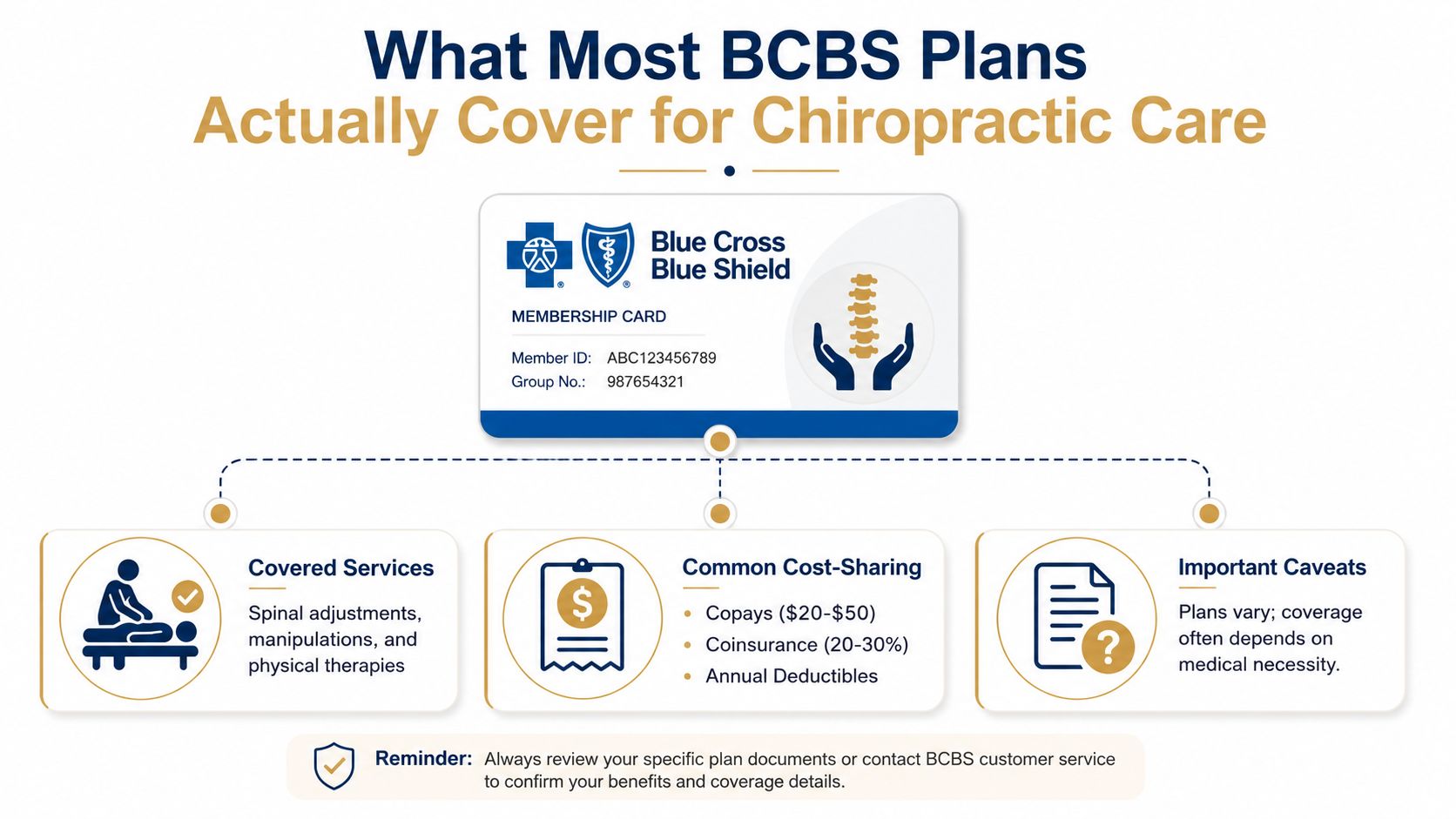
Plans may cover an initial examination, manual adjustment, spinal manipulation, and follow-up evaluation when those services support an active treatment plan. Therapeutic exercise or a physical modality may qualify separately when the plan considers it eligible, medically necessary, documented, and correctly billed.
Do not assume every service offered in a chiropractic office belongs to the chiropractic benefit. Nutrition counseling, maintenance care, wellness visits, massage therapy, acupuncture, SoftWave Therapy, MLS Laser Therapy, muscle stimulation, and spinal decompression with the DRX 9000 may fall under exclusions, separate benefit categories, authorization requirements, or direct patient payment.
“Medically necessary” means more than choosing routine wellness care. BCBSNC guidance requires clinical symptoms that may improve with standard chiropractic therapy, documentation of the diagnosis and modalities used, an anticipated treatment length, and measurable goals. Review BCBSNC's chiropractic medical-necessity guidance.
A reviewer expects an active problem, a reasonable plan, and measurable progress. That may include reduced pain, improved mobility, greater tolerance for daily activity, or better function. Open-ended maintenance care is more likely to trigger benefit limits or medical-necessity questions than treatment directed at a documented condition.
Foot mechanics can contribute to back symptoms. Patients who want to diagnose back pain from feet can use that resource to organize questions for a clinician. It cannot confirm BCBS coverage, but it may help clarify the symptom pattern during evaluation.
The BCBS name on your card does not define one standard chiropractic benefit. Commercial plans, Medicare Advantage plans, and federal employee plans can apply different covered services, visit caps, and documentation rules to the same treatment. The practical question is how many visits your plan allows, which services count, and what rules apply before the claim is submitted.
Commercial employer-sponsored and Marketplace plans often place chiropractic care inside a defined benefit with network requirements, cost sharing, and a treatment or annual limit. A prior review found that BCBS plans had offered chiropractic care as a standard benefit, with maximums of 12 to 20 visits per enrollee per year. That benchmark shows how benefits have been structured, not what your current policy guarantees.
Medicare-linked products may be narrower. One BCBS Medicare Advantage policy limits coverage to spinal manual manipulation and excludes extra-spinal manipulation and other services performed or ordered by a chiropractor. An examination, imaging, therapeutic exercise, or device-based modality may therefore receive different coverage treatment from the spinal manipulation service itself.
Federal employee coverage shows the same variation. The Federal Employee Program Standard Option historically combined chiropractic and osteopathic manipulative treatment at 12 visits per person per calendar year, while the Basic Option allowed 20 visits. BCBS policy materials outline those visit structures and code-based restrictions.
| Plan Type | Typical Covered Services | Common Visit Limits | Exams & X-Rays |
|---|---|---|---|
| Commercial or Marketplace | Often spinal manipulation and eligible services tied to medical necessity | Plan-specific annual or treatment limits | May be separate, limited, or subject to plan rules |
| Medicare Advantage | Often spinal manual manipulation for a covered spinal condition | Product-specific | Don't assume exams, imaging, or maintenance care are included |
| Federal employee plan | Chiropractic and osteopathic manipulative treatment under defined benefit rules | Historical examples include 12 or 20 visits | Coverage depends on the specific option and service |
The sponsor behind the card affects the benefit design. Your employer, federal program, state market, or Medicare-linked product may set the rules before the clinic submits a claim. Ask for the exact product name and evidence of coverage, not just the BCBS brand. For Salt Lake City and Sandy patients, Aspen Falls Wellness can handle the verification work, so you receive plan-specific answers before treatment begins.
The practical question is how many chiropractic visits your BCBS plan permits and which rules apply before you reach the limit. Visit caps, referrals, and prior authorization can determine whether treatment continues, pauses for review, or creates an unexpected bill.
Visit limits vary by product. One plan may combine manipulative-treatment visits under a shared cap, while another may set a separate limit for rehabilitation or habilitation services. A Texas BCBS benefit document illustrates how visit limits can vary by product. Check the evidence of coverage for the exact benefit, rather than relying on the BCBS brand name.
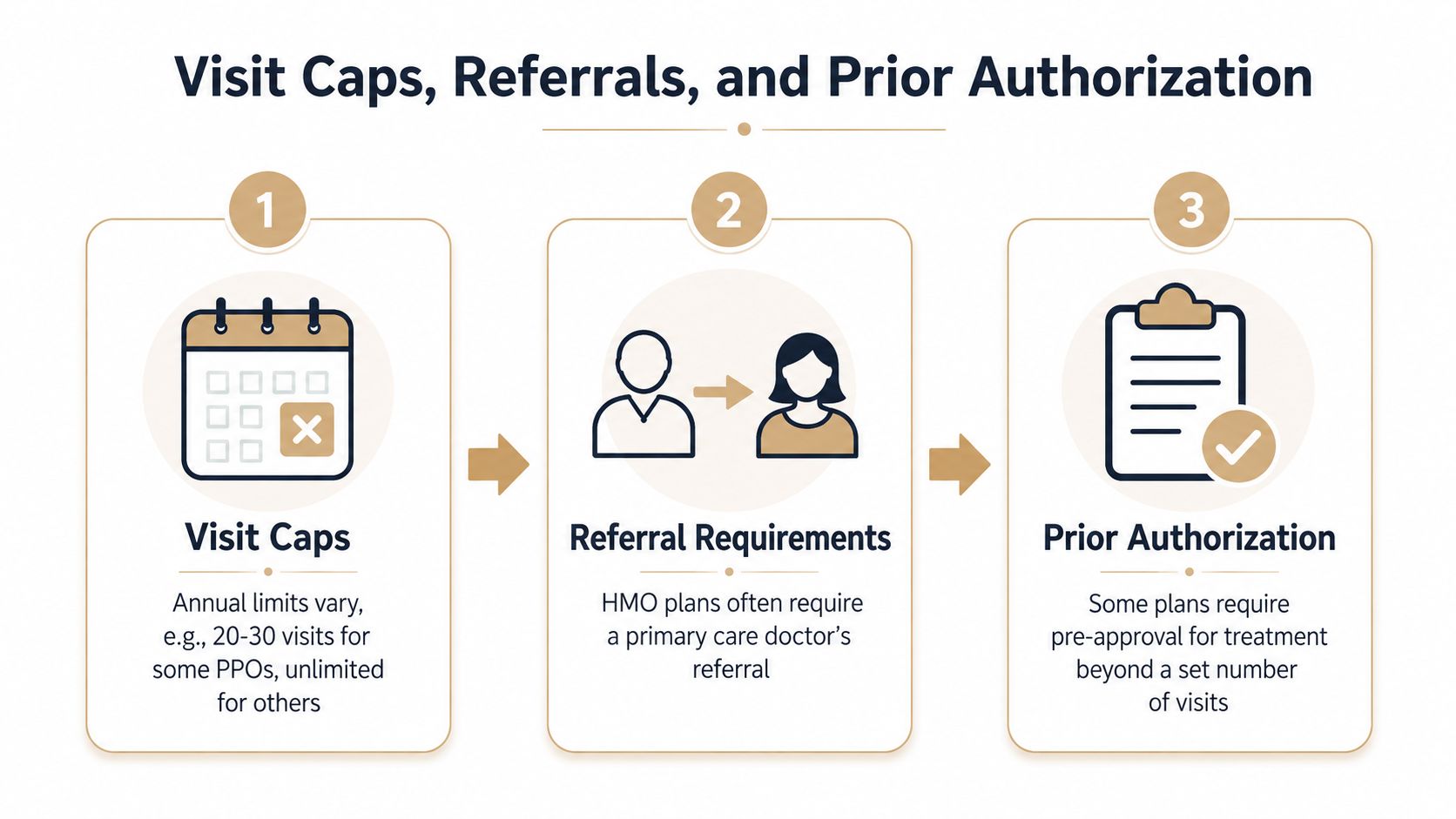
Some plans stop paying after the stated number of visits. Others allow additional care only after a medical-necessity review. A covered chiropractic benefit therefore does not guarantee unlimited treatment.
BCBS Massachusetts requires treating chiropractors to request authorization for visits beyond 12 visits per calendar year for affected plans. The initial visits do not require prior authorization, but treatment expected to continue past that threshold must be submitted before the next visit. Read the BCBS Massachusetts chiropractic authorization guide.
An HMO may require a primary care referral before the chiropractor can bill the plan. A PPO often permits direct access to an in-network chiropractor, while still requiring authorization if care continues beyond the plan's threshold. EPO and POS requirements depend on the policy.
Ask whether the rule applies to the first visit, follow-up care, imaging, therapeutic exercise, or treatment after a visit limit. BCBS Michigan materials also describe authorization requirements for some visits above defined thresholds. Check the BCBS Michigan outpatient rehabilitation authorization FAQ.
For Salt Lake City and Sandy patients, Aspen Falls Wellness can verify these requirements with BCBS before treatment begins. Ask the clinic and insurer to identify the exact visit that triggers authorization, then record who confirmed the answer.
Your provider's network status can change the financial result even when the clinical service is identical. In-network care usually gives you the cleaner billing path because the provider has agreed to the plan's negotiated rates and generally files the claim.
Out-of-network care can involve a separate deductible, a higher coinsurance responsibility, and balance billing. Balance billing occurs when a provider charges more than the amount the plan recognizes and the provider isn't bound by the plan's negotiated rate. Your policy may also reduce benefits or exclude out-of-network chiropractic care altogether.
| Factor | In-Network | Out-of-Network |
|---|---|---|
| Allowed amount | Based on the plan's negotiated rate | May use the plan's lower recognized amount |
| Patient cost | Usually the plan's stated copay or coinsurance | Often higher cost-sharing and possible balance billing |
| Claims | Provider commonly files directly | Patient may face more paperwork |
| Referral | Depends on plan type and benefit | May be required even when in-network care doesn't need one |
| Authorization | Plan-specific | Can be stricter or required for more services |
| HMO or EPO access | Usually the expected route | Often excluded except under limited circumstances |
| PPO access | Commonly covered at the plan's in-network level | May be covered at reduced benefits |
A chiropractor may participate with one BCBS product but not another. The clinic's website can be a useful starting point, but it isn't proof that the provider is in-network for your specific member ID and group.
The phrase “we accept BCBS” doesn't answer the question that controls your bill. Ask whether the provider is in-network for your exact plan.
Don't assume changing providers mid-treatment leaves your benefit calculation untouched. Ask BCBS how visits are counted when the provider changes, especially if one provider is in-network and the other isn't. Your plan may track the benefit across the member's coverage, while the cost-sharing rules change immediately with the new network status.
Verification should happen before the first appointment, not after the first explanation of benefits. Use this sequence and save the answers.
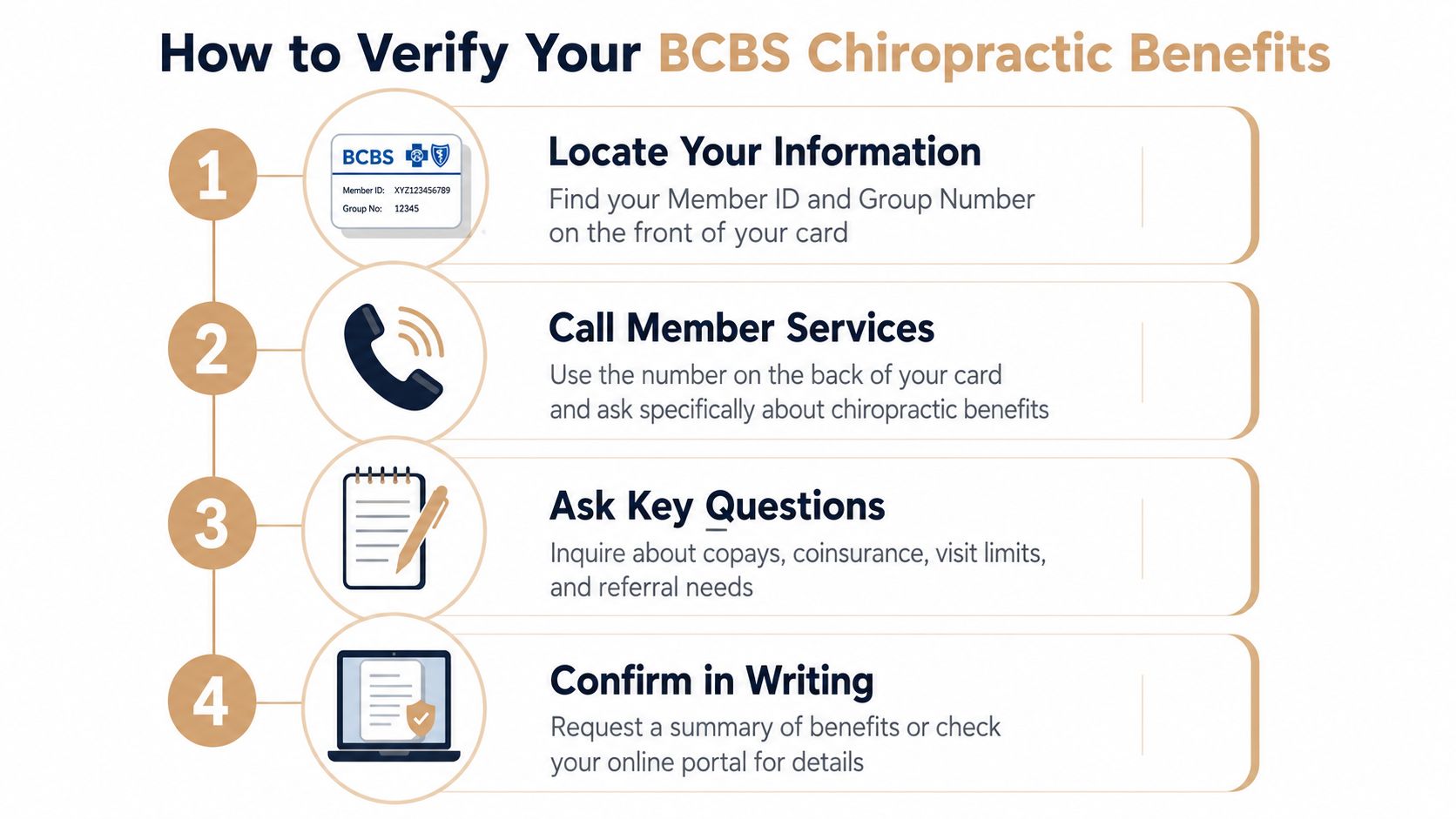
Locate the member ID and group number on your BCBS card. Call the member services number on the back and ask these questions directly:
Ask for the representative's name and a call reference number. Write down the date, the answers, and any instructions about authorization. A recorded verification doesn't guarantee payment, but it gives you a useful record if the claim is later processed differently.
Log into the member portal and download the Summary of Benefits and Coverage. Search the document for “chiropractic,” “spinal manipulation,” “rehabilitative services,” “manual therapy,” and “prior authorization.” If the summary is unclear, request the full evidence of coverage.
Then confirm network status through the BCBS provider directory or Doctor Finder tool. Don't stop at a general directory result. Verify the provider's name, location, and exact plan network.
For appointment information and the clinic's intake process, use the Aspen Falls Wellness new-patient page. Bring your notes to the appointment and ask the billing team to compare its verification with the information BCBS gave you.
For BCBS patients in Salt Lake City and Sandy, Aspen Falls Wellness starts with the insurance details before the first appointment. The front desk collects the member information, then an in-house benefits coordinator contacts BCBS to confirm the specific benefit rather than treating the BCBS brand as a blanket approval.
The coordinator checks chiropractic coverage, visit limits, copay, coinsurance, referral status, and prior authorization requirements. The findings are shared with the patient in writing, including the expected out-of-pocket cost per visit. That written explanation gives the patient a clearer basis for deciding whether to begin care.
For in-network patients, the clinic files claims directly with BCBS, posts payments, and bills secondary insurance when applicable. The services most often reviewed for chiropractic billing may include:
The clinic also provides services that may not fall under the same chiropractic benefit, including Spinal Decompression with the DRX 9000, SoftWave Therapy, MLS Laser Therapy, Massage Therapy, Acupuncture, Nutrition and Nutrition Counseling, Mobility Therapy, Golf Movement Screening, and Car Accident Treatment. Coverage must be checked service by service.
Aspen Falls Wellness repeats the verification process mid-year so patients can see when they're approaching a visit cap. That matters for a patient receiving Chiropractic Care, Sciatica Treatment, Pain Relief, Realignment, Muscle Stimulation, Personal Exercise Plans, or a structured Chiropractic Adjustment plan. The clinic's Salt Lake City chiropractic care service explains the broader care options, while the benefits coordinator addresses the insurance rules.
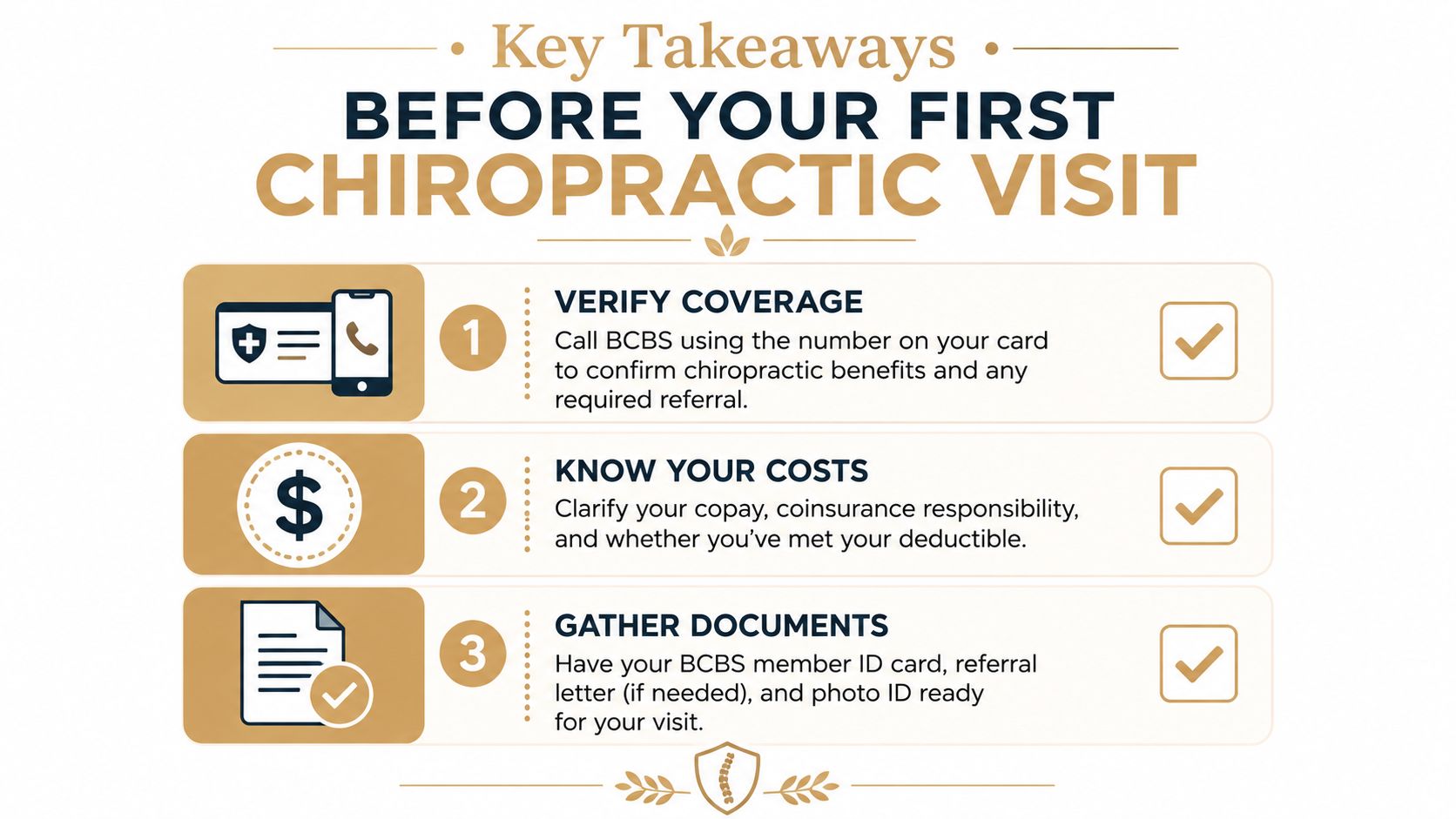
Settle three questions before you book:
Bring the documents that let the clinic verify your account without delay. You'll want your current BCBS member ID card, photo ID, any referral paperwork, and the relevant Summary of Benefits excerpt showing the chiropractic line item.
Coverage can run out while symptoms remain. Ask the clinic what happens before the final covered visit, rather than waiting for a denied claim.
Possible next steps may include:
If morning back discomfort is part of your routine, this guide to sleep solutions for back pain offers practical context about sleep-related factors to discuss alongside your clinical assessment. For local cost-conscious options, review the low-cost chiropractor information from Aspen Falls Wellness.
The best answer to “does Blue Cross Blue Shield cover chiropractic” is useful only as a starting point. The answer that protects your budget is the exact visit limit, network status, authorization rule, and patient responsibility recorded before care begins.
Aspen Falls Wellness helps Salt Lake City and Sandy patients verify BCBS benefits, clarify expected costs, and coordinate chiropractic care with services such as spinal decompression, rehabilitation exercise, massage, acupuncture, and mobility therapy. Visit Aspen Falls Wellness to start the verification process before your first appointment.

Stay updated with the latest chiropractic news and exclusive offers.