Discover an evidence-based rotator cuff injury recovery roadmap with phases, in-clinic therapies, timelines, and clear red flags to guide your healing journey.



You wake up, reach for a coffee mug, and your shoulder gives you that sharp, stubborn reminder that it's not going to cooperate today. Brushing your hair, pulling a shirt over your head, or sleeping on that side can suddenly feel like work. Rotator cuff injury recovery usually starts in exactly that messy middle, where pain, weakness, and uncertainty all show up at once.
The good news is that a shoulder problem doesn't always mean a long shutdown. The harder truth is that the right next step depends on whether you're dealing with irritation, a partial tear, or something that needs imaging and possibly surgery. A structured plan matters because recovery is usually measured in months, not days, and the early choices shape how well the tendon and surrounding muscles adapt.
You may notice it first in ordinary tasks. Combing your hair takes more effort than lifting a grocery bag, the shoulder feels weak, and pain settles in the front or side of the joint. Overhead movement then reveals the problem more clearly. That pattern can come from a strain, a tendon tear, or irritation around the joint, so the first question is not just how much it hurts, it is how much function has changed. AAOS OrthoInfo on rotator cuff tears describes weakness, night pain, and pain with lifting or lowering the arm as common tear symptoms.
An irritated shoulder usually still lets you work around the pain. A shoulder that keeps losing strength, will not tolerate sleep on that side, or suddenly refuses motion needs a closer look. If the weakness started after a fall, a jerking lift, or another clear injury, the threshold for evaluation should be lower.
Practical rule: pain that improves with rest is different from pain plus loss of power. When weakness is the main problem, rehab still matters, but exercise alone may not be enough.
Tears can also be painless at first, which makes them easy to miss. Some people keep training and keep using the arm, then realize the issue is larger when everyday tasks become clumsy or the shoulder no longer holds up under load. A clear decision framework matters because treatment depends on tear type, age, chronicity, and imaging findings, as noted in guidance from the NCBI Bookshelf.
Shoulder pain does not always come from the cuff itself. Neck referral, nerve irritation, and stiffness patterns can blur the picture, especially when symptoms spread down the arm or do not behave like a simple tissue flare. The location of pain, how it changes with movement, and whether strength drops help separate local shoulder injury from pain that starts elsewhere, as outlined in Aspen Falls Wellness shoulder pain resources.
For people who need documentation after a crash or injury, a separate care path can help, and therapy for ICBC claims in Kelowna is an example of how post-injury care often has to account for both pain and paperwork.
The best recovery plans start with the right label, not the most aggressive exercise.
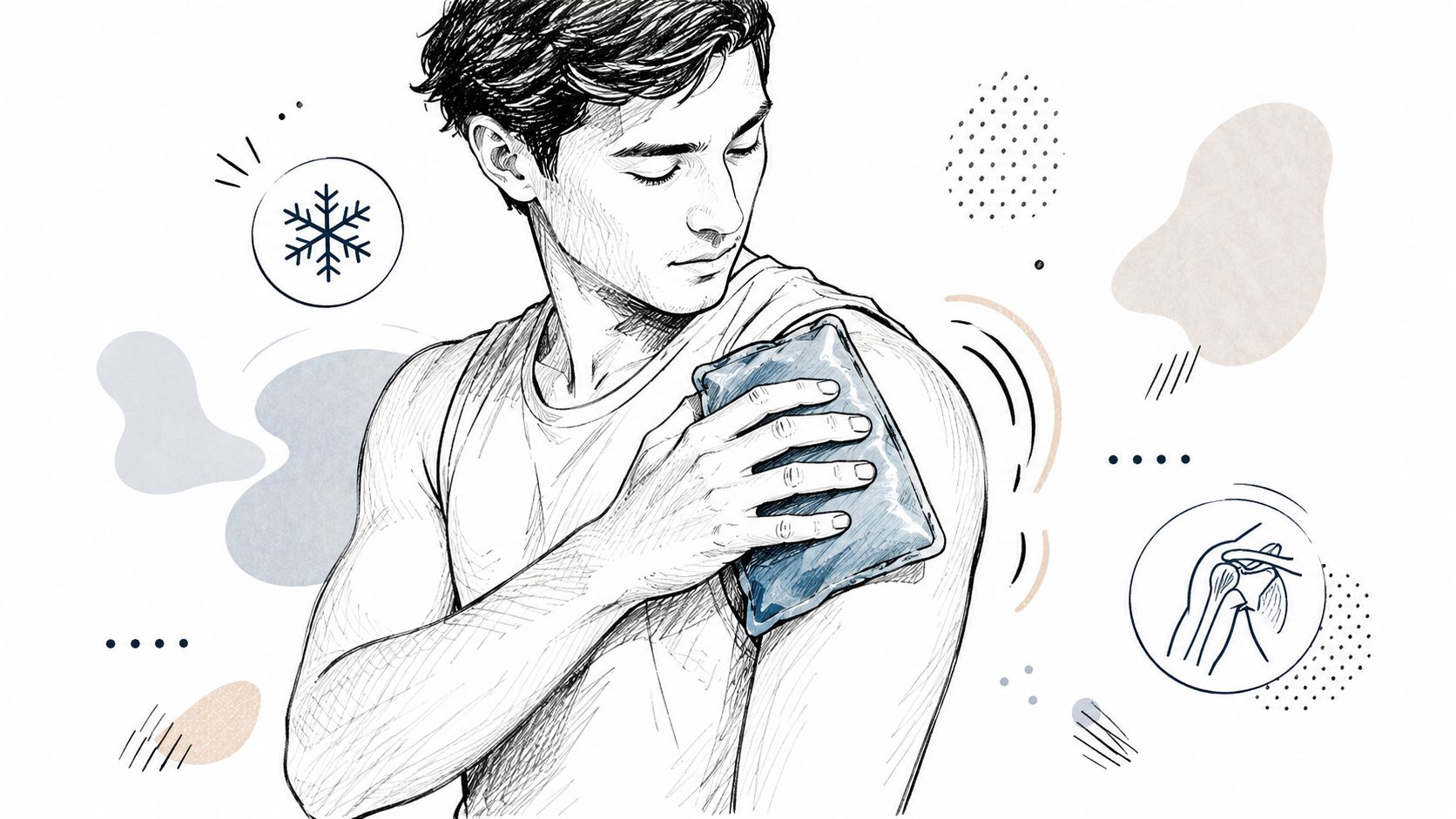
Pain control is not about doing as little as possible. It's about calming the tissue enough that the shoulder stops protecting itself with shrugging, guarding, and stiff movement patterns. For early loading, a review of orthopedic and sports medicine protocols emphasizes sub-painful isometrics first, then controlled external rotation and scapular retraction with 12 to 15 repetitions and 3-second holds to reduce irritation and avoid compensatory shrugging (PMC review).
The shoulder usually settles better when you stop feeding it high-irritation positions. Keep the elbow near your side or in the scapular plane, support the arm on a pillow when lying down, and avoid reaching overhead just to “test it.” Gentle, controlled movement is useful, but painful overhead motion tends to make a cranky cuff even more defensive.
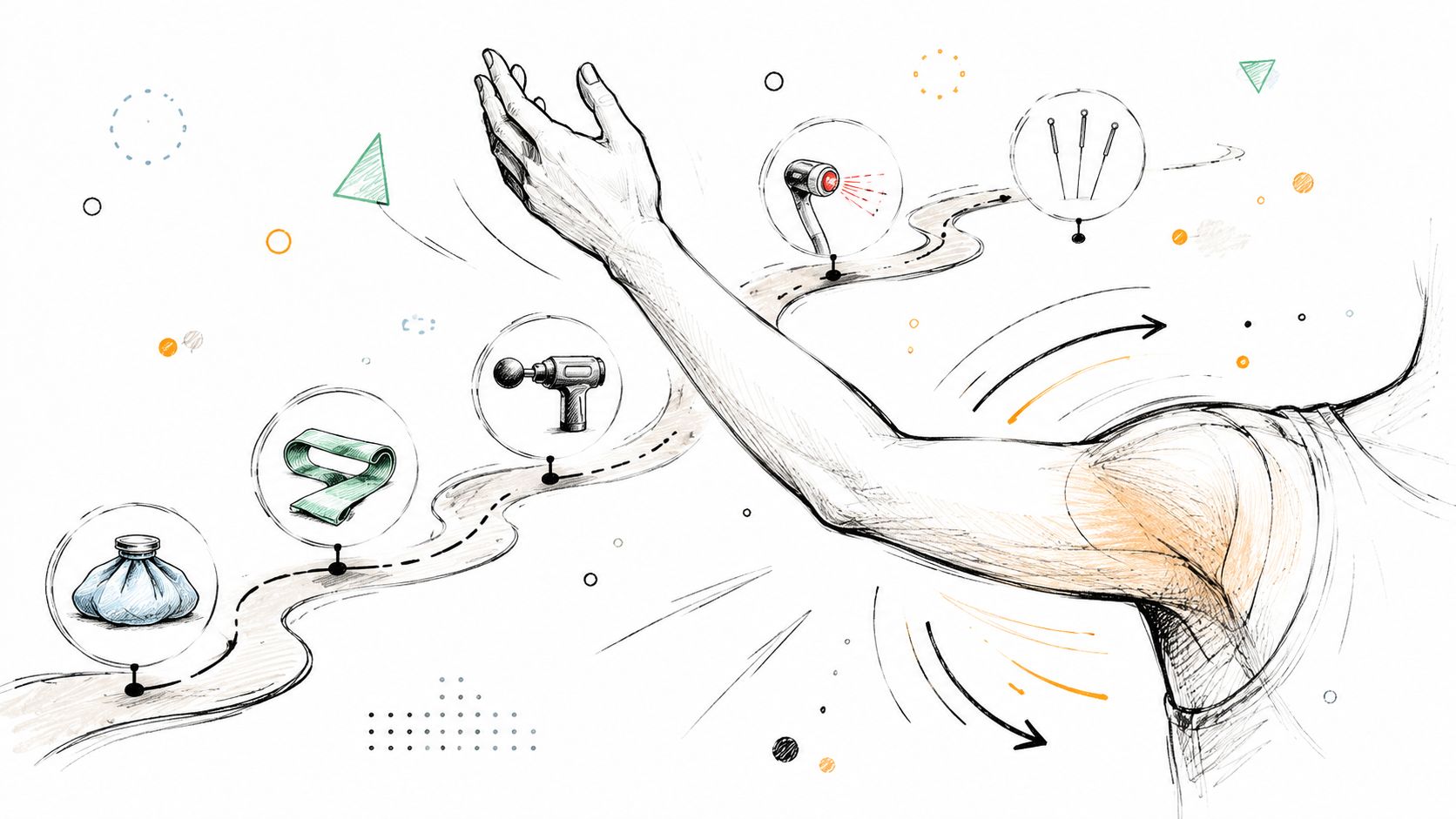
A few clinic-based options can fit into this phase if they're used conservatively. Chiropractic adjustment can be directed at the neck, upper back, or shoulder mechanics when motion is blocked by guarding, while massage therapy can help reduce protective tone in surrounding muscles. Muscle stimulation, MLS Laser Therapy, SoftWave Therapy, and acupuncture may also be used as adjuncts when the goal is less pain and better tolerance for exercise, not a quick fix.
Keep the load low enough that the shoulder feels worked, not provoked.
Sub-painful isometrics are the safest place to start because they let the rotator cuff contract without a big joint excursion. That's useful when the shoulder gets irritated by repeated reaching or by trying to “stretch through” a painful arc. If the arm starts hiking toward the ear, the exercise is too advanced for that day.
If you're taking medication and have questions about mixing over-the-counter pain relief with a prescription or antibiotic, review understanding azithromycin ibuprofen interactions before assuming everything is harmless to combine. Good pain relief supports movement, but it shouldn't mask the warning signs that tell you the shoulder needs reassessment.
Rehab works best when it's staged. A postoperative framework uses weeks 0 to 2 for immobilization, weeks 2 to 6 for passive ROM, weeks 4 to 6 for active-assistive ROM, weeks 6 to 12 for active ROM, weeks 12 to 20 for strengthening and endurance, and weeks 20 to 26 for higher-load strengthening (PMC framework). The key point is that progression is criterion-based, not just calendar-based.
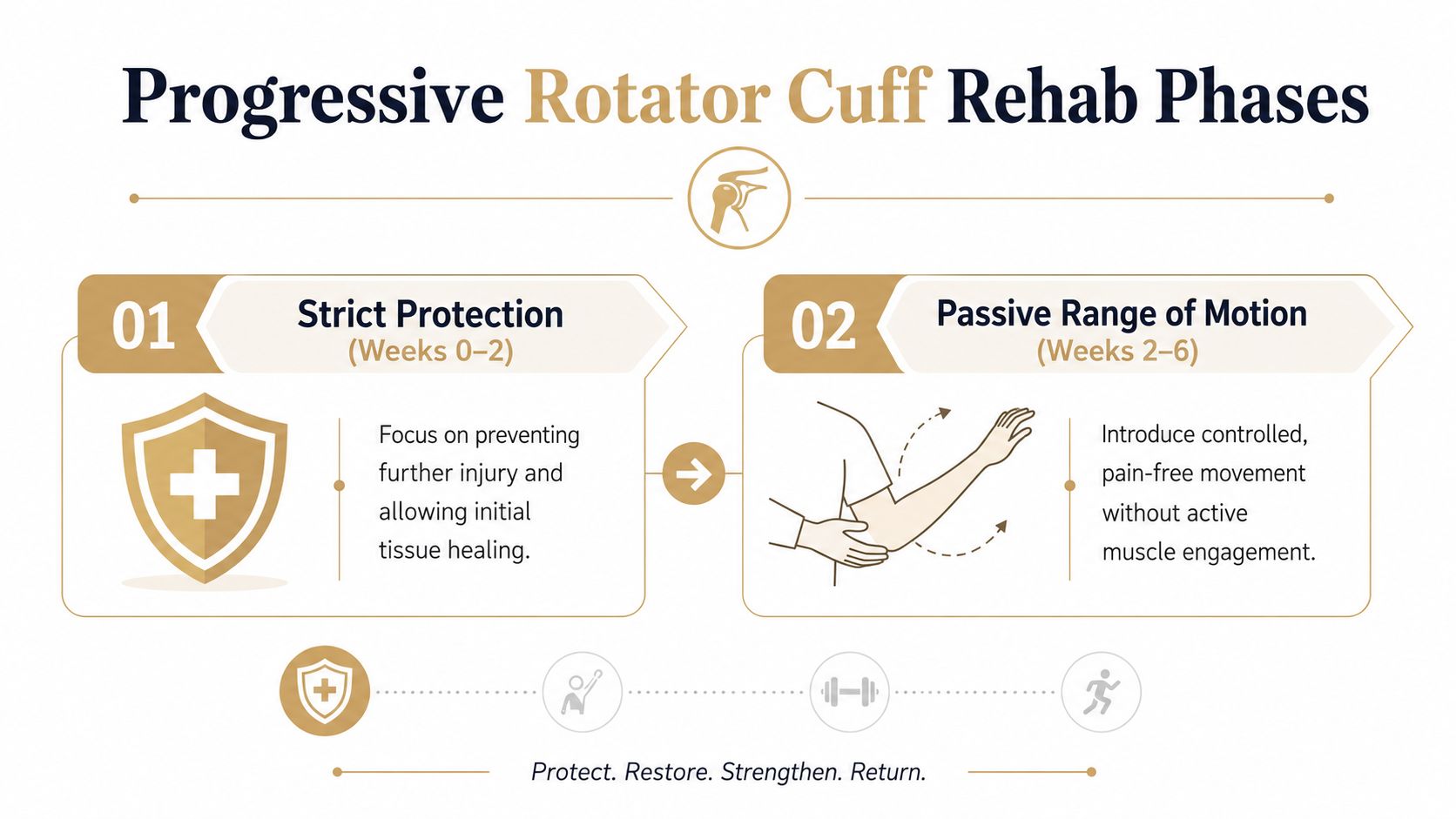
In the earliest phase, the job is to prevent more tearing, more inflammation, and more compensation. For a surgical repair, that means protecting the tissue with immobilization at first, then moving into passive range of motion only when the criteria line up. For nonoperative care, the same logic applies in a softer form, where the shoulder gets movement without being forced into pain.
A simple early drill is a pendulum swing with the torso supported and the arm relaxed. It should feel like a gentle joint wash, not a workout. If the shoulder tightens or the upper trap kicks in, reduce the range and slow the motion down.
The progression from assisted to active motion only makes sense when the shoulder can move without shrugging or sharp pain. The SICOT-J review describes early active ROM with less than 15% supraspinatus EMG activity, then later endurance work at 30 to 49%, and finally high-load strengthening at greater than 50% (SICOT-J review). That matters because “feels okay” isn't the same as “the tendon is ready.”
For exercise selection, a practical sequence usually looks like this.
A short internal reference can help patients pair these exercises with guided visits, and rehabilitation exercise guidance is a natural fit when home programming needs structure.
For people using braces, slings, bands, or other supports, understanding durable medical devices is useful because the right aid can protect the shoulder without making it lazy. The device should support the phase, not replace the work.
Rotator cuff rehab is rarely just one thing. A review in the American College of Sports Medicine literature describes nonoperative protocols as criteria-based, multimodal, and divided into acute, recovery, functional, and return-to-sport phases, which supports combining exercise with manual and device-based care (ACSM review). That approach is more realistic than trying to force one modality to do everything.
| Therapy | Mechanism | Benefit | Visit Frequency |
|---|---|---|---|
| SoftWave Therapy | Acoustic energy applied to irritated soft tissue | May support tissue stimulation and pain modulation | Often used in a short series, then reassessed |
| MLS Laser Therapy | Light-based energy directed at the painful region | Often used to reduce irritation and improve movement tolerance | Commonly paired with follow-up progress checks |
| Chiropractic adjustment | Gentle joint-based care for the neck, upper back, or shoulder complex | Can help restore motion when guarding is limiting mechanics | Usually scheduled around exercise milestones |
| DRX 9000 spinal decompression | Decompression-based care for spine-related loading issues | Useful when neck or thoracic mechanics are contributing to shoulder overload | Used when examination suggests a spine component |
| Acupuncture | Needle-based pain modulation | May help with pain control and relaxation of guarding muscles | Often used intermittently in symptomatic phases |
| Massage therapy | Soft-tissue work on surrounding muscle groups | Helps reduce protective tone and improve comfort before exercise | Best before or alongside rehab sessions |
The practical question isn't which service sounds impressive. It's which one lowers pain enough to let the shoulder move correctly and which one is helping only for an hour or two. If the shoulder gets looser but strength and control don't improve, the session plan needs to shift back toward exercise.
At Aspen Falls Wellness, MLS Laser Therapy is one of the in-house options that can be paired with a rehabilitation plan when inflammation and movement intolerance are getting in the way of progress. laser therapy for inflammation gives a broader look at how that type of modality is commonly used in an integrated care setting.
Recovery is easier to follow when it has checkpoints. In a PubMed-indexed study, clinical recovery after rotator cuff repair reached about 60% of ultimate recovery at 3 months and about 75% at 6 months, which shows why the shoulder can feel much better before it's done healing (PubMed study). That curve is why a one-and-done visit plan usually falls apart.
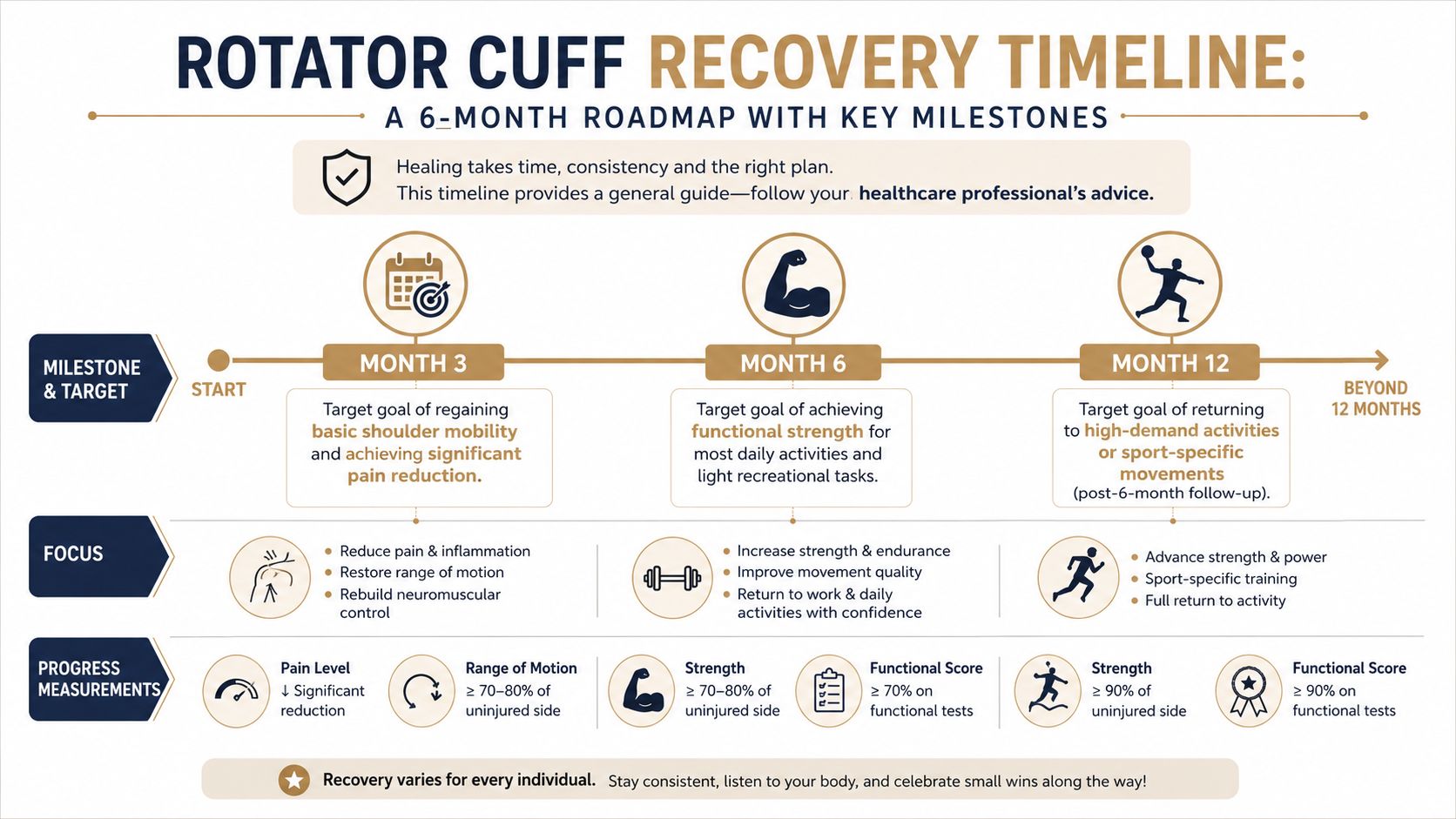
A useful rhythm is front-loaded care with less frequent reassessment as symptoms calm down. Early visits often focus on pain control, protecting mechanics, and making sure the home program isn't irritating the joint. As motion returns, the schedule can taper while the exercise load rises.
A follow-up cadence should match the phase, not the calendar. In the early stage, visits may be closer together because the plan changes quickly. Later, progress checks can be spaced out once the patient can self-manage exercise without flaring symptoms.
The clearest sign is not just less pain, it's better use. If the shoulder moves more cleanly, sleeps better, and tolerates home exercise without a rebound flare the next day, the program is on the right track. If those things improve but only after every appointment and then fall apart at home, the exercise dose or movement quality needs adjustment.
The same logic applies to in-office modalities. They should support the rehab cycle, not sit beside it as unrelated add-ons. A good timeline makes it obvious when care should intensify, when it should taper, and when the plan should be rechecked.
Going back too soon is where a lot of good progress gets lost. The shoulder should not just hurt less, it should move better, load better, and stay quiet after the workout is over. Return decisions are strongest when they're based on function, not ego.
A practical return screen starts with motion quality. Forward flexion should be smooth, rotation should be clean, and the shoulder shouldn't shrug to fake strength it doesn't really have yet. Pain-free isometric holds at different angles are useful because they expose whether the cuff can stabilize without triggering compensation.
That's especially important for overhead work, lifting, and golf-like rotational loads. A patient may be able to lift the arm, but still fail when the arm is held farther from the body or asked to decelerate under speed. Those are different demands, and the shoulder has to pass both.
Return to activity should look boring before it looks impressive.
A useful self-check is whether daily motion feels normal after repeated use, not just during one good rep. If the shoulder stays centered during reaching, resists hiking during external rotation, and doesn't flare that night, the workload is probably close to acceptable. If the next morning brings back sharp pain or guarding, the load was too much.
For golfers, lifters, and overhead workers, the safer return usually comes from gradual volume first, then speed, then full force. The order matters because tissue can tolerate a task once and still fail when that same task is repeated under fatigue. Clean mechanics are the gatekeeper, not enthusiasm.
There is a point where more rehab is not the right answer yet. The decision to image or refer should come from the story, the exam, and how the shoulder responds after a fair trial of care. Tear pattern, age, symptom duration, and imaging findings all shape the next step, and small or medium tears often improve with nonoperative therapy, while traumatic tears with muscle involvement or little atrophy deserve earlier surgical review.
A good clinic decision starts with the question, “Is this shoulder following the expected recovery pattern?” If the answer is no, the plan should change rather than repeat the same exercises and hope for a better result.
A conservative path is still reasonable for many patients, especially when the tear is smaller and function is returning. The trade-off is time. If the tissue pattern is one that heals poorly or needs repair to preserve strength, waiting too long can cost the patient a better window for recovery.
The clearest clinic conversation stays practical. If symptoms are improving on schedule, keep building. If the shoulder is stalling, getting weaker, or showing a traumatic pattern with poor mechanics, get the image, clarify the tear, and decide whether a surgical opinion belongs in the plan. That approach keeps rehab honest and avoids sending a patient through months of treatment that no longer matches the injury.

Stay updated with the latest chiropractic news and exclusive offers.