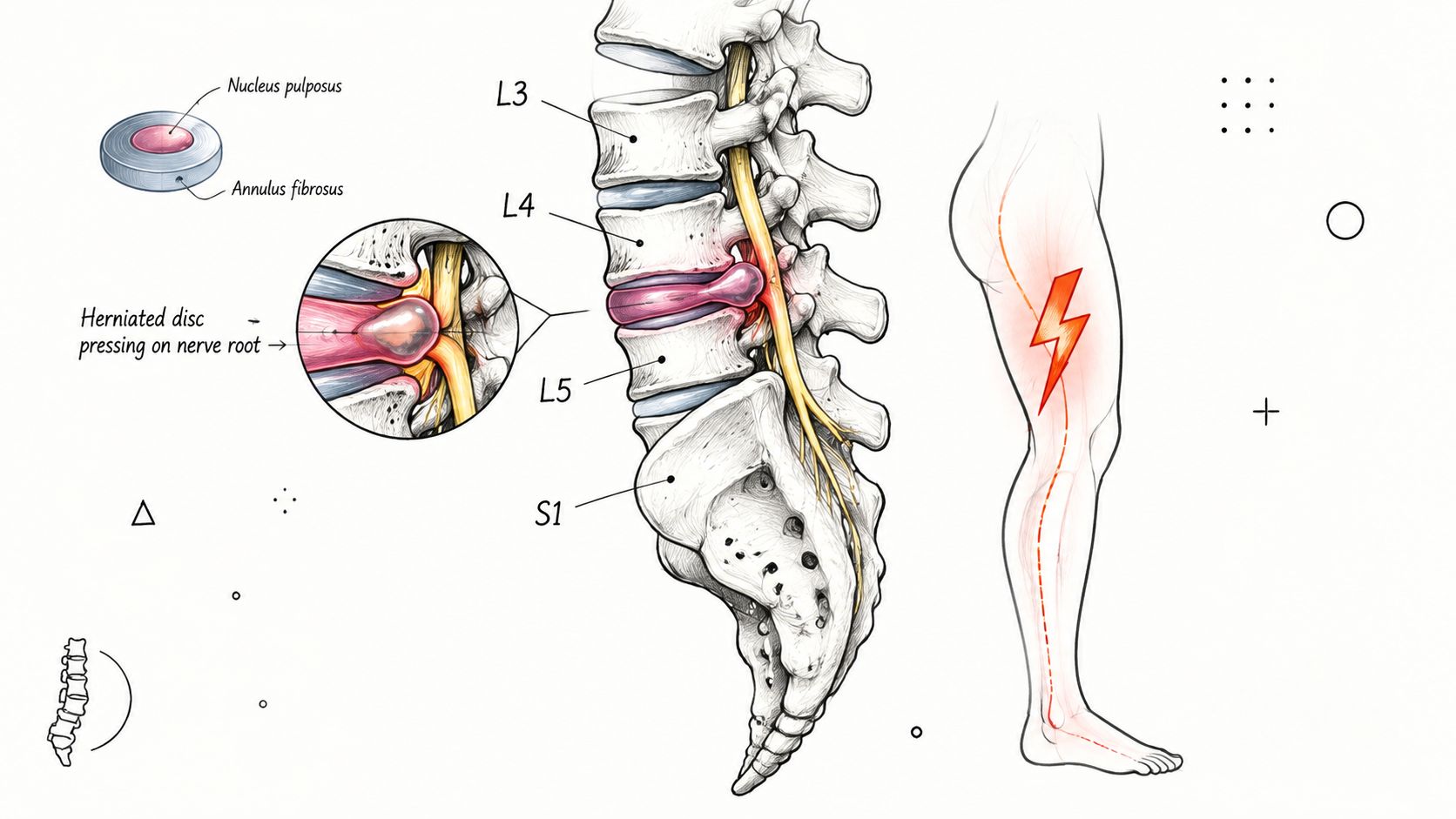
Does insurance cover spinal decompression? Learn how payers classify it, what documentation helps, and how to verify and appeal coverage before treatment.
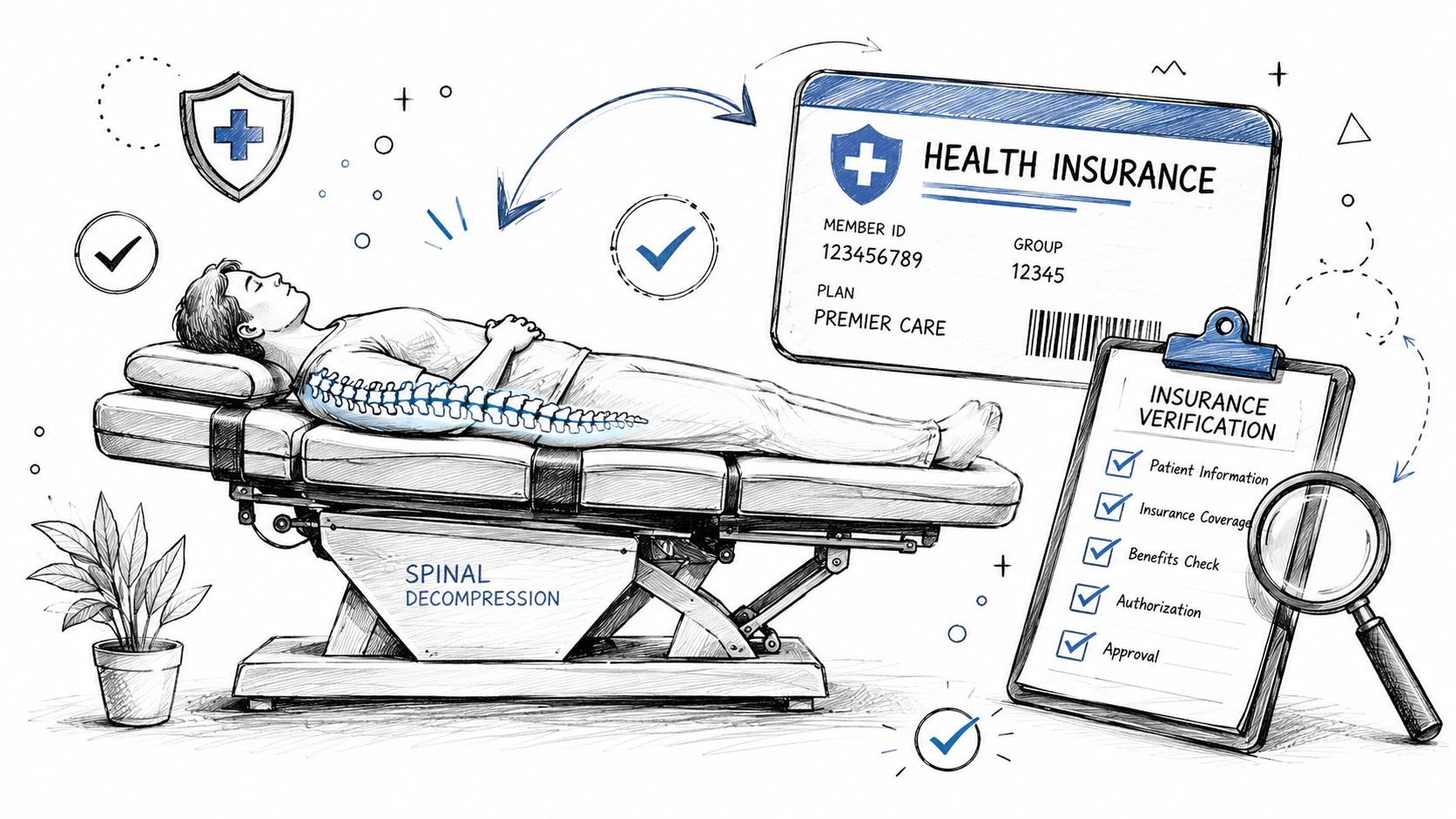



Most insurers classify non-surgical spinal decompression as investigational and therefore not routinely covered, so coverage hinges on your diagnosis, billing code, and plan type. Medicare covers the surgical subtype PILD only inside a CMS-approved clinical study under Coverage with Evidence Development, based on its January 9, 2014 national decision.
You may be sitting in a clinic waiting room with back pain, a treatment recommendation, and a price you weren't expecting to pay yourself. The frustrating part is that “does insurance cover spinal decompression” has no useful one-word answer. Your plan may cover chiropractic adjustment but exclude the motorized table. It may recognize traction under one code and reject the same visit under another. A preauthorization may confirm that the request was reviewed without promising that the claim will ultimately be paid.
The practical answer is simple: verify the exact device, code, diagnosis, network status, and written plan language before starting care. Don't rely on a receptionist's estimate, a general chiropractic copay, or a verbal statement that “decompression is covered.”
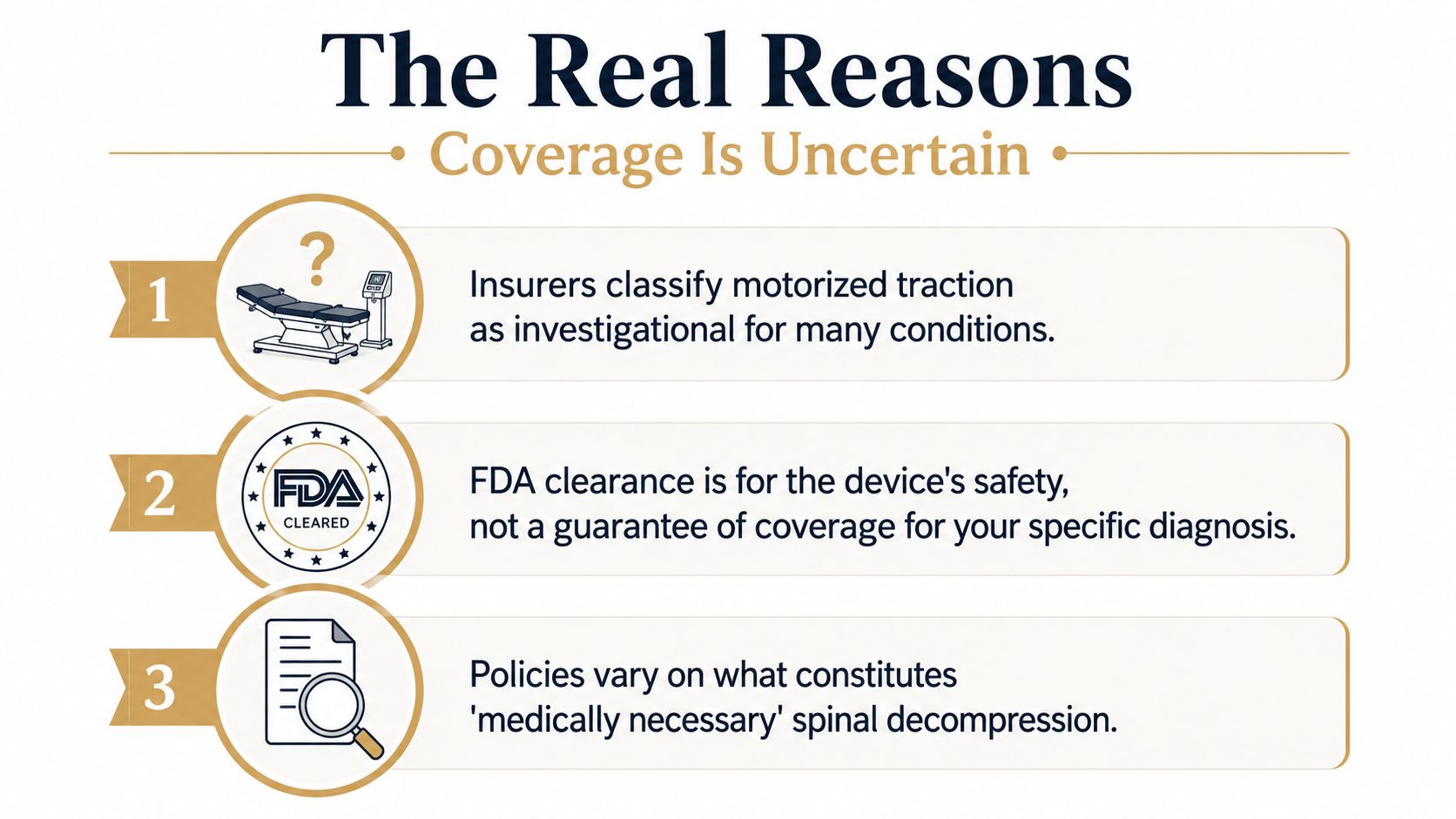
You may be in the waiting room with back pain, a treatment recommendation, and a cost estimate that assumes you will pay yourself. Before you schedule, identify what the insurer is being asked to cover. The decision depends on the device, billing code, diagnosis, provider, benefit category, and plan language, not just on the word “decompression.”
Many payer policies classify mechanized spinal distraction or vertebral axial decompression as investigational or not medically necessary. Policy language addressing mechanized spinal distraction identifies modalities such as VAX-D, DRS, and Accu-Spina IDD as investigational for low back pain and other conditions, as shown in the policy language on mechanized spinal distraction.
Regulatory clearance for a table does not determine reimbursement. Device clearance addresses the device category and its regulatory pathway. Your health plan applies its contract, exclusions, medical-necessity rules, and coding policies to the claim. The insurance contract controls payment.
A chiropractic copay does not automatically include a motorized decompression session, mechanical traction, laser therapy, muscle stimulation, or another advanced modality. Medicare's chiropractic coverage explanation illustrates the distinction. Part B covers manual spinal manipulation for correcting vertebral subluxation, while mechanical traction is not included under that chiropractic benefit.
Ask for the device name, CPT or HCPCS codes, ICD-10 diagnosis codes, clinic network status, modality network status, authorization requirements, and estimated patient responsibility. Get the answers in writing before treatment. Preauthorization confirms that the request was reviewed, but it does not guarantee payment if the policy contains a broad exclusion.
The word “decompression” creates confusion because it describes two very different categories of care. Non-surgical spinal decompression is an in-office, table-assisted therapy often described as motorized traction or vertebral axial decompression. A DRX 9000 is one example of the equipment used for this approach. Sessions commonly last 20 to 40 minutes and may be recommended over 15 to 35 sessions, depending on the provider's evaluation and plan of care.
Surgical decompression is different. A neurosurgeon or orthopedic spine surgeon may perform a discectomy, laminectomy, foraminotomy, or spinal fusion in a hospital or ambulatory surgery center. Insurers generally process those services through surgical benefits, with established procedure codes and medical-necessity pathways. This article focuses on the non-surgical category, where patients most often encounter coverage exclusions and coding disputes.
| Feature | Non-Surgical, such as DRX9000 | Surgical |
|---|---|---|
| Setting | Chiropractic, physical therapy, or medical office | Hospital or ambulatory surgery center |
| Method | Table-assisted motorized traction or vertebral axial decompression | Removal of disc, bone, ligament, or other structures compressing nerves |
| Typical provider | Chiropractor, physical therapist, or pain-management physician | Neurosurgeon or orthopedic spine surgeon |
| Insurance benefit line | Therapy, chiropractic, traction, or equipment-related benefits | Surgical and hospital benefits |
| Coverage pattern | Often excluded as investigational or not medically necessary | Often payable when strict medical-necessity criteria are met |
| Patient risk | Non-surgical, but still requires proper clinical screening | Invasive, with procedure-specific risks and recovery |
The insurer doesn't decide based on the shared word “decompression.” It decides based on what was performed, how it was coded, where it occurred, and which benefit applies. A plan can cover spinal surgery while excluding a motorized table-based service.
If you're evaluating non-surgical care for a disc-related condition, review the provider's explanation of spinal decompression services and then compare that description with your plan's exclusions. Ask whether the proposed service is being billed as traction, decompression, or an unclassified procedure. Those labels can produce different claim outcomes.
Coverage patterns vary by payer, but the administrative direction is consistent. Non-surgical spinal decompression is commonly treated as investigational, unproven, or not medically necessary, especially when the treatment uses mechanized distraction. Aetna states that it lacks adequate scientific evidence showing vertebral axial decompression is an effective adjunct to conservative therapy for back pain in its medical policy on vertebral axial decompression.
Medicare separates the non-surgical table-based service from the surgical PILD procedure. Medicare's PILD coverage standard dates to January 9, 2014, and coverage applies only when PILD is performed inside a CMS-approved clinical study under Coverage with Evidence Development. That narrow rule shouldn't be confused with routine coverage for office-based motorized traction.
For a Medicare patient, the regional Medicare Administrative Contractor, supplemental coverage, diagnosis, setting, and submitted code all matter. A supplement generally doesn't pay for a service that original Medicare excludes.
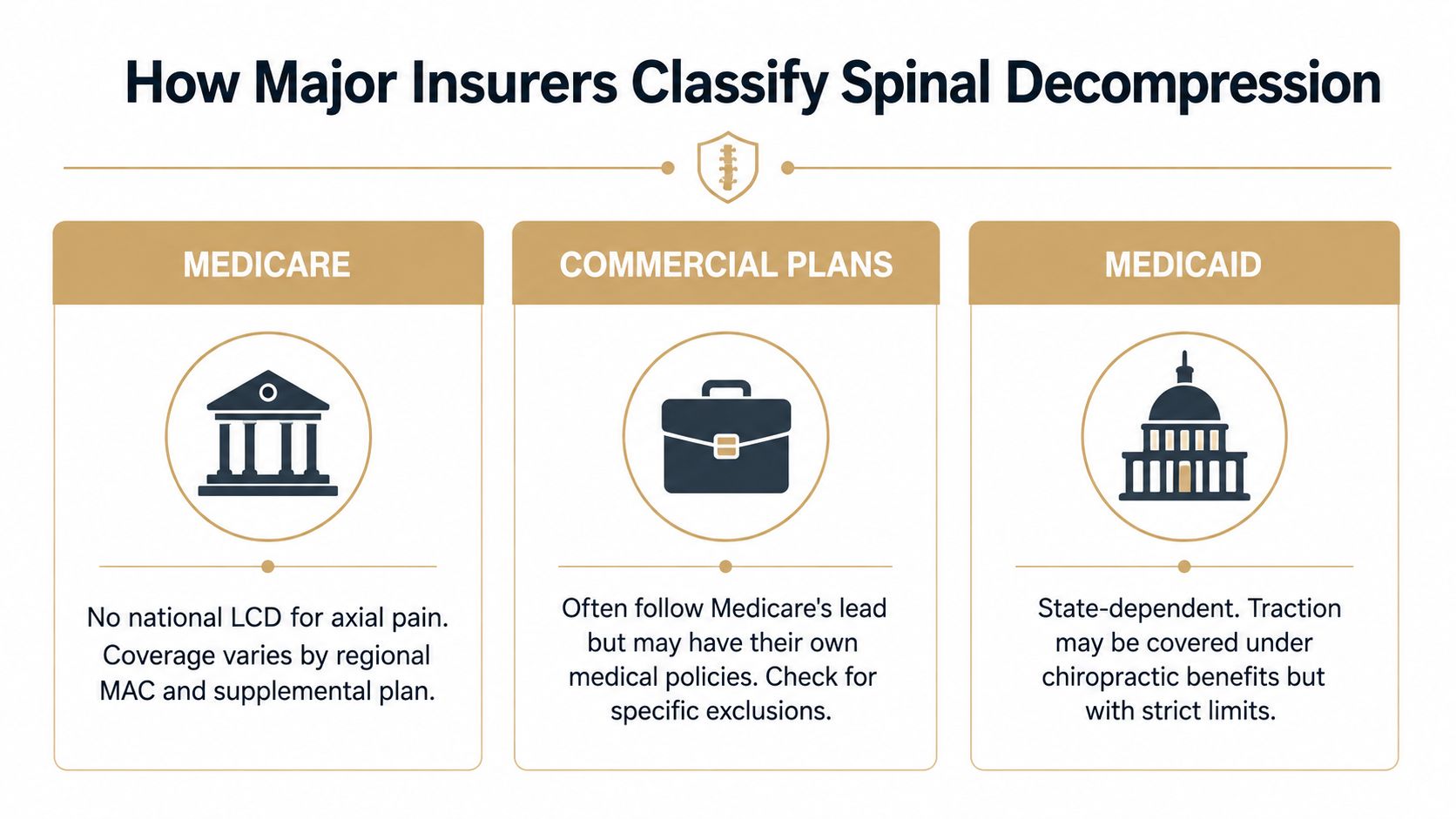
Commercial PPO, HMO, and EPO plans often publish policies that classify non-surgical decompression as investigational or not medically necessary. HMO and EPO products may add tighter referral and authorization requirements. A PPO can offer broader provider access while still excluding the modality itself.
A policy exclusion is the key issue. If the contract excludes mechanized spinal distraction, prior authorization usually won't convert the service into a covered benefit. The plan may review the request, issue an authorization number, and still apply an exclusion during final claims processing.
Medicaid rules depend on the state program and benefit category. A state plan may treat manual traction differently from motorized decompression. Self-funded ERISA plans can exclude the service through their governing plan document even when a similar fully insured product has a different rule.
Workers' compensation and auto PIP claims require separate handling. The injury documentation, applicable fee schedule, claim administrator, and medical review process can determine whether treatment is considered related and payable. Never assume that an auto claim follows your regular health insurance rules.
The code on the claim often decides how the payer sees the treatment. Non-surgical decompression has no widely accepted dedicated CPT code, so billing may map the service to CPT 97012 for mechanical traction or HCPCS S9090 for vertebral axial decompression. Some carriers may require an unlisted-service process or manual review.
That creates a mismatch between clinical language and insurance language. A provider may describe a DRX 9000 protocol as spinal decompression, while the payer's system reads 97012 as mechanical traction. Another payer may treat S9090 as a notification code rather than a promise of reimbursement. Coding guidance on mechanical traction and spinal decompression explains why code selection and payer interpretation frequently diverge.
| Code | Description | Typical payer treatment | Documentation trigger |
|---|---|---|---|
| 97012 | Mechanical traction | May be processed as a therapy modality, limited, bundled, or denied | Treatment time, body region, supervising provider, diagnosis, and medical necessity |
| S9090 | Vertebral axial decompression | May function as a notification code or face an exclusion | Device used, treatment plan, diagnosis, and payer-specific acceptance |
| Unlisted code | Service without a clear standard code | Often sent for manual review or rejected for incomplete information | Detailed procedure description, comparable service, records, and fee |
Diagnosis coding must support the clinical reason for care. A symptom code may not provide the same review context as a documented disc disorder, radiculopathy, or stenosis. That doesn't mean a more specific code guarantees payment. It means the diagnosis should accurately match the examination, imaging, and treatment plan.
Ask the billing office which ICD-10 codes appear on the superbill, whether the provider is billing 97012, S9090, or another pathway, and whether chiropractic manipulation will be bundled with the modality. A clean claim isn't the same as a covered claim, but a mismatched code makes denial more likely.
The verification call should happen before your first decompression session, not after the claim arrives. Start with the member-services number on your insurance card and ask the representative to review the exact service, not just your general chiropractic benefit.
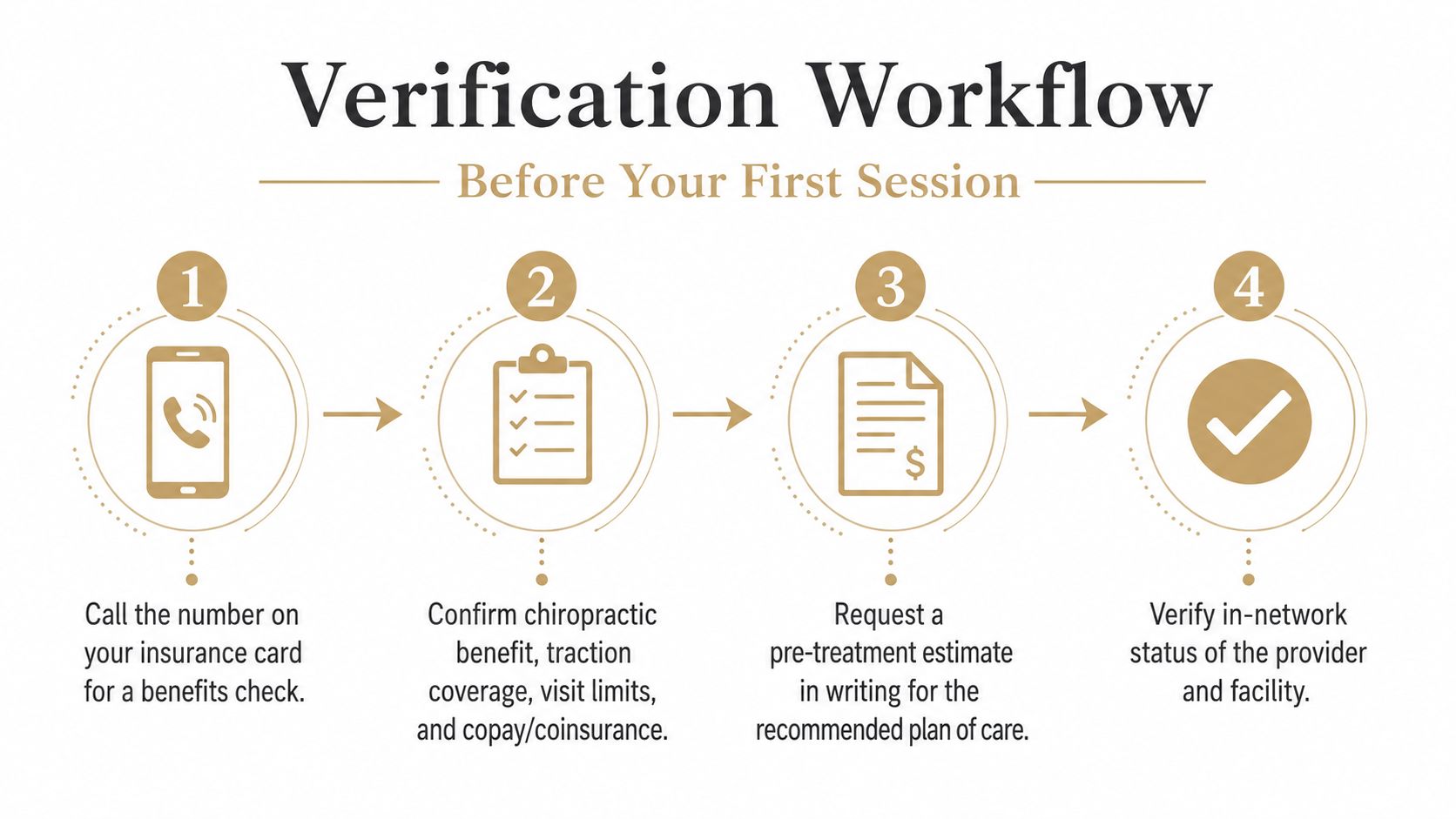
Write down the representative's name, the call date, the reference number, the authorization number if one exists, and whether a clinical reviewer made the determination. Ask this direct question: “If the claim is submitted under this code for this diagnosis, is the service excluded, covered subject to medical necessity, or pending review?”
A preauthorization can address medical necessity without overriding an exclusion. It also may apply only to a defined number of visits, a particular location, or a specific treatment period. Ask whether retroactive authorization is allowed. In many cases, starting treatment before approval leaves the patient responsible if the plan won't backdate the decision.
The payer may require an in-person evaluation, imaging, records of prior conservative treatment, or a peer-to-peer discussion between the treating clinician and reviewing physician. A documented history of chiropractic care, physical therapy, home exercise, medication trials, or other appropriate conservative measures can give the reviewer context, but it cannot defeat a categorical exclusion.
If your symptoms followed a collision, keep the health-plan process separate from the accident claim. The car accident injury treatment process may involve different documentation and claim rules.
A first denial isn't always the final answer, but an appeal must respond to the actual denial reason. If the explanation of benefits says “investigational,” argue with policy language and clinical evidence. If it says “not medically necessary,” provide the missing clinical record. If it says “duplicate therapy,” explain why the requested modality isn't duplicative of the other services being delivered.
Useful documentation can include:
The appeal should tell a coherent story. Start with the diagnosis and functional problem. State what conservative care has already been attempted, identify the objective findings, explain why the requested service is clinically distinct, and finish with the requested number of visits, monitoring plan, and reassessment criteria.
Appeal strategy: Don't ask the insurer to reconsider a vague “decompression package.” Ask it to review the exact code, diagnosis, treatment frequency, records, and medical-necessity rationale.
Internal appeal, external review, and independent medical review are separate routes. The available route and filing deadline depend on the plan, including whether it's employer-sponsored, Medicare Advantage, or an ACA marketplace product. Read the denial notice immediately. It should identify the appeal level, deadline, submission method, and records used in the decision.
Request a peer-to-peer review when the plan offers one. The treating clinician should speak directly to the reviewing physician and address the denial language point by point. If the plan excludes the modality, an appeal may confirm the exclusion rather than reverse it. That answer still matters because it prevents you from spending more time on an unlikely reimbursement path.
When the plan excludes non-surgical decompression, don't automatically choose between paying for a full program and giving up on care. Compare the proposed treatment with covered conservative options and ask what clinical question each option is meant to answer.
| Option | Typical coverage | Estimated cost | Approval requirements |
|---|---|---|---|
| Physical therapy | Often handled under rehabilitation benefits | Depends on plan and patient cost sharing | Referral, visit limits, or authorization may apply |
| Chiropractic manipulation | May be covered under a defined chiropractic benefit | Depends on copay, deductible, or coinsurance | Covered diagnosis, provider network, and benefit limits |
| Acupuncture | Covered by some plans and excluded by others | Plan-specific or self-pay | Verify benefit, diagnosis rules, and provider eligibility |
| Home exercise program | Usually no separate treatment claim | Often included in clinical care or performed independently | Provider instructions and participation |
| Non-surgical decompression | Frequently excluded or treated as investigational | Clinic-specific self-pay pricing | Written estimate, code review, and exclusion check |
| Workers' compensation or auto PIP care | May apply when the injury and treatment are accepted | Controlled by claim rules and fee schedules | Claim documentation, relatedness, and administrator approval |
Ask the clinic for the complete self-pay structure. Some offices charge per session, while others offer a bundled block of visits or a maintenance plan. The total commitment depends on the treatment frequency, reassessments, associated services, and whether the plan changes after an early clinical review.
You may also ask whether itemized receipts can support HSA or FSA reimbursement. Financing may be available through a healthcare financing program or an in-house arrangement, but read the repayment terms carefully. Don't accept a “no interest” offer without confirming the promotional period, deferred-interest rules, minimum payments, and balance due if the account isn't paid as required.
For lower-cost care, compare low-cost chiropractic options, physical therapy, chiropractic adjustment, acupuncture, massage therapy, mobility therapy, rehabilitation exercise, and a personal exercise plan. SoftWave Therapy, MLS Laser Therapy, muscle stimulation, and pain-relief services may also be discussed during a clinical evaluation, but each service has its own coverage and medical-necessity rules.
Salt Lake City and Sandy patients should treat this as a documentation project, not a guessing game. Bring your recent MRI or imaging reports to the consultation, along with a list of symptoms, prior treatments, medications, and functional limitations. The clinician needs enough information to decide whether spinal decompression with the DRX 9000 is appropriate and what diagnosis accurately supports the request.
Use this five-step workflow:
Utah fully insured plans may have a 30-day appeal window, so check the denial notice rather than assuming you have more time. If the insurer doesn't resolve the issue, contact the Utah Insurance Department's consumer assistance line for escalation guidance. Self-funded ERISA plans may follow a different process, so ask the plan administrator which rules govern your appeal.
Aspen Falls Wellness provides chiropractic care, adjustment and realignment services, DRX 9000 spinal decompression, sciatica treatment, massage therapy, acupuncture, SoftWave Therapy, MLS Laser Therapy, nutrition counseling, mobility therapy, rehabilitation exercise, and personal exercise plans. The clinic's care team can help you separate the clinical decision from the reimbursement decision, which is exactly what you need before committing to treatment.
Visit Aspen Falls Wellness to schedule an evaluation in Salt Lake City or Sandy and bring your imaging and insurance information for a focused benefits review. Ask the team to verify the proposed code, diagnosis, authorization requirements, and self-pay documentation before your first DRX 9000 session.

Stay updated with the latest chiropractic news and exclusive offers.