Can sciatica cause lower back pain? Learn how nerve-root irritation produces back and leg symptoms, what sets sciatica apart, and when to seek care in 2026.
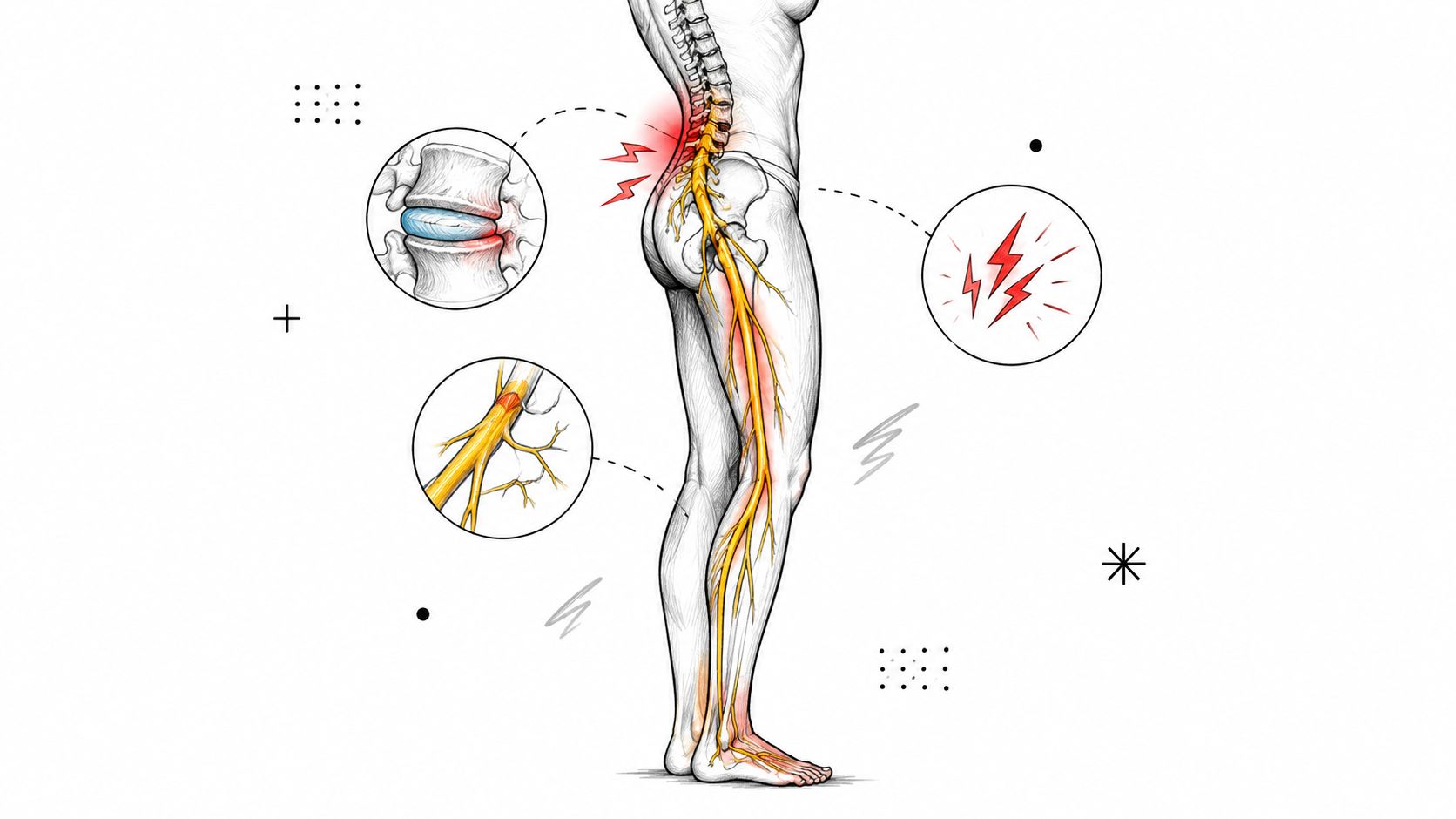
Yes, sciatica can cause lower-back pain, but its defining feature is pain radiating into the buttock and leg, not back pain alone. Estimated lifetime incidence ranges from 13% to 40%, but that doesn't mean every painful back involves the sciatic nerve.
If your lower back hurts, how can you tell whether a nerve is involved rather than a muscle or joint? The useful clues are where symptoms travel, how they feel, and whether strength or sensation changes, not how intense the back pain becomes.
Back pain and sciatica overlap, but they aren't interchangeable. Someone can have substantial lumbar discomfort without nerve-root involvement. Someone else can have troublesome nerve-related leg symptoms while their back feels only mildly sore.
The lifetime estimate above comes from clinical literature describing sciatica's frequency and presentation. Its broad range reflects differences in the populations studied and how researchers define sciatica. It isn't a way to calculate your personal risk or diagnose your current symptoms.
A useful starting question is whether discomfort stays around your waist or follows a recognizable route into your buttock and leg. Next, consider whether you've noticed altered sensation or difficulty using the leg normally. Those details give a clinician more useful information than the label “bad back.”
For example, consider these hypothetical descriptions:
These aren't diagnoses. They illustrate why the same complaint, lower-back pain, can lead to different examinations and care decisions.
Practical rule: Describe the full symptom route, including numbness or weakness, rather than naming only the place that hurts most.
The distinction also prevents a common misunderstanding: a more painful back doesn't automatically mean more nerve compression. Pain severity deserves attention, but it can't establish which structure is responsible.
The most useful outcome isn't a self-diagnosis. It's a clearer symptom map, an understanding of warning signs, and enough context to discuss conservative care without assuming that surgery or an immediate scan must come first.
The sciatic nerve is the body's longest nerve. It forms from lumbar and sacral nerve roots that leave the lower spine and join into a large nerve pathway through the buttock and down the leg.
Think of a tree. The spine is the trunk, the exiting nerve roots are branches, and the sciatic nerve is a long limb extending away from them. A problem near a branch's origin can affect signals farther along the limb.
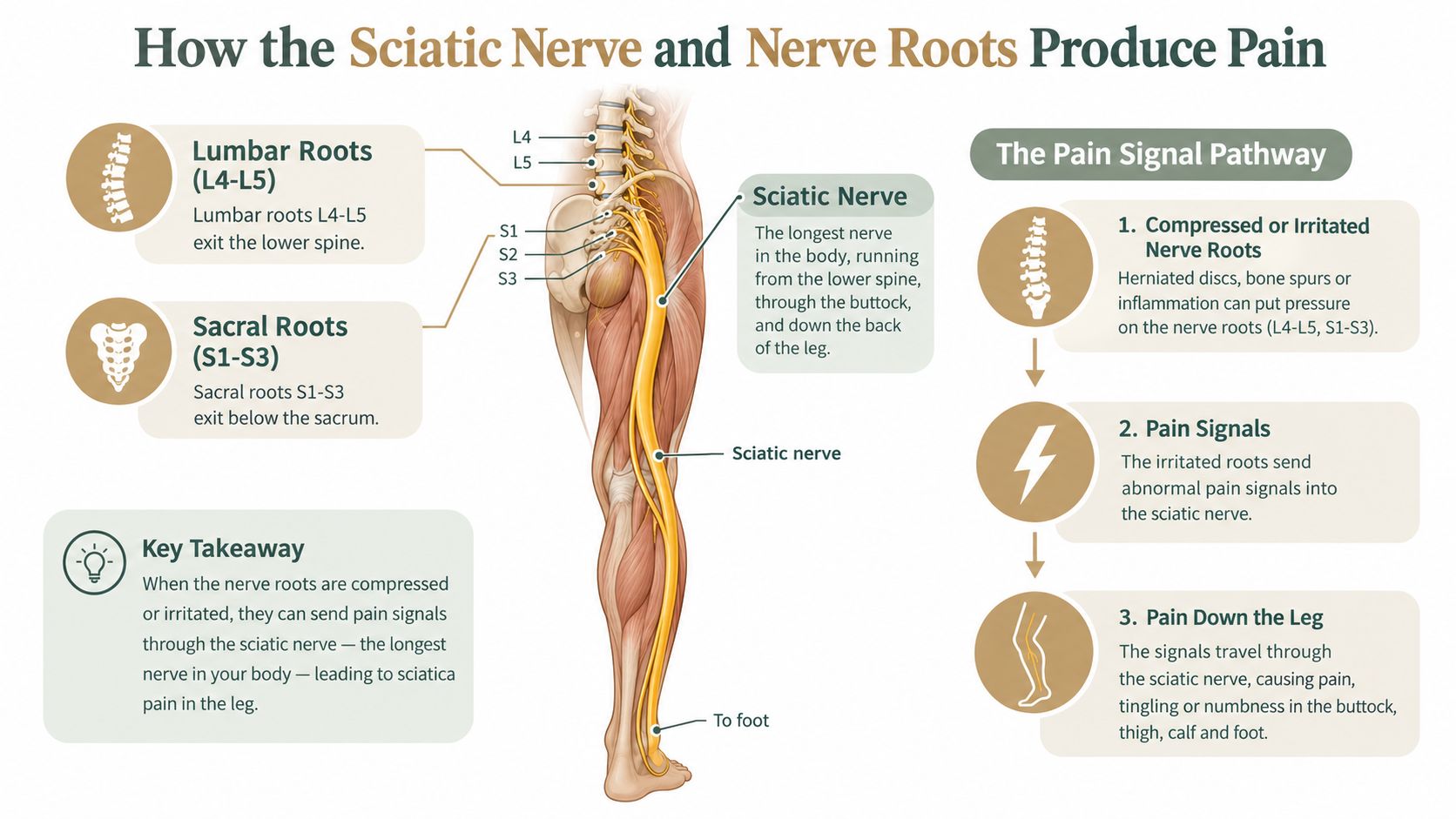
Sciatica generally results from irritation or compression of lumbosacral nerve roots, most often from a herniated lumbar disc. Bone overgrowth and narrowing around those roots can also contribute, as described in the British Journal of Anaesthesia review of sciatic neuralgia.
The location matters more than the everyday phrase “pinched sciatic nerve” suggests. Often, the problem begins near the spine, before the roots have joined into the larger nerve.
These are different structural situations, not interchangeable explanations for every episode of pain.
Nerve-root irritation involves more than physical pressure alone. Inflammation and sensitivity around the root can contribute to symptoms, while nearby back muscles may tighten protectively. That muscle guarding can add lumbar discomfort to the pain traveling into the leg.
An analogy is holding your shoulder tense around an irritated area. The protective response may become uncomfortable itself, even though it isn't the original problem.
The tree analogy has limits: nerves aren't passive wooden branches, and pain doesn't behave like a simple pressure gauge. It helps explain why symptoms can appear far from their origin, but it can't identify the cause in an individual person.
A hypothetical person stands after prolonged sitting and feels a sharp streak from the buttock down the back of the leg. Another notices tingling in the foot alongside a lower-back ache. Those descriptions are more suggestive of nerve involvement than “my back feels tight,” although neither establishes a diagnosis.
Leg pain is often more prominent than back pain in sciatica. It may travel below the knee and reach the foot or toes. The pattern and accompanying changes matter more than any single descriptive word.
Prepare a symptom description using these categories:
These are recognized features of sciatica in the clinical descriptions discussed earlier. Triggers are clues, not proof: sitting discomfort alone doesn't establish nerve-root compression.
Distinguish pain-limited movement from possible weakness. “I avoid lifting my foot because it hurts” and “I'm trying to lift my foot, but it won't move normally” describe different concerns. A clinician needs to examine either complaint rather than relying on that distinction at home.
Ordinary mechanical back pain may feel like a dull or movement-related ache centered around the lumbar area. It can also refer discomfort into the leg without true nerve-root involvement. That overlap is why a rigid rule such as “any leg pain means sciatica” is unreliable.
A more useful contrast is a localized ache without neurological changes versus a traveling pain pattern accompanied by altered sensation or weakness. Even that comparison is a guide to assessment, not a diagnostic checklist.
Record what happens during activities you already perform. Don't repeatedly provoke sharp symptoms to test yourself, and don't force a stretch because someone else found it helpful. Your symptom map should help explain your experience, not become another source of irritation.
“Back and leg pain” describes a location, not a cause. Muscles, joints, and nerve roots can produce overlapping complaints, so a clinician has to sort out which findings belong together.
Spinal stenosis deserves special clarification: it isn't always an alternative to sciatica. It can be the underlying condition producing nerve-related leg symptoms. Comparing a cause with a symptom label can otherwise create unnecessary confusion.
| Condition | Pain Pattern | Neurological Signs | Common Triggers |
|---|---|---|---|
| Radicular sciatica | Traveling buttock and leg pain, sometimes reaching the foot | Tingling, numbness, or weakness may occur | Sitting, bending, twisting, coughing, or sneezing |
| Nonspecific mechanical low-back pain | Mostly lumbar discomfort, sometimes with referred leg pain | Not typically a nerve-root pattern | Movement or sustained positions |
| Lumbar spinal stenosis | Back and leg symptoms with reduced walking tolerance | May occur if nerve roots are affected | Standing and walking can be important clues |
| Sacroiliac joint-related pain | Lower-back or buttock-centered discomfort | Neurological findings suggest looking beyond the joint alone | Activity and position changes need assessment |
| Facet-joint-related pain | More localized lumbar discomfort or referred pain | Not inherently a nerve-root problem | Lumbar movements and positions need assessment |
| Referred muscular pain | Back or buttock discomfort that may spread | True weakness or sensory loss needs separate evaluation | Muscle loading or movement may be relevant |
This is an orientation table, not a self-diagnostic tool. Individual presentations vary, and more than one contributor may be present.
Localized pain without leg radiation is less typical of sciatica and may instead reflect mechanical, facet-joint, sacroiliac, or muscular causes. Those distinctions are part of the clinical assessment framework used for radicular leg pain.
A treatment chosen for the phrase “back pain” may miss the actual problem. The examination should explain why that treatment fits your pattern.
Age, work demands, exercise habits, and recent injuries provide context, but none can confirm the diagnosis alone. A desk worker and a golfer can describe similar pain while having different functional limitations.
The practical consequence is simple: don't assume that everyone with back and leg discomfort needs the same stretch, adjustment, or device. Treatment selection should follow the working diagnosis and examination findings.
A useful visit starts with your story: when symptoms began, where they travel, what has changed, and how they affect daily life. The clinician also asks about injuries, health history, and warning signs that might change the urgency of care.
Diagnosis is primarily clinical. The examination connects your symptom description with observable findings rather than treating a scan as the final answer.
NHS Lothian's radicular leg pain guidance recommends mapping pain and assessing strength, sensation, reflexes, gait, and straight-leg raising. It also notes that disc abnormalities are common in adults without symptoms, which limits the usefulness of routine imaging.
Bring concrete examples: difficulty sitting through work, altered walking tolerance, or trouble moving the foot. Those details help establish a baseline for later reassessment.
Routine imaging isn't recommended in non-specialist settings. An abnormal disc image doesn't automatically explain pain, and an incidental finding can create concern without changing the initial treatment plan.
MRI or specialist referral becomes more relevant when symptoms persist, neurological deficits progress, or serious pathology is suspected. The key question is whether the result could change management, not whether a scan might reveal an abnormality.
For a patient-facing discussion of imaging choices, see MRI versus X-ray for back pain.
A reasonable question to ask is: “What decision would this scan help us make?” A clinician should be able to explain that decision and the safety plan if imaging isn't needed immediately.
Exercise and function should anchor the plan. NICE guidance on low-back pain and sciatica management supports self-management, appropriate activity, and exercise. It recommends manual therapy only within a broader program that includes exercise.
That doesn't mean every person should start with the same routine. A program needs to account for neurological findings, symptom behavior, current activity tolerance, and meaningful goals.
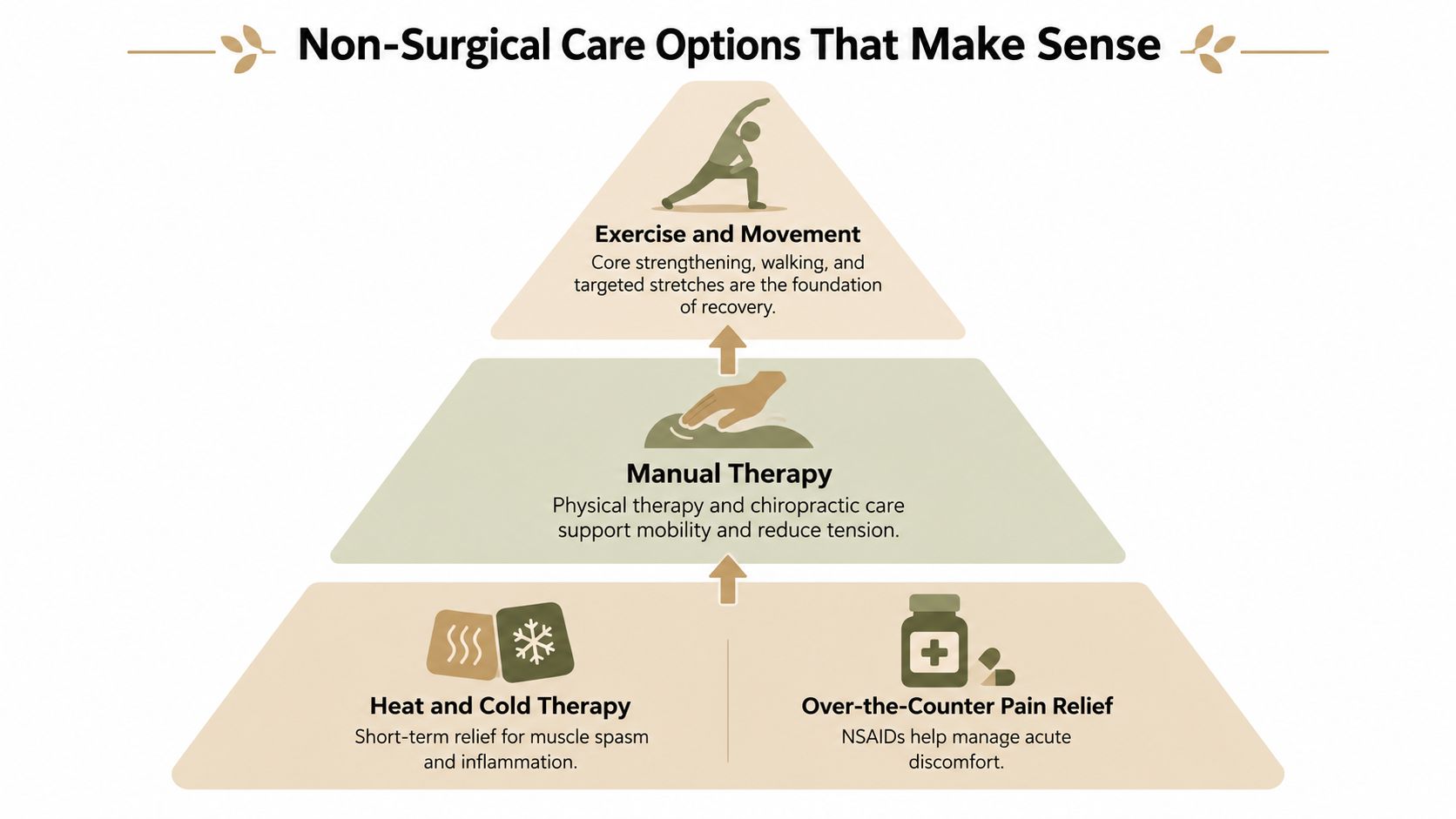
Integrative care can include several tools, but availability isn't a reason to use them all.
| Care option | Purpose to discuss |
|---|---|
| Rehabilitation Exercise, Mobility Therapy, and Personal Exercise Plans | Building activity tolerance and restoring useful movement |
| Chiropractic Adjustment and Massage Therapy | Manual support within an active rehabilitation program |
| Spinal Decompression with the DRX 9000 | Whether non-surgical decompression is appropriate for an assessed disc-related condition |
| Acupuncture | Complementary pain modulation, with response monitored |
| SoftWave Therapy, MLS Laser Therapy, and Muscle Stimulation | The proposed symptom-support role, evidence, and criteria for continuing |
A chiropractic adjustment isn't proof that a nerve has been released. Likewise, “realignment” shouldn't be interpreted as a guarantee that a structural cause has been corrected. Ask what the clinician found and how the proposed intervention addresses it.
For DRX9000 spinal decompression, clarify candidacy, contraindications, alternatives, and the expected functional goal. The research discussed below doesn't establish a device-specific outcome or guarantee.
A coordinated plan might first establish tolerable movement and a home program, then add a selected treatment if symptoms prevent participation. The team should reassess whether that addition helps you move, sleep, or complete daily tasks.
Pain Relief is a worthwhile goal, but it shouldn't replace rehabilitation. Nutrition and Nutrition Counseling may support broader health goals; Golf Movement Screening can address activity-specific demands, while Car Accident Treatment begins with assessment of the injury context. None should substitute for neurological evaluation when it's needed.
Compare these roles in the practice's overview of sciatica treatment options. Before starting a service, ask what improvement would justify continuing it and what would prompt a change or referral.
A more elaborate treatment room doesn't automatically mean a better plan. The useful question is whether the intervention has evidence relevant to your condition and whether you're improving in ways that matter.
Research must also be interpreted within its population. Findings about lumbar spinal stenosis can inform care for that condition, but they don't prove that every person with sciatica needs the same exercises.
A systematic review of exercise for lumbar spinal stenosis included 13 trials, 1,440 participants, and 23 exercise interventions. Stretching, trunk strengthening, general fitness, and cycling were common components of successful programs, but variation among studies limits any claim that one routine is universally effective.
A separate review of exercise for lumbar disc herniation included 611 participants and reported better pain, disability, movement, sensory-related, and quality-of-life outcomes in exercise groups. The authors described the findings as preliminary.
A systematic review of acupuncture for sciatica included 12 studies with 1,842 participants and reported favorable treatment-response and pain findings. A later meta-analysis also reported improvements, but pooled results don't guarantee individual benefit or demonstrate correction of a structural cause.
Those findings support a careful discussion of acupuncture as a complementary option, not a promise.
Measure useful change: Can you walk farther, sit more comfortably, sleep better, or resume a valued activity without declining strength?
The cited exercise and acupuncture studies don't establish outcomes for DRX9000 decompression, SoftWave, or MLS Laser Therapy. Their inclusion in a plan needs its own rationale.
Clinical literature distinguishing sciatica from other leg pain also reinforces why symptoms, disability, and neurological findings deserve attention beyond pain intensity. More severe pain alone doesn't tell you how much compression exists, and an image alone doesn't define recovery.
Some symptoms override a routine conservative-care plan. New bladder or bowel dysfunction, saddle-area numbness, or rapidly worsening weakness can indicate a serious neurological problem and require immediate emergency assessment.
Don't wait for a scheduled chiropractic, massage, acupuncture, or decompression appointment when those changes occur.
Guidance on assessment of serious causes of back pain and sciatica identifies warning signs that need urgent clinical attention.
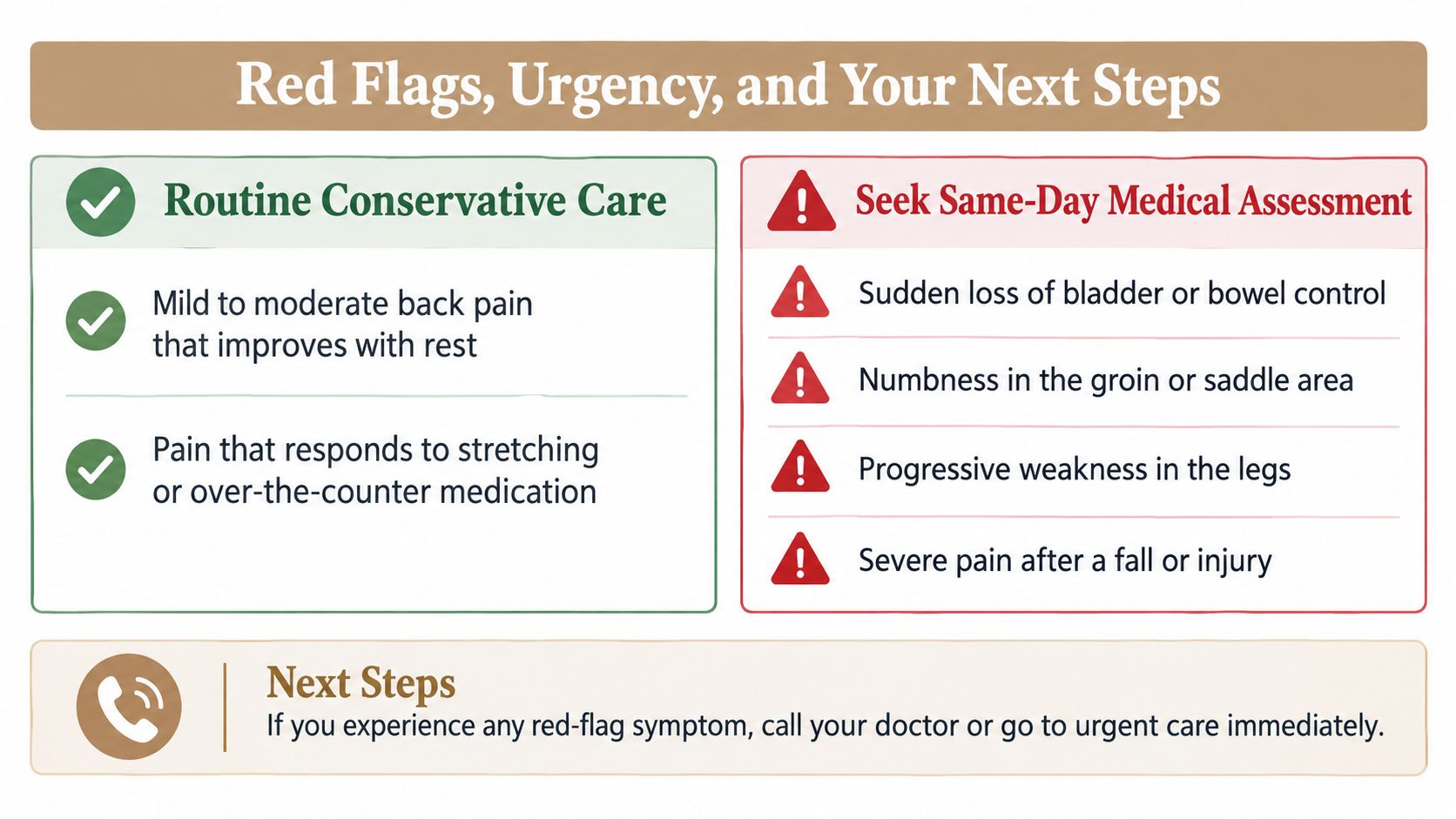
Pain relief from rest, stretching, or medication doesn't rule out a serious cause if warning signs are present. The practice's low-back pain red flags guide provides additional patient-facing context.
Can sciatica happen with little back pain?
Yes. Leg symptoms can dominate, so mild lumbar discomfort doesn't exclude nerve involvement.
Does lower-back pain alone mean sciatica?
No. Local pain without a characteristic leg pattern doesn't establish that diagnosis.
Should I keep moving?
Maintain activity as tolerated when there are no urgent warning signs. Get guidance if movement causes worsening symptoms or your function declines.
What if recovery stalls?
Request reassessment of the diagnosis, neurological findings, and treatment response rather than adding more passive services.
For uncomplicated symptoms, conservative care is often appropriate. Arrange evaluation when symptoms persist or recur, bring your symptom map, and agree on functional goals and a clear escalation plan. This information supports that conversation; it doesn't replace an individual examination.
For lower-back pain with possible sciatica, Aspen Falls Wellness offers individualized chiropractic care, rehabilitation exercise, mobility therapy, acupuncture, and non-surgical spinal decompression with the DRX9000 in Salt Lake City and Sandy. Visit the practice to request an evaluation and discuss which options fit your symptom pattern, neurological findings, and daily activity goals.

Stay updated with the latest chiropractic news and exclusive offers.