A practical athlete injury recovery roadmap covering phased rehab, return-to-play criteria, red flags, nutrition, and prevention strategies.
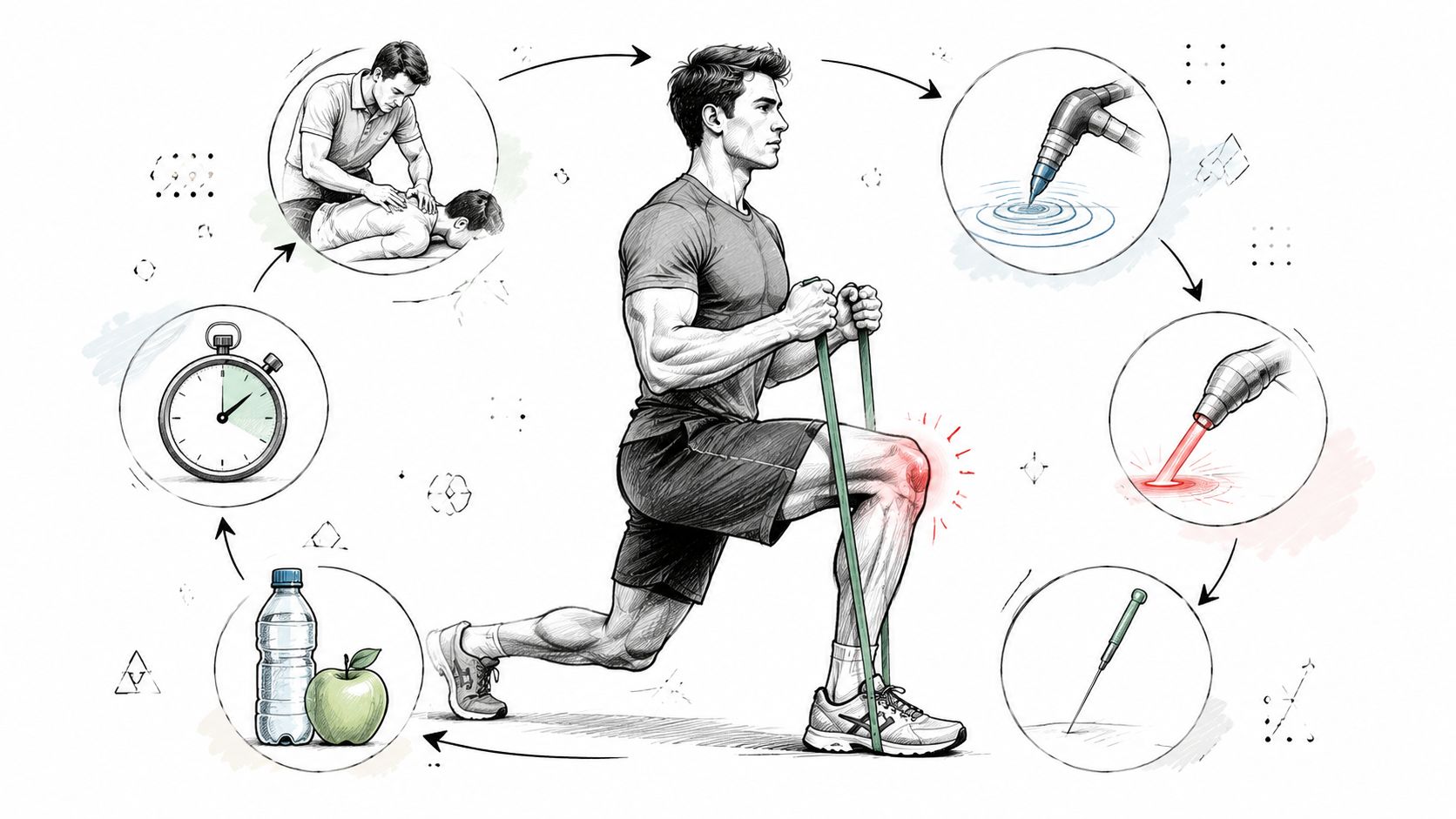



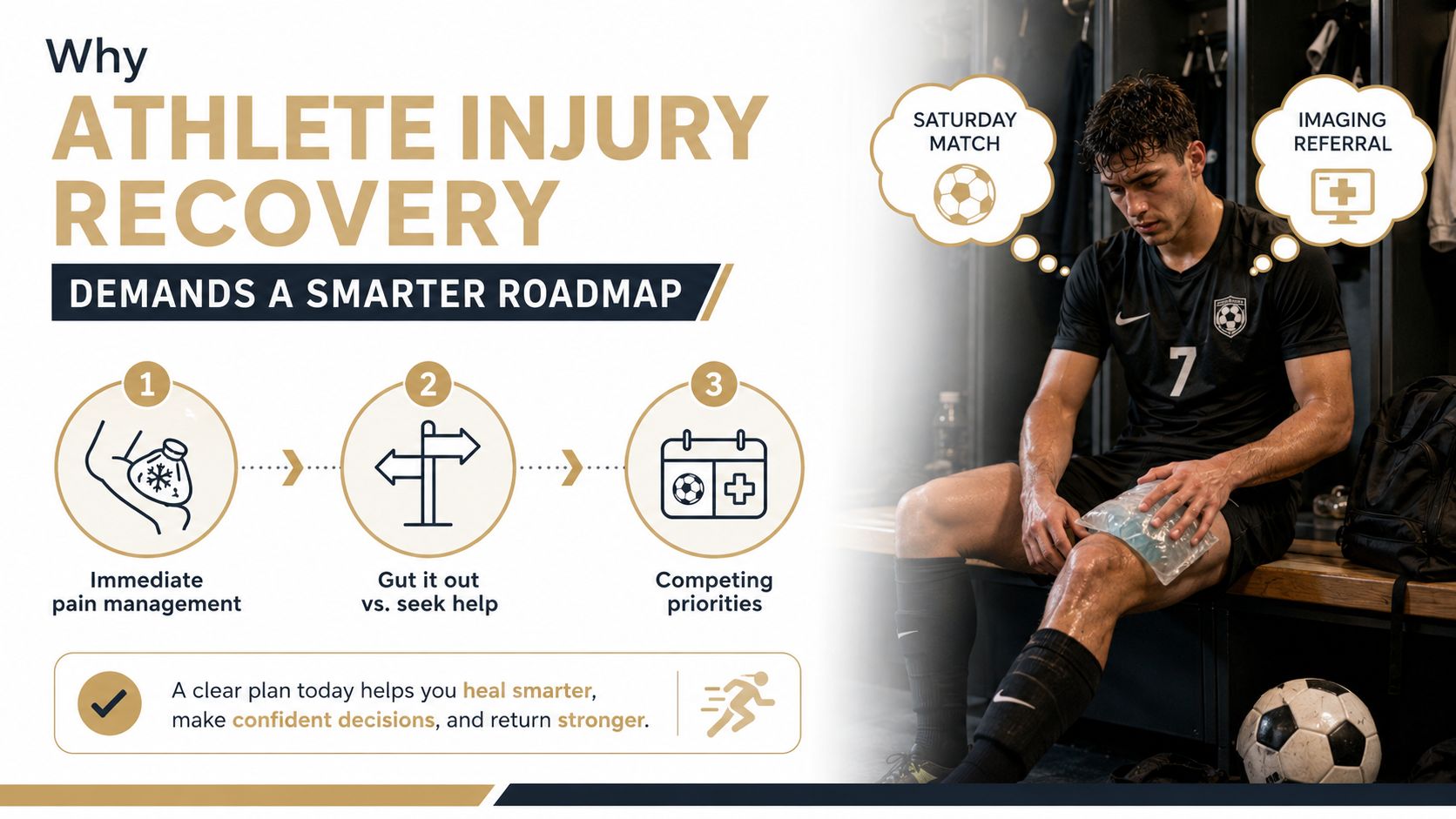
The ice pack has been on your hamstring long enough to numb the skin, but the primary discomfort is the decision in front of you. Saturday's match is approaching, teammates expect you at training, and you're weighing whether to test the leg or finally arrange an examination and imaging referral. That tension defines athlete injury recovery. The hardest decision often comes before the first exercise, when short-term availability competes with a safer return.
Recovery isn't a stopwatch. It's a clearance process that combines tissue healing, pain behavior, mobility, strength, conditioning, movement quality, sport demands, and confidence. Modern sports medicine separates return to participation, return to sport, and return to performance, rather than treating practice attendance as proof that an athlete is competition-ready (Bern consensus statement).
Modern sports medicine frames athlete injury recovery as a multi-domain clearance process. Tissue healing, movement quality, strength, conditioning, sport-specific skill, and confidence must align before competition returns. An athlete may be available for practice while still lacking the capacity to repeat high-speed efforts, absorb contact, or perform late in a match.
Anterior cruciate ligament rehabilitation shows why a single clearance label is inadequate. A 2016 consensus statement reported that about half of athletes returned to competitive sport after primary ACL reconstruction, while about 65% returned to their preinjury sport. Around 60% of non-professional athletes returned after non-operative treatment (ACL rehabilitation consensus statement).
A nationwide 2024 study sharpened that distinction. 62% returned to participation, 50% returned to sport, and only 17% returned to preinjury performance at a mean of 2.3 years after reconstruction. Attendance at training, completion of a controlled session, and competition readiness are different milestones.
Clinical rule: Passing one test doesn't prove that your whole athletic system is ready.
A stronger roadmap combines objective benchmarks with sport-specific exposure. Clinicians assess limb strength symmetry, hop performance, range of motion, acceleration, deceleration, cutting, and repeated-effort tolerance. Psychological readiness also matters. A player who can physically cut but avoids loading the planted leg may shift stress to another joint or tissue.
Recovery windows have become more complicated in elite sport. A recent professional soccer meta-analysis reported that 92.3% returned to play and 80.1% regained pre-injury performance, but mean return time was 263.2 days. It also reported slower return in 2022–2025, at 295.1 days, compared with 203.5 days in 2011–2016, without a corresponding reduction in graft re-rupture rates (professional soccer injury recovery meta-analysis).
Longer rehabilitation may reflect better separation of biological healing from repeatable performance. The practical question is whether the athlete can tolerate the demands of the position, recover from them, and reproduce them without changing movement quality. Conservative clinical care and sport-specific conditioning must progress together.
The first few days should protect the injury without turning the athlete into a statue. Traditional PRICE advice, protection, rest, ice, compression, and elevation, can help manage early symptoms, but complete rest usually loses value as the athlete moves beyond the initial flare. Contemporary PEACE and LOVE thinking places greater emphasis on protection and education early, followed by gradual loading, vascular activity, and exercise as tolerance allows.
During the first 72 hours, reduce the activity that provokes symptoms, use compression or elevation when swelling is present, and keep movement gentle. Pain shouldn't be the only guide, but a sharp increase during exercise or a clear worsening afterward means the current dose is too high.
Early range-of-motion work can prevent unnecessary stiffness. Isometric contractions, such as pain-tolerated quadriceps or hamstring contractions, maintain recruitment without demanding full movement. Training the uninjured side can also preserve some neuromuscular drive, provided the session doesn't increase overall fatigue or encourage compensation.
Medication decisions deserve individual attention. NSAIDs may help an athlete manage acute pain, but their effect on inflammation can be a trade-off when the inflammatory response contributes to tissue repair. A clinician or pharmacist should guide their use, especially when an athlete has medical conditions or takes other medication. Topical analgesics can provide local symptom relief without solving the underlying strength, mobility, or loading problem.
A sports-medicine chiropractor doesn't examine only the painful spot. The visit should consider adjacent joints, gait, swelling, range of motion, neurological signs, strength, movement strategy, recent training load, footwear, playing surface, and the exact mechanism of injury.
Two early mistakes show up repeatedly:
The goal isn't to eliminate every sensation before moving. The goal is to choose a load that gives the injured area a useful stimulus without provoking a setback.
A hamstring strain, lateral ankle sprain, and lumbar disc irritation may all limit sport, but they don't respond to the same progression. The hamstring needs carefully dosed lengthened loading and sprint mechanics. The ankle needs repeated balance and perturbation exposure. Disc-related symptoms require attention to directional preference, nerve sensitivity, and compressive tolerance.
| Injury | Weeks 1–2 Focus | Weeks 3–4 Focus | Weeks 5–6 Focus |
|---|---|---|---|
| Hamstring strain | Pain-tolerated walking, range of motion, isometrics, trunk and pelvic control | Progressive lengthened-state eccentric work, controlled running mechanics, hip extension strength | Acceleration, deceleration, sprint exposure, cutting, and position-specific drills |
| Lateral ankle sprain | Swelling control, protected range of motion, weight shifting, calf activation | Single-leg balance, peroneal endurance, hopping progression, controlled change of direction | Reactive balance, landing, cutting, and sport-specific movement under fatigue |
| Lumbar disc irritation with radicular symptoms | Directional-preference movements, symptom monitoring, gentle nerve gliding, walking tolerance | Trunk endurance, hip strength, graded lifting and rotation exposure | Controlled compressive loading, acceleration or contact preparation, sport-specific repetition |
The first milestone is not a calendar date. It's the ability to walk, hinge, and contract the hamstring without escalating symptoms. Later, the athlete needs lengthened-state eccentric work, because sprinting places high demand on the hamstring while it's lengthening. Sprint mechanics matter too. Overstriding, poor pelvic control, or a sudden jump in high-speed running can keep the athlete trapped in a cycle of improvement followed by recurrence.
A soccer player might progress from marching and controlled hinges to submaximal running, then acceleration and deceleration. Each step should be earned through symptom behavior, strength, and movement control.
An ankle that feels “strong enough” in a straight line may still fail during a cut or landing. Proprioceptive ladders, single-leg balance, peroneal endurance, hopping, and reactive drills restore the sensorimotor system that protects the joint. Chronic instability often reflects missed balance and reaction training, not just weak ligaments.
Athletes managing spinal asymmetry or overlapping back symptoms may also benefit from reviewing broader scoliosis pain relief options alongside an individualized assessment. A separate resource on rotator cuff injury recovery reinforces the same principle, shoulder rehabilitation must match the tissue and the sport rather than follow a generic exercise list.
Radicular symptoms change the priority. The athlete may need a directional preference, nerve gliding that doesn't reproduce or intensify symptoms, and a slow build of trunk and hip tolerance. The objective isn't to force the spine into a prescribed posture. It's to identify positions and loads the athlete can repeat without worsening leg pain, numbness, or weakness.
Sport-specific work comes later, after pain-free loading is established. A golfer may need controlled rotation and a golf movement screening. A field athlete may need progressive acceleration, contact position, and repeated trunk loading.
Adjunct care can make rehabilitation more tolerable, but it can't replace progressive loading. The right question is not which therapy is universally best. It's which intervention fits the tissue, phase, symptom behavior, and training objective.
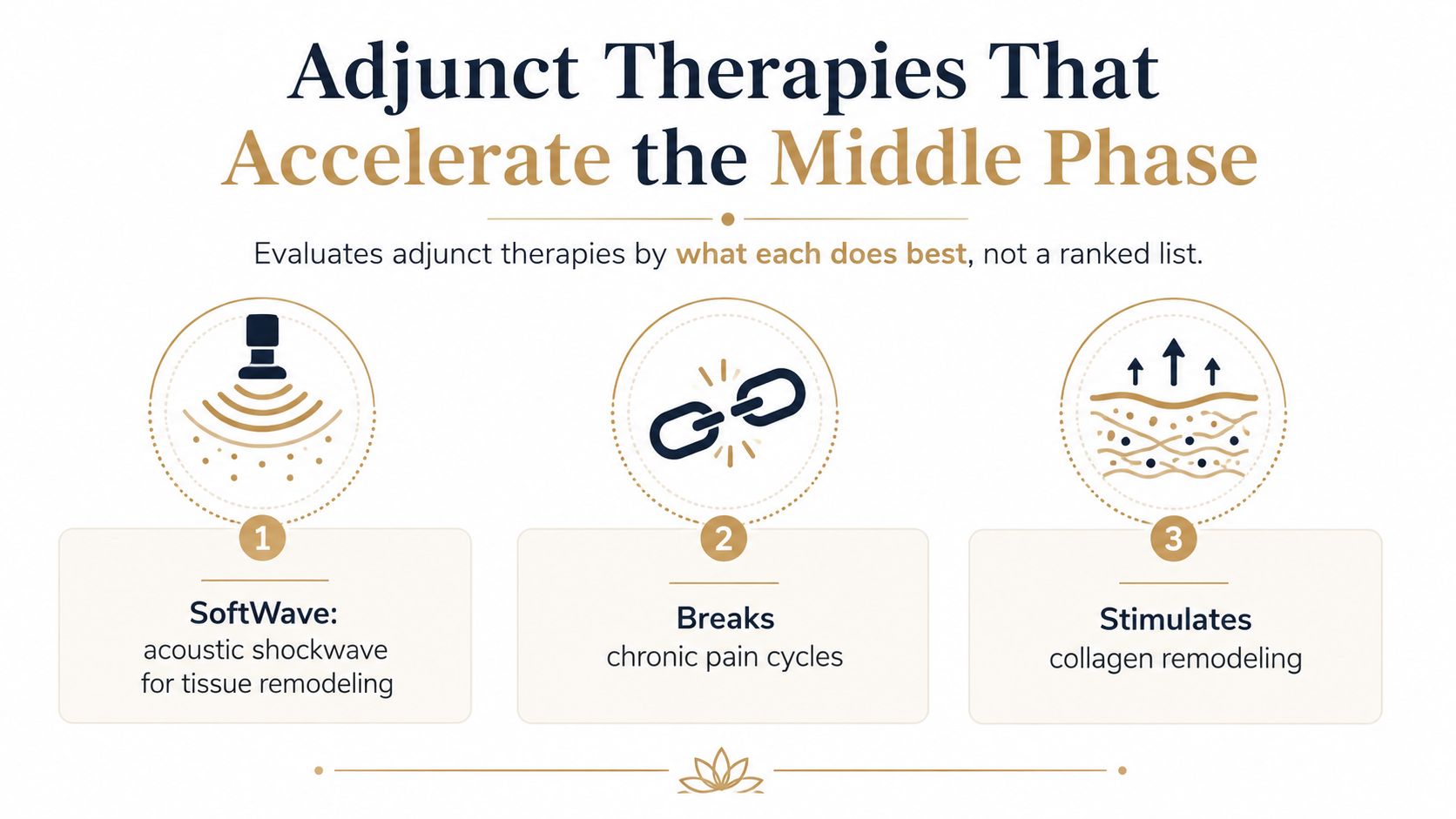
SoftWave Therapy uses acoustic shockwave input with the aim of stimulating tissue remodeling. It can be considered when a tendinopathy or stubborn muscle strain has become persistent and the athlete is caught in a pain cycle that limits useful exercise. It isn't a substitute for correcting load, technique, or capacity.
MLS Laser Therapy is used to support soft-tissue recovery and reduce inflammatory symptoms. It may be useful when pain and irritability restrict movement, allowing the athlete to participate more comfortably in mobility therapy and rehabilitation exercise. Evidence remains dependent on treatment parameters and condition, so claims should stay specific rather than absolute. A practical discussion of the modality is available in how MLS laser therapy works.
Spinal decompression, including spinal decompression with the DRX 9000, has a different clinical target. It may be considered for selected disc-related presentations when radiating symptoms limit sitting, walking, trunk movement, or strengthening. Clinical literature cited in the provided evidence reports 86% of patients with ruptured intervertebral discs achieved good-to-excellent improvement after decompression (spinal decompression research review). That result shouldn't be treated as a guarantee for every diagnosis.
Acupuncture can modulate pain and muscle tone while helping an athlete downregulate an overprotective nervous system. Massage Therapy may improve soft-tissue mobility, circulation, and scar or fascial restrictions, but aggressive work on an acutely injured area can irritate symptoms.
Aspen Falls Wellness provides chiropractic care, Chiropractic Adjustment, decompression, SoftWave Therapy, MLS Laser Therapy, massage, acupuncture, mobility therapy, and rehabilitation exercise within individualized care plans. Those services work best when paired with measurable home work, re-evaluation, and sport-specific conditioning rather than stacked indiscriminately.
A 2025 review found vibration therapy, compression garments, and massage appeared safe and potentially helpful, while emphasizing that standardized duration and frequency are still needed to identify optimal dosing (review of recovery modalities). The practical takeaway is simple. Use adjuncts to open a door to better movement, then walk through that door with progressive exercise.
A return-to-play decision should answer more than whether pain has decreased. It should show that the athlete can produce force, absorb force, control the body, tolerate the sport's speed, and repeat those tasks under realistic fatigue.
Common evidence-based thresholds include at least 90% limb symmetry on strength testing and 90% or more on multiple hop tests, combined with symptom-free full training, psychological readiness, and biomechanical assessment (return-to-sport rehabilitation criteria). These thresholds are useful gates, not permission to ignore movement quality or sport context.
Psychological readiness deserves its own assessment. Confidence scales, fear-of-movement screening, and tools such as ACL-RSI or the Tampa Scale can reveal a problem that strength testing misses. An athlete who passes a hop test but hesitates during an unplanned cut may need graded exposure before competition.
| Injury Type | Early Rehab | Sport-Specific Prep | Return-to-Play |
|---|---|---|---|
| Hamstring strain | Walking, isometrics, controlled range, hip and trunk work | Running progression, acceleration, sprint mechanics, cutting | Full-speed repeat efforts without symptom escalation or protective movement |
| Lateral ankle sprain | Range of motion, weight bearing, calf and peroneal activation | Hopping, landing, reactive balance, change of direction | Practice and competition loads tolerated without instability or swelling |
| Lumbar disc irritation | Walking, directional preference, nerve tolerance, trunk control | Rotation, lifting, contact or positional loading, repeated efforts | Sport demands tolerated without worsening neurological or radiating symptoms |
The transition should move from modified participation to unrestricted practice, controlled competition, and then full performance. A minimum of 9 months after ACL reconstruction before clearance is commonly cited in current synthesis, but time alone remains inadequate. In one systematic review, only 42.7% passed return-to-sport criteria, and 14.4% of those who passed sustained a second ACL injury (return-to-sport criteria synthesis).
For practical guidance on managing training variables during rehabilitation, athletes can review ways to speed up recovery, while remembering that faster symptom relief isn't the same as restored capacity.
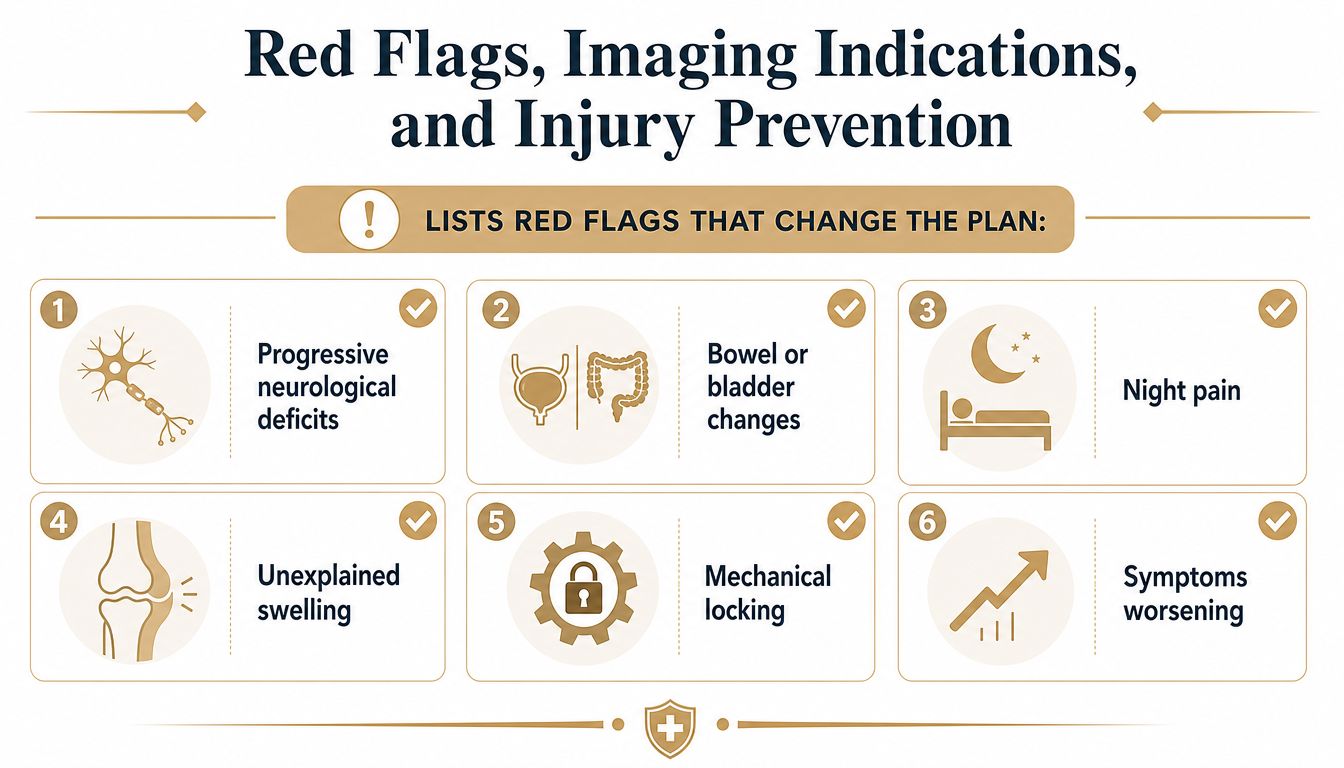
Some symptoms should stop a routine rehabilitation plan. Progressive neurological deficits, bowel or bladder changes, night pain, unexplained swelling, mechanical locking, and symptoms that worsen despite appropriate loading require prompt reassessment rather than another home exercise.
MRI may be appropriate when a clinician suspects a significant structural tear, stress fracture, or disc pathology, especially when the findings will change treatment. Ultrasound can help assess selected tendon and ligament problems and can support dynamic evaluation. Imaging should answer a clinical question, not just provide reassurance after every ache.
Seek urgent medical care for symptoms such as new or worsening weakness, changes in bladder or bowel control, severe deformity, fever with a hot swollen joint, or inability to bear weight after a significant injury. Athletes shouldn't use pain tolerance as proof that a serious problem is safe to train through.
Nutrition supports the work of rehabilitation. Maintain adequate protein and carbohydrate intake, hydrate around training, and choose a varied eating pattern that supports overall recovery. Nutrition counseling can help athletes whose intake has fallen during injury, whose training demands are changing, or whose return schedule is creating conflicting goals.
Sleep remains one of the most commonly neglected recovery behaviors. Keep a consistent sleep opportunity, especially during heavy rehabilitation blocks, travel, and competition periods.
Prevention should include movement screening, eccentric strength work, neuromuscular warm-ups, mobility therapy, and workload monitoring. A Golf Movement Screening can identify swing-related movement restrictions, while field and court athletes may need landing, cutting, sprint, and fatigue assessments. The prevention plan should address the deficit that contributed to the injury, not just repeat a generic warm-up.
A safer comeback begins with a written plan, not a hopeful date on the calendar. The plan should identify the diagnosis and define how pain, mobility, strength, conditioning, and sport-specific demands will be progressed and reviewed.
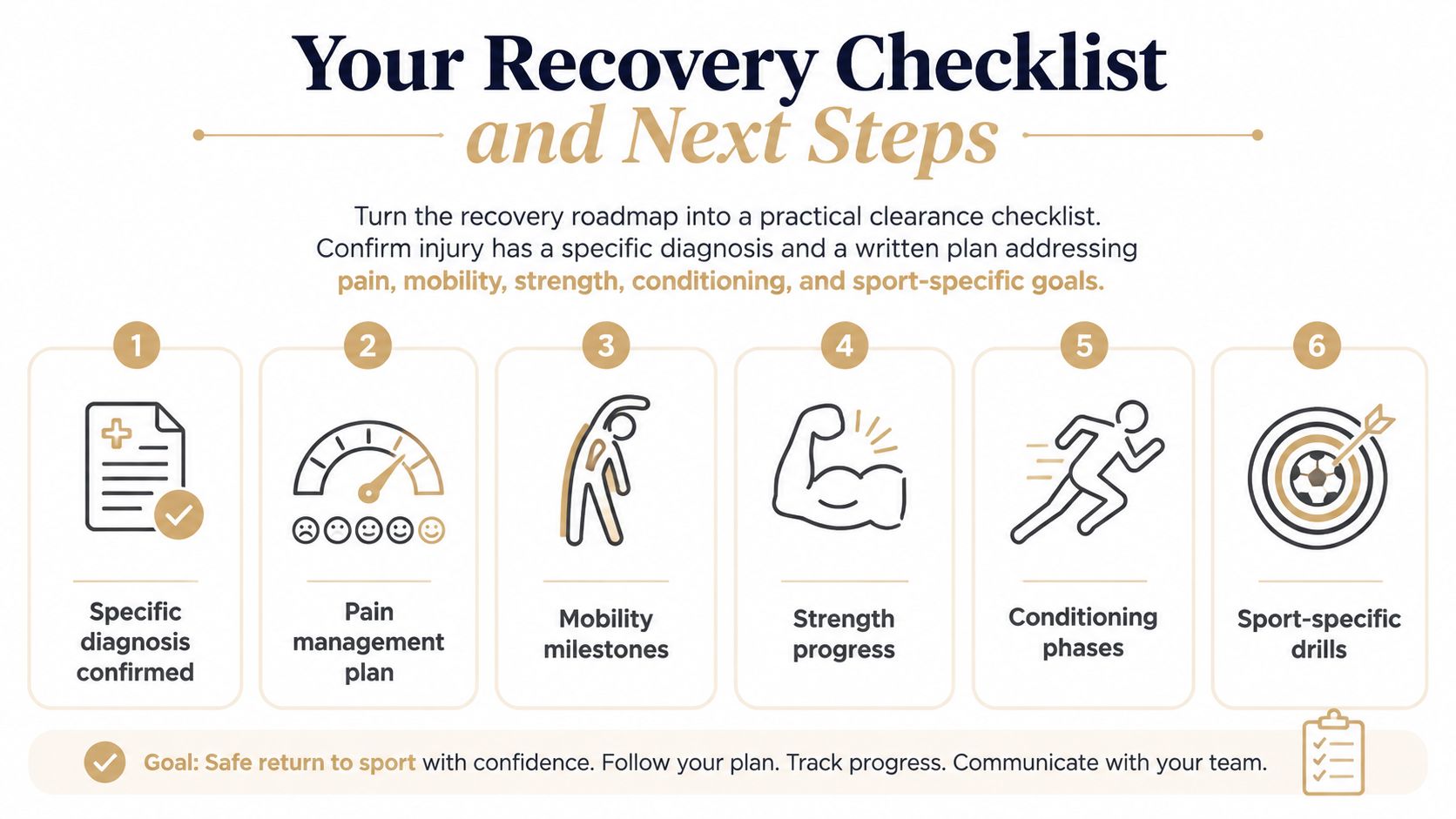
Use this checklist before increasing intensity:
A full return should progress from symptom-free participation to unrestricted practice, competition, and performance. Entering a game doesn't prove that you can finish a season at your previous output, especially when repeat efforts, contact, or fatigue expose deficits that a short test doesn't capture.
Keep protein, carbohydrate, hydration, and sleep consistent while training load rises gradually. Continue Chiropractic Care, Chiropractic Adjustment, Realignment, Muscle Stimulation, Pain Relief strategies, Personal Exercise Plans, Sciatica Treatment when indicated, and Rehabilitation Exercise only when each service supports a defined clinical or performance goal. Acupuncture, Nutrition and Nutrition Counseling, massage, and mobility work should complement the plan rather than distract from it.
Before clearance: Ask whether you can perform the task, repeat it, recover from it, and trust the movement when conditions become unpredictable.
Schedule a prevention review after returning. Document which exercises, workload changes, movement corrections, and recovery habits supported the progression, then address any remaining deficit before the next intense training block. If symptoms worsen, swelling becomes substantial, a joint locks, a deformity appears, fever develops, neurological symptoms progress, or you can't bear weight, stop self-management and arrange reassessment.
If you're recovering from a sports strain, joint injury, disc-related pain, or sciatica, Aspen Falls Wellness can evaluate your movement and build a conservative plan that may include adjustments, spinal decompression with the DRX 9000, SoftWave Therapy, MLS Laser Therapy, massage, acupuncture, mobility work, and rehabilitation exercise. Visit the clinic to establish baseline measures, clarify your next loading phase, and plan a return that considers performance as well as pain.

Stay updated with the latest chiropractic news and exclusive offers.