Chiropractic vs physical therapy compared on outcomes, cost, timelines, and conditions. Evidence-based guidance to help you choose the right care.
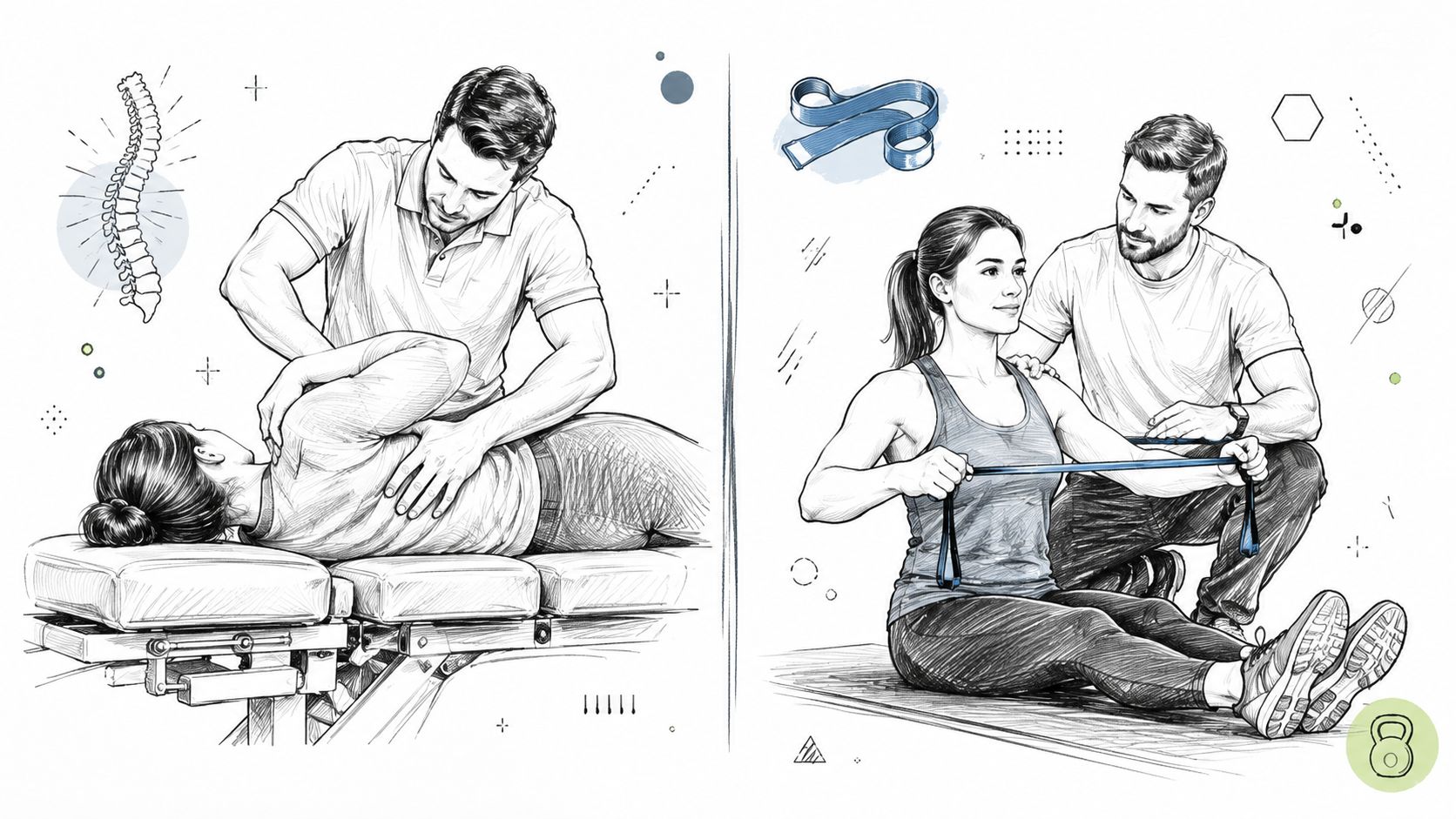



You've got a sore low back, maybe pain shooting down a leg, and two appointment types are sitting in front of you. One office says chiropractic, the other says physical therapy, and both sound reasonable enough that you don't want to choose wrong. The honest answer is that for a lot of back and neck problems, the bigger question isn't “which one works?” It's which one fits your body, your schedule, your insurance, and your tolerance for hands-on care versus exercise-led rehab.
| Criterion | Chiropractic Care | Physical Therapy |
|---|---|---|
| Main style | Adjustment-led, manual care | Exercise-led rehabilitation with manual therapy |
| Typical experience | Often more hands-on and visit-focused | Often more movement-focused and home-program driven |
| Best fit | Joint restriction, spinal pain, nerve irritation | Weakness, mobility loss, post-injury rebuilding |
| Access issues | Coverage can vary more by plan | Often covered for medically necessary care |
| Real-world decision factor | Visit frequency and treatment style | Longer sessions and structured exercise |
If you're sitting there with a herniated disc, sciatica, or a stubborn neck problem, you probably don't need another vague wellness essay. You need a straight answer about what each profession does, what the evidence says, and why the practical details, especially insurance friction and visit frequency, matter almost as much as the therapy itself.
A patient walks in with an L5 disc herniation and sciatica. The pain is sharp enough that bending hurts, sitting makes it worse, and every search result seems to point in a different direction. One friend says to see a chiropractor for the nerve irritation. Another says physical therapy is the smarter long-term play.
That's the core decision many people face. It's not academic, it's personal, and the stakes feel high because pain changes how you work, drive, sleep, and move through the day.
The problem is that both paths can sound right. Both professions work with musculoskeletal pain, both can use hands-on care, and both aim to get you back to function. The landmark randomized trial in low back pain found similar clinical outcomes between physical therapy and chiropractic manipulation over two years, with no meaningful differences in symptoms, disability, recurrences, days of reduced activity, or missed work (NEJM trial).
That matters because it takes the fantasy out of the decision. You're usually not choosing between one clearly superior fix and one obvious mistake. You're choosing between two legitimate care models with different mechanics, different visit patterns, and different access issues.
Practical rule: if the pain problem is already making you second-guess every move, pick the pathway that gets you evaluated quickly and starts a coherent plan. Delay is usually worse than choosing the “perfect” label.
The other reason this choice feels loaded is that patients don't just want symptom relief. They want the pain gone, the recurrence risk lower, and the process to be tolerable. A care plan that fits your life usually wins over one that looks elegant on paper but is hard to complete.
That's where an integrated clinic mindset becomes useful. In real practice, many people don't need a tribal choice between camps. They need a clinician who can tell them whether the problem is mostly structural, mostly movement-based, or a mix of both, then match the plan to that reality.
Chiropractic care and physical therapy are closer than the marketing makes them sound. Both are licensed, both are conservative, and both can help people with spine, joint, and soft-tissue pain. The difference is the dominant treatment style and the way each profession thinks about the problem.
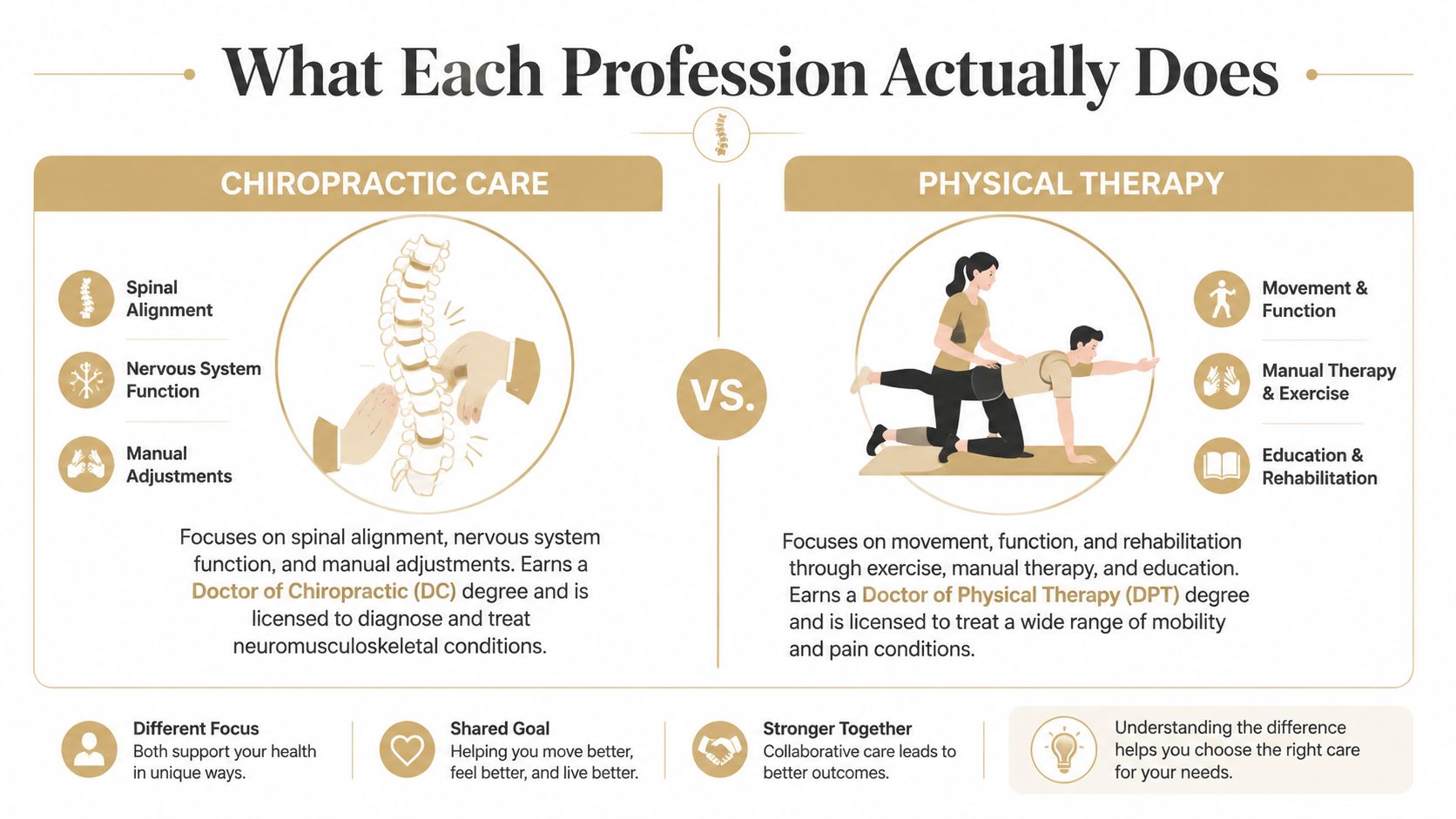
A chiropractor is trained to diagnose and treat neuromusculoskeletal conditions with an emphasis on the spine, joint motion, and manual adjustment. In the first visit, the pattern is usually history, examination, and a decision about whether a chiropractic adjustment, soft-tissue work, or other conservative care is appropriate. Many clinics also use adjuncts such as decompression, laser, massage, muscle stimulation, or acupuncture when they fit the case.
The guiding idea is straightforward. If a segment isn't moving well, or if joint dysfunction is contributing to pain and nerve irritation, restoring motion can help. That doesn't mean every problem is a “crack your back” problem. It means the chiropractor's primary lens is alignment, joint mechanics, and symptom relief through manual care.
A physical therapist is trained to assess movement, strength, balance, mobility, and function. The first visit is usually centered on a movement evaluation, then a plan built around exercise, manual therapy, education, and a home program. If you want a clear educational overview of therapeutic exercise, this internal guide on therapeutic exercise lays out why exercise is central to rehab.
PT is usually less about restoring a joint position and more about restoring the body's ability to use that joint well. That makes it especially useful when weakness, deconditioning, poor loading tolerance, or movement compensation are part of the picture.
Both professions can treat pain. The better question is whether the main problem is joint and nerve mechanics, or movement and load tolerance.
In practice, the overlap is real. A chiropractor may use mobilization, soft tissue, and exercise. A physical therapist may use manual therapy and spinal manipulation. The label matters less than whether the plan is coherent, evidence-based, and matched to the condition in front of you.
A patient walks into the clinic after weeks of nagging back pain and wants the answer everyone wants, which path gives relief without wasting time, money, or energy. The comparison that matters starts there, with the details patients feel: treatment style, visit rhythm, diagnosis, adjuncts, and what they will be asked to do at home.
| Criterion | Chiropractic Care | Physical Therapy |
|---|---|---|
| Primary treatment style | Adjustment-led, often with manual therapy and adjunct modalities | Exercise-led rehab, often with manual therapy and education |
| Visit rhythm | Can involve more frequent, shorter visits | Often fewer visits, longer sessions, more home work |
| Diagnostic emphasis | Joint motion, spinal mechanics, neuromuscular findings | Movement patterns, strength, balance, function |
| Adjunct tools | Decompression, laser, massage, acupuncture, stimulation | Manual therapy, graded exercise, balance and loading work |
| Home program expectation | Usually helpful, but clinic care may be more central early on | Usually central, because carryover depends on practice at home |
The difference is how each model starts. Chiropractic often centers the first stage of care around hands-on correction, while physical therapy usually centers the first stage around active rehabilitation. If you want something done to the painful area right away, chiropractic can feel more immediate. If you want a structured plan that builds capacity over time, PT usually fits better.
Visit rhythm matters too, and patients feel that fast. In the 1998 randomized trial, chiropractic averaged 6.9 visits and physical therapy averaged 4.6 visits, so chiropractic involved more appointments even though total mean costs stayed very close, $429 versus $437 over two years (NEJM trial). That is not a minor detail. More visits means more scheduling friction, more time away from work or family, and more chances for copays to pile up, even when the final outcome looks similar.
Chiropractic tends to fit well when the presentation feels stiff, locked, irritated, or nerve-driven, and when the patient responds clearly to manual care. Physical therapy tends to fit well when the main problem is weakness, deconditioning, poor control, or recurring compensation.
Patients do best when the care model matches the limiter in front of them. If the issue is mostly motion-based, hands-on care can make the first step easier. If the issue is mostly capacity-based, exercise and progression usually have the upper hand.
If a patient keeps saying, “It feels better when someone moves it, but it comes back,” I usually think in terms of a combined plan, not a forced choice.
That is the part most comparisons miss. An integrated clinic can often collapse the decision into one coordinated plan, manual care to settle symptoms, exercise to keep them from returning, and fewer handoffs between separate offices. Insurance rules and visit authorization can still get in the way, but the clinical logic is straightforward. Pick the model that addresses the main limiter first, then make sure the rest of the recovery plan is covered and realistic to follow.
A patient can do the right things and still want a clear answer. The evidence here is useful because it does not force one winner. In the classic randomized low back pain trial, physical therapy and chiropractic manipulation produced similar clinical outcomes over two years, with no significant differences in symptoms, function, disability, recurrences, reduced activity, or missed work. A related trial comparing the McKenzie method and chiropractic manipulation showed the same general pattern, with about 75% of patients in both groups rating care as very good or excellent and mean costs staying close, $437 for PT and $429 for chiropractic (PubMed).
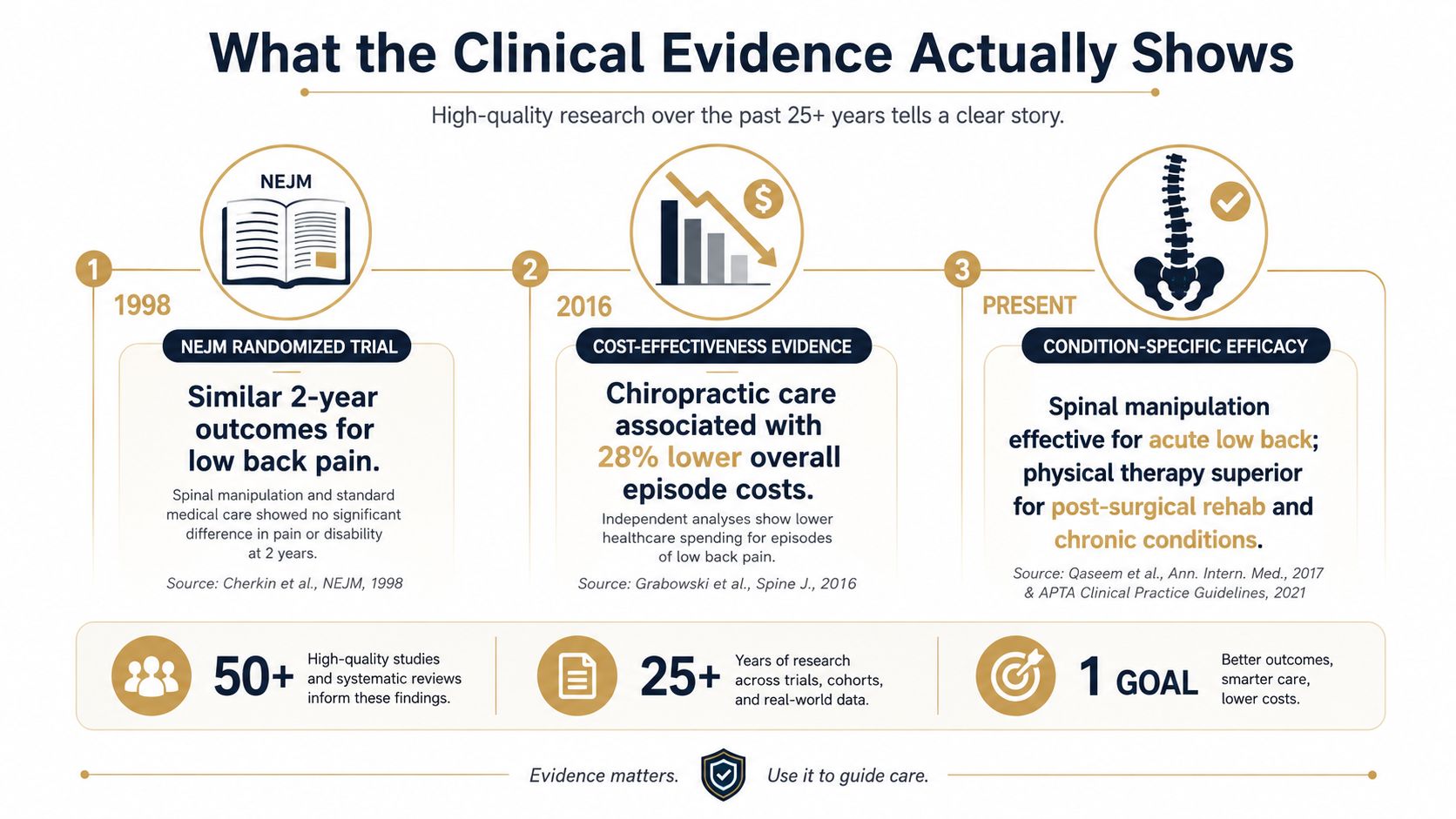
That same theme shows up in later economic work. A PMC analysis of adults with low back pain found chiropractic care was $48.56 cheaper than physical therapy over six months, with mean costs of $410.89 for chiropractic and $459.45 for physiotherapy, plus a small quality-adjusted survival advantage of 0.0043 DALYs in favor of chiropractic (PMC analysis). The authors concluded chiropractic was the more cost-effective option for adults with at least three weeks of low back pain over a six-month horizon.
Read that in context. It does not mean chiropractic is always cheaper in every market, every plan, or every clinic. It does mean cost can tip the decision when the clinical results are already close, especially once copays, visit authorization, and repeated appointments start to matter to the patient.
A contemporary evidence review found chiropractic manipulation and standard physical therapy are largely equivalent for chronic low back pain, with most studies showing no significant long-term differences in pain or function (review). That is the practical takeaway. Both approaches have support, both can be safe, and neither one earns a blanket claim of clear superiority.
The same review era also shows how access shapes use. Between 2002 and 2018, less than one-third of U.S. adults with low back pain used either chiropractic care or OT/PT, and each individual therapy stayed below 20%. After guideline changes in 2016, uptake rose modestly, with use in 2016–2018 higher than in 2002–2015, odds ratio 1.15 (PMC analysis).
That is the part many overlook. Insurance rules, visit frequency, and referral friction often decide what care a person gets, even when the evidence points to similar outcomes. In an integrated clinic, the smarter move is usually to combine the strengths of both pathways, manual care to settle symptoms, exercise to hold the gains, and a coordinated plan that keeps the patient from bouncing between separate offices. For a closer look at how that gets organized, see our guide to personalized treatment plans.
A disc herniation with sciatica belongs in a different care lane than a hamstring strain, and chronic neck pain does not behave like post-accident whiplash. Start with the condition pattern, then match the treatment to what the body is doing.
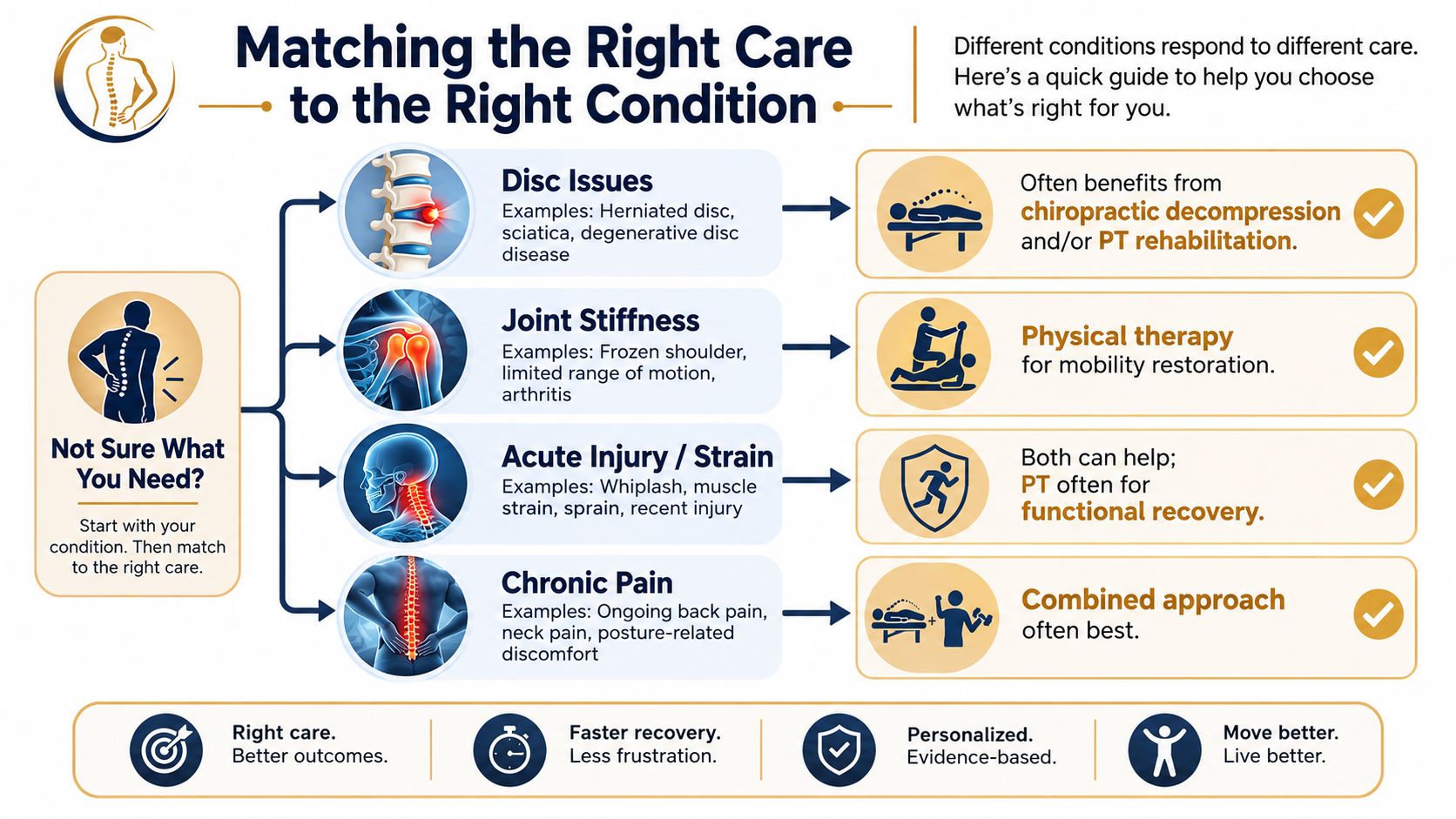
For disc herniation, sciatica, and stenosis, I favor a plan that addresses nerve irritation and mechanics at the same time. In an integrated clinic setting, that often means spinal decompression with the DRX 9000, targeted adjustment, and a rehab plan that keeps the spine tolerating load as symptoms calm down. If you want a closer look at how individualized care gets organized, this internal guide on personalized treatment plans is the right companion read.
Radiating pain needs more than symptom chasing. The goal is to reduce irritation, restore movement, and keep the surrounding tissues from locking the person into another flare.
For neck pain and cervicogenic headache patterns, chiropractic care often helps when the cervical joints are stiff and the upper neck is part of the pain picture. PT becomes especially useful when the issue includes posture endurance, scapular weakness, or movement control. In sports strains and overuse injuries, I usually favor progressive loading and movement retraining first, then use manual care to restore joint mechanics when they are limiting progress.
The split is straightforward. If the tissue needs to be loaded back to capacity, rehab should lead. If the joint is guarding and motion is blocked, manual care can open the door.
For post-motor-vehicle-accident whiplash, documentation and structured conservative care matter a lot. The patient needs a clear exam, a recorded baseline, and a plan that watches symptoms over time instead of assuming they will settle on their own. Chiropractic care often fits early here because the problem can include stiffness and joint irritation, while PT fits well once the person needs a more active rebuild.
Bottom line: do not pick a title, pick the problem pattern. Disc and nerve issues often need decompression plus adjustment and rehab. Movement-limited or weakness-driven problems usually deserve a stronger PT emphasis.
The pattern-based approach wins in the clinic because it respects how different these cases really are. Some people need a more manual start, some need a more active one, and many do best with both in sequence.
Most patients don't get stuck on theory. They get stuck on coverage. The practical question is usually, “Can I start this without a referral, how many visits will my plan allow, and what will this cost me?”
For medically necessary care, physical therapy is widely covered by major commercial plans, Medicare, and Medicaid, while chiropractic coverage can be more variable and may include visit caps or condition-specific limits. Referral rules can also differ by state and insurer, so two people with the same pain can face very different admin steps.
Here's the short checklist I'd use before booking anything:
The other friction point is access. A plan can technically cover care and still make it hard to use because of scheduling, referral steps, or narrow documentation rules. That's why patients often do better with clinics that can explain the insurance side in plain language before the first visit.
Aspen Falls Wellness operates two locations in Salt Lake City and Sandy, and it participates with multiple plans, with verification recommended before care starts. That kind of setup matters because it reduces the back-and-forth between the front desk, the insurer, and the patient, especially when the case needs manual care, rehab, or device-based modalities under one roof. If you're trying to keep costs predictable, their discussion of a low-cost chiropractor is a useful reference point for how clinics can talk about access without overselling.
The takeaway is simple. Don't compare office names first. Compare coverage, visit rhythm, and out-of-pocket exposure, because that's what determines whether a good plan is usable.
Use three questions and stop there. First, is the problem mainly joint and nerve-related. If yes, lean chiropractic, especially if decompression or targeted adjustment seems like the clearest fit. Second, is it mainly muscle weakness, mobility loss, or movement control. If yes, lean physical therapy. Third, is it chronic, recurrent, or mixed. If yes, stop forcing a single-label answer and consider combined care.
Chiropractic often means more frequent, shorter visits. Physical therapy often means fewer, longer sessions with more homework between appointments. If you hate exercise plans and want a clinician to do the heavy lifting early, chiropractic can feel easier to start. If you want a structured rebuild and don't mind doing work at home, PT usually fits better.
That preference isn't trivial. People abandon good plans when the rhythm of care doesn't match their personality or schedule.
A combined clinic solves a real problem. It lets the care team use chiropractic adjustment, massage, acupuncture, MLS Laser Therapy, SoftWave Therapy, mobility therapy, and rehabilitative exercise in one coordinated plan instead of making the patient choose a side before the exam is even done.
The best plan is the one that matches the case and gets followed. A simple, coordinated plan beats a “perfect” specialty label that nobody actually completes.
That's why integrated care is often the most pragmatic choice for chronic pain, stubborn disc issues, and post-accident recovery. It collapses the decision into one plan, one chart, and one team that can adjust as the body changes.
How long does it take? For many back and neck cases, the timeline depends less on the profession and more on the condition, irritability, and how well the plan matches the problem. A straightforward joint issue often moves faster than a chronic pain pattern with weakness, stress, and guarding layered on top.
Can you combine chiropractic and physical therapy safely? Yes, and that's often the smarter route when pain is mixed. The key is coordination, because one provider needs to know what the other is doing so the plan doesn't fight itself.
When should you switch or escalate? If pain is steadily worsening, function is dropping, or the story no longer sounds like a routine musculoskeletal problem, don't just keep repeating the same visits. Ask for a reassessment, and if needed, imaging or a specialist referral should enter the conversation.
What should you look for in a clinic? Look for a clear exam, a plan you can understand, honest talk about visit frequency, and a home program that makes sense. If a clinic also addresses nutrition, mobility, golf movement screening, or car accident treatment where relevant, that can be useful as long as it's tied to the diagnosis and not just stacked onto the bill.
What role do lifestyle factors play? A real one. Nutrition, mobility work, and exercise habits don't replace treatment, but they change how well the body holds onto progress after the session ends.
Aspen Falls Wellness takes this topic seriously because back and neck pain rarely stays in one lane. If you want a coordinated evaluation for chiropractic care, spinal decompression, rehab, or other conservative musculoskeletal services, visit Aspen Falls Wellness and book a visit with a team that can help you map the right next step.

Stay updated with the latest chiropractic news and exclusive offers.