Dry needling effectiveness is strongest short term for trigger-point pain, weaker at follow-up, and best paired with active rehab.
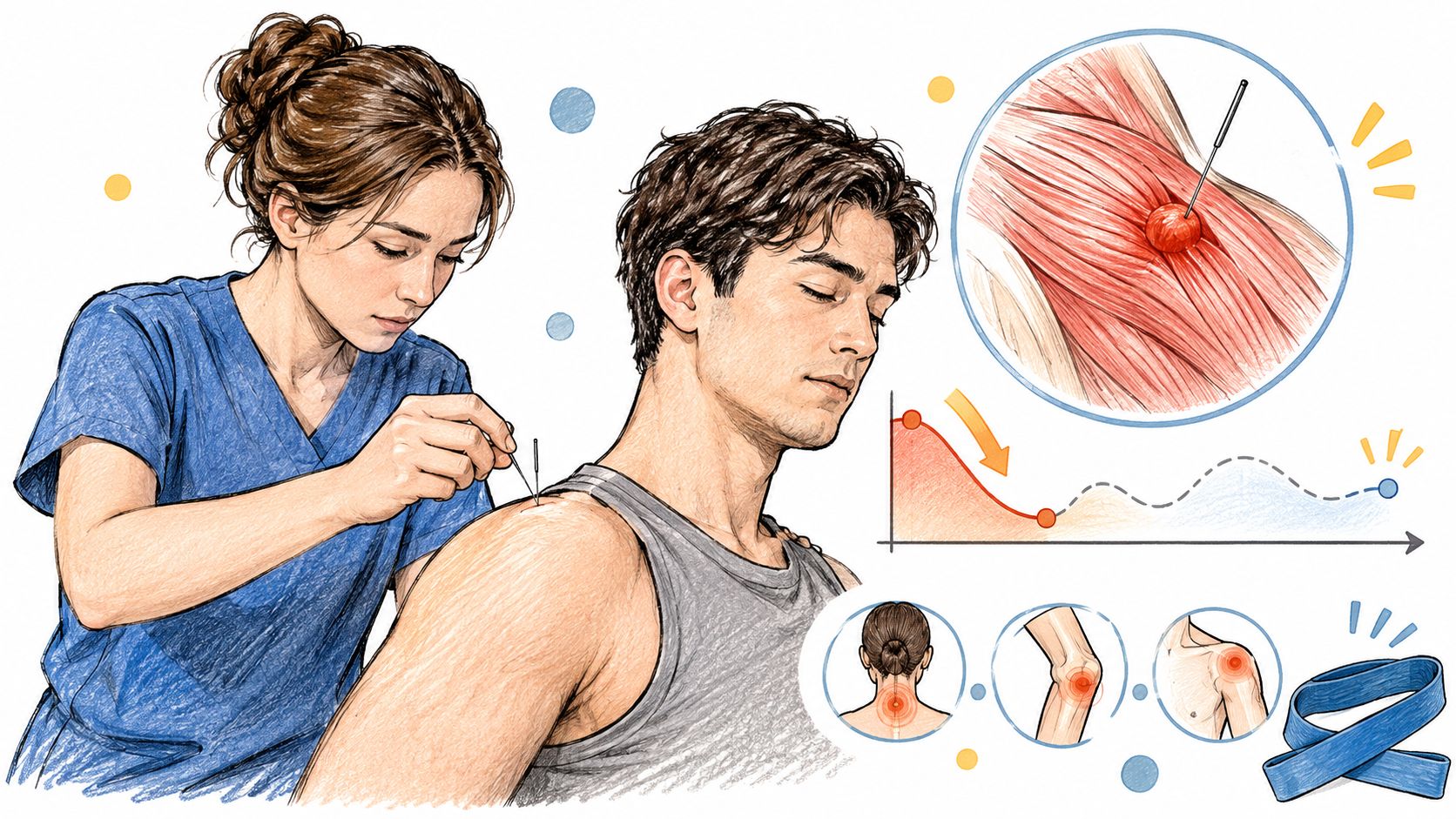
A pooled analysis found a standardized mean difference of -1.06 for myofascial pain after dry needling, favoring treatment over comparison care (2023 systematic review of myofascial pain). That short-term pain change does not establish lasting relief or restored strength.
The key distinction is feeling better versus functioning better for longer. Reduced tenderness may not translate into greater lifting capacity, and needling may add little when compared with well-designed rehabilitation. Its best use is alongside exercise that rebuilds strength and activity tolerance. Effectiveness depends on the diagnosis, the comparison treatment, and the outcome being measured.
A 2023 systematic review found that post-treatment pain favored dry needling for myofascial pain, with an SMD of -1.06 across 10 studies and 673 patients. Pain-related disability also favored needling, with an SMD of -0.76 across 8 studies and 353 patients. The review described an earlier synthesis in which immediate pain favored needling, while follow-up estimates for pain and disability did not establish a clear advantage.
The distinction matters: a short-term change in symptoms does not establish lasting relief or improved function.
A standardized mean difference, or SMD, converts results from different scales into one comparable value. Negative values in these comparisons favor dry needling because lower pain or disability scores are better.
A confidence interval describes uncertainty around an estimate. If it crosses zero, the comparison has not established a statistically clear advantage, even when the average result favors needling.
Dry needling results by condition
| Condition | Short-term pain | Function or disability | Durability signal | Evidence note |
|---|---|---|---|---|
| Myofascial pain, 2023 review | SMD -1.06 across 10 studies and 673 patients; p=0.003 | Disability SMD -0.76 across 8 studies and 353 patients | Earlier follow-up estimates for pain and disability had confidence intervals crossing zero | Protocols and follow-up periods differ |
| Knee pain syndromes | SMD -0.53 (95% CI -0.87 to -0.19); 463 participants | Disability SMD -0.58 (95% CI -1.08 to -0.09); 360 participants | Short-term focus | High heterogeneity: I² 68% for pain and 80% for disability |
| Orofacial pain versus sham | SMD -1.68 (95% CI -3.16 to -0.20) at 3 to 10 weeks | No function estimate reported in this summary | Follow-up limited to that window | Evidence certainty rated very low |
Read the row that matches the condition and comparison. For example, results against sham treatment answer a different question from results for needling added to usual care. A pooled estimate is therefore not a universal forecast.
High heterogeneity means study participants, techniques, or results differed substantially. The average may not describe what a particular patient will experience, especially when the evidence focuses on short-term symptoms rather than lasting function.
Practical rule: Use the evidence to define a measurable treatment trial, then judge whether pain and the activity it limits both improve.
Differences in technique, treatment combinations, and follow-up prevent a universal dosing recommendation. The likely value of needling depends on the diagnosis, the comparator, and whether treatment supports active rehabilitation.
Dry needling uses a thin solid filament inserted into a myofascial trigger point, a tender area associated with a palpable taut muscle band that can refer pain elsewhere. No medicine is injected. The intended stimulus is mechanical and neurological rather than pharmacological.
Say turning your head reproduces an ache near your shoulder blade. A clinician first checks whether pressing a particular muscle band reproduces the familiar symptoms, rather than assuming every tender spot explains the problem.
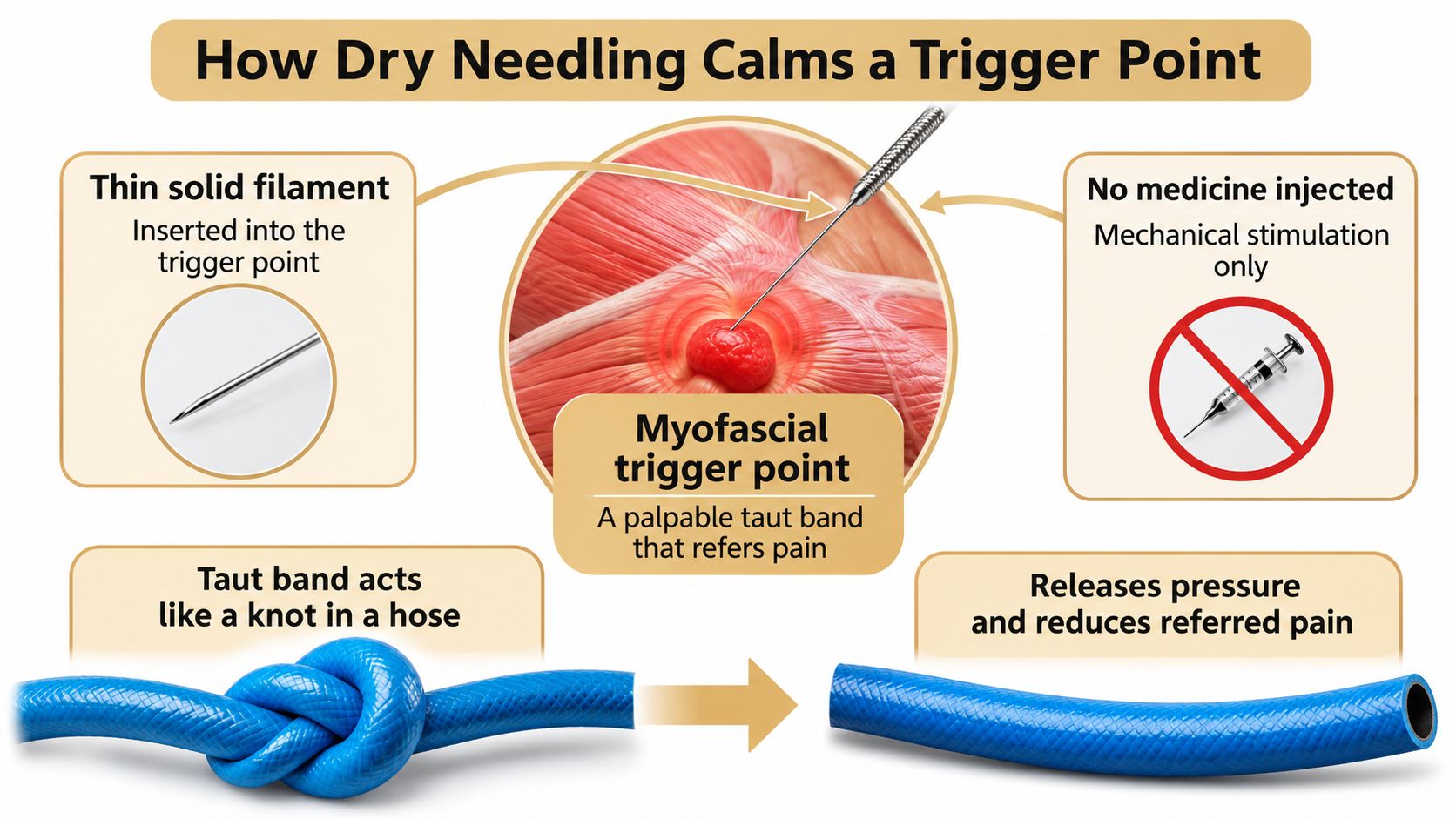
A taut band is sometimes compared with a kink in a hose. The analogy helps explain local irritability and the proposed relationship between sustained contraction, circulation, and pain-producing chemistry. It shouldn't imply that a clinician can untie a muscle and permanently solve the problem.
After locating the target by palpation, the clinician advances the filament toward the tender area. A brief involuntary contraction, called a local twitch response, may occur. Proposed explanations include changes in muscle contraction and local tissue chemistry, but those mechanisms shouldn't be presented as a proven sequence that occurs identically in every patient.
The stimulus may also alter how the nervous system processes pain. That provides a plausible explanation for reduced pressure sensitivity without an equally clear improvement in every movement.
A visible twitch doesn't prove the correct diagnosis, successful tissue healing, or readiness to return to sport. Nor does the absence of a dramatic twitch automatically mean the session failed. The useful test is whether the selected symptom or movement improves enough to help the person progress.
In the neck-and-shoulder example, easier head turning could make exercise more tolerable. It wouldn't establish that the person can sustain an entire workday at a desk or repeatedly lift overhead.
The mechanism therefore fits best with short-term symptom modulation. It doesn't justify identical treatment schedules, requiring a twitch with every insertion, or expecting equivalent results for muscle, disc, joint, and nerve-related pain.
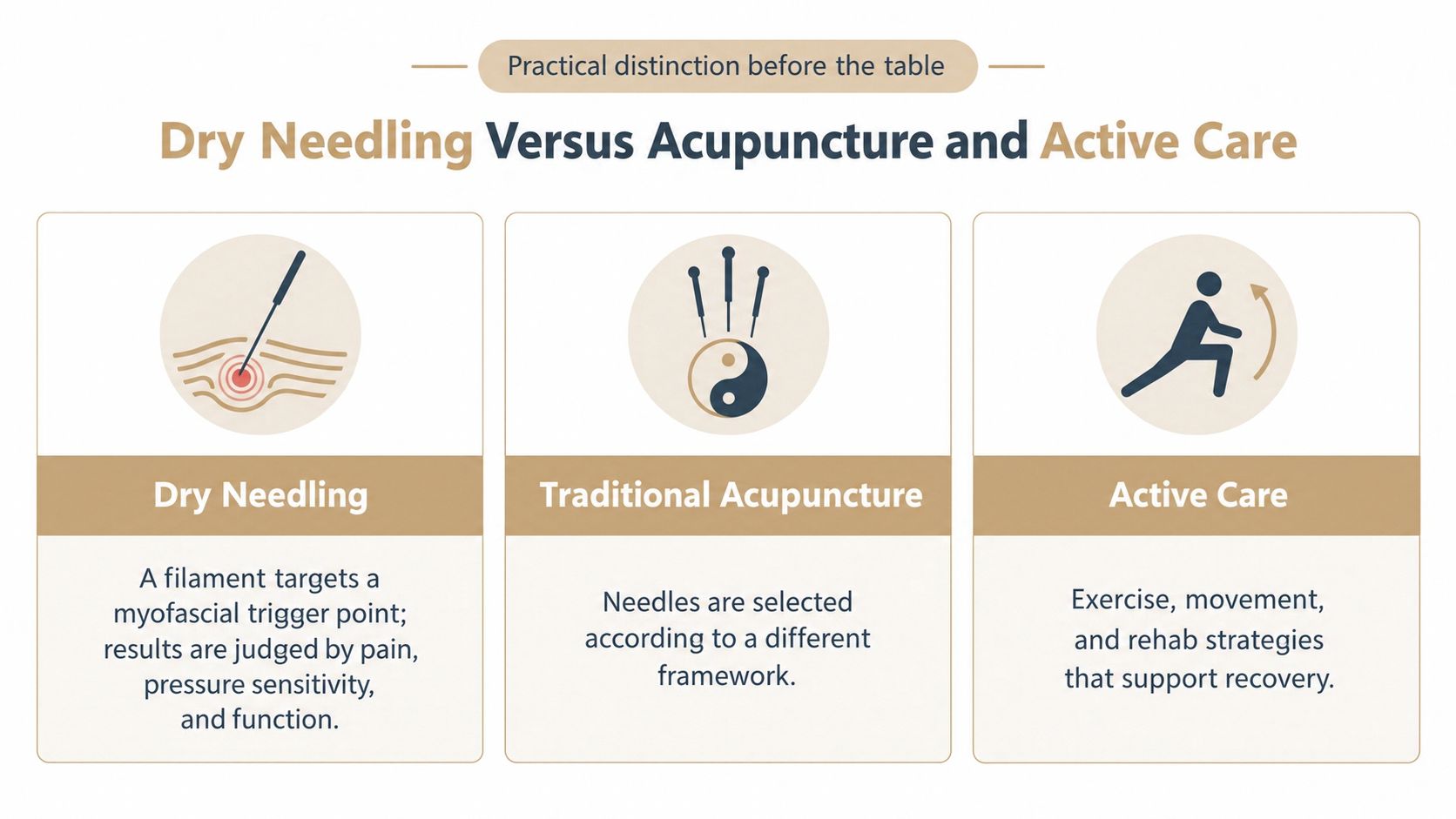
Dry needling and traditional acupuncture can both involve fine needles, but their target and clinical framework differ. Dry needling commonly targets a myofascial trigger point and evaluates pain, tenderness, and function. Traditional acupuncture selects points within a different framework, often including meridian-based reasoning and broader treatment goals.
The presence of a needle doesn't establish that the procedures are interchangeable. Our explanation of how acupuncture reduces pain provides context for patients weighing these approaches, but neither should automatically displace active rehabilitation.
In a randomized neck-pain trial comparing dry needling with TENS, both groups improved over 28 days in pain, Neck Disability Index, and cervical motion, with reported within-group P<0.001; dry needling produced a greater pain reduction from day 0 to day 28, also P<0.001. Flexion improved significantly in the needling group (P<0.008), while rotation toward the painful side improved significantly in the TENS group (P<0.001).
That last distinction matters. Significant improvement within a group isn't automatically proof of superiority over the other group. The trial supports a clearer comparative statement about pain than about which treatment is universally better for neck motion.
Where dry needling fits beside other care
| Question | Dry needling | Acupuncture | Exercise, manual care, or TENS |
|---|---|---|---|
| Main target | Myofascial trigger point in a taut band | Selected points, often within a meridian framework | Exercise targets capacity; manual care addresses movement or symptoms; TENS stimulates nerves through the skin |
| What a good early result looks like | Less pain or reduced pressure sensitivity | Pain modulation and easier function; also used for broader complaints such as stress or sleep | More manageable movement; exercise progressively develops load tolerance |
| Neck comparison with TENS | Greater pain reduction; flexion improved within the group | Not evaluated in that trial | Pain, disability, and motion improved; painful-side rotation improved within the TENS group |
| Best role in a plan | A symptom-focused adjunct when the target fits | An option selected according to goals and clinical assessment | Exercise provides active progression; manual care and TENS may support symptom management |
A treatment that lowers pain may be useful because it lets you perform rehabilitation more comfortably. That's a different job from increasing the amount of work a muscle or tendon can tolerate.
TENS belongs in the symptom-management category, not the strength-training category. Manual therapy is also not equivalent to active exercise, even when both appear within the same physical therapy program.
Choose the treatment by the missing ability, not by whether it uses a needle.
These comparisons don't establish that either needle approach is best for every diagnosis. A sound plan asks what each intervention contributes and removes interventions that don't help the chosen outcome.
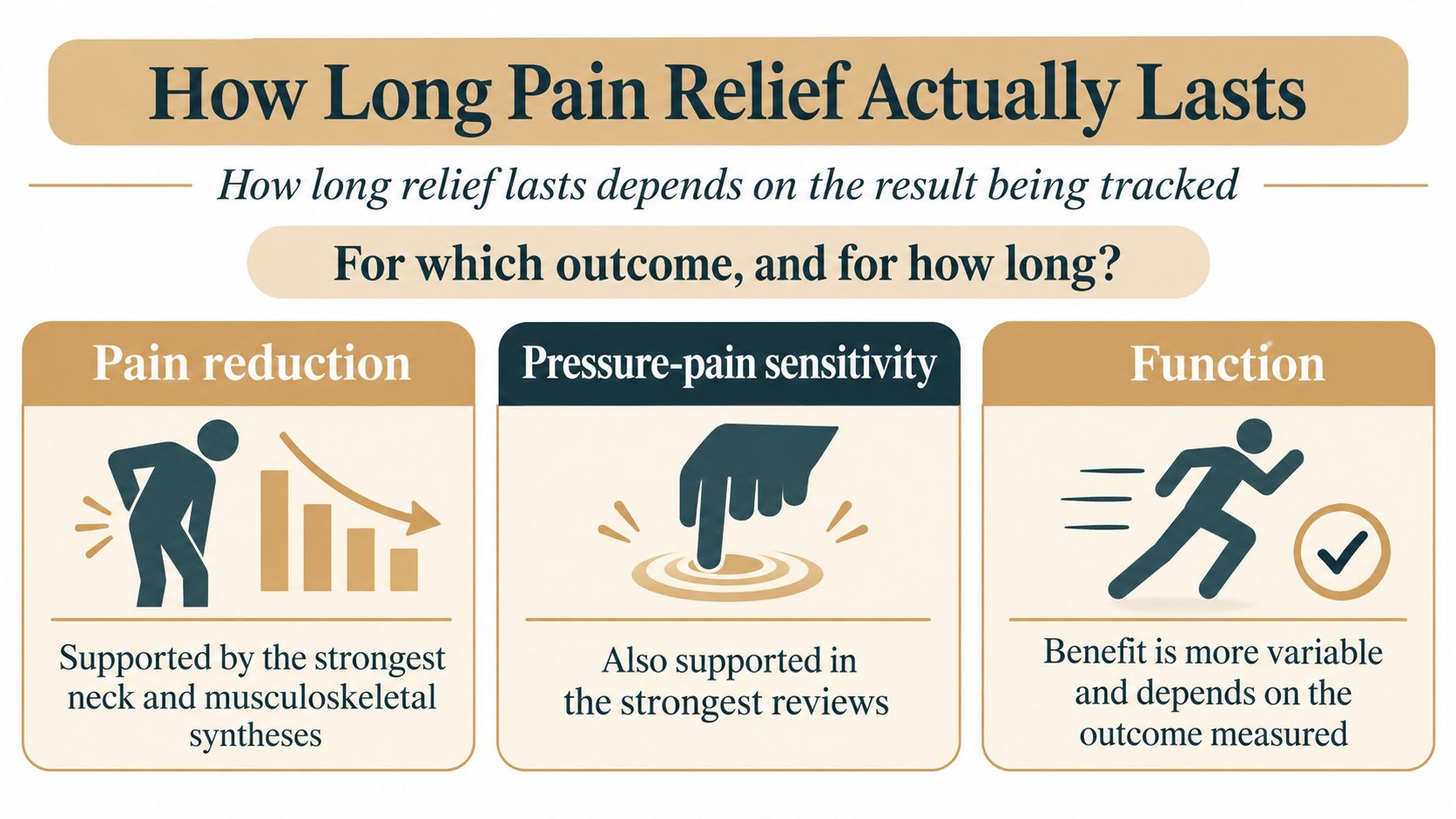
12 weeks is the furthest point at which a systematic review of trigger-point dry needling found evidence, ranging from very low to moderate quality, of reduced pain and pressure sensitivity. The review found no statistically significant pain advantage at 6 to 12 months. The evidence therefore supports short-term symptom changes more clearly than durable superiority over other care.
In a sham-controlled neck-pain trial with one-year follow-up, adding trigger-point dry needling to a multimodal program did not significantly improve disability (P=0.69), current pain (P=0.37), or average 24-hour pain (P=0.10) compared with the program without needling. Both groups improved substantially over time (P<0.001).
That pattern supports a useful distinction: patients may improve during a treatment program without the needling itself accounting for the change. Rehabilitation, treatment context, and symptom course may also contribute, though the trial does not separate their effects.
Before treatment, identify an activity symptoms interrupt and record both discomfort and capacity.
Reassess early enough to adjust an unhelpful plan, then continue tracking outcomes beyond the immediate post-treatment period. A comfortable afternoon alone does not establish lasting relief.
Reassessment standard: A lower pain score matters most when it helps you regain an activity you value.
If pain improves but capacity does not, reassess loading, movement strategy, diagnosis, and barriers to progression. More needling is not an automatic next step. If brief relief helps someone progress with meaningful exercise, needling may serve a useful role as an adjunct, even without producing lasting relief on its own.
Neck, shoulder, and tendon studies measure different outcomes. Pain sensitivity, joint motion, disability, and exercise tolerance are not interchangeable, so improvement in one does not establish improvement in the others.
| Condition and comparison | Pain | Motion or function | Limit |
|---|---|---|---|
| Mechanical neck pain, 2025 meta-analysis | Mechanical-neck-pain meta-analysis: pressure-pain threshold +0.52 units (95% CI 0.39 to 0.65) | Flexion +4.07 degrees (95% CI 0.39 to 7.75); right rotation +8.20 degrees (95% CI 3.05 to 13.35) | Extension, left rotation, and lateral flexion did not improve significantly |
| Neck trigger points versus sham, placebo, waiting list, or another needling approach | No pooled pain estimate included here | Neck trigger-point systematic review: disability SMD -0.87 (95% CI -1.60 to -0.14) | Immediate flexion 1.93 degrees, extension 5.23 degrees, and rotation 2.04 degrees, none statistically significant |
A driver may find it easier to check traffic after treatment while still having difficulty turning fully over the opposite shoulder. That is a movement-specific change, not evidence that neck mobility has broadly returned.
Pressure-pain threshold measures how much pressure a person tolerates before it becomes painful. A higher threshold suggests reduced sensitivity, but it does not directly measure driving safety, strength, or tolerance for prolonged positioning.
The trigger-point review shows a related distinction: disability may improve without a statistically clear immediate change in measured motion. Daily activities can feel more manageable even when a clinician finds little additional rotation.
Lifting a mug with less discomfort can be a meaningful early change for someone with shoulder pain. Repeated overhead work calls for a separate assessment of endurance, control, and tolerance for repeated loading.
The discussion of shoulder pain and posture can help frame questions about movement and positioning. Posture alone, however, should not be assumed to explain every painful shoulder. A diagnosis-focused examination remains important.
Pain relief makes progressive shoulder exercise easier to start; it does not replace it.
For someone with tendinopathy, less pain during exercise may make a loading program more manageable. It does not establish that the tendon can tolerate unrestricted running, jumping, or gripping. Substantial inconsistency between trials also limits how confidently pooled findings can predict an individual response.
An earlier systematic review of randomized trigger-point trials found short-term benefits for pain, range of motion, and quality of life compared with no intervention, sham, or placebo. Evidence remained insufficient for disability reduction, reduced analgesic use, and improved sleep.
The practical conclusion is specific: identify which outcome changed, then assess whether the activity that matters has improved.
Start a trial when a suspected trigger-point contribution limits a specific symptom or movement, and the treatment can accompany continued activity.
Use needling as one part of care, with a defined role alongside the intervention intended to restore function. It is a poor fit as the primary approach for goals such as strength, gait, long-term capacity, or suspected disc-related leg pain.
A 2023 review of subacromial pain and related evidence supports needling as an adjunct. Its discussion of musculoskeletal evidence reported a pain mean difference of -0.45 (95% CI -0.90 to -0.01) and a functional advantage when needling accompanied physical therapy of -0.80 (95% CI -1.36 to -0.23).
A 2024 systematic review of deep dry needling plus stretching found a pooled pain effect size of -1.73 (95% CI -3.06 to -0.40) across five randomized trials involving myofascial trigger points. These findings justify testing a combination, with the result left to the trial itself.
A useful trial has a target, an exercise progression, and a reason to stop or change treatment. Guidance on therapeutic exercise and its role in recovery can help clarify the active component's purpose beyond symptom relief.
At Aspen Falls Wellness, care plans are based on diagnosis and may include spinal adjustments, massage therapy, acupuncture, MLS® Laser Therapy, or non-surgical spinal decompression with the DRX9000. The treatment mix depends on the condition, not trigger-point tenderness alone. Patients typically begin to experience back pain relief within weeks; that expectation is not specific to dry needling.
An examination can establish whether a targeted trial fits the desired outcome and the condition being treated.
A 2025 patient-reported study found improvement in 73.8% of treated body regions for pain and 70.6% for mobility, compared with 38.5% for strength and 46.2% for gait. These are reported outcomes for treated regions, not proof that every patient has the same chance of benefit or that needling alone caused the improvement.
A looser neck isn't restored lifting strength. For an athlete or someone recovering after a collision, success should include the required task, not just a favorable description of how the muscle feels.
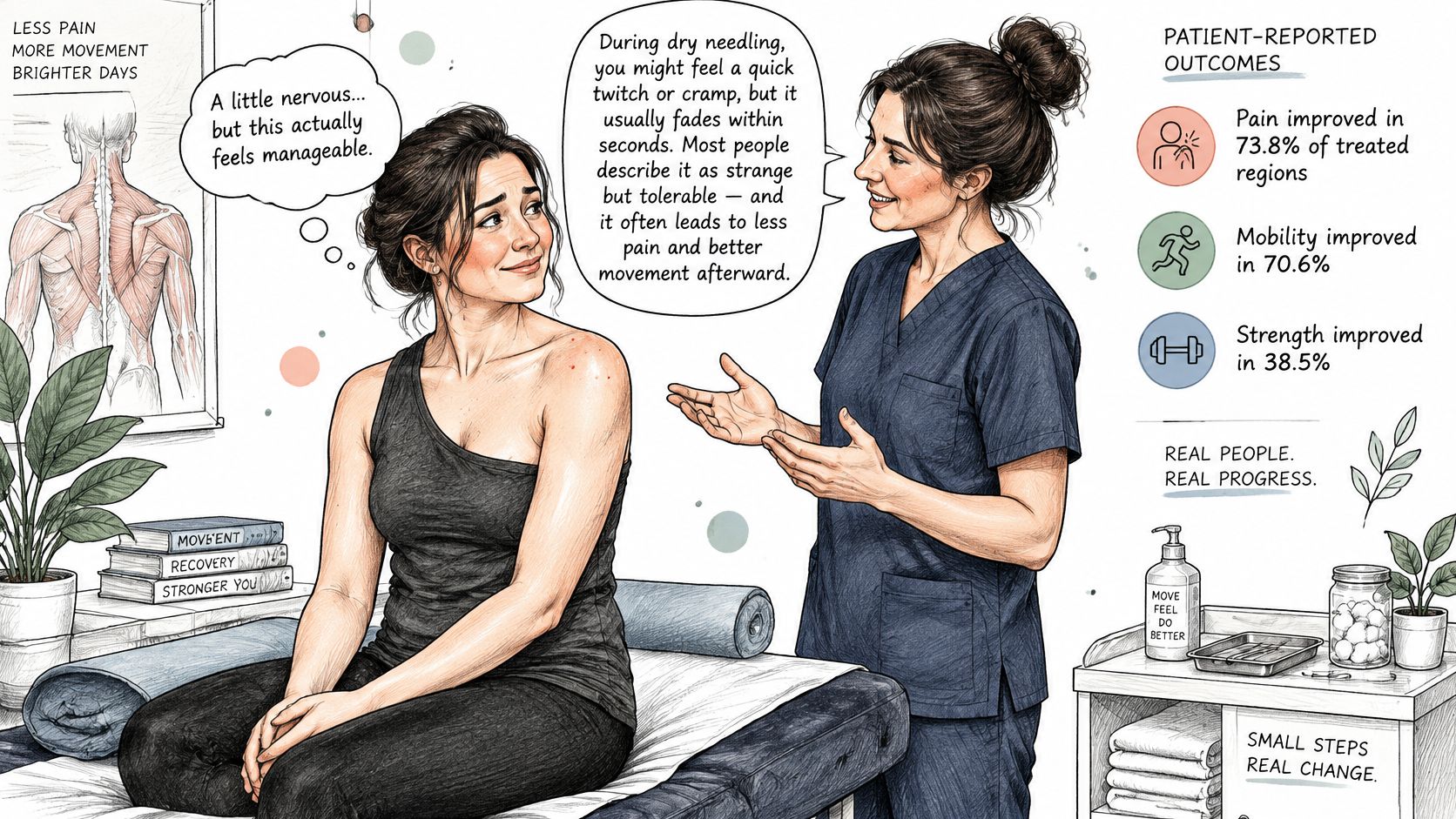
After a diagnosis-focused assessment and consent discussion, the clinician positions you, prepares the skin, and inserts a sterile, single-use filament into the selected area. Depending on technique, the clinician may briefly move the needle or leave it in place. You may feel a deep ache, cramp-like sensation, or twitch.
Tell the clinician if the sensation is sharp, unfamiliar, or difficult to tolerate. You don't need to endure escalating discomfort to make treatment effective.
Temporary local soreness can occur afterward. The clinician should explain what to expect for the particular region and technique, how to modify activity if needed, and when symptoms warrant contact. Neither soreness nor bruising should be treated as evidence that the procedure worked.
Extra assessment is appropriate before proceeding when any of the following apply:
Seek urgent medical evaluation for shortness of breath, chest pain, or progressive weakness after treatment. Contact the treating clinician for unusual, worsening, or persistent symptoms rather than assuming they're normal soreness.
The counseling standard is straightforward: discuss expected effects beforehand, recheck the chosen outcome afterward, and stop or reconsider when the response doesn't fit. A dramatic twitch is optional; informed consent and meaningful reassessment aren't.
Aspen Falls Wellness offers diagnosis-based musculoskeletal care, including chiropractic adjustments, massage, acupuncture, rehabilitation exercise, and non-surgical spinal decompression. Visit Aspen Falls Wellness to arrange an examination in Salt Lake City or Sandy and discuss whether a trigger-point-focused approach fits your symptoms, alongside a plan for restoring the activities you want back.

Stay updated with the latest chiropractic news and exclusive offers.