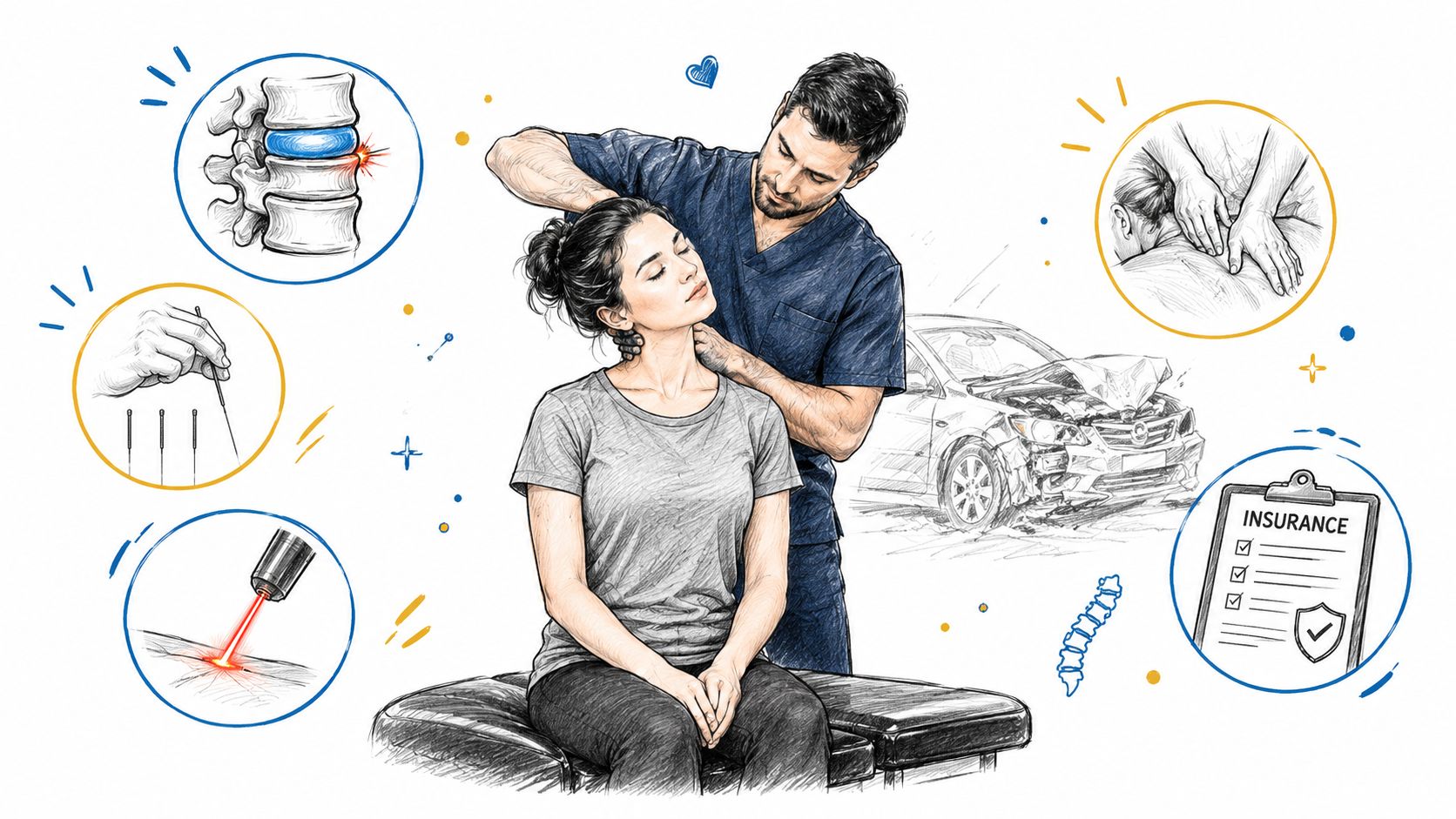
Learn how shoulder pain from poor posture develops, the signs to watch for, and effective relief strategies—from home exercises to professional care options.



You're halfway through a workday when the familiar ache appears between your shoulder blades. Your neck feels heavy, one shoulder sits higher than the other, and reaching for your coffee suddenly reminds you that your arm doesn't move as freely as it did that morning. You adjust your chair, roll your shoulders, and keep working, but the discomfort returns the next day.
That pattern is common, but shoulder pain from poor posture isn't as simple as “you slouch, so your shoulder hurts.” Sitting position can change how your shoulder blade and upper spine move in the short term. Longer-lasting symptoms may also involve sleep, stress, workload, repetitive arm use, and conditioning. A large Australian adolescent study found neck and shoulder pain was already common, with 47% reporting pain at some point in life, 29% within the previous year, and 5% at the time of assessment (PubMed). The researchers also found that posture alone didn't predict who had experienced pain after adjusting for gender.
This guide separates the immediate mechanical effects of posture from the broader reasons pain keeps returning. You'll learn what rounded shoulders do to movement, how to check your own patterns safely, which exercises may provide short-term support, and when an integrated clinical plan makes more sense than repeated posture reminders.
A deadline sprint often starts innocently. You sit down with your laptop, lean toward the screen, and promise yourself you'll move after finishing one more task. By midafternoon, your head has drifted forward, your upper back has rounded, and the shoulder on your mouse side has crept toward your ear.
The ache may feel dull rather than sharp. It often sits around the shoulder blade, across the top of the shoulder, or at the base of the neck. A short walk or shoulder roll might ease it, but the same discomfort returns when you resume the position that irritated it.
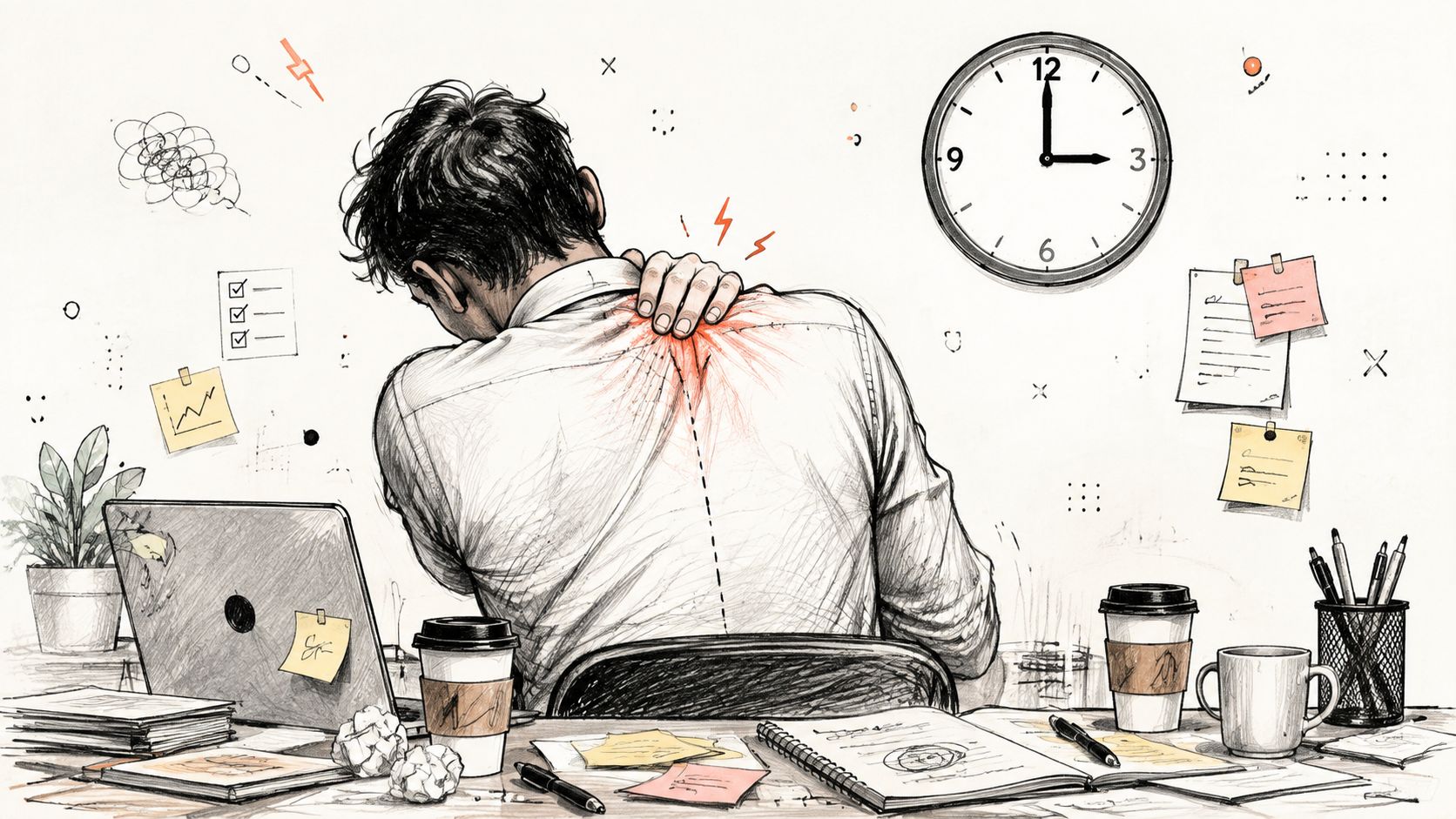
Your body responds to sustained positions, not just dramatic injuries. A shoulder that stays slightly forward for hours may ask some muscles to work continuously while other muscles contribute less. Add repeated mouse use, limited walking, poor sleep, or a stressful deadline, and the system has fewer opportunities to recover.
A modern worker study found 48.4% reported neck-and-shoulder pain, while 59.9% had an increased sitting head-neck posture and 59.9% had an increased standing head-neck posture (PubMed). Those findings show that measurable posture differences and shoulder-region symptoms commonly appear together in working populations. They don't prove that posture shape alone caused every person's pain.
Clinical perspective: Your posture is a movement habit, not a diagnosis. The useful question is which positions, tasks, and recovery factors make your symptoms better or worse.
Screen habits can also increase visual and physical fatigue. If squinting or leaning toward a screen encourages you to hold your head forward, learning ways to reduce workplace eye strain may complement changes to your desk setup.
The aim isn't to hold a rigid military posture all day. It's to give your neck, shoulder blade, and upper back more movement options, then build the strength and tolerance needed for your real workload.
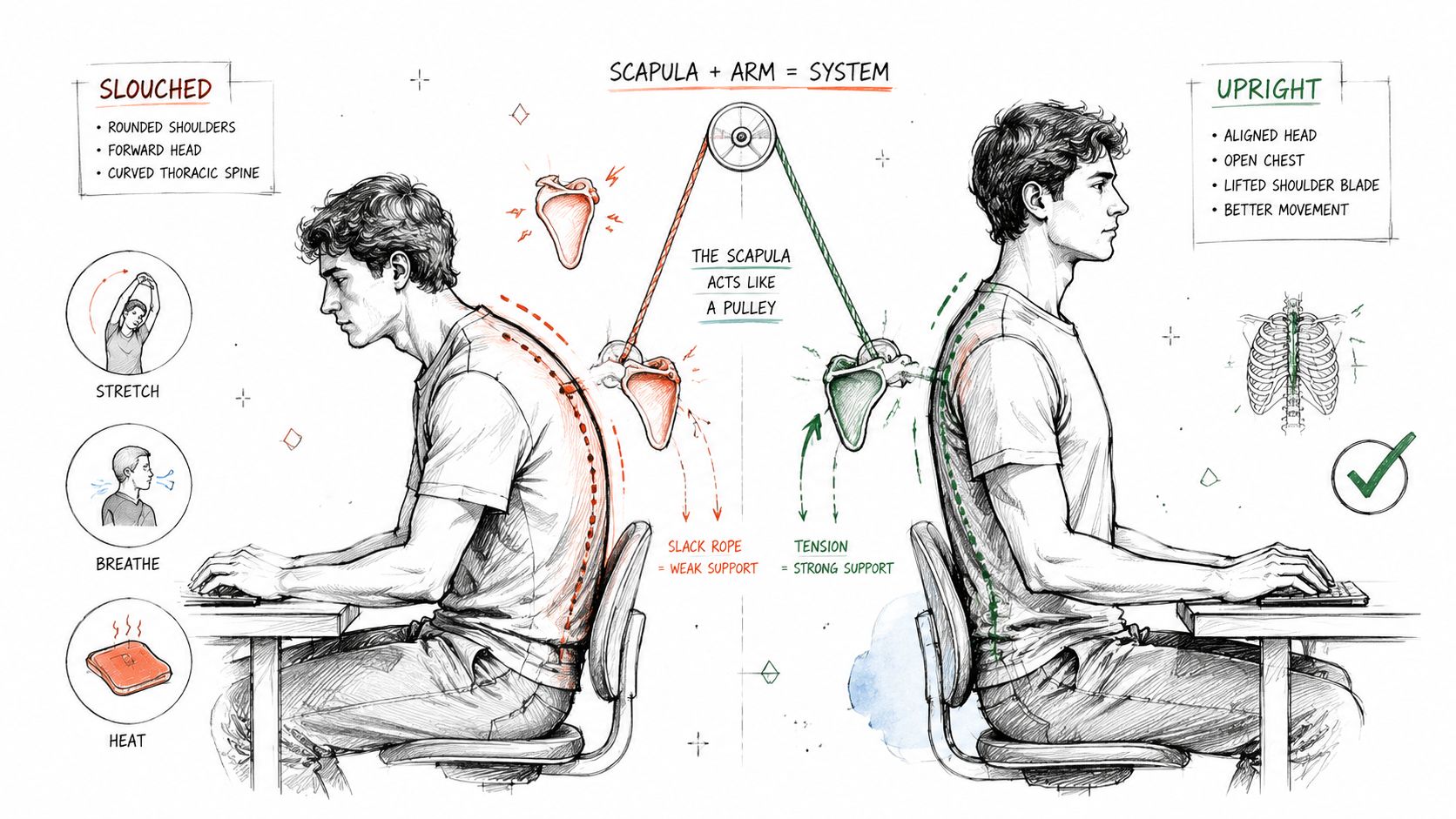
The shoulder blade rests on the rib cage and provides the anchor for arm movement. With rounded shoulders, that anchor shifts forward. Muscles around the blade and upper arm then begin from less efficient positions, much like workers trying to pull a load while standing at an awkward angle.
The scapula, or shoulder blade, must glide and rotate as the arm moves. The rotator cuff helps center the upper arm bone in its socket, while other muscles control the blade against the rib cage. Reaching, lifting, or holding the arm forward can demand more from these tissues when the shoulder rests forward for long periods.
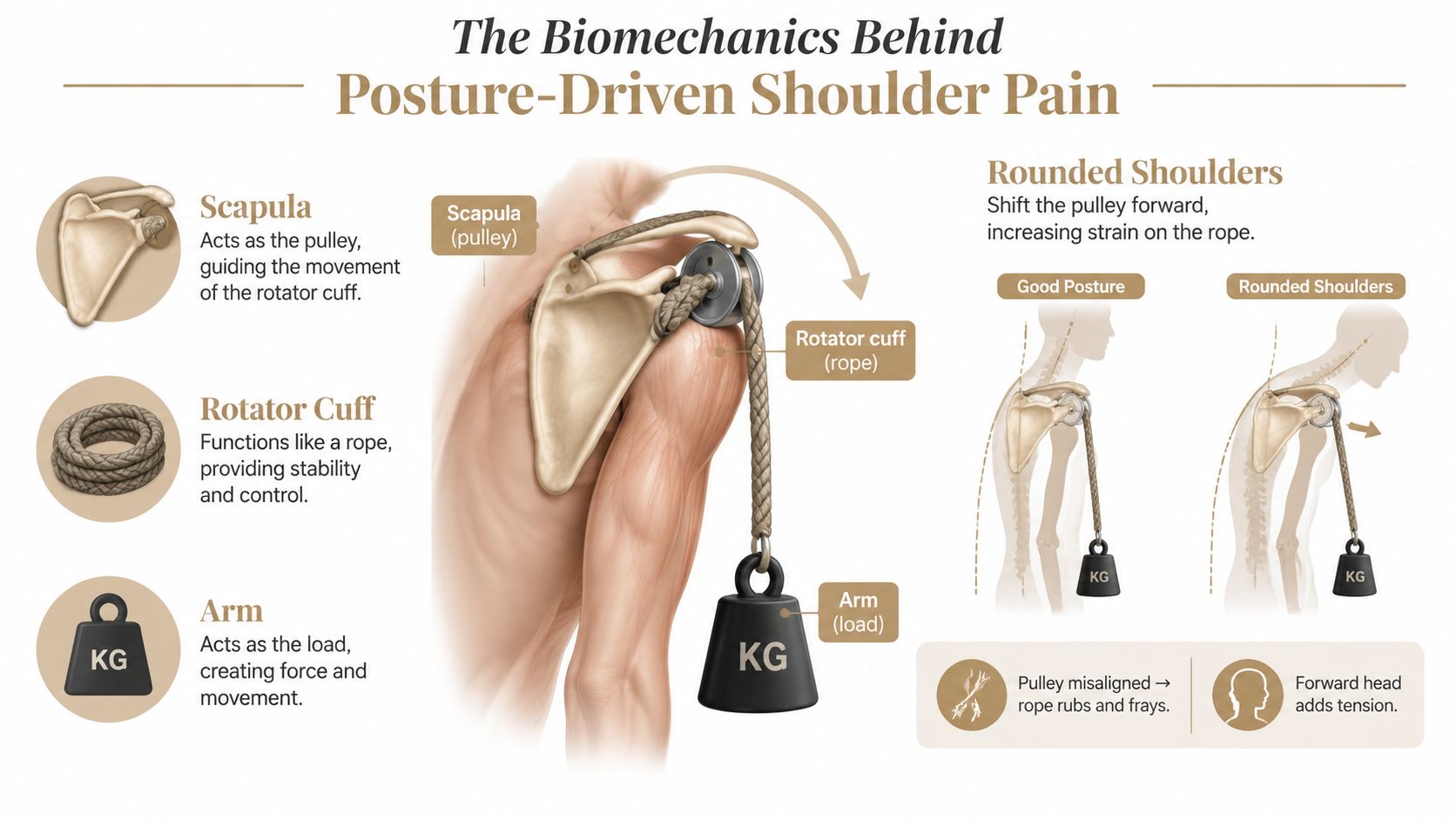
Scapular protraction means the shoulder blade rests farther around the side of the rib cage instead of drawing gently toward the spine. Anterior tipping means the upper part of the blade tips forward. Thoracic kyphosis describes the natural forward curve of the upper spine, which can become more pronounced when the chest collapses and the upper back remains rounded.
Forward head and rounded shoulder posture has been associated with shortened tissues at the front of the shoulder and lengthened posterior stabilizers. A review described altered scapular and glenohumeral orientation that may increase loading around the neck, shoulder, and arm (review in PMC).
In an overhead-task biomechanics study summarized in that review, people with forward head and rounded shoulder posture showed greater scapular internal rotation and reduced serratus anterior activation during flexion and reaching. They also showed increased upward rotation and anterior tipping during flexion. The shoulder blade still moved, yet its motion may have shared the task less smoothly.
A brief slouched position may cause no symptoms. Repeated exposure and long duration can lower the shoulder's tolerance, especially if the same tissues stay shortened, lengthened, or active for hours.
That pattern explains why someone may feel comfortable while sitting but develop an ache by late afternoon. The joints and muscles have spent too long managing an inefficient arrangement, so reaching or lifting becomes more irritating.
Posture is only part of the longer-term picture. Sleep, stress, workload, and physical conditioning can influence how well the shoulder recovers and adapts. Addressing those factors alongside movement mechanics gives a clearer explanation than blaming slouching alone.
Posture-related shoulder symptoms rarely look identical from person to person. One reader may have both shoulders rounded, while another keeps one shoulder raised because of mouse use or stress. Rounded shoulder posture is commonly described as forward displacement of the acromion, with the scapula raised, protracted, and downwardly rotated (peer-reviewed clinical study).
Use a mirror or side-view photograph to observe patterns, but don't treat appearance as proof of injury. A person can have a noticeable rounded posture without pain, while another can hurt despite looking relatively symmetrical.
| Pattern | Visual cues | Shoulder load |
|---|---|---|
| Forward head and rounded shoulders | Head sits ahead of the chest, shoulders drift forward, and collarbones may point down | More demand on neck and shoulder-blade stabilizers during desk work and reaching |
| Phone shoulder | One shoulder rolls forward or lifts while the head tilts toward the phone | Uneven loading across the neck, upper trapezius, and shoulder blade |
| Elevated mouse-side shoulder | One shoulder stays closer to the ear, especially during concentration | Sustained upper-trapezius activity and reduced opportunity for the shoulder to relax |
| Collapsed upper back with anterior tipping | Upper spine rounds, the front of the shoulder looks closed, and the lower shoulder blade edge may lift away | Less favorable shoulder-blade positioning during elevation |
Forward head and rounded shoulder posture often produces tension at the base of the skull, upper trapezius, chest, or inner border of the shoulder blade. A 2019 intervention study connected forward head and round-shoulder posture with altered scapular kinematics and muscle activity, which can increase stress on the shoulder complex (BMC Musculoskeletal Disorders).
A phone shoulder tends to create a clear side-to-side difference. Look for one elbow crease facing more backward, one collarbone sitting lower, or one shoulder blade appearing farther from the spine. The asymmetry matters most when it matches your symptoms or changes how you reach.
Stress can produce a different pattern. You may notice both shoulders rising, shallow breathing, and an upper trapezius that feels constantly switched on. In people with rounded shoulder posture and neck pain, upper trapezius stiffness has been measured as increased, supporting a mechanical change beyond a purely subjective sensation (PubMed).
A self-check can help you notice patterns, but it can't diagnose a rotator cuff tear, nerve problem, joint disorder, or other condition. Move slowly, compare sides, and stop if a test creates sharp pain, numbness, dizziness, or a sudden loss of strength.
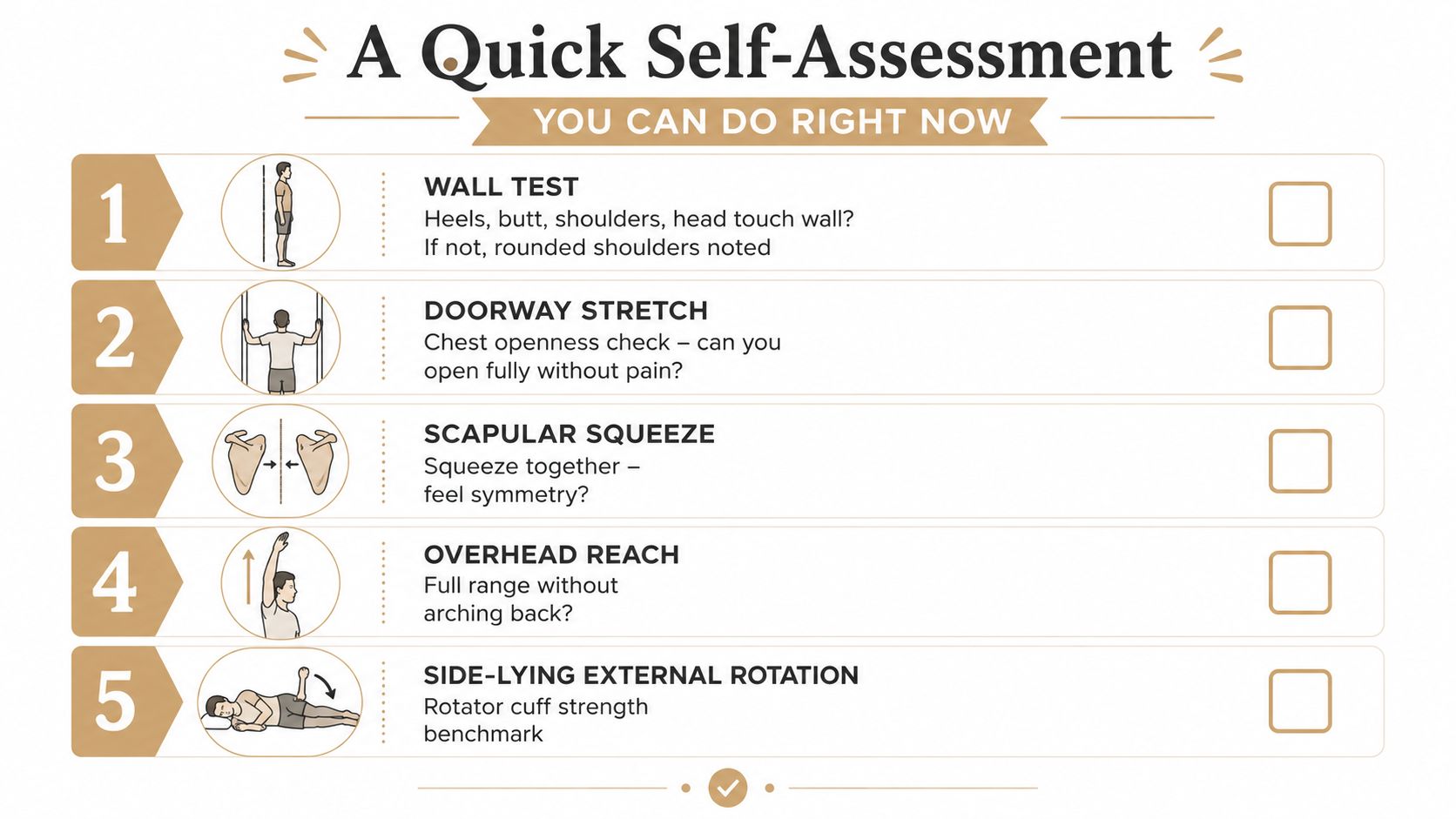
Wall test: Stand with your heels and buttocks near a wall. Let your upper back and head move toward it without forcing your chin upward. Notice whether your shoulders and head can approach the wall comfortably, or whether you need to arch your lower back and strain your neck.
Side-view check: Ask someone to take a relaxed side photograph, or use a mirror. Look for the ear sitting well ahead of the shoulder, a rounded upper back, and shoulder blades that appear to lift away from the ribs during arm movement.
Doorway chest check: Place your forearms on a doorway and take a small step forward. A comfortable stretch across the chest is expected. Pinching at the front of the shoulder, a large difference between sides, or an inability to keep the ribs relaxed deserves attention. For a more precise approach to how to measure ROM accurately, record the same position and compare changes over time.
Seated overhead reach: Sit tall without lifting the ribs or arching the lower back. Raise both arms as far as comfortable. A smooth, similar reach on both sides is reassuring, while painful restriction or marked asymmetry suggests the shoulder and upper back need a closer assessment.
Tenderness and control: Gently touch the upper trapezius and levator scapulae region. Then squeeze the shoulder blades lightly, keeping the shoulders away from the ears. Tenderness, shaking, or a clear difference between sides can guide what you tell a clinician, but it doesn't identify the exact cause.
Write down what you notice, including the activity that preceded the symptoms and which movements change them. A useful benchmark is not “perfect posture.” It's whether you can move with less discomfort and better control after a brief reset.
Start with the least demanding option that helps. If symptoms followed a recent flare, a wrapped cold pack may feel soothing. If the main sensation is muscular tightness without swelling or acute irritation, gentle warmth may be more comfortable. Keep either application brief and protect your skin.
A relaxed pendulum can reduce the urge to guard the shoulder. Lean forward with support from your unaffected arm, let the symptomatic arm hang, and make small circles or gentle forward-and-back movements. Keep the motion easy. The exercise should feel like the arm is swinging, not like you're forcing the joint.
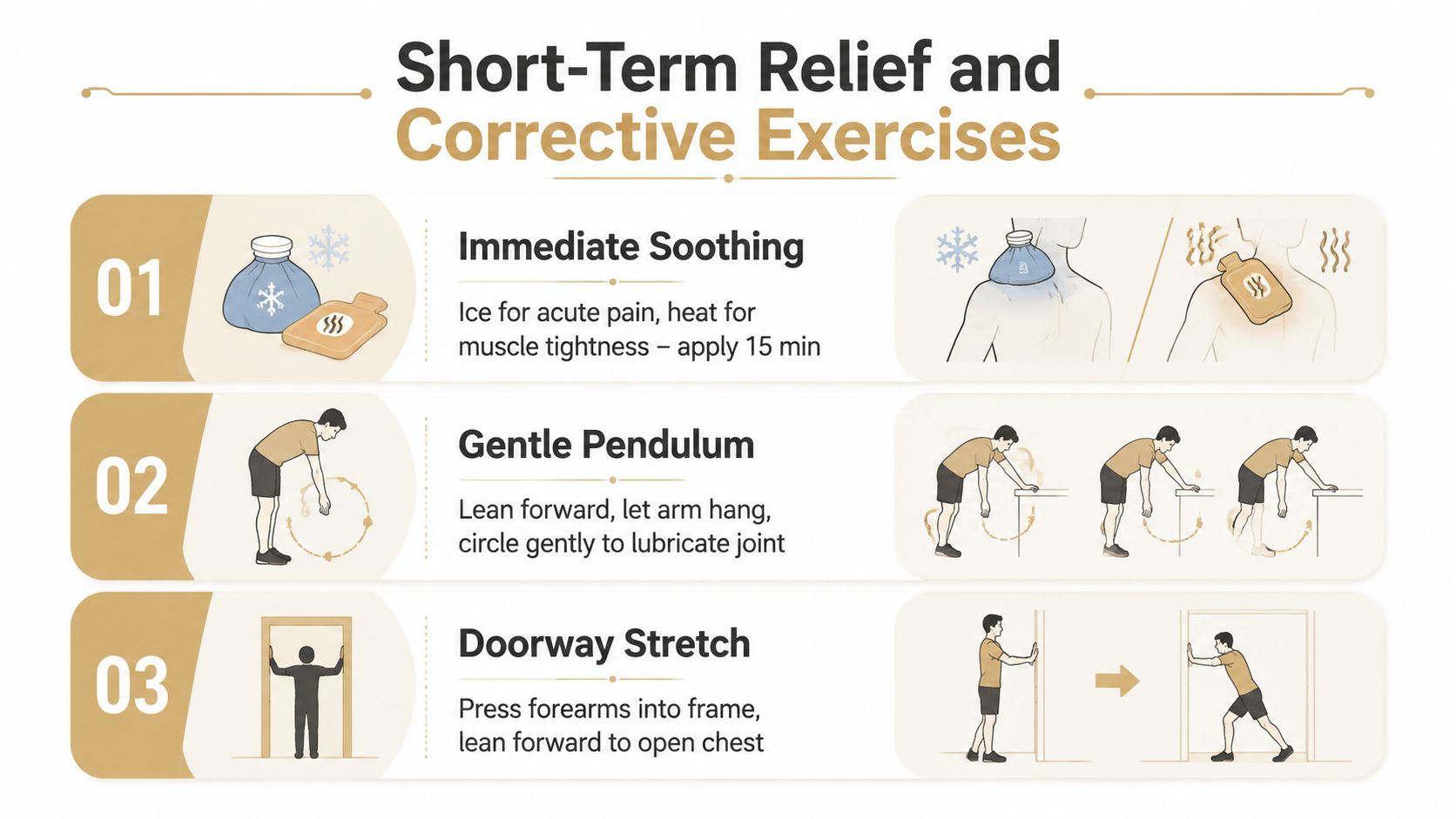
Try these beginner movements without chasing fatigue:
Chin tuck: Sit or stand tall and draw your head straight backward, as though making a small double chin. Don't look down or push the head forward at the end. This trains a more neutral head position without demanding a rigid posture.
Scapular setting: Let your shoulders drop away from your ears, then gently guide the shoulder blades back and slightly down. Avoid squeezing hard or pinning them together. You're practicing control, not creating tension.
Wall slide: Place your forearms against a wall and slide them upward only as far as you can keep the ribs from flaring. This encourages upward rotation and coordinated movement between the shoulder blade and upper arm.
Prone Y-to-W raise: Lie face down or hinge forward with a neutral spine. Raise the arms into a comfortable Y shape, then bend the elbows toward a W shape. Use small movements and keep the neck relaxed.
A doorway stretch can open the front of the chest, but forcing the elbows too far back or arching the lower spine can make symptoms worse. Review these common door frame stretch mistakes before adding intensity.
For more ideas, see this guide to best posture correction exercises. A home routine should complement evaluation when pain persists beyond two to three weeks, rather than replace it. Progress when the movement feels controlled, symptoms settle quickly afterward, and daily tasks become easier.
Self-care is reasonable when discomfort is mild, clearly linked to a temporary workload change, and steadily improving. Professional assessment becomes more important when pain lasts beyond two to three weeks, repeatedly returns, or interferes with sleep, work, dressing, or reaching.
Seek prompt clinical guidance if you notice:
Posture-related shoulder pain may involve joint mobility, muscle tone, motor control, workload, and recovery. An integrated clinic can assess those contributors together instead of treating the shoulder as an isolated body part.
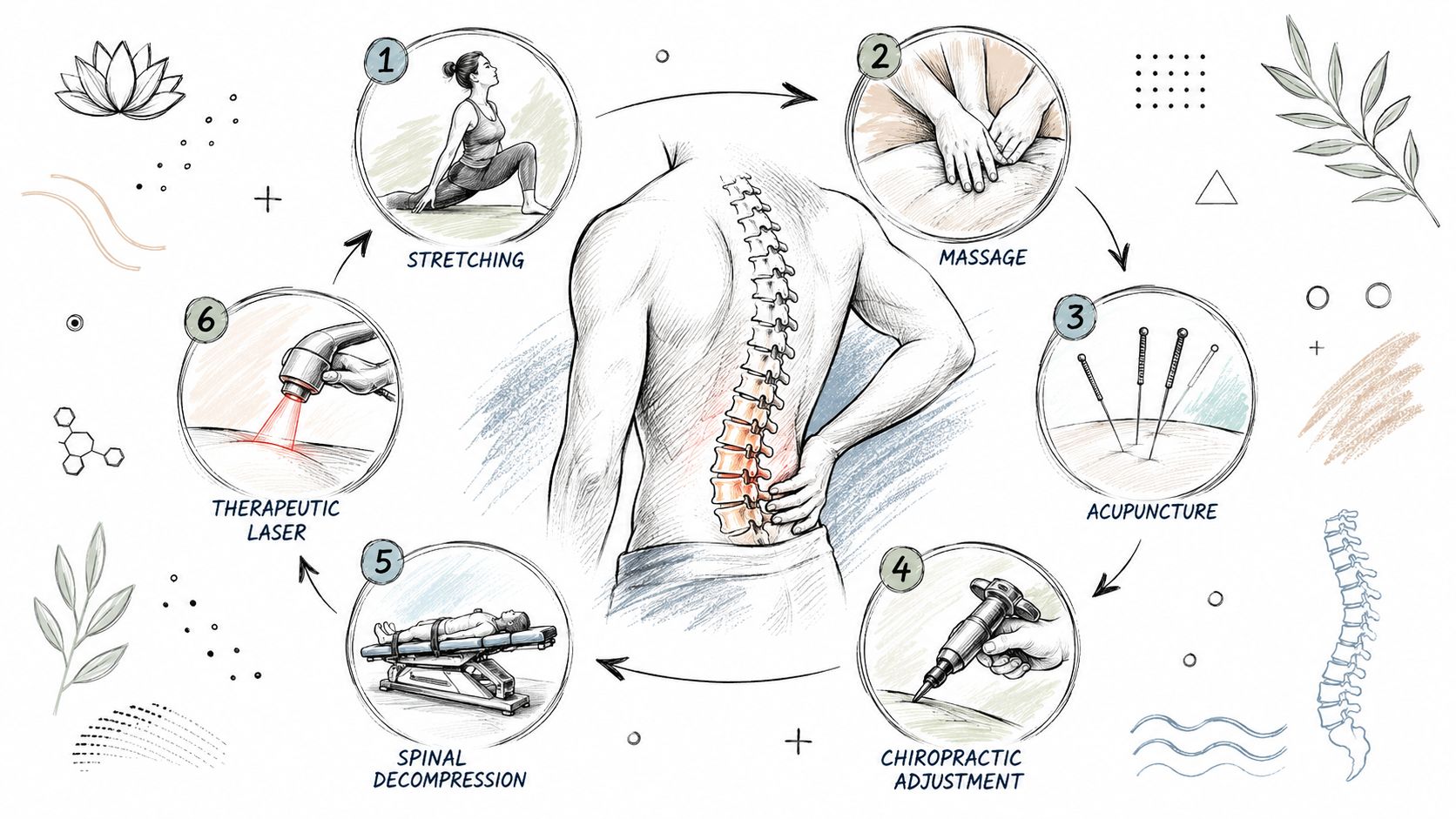
Chiropractic Adjustment and other targeted adjustment, realignment, and decompression approaches may be used to address joint mechanics and thoracic mobility when appropriate. Massage Therapy can help manage tight upper trapezius, levator scapulae, and chest tissues. SoftWave Therapy and MLS Laser Therapy may be included as non-surgical modalities for tissue stimulation and recovery support. Acupuncture can be considered as part of a broader pain-management plan.
A coordinated plan may also include Muscle Stimulation, Mobility Therapy, Rehabilitation Exercise, and Personal Exercise Plans. Aspen Falls Wellness is one example of a clinic offering chiropractic care, therapeutic massage, acupuncture, laser-based therapy, and exercise-focused services within an integrated model.
At an initial visit, expect questions about symptom behavior, work demands, sleep, previous injuries, and your goals. The clinician may examine neck and shoulder motion, strength, sensation, scapular control, and thoracic movement. If the pattern suggests a separate injury, the plan may include imaging referral or outside specialist coordination. Readers dealing with more specific shoulder concerns can also review information about rotator cuff injury recovery.
Lasting improvement usually depends on changing the daily environment that keeps provoking symptoms. The goal isn't perfect posture. It's frequent variation, adequate strength, and enough recovery for your shoulder to tolerate work, exercise, and ordinary life.
Begin with your workstation. Keep the screen high enough that you aren't constantly dropping your head toward the desk. Let the chair support your pelvis without forcing the shoulders forward, and keep the elbows close enough to the body that the mouse and keyboard don't pull one shoulder into a reaching position.
A short daily sequence might include a comfortable thoracic extension, a doorway chest stretch, wall slides, and controlled scapular setting. Adjust the range to your symptoms, and don't use an exercise to repeatedly provoke sharp pain.
Better target: Build the ability to change position and keep working comfortably, rather than trying to freeze yourself in one ideal alignment.
Professional care can provide the initial correction, but daily habits preserve it. Programs that combine mobility, strengthening, and motor retraining are more useful than reminders to “sit up” whenever you notice yourself slouching. Learn how structured therapeutic exercise can fit into a broader rehabilitation plan.
This week, complete a workstation audit, take a brief movement reset during each long work period, check whether your sleeping position compresses the shoulder, and reserve a short morning mobility routine. If symptoms remain, worsen, or include weakness, numbness, tingling, or significant night pain, arrange an evaluation rather than repeatedly restarting the same self-care cycle.
Aspen Falls Wellness offers individualized Chiropractic Care, Chiropractic Adjustment, Massage Therapy, MLS Laser Therapy, SoftWave Therapy, Acupuncture, Mobility Therapy, Rehabilitation Exercise, and Personal Exercise Plans for posture-related shoulder and musculoskeletal concerns. Visit Aspen Falls Wellness to request an assessment in Salt Lake City or Sandy and discuss a coordinated plan for pain relief and lasting movement.

Stay updated with the latest chiropractic news and exclusive offers.