Learn how does acupuncture reduce pain through proven neurophysiological mechanisms, including opioid release, neural gating, and inflammation modulation, plus
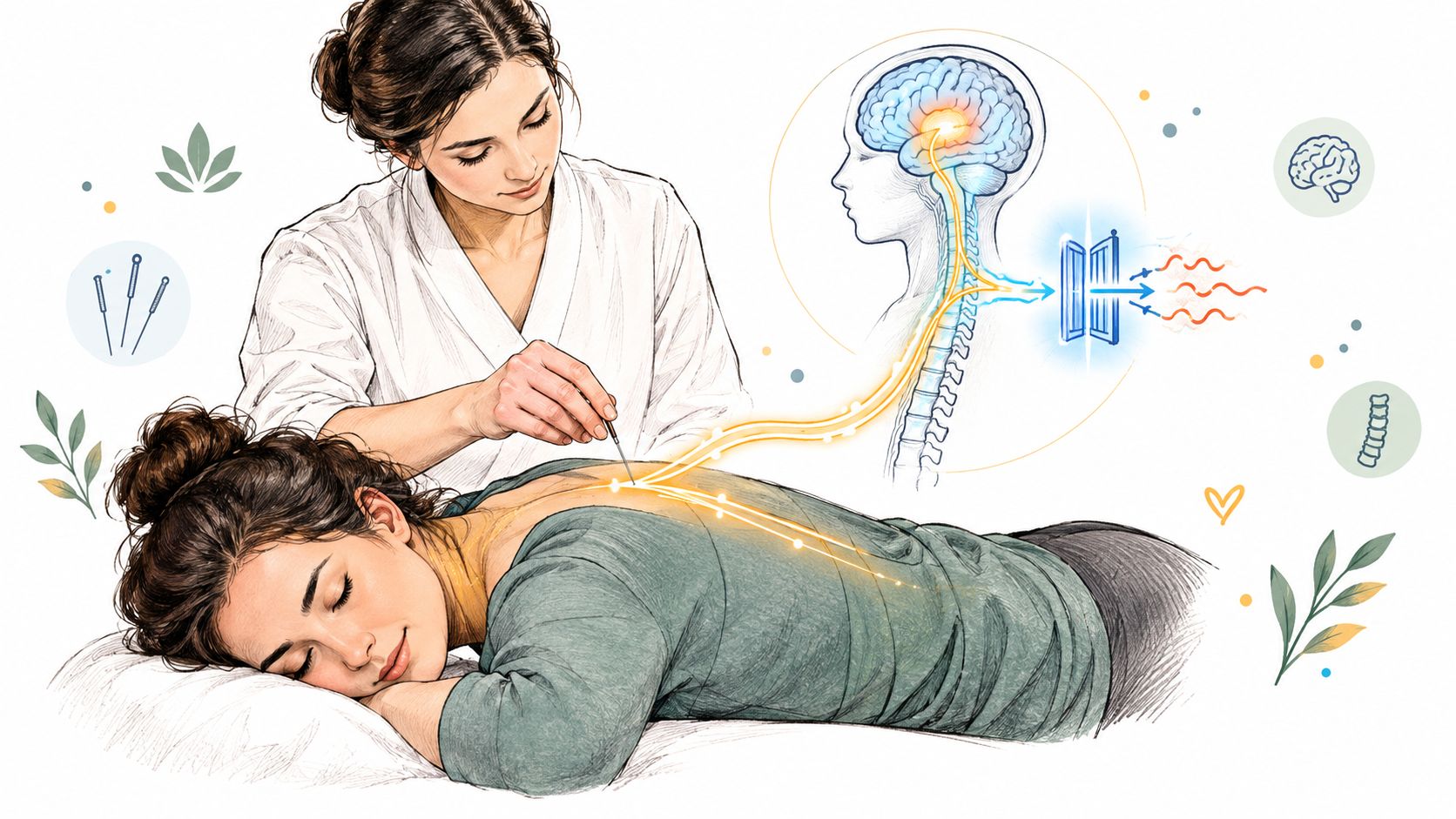
If pain comes from an irritated joint, disc, or nerve, how can a needle placed somewhere else make it hurt less? The answer starts with a distinction that's easy to miss: treating pain signals isn't the same as repairing the tissue that helped trigger them.
You may be asking how acupuncture works because medication, rest, or stretching hasn't settled your symptoms. Before trying another treatment, you deserve more than a promise that it will release endorphins or restore balance. You need to know what it might change, what it can't change, and how to judge whether it's helping.
Acupuncture is best understood as a pain-modulation treatment. Needle stimulation can influence how the nervous system transmits and regulates painful signals through interacting peripheral, spinal, and brain pathways. That makes it more than a vague wellness ritual, but it doesn't make it a universal solution for chronic pain, as explained in this review of acupuncture's analgesic mechanisms.
Think of treatment as answering different questions. What's producing the symptoms? What's keeping the nervous system sensitive? What's preventing you from moving comfortably?
Those questions may lead to different parts of a care plan:
Acupuncture belongs primarily in the pain-modulation category. Chiropractic care, decompressive techniques, soft-tissue work, and exercise may also be considered, but each should have a specific purpose rather than being added automatically.
Practical distinction: Feeling better can create an opportunity to move and rehabilitate. It doesn't, by itself, prove that an underlying injury has healed.
A useful starting expectation isn't that acupuncture will fix everything. It's that a clinician will explain why it fits your condition, agree on a reassessment point, and adjust the plan according to your response. Treatment frequency and duration should follow that reasoning, not a preset promise.
So, how does acupuncture reduce pain? The clearest explanation is that needling provides sensory input that can recruit several pain-regulating systems. These systems overlap rather than operating like separate switches.
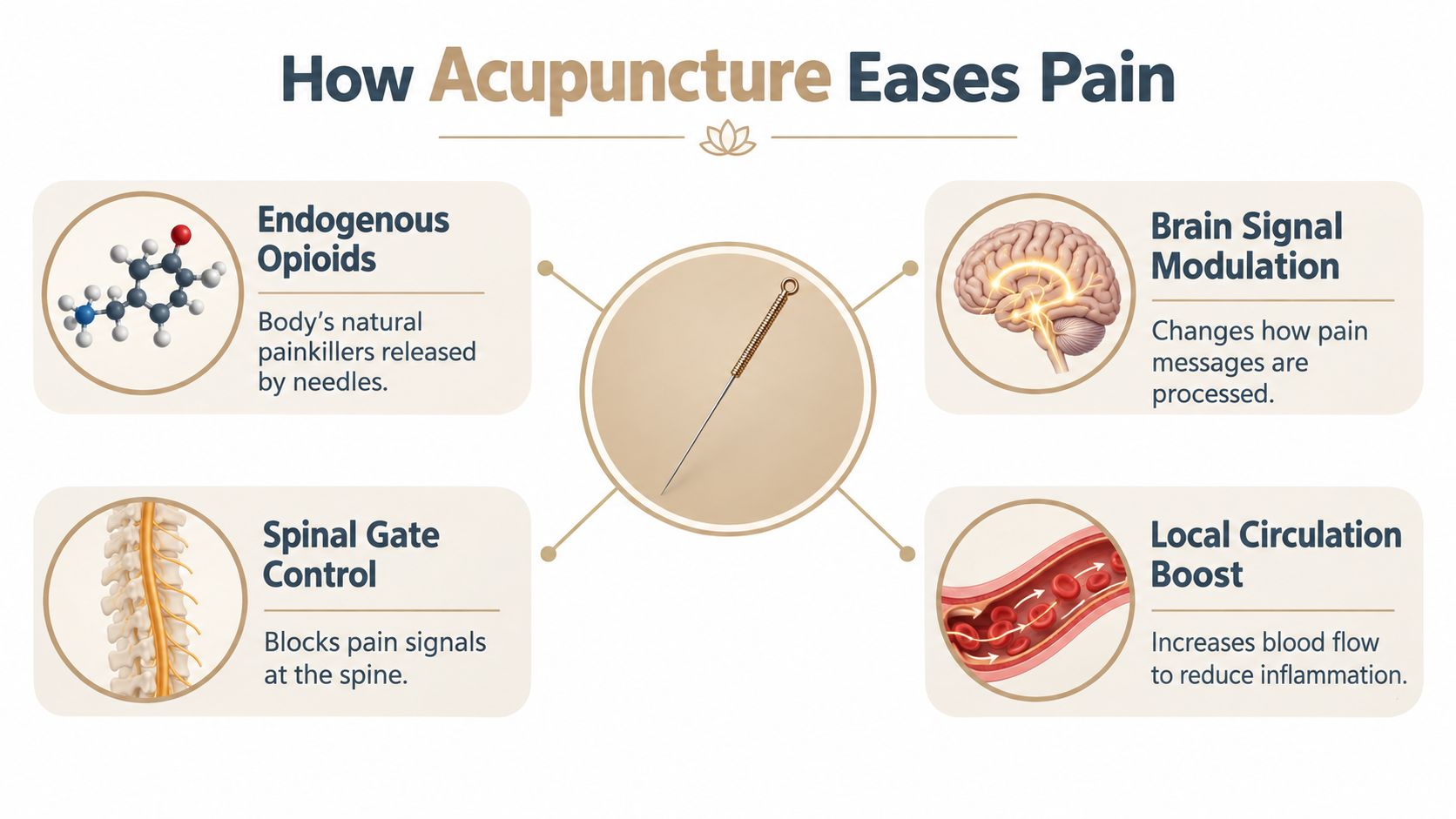
The nervous system has its own chemical braking system. Endogenous opioids, including endorphins, enkephalins, and dynorphins, act on receptors involved in pain regulation.
One important experimental clue comes from naloxone, a medication that blocks opioid receptors. Experiments in which naloxone interfered with acupuncture's analgesic effect support an opioid-related mechanism, although this pathway isn't fully established in humans, as summarized in the overview of acupuncture and traditional medicine.
That doesn't mean acupuncture delivers a drug or numbs the treated area. The idea is that sensory stimulation can recruit pain-inhibiting chemistry the body already possesses.
The spinal cord isn't just a cable carrying messages upward. It also regulates which signals pass through. Segmental inhibition, often described as a spinal pain gate, means that incoming sensory activity can dampen the relay of pain-related information.
The brain can also send inhibitory messages downward. Brainstem regions, including the periaqueductal gray, participate in these descending pathways, which use chemicals such as serotonin, norepinephrine, and endogenous opioids. Reviews also describe effects on excitatory signaling associated with persistent pain in this discussion of descending inhibition and acupuncture.
These connected pathways help explain why stimulation in one location might change pain experienced elsewhere. They don't establish that every distant needling point works equally well for every condition.
Four Pathways Acupuncture Uses to Modulate Pain
| Mechanism | Where It Acts | Key Chemical | What the Patient Notices |
|---|---|---|---|
| Endogenous opioid activity | Pain-regulating neural networks | Endorphins and related opioids | Pain may feel less intense |
| Segmental inhibition | Spinal cord | Multiple signaling chemicals | Incoming pain may feel less prominent |
| Descending inhibition | Brainstem and spinal cord | Serotonin, norepinephrine, opioids | Pain may feel less intrusive |
| Local signaling | Tissue near the needle | Adenosine | Local discomfort may ease |
These are possible experiences, not sensations that prove a particular pathway has activated.
Adenosine, a non-opioid signaling chemical, is another proposed contributor near the needling site. The circulation branch in the infographic shouldn't be interpreted as proof that increased blood flow explains every clinical benefit. The evidence supports a more complex account involving local and central processes, with limited and heterogeneous neuroimaging findings, including altered pain-network connectivity and opioid-receptor binding, discussed in this review of neurophysiological mechanisms.
For a related patient-facing explanation, consider this overview of nervous system regulation therapy. Mechanistic plausibility helps explain treatment, but it doesn't establish a guaranteed schedule or prove that repeated sessions will outperform an isolated visit for every patient.
A useful improvement isn't necessarily the complete disappearance of pain. For someone with low-back symptoms, it might mean walking with less interruption. For someone with neck pain, it might mean turning more comfortably during daily tasks.
These are examples of treatment goals, not promised outcomes or individual case reports.
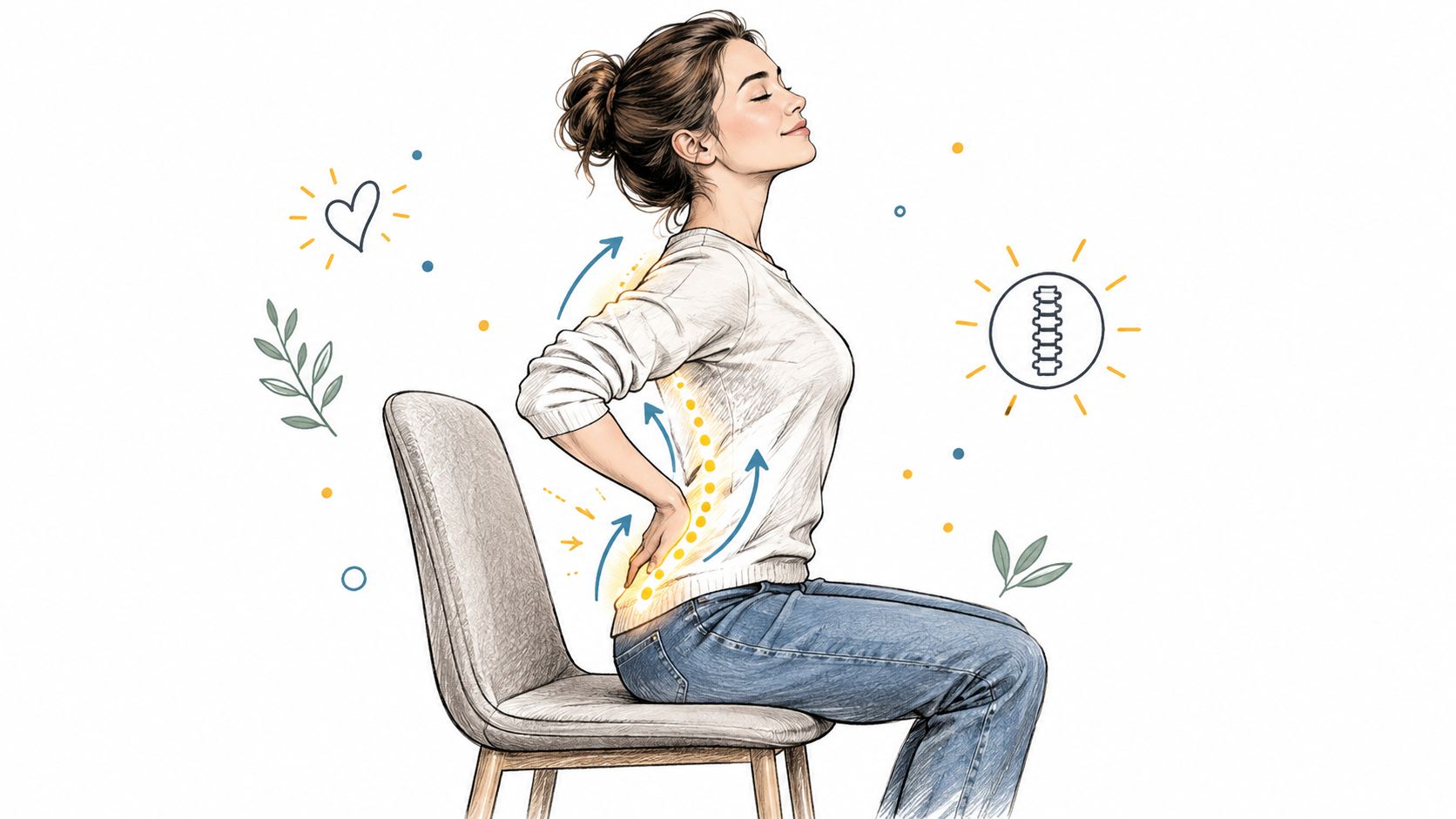
Before treatment, choose ordinary activities that your symptoms currently limit. Describe them clearly enough that you and your clinician can compare the same tasks later.
A pain score can still help. This explanation of pain scale assessment offers a starting point for describing symptom intensity, but a score shouldn't be the only basis for treatment decisions.
If radiating leg pain settles, that doesn't demonstrate that a disc herniation has disappeared. Likewise, a more comfortable neck after a post-accident treatment doesn't establish that every injured structure has recovered. Acupuncture may alter symptom processing without mechanically removing a herniation, reversing stenosis, or repairing torn tissue, a distinction discussed in this review of pain mechanisms and treatment personalization.
There isn't a universal timetable for when relief should begin or how long an individual session should last. Pain mechanism, symptom duration, baseline sensitivity, expectations, and accompanying rehabilitation can affect the response. A planned trial with follow-up is more informative than judging success from how you feel immediately after leaving the clinic.
Look for a pattern you can use in daily life, not just a pleasant treatment-room experience.
For broader reading about joint-care terminology, NexiHerb joint care insights from NexiHerb LLC provides a separate educational resource. Keep general joint-care information distinct from evidence that a particular treatment repairs a particular structure.
The strongest clinical question isn't whether acupuncture has a plausible mechanism. It's whether people receiving it improve more than people receiving a comparison treatment.
A landmark 2012 individual-patient-data meta-analysis analyzed 29 of 31 eligible randomized trials, involving 17,922 patients with back or neck pain, osteoarthritis, or chronic headache, as reported in the original chronic-pain meta-analysis.
Researchers compared acupuncture with both sham acupuncture and no-acupuncture controls. Sham procedures attempt to resemble treatment without delivering the same intervention, but they aren't necessarily devoid of sensory or contextual effects.
The following standardized differences favored acupuncture, according to the meta-analysis of acupuncture for chronic pain.
| Pain Category | Advantage Over Sham | Advantage Over No Acupuncture |
|---|---|---|
| Back and neck or musculoskeletal pain | 0.23 standard deviations | 0.55 standard deviations |
| Osteoarthritis | 0.16 standard deviations | 0.57 standard deviations |
| Chronic headache | 0.15 standard deviations | 0.42 standard deviations |
Standardized differences aren't percentages. They express differences on a shared statistical scale so researchers can combine studies using different pain measurements.
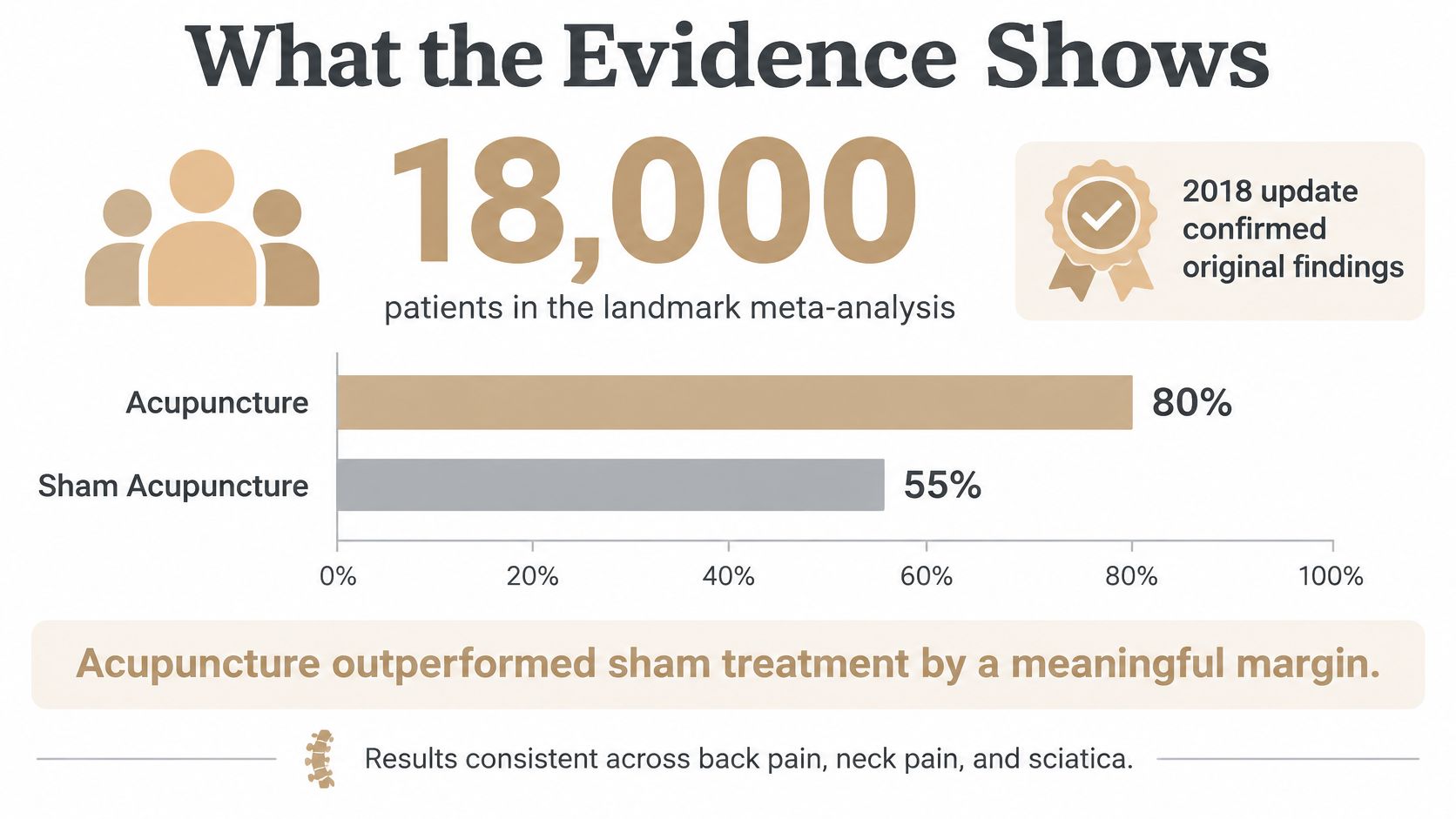
The graphic's percentage wording and illustrative bar lengths shouldn't be used as clinical effect estimates. The table gives the relevant standardized effects; the graphic also shouldn't be read as establishing sciatica-specific results.
The modest advantage over sham supports a contribution beyond expectation alone. The larger advantage over no acupuncture reflects the combined experience of needling, sensory stimulation, clinician contact, expectations, and the treatment setting. That doesn't make relief imaginary. It means the full treatment effect has several contributors.
The 2018 update expanded the evidence to 39 trials and 20,827 patients, finding statistically significant benefits over sham across four chronic-pain conditions. It estimated that approximately 60% of benefit relative to usual care reflected nonspecific and sham-related effects, while approximately 40% reflected specific effects; only about 10%–15% of benefit was lost 12 months after treatment, according to this summary of the updated evidence.
Those are group-level findings, not a forecast for an individual patient. Persistence of average benefit doesn't tell you exactly how long your next appointment's effects will last.
Condition-specific decisions still require separate evidence. If your question involves jaw pain, Eric Wiitala DDS's TMJ Botox treatment guide is a separate resource for discussing that option with a dental clinician, not evidence that the acupuncture results above apply to TMJ treatment.
The most defensible way to assess fit is to start with the condition studied, then consider the person. A convincing biological explanation alone can't tell us which individual will respond best.
The large analyses described above provide the clearest support here for chronic back and neck pain, osteoarthritis, and chronic headache. They don't justify treating all pain diagnoses as interchangeable.
| Clinical Presentation | How to Think About Fit | Important Limit |
|---|---|---|
| Chronic back or neck pain | A reasonable setting to discuss an adjunctive trial | Average benefit doesn't guarantee an individual response |
| Osteoarthritis-related joint pain | Consider symptom management alongside activity goals | Reduced pain doesn't demonstrate cartilage repair |
| Chronic headache, including presentations described as tension-type headache or migraine | Establish the headache diagnosis before selecting care | The pooled figures above don't provide separate estimates for every subtype |
| Sciatica associated with disc herniation or stenosis | Assess neurologic findings and the suspected cause first | Don't transfer general back-pain results directly to nerve-compression conditions |
| Post-accident neck symptoms | Begin with injury assessment and appropriate triage | A treatment response isn't a substitute for diagnosis |
The same caution applies to knee versus hip osteoarthritis. Broad osteoarthritis findings shouldn't be turned into an unsupported promise that every joint responds equally.
When pain involves amplified nervous-system sensitivity, modulation is a plausible treatment target. Inflammatory and neuropathic pain may involve different processes, and research is exploring whether protocols can be matched to those differences. That doesn't yet establish a universally superior technique or a reliable profile of the ideal responder.
A clinician should therefore explain why acupuncture fits your presentation, rather than claiming that sensitive patients, athletic patients, or people with a particular personality predictably do best. Expectations can influence the treatment experience without making persistent pain a matter of attitude.
For jaw symptoms, a dental assessment may answer a different question than a spine-focused evaluation. Dental Professionals of Fair Lawn's guide to TMJ care for families offers related reading without implying that headache evidence establishes effectiveness for jaw disorders.
In an integrated musculoskeletal plan, acupuncture, chiropractic adjustment, spinal decompression with the DRX 9000, MLS Laser Therapy, and corrective exercise should each have a defined indication. Their availability doesn't mean every patient needs the whole menu, or that combining them automatically produces a superior result.
Safety begins before the needles are opened. The treating practitioner should review your history, explain the proposed approach, and decide whether treatment needs modification, deferral, or coordination with another clinician.

Minor effects can include temporary soreness, bruising, localized bleeding, and lightheadedness. Serious adverse events are rare, but pregnancy and other risk factors require individualized screening rather than blanket reassurance, as discussed in this review addressing acupuncture safety and clinical precautions.
The U.S. Food and Drug Administration regulates acupuncture needles as medical devices and requires sterile, single-use labeling. Improper treatment can cause infection, punctured organs, or central nervous-system injury, according to the acupuncture effectiveness and safety overview.
Seek medical evaluation promptly: New progressive weakness, bowel or bladder dysfunction, fever, major trauma, unexplained weight loss, or suspected infection shouldn't be managed by simply booking another pain-relief session.
For care in Salt Lake City or Sandy, ask who coordinates the plan and how practitioners share findings. An approach to multidisciplinary pain management should connect symptom management with diagnosis, movement goals, and reassessment.
Possible services include chiropractic adjustment, non-surgical spinal decompression, massage therapy, mobility therapy, and home exercise. Sequence them around a clear purpose, such as making a prescribed movement task tolerable, rather than adding treatments without a way to judge their contribution.
Start with an assessment and a time-limited trial, not an open-ended commitment. Agree on the activities you want to regain, record a baseline, and decide when you'll review progress.
The service should fit the goal. Options may include SoftWave Therapy, Muscle Stimulation, Nutrition and Nutrition Counseling, Personal Exercise Plans, and Rehabilitation Exercise. Golf Movement Screening or Car Accident Treatment may address a specific activity or injury history; Sciatica Treatment requires attention to the underlying presentation.
Ask what any proposed adjustment, decompression, or realignment is intended to accomplish. The useful endpoint is a coordinated plan you understand, with realistic goals and a clear reason to continue, change, or stop.
Aspen Falls Wellness offers acupuncture alongside chiropractic care, DRX9000 spinal decompression, massage, mobility therapy, and personalized rehabilitation in Salt Lake City and Sandy. Visit Aspen Falls Wellness to schedule an evaluation and discuss whether a monitored acupuncture trial fits your condition, medical history, and movement goals.

Stay updated with the latest chiropractic news and exclusive offers.