Discover functional mobility exercises that build strength, relieve pain, and restore daily movement. A practical guide with routines for every level.
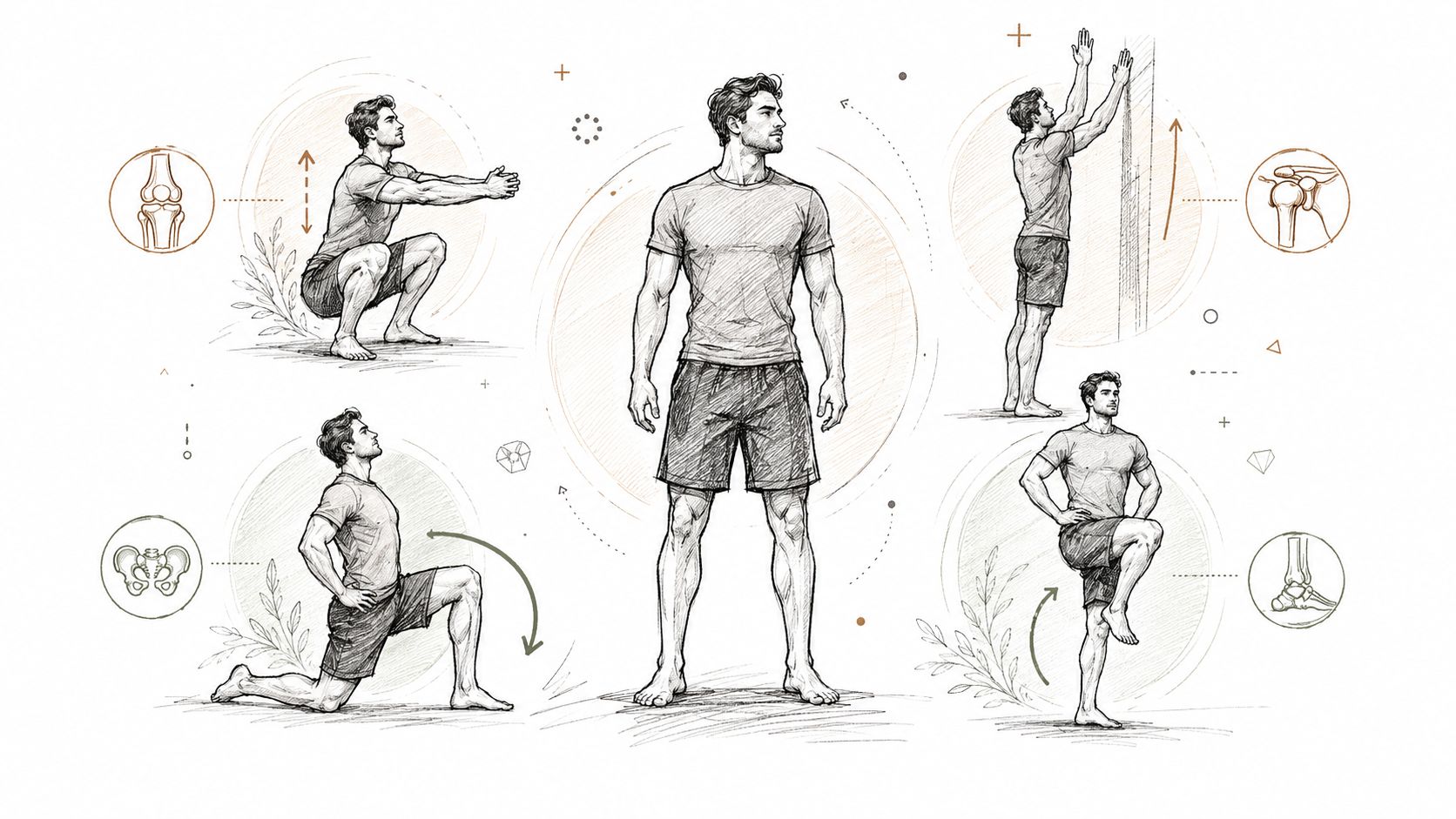



You've spent most of the day at a desk. When you stand, your lower back feels locked, your hips take a moment to catch up, and reaching for the seatbelt makes one shoulder complain. That pattern is common, but it isn't something you have to accept as a permanent part of getting older or working at a computer.
Functional mobility exercises train the movement your day demands, including sitting down, standing up, bending, lifting, reaching, turning, and walking. The strongest programs don't chase dramatic stretches for social media. They build control, usable range, balance, and confidence, then progress those qualities according to your symptoms and capacity.
Functional mobility is your ability to move through everyday tasks with enough range, control, and coordination to avoid unnecessary compensation. It's what lets you rise from a chair without twisting, pick up a laundry basket without folding through your lower back, turn to check traffic, or reach a high shelf without forcing the shoulder joint.
Flexibility and strength are related, but they aren't the same as mobility. Flexibility describes how much a muscle or joint can lengthen or move, often with assistance. Strength describes how much force you can produce. Mobility sits between those qualities. It asks whether you can actively use your available range while keeping your joints and trunk organized.
A person may be able to touch their toes but struggle to hinge safely while lifting. Someone else may have strong legs but lack enough ankle or hip motion to squat without the knees or back taking over. Functional mobility exercises address that gap by pairing range with active control.
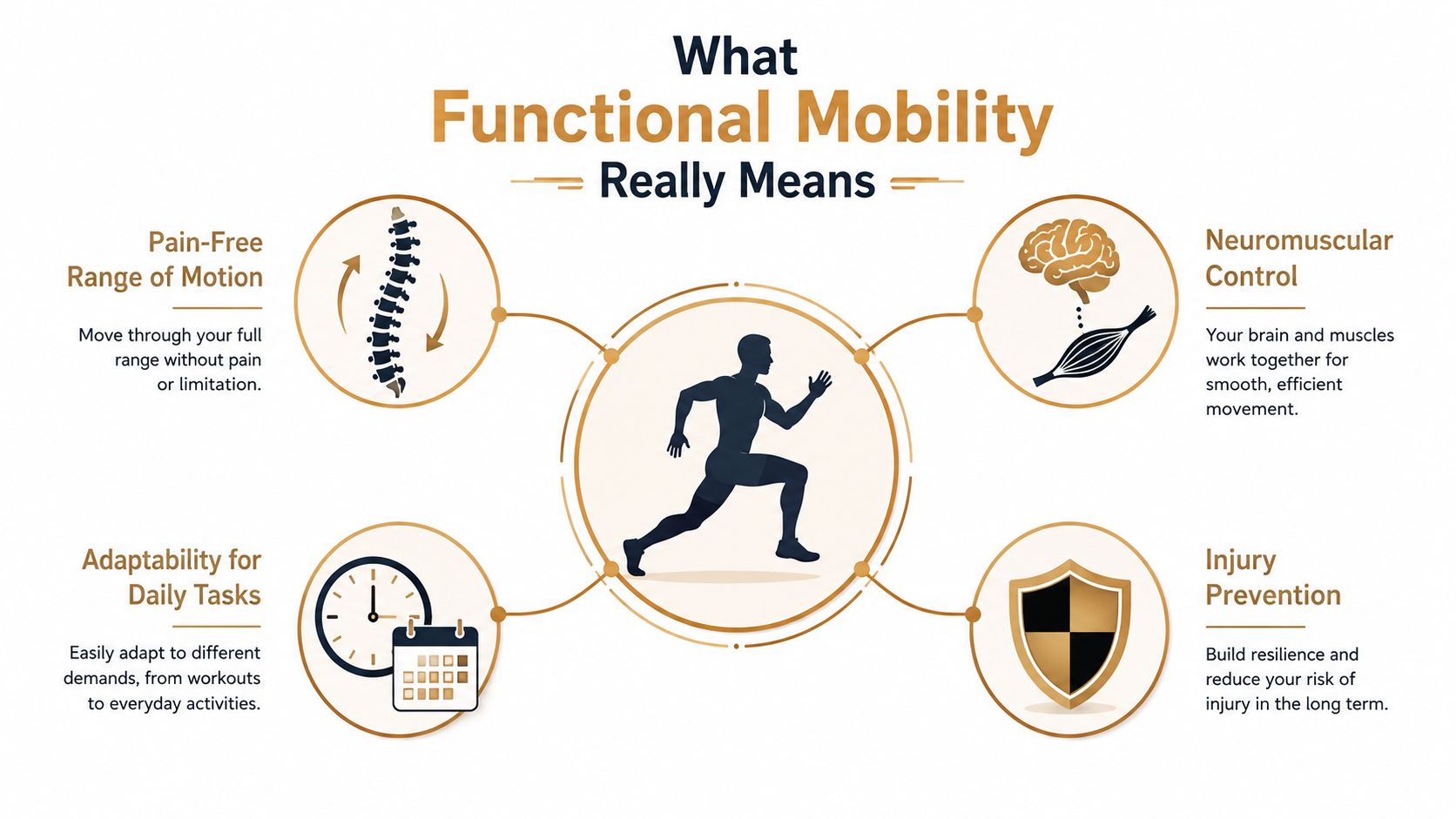
The value of mobility shows up outside the gym. You need hip and ankle motion to use stairs, thoracic rotation to look behind you, shoulder range to dress, and balance to step over an uneven surface. When those abilities decline, people often move less, which can make stiffness and deconditioning harder to reverse.
Public-health guidance has gradually moved from simple aerobic targets toward multicomponent activity that includes balance, strength, and mobility. The World Health Organization's guidance includes at least 150 minutes of moderate-intensity aerobic activity weekly, or 75 minutes of vigorous activity, and recommends balance-focused activity on 3 or more days per week for older adults with poor mobility. The CDC also recommends aerobic activity, muscle strengthening on at least 2 days per week, and balance work for adults 65 and older. Australia's 2026 recommendations specify functional activities targeting mobility, balance, and coordination on 3 or more days per week. These recommendations are summarized in the European Commission's physical-activity guidance table.
Practical rule: Train the movement you want to keep. A hip opener matters more when it helps you get out of a car, climb stairs, or lift from the floor.
Mobility is trainable at any age, but the dose must match the person. A calm, controlled chair transition may be more useful than an advanced balance drill for someone with pain or fall risk. If stress makes it difficult to notice how your body feels, a resource such as shadow work for anxiety may complement, but never replace, appropriate physical evaluation. For readers who want the broader role of movement in care, this guide to therapeutic exercise provides useful context.
Before choosing exercises, identify the movement that limits you. Use a sturdy chair, a clear wall, and a stable surface. Keep the tests gentle. Sharp pain, electric sensations, marked dizziness, or a feeling that a joint may give way are reasons to stop, not signs that you need to push harder.
Sit toward the front of a standard chair with your feet planted. Cross your arms over your chest if that feels safe, then stand and sit with control for 5 repetitions. Use your hands if you need them, but record that modification rather than treating it as failure.
Watch your knees, pelvis, and trunk. Do your knees collapse inward? Do you shift toward one side? Do you drop heavily into the chair? These details can reveal reduced hip or ankle motion, lower-body weakness, or limited trunk control. A smooth, symmetrical movement without sharp pain is a reasonable baseline for a healthy adult, but your own quality matters more than comparison.
Stand with your back near a wall and feet comfortably positioned. Raise one arm overhead, then the other, without forcing the ribs forward or arching aggressively through the low back. Notice whether one side stops earlier, whether the shoulder pinches, or whether your neck and ribs compensate to create extra range.
This screen gives you information about shoulder motion and the contribution of the upper back. If the arm reaches higher when you arch your back, the shoulder may not be providing as much usable motion as the total shape suggests. Repeat the test after a gentle warm-up and record whether the difference changes.
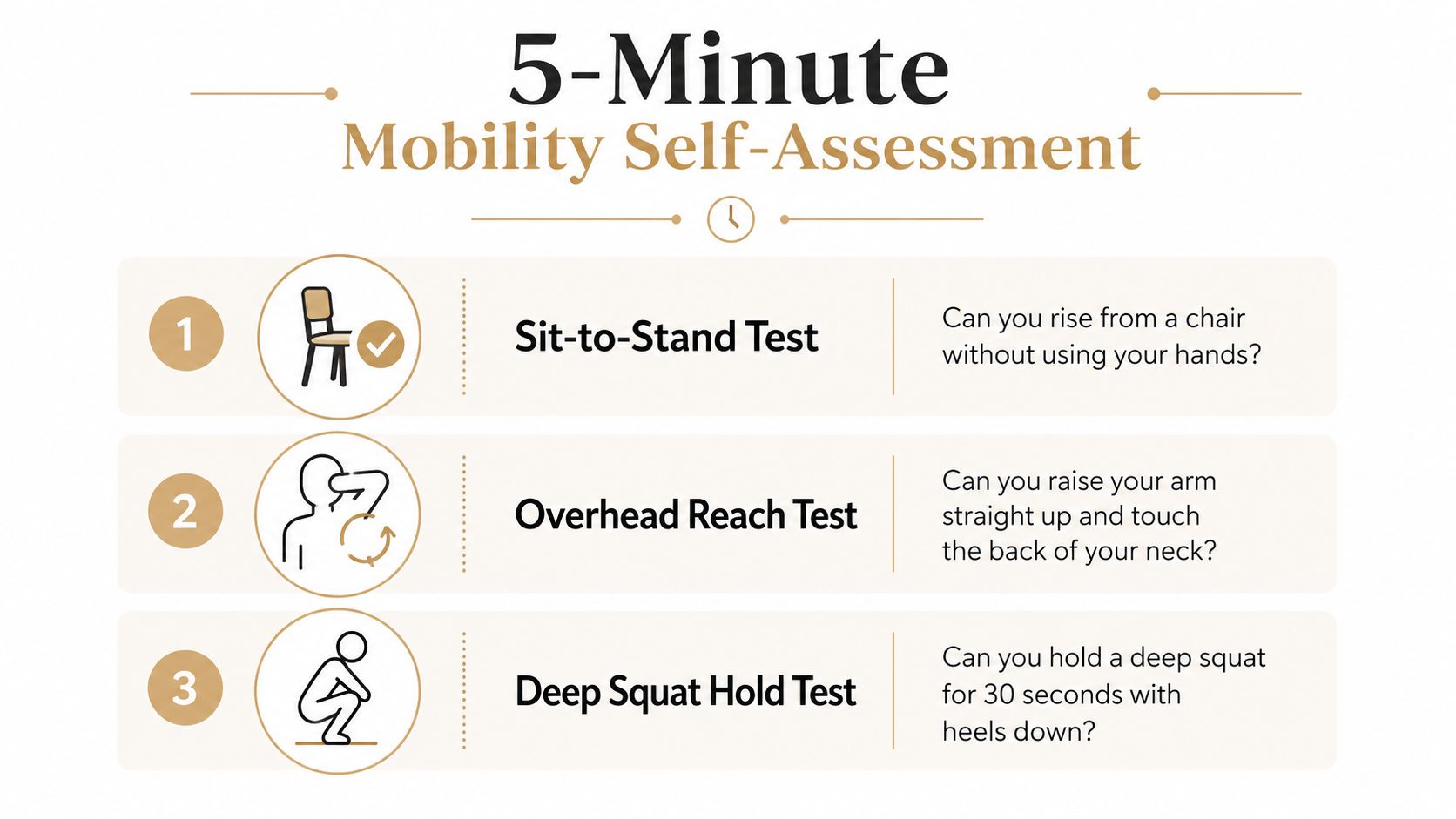
Stand beside a counter or wall. Lift one foot slightly, keep your eyes open, and note how much you sway or need support. Only attempt the eyes-closed version if the eyes-open test is steady and another person is nearby.
This test challenges ankle strategy, hip control, and the nervous system's ability to organize balance without visual input. Shaking, repeated foot taps, a major side-to-side difference, or fear of falling are useful clinical information. They're also reasons to choose supported balance practice rather than jumping directly into unstable surfaces.
Record three observations: pain, control, and symmetry. Repeat the same tests every few weeks under similar conditions. Improvement may look like less bracing, smoother transitions, better confidence, or fewer compensations, not just a larger range of motion.
A useful routine doesn't need thirty movements. It needs a small menu that covers hips, upper-back rotation, squatting, hinging, and carrying. Choose exercises you can perform with control, then progress one variable at a time.
Begin with a 90/90 transition on the floor or a supported version on a bench. Sit with both knees bent, rotate the legs gently from one side to the other, and keep the movement slow. The common error is forcing the knees down while the pelvis rolls backward. Use your hands behind you at first, then sit taller, move without support, and eventually add a controlled reach.
For a half-kneeling hip-flexor drill, place one knee down and the opposite foot forward. Tuck the pelvis slightly and shift forward without arching the low back. People often lunge too far and turn the stretch into lumbar extension. A small range with a stable trunk is more useful than an aggressive pull at the front of the hip.
The open-book rotation starts lying on your side with hips and knees bent. Reach the top arm across the body, then rotate it toward the floor behind you while allowing the upper back to turn. Keep the knees stacked so the motion comes from the thoracic spine rather than the pelvis.
A prone Y-to-W pattern adds shoulder-blade control. Move from a long Y position toward a W shape without shrugging. The beginner version uses no load and a short range. Progress by increasing control and pause time, not by swinging the arms.
Use a supported squat or light goblet squat to practice sitting between the hips. Keep the feet stable, let the knees track with the toes, and descend only as far as you can maintain a balanced trunk. A common error is chasing depth while the heels lift or the low back rounds. First remove support, then add a light load, and only later increase resistance.
For a Romanian deadlift, hold a light object close to the body, soften the knees, and push the hips backward. Stop when the hamstrings provide a clear stretch without the spine losing position. The movement should teach you how to lift from the hips, not how to reach the floor at any cost.
A suitcase carry combines walking with lateral trunk stability. Hold a manageable weight on one side, stand tall, and walk without leaning toward or away from the load. Progress from a short, supported walk to longer controlled paths, then add turns or an overhead carry if your shoulder and balance are ready.
These exercises pair well with a warm-up when you're preparing for lifting or sport. Rotations and hip transitions can also work as skill practice on their own. If emotional stress makes body awareness difficult, guidance on how to release stored trauma safely may be useful alongside, not instead of, physical rehabilitation. For more hip-specific instruction, see how to improve hip mobility.
The same movement can serve different purposes depending on its order, support, and load. A desk worker may need gentle hip and upper-back motion before strengthening. An athlete may need controlled single-leg loading. An older adult may need a stable surface and repeated practice of transitions.
Start with light walking or marching, followed by half-kneeling hip-flexor work and open-book rotations. Move into glute bridges, supported squats, and a slow hip hinge. Finish with relaxed walking and breathing rather than a long, passive stretch.
The clinical emphasis is hip motion and trunk control, not repeatedly bending the lumbar spine. A conservative protocol from Mass General places hip and lumbar mobility limitations in Phase I, covering 0 to 4 weeks, with 4 to 6 physical therapy visits, while maintaining cardiovascular conditioning. Its mobility list includes supine hip-flexor, piriformis, hamstring, and gastrocnemius stretching, as described in the Mass General rehabilitation protocol.
Begin with easy dynamic movement that doesn't reproduce symptoms. Add thoracic rotations, scapular wall slides, and a supported single-leg hinge. The athlete can progress toward a light Romanian deadlift and suitcase carry once the injured side matches the other side in control and confidence.
The trade-off is important. Too little loading can leave an athlete hesitant and underprepared, but advancing because a stretch feels tolerable can expose a weak link. Keep the range conservative, use a controlled tempo, and increase load only when the movement remains clean.
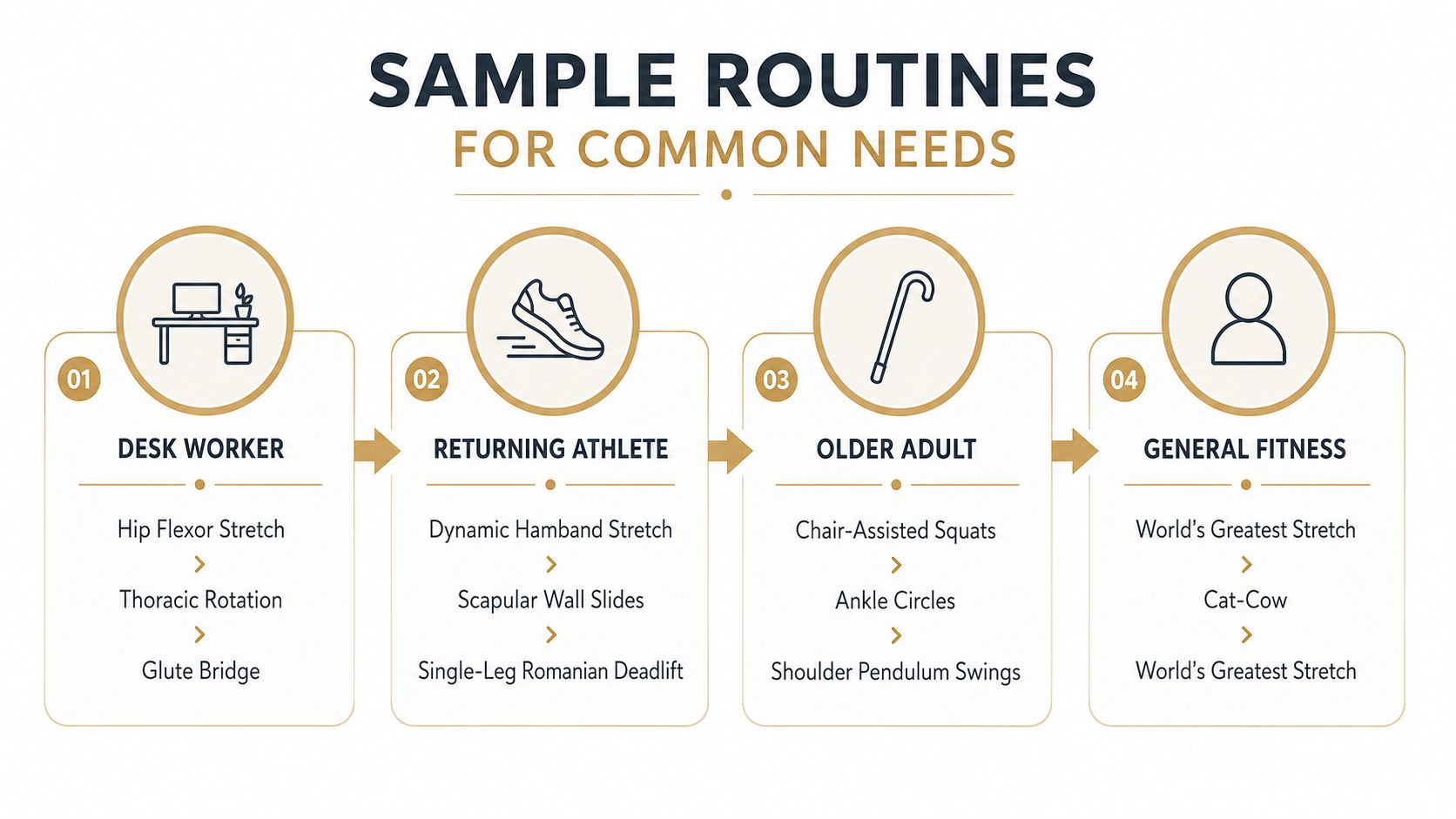
Use chair-assisted squats, seated marching, ankle circles, and supported weight shifts. Practice step-ups with a pause only when standing balance is reliable. The routine should make everyday actions feel more predictable, including standing from a chair, walking around furniture, and stepping onto a curb.
Guidance for older adults quantifies balance practice at at least 2 hours per week, continued long term for lasting fall-prevention effects, according to the clinical guidance summarized in the systematic review and guidance source. Break practice into manageable sessions and keep a stable support within reach.
After a motor-vehicle collision, begin with an evaluation rather than assuming stiffness is a simple flexibility problem. Once cleared, the routine may include gentle walking, pain-free shoulder pendulums, supported wall slides, small-range thoracic rotation, and gradual reaching.
Neck symptoms can change quickly after an accident. Headache, dizziness, visual changes, jaw stiffness, or arm symptoms deserve assessment before you add aggressive stretching or loading. A car accident treatment plan should follow the examination findings, not a generic online sequence.
Home mobility work can reduce general stiffness and build confidence with mild restrictions. It cannot determine whether recurring symptoms come from nerve irritation, structural injury, or another condition that needs examination.
Evidence supports task-specific practice, especially for frail, community-dwelling older adults. A Cochrane review of 12 trials involving 1,317 participants found improved mobility, with 12 studies and 1,151 participants showing a clinically important gain compared with controls. The programs used sit-to-stand practice, stepping, walking, and balance work rather than relying only on gentle range exercises. See the Cochrane review record.
For chronic low-back pain, mobility or trunk-mobility exercise is one option alongside strengthening, endurance, aerobic, aquatic, and general exercise. Therapeutic exercise can also include range-of-motion and stretching, as outlined in the clinical practice guideline. One structured protocol combined 10 minutes of mobility and motor-control exercises, 20 minutes of resistance and strengthening, and 20 minutes of deep-water running, performed 3 times weekly for 52 weeks. That model shows the practical trade-off: mobility drills may help movement, but lasting progress often requires strength, conditioning, and consistent practice. The protocol appears in this exercise trial.
| Need | Self-Directed Mobility | Professional Care |
|---|---|---|
| Mild stiffness | Controlled range, walking, basic strengthening | Mobility therapy and a personalized exercise plan if progress is limited |
| Pain that travels | Stop and avoid provoking drills | Examination, diagnosis, and targeted sciatica treatment when appropriate |
| Disc-related symptoms | Don't force stretching or loaded hinging | Spinal decompression and coordinated rehabilitation when indicated |
| Post-accident pain | Avoid guessing at the cause | Evaluation and staged neck and shoulder care |
| Persistent joint restriction | Use supported, pain-free movement | Hands-on care, rehabilitation, or other clinically appropriate treatment |
At Aspen Falls Wellness, Mobility Therapy may be combined with rehabilitation exercise, chiropractic adjustment, spinal decompression, massage, acupuncture, or device-based care when an examination supports those options. A mobility therapy assessment can clarify whether the problem is limited range, poor control, weakness, or a condition requiring a different plan.
Book an evaluation if pain travels, numbness appears, a joint locks, motion is blocked, or progress stalls for more than 3 weeks. Stop trying to stretch through a problem that keeps returning.
Mobility work should feel productive, not punishing. Mild effort or a tolerable stretch can be acceptable, but sharp, shooting, electric, or traveling pain means the drill needs to stop.
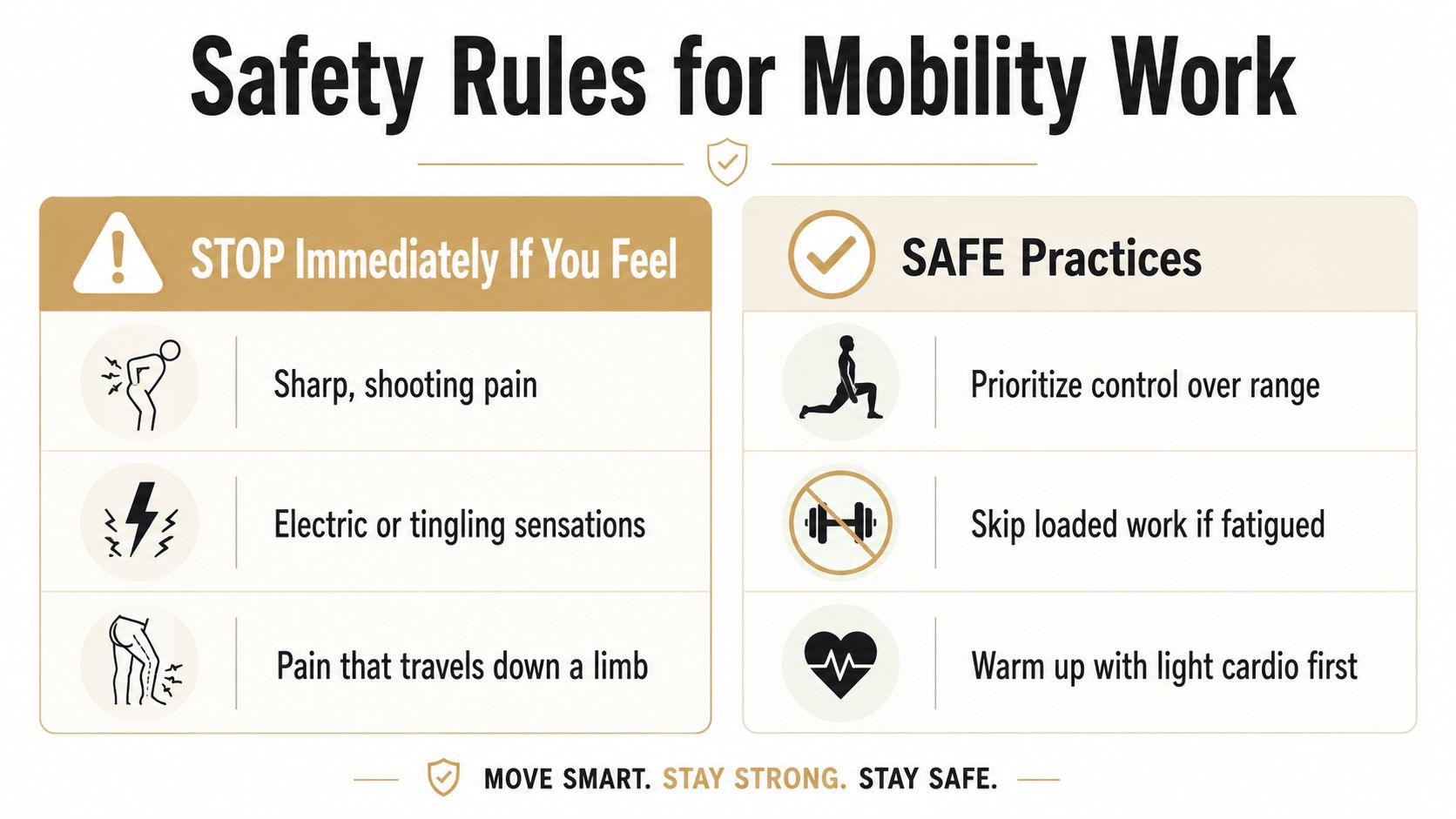
Use these rules during every session:
Pain that wakes you at night, swelling that doesn't settle, recurrent locking, or symptoms below the knee or elbow shouldn't be managed by repeatedly stretching the area. Stop self-treating and seek an appropriate clinical assessment.
Think in tasks, not tricks. A practical starter session can include supported squats, half-kneeling hip-flexor work, open-book rotations, light hip hinges, and a short suitcase carry. Keep the session to 10 minutes, 3 times a week, use a range you can control, and repeat your self-assessment every 2 weeks to decide whether to progress or simplify.
The markers are ordinary wins, sitting more comfortably, reaching a shelf, turning to check traffic, or walking without the stiffness that used to control your day. Consistency beats intensity, especially when pain or balance limitations are part of the picture.
If symptoms persist, spread, or stop improving, a personalized plan can pair mobility therapy with manual care, modalities, rehabilitation exercise, and take-home programming instead of asking you to guess at the cause.
Aspen Falls Wellness provides personalized chiropractic care, mobility therapy, rehabilitation exercise, massage therapy, acupuncture, SoftWave Therapy, MLS Laser Therapy, and spinal decompression with the DRX 9000 for appropriate spine, joint, and soft-tissue cases. Visit Aspen Falls Wellness to request an evaluation in Salt Lake City or Sandy and build a mobility plan around the tasks you need to perform confidently.

Stay updated with the latest chiropractic news and exclusive offers.