Learn how health savings account chiropractic care works, what is eligible, how to pay with your HSA card, and tips for using it at Aspen Falls Wellness.

You've finished a long day with back pain that won't settle, and your chiropractor has recommended an examination, adjustments, and possibly spinal decompression. Your HSA card is in your wallet, but one question is holding you back: Can health savings account funds pay for chiropractic care, and do they cover every service in an integrated treatment plan?
The short answer is often yes for medically necessary chiropractic treatment, but the details matter. The service usually needs to address a diagnosed condition, and bundled therapies may need to be reviewed individually rather than treated as one blanket expense. Aspen Falls Wellness patients in Salt Lake City and Sandy may encounter care plans that combine chiropractic adjustment, decompression, massage, laser therapy, acupuncture, and rehabilitation exercise, so understanding the billing record is just as important as understanding the treatment.
If you're new to the account itself, this plain-language guide to what is an HSA account can help you understand the basic wallet before applying it to chiropractic visits. The practical goal is simple: know which care is likely qualified, pay in a way that creates a clean record, and ask the clinic or HSA administrator about anything that falls into a gray area.
Consider a patient with recurring sciatica. The first visit may include an examination and a treatment plan. Later visits may involve chiropractic adjustments, spinal decompression with the DRX 9000, mobility therapy, and a personal exercise plan. The patient isn't buying a single product. They're receiving coordinated care for a condition that affects movement and daily life.
That difference matters for HSA use. The central question isn't whether a clinic calls itself chiropractic or wellness focused. It's whether the expense represents qualified medical care under the applicable rules. A treatment visit connected to a diagnosis is easier to document than a general maintenance appointment with no stated medical purpose.
Integrated clinics also create practical confusion. One invoice may include an adjustment, SoftWave Therapy, MLS Laser Therapy, massage therapy, or acupuncture. Some services may clearly support a documented treatment plan, while others may require additional evidence of medical necessity or separate review by the account administrator.
You'll learn how to:
The HSA can make qualified care easier to budget for, but it doesn't turn every service into an eligible expense. A careful patient treats the account like a medical wallet with rules, not like unrestricted cash.
A Health Savings Account, or HSA, is a tax-preferred account used for qualified medical expenses. It generally works with a High-Deductible Health Plan, commonly called an HDHP. The account holder uses available funds to pay or seek reimbursement for eligible care, while keeping records that show the expense meets the applicable standard.
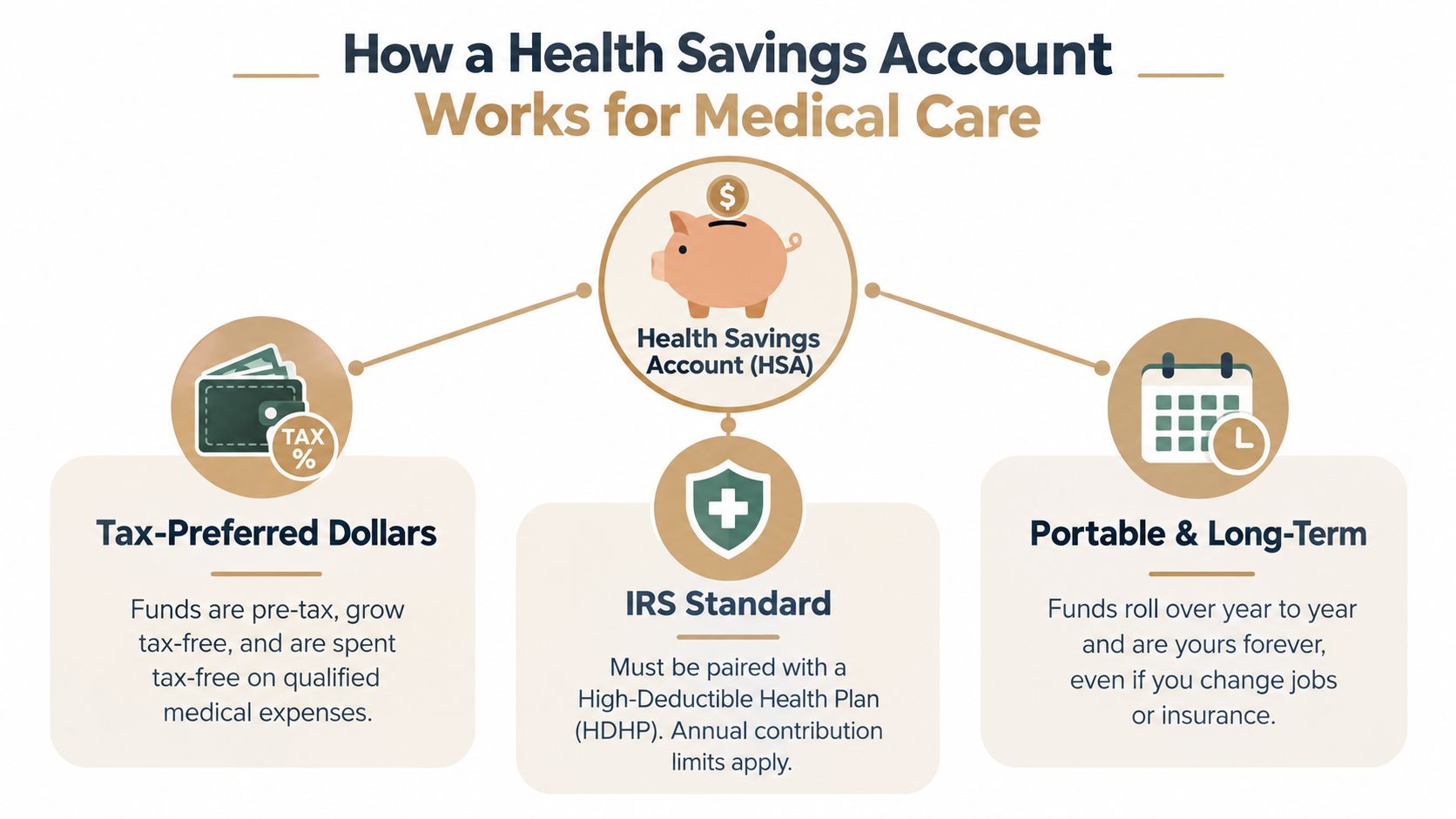
Think of an HSA as a restricted medical wallet. You can put money into the wallet under tax-preferred rules, but you can't use it casually for anything sold inside a healthcare office. The purchase needs to qualify as medical care, and you should be able to show what you paid for if the account administrator or tax authority asks.
The IRS Publication 502 framework includes fees paid to a chiropractor for medical care among medical expenses. HSA funds can reimburse Section 213(d) medical care, which uses the same underlying standard associated with deductible medical expenses. The IRS explanation of medical and dental expenses is the primary reference for understanding that framework.
That's why chiropractic isn't treated as a fringe exception. The category sits within a long-standing medical-expense structure. For a patient receiving an examination, adjustment, or treatment visit connected to a diagnosis, the account's use is generally consistent with that medical-care standard.
An HSA card may approve a transaction at the point of sale, but a successful card payment doesn't automatically prove that every item was qualified. The patient remains responsible for keeping documentation and using funds only for eligible expenses.
A useful distinction is:
That distinction becomes important when a visit includes both treatment and optional services. The next question isn't whether the provider is a chiropractor. It's what each charge represents and how the clinic records its medical purpose.
The strongest eligibility case usually begins with a diagnosed condition and a documented treatment plan. Back pain, neck pain, sciatica, and post-injury rehabilitation are examples of clinical situations in which an examination and treatment may be medically necessary. The diagnosis, not just the service name, helps explain why the expense belongs in the medical-care category.
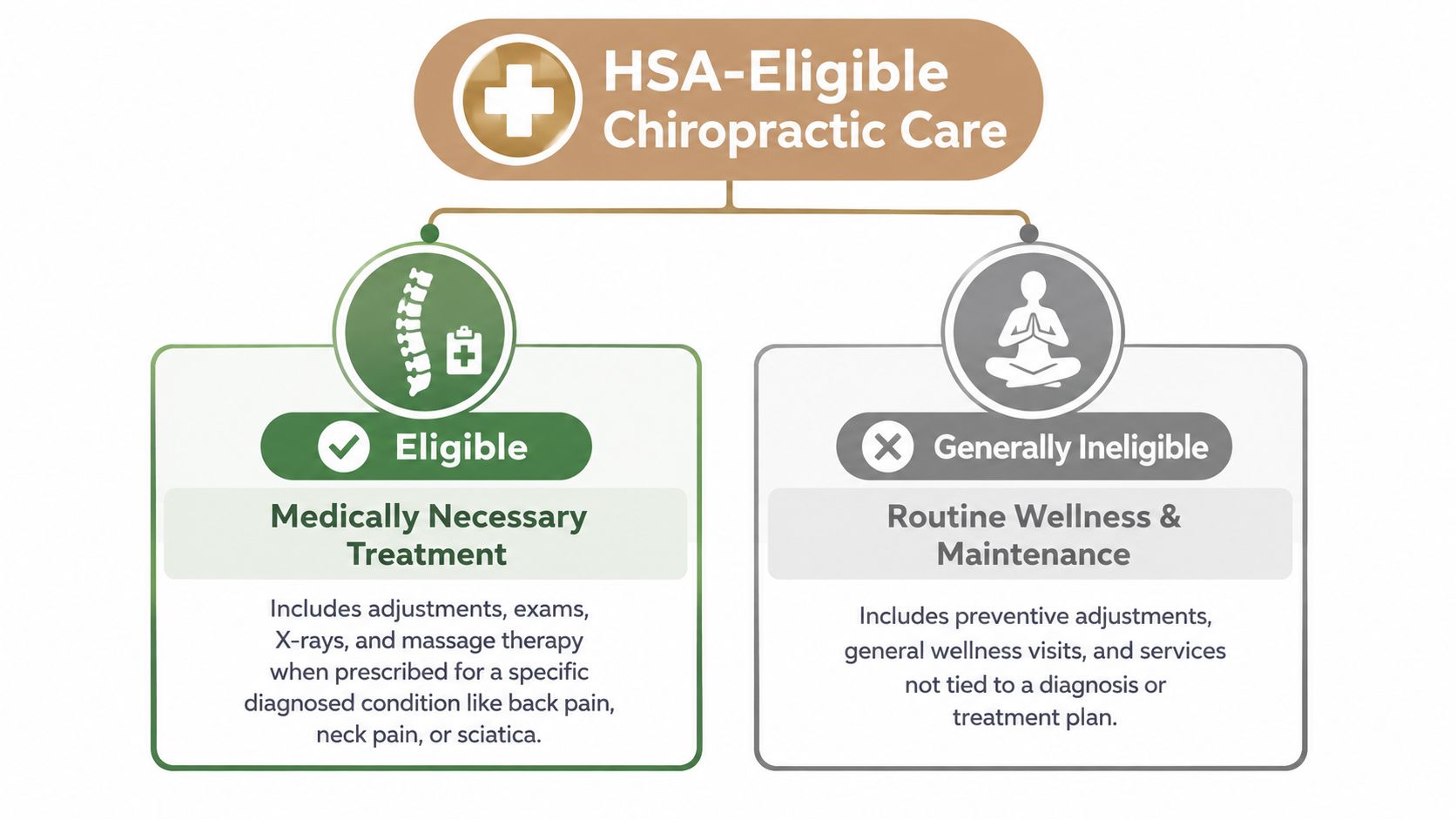
At a practice providing chiropractic care in Salt Lake City, the same service can require different documentation depending on why the patient receives it. An adjustment for diagnosed neck pain is different from a preventive adjustment that isn't tied to a condition or treatment plan.
The following services may generally be HSA-eligible when they are medically necessary and properly documented:
The service label alone doesn't settle the issue. A treatment plan should connect the procedure to the patient's symptoms, diagnosis, clinical goals, and progress.
Routine wellness visits, preventive adjustments, posture-focused services without a diagnosed condition, and general maintenance care are generally not treated the same way as medically necessary treatment. Chronic symptoms can make the boundary harder to judge, especially when a patient continues care after acute pain improves.
Practical rule: Ask whether the invoice would make sense to someone who only saw the diagnosis, treatment purpose, date, and itemized charge. If the medical connection isn't clear, request clarification before using HSA funds.
Patients should also ask whether the clinic can provide an itemized receipt, the relevant diagnosis information, and a written statement of medical necessity when an administrator requests one. Those records don't guarantee reimbursement, but they make the clinical purpose easier to evaluate.
An integrated visit can feel like one experience, but an HSA administrator may evaluate it as several separate expenses. An adjustment, SoftWave Therapy, MLS Laser Therapy, acupuncture, massage, supplements, and a posture device may appear on the same plan while serving different billing and eligibility purposes.
That's why a blanket answer such as “chiropractic care is covered” can mislead. The safer approach is to separate the invoice into line items and ask what medical condition each item treats. A therapy that is prescribed as part of rehabilitation may have a stronger case than a product or service purchased for general wellness.
| Service Component | Typical HSA Treatment | What Makes It Eligible |
|---|---|---|
| Examination and evaluation | Generally eligible when medically necessary | A documented assessment of a diagnosed or suspected condition |
| Chiropractic adjustment | Generally eligible for treatment | The adjustment addresses a documented condition such as back or neck pain |
| Spinal decompression with the DRX 9000 | May be eligible as treatment | The care plan connects decompression to a diagnosed spinal or disc-related problem |
| Massage therapy | Conditional | The massage supports treatment of a specific condition rather than relaxation or routine wellness |
| MLS Laser Therapy or SoftWave Therapy | Conditional | The clinic documents the medical purpose, diagnosis, and role in the treatment plan |
| Acupuncture | Conditional | Records show that it is being used for a diagnosed condition and medical treatment goal |
| Muscle stimulation or mobility therapy | Conditional | The modality supports rehabilitation, pain relief, or functional recovery |
| Nutrition counseling | Requires careful review | The service is connected to a medical treatment need rather than general lifestyle coaching |
| Supplements | Often requires separate review | The item and its medical purpose meet the administrator's requirements |
| Posture devices or other equipment | Requires separate review | The item is medically necessary and supported by appropriate documentation |
| Prepaid treatment plan | Timing and allocation can be unclear | The expense is properly incurred, itemized, and tied to eligible care rather than future undefined services |
A bundled discount doesn't necessarily make every component eligible. If a prepaid plan combines several visits and add-ons, ask whether the clinic can identify the actual service dates, individual charges, and medical purpose of each component.
Use direct questions at the front desk:
If the answer is uncertain, pay attention to the separation between clinical treatment and wellness convenience. That distinction gives both the patient and the administrator a clearer record.
Patients usually have two practical payment routes. The first is to present the HSA card at the clinic. The second is to pay with another method and request reimbursement from the HSA administrator later.
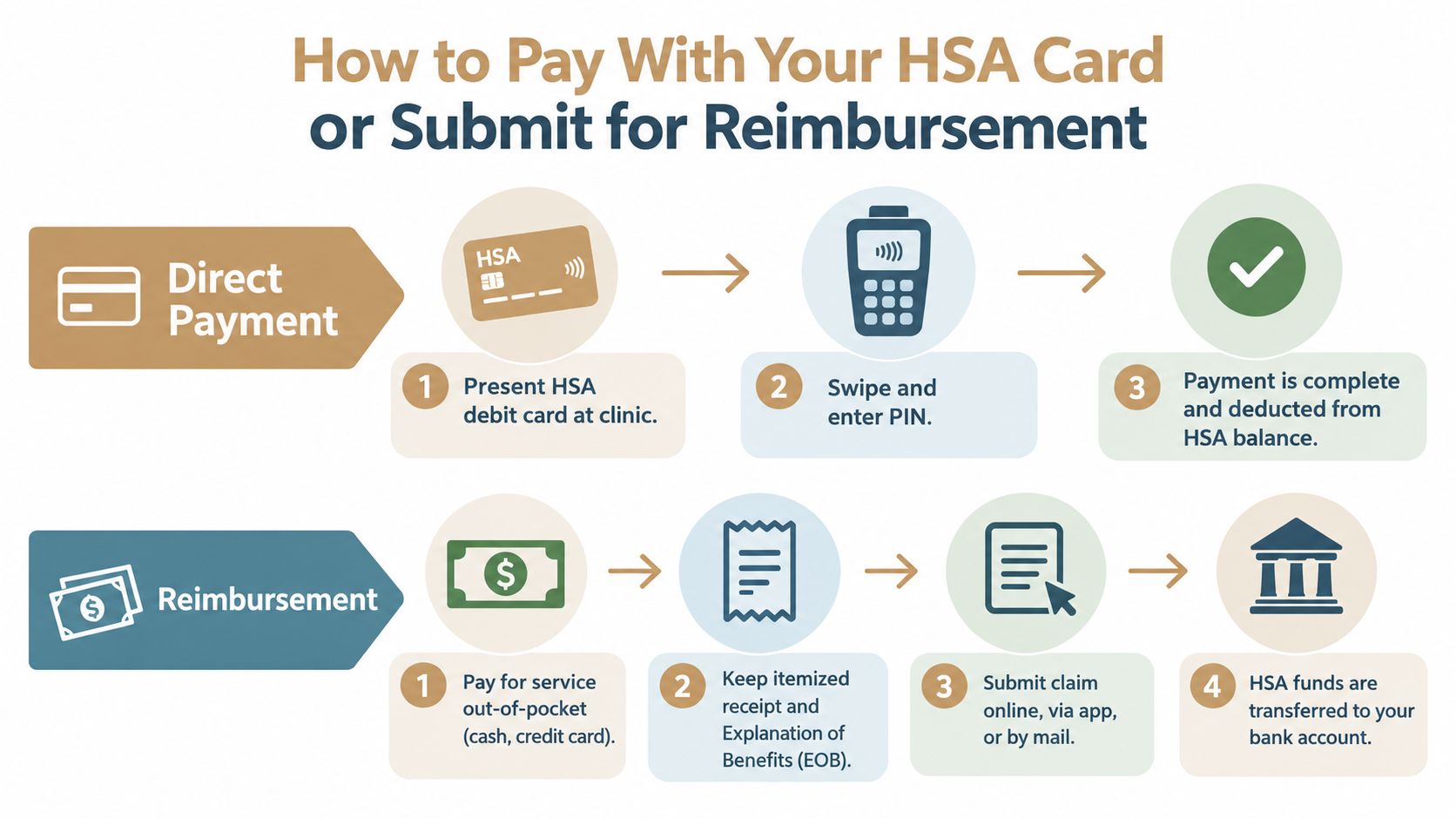
Before swiping the card, confirm that the charge represents an eligible service. If an integrated visit includes both treatment and gray-area add-ons, ask the office to separate the charges rather than placing the entire bundle on the card.
Keep the receipt even after the card transaction succeeds. Save the date, provider information, service description, amount, and any supporting diagnosis or treatment-plan documentation. The account administrator may later request evidence that the withdrawal paid for qualified care.
Paying out of pocket can be useful when the clinic can't separate mixed services at the terminal or when you want to review the invoice first. Ask for an itemized receipt and, when applicable, an Explanation of Benefits from the insurer.
A clean reimbursement file should include:
For patients seeking a clinic with clear self-pay documentation, the low-cost chiropractor resource from Aspen Falls Wellness may help frame questions about pricing and receipts. The account holder, however, still needs to confirm eligibility with the HSA administrator.
Recurring treatment for chronic back or neck pain can blur the line between therapy and maintenance. Keep updated records when the diagnosis, treatment goals, or frequency of care changes. A service that was medically necessary during rehabilitation should not automatically be assumed eligible forever without continued clinical support.
Keep the receipt until you can explain the expense without relying on memory. A transaction record shows that money moved. It doesn't always show why the care qualified.
Don't submit the same expense for reimbursement through another account or insurance arrangement. If the administrator asks for clarification, respond with the itemized record rather than guessing.
An HSA, an FSA, and health insurance solve different payment problems. Insurance processes covered services under a policy, while an HSA or FSA provides a way to pay qualified out-of-pocket medical expenses. The accounts don't replace the policy's rules about deductibles, copays, network participation, or covered treatment.
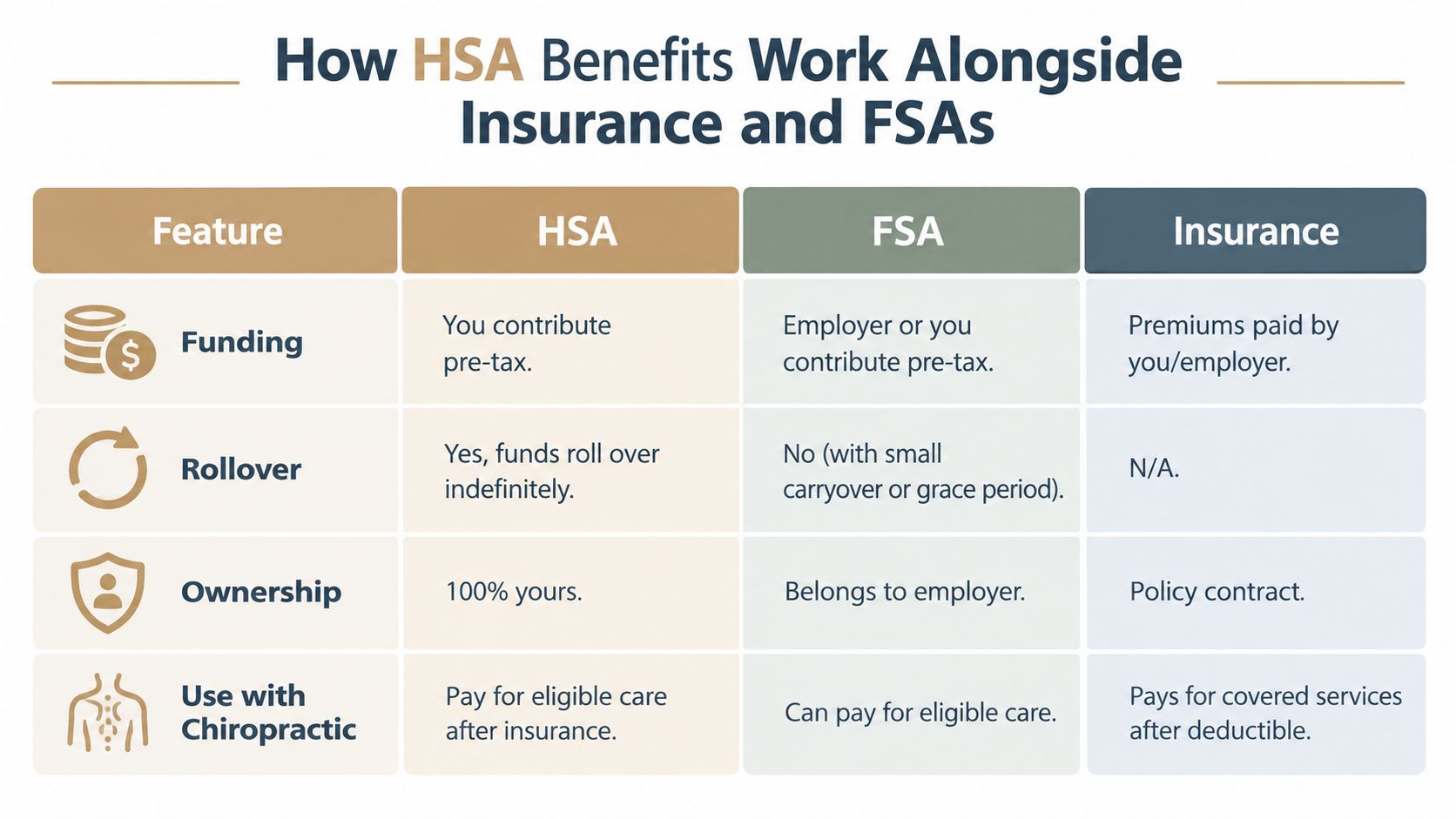
| Feature | HSA | FSA | Insurance |
|---|---|---|---|
| Funding | The account holder contributes under tax-preferred rules | An employer or employee contributes under tax-preferred rules | Premiums are paid by the patient, employer, or both |
| Rollover | Funds generally remain available and roll over | Employer plan rules may limit carryover or provide a grace period | Not applicable |
| Ownership | The account belongs to the account holder | The account is connected to the employer's benefit plan | The policy is governed by the insurance contract |
| Chiropractic use | Can pay for eligible care after insurance processing, when applicable | Can pay for eligible care under the plan's rules | Pays for covered services according to the policy and cost-sharing terms |
The most important coordination rule is don't double-dip. If insurance pays the full expense, you can't also claim that same expense as an HSA reimbursement. If insurance pays part of a qualified visit, an HSA may be used for the remaining eligible patient responsibility, subject to the account rules and documentation.
Start by asking whether the clinic participates in your insurance plan and whether the specific service is covered. Aspen Falls Wellness can verify participation with multiple plans, but patients should confirm benefits before care because participation and coverage aren't the same thing.
For general background on administrative work that can affect access to covered care, streamline prior authorization for clinics offers useful context. Prior authorization, when required, is an insurance process. It doesn't automatically determine whether the same service is HSA-eligible.
Patients often use insurance first when a covered service applies to a deductible or copay. An HSA can then help pay an eligible balance or medically necessary self-pay care that insurance doesn't cover. The Blue Cross Blue Shield chiropractic coverage guide can help readers form better questions, but the policy document and benefits verification control the final answer.
An FSA may also pay eligible chiropractic care, but its timing and employer-plan rules differ from an HSA. Keep separate records for each account, and never move the same receipt through both.
Prepare before the appointment instead of waiting until the payment terminal. Confirm that your account is active, ask whether the clinic accepts HSA card payments, and check whether your insurance requires a referral or prior authorization for the planned care.
At the visit, describe the condition accurately. Ask for an examination and treatment plan that identifies the clinical problem, intended services, and follow-up process. If your plan includes chiropractic adjustment, spinal decompression with the DRX 9000, MLS Laser Therapy, SoftWave Therapy, massage therapy, acupuncture, muscle stimulation, mobility therapy, or rehabilitation exercise, request that each service appear clearly on the invoice.
Aspen Falls Wellness serves patients in Salt Lake City and Sandy through coordinated chiropractic and integrative musculoskeletal care. Its services include adjustments, spinal decompression, pain relief programs, personal exercise plans, nutrition counseling, golf movement screening, and car accident treatment, so clear line-item billing helps patients match care to their HSA records.
If your symptoms aren't improving, ask for a re-evaluation rather than continuing an undefined maintenance plan. The clinical team can adjust the plan or refer you outside the practice when your needs fall beyond its scope.
Visit Aspen Falls Wellness to ask about HSA payment, itemized receipts, and a personalized plan involving chiropractic adjustment, DRX 9000 spinal decompression, rehabilitation exercise, or related therapies. The Salt Lake City and Sandy clinics can help you understand how your planned care is documented before you pay.

Stay updated with the latest chiropractic news and exclusive offers.