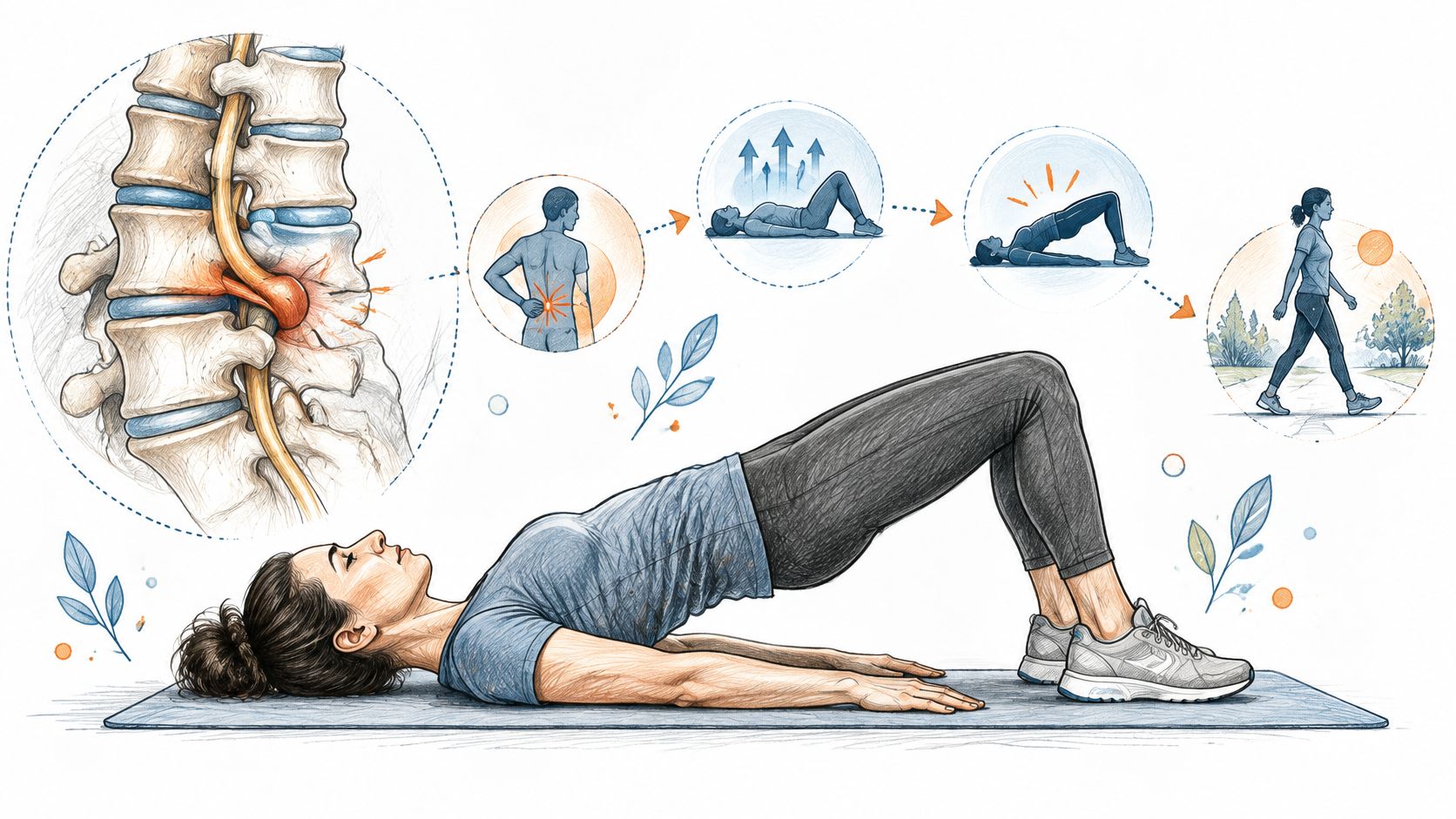
Low back pain after car accident can last. Learn red flags, when imaging helps, and conservative care for recovery.
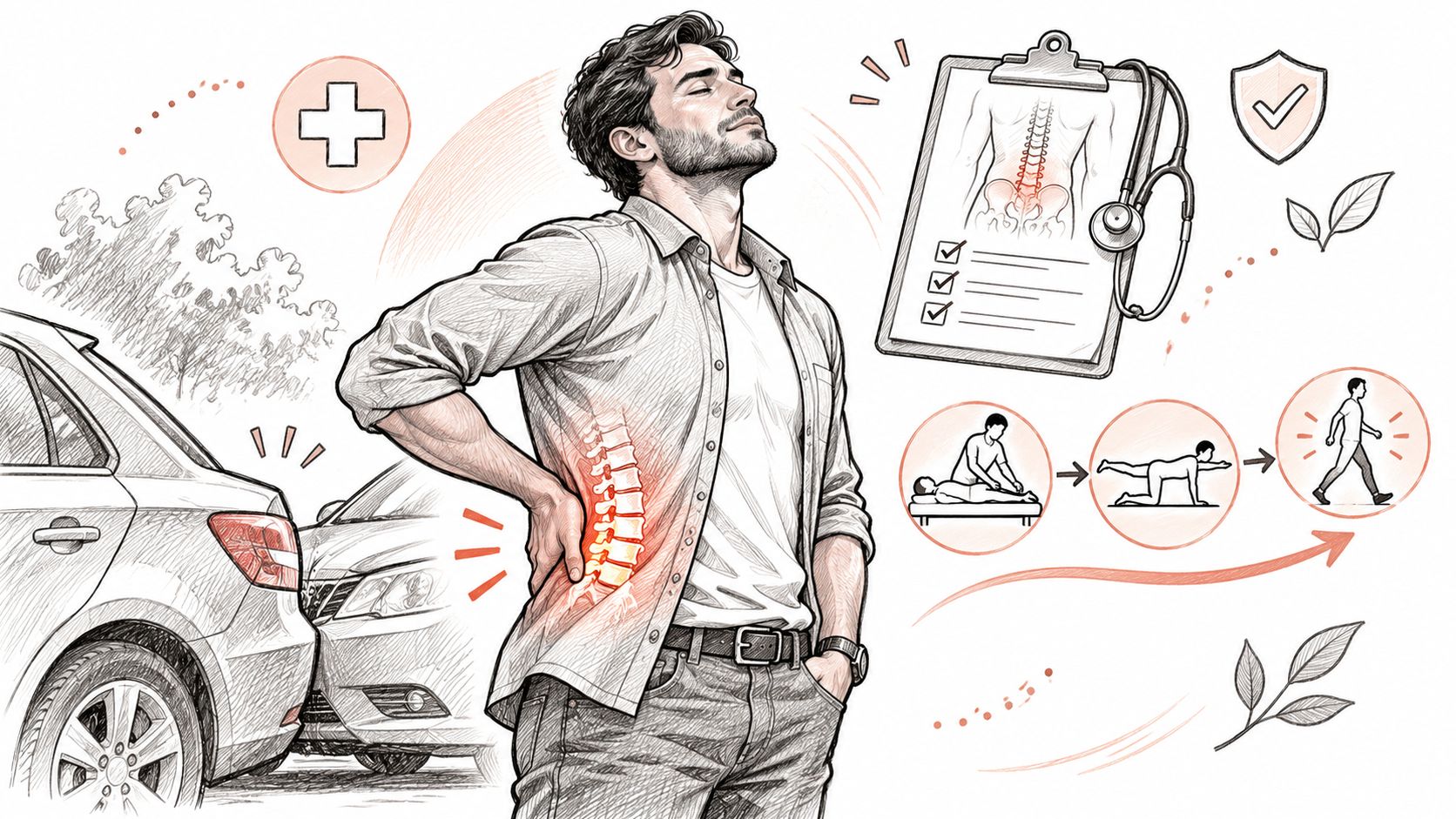



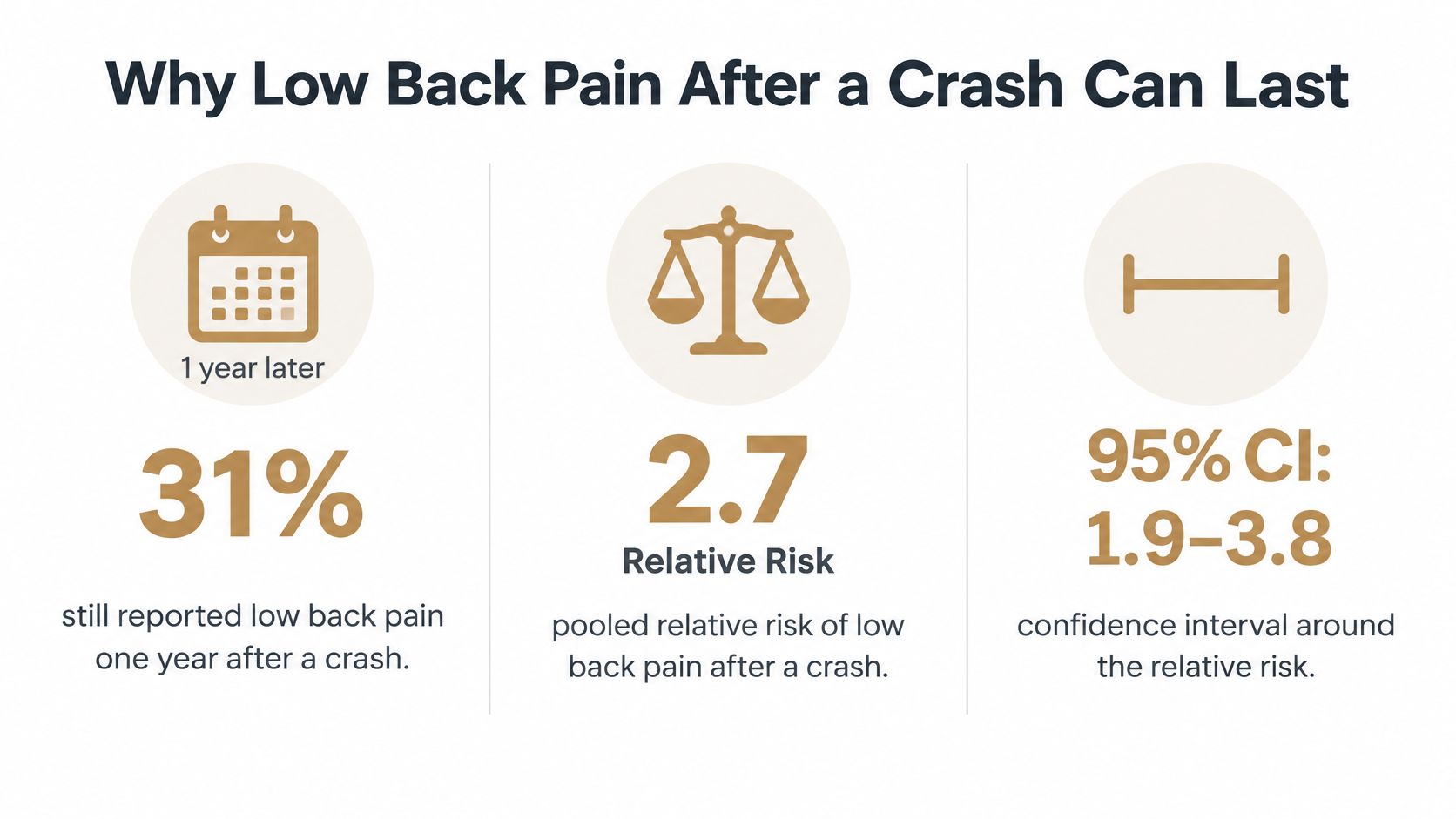
At least 31% of people exposed to a crash still reported low back pain one year later. That figure, from a systematic review and meta-analysis summarized by the Atlas of Chiropractic, is the reason low back pain after car accident care should not be built on the hope that soreness fades. Injured people in those studies had a pooled relative risk of 2.7 for future low back pain compared with people who were not in a collision (95% confidence interval 1.9 to 3.8), and an estimated 63% of the exposed group's low-back-pain risk was attributable to the collision. These are population associations, not proof that every person's pain came only from the crash.
Say you are rear-ended at a light, step out, and tell the other driver you feel fine. That evening your low back tightens. By the next morning, sitting through breakfast is the hard part. Feeling steady at the scene does not clear the lumbar spine. Adrenaline can mask pain, and stiffness often builds over hours to days rather than in the first minutes.
The same review cited a U.S. Insurance Research Council look at more than 21,000 injury claims from a two-week period. In that sample, 58% of people injured in motor-vehicle crashes reported low back pain, close to the 66% who reported neck pain. Lumbar symptoms sit among the most common musculoskeletal complaints after collisions, and a substantial minority are still symptomatic at 12 months.
Before the ache shifts, write four things you can recheck later.
That note is what later visits compare. Delayed stiffness is common enough that Nares Law Group delayed symptom guidance is worth reading if symptoms show up after you have already left the scene. The next sort is emergency care versus a clinic visit, then what the collision loaded, when an image helps, and which conservative tools match the finding.
Match one row before you read further, and act on the first row that fits. Do not book a routine visit while an emergency-row sign is present.
| Finding | Possible concern | Where to go | How fast |
|---|---|---|---|
| Progressive leg weakness | Significant nerve compression | Emergency care | Same day |
| Saddle numbness, new urinary retention, or loss of bowel control | Cauda equina | Emergency care | Immediately |
| Inability to walk, loss of consciousness, or sudden severe pain after major trauma | Serious structural injury | Emergency care | Immediately |
| Midline tenderness, bruising, older age, osteoporosis, or steroid use | Possible compression fracture | Emergency or urgent clinical exam | Same day |
| Stable pain, tingling, or numbness into one leg without worsening weakness | Possible nerve-root irritation | Clinician assessment | Within a few days |
| Localized ache or stiffness and no neurologic change | Soft tissue or mechanical pain | Clinician assessment | Within a few days |
| Pain still limiting work or daily activity after about six weeks | May need specialist imaging | Specialist setting | Around six weeks |
Progressive leg weakness, saddle anesthesia, new urinary retention or overflow incontinence, loss of bowel control, and bilateral neurologic symptoms can fit cauda equina or significant neural compression. Inability to walk, loss of consciousness, or sudden severe pain after major trauma can fit serious structural injury. Any of those means the emergency department comes before a chiropractic or therapy appointment. A more detailed symptom list sits in our guide to low back pain red flags.
An impact can produce vertebral compression, especially if the collision was severe, you are older, you have osteoporosis, you use corticosteroids for a long time, or you have focal midline tenderness, bruising, or abrasions. The American Academy of Family Physicians treats post-collision low back pain as potentially traumatic, not automatically as uncomplicated mechanical pain. Those features justify a same-day emergency or urgent clinical exam, and they may justify prompt lumbar radiography or CT when fracture is suspected. MRI is the better look when discs, ligaments, neural structures, or marrow need to be seen, because it does that without ionizing radiation.
Most collision-related low back pain is localized rather than nerve-root pain. Without neurologic findings or other red flags, early imaging rarely changes the first plan, a point developed in an Oxford University Press chapter on spinal imaging after trauma. A localized ache, stiffness, or stable symptoms into one leg, without worsening weakness, needs a clinician within a few days, not an automatic scan.
Practical rule: If pain still limits work or daily activity after about six weeks of conservative care, or if neurologic findings appear, that is the point to reconsider specialist imaging.
Incidental degenerative findings are common and may not explain the pain, so the image has to match trauma severity and the exam.
A belt and seat can hold the pelvis while the torso keeps moving. That loads discs, facet joints, and ligaments in a fraction of a second. A rear impact can also drive force through a lumbar spine that is flexed or rotated. Picture a tire that already has some tread wear hitting a pothole. The hit is sudden, and the structure was not brand new.
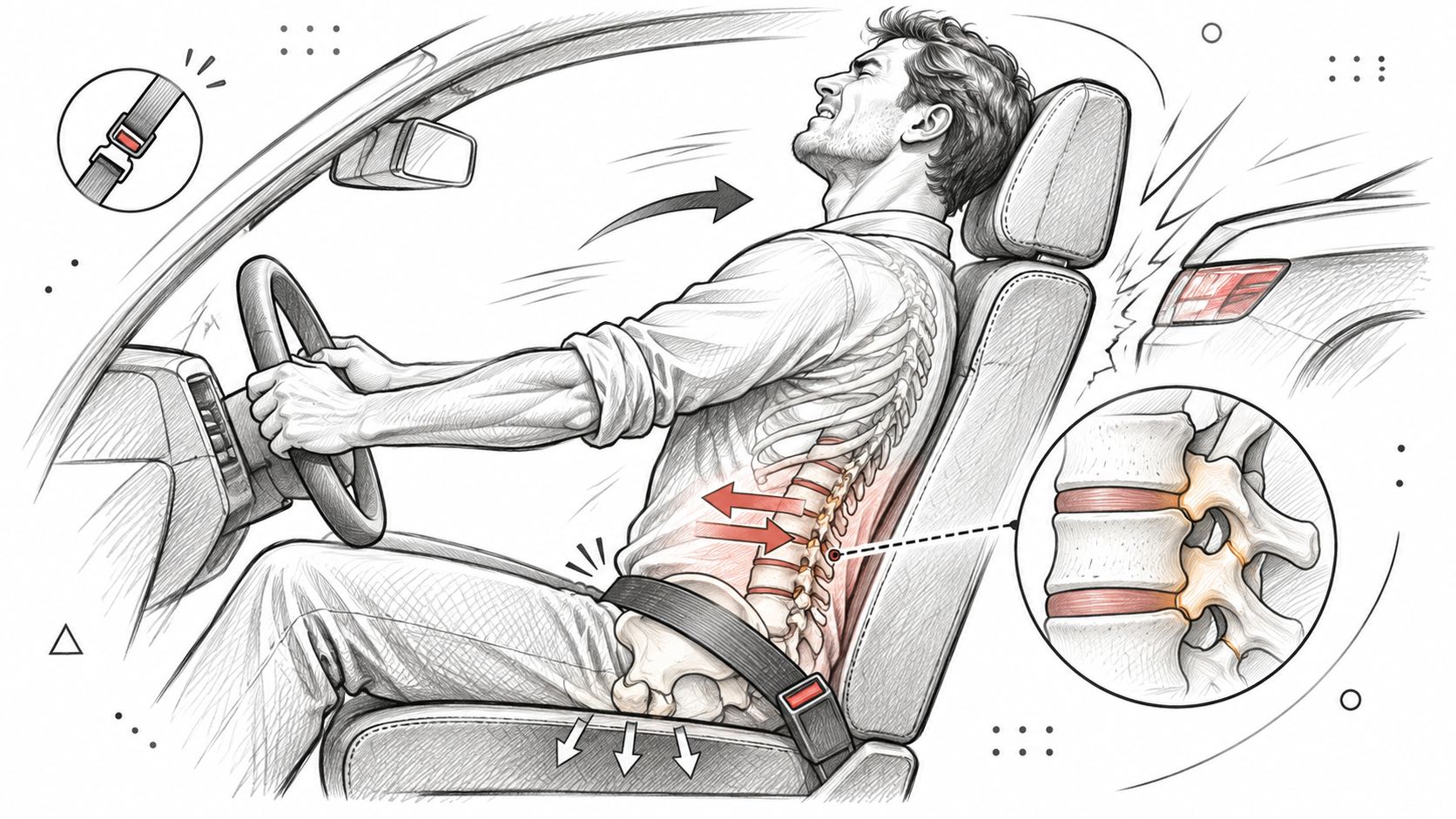
Muscle and ligament strain often feels like a deep ache and spasm that peaks the next day, not at the curb. Movement is sore, and guarded muscles limit bending.
Disc irritation may bother a nerve root. Pain, tingling, or numbness below the knee, especially with sitting or bending, is the pattern people often call sciatica. Strength that stays steady is a different story from a leg that is getting weaker.
Facet or sacroiliac irritation tends to catch with twisting or with standing up from a chair. The pain is often more local, on one side, and tied to a specific motion.
Fracture is uncommon in ordinary crashes. It is more plausible with a severe impact or with fragile bone, which is why midline tenderness and bone-health history change the exam.
A collision can start a new injury or aggravate an old one. The World Health Organization estimated that 619 million people experienced low back pain in 2020, about one in 13 worldwide, a 60% increase in cases since 1990. Low back pain accounted for 8.1% of all global years lived with disability in 2020. WHO projects approximately 843 million cases by 2050, largely from population growth and aging. Those figures are not crash counts.
They explain why the exam should separate a new injury from a flare of prior pain. The comparison is practical: range of motion, leg symptoms, activity tolerance, and how long symptoms last. Strain sends the clinician toward muscle guarding and motion loss. Pain below the knee sends the exam toward nerve-root tests. A catch with twist points at a facet or pelvic joint. Severe impact plus fragile bone points at bone injury. Naming the pattern is not the same as prescribing care.
An image is a tool. It is not the visit. For adults with low back pain or sciatica, NICE recommends against routine imaging in a non-specialist setting, and says to consider imaging in a specialist setting only when the result is likely to change management. Pain alone does not prove a disc injury or a fracture. Disc degeneration also shows up on scans of people who never crashed.
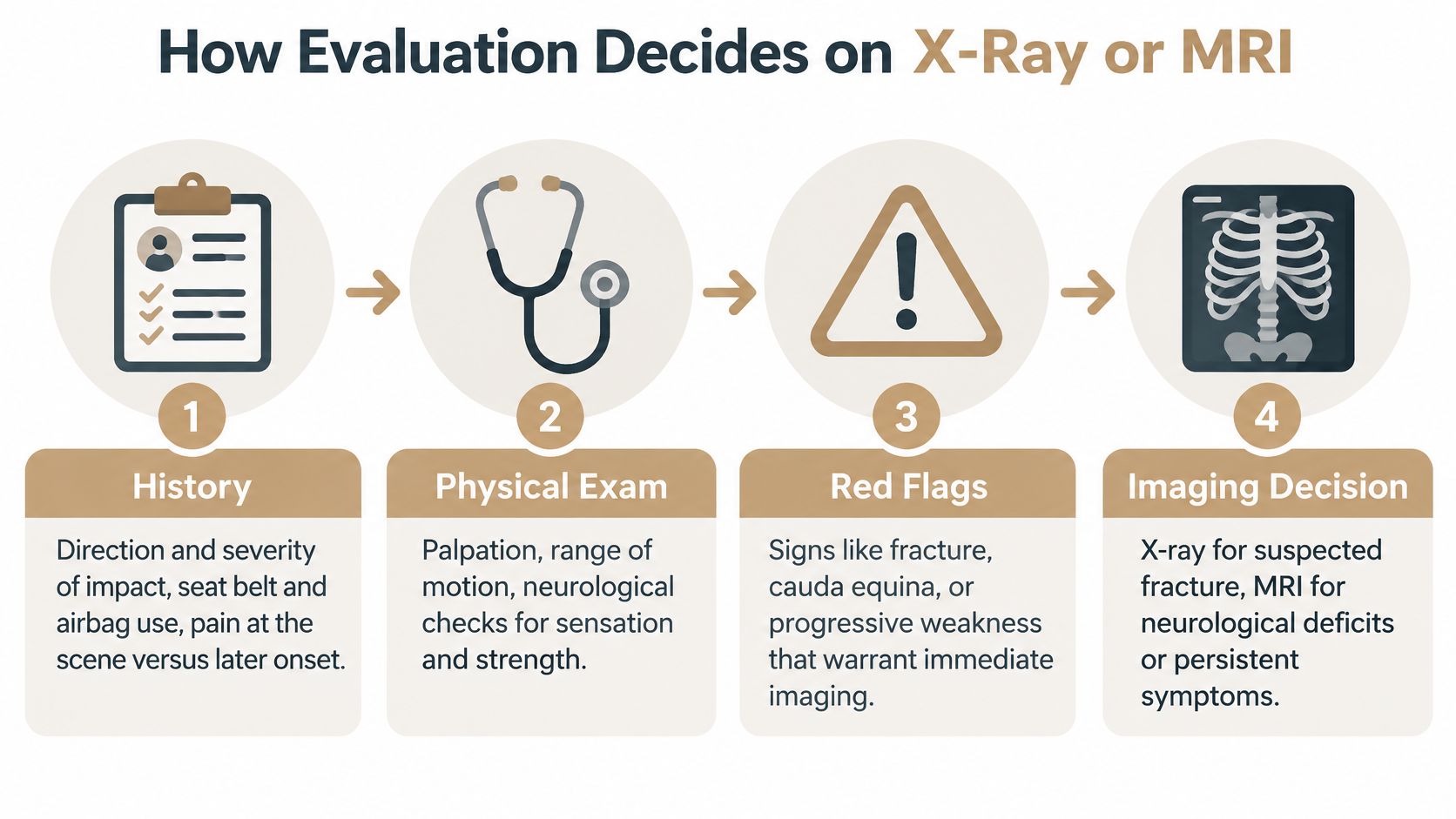
Leave the visit able to ask, "Will this image change what we do this week?" If the answer is yes and the finding is outside in-house scope, expect a referral. A side-by-side of the two tests is in our note on MRI versus X-ray for back pain.
If the picture would not change the plan, it can wait. If progressive neurologic loss or a suspected structural injury would change it, referral is the point of the visit.
The first one to two weeks are about staying moving without provoking a flare. Skip prolonged bed rest. Use short walks as tolerated. Choose ice or heat by comfort. Use pain relief only as a clinician advises. After that, tools are matched to findings. Not every crash gets every service.
A customized treatment plan is developed from the diagnosis and may include chiropractic adjustments, DRX9000 decompression, and/or MLS Laser Therapy. Patients typically begin to experience back pain relief within weeks, not after a single visit. The plan is rechecked against walking, sitting, and leg symptoms. Worsening weakness stops this pathway and sends you back to emergency care. Our overview of lower back pain solutions sits beside that matching, not in place of the exam.
| Option | Best fit | Intended effect | Caution |
|---|---|---|---|
| Chiropractic adjustment | Restricted spinal or pelvic joints | Restore motion within tolerance | Not a substitute for emergency care |
| Therapeutic massage | Muscle spasm and soft-tissue pain | Ease guarded muscles | Avoid bruises, inflamed skin, tumors, hernias, or recent fracture |
| MLS laser therapy | Inflamed or slow-healing tissue | Reduce inflammation and support recovery | Adjunct, not a diagnosis |
| SoftWave therapy | Strain, tendon or ligament irritation | Stimulate tissue recovery | Adjunct after exam |
| DRX9000 spinal decompression | Disc-related pain after diagnosis | Non-surgical mechanical unloading | Evidence unproved versus comparison care |
| Rehabilitation exercise | Stiffness once irritation settles | Rebuild tolerance and control | Progress by symptoms, not a fixed calendar |
| Acupuncture | Persistent pain limiting function | Pain modulation | Part of a plan, not a standalone crash workup |
Chiropractic adjustment aims to restore motion in restricted spinal or pelvic joints and is scaled to pain tolerance. Massage works on muscle and soft tissue, not as a substitute for joint assessment. Clients with bruises, inflamed skin, tumors, hernias, or a recent fracture should tell the massage therapist so those areas can be avoided. MLS laser and SoftWave are used to calm inflammation and support tissue recovery. They do not replace the diagnosis.
Non-surgical spinal decompression on a DRX9000-style table is reserved for a working diagnosis of disc-related pain, and it is monitored, not promised as a cure. A systematic review on PubMed of motorized spinal decompression for chronic discogenic low back pain analyzed 10 studies, seven of them randomized. Six randomized trials found no difference from comparison treatment. One reported reduced pain but not improved disability. Three uncontrolled studies reported pain reductions of 77% to 86%. Methods were inconsistent, patients differed, and the pulling treatment was hard to mask, so effectiveness remained unproved.
Mobility work, rehabilitation exercise, and a take-home plan begin once irritation allows. Acupuncture may be added for pain modulation. Progress follows symptoms, not a calendar date on the wall.
Three short cases show how the same crash week can split. None of them is a diagnosis. They are patterns you can compare with your own notes.
A 34-year-old is rear-ended at a light, feels fine in the car, and is stiff the next morning. There is no pain below the knee. Walking is limited for about a week. The exam finds guarded motion and no neurologic loss. Care stays with activity, adjustment as tolerated, massage away from any bruise, and a short home mobility plan. Sitting and sleep improve over several weeks.
A 52-year-old had an occasional backache before the collision and now cannot sit through a meeting. Pain reaches the calf, but strength stays stable. The exam points toward nerve-root irritation. Imaging is considered only if it would change care. The plan may combine laser for inflammation with monitored decompression once disc-related pain is the working diagnosis, plus exercise advanced by tolerance rather than by a calendar.
Someone keeps working for a month, then notices the leg getting weaker. That change ends home stretching and clinic-only care. The next stop is emergency or specialist evaluation, not another week of the same exercises.
Name which case is closest, then name which switch would make you leave that path.
| Switch | What it suggests | Action |
|---|---|---|
| No meaningful change in walking, sitting, or sleep by about six weeks | Conservative care is not working | Specialist imaging and referral review |
| Any new symptom below the knee | Possible nerve-root involvement | Clinician reassessment within days |
| Inability to do essential work | Functional limit not met by current plan | Reassess plan and imaging need |
Walking, sitting, and sleep are the three functions that tell you whether the plan is working. A new symptom below the knee, or work you can no longer do, is an exit, not a reason to push harder at home.
If any emergency-row finding is present, go to an emergency department now. That includes progressive leg weakness, saddle numbness, new urinary retention, loss of bowel control, inability to walk, loss of consciousness, or sudden severe pain after major trauma. Do not start with a clinic visit.
If the pain is localized or stable and there is no neurologic change, book a documented post-crash exam within a few days rather than waiting to see whether it settles. Bring the baseline: walking tolerance, sitting time, sleep, any leg symptoms, and the date and direction of the crash. After the exam, expect the plan to be rechecked against walking, sitting, and sleep at about six weeks.
Dr. Jeremy Kaier specializes in treating herniated discs, stenosis, and sciatica. Gabriel, in Salt Lake City, put the result this way: "I herniated my disc in my low back and Dr Hedstrom has helped me go from bed ridden to better than I felt even before I hurt myself." Listed services are Chiropractic Care, Spinal Decompression, Softwave therapy, MLS Laser Therapy, Massage Therapy, Acupuncture, Nutrition, Mobility Therapy, Rehabilitation Exercise, Golf Movement Screening, and Car Accident Treatment. We refer out for X-ray or MRI when imaging would change care, and for suspected fracture or progressive neurologic loss. Confirm which insurance plans are accepted before you book, since coverage varies, and read practical steps for handling insurance claims after a wreck so the medical record and the claim are not working against each other.
Aspen Falls Wellness offers an initial car accident assessment and conservative care for low back pain after a car accident, matched to the exam rather than promised as a scan or a device. If your symptoms are stable and not an emergency, bring your walking, sitting, and sleep notes and start with a documented visit. Visit Aspen Falls Wellness to arrange that post-crash exam.

Stay updated with the latest chiropractic news and exclusive offers.