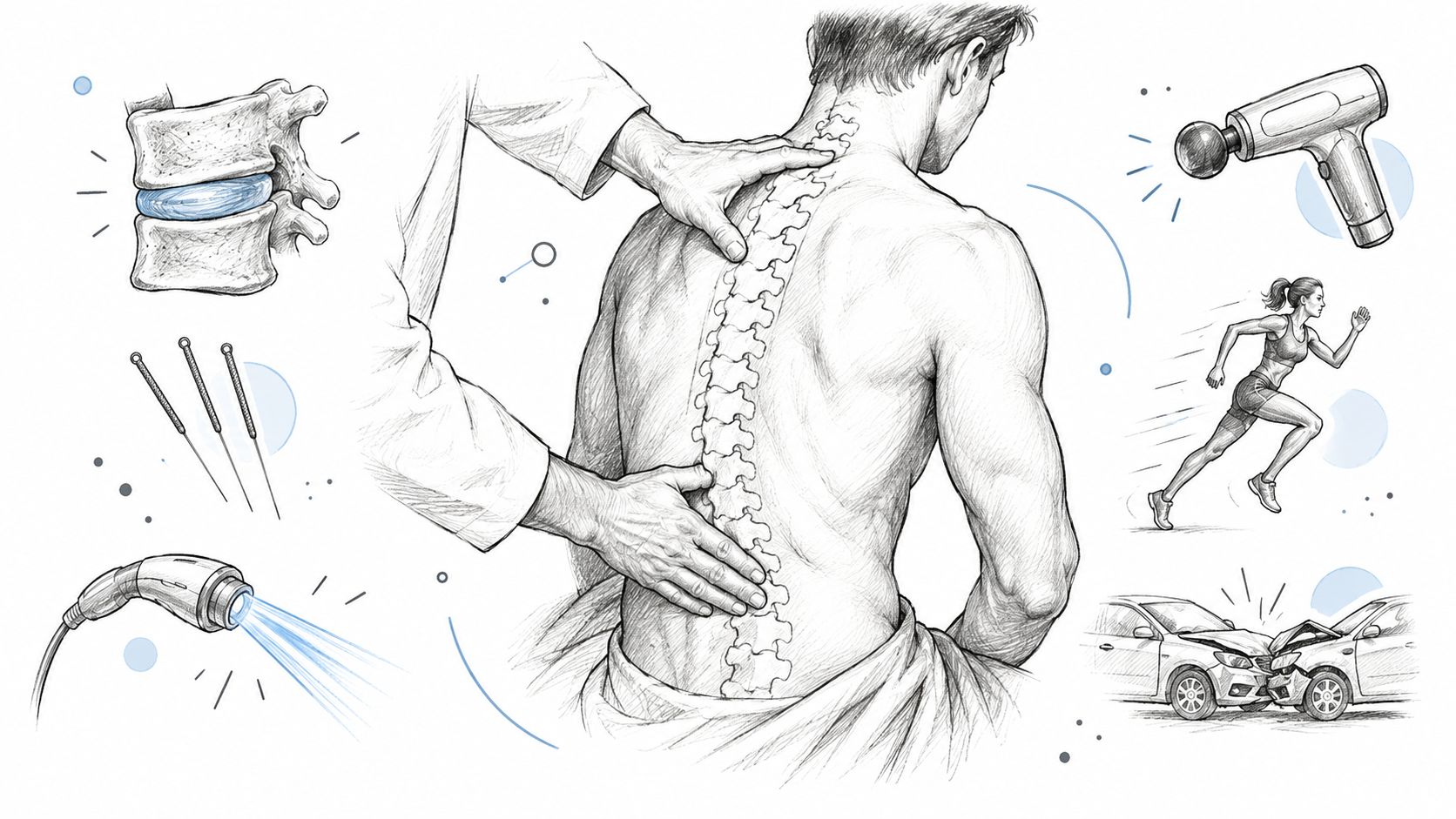
Bulging disc treatment without surgery: a phased plan covering rest, exercise, decompression, red flags and when to escalate care.
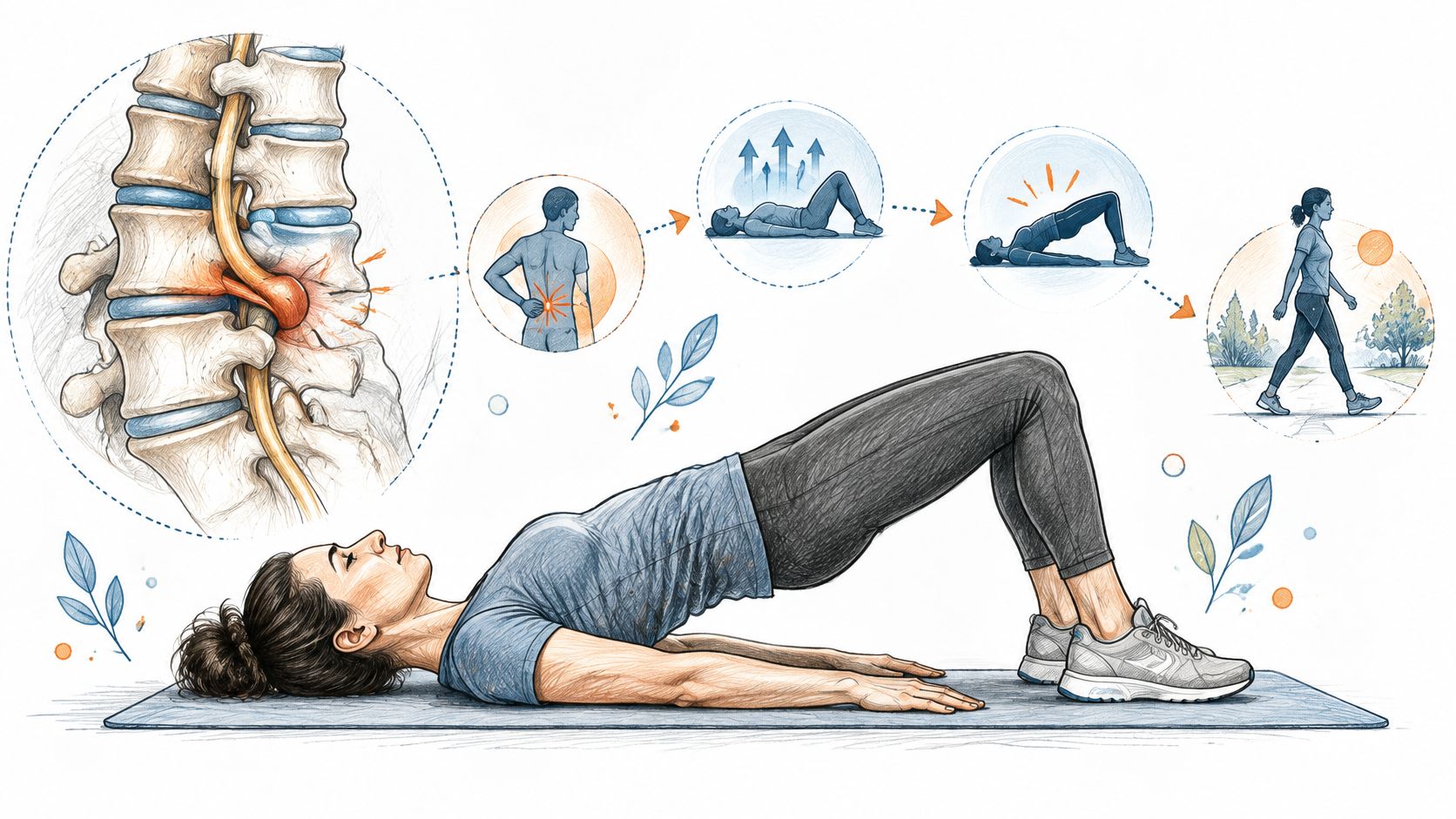
You're shifting in your chair because sitting hurts, walking carefully because pain travels into your leg, and wondering whether an MRI finding means surgery is inevitable. You want relief, but you also want to know how long it's reasonable to keep trying conservative treatment.
Bulging disc treatment without surgery should be a monitored plan, not an unlimited series of appointments. The practical questions are what you can safely do now, which changes count as progress, and what would mean it's time for a different approach. This guide focuses on lower-back disc symptoms and sciatica, where the evidence below applies.
If leg pain from a lumbar disc is limiting daily activity, the next step is a monitored trial with clear review points. A 2007 randomized trial of 283 adults with severe sciatica found that surgery brought faster improvement between approximately 4 and 12 weeks, while differences were no longer apparent at one year, according to the NEJM Clinician treatment summary. Conservative care here means active treatment with scheduled monitoring, with surgery remaining an option if symptoms persist or worsen.
Use this timetable to agree on a plan with your clinician. Treat each phase length as a minimum review point, and adjust the plan to your symptoms and function.
| Phase | Timing | Main focus | Progress to expect | Escalate if |
|---|---|---|---|---|
| Acute | Days 1-14 | Symptom control, activity within limits, no prolonged bed rest | Leg pain easing; walking more comfortable | New weakness, groin numbness, or bowel or bladder change |
| Early conservative care | Weeks 2-6 | Guided exercise, mobility work, decompression or adjustment if suitable | Sitting and standing tolerance improving | Pain worsening despite a full trial; neurological signs progressing |
| Structured rehabilitation | Weeks 6-12 | Progressive core work, stretching, posture and work-task training | Oswestry score falling; sleep improving | Plateau with persistent radiating pain |
| Reassessment | Around month 4 | Review symptoms, function and response to rehabilitation | Measurable gains in walking and daily function | No functional change since the last review |
| Long-term check | Around month 10.5 | Confirm recovery or obtain a surgical opinion | Near-normal activity and work | Ongoing disability requiring specialist review |
In the acute phase, change positions regularly, take short walks within comfort, and try ice or gentle heat with a protective layer for symptom relief. Ask your clinician about pain medication before starting it, especially if you take other medicines or have kidney, stomach, or cardiovascular conditions.
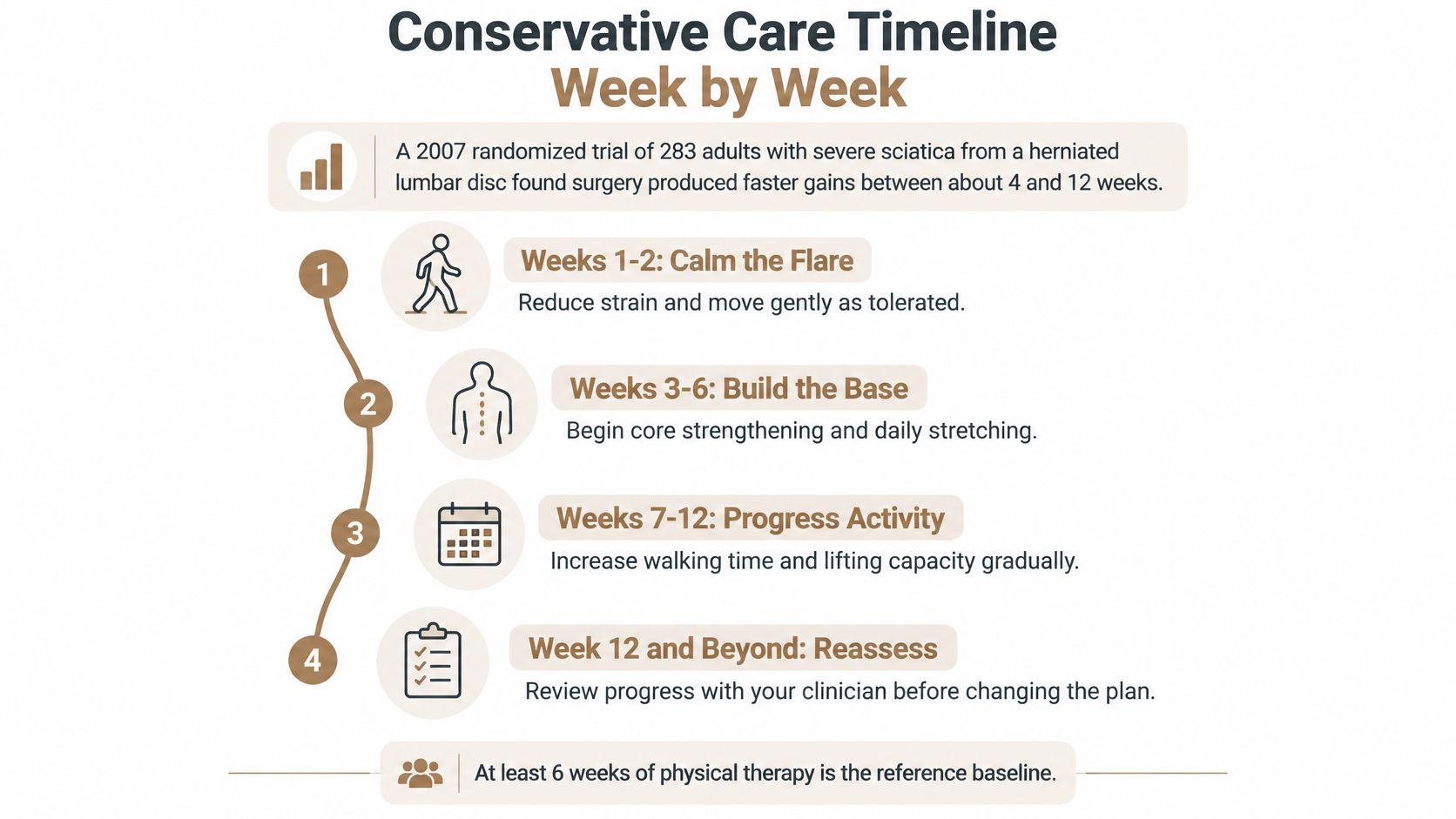
A minimum conservative trial of 4-6 weeks is supported by a systematic review of treatment guidelines, which found that many guidelines recommend waiting 6 weeks to 2 months before considering surgery when neurological function is stable. Recommendations vary, so use the review points to judge progress rather than waiting out a fixed schedule.
Checkpoint rule: Increase workload when function is improving. Review the plan when progress stalls or symptoms worsen.
Recovery can extend beyond the early treatment phases. Use this herniated disc recovery timeline to discuss realistic expectations at your examination.
Start with a safety check: is conservative treatment appropriate today? Before recommending an adjustment, decompression session, or exercise, a clinician should assess strength, reflexes, and sensation, map where symptoms travel, and establish how long they have lasted. The NICE assessment and management guideline supports selective imaging and individualized exercise, rather than routine scans or a standard treatment package.
A cancer history alone does not establish an emergency diagnosis, and back pain alone does not confirm serious disease. Urgency depends on the combination of history, symptoms, and examination. If you are unsure where to go, seek urgent medical triage instead of continuing treatment.
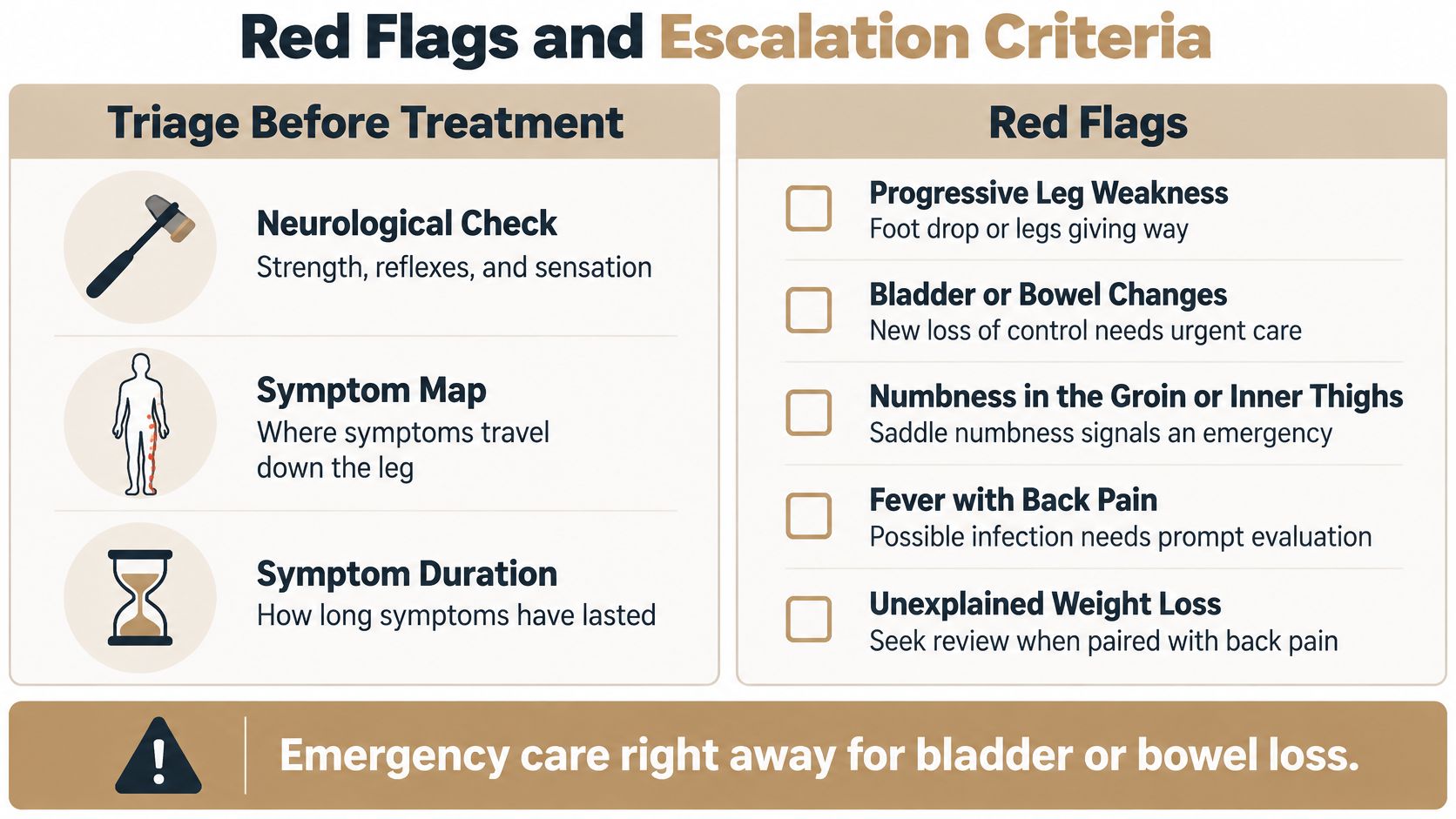
A bulge on imaging may be incidental. Before using it to guide treatment, check whether its level and side match the symptom pattern and examination.
At home, mark symptoms on a body outline. Record whether pain stays above the knee or travels below it, where numbness appears, and which activities bring symptoms on. Log daily pain and walking distance, but do not repeatedly provoke a flare to test your limits.
Progress measures and what each reading means
| Measure | On track | Concern | Action |
|---|---|---|---|
| Oswestry Disability Index | A clinician-agreed target, such as a drop of about 10 points from baseline | Score unchanged or rising across two planned reviews | Reassess treatment and discuss adjuncts or referral |
| Walking tolerance | Walking time before leg pain increases improves over successive weeks | Tolerance falls or stays flat through the planned 6-12-week rehabilitation window | Review exercise load and imaging correlation |
| Neurological exam | Strength, reflexes, and sensation remain stable or improve | Weakness or sensory loss progresses | Arrange urgent specialist review |
| Night pain and sleep | Sleep becomes less interrupted | Repeated waking despite treatment | Check for red flags and adjust positioning and load |
| Work and daily tasks | Sitting, lifting, and driving become easier | Restrictions persist at the planned month 4 checkpoint | Discuss next steps with the clinician |
| Pain response to injection | Meets the agreed pain and function target | Relief falls short or is brief | Do not repeat automatically; obtain specialist review |
The example Oswestry target is a planning aid, not a universal measure of success. Interpret it alongside baseline disability, walking capacity, and neurological findings.
Recovery can occur without surgery, but individual outcomes vary. A systematic review of lumbar disc herniation management reports eventual symptom resolution in more than 85% of patients with acute lumbar disc herniation and radiculopathy, and spontaneous reabsorption in more than half of symptomatic conservatively managed cases. These findings do not predict the course of every MRI-described bulge.
A 2025 retrospective study in the Journal of Clinical Medicine found that 25% of patients initially managed conservatively required surgery within one year. Surgery may become appropriate when symptoms or functional loss persist despite a reasonable trial, or when neurological findings worsen. That outcome does not make the initial conservative approach unreasonable.
Use the planned review dates and escalation criteria to decide what happens if function plateaus. The timeline's reassessment checkpoint is the place to discuss physician assessment and whether an injection or surgical opinion is appropriate. If an image-guided epidural injection is considered, agree beforehand on a target, such as at least 50% pain reduction, and a functional goal. Assess the response before considering another procedure.
Progressive neurological deficit requires prompt spine-specialist assessment; pain treatment should not delay it. The low-back-pain red-flag guide can help you prepare questions, but an online checklist cannot rule out an emergency.
Ask for reassessment dates and escalation criteria in writing. Conservative care should have defined checkpoints and an endpoint, not an open-ended series of appointments.
The National Library of Medicine clinical reference recommends attempting at least 6 weeks of physical therapy emphasizing core strengthening and stretching when appropriate. It also includes activity modification, healthy weight, exercise, and diet within conservative management.
Personal exercise plans should reflect your examination and current capacity. The doses below are an example to discuss with your clinician, not a prescription to begin every exercise immediately. A highly irritable nerve may need a simpler starting routine.
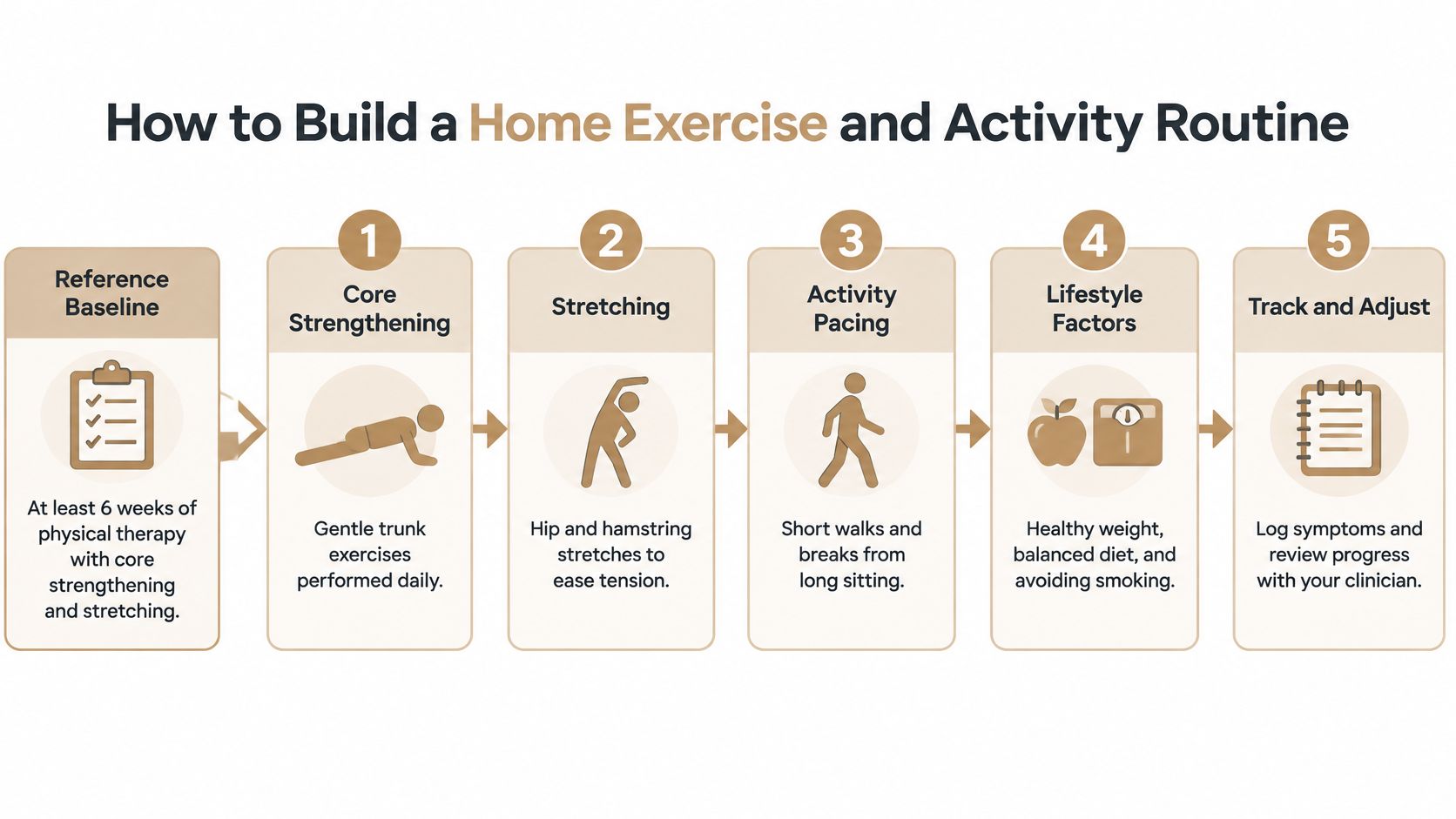
Record your baseline. Note minutes of comfortable walking, minutes of sitting, and a 0-10 pain rating. Use similar conditions when checking again, so a harder route or unusually demanding day doesn't distort the comparison.
Test movement direction under guidance. A clinician might spend five minutes testing gentle repeated movements and retain a direction if symptoms ease or centralize, meaning retreat toward the back. Stop a movement if pain spreads farther down the leg or numbness increases.
Choose manageable core exercises. An example later-stage prescription is two sets of 8-10 bird dogs, dead bugs, or bridges, progressing toward 20-30-second holds where appropriate. Start with the easiest tolerated version rather than completing all three exercises through pain.
Break walking into short bouts. A starting example is 5-10 minutes, adding one to two minutes every few days if symptoms remain settled. Finish with capacity left rather than walking until your gait deteriorates.
Stretch without pulling on nerve symptoms. Your clinician may suggest hip-flexor or hamstring stretches held for 30 seconds. Skip any stretch that produces shooting pain, tingling, or symptoms farther down the leg, even if the muscle feels tight.
Interrupt sustained positions. Try changing position every 30-45 minutes at a desk, and plan safe stopping breaks during longer drives. For evening relaxation, SleepHabits offers a nighttime wind-down guide for restless sleepers, but keep only movements your clinician has cleared.
Use a recovery rule before progressing. One practical example is increasing the workload only when symptoms return to baseline within 24 hours. If the next day brings more leg pain, reduce the range, repetitions, or duration and discuss persistent worsening with your clinician.
Nutrition counseling can help translate general healthy-eating advice into realistic meals and weight-management goals. It shouldn't come with a claim that a particular food or supplement repairs a disc.
Exercise filter: Choose movements for your capability, not for someone else's back in an online video.
A modality earns a place in a conservative plan when it addresses a specific barrier to activity. For example, reducing muscle guarding may make walking or exercise more manageable. I would pair in-office care with active movement, then judge each treatment by its effect on day-to-day function.
A 2021 expert consensus on lumbar disc herniation describes traction as potentially reducing disc pressure, relaxing ligaments, easing muscle spasm, improving local circulation, and addressing facet-joint dysfunction. These proposed mechanisms support discussing Spinal Decompression with the DRX 9000. They do not establish identical results across branded devices or show that treatment permanently repositions a disc.
A 2024 review of nonsurgical lumbar disc treatment reports moderate support for mobilization, manipulation, exercise, and short-term traction outcomes. That evidence can inform a treatment choice, but it does not guarantee an individual response or establish the results of a particular device.
| Option | Main purpose | Evidence picture | Good fit when | Limit |
|---|---|---|---|---|
| Chiropractic adjustment or mobilization | Joint mobility and pain modulation | Moderate support for mobilization and manipulation | Restricted movement contributes to symptoms | Doesn't remove disc material |
| DRX9000 spinal decompression | Traction intended to reduce disc pressure and spasm | Moderate support for short-term traction; device-specific outcomes aren't established by mechanics alone | Radiating symptoms change with position and assessment supports a trial | Needs defined goals and reassessment |
| MLS Laser Therapy | Intended inflammation control and recovery support | Limited disc-specific evidence in the cited literature | Considered as an adjunct alongside exercise | Shouldn't replace active rehabilitation |
| SoftWave Therapy | Tissue stimulation and healing support | Limited disc-specific evidence in the cited literature | A soft-tissue component warrants an adjunct trial | Benefit for disc-specific pain remains unproven |
| Acupuncture | Pain modulation and function | Included among consensus conservative options | Pain limits tolerance of manual care | Symptom relief isn't proof of disc healing |
| Massage Therapy | Reduce soft-tissue tension and guarding | Condition-dependent adjunct in expert consensus | Muscle spasm limits comfortable movement | Temporary relief without demonstrated structural correction |
| Epidural steroid injection | Short- to medium-term pain relief | Analgesic benefit with limited durable nerve-function improvement | Persistent radicular pain after conservative treatment | External physician referral, not an in-house service |
A meta-analysis of epidural steroid injections found pain relief within 3 and 6 months, without significant improvement in sciatic nerve function at short- or long-term follow-up. The practical trade-off is symptom relief that may support rehabilitation, without assuming the injection restores nerve function.
Set a functional target before starting treatment. “Realignment” can refer to a movement or posture goal, rather than a promise to permanently reposition a disc. For passive options such as SoftWave, define the role in the plan and how improvement will be judged.
Before a spinal decompression therapy trial, agree on what would justify continuing. I would change one modality at a time and review progress within an agreed two-to-four-week review window, stopping sooner if symptoms deteriorate. Continue only when walking, sleep, or daily function improves; an immediate change in sensation alone is not enough to show meaningful benefit.
Book an initial examination this week and bring existing MRI or X-ray reports, your symptom log, and a list of aggravating activities. Include what you want to return to, whether that's a full workday, lifting a child, or playing golf.
The first visit should establish the working diagnosis, screen neurological function, and determine whether imaging referral is indicated. The resulting plan may include individualized adjustments, DRX9000 decompression, MLS laser, SoftWave, acupuncture, massage, and take-home rehabilitation exercise, with scheduled re-evaluations rather than automatic continuation.
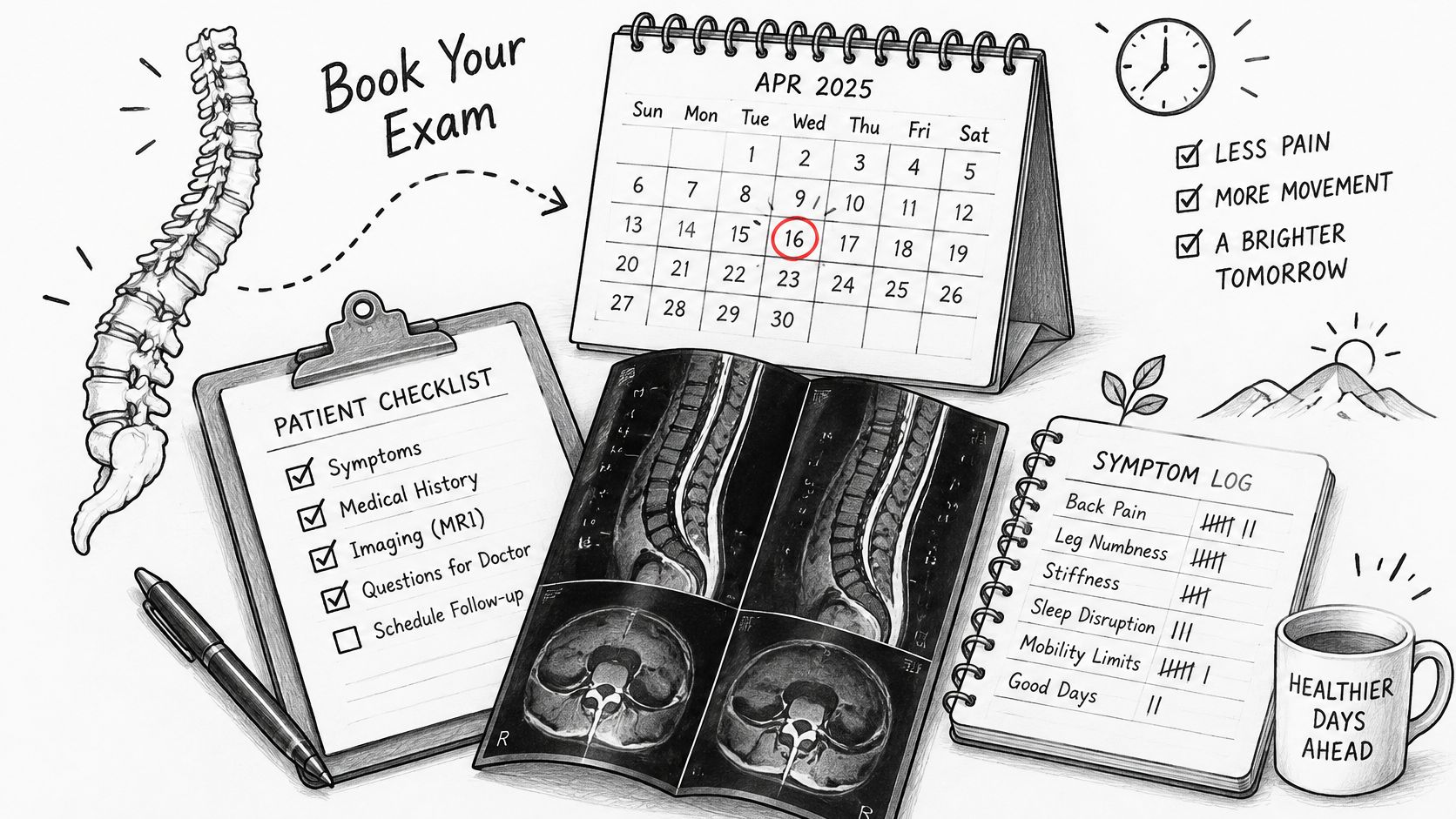
Ask whether mobility therapy, nutrition counseling, Golf Movement Screening, or Car Accident Treatment is relevant to your goals. Not every available service belongs in a disc-care plan. Needs outside the clinic's scope should prompt external referral.
For care in Salt Lake City or Sandy, confirm insurance coverage before your first visit. When contacting any clinic, distinguish appointment support from medical triage: a service such as Chimehill's AI receptionist for allied-health clinics is an administrative resource, not a substitute for urgent clinical assessment.
Aspen Falls Wellness offers individualized chiropractic care, DRX9000 spinal decompression, and rehabilitation exercise for people considering bulging disc treatment without surgery. Visit Aspen Falls Wellness to arrange an examination in Salt Lake City or Sandy and discuss a conservative plan with measurable goals, scheduled checkpoints, and referral when needed.

Stay updated with the latest chiropractic news and exclusive offers.