Multidisciplinary pain management combines chiropractic, therapy, and rehab for chronic pain. Learn how it works, what to expect, and how to start in SLC.


You've probably been there already. The pain starts as a stiff neck, a stubborn low back, or a sharp line down one leg, and then it becomes a rotation of visits, stretches, scans, medications, and temporary relief. Each appointment may help one piece, but the whole problem keeps showing up because no one is coordinating the moving parts.
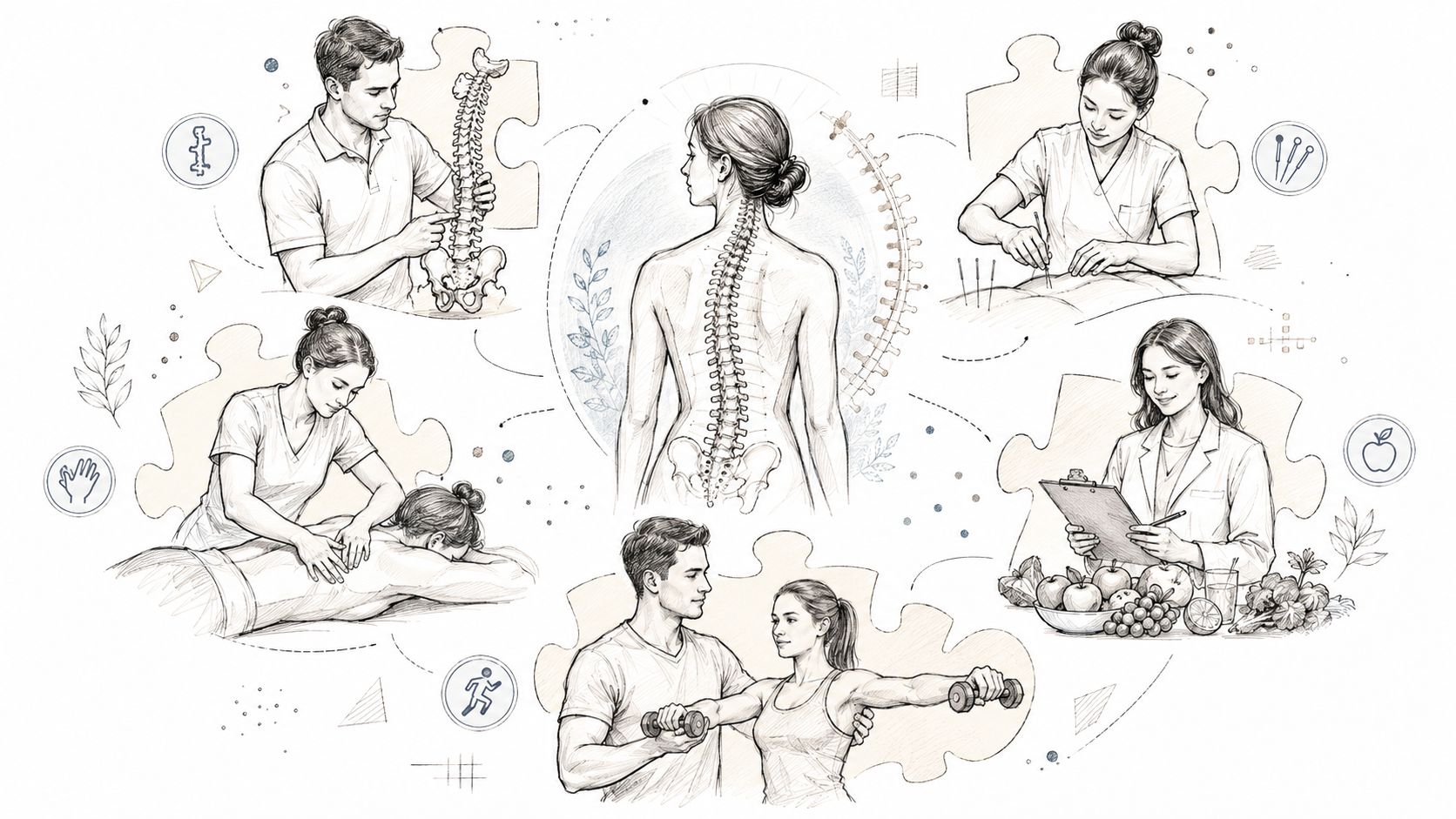
That is where multidisciplinary pain management changes the conversation. It treats pain as a system problem, not a single broken part, which is why a local outpatient clinic can combine manual care, decompression, soft-tissue work, exercise, and education into one plan instead of sending you from one isolated visit to another. If you want a broader sense of the kinds of options people usually explore, this resource on browse advanced pain management options gives a helpful overview.
A lot of readers come here after the same pattern. A chiropractor helps the joint motion for a while, a massage therapist eases the muscle guarding, an injection or prescription calms a flare, and then the pain comes back when you sit too long, lift wrong, sleep badly, or stress spikes. The frustrating part isn't that any one step was useless. It's that each step treated only one slice of the problem.
Pain often behaves like a construction site with several crews working at once. If you fix the drywall without checking the wiring, the plumbing, or the structure behind it, the wall may look better for a bit while the issue keeps spreading. Chronic pain works the same way. Tissue irritation matters, but so do movement habits, nervous system sensitivity, sleep, fear of motion, and the demands of daily life.
Practical rule: If one treatment keeps helping briefly and then the same pain pattern returns, the missing piece is often not “stronger treatment.” It's coordination.
That's why the better question is usually not, “What single thing should I try next?” It's, “What's the plan, who is guiding it, and how do the pieces fit together?” In a coordinated clinic, the patient isn't passed around as a series of unrelated problems. The team looks at the whole pattern, then chooses which tools belong in the same sequence and which ones would only duplicate each other.
A multidisciplinary model starts to make sense. It doesn't deny that an irritated disc, a tight muscle, or a restricted joint can be real. It just refuses to pretend those findings explain everything by themselves. When pain has outlasted the original trigger, the whole system usually needs attention, not just the loudest symptom.
A patient may come in with back pain and expect one fix, one visit, one answer. In a multidisciplinary plan, the clinician looks at the pain the way a construction crew would inspect a house with a leak, a crack, and a wiring problem at the same time. The goal is to find which parts are driving the pain, which parts are reacting to it, and which parts need coordinated care so the whole system can settle down.
That is the heart of a biopsychosocial framework. Pain has a body component, a behavior component, and a life-context component, so care has to match that reality instead of chasing one cause in isolation. The International Association for the Study of Pain describes multidisciplinary pain management as integrated multimodal treatment delivered by a team that shares a biopsychosocial model, with access to medical leadership, psychological expertise, physiotherapy or occupational therapy, education, and evaluation for complex comorbidities when needed IASP toolkit. For some patients, that broader evaluation includes PTSD care from IPA, because stress responses and trauma history can shape how the nervous system holds on to pain.
The U.S. Agency for Healthcare Research and Quality defines a multidisciplinary pain management program around medical therapy, behavioral therapy, physical reconditioning, and education AHRQ technical brief. That gives the model a clear structure, and it also explains why local outpatient care can look different from a single-service visit. In a musculoskeletal clinic, those pillars may show up as a focused exam, a plan for movement retraining, in-clinic modalities such as decompression or laser therapy, acupuncture where appropriate, and home exercise that keeps the work going between appointments.
Pain care works best when the patient leaves with a plan they can repeat at home, not just a temporary sense of relief in the office.
That is why a clinic can offer several services and still fall short of multidisciplinary care. The test is whether those services are tied to shared goals, reassessment, and communication. If the adjustments, decompression, exercise, acupuncture, and education all point in the same direction, the team is working like a pit crew, each person handling a different task so the whole vehicle can get back on the road safely.
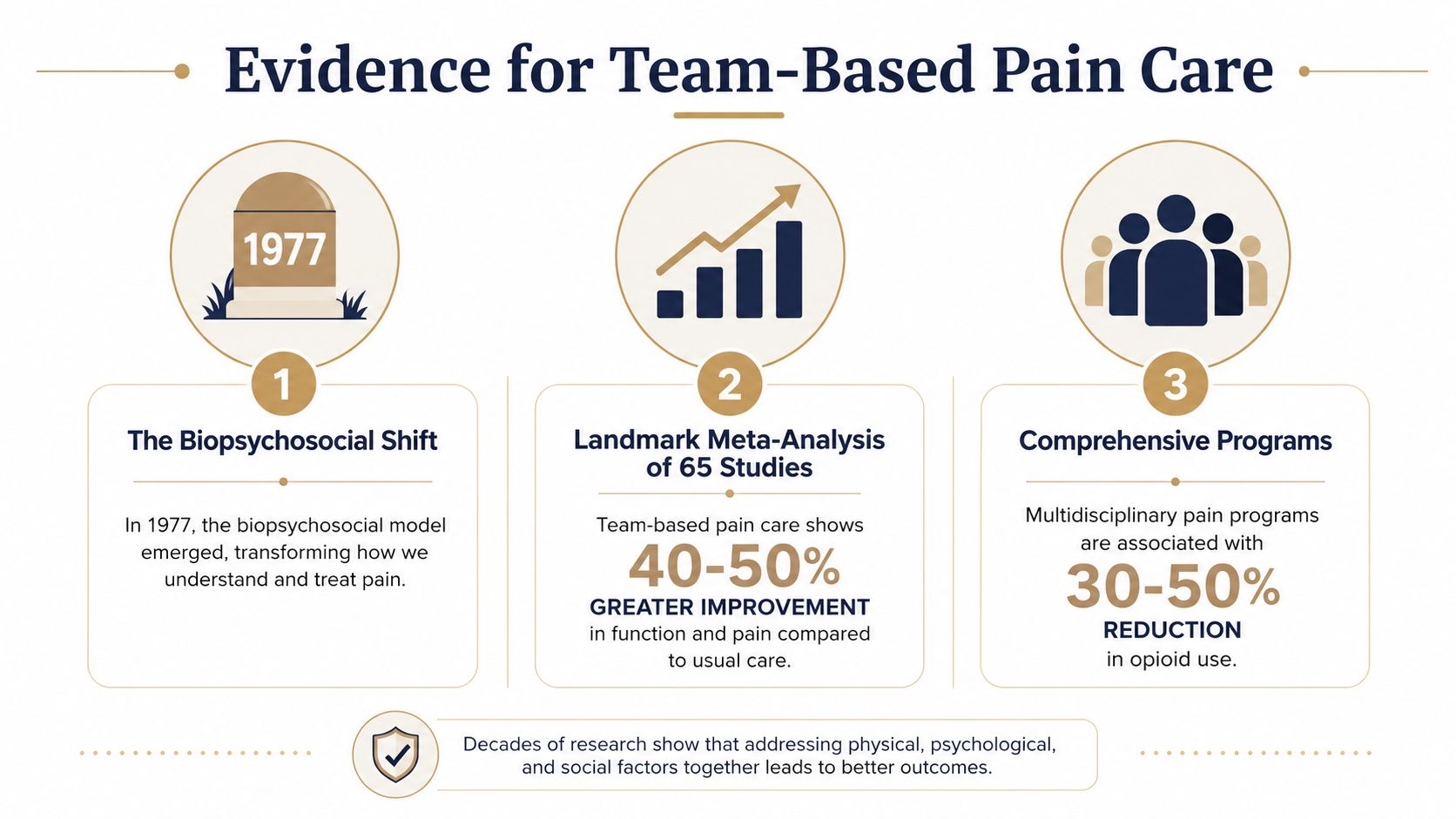
The modern model didn't appear out of nowhere. It grew from the biopsychosocial shift, which reframed chronic pain as more than a purely tissue-based problem and helped establish the structure still used in many programs today historical review. That review also described early multidisciplinary programs as intensive, about 27 hours per week over 15 to 25 days, which shows how seriously the model was originally built around coordinated rehabilitation rather than occasional visits.
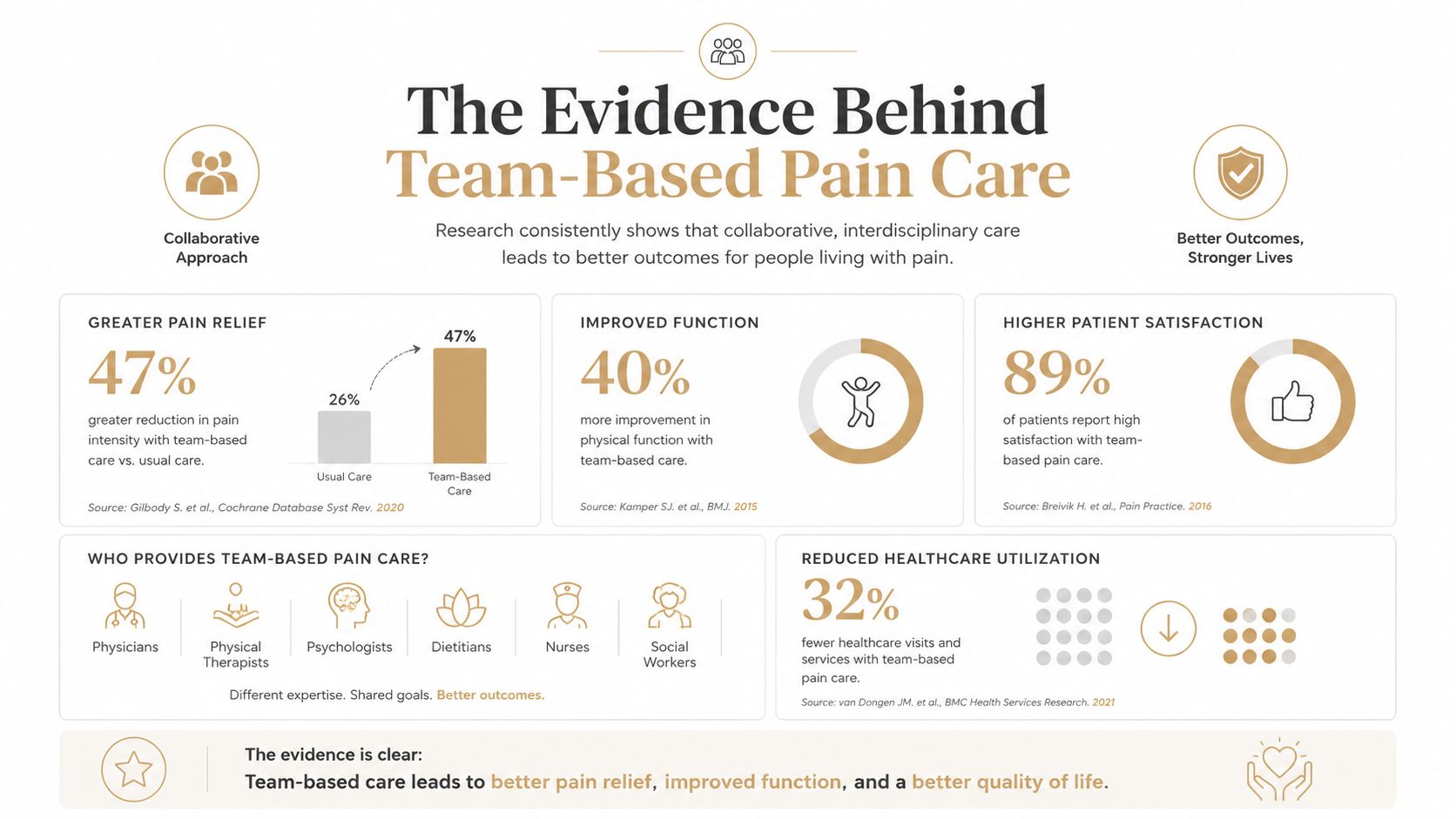
The strongest argument for this approach is not philosophy. It's that team-based care has repeatedly shown better results than fragmented care in the right settings. A classic meta-analysis of 65 studies found multidisciplinary treatments superior to no treatment, waiting list, and single-discipline care such as medical care or physical therapy, with benefits reaching pain, mood, interference, return to work, and health-care use meta-analysis.
That matters because chronic pain rarely improves in one dimension only. A person can have less pain and still be unable to work, or move better while still feeling anxious and guarded. The best programs target more than one outcome at once, which is why the gains are more meaningful than a simple “pain score” drop.
A more recent interdisciplinary pain review reported pain reduction ranging from 14% to 60%, with an average of 20% to 30%, and about a 65% increase in physical activity compared with 35% with conventional medical care IASP review. Those numbers don't promise a cure. They do show that coordinated care can move people in the right direction in a measurable way.
The cleanest takeaway is that the goal isn't only symptom suppression. It's better function, better movement, and better self-management. That's why a patient may still have some pain while also walking more, relying less on crisis care, and needing fewer rescue interventions over time.
The win is often not “zero pain,” it's fewer flare-ups, more control, and a body that works better in daily life.
A coordinated plan brings the four pillars into one clinic visit pattern, and in a musculoskeletal setting those pillars show up as specific therapies that support one another. The goal is not to stack services for their own sake. It is to choose the right ones in the right order, the way a pit crew each handles a different job so the car gets back on the road with less delay.
| Pillar | Therapies | Primary Role |
|---|---|---|
| Medical therapy | Chiropractic adjustment, spinal decompression with the DRX 9000, realignment, car accident treatment, pain relief evaluation | Address joint mechanics, nerve irritation, and structural load |
| Behavioral therapy | Acupuncture, nutrition and nutrition counseling, pain education, self-management coaching | Support symptom modulation, coping, and recovery habits |
| Physical reconditioning | Massage therapy, mobility therapy, rehabilitation exercise, personal exercise plans, muscle stimulation | Restore movement, reduce guarding, and rebuild tolerance |
| Education | Golf movement screening, home guidance, posture retraining, activity pacing, rehab instruction | Teach the body's “user manual” so progress continues outside the clinic |
Chiropractic adjustment and realignment fit the medical side of the plan because they address joint motion and mechanical restriction. Spinal decompression with the DRX 9000 fits when disc-related symptoms or nerve irritation make spinal unloading part of the strategy. MLS Laser Therapy and SoftWave Therapy can also be used as supporting tools when the aim is to calm irritated tissue and support recovery.
The behavioral side often includes acupuncture, which many patients use when pain feels tied to the nervous system rather than only to a joint or muscle. If you want a closer look at that option, this internal resource on acupuncture for chronic pain fits naturally with the framework. Some patients also ask about using CBD for chronic pain, and that conversation belongs in the same symptom-management category rather than as a stand-alone cure HempWell USA.
Physical reconditioning is where a plan starts to hold together over time. Massage therapy can reduce guarding and make movement feel more tolerable. Mobility therapy, rehabilitation exercise, and personal exercise plans build the strength and range needed to keep that progress going, while nutrition and nutrition counseling recognize that recovery happens in the context of the whole person, not in isolation. Golf movement screening is a practical example of shaping care around the way someone moves in daily life.
A good multidisciplinary clinic doesn't hand you a stack of unrelated appointments. It sequences care so each step prepares the next one. That matters because a plan for a disc herniation, chronic low back pain, or whiplash should look different on paper, even if the same clinic is involved.
A patient with lumbar disc herniation and sciatica usually needs a plan that reduces nerve irritation, protects tolerable movement, and checks whether decompression belongs early in the process. A patient with chronic mechanical low back pain may need more emphasis on adjustments, mobility, graded exercise, and home practice. A patient recovering from post-motor-vehicle whiplash often starts with careful evaluation, symptom tracking, and a conservative progression that respects how easily the neck can flare.
The first appointment usually starts with an exam and, when indicated, imaging referrals such as X-ray or MRI. After that, the care coordinator or clinician lines up the next steps instead of sending the patient to a different office for every issue. If spinal unloading is part of the plan, a page like spinal decompression therapy helps readers understand why decompression may be used before or alongside other treatments.
If the plan is working, the clearest sign is often not a dramatic instant cure. It's that daily tasks become easier and flare-ups are less disruptive.
A coordinator matters. Without that role, one treatment can cancel out another, or the patient can be sent home with a list that never gets organized into a sequence. With coordination, the plan becomes cumulative instead of random.
The first misconception is that multidisciplinary care means “too many appointments.” In reality, the right model reduces confusion because each visit has a purpose. You're not collecting services, you're following a plan.
The second misconception is that this kind of care is only for severe or post-surgical cases. That's too narrow. People often benefit when the issue is still stubborn but not catastrophic, especially if the pattern has stopped responding to one-provider care. The better signal is not severity alone, it's whether the problem keeps recurring or keeps interfering with normal life.
The third misconception is that the goal has to be zero pain before progress counts. That's not how chronic pain care usually works. A person can still have some pain and yet move better, sleep better, need fewer rescue interventions, and function more reliably.
Patients usually do better when they come in with realistic goals and a willingness to follow the home plan, not when they wait for an image to look dramatic enough to justify care.
One more thing confuses people. They assume the most important finding is what shows up on a scan. Imaging matters, but it doesn't tell the whole story of how the nervous system, muscles, and habits are interacting day to day. The most useful question is how the body is working, not just what one structure looks like on paper.
If pain has lasted more than 4 to 6 weeks, keeps coming back, followed a car accident, or still feels nerve-like with leg or arm symptoms, it's reasonable to look for a coordinated evaluation. The same is true when single-provider care has plateaued and the plan has stopped moving you forward. Chronic pain doesn't need to be unbearable before it deserves a more complete strategy.

A strong clinic should have a shared plan, reassessment built into the process, and access to more than one discipline in-house rather than sending you out for everything. It should also explain why a treatment is being used, how long it's expected to help, and how progress will be measured. If a clinic offers DRX9000 decompression, MLS laser, manual care, acupuncture, exercise, and education under one roof, that usually signals the kind of coordination people are looking for.
For local readers, Aspen Falls Wellness serves Salt Lake City and Sandy with two clinic locations, and the practice includes decompression, adjustments, soft-tissue care, acupuncture, mobility work, and rehabilitation exercise within a coordinated musculoskeletal model. Insurance participation may include plans such as Aetna, BCBS, Cigna, Humana, GEHA, and Motiv Health, but verification is still the smart move before starting care. The Salt Lake City location details are available at Aspen Falls Wellness Salt Lake City.
If you're deciding whether now is the time, call for a consultation before you commit to a long course of care. A good first conversation should leave you clearer, not more confused, about what the plan is and why it fits your pain pattern.
Aspen Falls Wellness offers coordinated chiropractic and integrative musculoskeletal care for back pain, neck pain, sciatica, whiplash, and other stubborn movement problems. If you want a plan that combines examination, decompression, adjustments, soft-tissue work, acupuncture, exercise, and education, visit Aspen Falls Wellness to see how multidisciplinary pain management can be organized around your daily function.

Stay updated with the latest chiropractic news and exclusive offers.