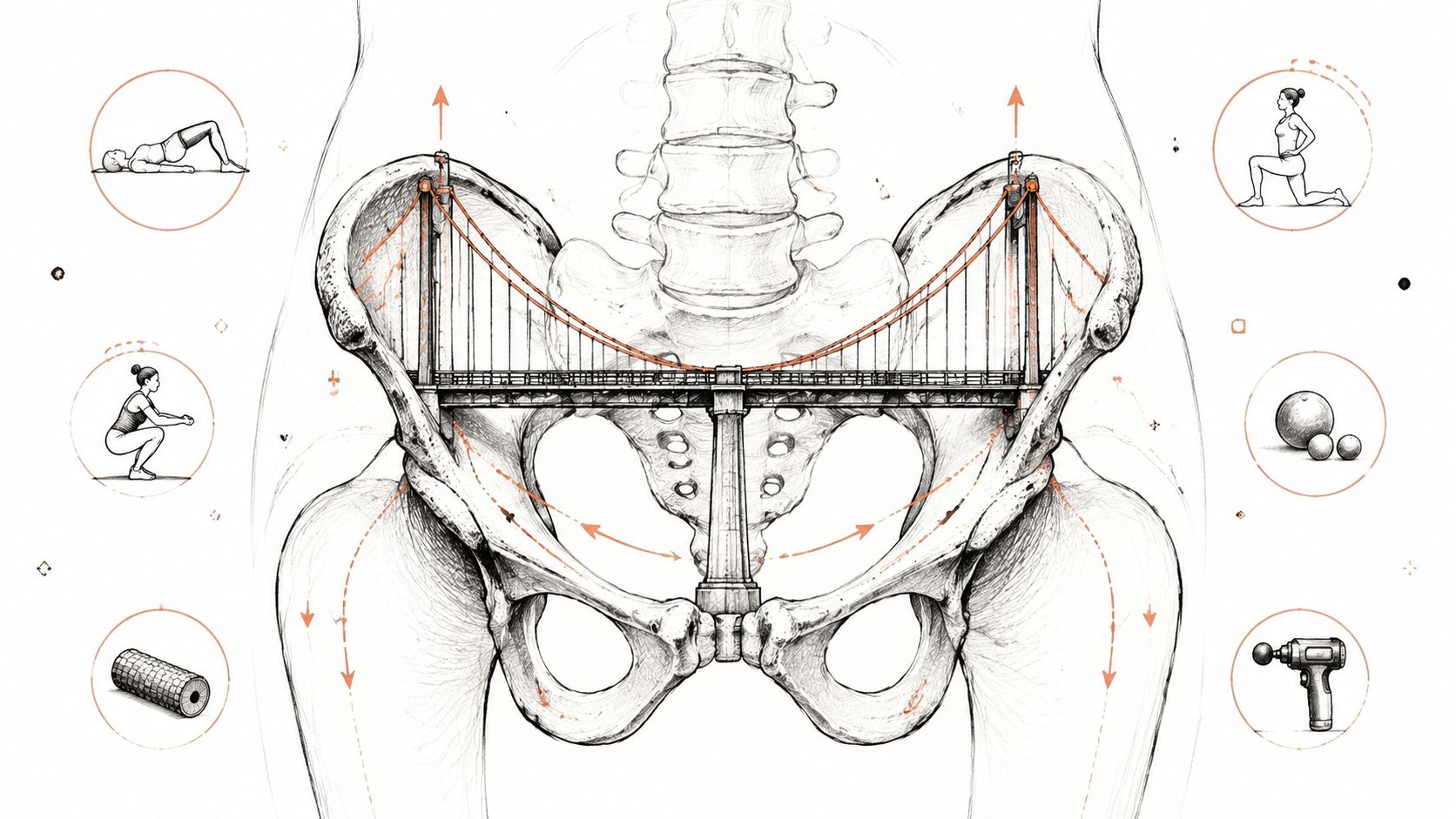
Weigh the pros and cons of spinal decompression, from evidence and candidacy to red flags, costs, and when to seek evaluation in Salt Lake City or Sandy.
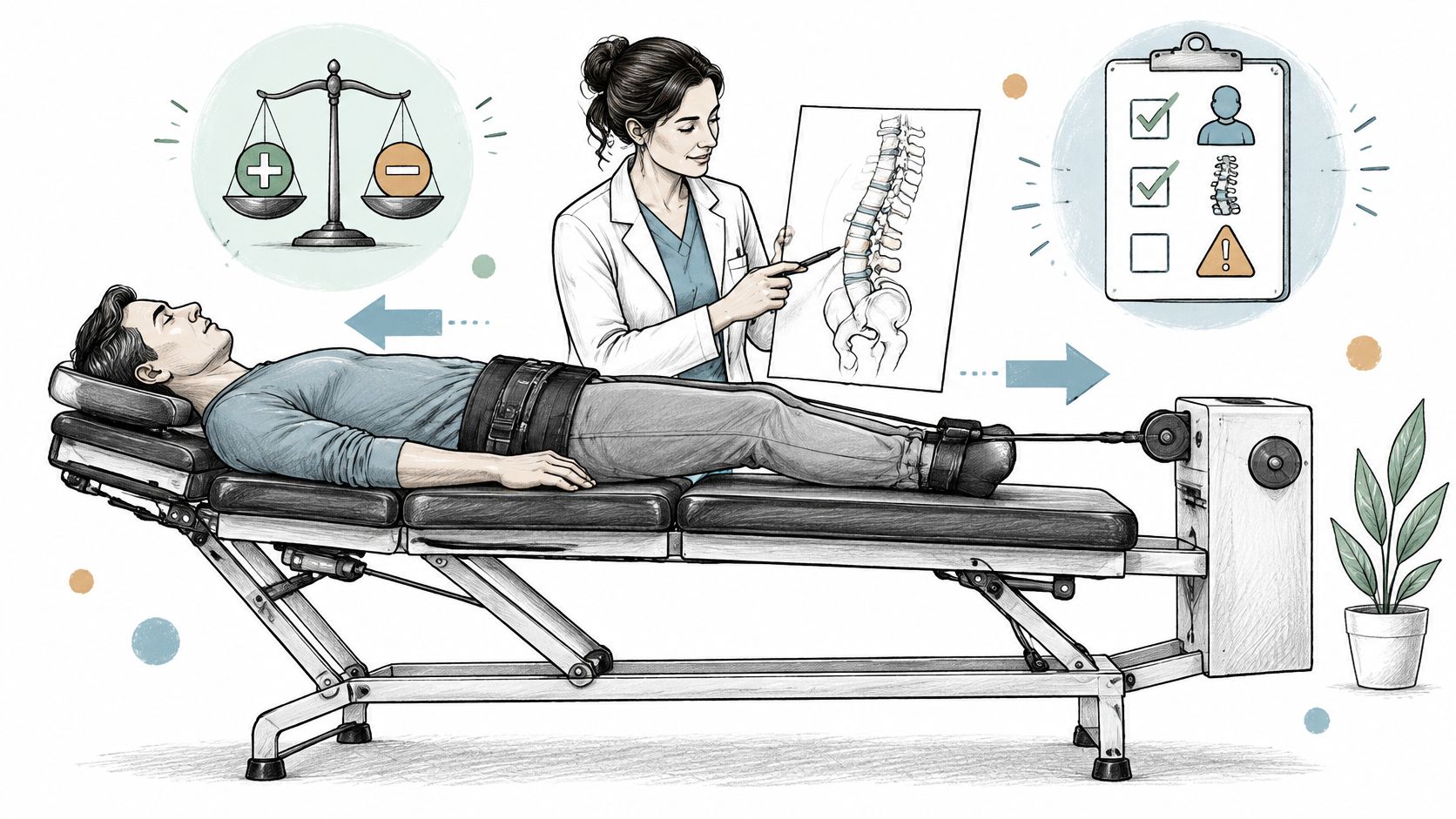
The popular advice to try spinal decompression before considering surgery skips the most important question: what's causing the symptoms? A traction table may be worth discussing for selected patients, but it isn't a universal disc-repair treatment. The useful way to weigh the pros and cons of spinal decompression is to examine candidacy, meaningful daily function, and the point at which treatment should stop.
Non-surgical spinal decompression can be a reasonable, time-limited trial for selected people with disc-related back pain or sciatica. It isn't a proven cure, and it shouldn't replace medical evaluation, exercise, or surgery when surgery is indicated. Its practical appeal is that it tests whether symptoms and activity tolerance improve without starting with an invasive procedure.
Decide on whether a supervised trial justifies the visits, cost and risk of aggravation for your diagnosis. A sensible frame is to track function, set a review point, and allow the option of stopping if the treatment fails to earn its place.
Spinal decompression pros and cons at a glance
| Decision point | What it does well | What it does not establish |
|---|---|---|
| Non-surgical approach | Uses a traction table applied from outside the body, without an incision | Does not prove repair of every disc, stenosis, or nerve problem |
| Pain and function | May help selected patients move better and report less pain | Does not guarantee lasting change in walking, sitting, sleep, or work tolerance |
| Evidence strength | Has a body of evidence for traction-based treatment | Does not match stronger claims sometimes made about cure or consistent benefit |
| Time and cost | Can be scheduled as outpatient care and paired with exercise | Repeated visits require time and money before the benefit is clear |
| Risk burden | Has a low procedural burden when patients are screened | Does not remove the need to respond promptly to increased pain or temporary soreness |
| Candidacy | May fit selected disc-related pain or sciatica after examination | Does not replace evaluation when symptoms or red flags suggest another cause |
Use the table as a decision aid, not a verdict. The detailed sections explain where benefits are modest, which risks deserve attention, how decompression compares with other options, and how candidacy should be screened.
Spinal decompression describes different treatments. An outpatient traction table applies a controlled pulling force from outside the body. Surgical decompression addresses compressed structures through a procedure. A favorable surgical result doesn't establish that traction tables work, and disappointing traction findings don't settle whether someone needs surgery.
That distinction matters when you're comparing testimonials, treatment packages, or recovery expectations. Before weighing a claim, identify whether it concerns a machine-based treatment, an image-guided procedure, or an operation. The same word can describe very different interventions with different recovery demands and evidence.
Also separate less pain during treatment from better capacity afterward. Feeling comfortable on a padded table may be welcome, but it doesn't establish that you can sit through work, walk farther, or resume necessary activities. Those are different outcomes and deserve separate tracking. A short-lived improvement in comfort has less decision value than a measurable gain in function that holds between visits.
A reasonable decision leaves room for both possibilities: treatment may help, or another approach may fit better. Agreeing to a trial shouldn't mean agreeing to continue regardless of the result. Define the measures you care about before you start, review them at the planned point, and let the response determine whether continued visits make sense.
Judge decompression by measurable function and a planned reassessment, not by dramatic before-and-after claims.
Non-surgical spinal decompression is a form of motorized traction. You remain clothed and awake while a table and harness apply controlled pulling forces, often alternating stretch and relaxation. The clinician adjusts position, force, and timing rather than cutting, fusing, or removing tissue.
The proposed mechanism is straightforward: changing the mechanical load might reduce pressure on discs, joints, or irritated nerves. That's a mechanical premise, not proof of disc healing. A plausible explanation for a treatment doesn't establish that it reliably produces lasting clinical improvement.
Surgical decompression includes procedures such as discectomy and laminectomy, which remove tissue contributing to compression. Image-guided stenosis procedures are another distinct category. Their indications, risks, recovery requirements, and evidence must be evaluated separately from traction.
This prevents a common reasoning error: borrowing the credibility of a medical procedure to support an outpatient machine. Sharing the word decompression doesn't mean treatments achieve the same anatomical change.
The FDA's 2006 DRX9000 clearance document describes a non-surgical system for pain and disability associated with incapacitating low-back pain and sciatica, listing herniated, bulging, or protruding discs, degenerative disc disease, and posterior facet syndrome; clearance rested on substantial equivalence to legally marketed predicate devices.
That isn't the same as FDA premarket approval demonstrating clinical effectiveness. The document supports the device's legally marketed indications, not a conclusion that it outperforms exercise, conventional traction, injections, or surgery.
A diagnosis appearing among device indications also doesn't establish individual candidacy. Someone with radiating pain still needs an examination that considers neurological findings, symptom progression, and competing explanations.
Before comparing clinics, ask for the device name, force protocol, and diagnosis being treated. Then ask what clinical outcome justifies that choice. A brand name describes equipment; it doesn't replace a treatment rationale.
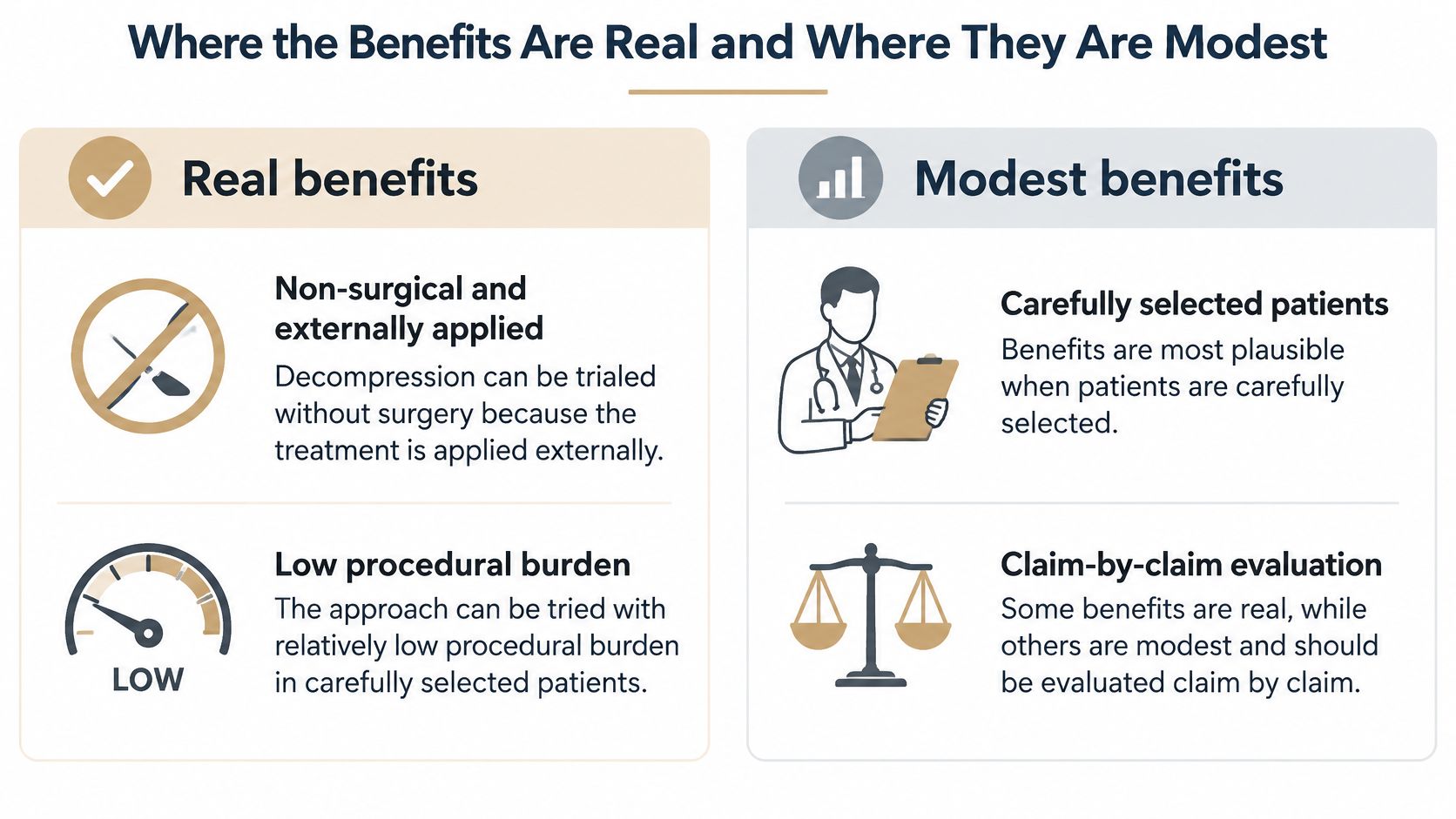
The clearest benefit is procedural: traction-table decompression is non-surgical and externally applied. For a carefully screened patient who wants a conservative option, it offers treatment that involves no incision and no surgical recovery. That practical advantage is real even when its added therapeutic benefit remains uncertain.
Some patients do experience symptom relief, and decompression can be incorporated into a rehabilitation program rather than used alone. The qualification is attribution: when a patient improves while receiving adjustments, exercise, and traction together, the improvement alone cannot identify which component caused the change.
A Cochrane review of traction for low-back pain identified 32 randomized controlled trials involving 2,762 participants and found little or no meaningful improvement compared with sham treatment for chronic low-back pain without sciatica.
That result narrows the defensible claim. It doesn't mean nobody feels better. It means improvement during treatment cannot automatically be credited to a special decompression effect. Diagnosis, comparison treatment, accompanying exercise, and the outcome measured all shape what a trial can show.
The difference between pain relief and reduced disability matters here. A patient can report a better pain score while remaining unable to do the activities that prompted treatment. Someone else can regain useful activity despite lingering discomfort. Judging decompression by pain scores alone can mislabel which of those outcomes the treatment produced.
Decompression is easiest to justify as a short, measured trial rather than a promise to heal a disc.
A systematic review of motorized spinal decompression reported pain reductions of 77% to 86% in uncontrolled case series, but those studies lacked comparison groups and couldn't establish causation.
Without a control group, several explanations remain open. Symptoms change over time on their own. Patients adjust activity and medication during treatment. Clinics often deliver exercise or manual therapy alongside traction, and any of those can account for improvement. A compelling personal account can describe a genuine recovery without proving what caused it.
The accurate summary is that benefits are condition-specific and modest, rather than device-dependent or universally effective. The useful question is whether adding decompression improves outcomes that matter to the patient.
Look for gains that persist between appointments. Relief that only exists while you're receiving passive treatment deserves a different conversation from improvement that helps you resume daily life.
The main disadvantage isn't that decompression requires appointments. It's that you may invest time and money without obtaining clinically important added benefit. Statistical uncertainty belongs in the treatment discussion before a course begins, not after progress stalls.
In the Cochrane evidence summarized for traction, a sham comparison reported a mean pain difference of -4 points on a 0-to-100 scale, with a 95% confidence interval from -17.7 to 9.7; functional comparisons reported standardized mean differences from -0.08 to 0.51, with intervals including no effect, while one trial reported increased pain in 31% receiving static traction and 15% receiving intermittent traction.
Because the pain interval crosses zero, the result is compatible with no benefit. It also spans possible benefit and possible worsening, so the small average difference shouldn't be treated as a dependable expected result for an individual.
Evidence caution: A confidence interval that crosses zero doesn't establish a proven benefit. A promising add-on still needs a measured clinical test.
Functional estimates expressed as standardized differences aren't directly convertible into walking distance or time at a desk. Their practical message here is that the comparisons didn't establish dependable functional superiority.
The adverse-event figures also need boundaries. They concern particular traction protocols, not a universal risk estimate for every modern decompression device. They nevertheless show why a non-surgical treatment shouldn't be described as risk-free.
Your real cost includes more than the session charge:
Use our guide to whether insurance covers spinal decompression to prepare coverage questions. Confirm benefits and expected out-of-pocket costs for the actual proposed treatment rather than assuming general chiropractic coverage answers the question.
Machines, force levels, schedules, diagnoses, and accompanying exercise differ across treatment protocols. That makes it difficult to transfer a result from one setup to every branded system. Neither a negative study nor a positive testimonial should be stretched beyond the treatment it evaluated.
A responsible monitoring record should distinguish back pain, radiating pain, neurological symptoms, and function. These can move in different directions. Less central back pain isn't reassuring if leg weakness or spreading numbness is worsening.
Don't accept escalating force or extending the course as the automatic response to poor progress. Worsening symptoms call for reassessment, and inadequate benefit calls for reconsidering the plan.
Structured exercise and physical rehabilitation provide the baseline against which an optional passive treatment should be judged. Ask whether the proposed approach helps you rebuild activity or mainly schedules more time on a treatment table. Exercise selection should reflect your examination and tolerance, not a generic routine.
Our explanation of chiropractic care versus physical therapy can help clarify differences in approach. The useful comparison is the actual plan: what you'll practice, what you'll do at home, and how progress will be assessed.
| Option | Decision it should answer |
|---|---|
| Exercise and rehabilitation | What activity limitations need active retraining? |
| Traction-table decompression | Does this optional addition produce meaningful improvement? |
| Targeted injection | Is a physician-directed intervention appropriate for the identified pain pattern? |
| Surgical or image-guided procedure | Does structural compression require procedural evaluation? |
Targeted injections for sciatica have their own indications, evidence, and risks. Discuss them with the treating physician rather than assuming traction either replaces them or must always precede them.
Surgical choices can include discectomy, laminectomy, and other diagnosis-specific procedures. A 2025 database study comparing lumbar surgical approaches reported two-year costs of $18,089 for open decompression and $20,347 for endoscopic decompression, a $2,258 difference. These are surgical costs, not traction prices or a personal estimate.
A 2025 meta-analysis of minimally invasive lumbar decompression for stenosis included 12 studies and 500 patients, reported potentially meaningful improvements, and called for better-designed, adequately powered randomized trials. Those findings concern an image-guided procedure, not a traction table.
If morning stiffness is part of the problem, Tyner Furniture's resource can help you find a mattress for morning stiffness. Treat that as a comfort-related purchasing decision, not evidence that bedding corrects nerve compression.
The strongest option isn't necessarily the least invasive or most technologically elaborate. Ask which treatment has the strongest rationale for your specific diagnosis and functional limitations.
Screen before scheduling a traction course. Sciatica-like symptoms don't establish that traction is appropriate, and a pain label doesn't exclude neurological compromise or structural injury.
The clinical reference on traction identifies possible contraindications or relative contraindications, including aortic aneurysm and acute torticollis, while noting that published evidence doesn't accurately define contraindications and that much cervical-traction evidence is small and low quality.
These findings don't all mean the same thing or demand identical testing. They do mean the clinician must resolve the concern rather than interpret every symptom as a routine mechanical problem.
Candidacy and stop rules for a decompression trial
| Presentation | Reasonable to discuss | Check first | Stop or escalate if |
|---|---|---|---|
| Disc-related low-back pain or sciatica without red flags | Yes, after examination | Neurological exam, imaging if indicated, red-flag screen | New or worsening weakness, numbness, or bowel or bladder change |
| Chronic low-back pain without sciatica | Cautious; evidence is weak | Functional goals, alternatives, cost, and visit burden | No measurable functional gain at planned reassessment |
| Lumbar stenosis in an older adult | Possible conservative trial, not a substitute for specialist care | Walking tolerance, imaging or referral when indicated | Progressive weakness, falls, or bladder changes |
| Post-motor-vehicle-collision neck or back pain | Only after structural injury is excluded | Trauma exam and imaging when indicated | New neurological signs or severe unremitting pain |
| Progressive neurological deficit or suspected cauda equina syndrome | No; urgent evaluation comes first | Emergency assessment, imaging, and specialist referral | Immediate escalation rather than a traction trial |
A systematic review of motorized decompression found that six of seven randomized studies showed no difference from comparison treatment, while the remaining study found reduced pain without improved disability. That makes functional tracking more defensible than committing to a fixed package based on the machine alone.
Never adjust the machine yourself or push through a red flag. Ask the clinic directly: what outcome would make you stop?
For stable mechanical symptoms without warning signs, arrange an examination before committing to treatment. A traction-table session is not a verdict by itself; the useful sequence is working diagnosis, documented functional baseline, and an agreed endpoint. If strength is dropping, sensation is spreading, or bladder or bowel control changes, medical evaluation comes before a treatment table.
At Aspen Falls Wellness, non-surgical DRX9000 Decompression is available in Salt Lake City and Sandy. A customized plan follows the diagnosis and can draw from chiropractic adjustments, DRX9000 Decompression, MLS Laser Therapy, and take-home mobility exercises. Let the diagnosis set the plan, not the machine on hand.
Bring existing imaging reports, a medication list, and a description of activities you can no longer tolerate. State whether symptoms are stable, improving, or worsening, especially any change in strength or sensation.
Before the first session, get clear answers to these questions:
A useful appointment should produce either a reasonable conservative trial or a clearer referral pathway. The standard is measurable improvement or a timely pivot, rather than an open-ended run of visits.
Aspen Falls Wellness offers non-surgical spinal decompression and individualized musculoskeletal care for adults in Salt Lake City and Sandy. Visit Aspen Falls Wellness to arrange an examination and discuss whether a diagnosis-based decompression trial fits your needs.

Stay updated with the latest chiropractic news and exclusive offers.