Shockwave therapy for tendonitis is stronger for some tendons than others. Compare evidence, typical sessions, limits, and when to get checked.
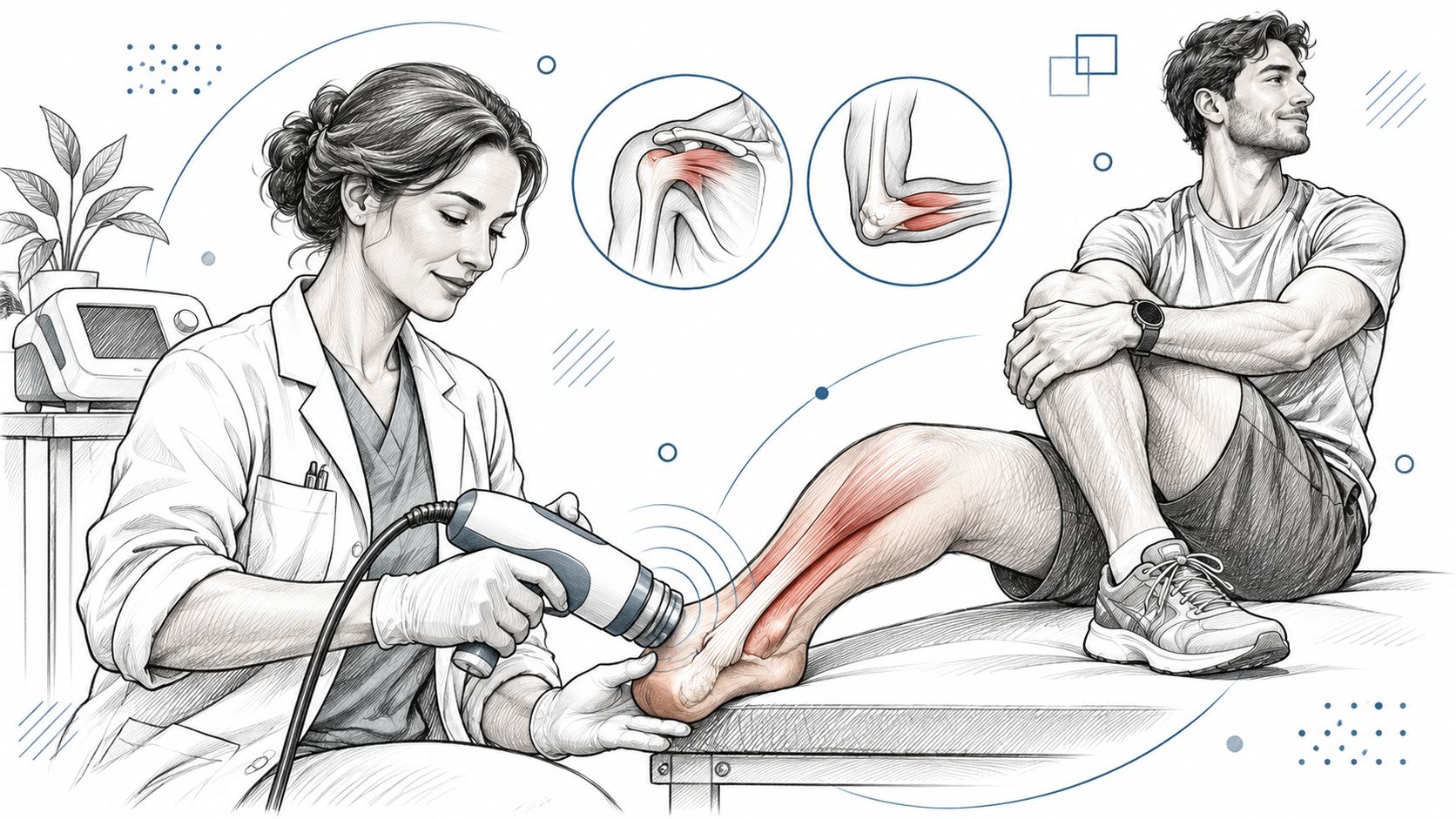
A familiar claim says shockwave therapy restarts a stalled tendon's healing, so you book sessions, wait six weeks, and expect the pain to fade. The evidence is more selective: results vary with the tendon, treatment protocol, patient, and outcome measured.
Shockwave therapy has a clinical record in musculoskeletal care spanning more than two decades. A review notes that the FDA first cleared a shockwave device for proximal plantar fasciitis in 2000 and later for lateral epicondylitis (review of shockwave therapy for tendon disorders). The same review reported early plantar fasciitis success rates from 34% to 88% (review of shockwave therapy for tendon disorders). That broad range is a reminder that outcomes depend on what is treated and how success is defined.
The useful question is which tendon is involved, what shockwave therapy is compared with, and whether the diagnosis is clear enough to guide a decision. Two people can receive treatment with the same machine and have different prospects. Mid-portion Achilles pain and pain at the heel insertion involve different sites, and the evidence can lead to different conclusions.
Pain relief also deserves careful interpretation. A lower pain score can matter in daily life, but it does not by itself prove that a tendon has healed. The next step is to look at evidence tendon by tendon, including what the treatment is measured against.
Shockwave therapy does not have one verdict for every tendon. The location of the problem and the comparison used in a study can change what the results mean. Read the table by tendon first, then check what treatment was compared.
| Tendon problem | Evidence quality | Main reported result | Planning takeaway |
|---|---|---|---|
| Mid-portion Achilles, versus standard care | Moderate | VISA-A +9.08 points (95% CI 6.35 to 11.81) (systematic review of shockwave therapy for Achilles tendinopathy) | Useful adjunct, not a stand-alone cure |
| Mid-portion Achilles added to standard care | Moderate | VISA-A +10.28 points (95% CI 7.43 to 13.12) (systematic review of shockwave therapy for Achilles tendinopathy) | Best supported when paired with rehab |
| Insertional Achilles added to standard care | Very low | SMD -0.02 (95% CI -0.27 to 0.23) (systematic review of shockwave therapy for Achilles tendinopathy) | No meaningful added benefit shown |
| Achilles tendinopathy used alone | Very low, inconclusive | Pain difference -0.80 (95% CI -3.15 to 1.56); VISA-A +5.74, not significant (systematic review of shockwave therapy for Achilles tendinopathy) | Don't expect monotherapy to beat other conservative care |
| Shoulder tendinopathy versus sham, short term | Modest pooled effect | SMD -0.28 (95% CI -0.55 to -0.01); 9 studies, 543 people (meta-analysis of shockwave therapy for shoulder pain) | Small short-term pain edge over sham |
| Mixed upper- and lower-limb tendinopathies | 22 randomized trials | No significant pain difference at 4 weeks (p=0.26) or 12 weeks (p=0.33) (review of 22 randomized trials across limb tendinopathies) | Results depend on the comparison, not the label “shockwave” |
Achilles tendinopathy has the clearest evidence in this group, but the site of pain matters. A systematic review found moderate-quality evidence that shockwave therapy improved VISA-A function scores for mid-portion Achilles tendinopathy compared with standard care. The pooled mean difference was 9.08 points, increasing to 10.28 points when shockwave was added to standard care (systematic review of shockwave therapy for Achilles tendinopathy). VISA-A is a validated measure of Achilles symptoms and function. A ten-point gain is a measurable functional improvement, not proof of tendon tissue regeneration.
At the Achilles insertion, the evidence is much less encouraging. The same review rated the evidence very low quality and found no meaningful added benefit over standard care. Shockwave used alone also did not clearly outperform other conservative care. The pooled pain estimate was uncertain, and substantial heterogeneity means the studies' results varied considerably (systematic review of shockwave therapy for Achilles tendinopathy).
Shoulder findings suggest a modest short-term pain benefit over sham. A meta-analysis found a small pooled effect, based on 9 studies and 543 participants (meta-analysis of shockwave therapy for shoulder pain). Across upper- and lower-limb tendinopathies, a review of randomized trials found no significant pain difference at the reported follow-up points compared with other treatments (review of 22 randomized trials across limb tendinopathies. That broader result does not erase the tendon-specific findings. It shows why the comparator and the condition need to be considered together.
The planning rule: identify the tendon and the precise pain location before choosing a treatment. Evidence for mid-portion Achilles pain does not establish the same benefit for insertional pain.
Match your diagnosis to the relevant row, and read the result as evidence about that condition and comparison. Pain relief and improved function can matter, while neither alone proves that a tendon has healed.
Shockwave therapy aims to prompt a tendon's cells to respond to mechanical stimulation. Brief acoustic pressure waves pass through the skin into the affected tissue, where the pressure can trigger biological signals. Those signals are one proposed way treatment may influence repair and remodeling.
The sequence from pressure to cellular activity is summarized in this concept map.
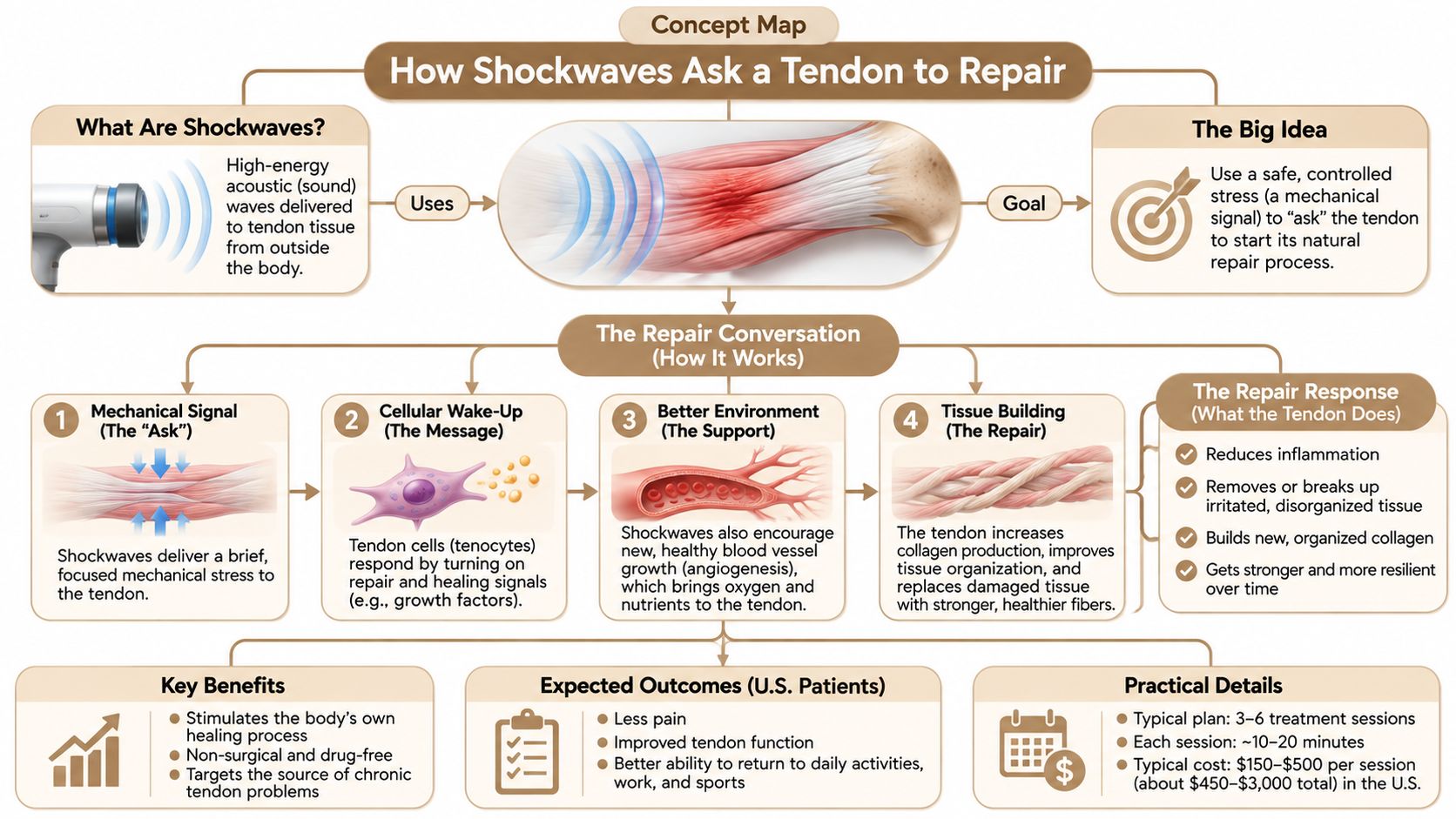
A 2023 review describes mechanotransduction as the primary biological mechanism: pressure-wave stimulation is converted into cellular signals that may influence tissue repair, blood-vessel formation and tendon remodeling (review of shockwave mechanisms and outcomes). Across 19 randomized clinical trials, shockwave treatment reduced pain by an average of 1.49 points on a visual analogue scale compared with control interventions, according to that same review.
That average depends on what treatment is compared with. Benefits over placebo, or placebo combined with eccentric exercise, were limited in the short term. The difference was larger against broader conservative treatment. A pain-score improvement is meaningful to a patient, but it does not by itself show that tendon structure has healed.
Radial devices report pressure in bars and distribute energy over a wider surface. Focused devices report energy-flux density in mJ/mm² and direct energy into a smaller, deeper target. The units describe different kinds of output, so a value in bars cannot be directly compared with one in mJ/mm².
Shoulder findings also vary by tissue type. A systematic review reported better pain and shoulder-function outcomes with focused doses at or above 0.28 mJ/mm² than with low-energy protocols below 0.08 mJ/mm², particularly for chronic calcific disease (review of shockwave dose in rotator-cuff tendinopathy). The evidence does not establish a universal dose-response rule, and calcific and non-calcific shoulder problems should not be treated as interchangeable.
The goal is a repair signal paired with progressively heavier loading. Shockwave therapy does not replace rehabilitation: the tendon still needs a gradual return to the forces it must handle. Calf raises or wrist-extensor exercises may cause soreness as that load increases. These practical tips to prevent next-day workout aches can help you manage exercise soreness while continuing the planned progression. Pain relief and tendon healing are related questions, but they are not the same measure.
Shockwave protocols vary by tendon and by visit. For hip- and pelvic-region tendinopathies, 72% of protocols in a systematic review used 3 to 4 weekly sessions, while 83% delivered 2,000 to 3,000 pulses per session. In that review, pulse frequency ranged from 1 to 5 Hz, with 4 Hz the most common choice, and individual protocols ranged from 600 to 2,500 pulses (review of shockwave protocols for hip and pelvic tendinopathies).
Those figures describe published protocols, not a universal prescription. A written plan should identify the target, session schedule, and settings used for that specific tendon.
The list helps you see what “shockwave” means in practice. The review reported pain and function improvements with minimal adverse effects across several hip and pelvic tendinopathies, while noting that standardized protocols remain unresolved. Two treatment plans can use the same therapy name yet differ in target and dose.
The reported Achilles and elbow settings below show how parameters can vary by tendon and session (reported Achilles and elbow shockwave settings).
| Tendon and session | Frequency | Pressure | Shocks |
|---|---|---|---|
| Achilles, first session | 21 Hz | 1.8 bar | 2,000 |
| Achilles, later sessions | 15 Hz | 2.0 bar | 3,000 |
| Elbow, first session | 21 Hz | 1.8 bar | 2,000 |
| Elbow, later sessions | 15 Hz | 1.6 bar | 1,500 |
The first visits use the same listed values, but later plans diverge. The Achilles plan increases the shock count to 3,000, while the elbow plan reduces it to 1,500; frequency and pressure also differ. A runner with mid-portion Achilles pain and a racquet-sport player with lateral elbow pain need plans tied to their respective tendon and presentation. A clinic that hands both patients the same printed card has not assessed either tendon.
During treatment, the applicator moves over the sore region. The visit is short compared with a full rehabilitation appointment. Tapping or aching should remain tolerable, rather than becoming an endurance test. Mild soreness or bruising may follow. Tell the clinician about numbness, skin changes, or pain that worsens between visits instead of waiting until the course ends.
Shockwave treatment should sit alongside graded loading, not replace it. For Achilles pain, that may mean calf-loading exercises; for elbow pain, wrist-extensor loading. Aspen Falls Wellness can pair appointments with a rehabilitation exercise program, helping you continue tendon-loading work between visits.
Judge progress over several weeks, not after one session. Track pain on the same 0 to 10 scale, tolerance for tendon-loading exercises, and a daily task such as climbing stairs or taking a short run. Published settings can inform a discussion with a clinician, but they are not instructions for self-treatment.
A reduction in pain does not, by itself, show that shockwaves healed a tendon. A double-blind randomized trial of 68 people with chronic noninsertional Achilles tendinopathy compared three weekly sessions of recommended-dose radial shockwave therapy with minimal-dose treatment designed as a sham (double-blind trial of radial shockwave dose). The groups did not differ meaningfully at follow-up.
Average pain fell by 34% at six months, with no consistent gains in global function, activity or mood, according to the trial (double-blind trial of radial shockwave dose). Both groups improved, leaving a practical question: did symptoms ease because of the shockwaves, rehabilitation, or normal fluctuation? The study supports a distinction between feeling less pain and demonstrating tendon healing.
Before weighing that evidence, some tendon problems need an examination rather than a device.
Pain is one measure, not the whole result. Track walking distance, stair tolerance, time in sport and a validated score for the affected tendon. A simple weekly diary can show whether everyday function changes alongside pain. Set a review point before treatment begins.
More energy and more discomfort during a session mean the dose was higher, not that healing is faster.
The variables from the previous section apply here too. Judge progress by a clear change in symptoms and function, not by how intense a session feels. If those measures do not improve, reconsider the course with a clinician.
A shockwave device cannot identify what is causing pain. If the tendon may be torn, the pain could come from another structure, or symptoms suggest infection or a nerve problem, start with an examination. That helps determine whether shockwave therapy belongs in the plan at all.
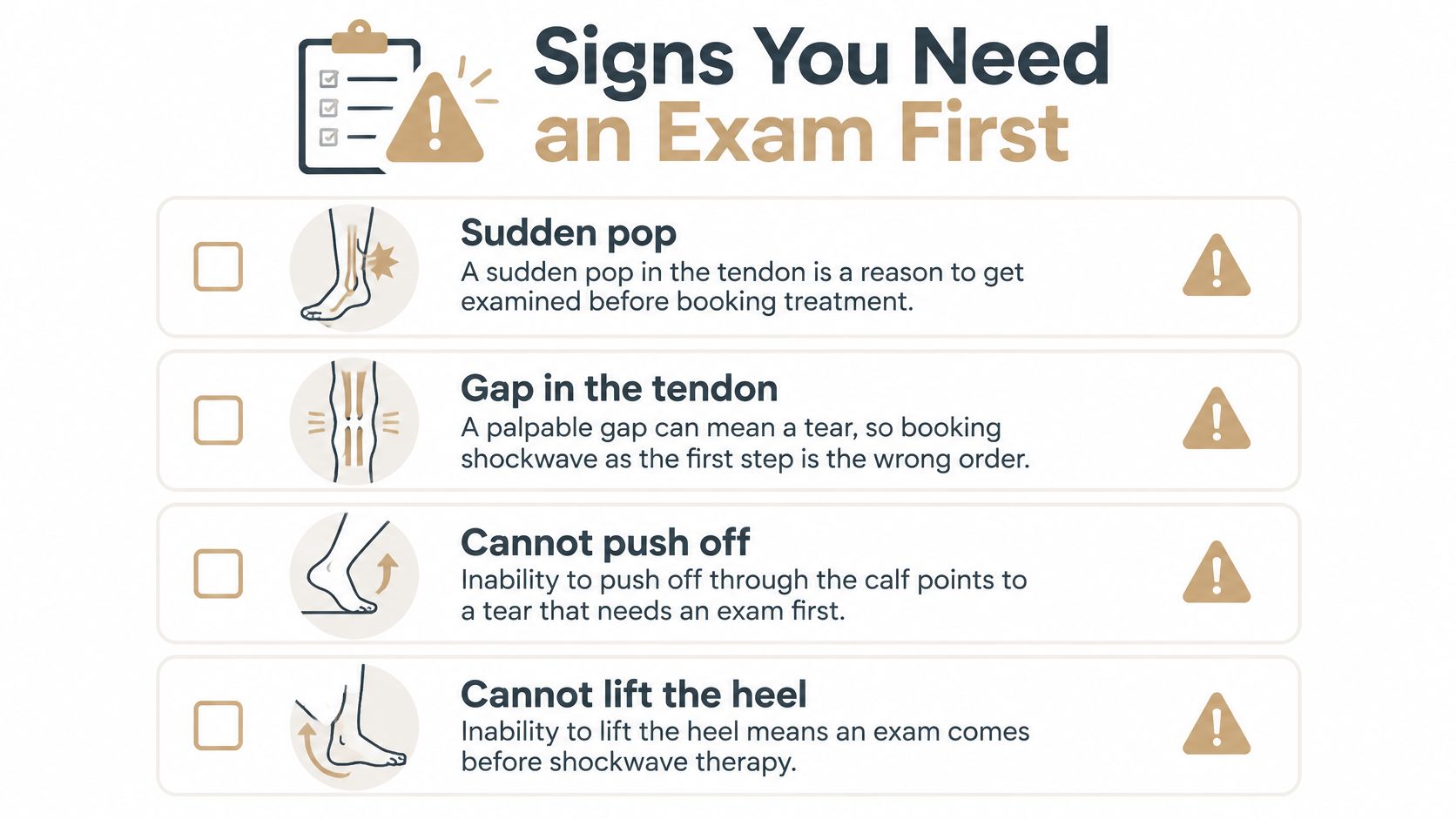
A sudden pop during activity, a gap you can feel along the tendon, or difficulty pushing off or lifting your heel warrants prompt assessment. These signs can point to a tear, which needs evaluation before treatment is considered.
Hot, red swelling with fever, or pain following a puncture wound raises concern for infection. Worsening night pain, unexplained weight loss, or a history of cancer also calls for medical review. Numbness, increasing weakness, or pain that follows a nerve line rather than staying near the tendon may indicate a different cause.
A useful assessment identifies the tendon involved and whether pain is mid-portion or at its insertion. The clinician asks how long symptoms have lasted, checks how loading reproduces pain, and examines nearby joints. A stiff ankle or irritated wrist can change how force reaches a tendon, much as a kink changes the pull along a rope.
Imaging is reserved for cases where a tear, calcification pattern, or another diagnosis would change the plan. A tendon is soft tissue, so understanding what counts as soft tissue damage can clarify why identifying the injury matters before choosing a treatment. Medication and clotting history, pregnancy, and an open growth plate in an adolescent are also reasons to pause and consult a clinician.
If you are asking is shockwave therapy safe, general information can help, but it cannot determine whether treatment suits your specific symptoms. Screening depends on the diagnosis and individual circumstances.
The decision rule: Get examined first if the diagnosis is unclear, function is declining, or a red-flag symptom is present. Discuss shockwave only after the cause of the problem has been assessed.
If the tendon has hurt for weeks, everyday loading is limited, and no red-flag symptom is present, a clinical evaluation is the right next step rather than a copied protocol. The examination confirms which tendon is involved and whether the pain is mid-portion or insertional, then sets a plan around that answer.
At Aspen Falls Wellness, SoftWave Therapy is an acoustic shockwave option a clinician may consider for tendonitis, and it sits inside a wider plan rather than standing alone. Most SoftWave sessions take 10 to 20 minutes, and patients can return to daily activities immediately afterward. Most patients see significant improvement within 6 to 8 sessions, though the total course depends on the severity of the condition and the plan your provider recommends.
The load work carries the rest. A personal exercise plan and rehabilitation exercise rebuild the tendon's tolerance, and where they fit, options such as MLS Laser Therapy, massage therapy, mobility therapy or acupuncture may be discussed. Sessions are customized from your diagnosis and history. Some people feel mild pulsing or tapping during treatment, and temporary discomfort usually settles quickly. Shockwave therapy here is a conservative option considered before surgery, not a guarantee.
Bring four things to the visit: which tendon hurts, how long it has been sore, what makes it worse, and any imaging you already have. The appointment should confirm the diagnosis, decide whether SoftWave Therapy fits, and set a review point based on function rather than pain alone. The Salt Lake City clinic details and scheduling are on the Salt Lake City location page.
Aspen Falls Wellness offers SoftWave Therapy for tendonitis alongside chiropractic care, rehabilitation exercise and MLS Laser Therapy, with plans built from an examination rather than a template. If a tendon has been limiting your stairs, your runs or your workday, book an evaluation and find out which tendon problem you have before committing to a course of treatment. Visit Aspen Falls Wellness to schedule your first visit in Salt Lake City or Sandy.

Stay updated with the latest chiropractic news and exclusive offers.