Learn what is myofascial release therapy, its techniques, benefits, and what to expect. Aspen Falls Wellness offers personalized musculoskeletal care.




You're lying awake with a stiff neck, a tight low back, or that deep, nagging band of tension that keeps showing up after work, workouts, or a long commute. You stretch, roll, and rest, but the same restriction keeps coming back, and everyday movement starts to feel smaller than it should. Myofascial release therapy is one of the hands-on approaches clinicians use when the problem seems to live in the body's connective tissue, not just in the muscle itself.
A common story sounds like this, a person can still walk, work, and lift, but every turn of the torso or reach overhead brings back the same pulling sensation. Standard stretching helps for a minute, then the tension returns. That's where myofascial release therapy enters the conversation, as a targeted manual technique for stubborn restriction in the myofascial system, not a generic relaxation massage.
Hospital for Special Surgery describes myofascial release as a targeted treatment for restrictions in the myofascial system, popularized by John Barnes, PT, LMT, NCTMB, and used to address trigger points, muscle tightness, and soft-tissue dysfunctions (HSS). That distinction matters because people often assume every hands-on therapy is basically the same. It isn't.
Practical rule: if pressure feels slow, sustained, and specific, you're probably dealing with a fascial approach rather than a quick rubbing style.
In integrative musculoskeletal care, MFR is usually one part of a bigger plan, not the whole plan. A patient might use it alongside mobility work, exercise, or other conservative therapies when movement is limited by soft-tissue restriction and the goal is to restore function, not just chase short-term relief.
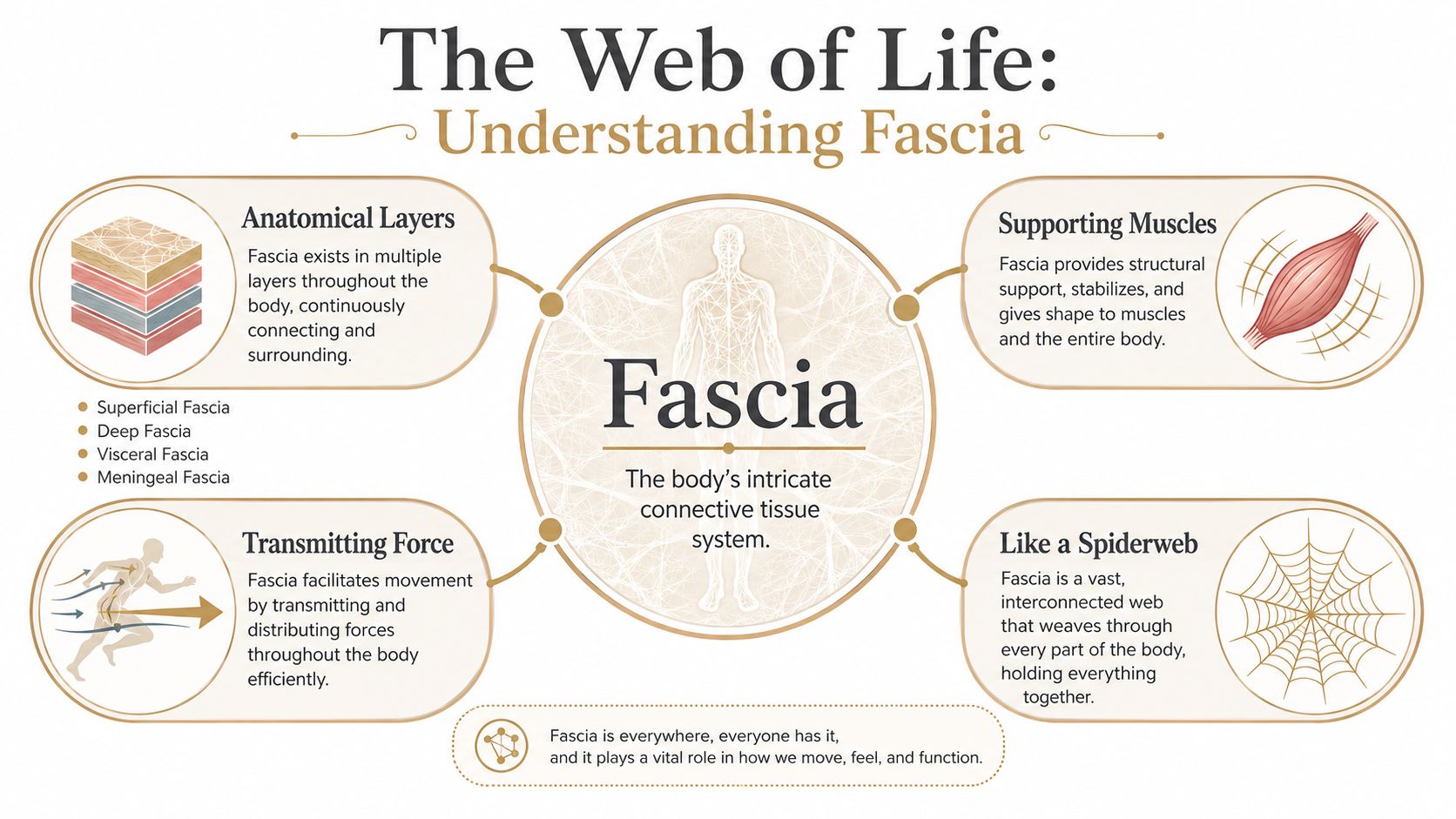
Fascia is easier to understand if you stop thinking of it as a single sheet and start picturing a 3D web running through the body. It wraps, separates, supports, and links tissues so muscles can glide instead of snag. When that web is healthy, movement feels smoother and more coordinated.
The connective tissue system has multiple layers, including superficial, deep, visceral, and meningeal layers, and it helps maintain shape while also transmitting force through movement. A useful metaphor is a suit of armor that isn't rigid, it's protective, flexible, and threaded through the whole body. Fascia supports muscles, but it also influences how force moves from one region to another.
When fascia loses glide, people may feel stiffness that doesn't match a single sore muscle. That's where terms like myofascial restriction and trigger point come in, because the discomfort can feel local, referred, or oddly widespread. The basic idea is simple, if layers stop sliding well, movement gets expensive, and the body starts guarding.
Clinical language often treats fascia and muscle as separate targets, but in real life they work as a unit. That's why a therapist palpates for restricted areas rather than only chasing the obvious pain spot. If you're looking for a broader care framework that connects tissue work, movement, and lifestyle factors, integrated healthcare strategies for practices can help make that model easier to understand.
MFR is built on slow force, not fast friction. The therapist applies low-load pressure at a restrictive barrier and then waits. That waiting matters, because fascia responds differently to prolonged contact than it does to a brisk stroke.
In the literature, myofascial release is described as a low-load, sustained mechanical intervention. Holds of roughly 90 seconds or longer are used to create creep and stress relaxation, which means the tissue gradually yields and then resists less under the same load (PMC). This process is analogous to slowly stretching a rubber band instead of yanking it, allowing the material time to adapt.
Tissue change in MFR is often about patience. The therapist finds a barrier, holds steady, and lets the tissue respond instead of forcing the issue.
Clinical descriptions often follow a repeatable sequence. The therapist locates the tight area, applies light pressure and/or stretch, waits for relaxation, then gently increases pressure or stretch and repeats the process until release is felt (CHOC). That can happen around the shoulder girdle, lower back, hips, or other restricted regions depending on the complaint.
Live Science notes that myofascial release commonly uses sustained, targeted pressure for three to five minutes on fascia, which is mechanically different from ordinary massage strokes (Live Science). That timing helps explain why some people describe the experience as subtle but intense, even when the force isn't aggressive.
For readers comparing bodywork styles, a useful reference point is the structure of therapeutic massage services, where the goals and pressure patterns may overlap, but the session logic can be different.
A person with lingering low back pain may hear that myofascial release can help, then wonder whether the claims are stronger than the evidence. The research is more measured than many consumer articles suggest. Myofascial release is best understood as one tool in a broader plan, not a universal fix.
The evidence has developed from general enthusiasm into more condition-specific support. A 2017 systematic review screened 513 records and included only 8 relevant trials, covering 427 participants across lateral epicondylitis, fibromyalgia, low back pain, and heel pain. The authors concluded that the evidence was not sufficient to recommend MFR as a treatment for chronic musculoskeletal pain (PubMed). That older caution still matters because it keeps expectations grounded.
More recent findings are more encouraging for chronic low back pain. A 2021 systematic review and meta-analysis of 9 studies found statistically significant improvement in pain (SMD = -0.37, P = 0.01) and physical function (SMD = -0.43, P = 0.007), while showing no significant effect on trunk mobility or quality of life. The pattern points to a narrower role for MFR, where symptom relief and day-to-day function improve more clearly than broader whole-person outcomes.
That distinction matters in practice. If a patient is stiff enough that walking, bending, or starting rehab feels out of reach, a manual technique that reduces pain can create room for movement work, exercise, and better load tolerance. If the goal is to change every part of a pain condition on its own, the evidence does not support that expectation.
In a multidisciplinary clinic, this evidence usually leads to a specific question. What problem is MFR solving inside the larger care plan?
For someone with recurrent back pain, MFR can be used as an adjunct when the therapist sees that soft tissue sensitivity is limiting exercise, posture retraining, or normal activity. It may calm symptoms enough for the rest of treatment to make sense. It is also a useful fit when symptoms are part of a broader mechanical pattern, such as after a strain or a neck injury that still protects movement. In that setting, a care plan may include soft tissue work, guided exercise, and education about pacing, rather than relying on manual therapy alone. For readers looking at a related injury pattern, massage therapy for whiplash shows how manual care can fit into recovery when neck pain and guarding are part of the picture.
That evidence-based lens is also the right way to read ProMed Certifications on EBP. Research, clinical judgment, and patient goals need to sit together. Aspen Falls Wellness would read the studies the same way, then decide whether MFR belongs in the plan based on the person's symptoms, movement limits, and response to care.
A professional session usually starts with a short check-in, then a look at posture, pain pattern, and movement limits. The therapist palpates for restrictions and decides where pressure should begin. Clients often expect a deep rub, then notice the work feels slower, more deliberate, and more specific.
MFR usually feels like gentle, sustained pressure with an emphasis on waiting for the tissue to soften. That can be uncomfortable at times, but it shouldn't feel sharp or alarming. A good therapist keeps checking in so the pressure stays within a tolerable range.
Session frequency varies with the problem being treated, and home care often includes light stretching, movement, and staying active within comfort. Patients with recent injury, complex medical history, or unexplained symptoms should get assessed before starting bodywork. If the pain pattern suggests something beyond soft tissue, referral or imaging may be more appropriate than pushing ahead with manual treatment.
MFR gets lumped together with massage and trigger-point work all the time, but the distinctions matter. The differences show up in the pressure pattern, the target tissue, and the logic of the session. Once you see those differences, it's easier to pick the right tool for the job.
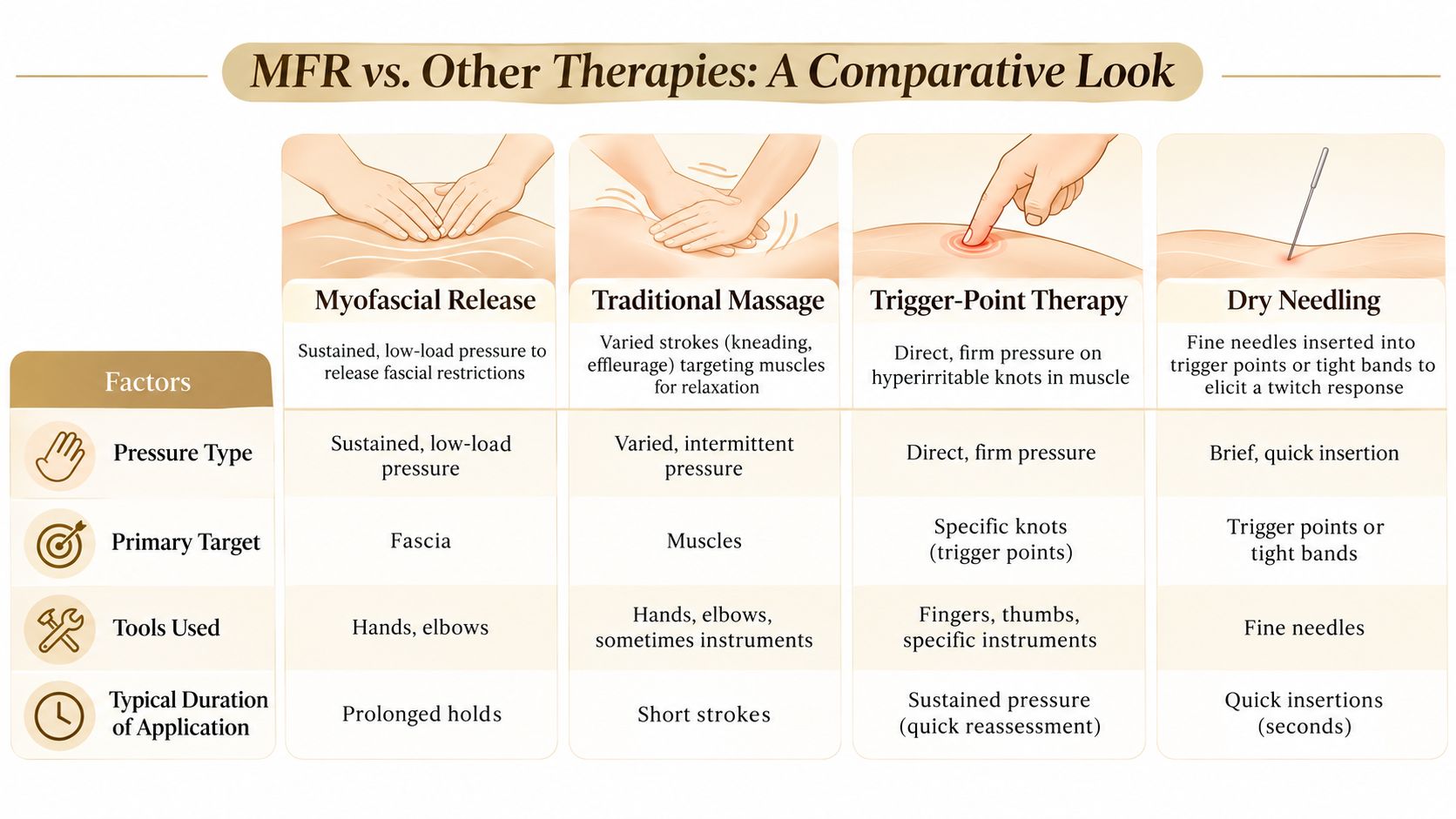
| Therapy | Target Tissue | Pressure Type | Session Duration | Evidence Strength |
|---|---|---|---|---|
| Myofascial release | Fascia and restricted myofascial tissue | Sustained, low-load pressure | Prolonged holds | Strongest for selected musculoskeletal pain, especially chronic low back pain |
| Traditional massage | Muscles and general soft tissue | Rhythmic, varied strokes | Typically session-based and broad | Useful for relaxation and general soft-tissue comfort |
| Trigger-point therapy | Hyperirritable knots in muscle | Direct, firm pressure | Shorter focused applications | Often used for focal pain patterns |
| Dry needling | Trigger points or tight bands | Needle insertion | Brief insertions | Used in some pain and movement cases, depending on presentation |
Consumer content often blurs MFR, massage, and trigger-point therapy, but clinical sources note that MFR uses sustained pressure on fascia rather than rhythmic rubbing and has distinct session protocols (PMC). That makes the choice less about labels and more about the symptom pattern in front of you.
If pain feels diffuse, layered, and movement-related, MFR may fit better. If the complaint is more about general relaxation or broad muscle soreness, another approach may be more appropriate. When structural drivers like disc pathology or whiplash are suspected, manual therapy should stay connected to a bigger clinical picture, not operate in isolation.
In a multidisciplinary setting, MFR works best when it's matched to diagnosis, symptom behavior, and the patient's movement goals. That's especially true for back pain, post-accident stiffness, and recurring neck restriction, where soft tissue may be part of the problem but not the whole problem.
MFR is best used within a broader musculoskeletal care plan, because patients often need guidance on when to add manual work, when to prioritize exercise, and when structural evaluation matters (Cleveland Clinic). At Aspen Falls Wellness, that kind of coordination can sit alongside chiropractic adjustment, mobility therapy, rehabilitation exercise, acupuncture, SoftWave therapy, MLS laser therapy, and spinal decompression with the DRX 9000.
A typical care pathway might start with an examination, then move toward soft-tissue work if the tissues are guarding and movement testing suggests restriction. If the presentation points to disc-related pain or a post-collision issue, the clinician may coordinate imaging or referral before leaning too hard on hands-on treatment. For readers who want a broader context on that kind of care model, multidisciplinary pain management is the right place to start.
A person with chronic low back pain might begin with assessment, then receive MFR to reduce guarding, followed by movement retraining and a home exercise plan. If progress is slow or the symptom pattern suggests nerve involvement, care can shift toward decompression, adjustments, or further workup. That flexibility is what makes an integrated clinic useful, because the treatment plan can change as the findings change.
A person with ongoing back pain, stiffness, or movement limits often wants to know whether another hands-on therapy will finally help. Myofascial release therapy can be one useful piece of that picture, especially when the problem seems tied to fascial restriction and the tissues feel guarded rather than just sore. It is not a replacement for every other form of care, and it works best when it is matched to the right situation.
The clearest support for MFR is in pain relief and functional improvement for chronic low back pain, while other outcomes are less certain, as noted earlier in the evidence summary. That matters because it sets a realistic expectation. MFR is most valuable when it sits inside a broader plan that also includes movement, reassessment, and goals that can be measured in daily life.
If pain feels repetitive, stays in the same pattern, or seems linked to a specific motion, fascia may be part of the answer. A careful evaluation can help sort out whether MFR fits, whether the main issue is better addressed through exercise or another conservative approach, or whether the pattern calls for a different clinical path.
If you are dealing with persistent pain or stiffness, Aspen Falls Wellness can evaluate whether myofascial release belongs in your care plan and combine it with exercise, chiropractic care, or other non-surgical therapies when appropriate. Visit Aspen Falls Wellness to schedule a consultation and discuss a personalized plan for your movement, pain, and recovery goals.

Stay updated with the latest chiropractic news and exclusive offers.