Find accident chiropractic near me in Salt Lake City and Sandy. Learn what to expect, recovery timelines and documentation tips.
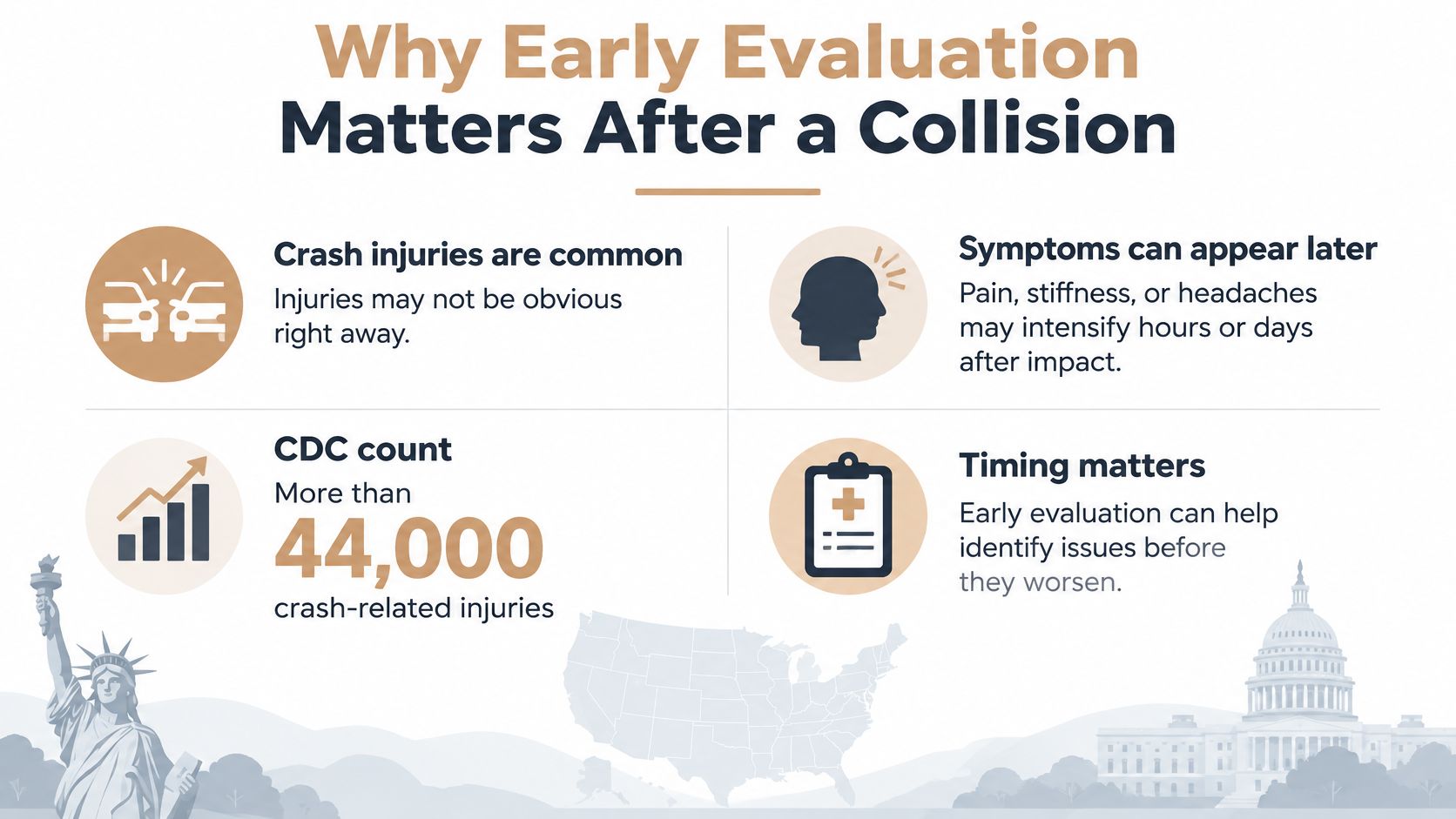
More than 44,000 people died in motor-vehicle crashes in 2023, over 120 deaths a day, and those crashes produced more than 2.8 million emergency-department visits for injuries the same year, according to the U.S. Centers for Disease Control and Prevention. If you're typing accident chiropractic near me after a fender-bender, the first job isn't booking the soonest hands-on visit. It's sorting emergency warning signs from problems that belong in a documented exam, and knowing when a scan should come before any adjustment.
Fatal crashes get the headlines. The larger group is people who walk away and still need care. The National Highway Traffic Safety Administration's 2024 Quick Facts recorded 2,422,195 people injured in U.S. motor-vehicle crashes in 2024. Fewer deaths on the road doesn't erase that injury total. A collision can spare you a catastrophic injury and still leave the neck, back, muscles, or joints working poorly for weeks.
Adrenaline hides a lot in the first hours. You check the car, exchange information, and feel "mostly fine." Stiffness, a headache, or pain that travels into an arm can show up that night or two days later. A mirror check won't catch reduced neck rotation, muscle guarding, or a joint that only hurts when you turn to park.
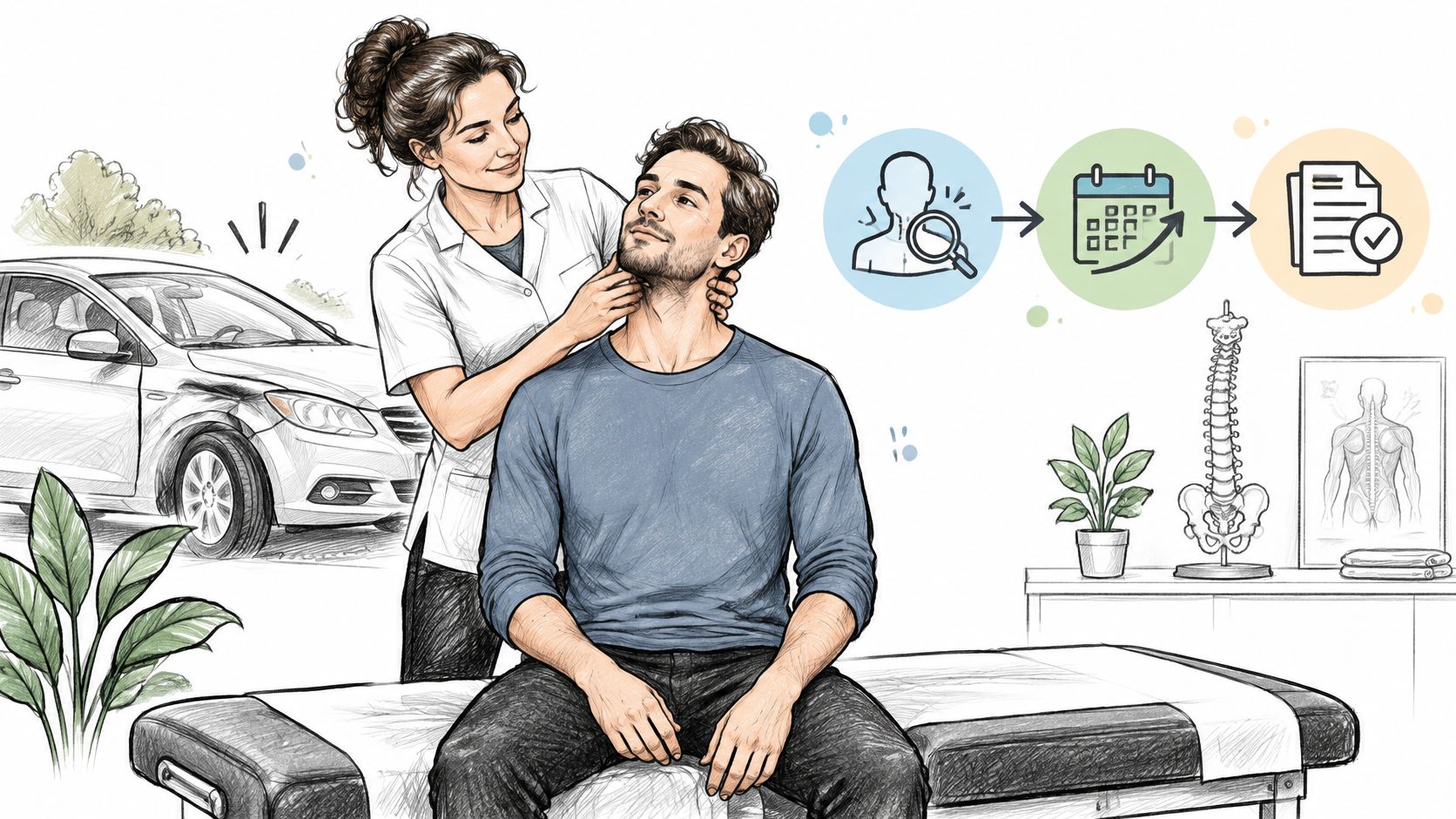
A written exam creates a baseline. The clinician records how the crash happened, what hurts, how far you can move, and what the nerve tests show. Later visits compare against that record, so recovery isn't guessed from memory. The same notes matter if a claim is reviewed months from now, because "I think it started Tuesday" is weaker than a dated exam.
Chiropractic care in that setting is conservative treatment plus referral. It covers assessment, manual care, exercise, and a handoff when imaging or a specialist is warranted. It does not replace an emergency department when red-flag symptoms are present.
Start with triage, then the first visit, the weeks of recovery, the treatments that match the diagnosis, the paperwork that keeps the record intact, and a clinic you can reach in Salt Lake City or Sandy.
In the first hours, you're choosing a door, not a brand of care. Some symptoms mean 911 or the emergency department before anyone adjusts your neck. Others mean a documented chiropractic or medical exam within a few days. A few mean the first exam already happened and the next step is imaging or a specialist.
| Symptom or situation | Action to take |
|---|---|
| Weakness, spreading numbness, or loss of coordination | Seek emergency care now |
| Severe midline neck tenderness, altered consciousness, or trouble breathing or swallowing | Seek emergency care now |
| Neck or back pain, stiffness, or headache with no red flags | Schedule a documented chiropractic or medical exam within days |
| Radiating arm or leg pain that persists after the first exam | Coordinate imaging or specialist referral |
| Pain that worsens over several days after the crash | Re-evaluate promptly; symptoms can intensify after the initial event |
Emergency now. Weakness, numbness that is spreading, or trouble coordinating your hands or feet can signal nerve or spinal-cord involvement. The same urgency applies to severe tenderness right on the midline of the neck, confusion or a change in alertness, and trouble breathing or swallowing. Don't drive yourself if any of those are present.
Exam within days. Neck or back pain, stiffness, or a headache without those red flags is the usual pattern after a collision. You still want a recorded exam, not a wait-and-see week. Our guide on what to do after car accident neck pain walks through that early window in more detail.
After the first exam. Pain that shoots down an arm or leg and doesn't settle needs a coordinated referral, not another week of the same plan. Pain that clearly worsens over several days also needs a fresh look, because the first snapshot can undershoot the injury.
A stiff neck isn't a standing order for a scan. Clinical decision rules, including NEXUS and the Canadian C-Spine Rule, sort out who needs radiography after trauma. As the Medscape review of cervical spine trauma imaging explains, acute films are often unnecessary for uncomplicated cervical strain. CT fits better when cervical pain is significant, a neurological deficit is present, or fracture is a real concern. MRI fits better for persistent focal deficits, radicular symptoms, suspected spinal-cord or ligament injury, or new neurological symptoms after the first evaluation.
Practical rule: More pictures don't predict who recovers. Pain, anxiety, and catastrophizing track poor outcomes more consistently than what shows up on a routine image.
The point is the right door at the right time, not a single type of provider.
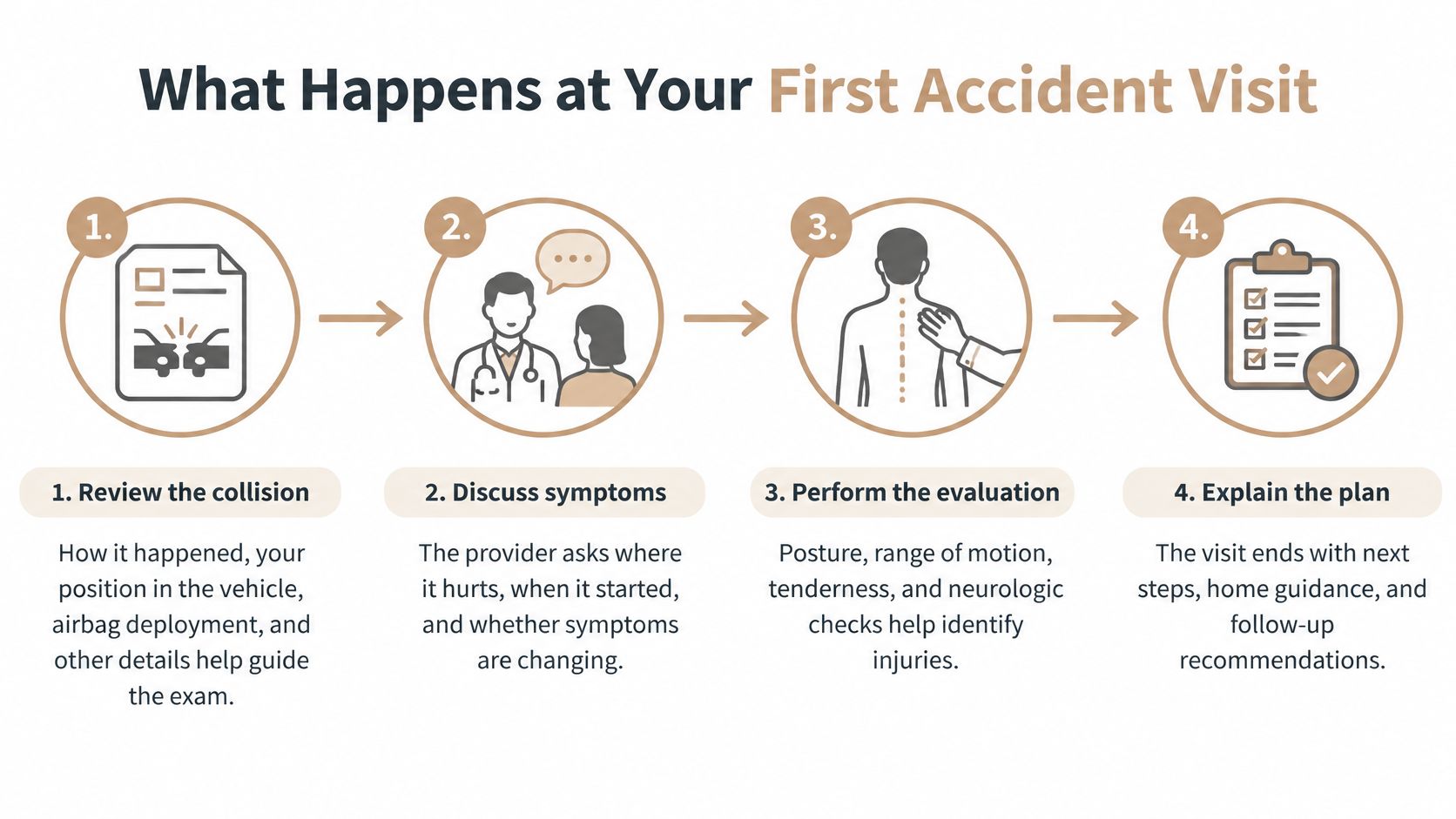
Say you were the driver in a rear-end crash, the airbag didn't deploy, and neck pain started the next morning. You have no weakness, no spreading numbness, and you can swallow and breathe normally. The visit is an evaluation first. Treatment waits until the cause is identified.
Each patient gets a thorough chiropractic evaluation so the doctors can identify the root cause, and then a customized treatment plan is built from that diagnosis. For a closer look at a standard new-patient flow, see what to expect at a first chiropractic visit. An accident visit adds collision-specific steps.
For adults with acute whiplash-associated disorder grades I-II, routine CT or MRI is generally not recommended. The NSW State Insurance Regulatory Authority whiplash guidelines note that imaging abnormalities, including common degenerative findings, don't reliably predict persistent pain or disability. A practical intake documents mechanism, red flags, neurological status, cervical motion, and validated decision-rule criteria before anyone orders films.
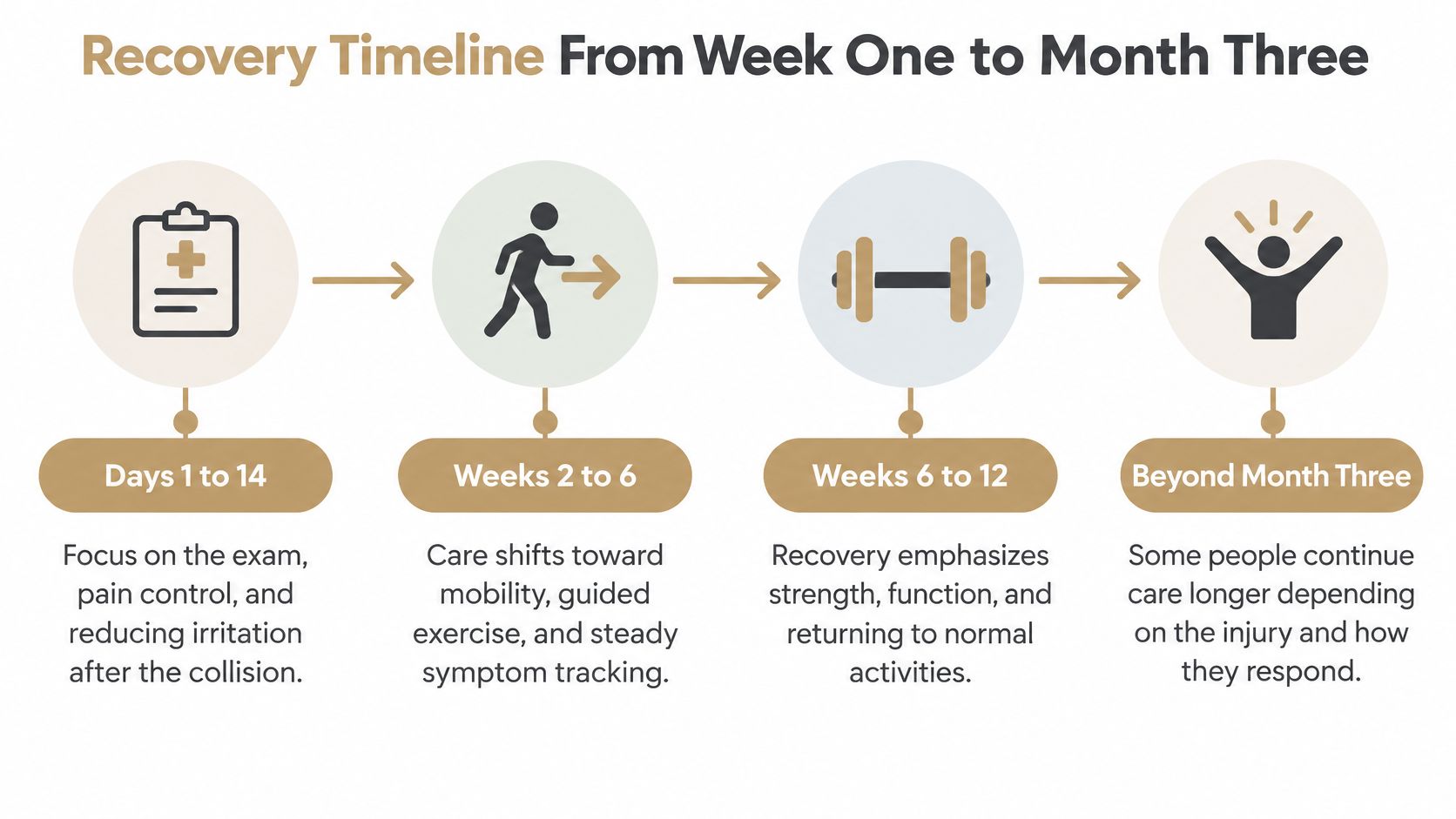
Recovery is staged, and the calendar bends to the injury, the person, and how symptoms change. Someone with a simple neck strain and someone with disc-related leg pain won't share a visit schedule. Chiropractic treatment often takes multiple visits, and you should be told the recommended extent and duration up front, then updated when the findings change.
| Phase | Typical care focus | Typical visit pattern |
|---|---|---|
| Days 1-14 | Exam, pain control, gentle range-of-motion work | 2-3 visits per week |
| Weeks 3-6 | Progressive mobility, adjustments as tolerated, first home exercises | 1-2 visits per week |
| Weeks 7-12 | Strength, return to daily and work activity, formal reassessment | About 1 visit per week, tapering |
| Beyond 12 weeks | Maintenance care, or referral when progress has stalled | Reassess monthly |
Days 1 to 14 are about settling irritation and learning your limits. Visits cluster so pain control and gentle motion aren't left to a single appointment. Weeks 3 to 6 add motion you can tolerate, adjustments matched to that tolerance, and the first home exercises. Weeks 7 to 12 shift toward strength, work tasks, and a formal reassessment, with visits thinning out. After 12 weeks, either care spaces into maintenance or the lack of change triggers a referral.
Track five things in a notebook or phone note: pain on a 0-10 scale, range of motion, sleep, how long you can work, and how far you can walk or what you can lift. If nothing measurable has changed in four to six weeks, that's a checkpoint for a new exam, not a reason to keep the same plan on autopilot.
If measurable pain, motion, and function haven't budged in four to six weeks, the plan should change or you should be referred.
If you've already waited more than a week since the crash, say that at intake. The exam records the delay, and the plan starts from today's findings rather than pretending an early baseline exists. The medical record and the claim file are easier to reconcile when dates are honest. Practical settlement guidance from Lawyer in Martin County is one place to see how injury documentation connects to compensation questions, and it isn't a substitute for advice on your own policy or state.
A crash rarely injures one tissue in isolation, so the diagnosis picks the mix rather than any single treatment doing the whole job. Custom chiropractic adjustments, decompression, take-home mobility exercises, laser therapy, massage, and acupuncture can sit in one plan, or only two of them may fit. We use non-surgical spinal decompression and MLS laser therapy among evidence-based techniques for relieving pain, reducing inflammation, and enhancing mobility and strength. Each option earns its place through the exam.
| Option | Typical use after a crash | Evidence note |
|---|---|---|
| Chiropractic adjustment | Restore spinal and joint motion | Matched to the diagnosis and daily tolerance |
| Spinal decompression (DRX9000) | Disc-related pain or sciatica after exam | Applied only when exam findings support it; findings outside conservative care go to imaging or referral |
| MLS Laser Therapy | Adjunct for pain and inflammation | A 2017 meta-analysis found a modest pooled pain reduction versus control |
| Soft-tissue massage | Muscle guarding and tightness | Supports comfort and mobility alongside other care |
| Acupuncture | Pain modulation within a plan | Can be part of a chiropractic plan or booked alone |
| Home exercise and mobility work | Regain neck and back range of motion | Core of long-term recovery; for example neck rotation and shoulder rolls |
Chiropractic adjustment is aimed at joints that aren't moving well. Each adjustment is matched to the condition and to what you can tolerate that day. A person who flinches at end-range neck rotation doesn't get the same setup as someone whose main limit is a stiff mid-back.
Spinal decompression with the DRX9000 is considered after the exam when symptoms point to disc-related low-back pain or sciatica. The FDA filing for the DRX9000-SL describes it as a non-surgical spinal decompression modality for incapacitating low-back pain and sciatica, and notes that clinical testing wasn't required for that submission because nonclinical testing was enough to show substantial equivalence. Clearance defines a permitted use for the device. Your exam findings still decide whether decompression fits, and anything that points outside conservative care goes to imaging or referral first.
MLS Laser Therapy is an adjunct for musculoskeletal pain, not a standalone recovery plan. A 2017 systematic review and meta-analysis of low-level laser therapy for adult musculoskeletal disorders included 18 studies, 21 head-to-head comparisons, and 1,462 participants. Across comparisons, laser therapy produced a pooled raw between-group pain difference of -0.85 points (95% confidence interval -1.22 to -0.48) versus control. In the subgroup that followed World Association for Laser Therapy dosage recommendations, the difference was -1.52 points (95% confidence interval -2.34 to -0.70).
Massage targets muscle guarding and tightness so motion practice is less miserable. The split of labor is straightforward: massage focuses on muscles and tissues, while chiropractic adjustments restore motion to the spine and joints. Acupuncture can sit inside the chiropractic plan or be booked on its own for pain modulation. SoftWave Therapy, which uses patented acoustic shockwaves, is another tissue-stimulation option when the diagnosis supports it.
Home exercise carries the weeks you're not in the clinic. The Mayo Clinic whiplash guidance lists neck rotation, side-to-side tilting, flexion toward the chest, and shoulder rolls as example movements, and notes that moist heat or a warm shower beforehand can make them easier. Your set and the timing still come from the exam, since a generic list can't account for what your evaluation found.
Pain-relief options earn a place beside examination and exercise. The exam chooses them, and the exercise plan carries the recovery between visits.
The first two weeks are when records are easiest to collect and easiest to lose. Rules change by state and by policy, so confirm the details that apply to yours.
If one clinic records a rear-end impact and another describes a side impact, ask each provider to clarify their own note instead of reconciling the difference yourself.
Two clinics may give different explanations for the same crash. Keep both notes and leave them as written. An adjuster reading your file will line the intake date at urgent care up against the date on your first chiropractic note, and consistency across dates matters more than polished wording.
Pick a licensed chiropractor who does five things without hedging. You want a documented exam, a plan that names visit frequency and re-evaluation dates, a path to imaging and specialists, insurance checked before you start, and a location you can reach when you're sore and driving is uncomfortable.
Aspen Falls Wellness provides family chiropractic care in Salt Lake City and Sandy, Utah, with car accident treatment built into that model. Services include chiropractic care and chiropractic adjustment, spinal decompression, SoftWave therapy, MLS Laser Therapy, massage therapy, acupuncture, nutrition counseling, mobility therapy, rehabilitation exercise, and golf movement screening. Spinal decompression here uses the DRX9000. The chiropractors are Dr. Dustin Hedstrom, Dr. Zachary Taylor, Dr. Jeremy Kaier, Dr. Nav Brar, Dr. Rebekah Patton, and Dr. Megan Gorton. Chiropractors, massage therapists, acupuncturists, mobility specialists, and nutrition coaches build the plan together, and referrals go out when a problem sits outside that scope.
A short checklist for how to choose a chiropractor covers credentials and fit in more detail. For an accident evaluation specifically:
Schedule within days of the crash. Symptoms and the paper trail are both more useful while the dates are still fresh.
Aspen Falls Wellness provides car accident evaluation and non-surgical rehabilitation for people in Salt Lake City and Sandy, including chiropractic adjustment, DRX9000 spinal decompression, MLS Laser Therapy, massage, and rehabilitation exercise matched to the diagnosis. If neck or back pain, stiffness, or headaches are interfering after a collision and emergency signs are absent, a documented exam is the right next step. Visit Aspen Falls Wellness to book an accident evaluation and bring your records with you.

Stay updated with the latest chiropractic news and exclusive offers.