Learn how to choose a chiropractor by checking licensing, evidence-based care, imaging decisions, and the questions to ask before you book.

You've had a rough week. Meetings locked up your low back, the drive home made it worse, and now you're comparing clinics that all promise fast pain relief, same-day visits, and glowing reviews. You don't have spare afternoons to tour offices. You need a way to choose a chiropractor that doesn't default to whoever picked up the phone.
The first provider you book often shapes the working diagnosis, how long care lasts, and whether the plan fits the problem. A sciatica flare, a stiff neck after a collision, and a golf swing that keeps grabbing the same side are not the same job. Treat them with one script and you can spend months on adjustments that never address the main limiter.
Most searches start the same way. You're sore, short on time, and looking at four websites that look interchangeable: adjustments, decompression, massage, and a promise that everyone gets better. Star ratings don't tell you whether the clinician screens for serious disease, explains alternatives, or has a date when the plan gets rewritten if nothing changes.
If you only have a few minutes, three checks outweigh the rest.
The fuller order of operations sits underneath those three: credentials, then evidence and safety, then imaging and red flags, then modalities and rehabilitation, then reviews, insurance, and location. Walk into the first visit with written questions instead of a prepaid package. Clear guides to chiropractic support are useful when you want to see how clinics explain that sequence before you commit a morning off work.
An active license is the first filter, not a bonus. The National Center for Complementary and Integrative Health reports that all 50 states and the District of Columbia require chiropractors to hold an accredited Doctor of Chiropractic degree and to pass state examinations, National Board of Chiropractic Examiners examinations, or both. Credentialing for complementary care isn't standardized nationally, so requirements still differ by state and by discipline. A website bio is not the lookup.
Work in this order, and write the answers down.

Practical rule: If the clinic can't point you to a public license record in one conversation, stop. You're not being difficult. You're doing the step the law already requires.
A solid clinician will also describe the exam, the likely diagnosis, treatment alternatives, how long care might last, and when you'd be sent to another medical professional. That conversation separates regulated, individualized chiropractic care from a one-size plan built around spinal "misalignment" as the cause of every complaint. Do this paperwork before you book, not after you've paid for a twelve-visit block.
Popularity is not the same thing as equal proof for every technique. Chiropractic care is mainstream. The NCCIH overview of spinal manipulation reports that 11.0% of U.S. adults received chiropractic care in 2022, up from 7.4% in 2002. That rise shows people use the service. It doesn't show that every method, or every advertised cure, has the same support.
For chronic low-back pain, NCCIH describes a systematic review of 32 randomized controlled trials with more than 6,000 participants that found modest short-term improvements from spinal manipulation. The 2017 American College of Physicians guideline strongly recommended manipulation as an initial option and graded the underlying evidence as low quality. A careful chiropractor should say that out loud. Expect a realistic range of change, measurable goals, and a recheck if walking, sitting, or work tolerance isn't moving. Guaranteed cures are a sales line, not a clinical plan.
Safety belongs in the same conversation. A review of 250 scientific publications, also summarized by NCCIH, found that temporary soreness, increased pain, stiffness, or headache are common mild-to-moderate effects and usually settle within 24 hours. Serious neurological complications and neck-artery strokes have been reported and are very rare, with no accurate frequency estimate. Rare isn't the same as impossible, and it isn't a reason to skip the question.
Before any chiropractic adjustment, disclose osteoporosis, fractures, cancer, neurological symptoms, blood-clotting conditions, recent trauma, and other relevant diagnoses. Ask specifically about alternatives to high-velocity neck manipulation if your complaint is cervical or if those risks worry you. A responsible clinician welcomes that question, coordinates with your physician, and refers when symptoms sit outside chiropractic scope.
People comparing health optimization versus traditional care often want both symptom relief and a longer view of function. That pairing only works when the chiropractor states benefits, risks, and the point at which hands-on care should stop or be shared.
A clinic with an X-ray room is not automatically the better clinic. On-site imaging is equipment. Diagnostic restraint is a clinical habit, and for uncomplicated pain it's often the stronger signal.
Current guidance generally recommends against routine imaging for uncomplicated musculoskeletal pain. Imaging should follow a history and a physical exam, and it earns its place when red flags, trauma, serious disease, neurological deficits, or failure to improve could change what you do next. For uncomplicated acute low-back pain without red flags, the American College of Radiology appropriateness criteria classify initial lumbar radiography, CT, and MRI as usually not appropriate. Imaging becomes more defensible after up to six weeks of unsuccessful conservative care, or sooner when serious pathology is suspected.
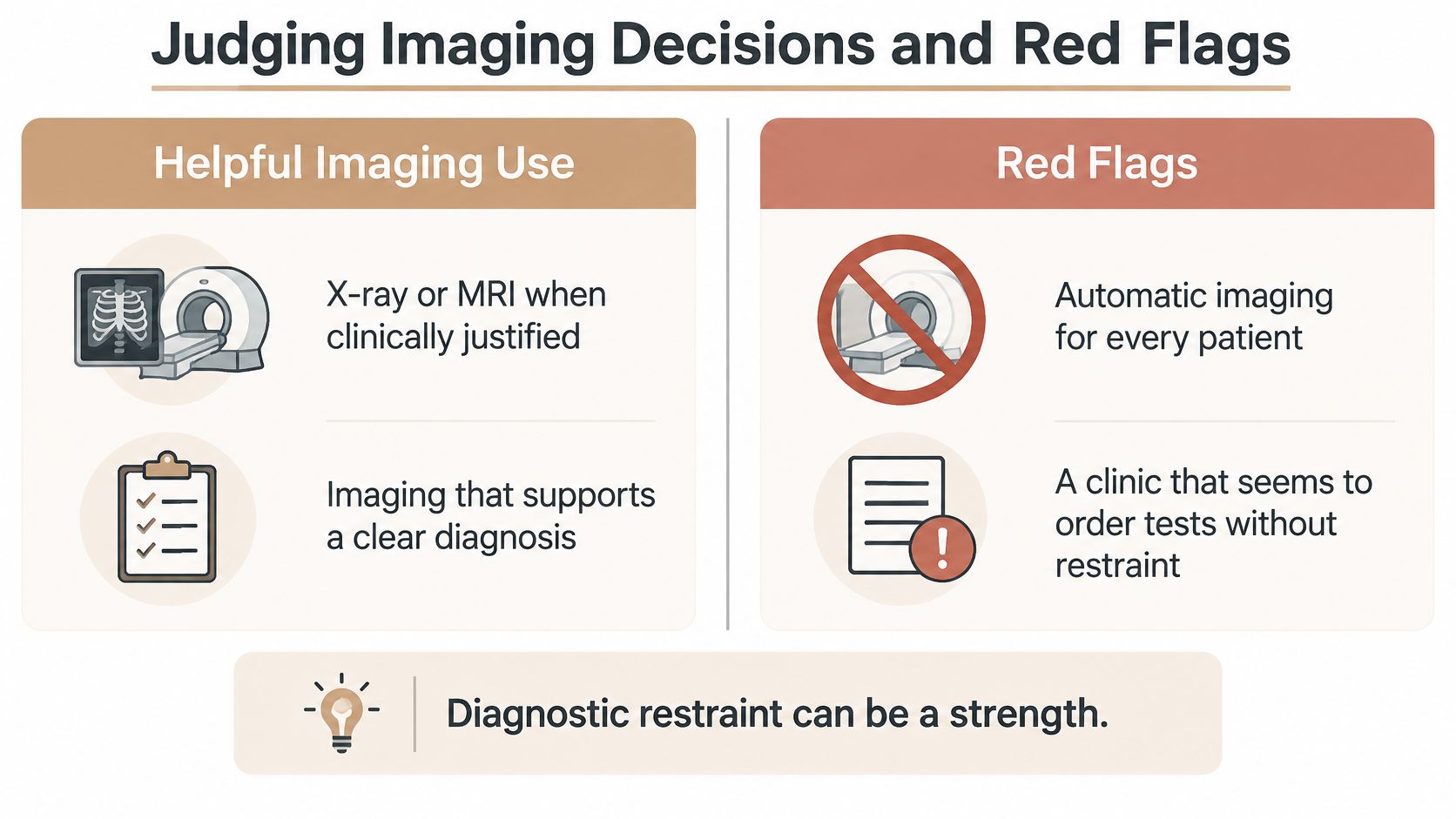
Ask both before you agree to films.
Also ask about radiation exposure, who interprets the images, and whether referral criteria are written down. A clinic that doesn't image every new patient may be following safer practice. A clinic that orders studies for every sore back may be using pictures to justify a long plan. Choosing a chiropractor includes judging that restraint, not only the hardware.
A provider who screens first and images second is a safer bet than one who treats every presentation the same way.
Get medical assessment, not a routine manipulation slot, if you have progressive weakness, bowel or bladder changes, saddle numbness, fever, unexplained weight loss, cancer history, significant trauma, osteoporosis, or prolonged steroid use. The same urgency applies to gait changes, suspected fracture, infection, or vascular symptoms. If you want a plain comparison of when each study helps, read through MRI versus X-ray for back pain before you accept a default set of films.
Passive care can calm a flare. It rarely rebuilds the capacity you lost. For low-back pain and sciatica, NICE guidance says to consider spinal manipulation, mobilization, or soft-tissue techniques such as massage only as part of a package that includes exercise, with or without psychological therapy. The same guidance supports an exercise program for a specific episode or flare, matched to your needs, preferences, and what your body can do that week.
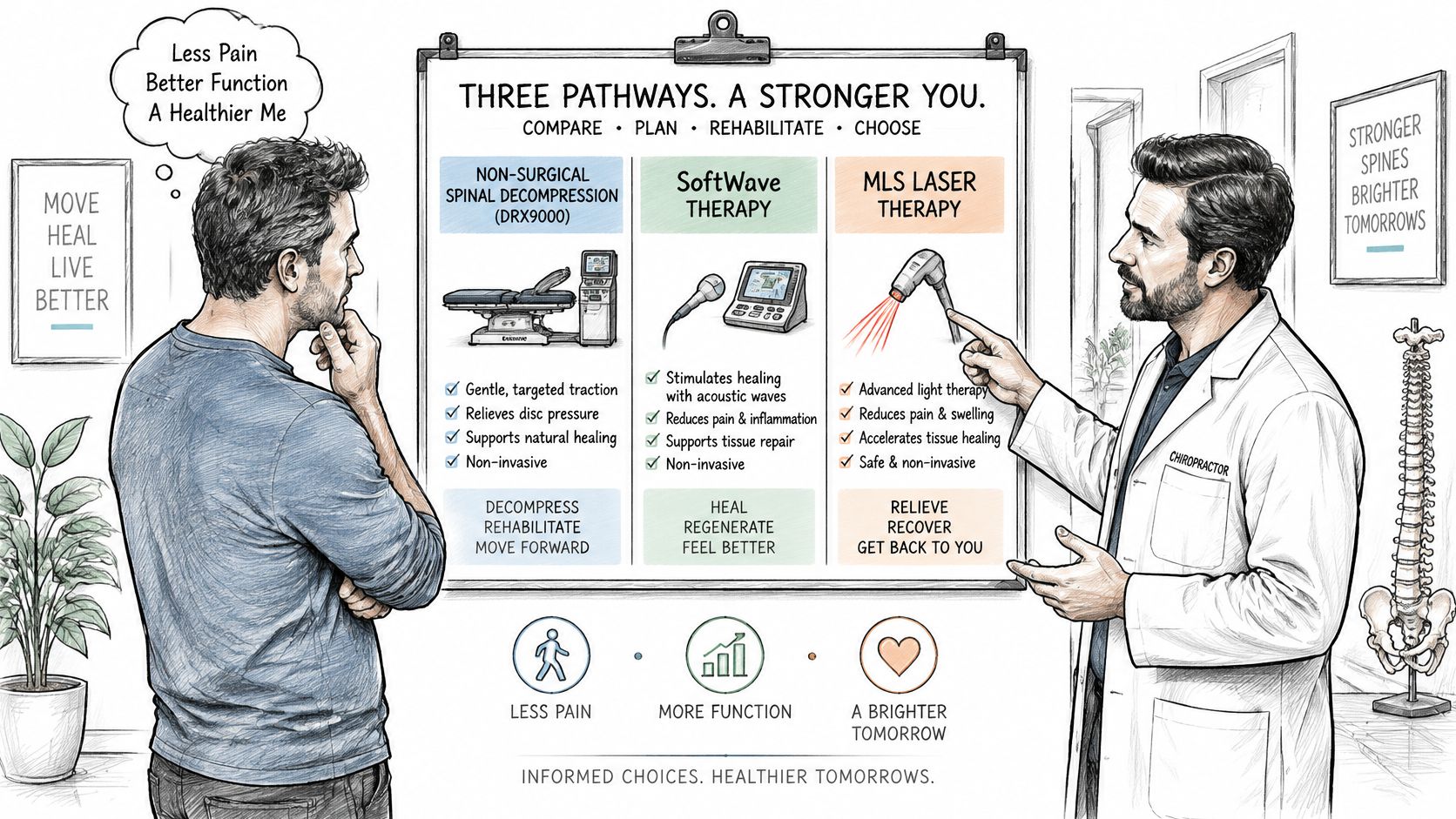
Use the tool for the job, and make the clinic justify each line.
| Option | Generally aimed at | What you should hear |
|---|---|---|
| Spinal decompression (DRX 9000) | Disc-related leg or arm pain when exam findings fit | Why traction is safer than manipulation here, and how progress is measured |
| Chiropractic adjustment and realignment | Joint restriction that matches the exam | What "realignment" means in your case, and what it will not fix |
| SoftWave therapy and MLS laser therapy | Tissue irritation and recovery support | Why this device, for how many visits, and what changes if pain doesn't drop |
| Massage, mobility therapy, muscle stimulation | Soft-tissue tension and movement limits | How hands-on work connects to a home plan, not a standing weekly appointment |
| Acupuncture and nutrition counseling | Pain modulation and recovery support | Who is credentialed, and how this piece serves the same goals as the adjustment |
Sciatica treatment that is only a fixed series of passive adjustments is the weak version. The stronger version pairs manual care with rehabilitation exercise, mobility work, and a personal exercise plan you can do between visits. Golf movement screening belongs in that same logic if the swing is the load that keeps restarting the pain. Car accident treatment should start with a structured exam and documentation, not a package sold before anyone has tested strength or reflexes.
An integrated plan names who delivers each therapy and why that piece is in the file. An unbounded bundle adds decompression, laser, acupuncture, and massage because the menu is long. Aspen Falls Wellness is one example of the integrated model: chiropractors, massage therapists, acupuncturists, mobility specialists, and nutrition coaches in house, take-home exercise, and referral out when the problem leaves that scope. The test isn't how many modalities sit on the wall. It's whether each one has a job, a stop date, and a reason to stay.
Reviews are patterns, not a trophy average. Read for repeated comments about explanations, whether someone described risks, pressure to buy large prepaid packages, and whether people got better over weeks rather than after a single visit. One angry review about parking doesn't matter. Five reviews that mention the same hard sell do.
Network status changes. Verify coverage with the clinic and with your insurer before you book, or the first surprise is the bill. Aspen Falls Wellness participates with multiple plans, including Aetna, BCBS, Cigna, Humana, GEHA, and Motiv Health, and you should still confirm your specific policy. If Blue Cross Blue Shield is your plan, start with whether Blue Cross Blue Shield covers chiropractic and then match that general picture to your card.
Travel time is part of the treatment. A plan that needs several visits a month fails if the office is an hour away and you skip half of them. Aspen Falls Wellness has clinics in Salt Lake City and Sandy, Utah, which matters if you're choosing between a closer passive-only office and a slightly longer drive to a place that will reassess.
A course of manual therapy, including spinal manipulation, mobilization, or massage, is described in a NICE-linked recommendation as up to nine sessions over up to 12 weeks. Where acupuncture is clinically appropriate under that same guidance, the figure is up to 10 sessions over up to 12 weeks, per the NICE-linked manual therapy schedule. Those numbers aren't a prescription for you. They're a benchmark for asking how many visits are proposed up front, when progress is measured, and what happens if symptoms stall. Get total expected cost, visit frequency, cancellation terms, and referral criteria in writing before you buy a package.
A useful first visit ends with a diagnosis or clinical impression, an evidence-informed plan, expected outcomes, and a clear picture of what care looks like. If you aren't responding on that timeline, co-management or referral should be on the table. Most "how to choose a chiropractor" lists stop at credentials and reviews. They skip the stopping rules, and those rules are how you avoid an open-ended adjustment schedule.
Regulatory backup is thin, which is why you have to ask. A review of U.S. state regulator websites, summarized in Canadian Chiropractic Association practice recommendations, found that 29 jurisdictions (53%) didn't report chiropractic informed-consent requirements, and 45 states (82%) had no minimum requirement for the format of consent. You can't assume the consent form will cover benefits, risks, alternatives, cost, and the option to do less.

Ask these, and don't leave without dates attached.
The exam itself should include a history plus a neurological or musculoskeletal examination, not a sales tour of devices. Be wary of guarantees, pressure to prepay a large block, claims that every condition comes from spinal misalignment, and routine imaging without a clinical reason.
The strongest chiropractor isn't the one with the longest menu. It's the one who can justify each component, track outcomes, disclose the money, and stop or refer when progress is inadequate. Use the first consultation to run this script. If you want a preview of how that hour usually unfolds, see what to expect at a first chiropractic visit and bring the questions with you.
Aspen Falls Wellness offers evidence-based chiropractic care, DRX 9000 spinal decompression, SoftWave and MLS laser therapy, massage, acupuncture, mobility work, and personal exercise plans for back pain, sciatica, and post-collision injuries at its Salt Lake City and Sandy clinics. Bring the checklist from this article to an initial consultation and use that visit to test licensing transparency, imaging restraint, and written stopping rules. Book through Aspen Falls Wellness and ask for a plan that measures function, not just visit count.

Stay updated with the latest chiropractic news and exclusive offers.