Explore the best exercises for neck pain and headaches, from chin tucks to nerve glides, with progressions, cautions, and care-plan tips.

By mid-afternoon, you're at your desk with a stiff neck, tight shoulders, and a headache building at the base of your skull. You may rub the back of your neck, stretch once, and feel temporary relief, only for the pressure to return when you look back at the screen. Forward head posture, weak deep neck muscles, and restricted upper-back and shoulder movement can all increase the load on the cervical spine and refer discomfort toward the head. Jaw tension can contribute to some headache patterns too, as explained in this guide to headache and jaw pain.
The best exercises for neck pain and headaches depend on the likely source of your symptoms, your irritability, and whether you have arm symptoms or neurological changes. The exercises below cover gentle control, mobility, strengthening, endurance, and nerve-focused movement. Each one includes when it may help, when to avoid it, how to progress, and how it can fit into an integrated care plan rather than functioning as a standalone workout.
The chin tuck is often the most useful starting point when prolonged screen time leaves your head positioned in front of your shoulders. The exercise trains the deep cervical flexors, including the longus colli and longus capitis, while reducing the tendency to overuse the superficial neck muscles and suboccipital region.
Lie on your back with a small towel roll supporting the natural curve of your neck. Gently draw your chin inward, as though creating a small double chin, while lengthening the back of your neck. The movement should be subtle. Don't lift your head, jam your chin toward your chest, or clench your jaw.
Practical rule: Use only enough effort to create controlled movement. A forceful chin tuck usually trains tension rather than coordination.
Frimley Health NHS advises using about 50% effort, repeating the movement 3 to 5 times, and stopping if it causes real pain or dizziness in its guidance on head, neck, and shoulder stretches. A rehabilitation plan may build toward a 10-second hold for 10 repetitions, once or twice daily, if that dosage remains comfortable. Progress from lying down to sitting and standing once you can maintain a relaxed jaw and steady breathing.
The exercise fits well with desk posture changes and regular movement breaks. At Aspen Falls Wellness, chin tucks may be included in personal exercise plans and rehabilitation exercise alongside cervical Adjustment, soft-tissue care, and mobility work. You can also review this practical guide to neck pain exercises at home.
Avoid self-progressing if chin tucks increase dizziness, arm symptoms, or a headache that continues to worsen. If forward head posture is part of the problem, combine this drill with upper-back mobility and scapular strengthening rather than trying to hold your head rigidly all day. More guidance on correcting forward head posture can help reinforce that broader approach.

Neck muscles often work harder when the shoulder blades lack endurance. Band rows, wall slides, and supported Y raises train the mid and lower trapezius and rhomboids, helping the shoulder blades sit more securely against the rib cage. Rounded shoulders can keep the head forward and increase tension through the upper trapezius.
Start with a light resistance band anchored securely in front of you. Sit or stand tall, keep your ribs relaxed, and draw the shoulder blades down and back before pulling the band. Hold the end position briefly without shrugging or jutting your chin forward.
Use a slow tempo and let the neck remain quiet. A useful starting point is 2 to 3 sets of 10 to 15 repetitions, three times weekly, with about a 2-second hold when the shoulder blades reach their controlled end position. These exercise quantities are a practical starting prescription, not a requirement to push through fatigue.
Office workers may use rows during a graded posture and mobility program. Athletes may add them during a return to activity after overuse strain. Aspen Falls Wellness uses scapular strengthening within mobility therapy, posture retraining, and take-home Personal Exercise Plans. A related resource explains posture correction exercises in more detail.
Rows won't correct every headache pattern. They're most useful when shoulder-blade weakness, rounded posture, or upper-back fatigue clearly contributes to your symptoms. If the headache is sudden, neurologically unusual, or unrelated to neck loading, strengthening shouldn't replace an evaluation.

Isometric neck exercises build strength without requiring the head to move through a large range. You press gently into your hand or a stable surface while keeping the head still. That makes them useful when dynamic neck movement feels irritating, but the cervical muscles need better endurance for work, driving, sport, or daily activity.
You can train forward, backward, and side-to-side directions. Place your palm against your forehead for flexion, the back of your head for extension, or the side of your head for side bending. Apply light pressure, keep your eyes level, and breathe normally.
A practical starting point is 10% to 20% of maximum effort, holding for 5 to 10 seconds and repeating 3 to 5 times per direction. These figures come from the exercise plan for this movement, while the appropriate dose depends on your diagnosis and tolerance. The head should not visibly move during the contraction.
Isometrics may be appropriate during a conservative program for mild whiplash-related pain, recurrent tension headaches, or reduced neck endurance. They can also help an active person prepare for a gradual return to cycling, lifting, or other activities that require the head and neck to remain controlled.
They're not a good self-directed choice when you have unexplained dizziness, increasing headache pain, arm numbness, progressive weakness, or symptoms after significant trauma that haven't been assessed. After a car accident, Aspen Falls Wellness uses a structured examination to decide whether isometric loading belongs alongside Car Accident Treatment, Chiropractic Care, soft-tissue work, or Rehabilitation Exercise.
Keep the contraction gentle enough that you can breathe, relax your jaw, and stop immediately if symptoms spread into the arm.
Isometrics can support a broader program that includes Chiropractic Adjustment, massage therapy, Muscle Stimulation, or other clinically appropriate care. Their value comes from controlled progression, not from pressing as hard as possible against your hand.
A stiff upper back can force the neck to compensate. When the thoracic spine remains rounded, the head may drift forward and the cervical muscles may work continuously to keep your eyes level. Thoracic extension drills address that limitation without aggressively stretching the neck itself.
Sit toward the front of a chair with your hands behind your head. Keep your lower back relatively still and gently extend your upper back over the chair's backrest. Your neck should stay neutral. Don't pull your head forward or force the movement from the lumbar spine.
A supported foam roller or rolled towel can provide another option. Move slowly, pause briefly where the upper back extends comfortably, and return to neutral. A reasonable starting point is 8 to 10 repetitions with a 3- to 5-second pause, provided the movement doesn't provoke symptoms.
Thoracic extension can make chin tucks, rows, and upright sitting feel easier, but more range isn't always better. People with sensitive necks may respond poorly when they arch aggressively or allow the head to fall backward. Keep the movement focused through the mid-back and stop at mild resistance rather than chasing a deep stretch.
This exercise can fit between work periods, after prolonged sitting, or before strengthening. Aspen Falls Wellness may combine thoracic mobility with Mobility Therapy, posture retraining, Realignment, and individualized manual care. If neck pain is persistent, repeated extension brings on arm symptoms, or you've had a recent injury, an examination should guide the exercise selection.
The goal isn't to maintain a rigid “perfect” posture. It's to give the upper back enough movement that the neck doesn't have to perform every postural task by itself.

The upper trapezius and levator scapulae often become guarded after long periods at a computer, stressful work, or a car accident. Gentle stretching can reduce the feeling of tightness and make neck rotation more comfortable. It works best as a way to calm an irritable area, not as the only intervention for weakness or poor endurance.
For an upper trapezius stretch, sit tall and keep the shoulder on the side being stretched relaxed. Reach that hand beneath the chair, then gently tilt your head away. For the levator scapulae, turn your head slightly toward the opposite armpit before allowing a mild forward angle. Use your hand only for light guidance, never force.
Hold for 20 to 30 seconds and repeat 2 to 3 times per side. Slow breathing can reduce the tendency to brace. Berkshire Healthcare NHS also describes controlled neck rotation and side-neck stretching for cervicogenic headache, with movement kept within a comfortable range in its patient guidance.
Stretching may feel immediately soothing, but relief can be short-lived when the muscles are reacting to poor endurance, restricted upper-back motion, or nerve sensitivity. The Cochrane review of exercise for neck pain supports targeted strengthening of the cervical, scapulothoracic, shoulder, and upper-extremity muscles rather than relying only on general activity or nonspecific stretching in its evidence summary.
Aspen Falls Wellness may pair stretching with Massage Therapy, Acupuncture, and controlled strengthening for tension-related headaches. After trauma, stretching should remain gentle and should be adjusted if it increases headache intensity, dizziness, or arm symptoms.
Active cervical range-of-motion exercises keep the neck moving through comfortable flexion, extension, rotation, and side bending. They're often useful when stiffness and guarding make people afraid to turn their head. Smooth movement can restore confidence and reduce the habit of holding the neck in one fixed position.
Sit or stand upright and move slowly. Turn your head to one side, return to center, and repeat on the other side. Then explore gentle side bending, looking down, and looking up, stopping at mild resistance rather than pain. Don't bounce, circle forcefully, or use your hands to push the neck farther.
NHS inform advises beginning with 2 to 3 repetitions, spreading them through the day, and adding 1 to 2 repetitions every few days if the movement remains comfortable, gradually working toward approximately 10 repetitions in its neck exercise guidance. DynamicHealth NHS recommends 5 to 10 repetitions, 3 to 5 times daily, for prescribed neck exercises, with progression through repetitions, hold time, or exercise difficulty when the movement becomes easy in its neck pain guidance.
Movement should leave you feeling more capable, not progressively more threatened by your neck.
For people recovering from whiplash, rotations and tilts may begin in a small range and expand as tolerance improves. When pain radiates into an arm, Aspen Falls Wellness may combine range-of-motion work with cervical Chiropractic Care and, when clinically appropriate for disc-related conditions, non-surgical Spinal Decompression with the DRX 9000. Progressive weakness, persistent numbness, or dizziness warrants assessment rather than repeated self-testing.
Tight chest muscles can pull the shoulders forward and make the upper trapezius work harder. A doorway stretch creates a simple way to open the front of the shoulders while reinforcing a more comfortable upright position. It's especially useful when long periods of typing, driving, or pressing exercises keep the arms in front of the body.
Place your forearms against a doorframe around shoulder height. Step forward gently until you feel a stretch across the chest and the front of the shoulders. Keep your ribs controlled and avoid arching your lower back to create a larger sensation. Your neck should remain relaxed.
Hold for 30 seconds and repeat 2 to 3 times. If the shoulder feels pinched, lower the arms or reduce the step forward. The stretch should feel broad and manageable, not sharp or concentrated inside the joint.
A doorway stretch may improve short-term comfort, but it won't strengthen the muscles that hold the shoulder blades in position. Pair it with chin tucks and rows so the body practices both length and control. Athletes who perform frequent pressing movements may use it to maintain shoulder balance, while desk workers may include it after long static periods.
Aspen Falls Wellness can include chest mobility in Personal Exercise Plans, posture retraining, and Rehabilitation Exercise. The broader plan may also address tissue sensitivity through SoftWave Therapy, MLS Laser Therapy, massage, or acupuncture when those services fit the clinical findings.
Avoid forcing the stretch after recent shoulder surgery, acute shoulder injury, or unexplained arm symptoms. If opening the chest increases tingling or radiating pain, stop and seek an examination.
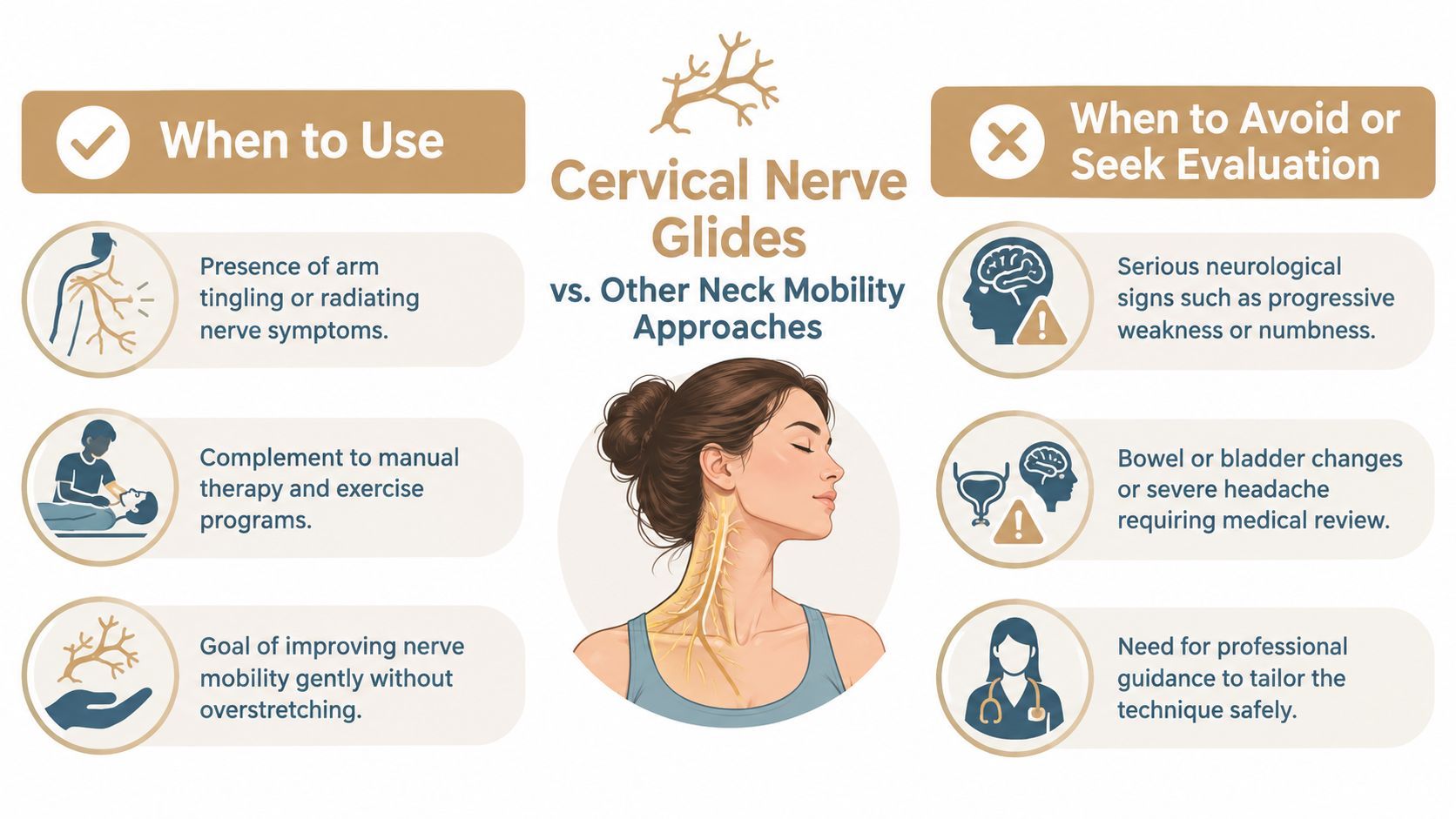
Cervical nerve glides are not ordinary neck stretches. They use gentle, coordinated movements of the neck and upper limb to help the nervous system move through surrounding tissues. They may be considered when neck pain includes tingling, radiating discomfort, or sensitivity into the arm, but they require more caution than basic mobility work.
The exact movement depends on which nerve pathway appears involved. A clinician may position the shoulder, elbow, wrist, and neck in a sequence that creates a mild sensation without holding a strong end-range stretch. The intent is movement, not tension. If symptoms intensify and remain high after the exercise, the dose or technique isn't appropriate.
A guided program may begin with 8 to 10 repetitions once or twice daily, stopping if symptoms increase or persist. Don't force the wrist, elbow, or neck into a stronger stretch to “release” the nerve. Progressive weakness, worsening numbness, bowel or bladder changes, severe headache, or symptoms after trauma require medical evaluation.
Aspen Falls Wellness begins with a thorough examination and may recommend X-ray or MRI referrals when indicated before introducing neural mobilization. Care may include posture training, cervical Adjustment, Spinal Decompression, Pain Relief strategies, or referral outside the clinic's scope when appropriate. This resource on a pinched nerve in the neck explains why radiating symptoms deserve more careful assessment than ordinary muscle tightness.
| Exercise | Implementation complexity | Resource requirements | Expected outcomes | Ideal use cases | Key advantages |
|---|---|---|---|---|---|
| Chin Tuck (Deep Neck Flexor Activation) | Low, simple movement but easy to perform incorrectly | Minimal, none required (towel optional) | Improved deep neck flexor endurance, better head alignment, fewer cervicogenic headaches over weeks | Forward head posture, tension headaches, desk workers | Low-impact, targets root cause of forward head posture |
| Scapular Retraction & Rowing Exercises | Low–moderate, requires scapular control and cueing | Bands/cables/weights or bodyweight | Stronger mid/lower trapezius and rhomboids, improved shoulder blade positioning over weeks | Rounded shoulders, weak scapular stabilizers, postural rehab | Scalable resistance, improves upper-back support for the neck |
| Isometric Neck Strengthening | Low, simple holds but requires controlled effort | None, hands or wall only | Increased cervical endurance and gentle strength with minimal joint load | Acute/irritable neck pain, early rehab, limited-motion patients | No equipment, gentle option during painful phases |
| Thoracic Extension Mobility Exercises | Low, technique-sensitive to protect lower back | Chair, foam roller, or towel roll | Increased thoracic extension, improved posture and breathing mechanics | Stiff upper back, compensatory neck motion, prolonged sitting | Addresses mechanical contributor to neck strain and enhances other exercises |
| Upper Trapezius & Levator Scapulae Stretch | Very low, easy, passive stretch | None | Short-term reduction in muscle tightness and neck stiffness | Acute tension, stress-related tightness, quick relief needs | Fast, safe, repeatable relief with no equipment |
| Active Cervical Range-of-Motion Exercises | Low, controlled movement; caution after trauma | None | Restored neck mobility, reduced stiffness, improved movement confidence | Early rehab, general stiffness, daily mobility maintenance | Restores motion, easy to integrate into routines |
| Pectoral Doorway Stretch | Low, straightforward position with adjustable intensity | Doorway or wall | Reduced chest tightness, improved shoulder and thoracic posture over weeks | Rounded shoulders, tight pecs from desk work or pressing | Simple, pairs well with scapular strengthening to rebalance posture |
| Cervical Nerve Glides (Neural Mobilization) | Moderate, technique and symptom monitoring required | Minimal, professional guidance recommended | Improved nerve mobility and reduced radiating symptoms when appropriate | Neck pain with arm tingling/radicular symptoms, nerve sensitivity | Targets neural mobility specifically; complements manual therapy and exercise |
The most useful program is usually smaller than people expect. During an irritable phase, begin with comfortable active range of motion and gentle isometric work. Add chin tucks when you can control the movement without dizziness or increased headache, then introduce scapular rows and other endurance exercises as your neck and shoulders tolerate them.
Thoracic extension and pectoral mobility can support the strengthening work by giving the upper back and shoulders more movement. Upper trapezius and levator scapulae stretching may reduce guarding, but it shouldn't replace cervical and scapular endurance training when weakness or fatigue is part of the pattern. Nerve glides belong in a separate category. Use them only when arm symptoms have been assessed and the movement is clearly tolerated.
Exercise dose matters. A 2025 randomized workplace study prescribed supervised neck and shoulder-girdle training three times weekly for 12 weeks, yet only 27% of participants met or exceeded the recommended frequency; 73% exercised less often, and 21% reported one or fewer sessions weekly as reported in the study summary. The practical lesson isn't to chase a perfect schedule. It's to make the plan simple enough to repeat and to track session frequency, headache days, intensity, disability, and adverse responses.
The evidence also supports a preventive role for exercise. A 2023 systematic review and meta-analysis reported that exercise reduced the risk of a new neck-pain episode by 53%, with a risk ratio of 0.47 and a 95% confidence interval from 0.32 to 0.68, under the conditions studied in the Journal of Orthopaedic and Sports Physical Therapy review. That finding supports regular, progressive activity, but it doesn't mean every headache comes from the neck or that exercise should replace diagnosis.
Cervicogenic headache deserves particular care. A systematic review of six randomized controlled trials involving 457 participants found meaningful improvements in headache frequency, headache intensity, and neck pain with exercise-only programs at approximately seven weeks, with benefits still present for these outcomes at 12 months in the review available through PubMed Central. The strongest practical approach is usually controlled progression, not aggressive stretching or maximal strengthening.
Stop self-directed exercise and seek prompt medical care for a sudden severe headache, new neurological symptoms, progressive weakness, major sensory changes, fever, visual changes, symptoms after significant trauma, or a substantial change in your usual headache pattern. Persistent radiating pain also deserves assessment before you increase loading.
An examination can identify whether your plan should emphasize Chiropractic Adjustment, manual Realignment, massage, Acupuncture, SoftWave Therapy, MLS Laser Therapy, Muscle Stimulation, Mobility Therapy, exercise, nutrition counseling, or a referral for further investigation. Aspen Falls Wellness provides coordinated chiropractic and integrative musculoskeletal care in Salt Lake City and Sandy, with ongoing re-evaluation to adjust treatment as your symptoms and tolerance change. A professional assessment is the most reliable next step when exercises provide only temporary relief or when you're unsure which headache pattern you have.
For additional perspective on conservative approaches to persistent pain, you can review this chronic pain treatment guide.
Aspen Falls Wellness offers examinations, individualized Chiropractic Care, manual treatment, Mobility Therapy, Rehabilitation Exercise, massage, acupuncture, SoftWave Therapy, MLS Laser Therapy, and Spinal Decompression with the DRX 9000 when clinically appropriate. Visit Aspen Falls Wellness to request an evaluation and build a neck pain and headache plan matched to your symptoms, goals, and tolerance.

Stay updated with the latest chiropractic news and exclusive offers.