Explore 7 best posture correction exercises with cues, sets, progressions, modifications, safety guidance, and clinical support options.



One exercise can't fix every posture problem. Forward head posture, rounded shoulders, limited chest mobility, poor spinal control, and pain can look similar from the outside, but they don't respond to the same progression. The best posture correction exercises are selected according to the movement pattern, then progressed only when the technique stays comfortable and controlled.
This roundup moves from low-risk awareness and mobility work toward strength, clinical posture retraining, and pain-limited care. You'll find practical cues, dosage guidance, modification options, and situations where self-care isn't enough. Persistent pain, numbness, weakness, radiating symptoms, or concerns after an accident deserve professional evaluation rather than a more aggressive home routine. For additional health topics on staying active, keep the same principle in mind: regular, appropriate movement usually matters more than forcing a perfect position.
Chin tucks are a useful starting point when your head drifts forward while you work, drive, or look at a screen. The movement trains the deep cervical flexors, including the longus colli and longus capitis, by drawing the chin straight backward without tipping the head down. That distinction matters. You're repositioning the head over the neck, not pressing your chin toward your chest.
Sit or stand tall with your gaze level. Gently glide your chin backward until you feel mild work deep in the front of the neck, hold for 2 to 3 seconds, and release slowly. Begin with 2 to 3 sets of 12 to 15 repetitions daily, provided the movement doesn't reproduce sharp pain, dizziness, or arm symptoms.
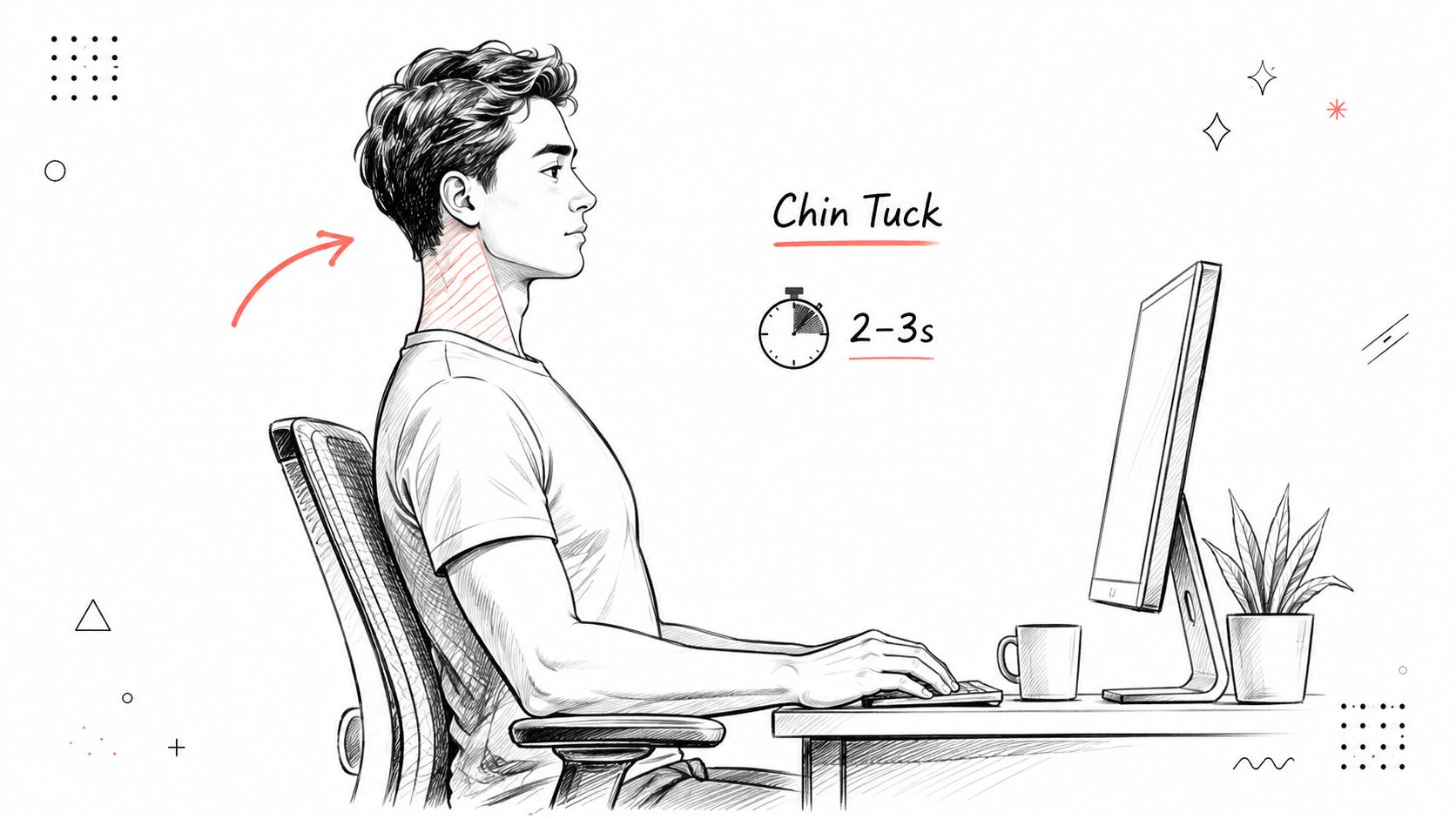
Office workers can use chin tucks during hourly screen breaks, while athletes may include them in a pre-activity mobility sequence. People recovering from a car accident or whiplash should use a smaller range and follow the progression provided by a qualified practitioner. Headaches or neck pain can have several causes, so chin tucks shouldn't replace an examination.
Practical rule: If your eyes look toward the floor, you're nodding instead of retracting.
Aspen Falls Wellness may incorporate cervical mobility work, Chiropractic Adjustment, and individualized exercise plans when neck positioning contributes to discomfort. Its guidance on neck pain exercises at home can complement, but not replace, personalized assessment. People also researching ways to fix misaligned jaw naturally should remember that jaw symptoms and neck posture can overlap without having the same underlying cause.
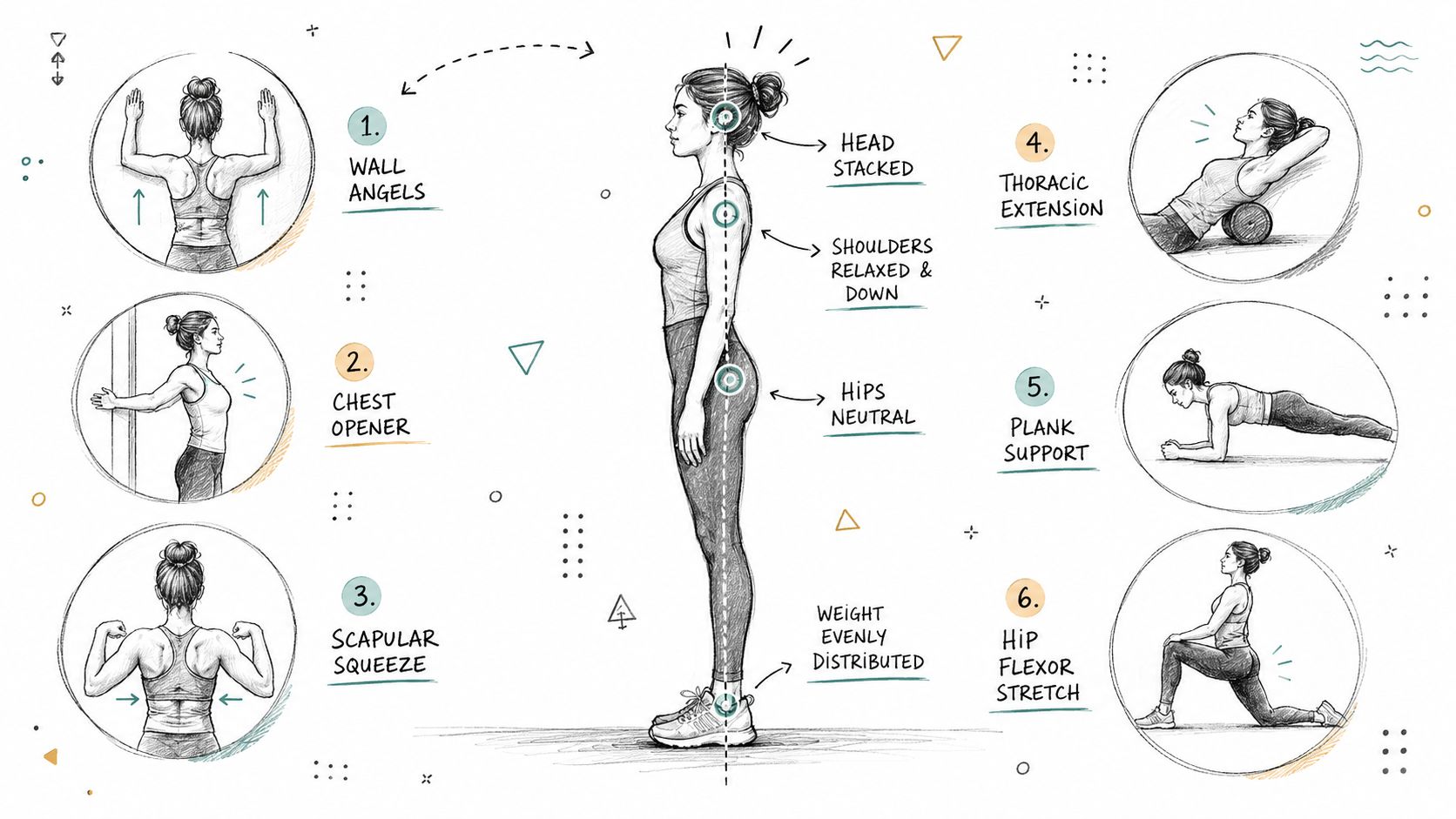
Wall angels expose a common limitation quickly. You may be able to raise your arms overhead, but maintaining contact with the wall can reveal restricted chest mobility, poor scapular control, or compensation through the lower back. The exercise strengthens the rhomboids and middle and lower trapezius while asking the shoulder blades to move more effectively over the ribcage.
Stand with your back against a wall. Keep your head, upper back, and hips comfortably supported, then position your arms in a goalpost shape. Slowly slide the arms upward and back down, keeping the ribs from flaring and avoiding a forced range. If your wrists or elbows can't stay near the wall, widen the arms or reduce the height.
Perform 2 to 3 sets of 10 to 12 repetitions daily if the motion remains smooth. A person who spends much of the day at a desk might use wall angels during breaks, while an athlete may use them to assess overhead control. Someone recovering from a shoulder strain or car-accident injury should stay within a pain-free range and may need a different scapular drill first.
A controlled thoracic posture program found that correcting thoracic kyphosis should be included when exercise aims to restore normal scapular alignment, connecting upper-back extension with measurable scapular position changes rather than treating posture as a purely visual issue (controlled thoracic posture research).
Therapeutic Massage can help reduce soft-tissue restriction around the pectoral muscles before active work. As control improves, you can use a light resistance band or perform the movement away from the wall, but only if you can keep the ribcage and pelvis steady.
A dead bug doesn't look like a posture exercise, yet it teaches one of the skills upright posture depends on most, maintaining a stable spine while the limbs move. Lying on your back also gives you immediate feedback. If the lower back lifts excessively from the floor as an arm or leg extends, the abdominal muscles aren't controlling the movement effectively at that level.
Lie on your back with your hips and knees bent and your arms raised. Gently brace your abdomen, then lower one arm and the opposite leg without allowing the lower back to arch away from the floor. Return to the starting position and switch sides. Move slowly, taking roughly 3 to 5 seconds per repetition, rather than chasing speed.
Start with 2 to 3 sets of 10 to 15 repetitions, 5 days per week, if that schedule is comfortable. Make the exercise easier by moving only the arms or sliding one heel along the floor. Progress by extending both limbs together or adding light resistance, but don't advance if your ribs flare or your back repeatedly lifts.
Desk workers may use dead bugs to build lumbar endurance for sitting and standing tasks. People with sciatica, disc-related pain, or recent treatment should avoid assuming that a low-intensity exercise is automatically appropriate. Aspen Falls Wellness can pair rehabilitation exercise with personal exercise plans and, when clinically appropriate, Spinal Decompression with the DRX 9000.
Neutral spine is a controlled position, not a rigid brace. You should be able to breathe while maintaining it.
Stop if the exercise causes increasing leg pain, tingling, numbness, or weakness. Those symptoms need assessment before you add repetitions or resistance.
Rounded shoulders often involve more than weak upper-back muscles. Tightness through the pectoralis major and minor can limit how the shoulder blades rest and move, making an upright position feel forced. The doorway chest stretch creates space at the front of the shoulders so strengthening exercises can work through a more usable range.
Place one forearm against a doorframe with the elbow bent to 90 degrees. Step forward gently until you feel a mild stretch across the chest and front of the shoulder. Keep the ribs relaxed, breathe normally, and avoid twisting the torso to create a stronger sensation. Hold for 25 to 30 seconds, then change sides.
Perform the stretch 2 to 3 times daily, adjusting the arm height to influence different areas of the chest. A high, middle, or low position can feel very different, so choose the angle that produces a comfortable stretch rather than shoulder pinching. Office workers can use it during a break, while athletes may include it after training when overhead mobility is limited.
Post-accident patients and people with chronic pain should be particularly cautious about aggressive stretching. A protective muscle response may be present, and forcing the tissue can increase symptoms. Massage Therapy may be used alongside mobility work to address soft-tissue dysfunction, but manual treatment works best when followed by controlled movement.
Chiropractic Adjustment may also be included in a broader plan when joint mobility and muscle tension are contributing to restricted posture. The stretch itself should feel gradual. Sharp pain, tingling, instability, or symptoms extending into the arm are reasons to stop and seek guidance.
Prone Y-T-W raises are a progression for people who can already perform wall angels without losing control. Lying face down reduces the opportunity to use momentum and makes it easier to focus on the lower trapezius, rhomboids, and external rotators. The three arm shapes create different demands, but the central objective stays the same, controlled scapular movement without shrugging.
Lie face down with your forehead supported comfortably. Raise your arms into a Y, lower them, move into a T, lower again, and then bend the elbows into a W while drawing the shoulder blades gently toward the spine. Keep the neck relaxed and avoid lifting the chest through the lower back. Begin with bodyweight only.
Use 2 to 3 sets of 12 to 15 repetitions per position, 3 times per week. The exact range matters less than the quality of the lift. If the shoulders rise toward the ears, reduce the height or pause between repetitions. Once bodyweight control is reliable, light dumbbells can add resistance, but the load should never replace scapular precision.
The right sensation is work around the mid and lower shoulder blade, not a gripping neck.
Athletes in golf, throwing, or overhead sports may use Y-T-W raises to support shoulder mechanics. Office workers with chronic postural strain may need to begin with shorter sets. Aspen Falls Wellness can place the exercise inside a Personal Exercise Plan that progresses from dead bugs and wall angels to more demanding posterior-chain work, alongside Mobility Therapy or Chiropractic Care when indicated.
People with acute shoulder pain, recent surgery, or unexplained weakness shouldn't treat this as a universal strengthening test. A practitioner can modify the arm position, range, or loading strategy.
Spinal Decompression with the DRX 9000 isn't a home exercise. It's an advanced, non-surgical, device-based intervention intended for selected patients whose pain prevents them from standing upright, walking comfortably, or participating in corrective exercise. Treatment applies controlled mechanical separation to the spine, with the aim of reducing disc-related pressure and making active rehabilitation more tolerable.
This option belongs later in the progression because pain changes how people move. Someone with sciatica, a disc-related condition, or persistent lower-back symptoms may compensate through the hips, thoracic spine, or neck. Reducing symptoms can create an opportunity to restore movement, but decompression shouldn't be presented as a substitute for strength, motor control, or diagnosis.
A practitioner should first evaluate the symptoms and determine whether DRX 9000 treatment is appropriate. Aspen Falls Wellness describes its DRX 9000 spinal decompression approach as part of non-surgical care for disc-related problems. A plan may also include Chiropractic Adjustment, Massage Therapy, SoftWave Therapy, MLS Laser Therapy, Acupuncture, or rehabilitation exercises, depending on the examination and tolerance.
The most useful integration point is active participation. A patient who can move more comfortably may be able to practice dead bugs, core stabilization, walking, or other prescribed exercises with better control. Treatment still needs to be paired with realistic activity modification and ongoing reassessment.
Don't use decompression as a reason to ignore worsening neurological symptoms. New or progressive weakness, significant numbness, or radiating pain that continues to escalate requires prompt clinical attention and may require referral outside the clinic's scope.
Posture retraining addresses movement behavior, not only the position visible in a photograph. A practitioner observes how the head, shoulders, thoracic spine, pelvis, hips, and feet coordinate during sitting, standing, walking, and task-specific movement. The resulting plan may combine mobility therapy for posture, strengthening, body-awareness drills, manual treatment, ergonomic changes, and gradual habit practice.
Assessment becomes more useful when several patterns overlap. An office worker might need chest mobility and cervical control alongside low-back conditioning. An athlete may stand upright yet lose trunk or scapular control during a golf swing or overhead task. After a car accident, pain and guarding can reduce movement confidence, so the exercise range and loading may need to progress more slowly.
A clinical plan may use Chiropractic Adjustment, soft-tissue release, Mobility Therapy, massage, rehabilitation exercise, and home practice. Aspen Falls Wellness also provides examination, referrals for X-ray or MRI when indicated, Nutrition and Nutrition Counseling, Golf Movement Screening, Car Accident Treatment, and other supportive services within its musculoskeletal care model. Home functional mobility exercises can reinforce clinic-based work when symptoms remain controlled.
The 2026 systematic review and meta-analysis pooled 28 randomized controlled trials with 901 participants and reported large improvements in forward head angle, forward shoulder angle, and thoracic hyperkyphosis angle. All reported significance values were below 0.01 (2026 posture exercise meta-analysis). However, heterogeneity was high, with I² values from 78% to 88%. That variation supports selecting exercises according to the person's presentation rather than prescribing one fixed routine.
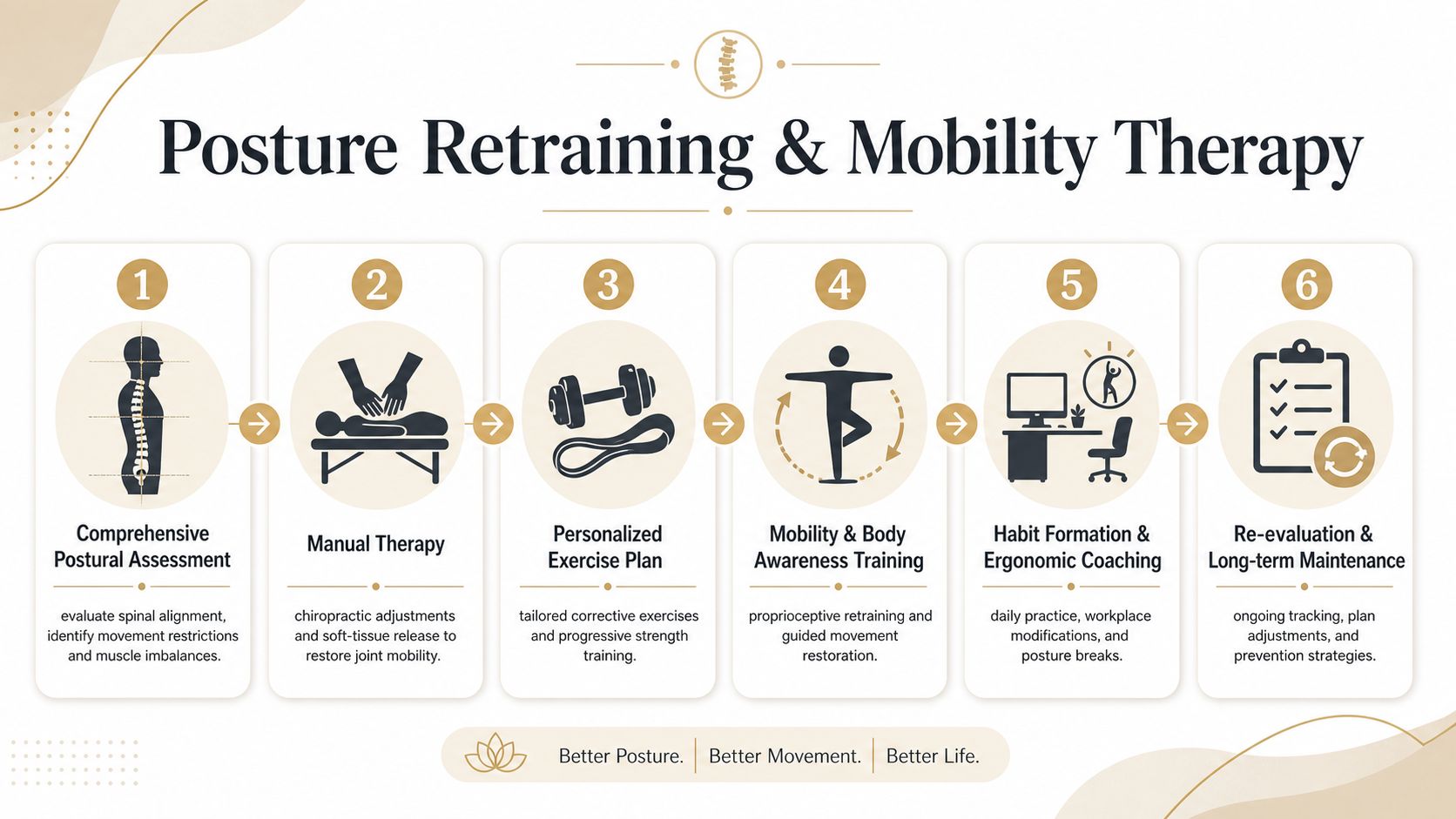
A plan may run for 8 to 12 weeks, with home exercises practiced daily and clinic visits commonly scheduled 1 to 2 times per week. Those parameters should change with symptoms, tolerance, and goals. Evidence also favors combining strengthening with stretching, using a medium-term routine instead of expecting one movement to permanently change alignment (systematic review of posture interventions). Pain, numbness, weakness, or worsening function warrants assessment before increasing exercise difficulty.
| Item | Implementation complexity | Resource requirements | Expected outcomes | Ideal use cases | Key advantages |
|---|---|---|---|---|---|
| Chin Tucks (Cervical Retraction) | Very low, easy to learn with brief cueing | None; can be done seated/standing | Improved neck stability, reduced forward head posture and headache frequency (weeks) | Office workers, mild FHP, whiplash rehab adjunct | Low risk, portable, complements chiropractic care |
| Wall Angels (Shoulder Blade Activation) | Low–moderate, requires scapular control and wall feedback | Wall space; optional band for progression | Improved scapular positioning, shoulder mobility, reduced impingement | Rounded shoulders, thoracic kyphosis, athletes needing scapular control | Combines mobility and strength with immediate feedback |
| Dead Bugs (Core Stability and Spinal Alignment) | Moderate, needs motor control to avoid compensation | Mat; supervision recommended for pathology | Enhanced core endurance, neutral spine control, reduced lumbar instability (4–6 weeks) | Post-decompression rehab, disc-related conditions, lumbar instability | Low spinal compression, scalable, foundational for stability |
| Doorway Chest Stretch (Pectoralis Lengthening) | Very low, simple static stretch with correct alignment | Doorway or vertical edge | Increased pectoral length, improved thoracic/shoulder mobility | Desk workers, anterior chest tightness, postural mobility prep | Immediate tension relief, easy to perform anywhere |
| Prone Y‑T‑W Raises (Posterior Chain Strengthening) | Moderate–high, advanced technique to avoid compensation | Mat; optional light weights; instructor guidance | Comprehensive posterior chain strength, scapular stability, visible posture gains (4–6 weeks) | Athletes, progressive postural rehab, chronic upper‑back weakness | Targets multiple posterior muscles; scalable progression |
| Spinal Decompression (DRX 9000) | High, device-based therapy delivered by trained clinicians | Specialized DRX 9000 device, clinic sessions (15–25 sessions) | Reduced intradiscal pressure, less radicular pain, enables active rehab | Herniated discs, sciatica, stenosis when conservative care indicated | Non‑surgical, targets disc pathology and facilitates exercise |
| Posture Retraining & Mobility Therapy (Integrated) | High, comprehensive assessment and individualized program | Multidisciplinary clinic visits, therapist time, home exercise adherence | Long‑term postural correction, habit change, reduced recurrence (8–12+ weeks) | Complex/chronic postural dysfunction, post‑accident rehab, athletes | Addresses root causes, integrates therapies, measurable long‑term outcomes |
Start with the smallest useful progression. Chin tucks and doorway chest stretches suit people who need neck awareness and chest mobility. Wall angels and Y-T-W raises are better choices when scapular control is the limiting factor, while dead bugs address the ability to stabilize the lumbar spine as the limbs move. You don't need to perform every exercise at once, and adding volume before you can control the basic movement usually creates compensation rather than better alignment.
The research supports a combined approach, but it also shows why popular “one perfect exercise” advice falls short. A 2020 systematic review identified 22 randomized controlled trials involving 1,209 participants, while a separate review of chronic low-back-pain rehabilitation summarized 26 studies across approaches including Pilates, McKenzie, Feldenkrais, Global Postural Rehabilitation, and Proprioceptive Neuromuscular Facilitation (review of exercise interventions for postural malalignments). Those findings support posture correction as a broad rehabilitative category, not a quick cosmetic fix.
Choose a dose you can repeat and keep the effort comfortable. One randomized trial of a 12-week self-natural posture exercise program reported retention of 80% for face-to-face participants and 78% for virtual participants. Attendance was 88% with face-to-face delivery and 60% virtually, and both formats improved pain and disability outcomes, although in-person care produced broader and larger gains (trial of face-to-face and virtual posture exercise). That difference highlights the practical value of supervision, feedback, and accountability.
Stop any movement that worsens symptoms instead of producing manageable muscular effort or a gentle stretch. Seek assessment for persistent pain, numbness, weakness, radiating symptoms, suspected disc pathology, or concerns after a car accident. Aspen Falls Wellness can combine examination, Personalized Exercise Plans, Mobility Therapy, Chiropractic Care, Massage Therapy, and, when clinically appropriate, DRX 9000 spinal decompression into an individualized plan. A six-month randomized trial in older adults with hyperkyphosis also found that targeted spine-strengthening and posture training reduced the Cobb angle by 3.0 degrees more than control, with a 95% confidence interval from -5.2 to -0.8 and p=0.009, while improving self-image and appearance satisfaction (hyperkyphosis exercise trial).
For screen users, posture habits matter between sessions. A smartphone study found cervical erector spinae activity increased as neck flexion increased, while activity stayed acceptably low from 0 to 15 degrees of flexion, leading the authors to recommend keeping neck flexion within that range (smartphone use and neck muscle activity). Keep your gaze as level as practical, change positions regularly, and treat exercise as training for everyday movement rather than a separate task.
Aspen Falls Wellness provides examinations, chiropractic adjustments, spinal decompression with the DRX 9000, massage therapy, acupuncture, laser and SoftWave therapies, mobility therapy, and take-home rehabilitation exercise plans for musculoskeletal concerns. If posture-related neck or back symptoms keep returning, visit Aspen Falls Wellness to discuss an individualized evaluation and care plan.

Stay updated with the latest chiropractic news and exclusive offers.