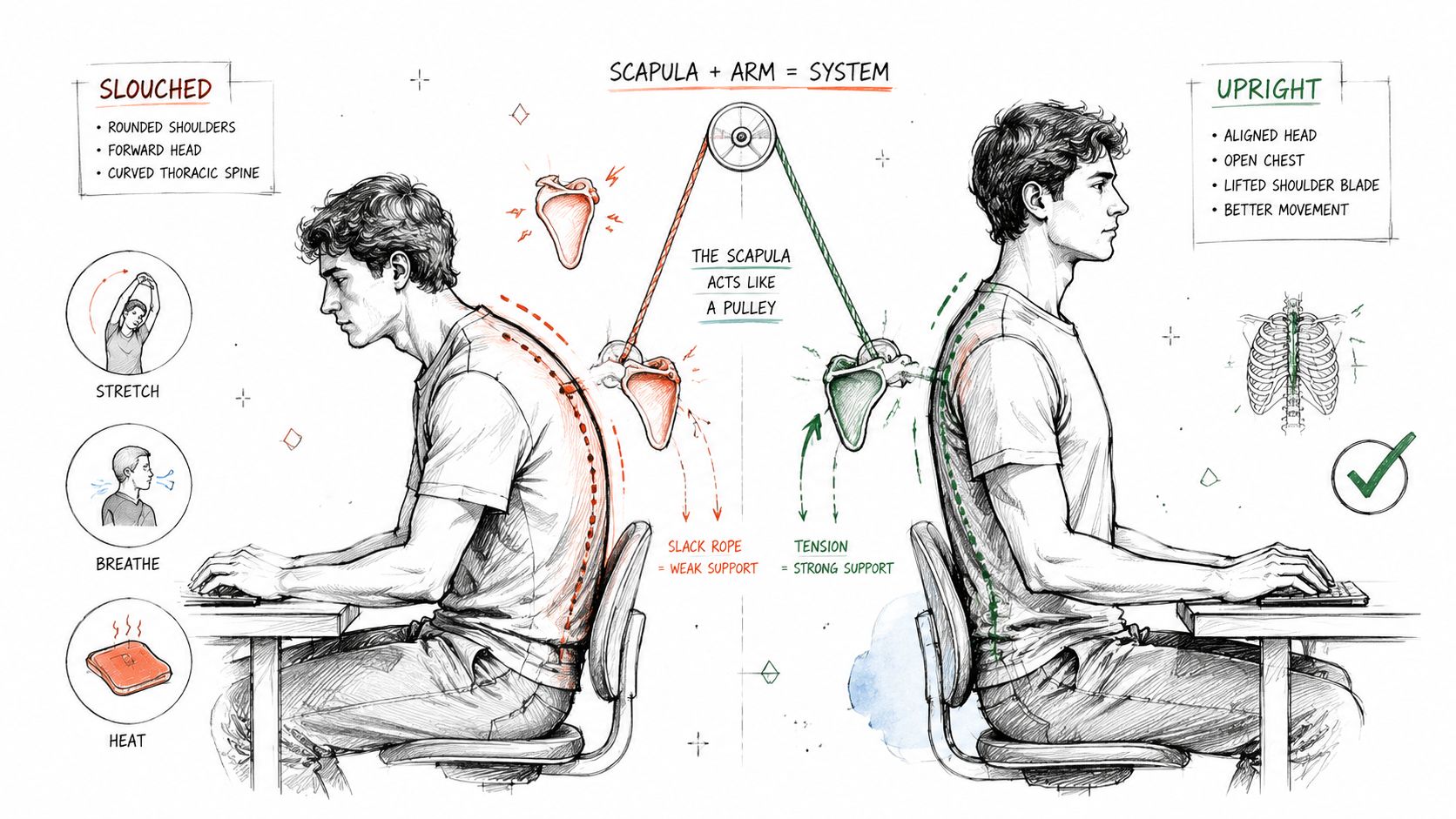
Find the best pillow for neck pain and headaches side sleeper with our evidence-based guide. Compare materials, height, and support for real relief.
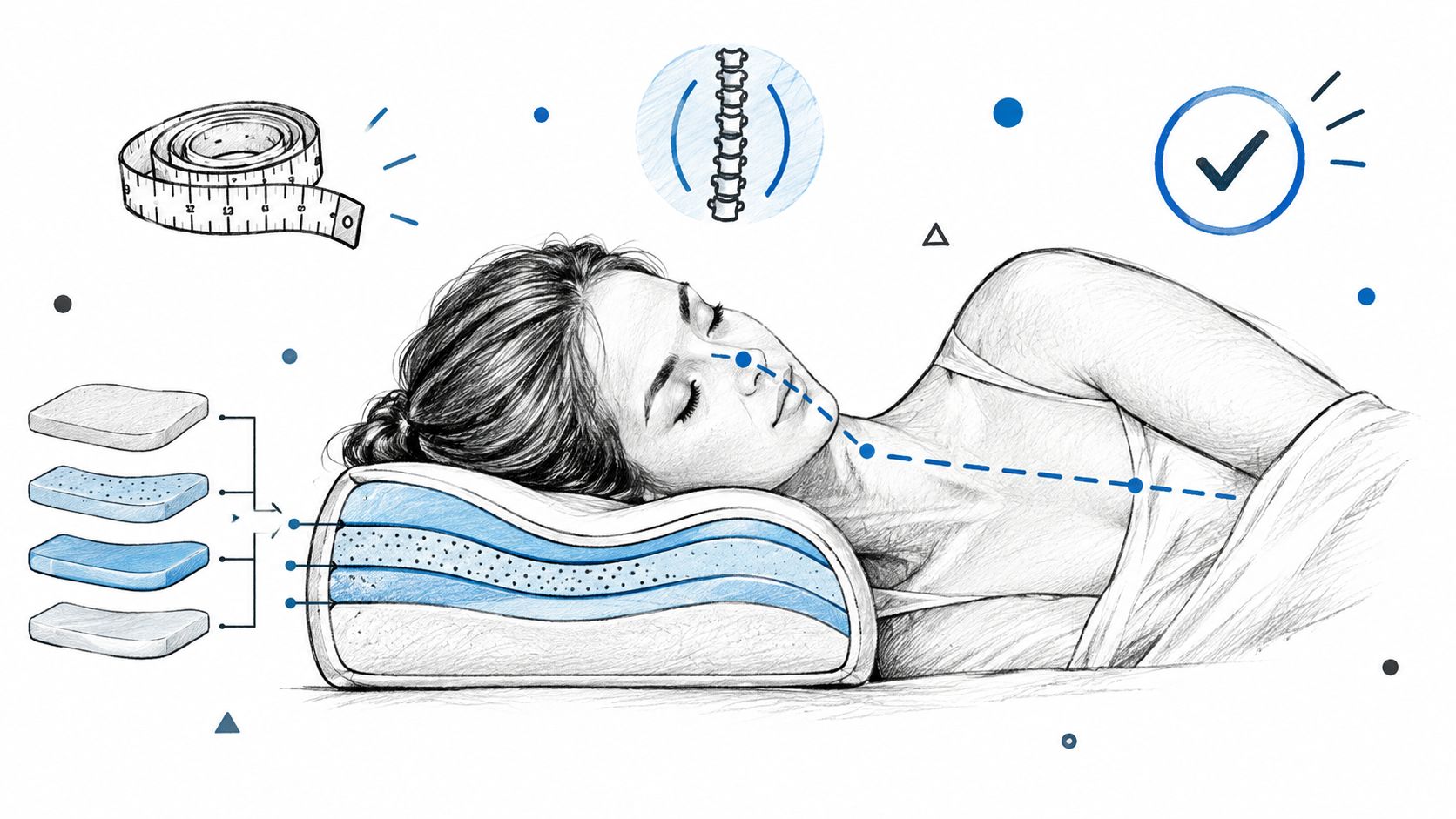
Most pillow buying guides begin with the wrong question. They ask whether latex, memory foam, or an orthopedic pillow is best, as though one material can solve every side sleeper's neck pain and morning headache. In practice, a pillow can be expensive, highly contoured, and completely wrong for your shoulder width, mattress, and cervical position.
The better question is simple: does the pillow keep your head aligned with your spine while you sleep on your side? Height, shape, compression, and neck support usually matter more than the label on the filling. Research also cautions against promising too much. A 2021 systematic review found that some rubber and spring pillows improved neck pain, waking pain, disability, and satisfaction, but pillow design did not significantly improve overall sleep quality, and no design proved universally superior for side-sleeper cervical alignment (systematic review of pillow design and neck symptoms).
This guide takes a clinical approach to finding the best pillow for neck pain and headaches for a side sleeper. You'll learn how to assess alignment, compare constructions, test height at home, and recognize when another pillow purchase is unlikely to address the underlying issue.
The “best” pillow material is often the wrong starting point. In clinical practice, side sleepers rarely need a material ranking. They need a pillow that holds the head in a workable position for several hours without creating new pressure or strain.
For a side sleeper, the pillow fills the space between the mattress and the side of the head. That space varies with shoulder breadth, body size, mattress firmness, pillow compression, and sleeping posture. A latex pillow may retain enough height for someone with broad shoulders, yet feel excessive for a narrower frame. Memory foam may contour comfortably around one neck while lifting another sleeper's head because its shape or depth does not suit that person.
Material still affects the experience. It changes how quickly the pillow compresses, how easily its height can be adjusted, and how stable the head feels during movement. Those features matter only after the pillow's height and support match the sleeper's anatomy.
The research does not establish one universal winner. A 2025 systematic review found that the available evidence remains limited and did not demonstrate definitive superiority for latex, foam, or standard pillows in chronic neck pain (systematic review of pillow types and neck pain). Labels such as “orthopedic,” “cervical,” and “ergonomic” describe intended design features, not guaranteed results.
A 2021 meta-analysis found that rubber pillows reduced neck pain compared with other pillow types, with a standardized mean difference of -0.263 and P < 0.001 (review findings on rubber pillows and neck pain). Rubber and spring pillows also improved waking pain, with an SMD of -0.228 and P < 0.001, and reduced neck disability, with an SMD of -0.506 and P = 0.020. Satisfaction improved, with an SMD of 1.144 and P < 0.001.
Those findings support considering rubber or spring construction. They do not show that every side sleeper with neck pain or headaches should choose one. The same analysis found no significant improvement in overall sleep quality, with an SMD of 0.047 and P = 0.703, and no significant difference in cervical-spine alignment between pillow designs for side sleepers, with an SMD of 0.049 and P = 0.280.
Clinical rule: A supportive pillow at the wrong height can fail. A simpler pillow adjusted to your anatomy can work better than an expensive contour design.
Start with neutral alignment, then assess comfort, morning symptoms, and whether the pillow keeps its height overnight. If neck pain or headaches persist despite a sensible adjustment period, reassess the cause rather than continuing to buy different materials.
Side sleeping creates a mechanical problem that back sleepers don't face to the same degree. Your shoulder sits between the side of your head and the mattress, so the pillow must support the head across a larger horizontal gap. The correct height depends on how far your shoulder projects above the mattress and how much both the mattress and pillow compress.
If the pillow is too low, your head drops toward the mattress. That side-bends the neck downward and may leave the muscles on one side working through the night. If the pillow is too high, the head moves away from the mattress, pushing the neck upward. Neither position is automatically harmful after one night, but repeated hours in either position can contribute to morning stiffness or headache symptoms in susceptible people.
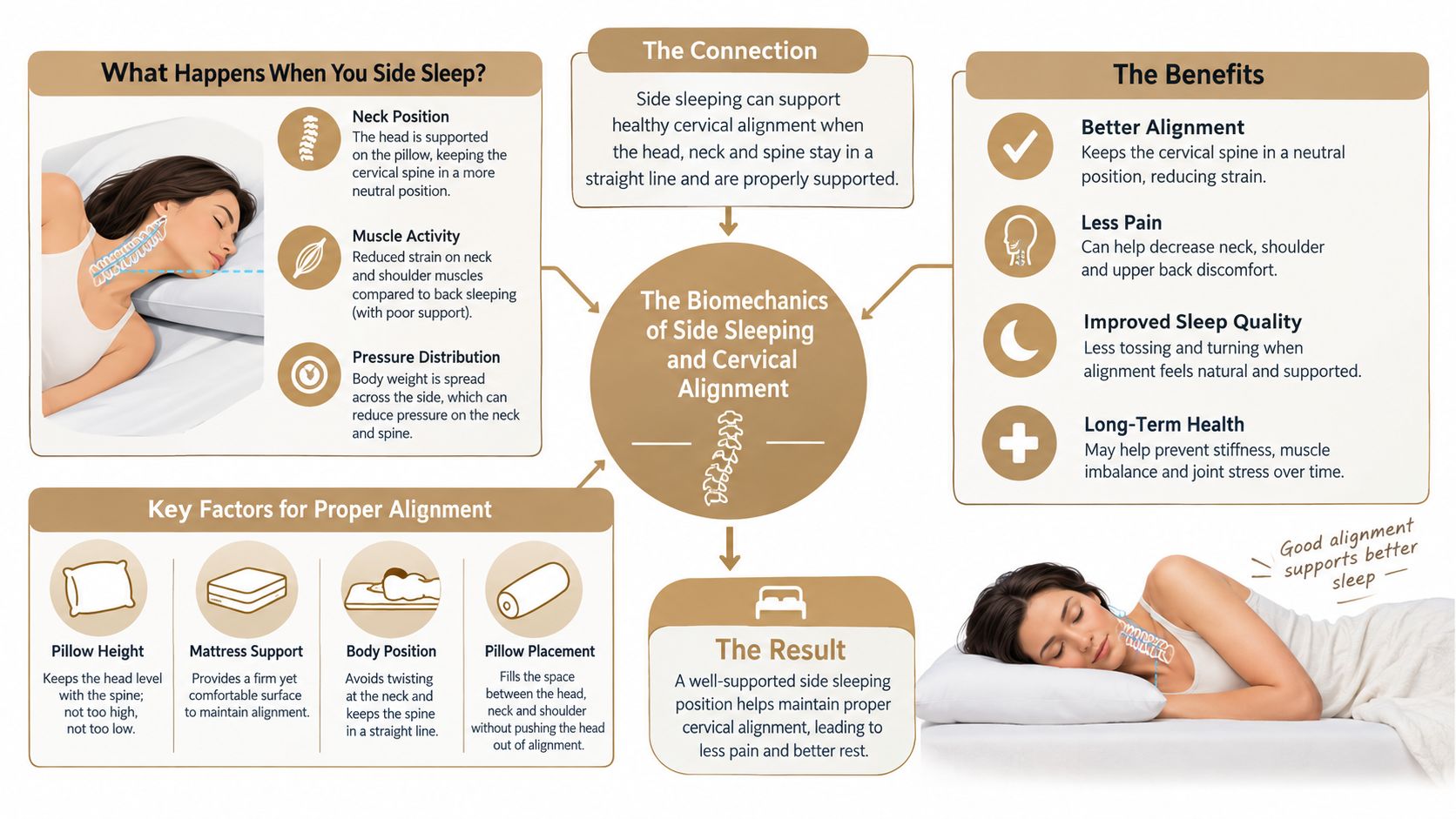
Lie on your usual side on your actual mattress. Don't judge the pillow on a showroom surface or while holding it in your hands. The mattress changes how far your shoulder sinks, which changes the pillow height your neck receives.
Look at your face from the side, or ask someone to take a photograph without changing your position. Your nose should point straight forward and remain vertically aligned with your sternum, rather than angling toward the mattress or ceiling. The neck should feel supported through the gap, without a firm ridge pressing into the side of the neck.
A pillow that feels soft isn't necessarily well aligned. Likewise, a firm pillow isn't automatically excessive. The relevant question is whether the pillow maintains a neutral relationship between your head, neck, and trunk after your weight compresses it.
For a broader explanation of mechanical contributors, see this guide to what causes neck pain.
A 2024 biomechanical study tested foam-latex pillows at 8, 10, 12, and 14 centimeters, with and without dedicated neck support, in 9 healthy participants (study of individualized pillow height in side sleepers). The researchers examined cervical-curve morphology and individualized pillow height rather than assuming one standard loft.
The medium individualized height with neck support, corresponding to approximately 9.74 to 11.76 centimeters, produced a cervical curve closest to natural standing posture and the lowest modeled musculoskeletal internal force. That range is a useful starting benchmark, not a prescription. Shoulder width, head size, mattress firmness, and body dimensions still determine the final fit.
A soft mattress can allow the shoulder to sink, reducing the effective height needed from the pillow. A firm mattress may keep the shoulder higher, increasing the gap. This is why a pillow can feel correct in one bed and fail in another, even when your body has not changed.
The most useful comparison isn't “which pillow wins?” It's which construction gives you enough control to maintain alignment without creating a new problem. Side sleepers with broad shoulders may need stable loft, while smaller-framed sleepers on firm mattresses may need less height and more forgiving compression.
| Construction | Height Control | Loft Retention | Best For | Typical Failure |
|---|---|---|---|---|
| Contour cervical | Fixed, defined profile | Usually stable | Sleepers who stay in one position and want direct neck support | Contour may be too tall or feel restrictive |
| Shredded adjustable fill | High, fill can be added or removed | Variable | People who need to fine-tune height | Fill may shift and create uneven support |
| Solid memory foam | Fixed to moderately compressive | Generally stable | Sleepers who prefer a molded, steady feel | Can trap heat or feel too rigid |
| Latex | Fixed, responsive loft | Generally stable | Sleepers who want springy support and less sink | May feel too tall or firm |
| Down or down-alternative | Limited unless gusseted or refilled | Often variable | Sleepers prioritizing softness and pressure relief | Can flatten and let the head drop |
A contoured pillow can support the neck while leaving a lower area for the head. That geometry may suit a side sleeper who stays relatively still and wants a clear support zone. It can fail when the contour doesn't match the sleeper's neck length or when the taller edge pushes the head upward.
A contour also reduces your freedom to move across the pillow. If you regularly rotate between side and back positions, a fixed shape may feel “bossy” rather than supportive.
Adjustable fill is often the most practical choice when you don't know your ideal loft. You can remove material if your head is being pushed upward or add material if your nose angles down. The ability to make smaller changes is more valuable than a label promising universal orthopedic support.
The trade-off is consistency. Shredded fill can migrate during the night, creating high spots or a hollow under the neck. Kneading and redistributing the fill may help, but some sleepers prefer the stable feel of a solid core.
Solid memory foam can provide predictable resistance and a defined support surface. It may suit a side sleeper whose head drops into softer pillows, but heat retention and limited adjustability remain practical concerns.
Latex tends to feel more responsive. It can preserve loft without the same deep sink as softer materials, which may help sleepers who need stable height. However, a responsive pillow that's too tall still creates upward tilt. Cooling features can improve comfort, but they don't compensate for poor cervical geometry.
For readers comparing construction details and support features, this guide to pillows for better neck support offers an additional furniture-focused resource.
Down and down-alternative pillows can feel gentle around the ear and jaw, which matters when pressure disrupts sleep. Their weakness for many side sleepers is height retention. If the pillow compresses below the shoulder-to-neck gap, the head gradually falls toward the mattress.
A gusseted design may hold its shape better than a completely soft, flat pillow, but the fit still needs testing. If your neck feels better initially and symptoms return as the pillow flattens, the issue may be loft retention rather than the material itself.
A new pillow rarely solves a poorly defined problem. Test height and alignment before judging materials. The goal is to identify the support configuration that produces better mornings on your mattress, then reassess whether the change is helping.
For several mornings, record three observations using the same method each day:
Also note whether you slept on your usual side, changed pillows, or woke repeatedly. Keep the record brief. Consistent observations are more useful than detailed entries recorded inconsistently.
Start with pillow height. Use an adjustable pillow, removable inserts, or folded towels beneath the pillow to alter effective height in roughly 1-centimeter increments. A 2024 study tested discrete heights of 8, 10, 12, and 14 centimeters, while an individualized pillow-height intervention adjusted height in millimeter increments so the head and trunk aligned during lateral sleeping (individualized pillow-height intervention).
Lie on your side in your normal sleeping position. Check whether your nose points straight forward. If it angles down toward the mattress, raise the height gradually. If it angles upward, reduce it. Keep the mattress, pillow material, sleep position, and neck exercises unchanged during this test. Otherwise, you cannot identify which adjustment influenced the result.
Give each meaningful adjustment several nights rather than deciding after one bedtime. Compare morning pain, headache frequency, and neck movement across the testing period. A pillow may feel comfortable at bedtime yet fail to improve morning symptoms, so immediate comfort does not confirm suitable support.
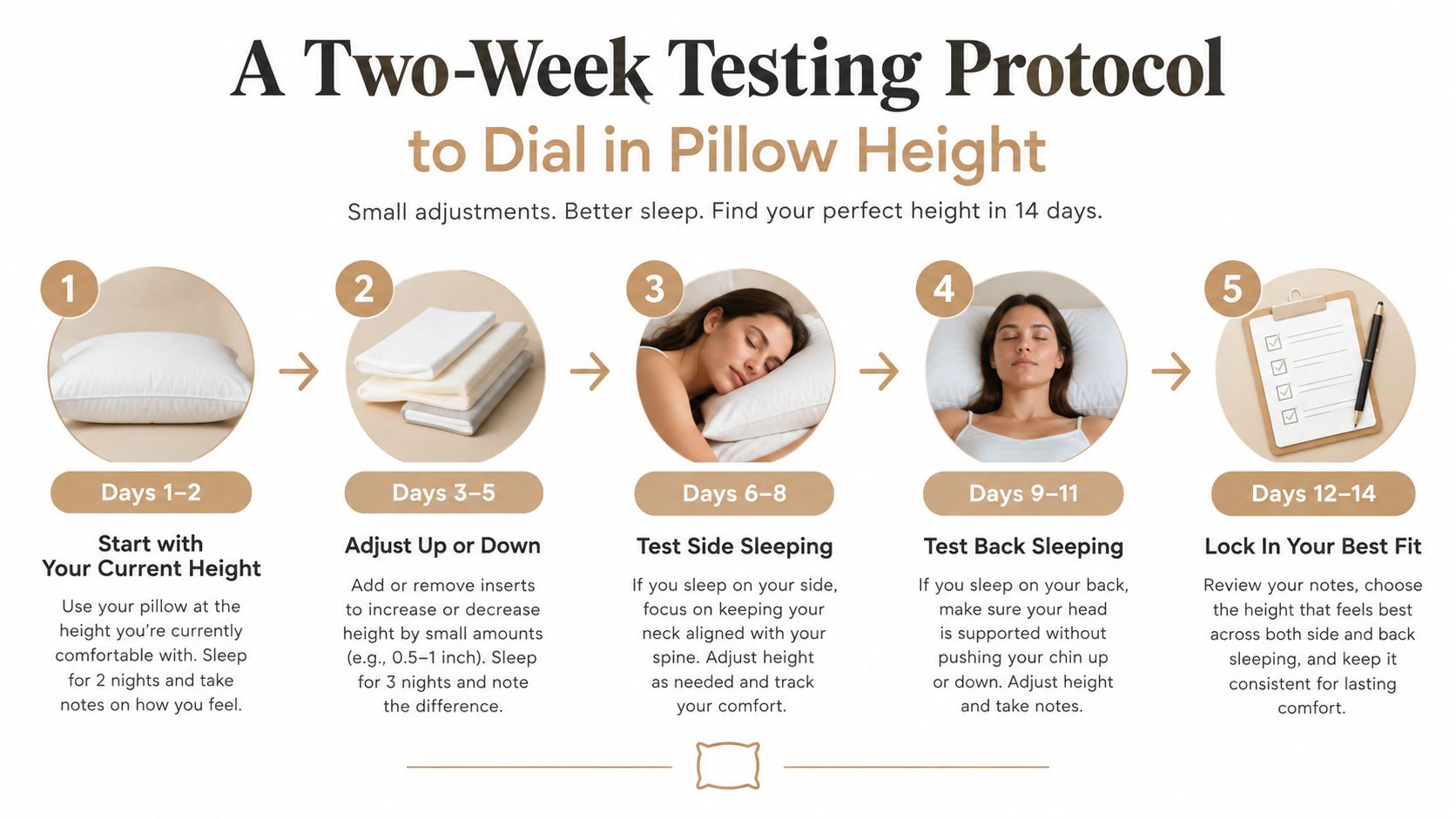
A 2025 longitudinal study followed 84 adults with neck pain and related somatic symptoms after individually adjusting pillow height; 42 participants, or 50% of the sample, achieved a clinically important improvement of at least 3 points on a numerical rating scale. The finding supports individualized adjustment, not the claim that a pillow treats every cause of neck pain or headache.
For safe home movement ideas, review neck pain exercises at home. Stop the process if exercises or pillow changes worsen symptoms.
Stop adjusting and seek evaluation if you develop new numbness, weakness, visual changes, severe or worsening headaches, or pain that travels beyond the shoulder.
A pillow can influence the position of your neck, but it can't correct every source of pain. Persistent morning headaches may involve cervical joints, irritated muscles, disc-related pathology, jaw tension, migraine, sleep disruption, or another condition that requires assessment. Repeatedly changing pillows can delay the evaluation that identifies the actual driver.
Certain patterns deserve more attention than another product trial. Pain radiating past the shoulder, new numbness or weakness, headaches that wake you, visual changes, and rapidly worsening symptoms shouldn't be managed through pillow adjustment alone. Seek appropriate medical care when those symptoms appear.
A practitioner looks at more than the pillow. The examination may consider neck range of motion, muscle tenderness, joint behavior, neurological signs, posture, shoulder mechanics, headache pattern, and aggravating activities. Imaging or referral may be appropriate when the history and examination suggest structural involvement or when symptoms don't follow a straightforward mechanical pattern.
A randomized, double-blind controlled trial of side sleepers with waking cervical symptoms and radiologic cervical degeneration found that no tested pillow significantly changed every outcome measure (controlled trial of pillows and waking cervical symptoms). Trends suggested that a polyester pillow increased waking side-flexion range of motion and affected nocturnal waking cervical pain, but the findings reinforce a cautious conclusion: pillow response is individual, and no pillow should be presented as a treatment for cervical disease or recurrent headaches.
At Aspen Falls Wellness, care for persistent neck pain can include examination, Chiropractic Adjustment, soft-tissue work, Mobility Therapy, rehabilitation exercise, and individualized home guidance. Depending on the clinical findings, treatment may also include Massage Therapy, Acupuncture, SoftWave Therapy, MLS Laser Therapy, Muscle Stimulation, Pain Relief strategies, or Personal Exercise Plans.
For disc-related pathology, non-surgical Spinal Decompression with the DRX 9000 may be considered when clinically appropriate. That decision belongs in an individualized care plan, not in a pillow comparison. Nutrition and Nutrition Counseling can also support broader recovery goals, while car accident treatment may be relevant when neck symptoms began after whiplash or another collision.
For headache symptoms that overlap with muscular tension or pain modulation needs, acupuncture for neck pain and headaches may be one component of a coordinated evaluation.

The right handoff is not “your pillow doesn't matter.” It's that the pillow is one modifiable factor within a larger musculoskeletal picture. If correct alignment and consistent testing don't improve the trend, stop shopping and get the pattern assessed.
A useful buying decision begins before you choose a material. Measure the problem your current pillow creates, then buy for control and reassessment rather than for a persuasive label.
Choose adjustable fill if you're still discovering your ideal height. Consider a fixed contour if your alignment is consistent, you stay in one position, and the shape supports your neck without forcing your head upward. Choose a responsive material if your current pillow collapses, but lower the loft if firmness begins to push you away from the mattress.

Your sleep setup also works alongside daytime habits. Mobility work, strengthening, posture retraining, hydration, and regular movement can matter when symptoms persist. A pillow is a positioning tool, not a stand-alone treatment.
Use a consistent trial over several nights and compare trends rather than one morning. Keep the mattress, sleep position, and other variables as stable as possible so you can identify whether the pillow changes morning pain, headache frequency, or neck mobility.
It can be useful if the contour supports the neck and keeps the head level, but it isn't automatically better. A defined shape may feel restrictive if you move often, and a contour that's too tall can create the same upward tilt as an overfilled pillow.
Check whether the pillow is too high and whether the mattress is allowing adequate shoulder sink. A pillow that supports the neck while jamming the shoulder still needs adjustment. Also check the position of your top arm, since allowing it to fall forward can increase shoulder and upper-neck tension.
A headache that repeatedly begins with neck stiffness, changes with neck movement, or follows a clear mechanical position may have a cervical contribution. That pattern isn't a diagnosis, however. Persistent, severe, unusual, or neurologically accompanied headaches require professional evaluation rather than self-classification.
No. If careful height adjustment and alignment checks don't improve the pattern, the pillow may not be the main cause. Persistent pain, radiating symptoms, neurological changes, or worsening headaches are reasons to seek assessment.
If your side-sleeper pillow adjustments haven't resolved recurring neck pain or morning headaches, Aspen Falls Wellness offers individualized chiropractic care, mobility therapy, rehabilitation exercise, massage, acupuncture, and non-surgical options such as Spinal Decompression with the DRX 9000 when appropriate. Visit the practice to arrange an evaluation in Salt Lake City or Sandy and build a care plan based on your symptoms, movement, and clinical findings.

Stay updated with the latest chiropractic news and exclusive offers.