Cervicogenic headache vs migraine explained: compare symptoms, causes, diagnosis and treatment, and learn when to see a clinician.
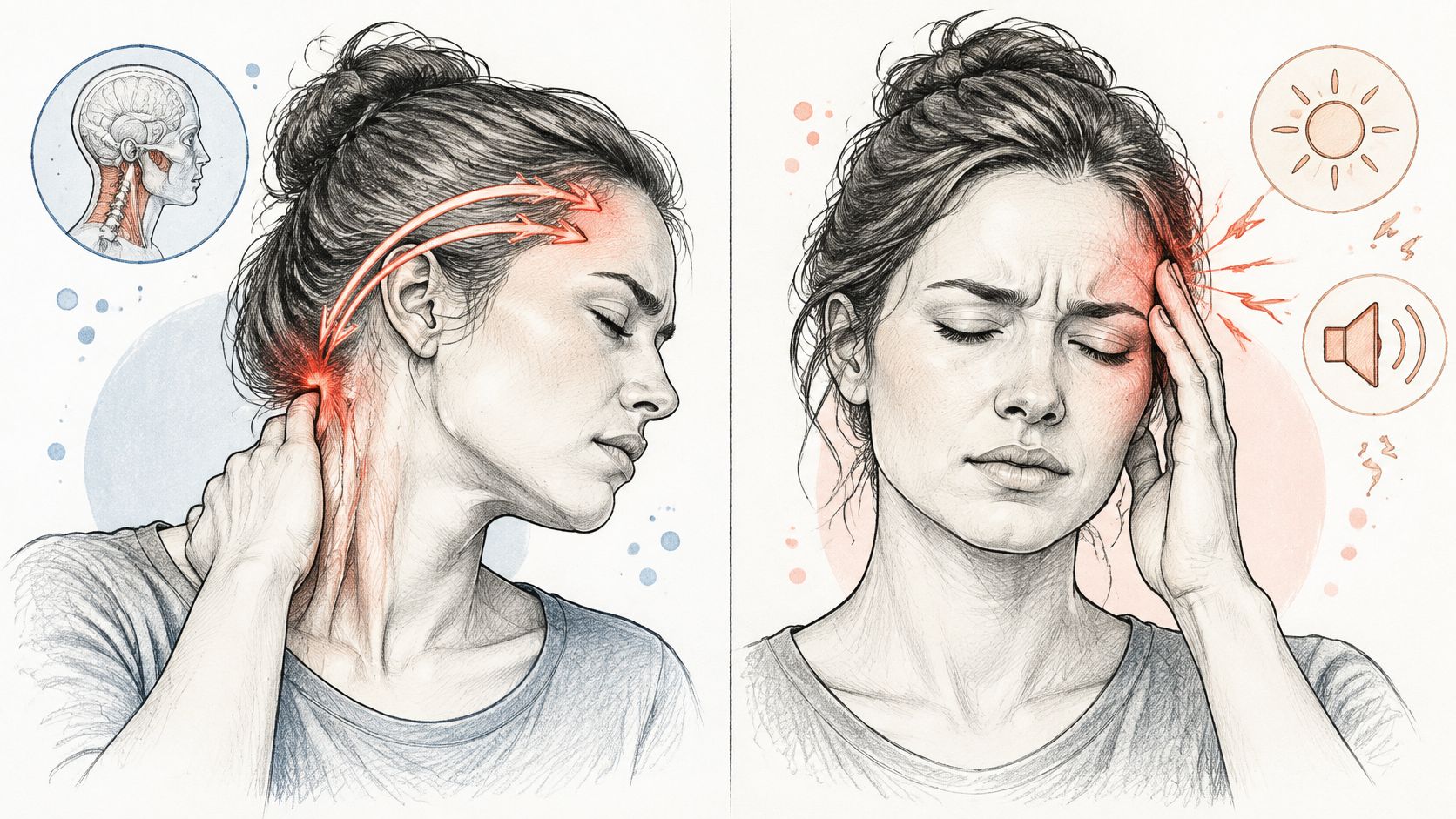
Search for headache advice and you'll hit the same confident line again and again. If the pain starts at the back of your head and stays on one side, it's a neck headache. If you feel sick and light bothers you, it's migraine. Pick the matching box, book the matching appointment.
That tidy advice fails a large share of the people who follow it. Neck pain and light sensitivity turn up in both conditions; a headache can be driven by the neck and still arrive with nausea, and plenty of people carry a real cervical disorder and migraine at the same time. Choosing one label means one driver goes untreated. The better question isn't which headache you have. It's which components are active in your case, and what each one needs.
Symptom comparison: cervicogenic headache and migraine
| Feature | Cervicogenic headache | Migraine |
|---|---|---|
| Location | Usually one side, starting at the back of the head or neck and radiating forward | Often one side, though it can occur on either side |
| Provoked by neck movement or neck muscle pressure | Typically yes | Not typically; neck tenderness can occur |
| Pulsating quality | Not a defining feature | One of four core features |
| Nausea or vomiting | Can occur, usually less prominent | Common; part of core criteria |
| Light and sound sensitivity | Can occur, usually less prominent | Common; part of core criteria |
| Attack duration | Tied to neck load rather than a clock, often easing once the neck rests | 4 to 72 hours when untreated |
| Attacks needed for diagnosis | Requires a demonstrable neck disorder plus causation indicators | At least five attacks |
No single row in that table is a diagnosis. What separates the two conditions is the shape of the whole pattern: how the pain starts, what provokes it, how long it runs, and which associated symptoms travel with it.
ICHD-3 lists side-locked pain, reproduction of the typical headache by pressure on neck muscles or by head movement, and pain radiating from the back of the head toward the front as features that tend to distinguish cervicogenic headache from migraine (ICHD-3 guidance on headache attributed to a neck disorder). None of those features is definitive alone, because other headache disorders produce them too. Their value comes from stacking: side-locked pain plus restricted neck movement plus a demonstrable neck disorder points toward a cervical source.
Location alone won't settle it. Pain can project from the neck or occipital region to the forehead, orbit, temples, vertex, or ears, so a headache behind the eye can still be generated in the upper neck.
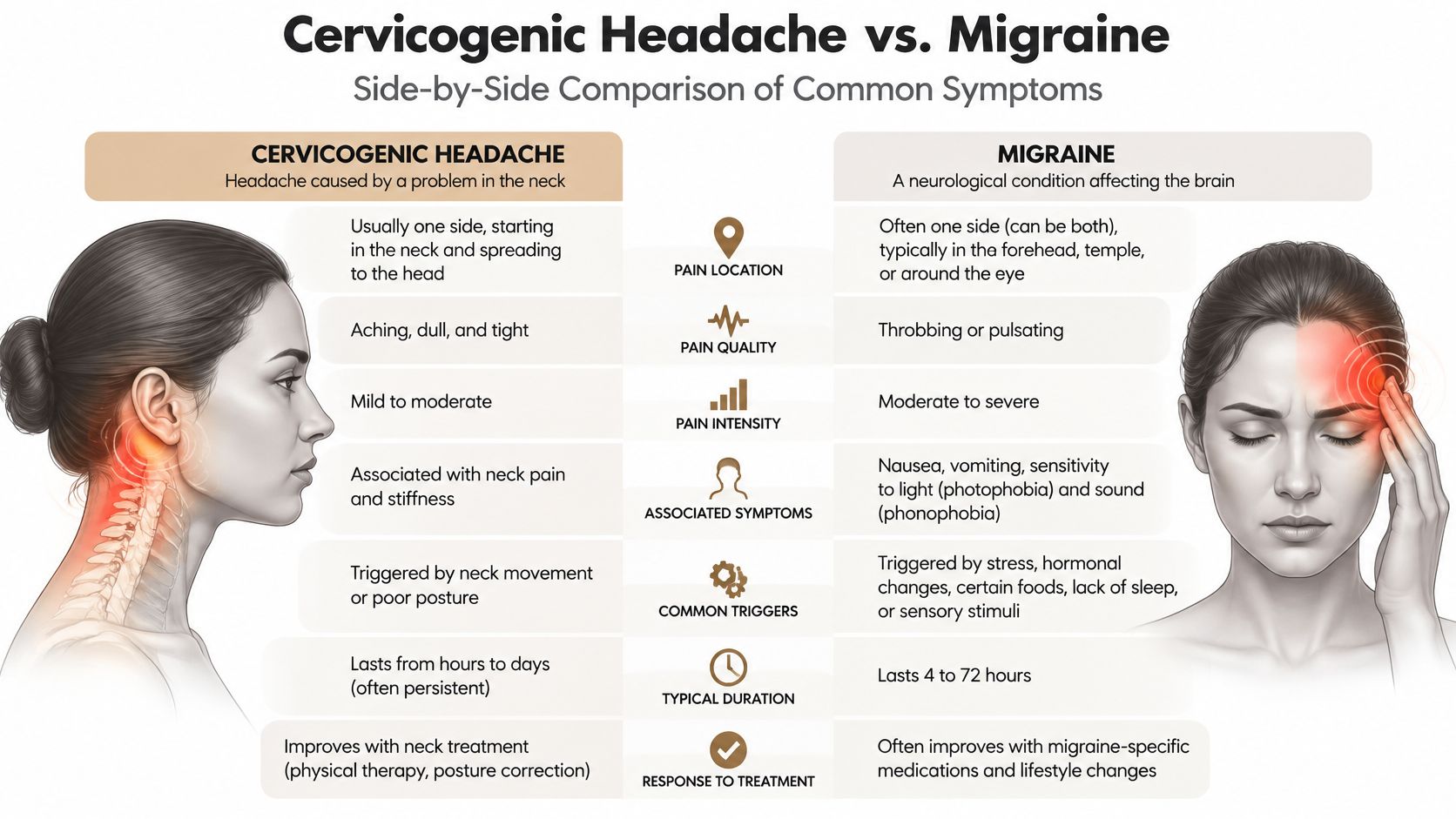
Migraine is counted rather than provoked. The clinical definition requires at least five attacks lasting 4 to 72 hours when untreated, with at least two of four features (one-sided pain, pulsating quality, moderate or severe intensity, worsening with routine activity) and either nausea or vomiting, or both light and sound sensitivity (Cleveland Clinic's overview of cervicogenic headache). Counting attacks is what makes the pattern visible. One bad headache with nausea proves little. Five similar attacks across a year, each lasting most of a day, is a different story.
Read the table as a sorting tool, not a verdict. A one-sided headache that reproduces when you turn your head, comes without much nausea, and eases when you rest your neck deserves a neck examination first. A pulsating headache that builds on stairs, brings nausea and light sensitivity, and puts you in a dark room points toward migraine first. Before any appointment, write down your own pattern: which side, what time of day it starts, how long it lasts, what you were doing beforehand, and which associated symptoms appear. If you're weighing hands-on and regenerative options at the same time, browse key regenerative therapy terms so the vocabulary in your consultation is clear.
The either-or framing is the first thing to drop. Online explanations split the world cleanly: cervicogenic headache comes from the neck, migraine comes from the brain, one is mechanical and the other neurological, so you must belong to one camp.
Patients arrive at appointments having absorbed that split, and it costs them. Symptoms overlap, different headache disorders can occur simultaneously, and migraine without aura can be particularly hard to separate from a neck-generated headache. A person can carry a cervical disorder that aggravates migraine attacks without having to choose a label, and an evidence-based review of the overlap recommends directing treatment at each disorder when both are present (review of coexisting cervicogenic headache and migraine).
Say a software tester has had migraine since her twenties. She also spends nine hours a day at a monitor, and her upper neck has grown stiff and guarded. Her attacks now open with two days of neck ache, and turning her head to reverse the car reproduces the pain. Her migraine is real. So is the cervical component feeding it.
Say a warehouse worker develops one-sided headaches after a lifting injury. They stay on the right and flare with overhead work, and he assumes that's the whole story. Then separate episodes begin: throbbing pain behind the left eye, nausea, a need for a dark room. Two disorders in one person, each needing its own plan.
The question worth asking your clinician: are my neck findings real, and do I also have migraine? Both can be answered, and the answer changes the plan.
A plan that only mobilizes the neck can leave frequent attacks untouched. A plan that only manages migraine can leave a mechanical trigger in place that keeps restarting the cycle. That's why clinicians look for coexisting conditions rather than a single culprit, working through headache history, attack duration and frequency, migraine-associated symptoms, neck-motion provocation, restricted cervical movement, referred pain, and when appropriate diagnostic anesthetic blocks.
A headache diary answers most of those questions before you sit down. Log attack days, neck symptoms, sleep hours and what you took for the pain, and the pattern separates itself. If neck-directed care is part of your plan, acupuncture for neck pain and headaches is one option worth discussing with your provider.
The two headaches start in different tissue, and that difference drives everything downstream. The International Classification of Headache Disorders defines cervicogenic headache as pain caused by a disorder of the cervical spine or its bony, disc, or soft-tissue structures (ICHD-3 definition of cervicogenic headache).
Clinicians look for specific sources in the upper neck: degenerative joint change in the upper cervical segments, disc problems, sustained muscle guarding, joint restriction after an injury such as whiplash, and long stretches of forward head posture. A finding on its own never settles the question, which is why the classification demands more than a suspicious neck. Diagnosis requires evidence of a potentially causative neck disorder plus at least two causation indicators: onset linked to the cervical condition, improvement parallel to improvement of that condition, reduced cervical range of motion with headache provoked by neck maneuvers, or abolition of pain after diagnostic blockade of a cervical structure or its nerve supply.
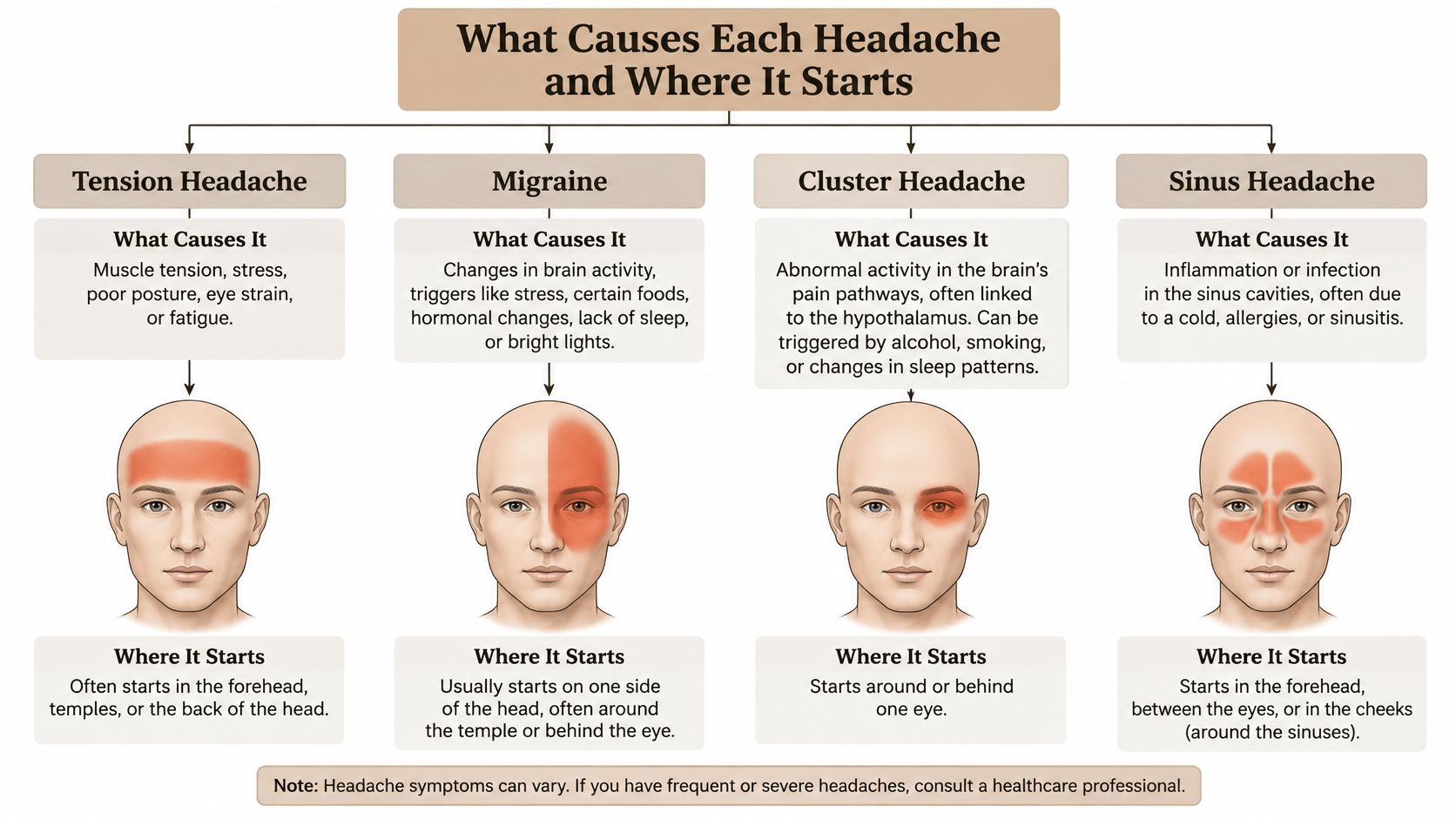
Migraine starts in the nervous system itself. It is a primary headache disorder, meaning the brain generates the attacks rather than reacting to a structural lesion somewhere else. Recognized triggers include irregular or poor sleep, stress, hormonal shifts, skipped meals, dehydration, and some foods or alcohol. That list explains why two people with identical neck findings can have completely different headache lives.
Migraine also produces neck tenderness and stiffness through muscle guarding during and around an attack. A sore neck therefore never rules migraine out. It adds a second thing to evaluate.
Watch how the pattern behaves. Headaches that sharpen when you rotate your head or press a tender spot at the base of the skull look nothing like attacks that follow short sleep and arrive with throbbing pain, nausea and light sensitivity. Same symptom, different engine.
The more useful question is often "how much of this pattern is coming from the neck?" Two headache mechanisms can share the same appointment, so clinicians build the case in layers instead of betting on one sign.
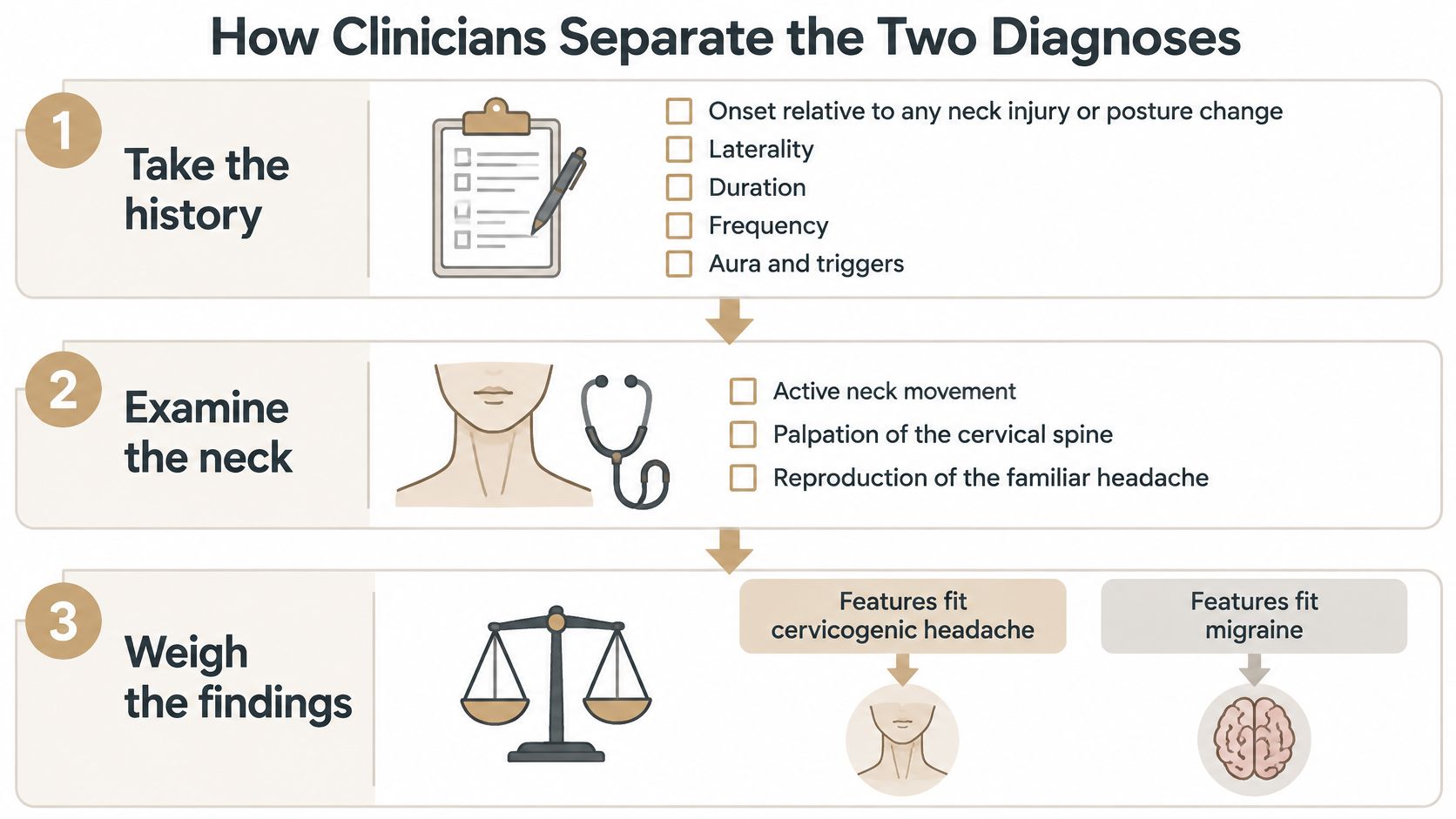
Migraine is identified by its attack pattern and associated features (clinical guidance on headache diagnosis). The neck exam still matters, because a positive cervical finding can add a second treatment target to an active migraine diagnosis.
A systematic review of bedside assessment gathered the reported ranges for clinical tests used to identify cervicogenic headache, along with a combined battery tested in a single study.
Accuracy of bedside cervicogenic headache tests (systematic review of cervicogenic headache assessment)
| Test approach | Sensitivity | Specificity | Positive likelihood ratio | Negative likelihood ratio |
|---|---|---|---|---|
| Individual clinical assessments | 70 to 91.3% | 70 to 92% | 2.33 to 10 | 0.09 to 0.43 |
| Combined battery of cervical range of motion, C0 to C3 palpation and craniocervical flexion test, single study | 100% | 94.4% | About 17.9 | 0 |
Read the columns this way: sensitivity shows how often a test catches people who have the condition, specificity shows how often it correctly clears people who do not, and likelihood ratios describe how much a result should shift the diagnosis. The combined-battery numbers look decisive. They come from one study, one population, one set of examiners and a reference standard other clinics may not apply the same way.
The review singled out the flexion-rotation test and impaired neck-flexor performance as useful differentiators, then concluded plainly that physical findings alone cannot definitively separate cervicogenic headache from migraine.
A positive test pattern raises suspicion and justifies focused cervical assessment. It doesn't close the case.
Diagnostic blocks sit late in the sequence. Once the history, examination and neurologic screening point toward a cervical source, a block can confirm that suspicion. Expect your clinician to weigh phenotype, causation criteria, neurologic examination, red-flag screening and your response over weeks alongside the examination pattern.
Most cervicogenic and migraine headaches are stable and predictable from attack to attack. A handful of presentations are not, and they outrank everything else in this article.
Headache situations that need medical attention
| Situation | Why It Matters | Action |
|---|---|---|
| Sudden severe headache reaching peak within about a minute | Can signal bleeding around the brain | Call emergency services now |
| Fever with stiff neck or rash | Can signal meningitis | Seek emergency care now |
| Weakness, numbness, slurred speech or vision loss | Can signal stroke | Call emergency services now |
| Headache after head injury or car accident | Can signal internal injury or bleeding | Same-day medical evaluation |
| New or changing headache after age 50 | Can signal a secondary cause | Prompt medical review |
| Headache that wakes you from sleep or worsens with coughing or straining | Can signal raised pressure or a structural cause | Prompt medical review |
Vision loss deserves its own caution, because a sudden visual change during or after a headache has several possible causes. Retinal detachment warning signs are one reason that particular symptom needs same-day attention rather than a wait-and-see approach.
Headaches that wake you from sleep, worsen with coughing, straining or bending, or build steadily worse over weeks need prompt medical review. A migraine or cervicogenic pattern usually repeats itself closely. A clear change in pattern is a reason for reassessment, not a reason to assume the usual diagnosis.
When you call, have three facts ready: the time the pain started, how quickly it reached its worst, and any associated symptoms. Those details let a clinician judge urgency in seconds. For severe or sudden headache, call emergency services rather than waiting for a clinic appointment. For the stable, recurring pattern, neck pain headache treatment covers the non-urgent side.
Match the plan to what is generating the pain, and progress becomes measurable.
Treatment focus by headache type
| Headache pattern | Main treatment focus | Typical providers | Sign of progress |
|---|---|---|---|
| Cervicogenic headache | Restore neck motion, reduce muscle guarding with manual therapy and targeted neck exercise | Chiropractor or physical therapist | Less neck-provoked pain and better range of motion |
| Migraine | Manage attacks and prevent them through sleep regularity, trigger control and medication when indicated | Primary care physician or neurologist | Fewer attack days and less disability |
| Both present | Treat each disorder directly and coordinate care | Physician with a rehabilitation provider | Neck findings and attack frequency both improve |
The third row is where most treatment plans go wrong. A person carrying both disorders often gets treated for only one: migraine medication while a stiff upper neck keeps feeding pain upward, or months of neck work while attacks keep arriving on their own schedule. Each disorder needs its own line of treatment and its own way of measuring response. A neck that moves better does not prove the migraine side improved, and fewer attack days say nothing about whether the neck still triggers pain on rotation.
For the cervical side, the work is mechanical. Hands-on care frees restricted upper neck segments, soft-tissue work settles guarding muscles, and targeted exercise builds endurance in the deep neck flexors. The clearest sign it is working is a headache you can no longer trigger by turning your head.
For the migraine side, the work is medical and behavioral: regular sleep and meal timing, trigger control, and medication prescribed by a physician when attacks are frequent or disabling. Medication decisions belong with a physician, and that matters more than it sounds, because overusing acute headache medication can itself keep headaches going.
Massage focuses on muscles and tissues, while chiropractic adjustments restore motion to the spine and joints, so a plan for a mixed picture often uses both for different reasons. Acupuncture can be part of a chiropractic treatment plan or booked as a stand-alone service. The treatment approach at Aspen Falls Wellness includes custom chiropractic adjustments, decompression, take-home mobility exercises, laser therapy, massage, and acupuncture, chosen to fit what the examination finds.
Set your yardsticks before the first visit: headache days per month, how far you can turn your head before pain starts, and how many workdays you lose. Recheck all three at four to six weeks. If nothing has moved, ask for the plan to be revised rather than repeated.
For the exercise side of a neck-focused program, this guide to best exercises for neck pain and headaches walks through the progressions. When a migraine attack is already underway, practical aids help you get through the day, and this roundup of ways to find relief for migraine days covers the recovery supports worth keeping within reach.
Choosing a treatment before anyone has examined your neck is guesswork with a copay. The stakes rise when both headache types are in play, because a plan built for one leaves the other driver running. Four steps get you to a plan that matches your actual pattern.
Aspen Falls Wellness can serve as the chiropractic or rehabilitation partner in step four. Each patient gets a thorough chiropractic evaluation with the trusted doctors to identify the root cause of the issues, and a customized treatment plan is developed from that diagnosis. Chiropractic care, massage therapy, mobility therapy and rehabilitation exercise are all on the service list, alongside care for neck pain and migraine/headache.
Ask about visit frequency at the first appointment instead of guessing. Some clients with chronic pain visit once a week to alleviate their pain, while others plan a monthly appointment, and the right rhythm depends on what the examination shows. Expect a referral to an outside specialist if something falls outside the clinic's scope. That handoff keeps your care inside what each clinician is equipped to treat.
The order matters because the two headaches share many of the same symptoms and still call for different treatments. An examination decides which driver, or which combination of drivers, your plan has to address.
Aspen Falls Wellness evaluates and treats neck pain, migraine and headache, and the other musculoskeletal conditions that keep people in Salt Lake City and Sandy from moving comfortably. A first visit means a thorough examination, a clear explanation of what's driving your headaches, and a customized plan that states what we're treating and how we'll measure progress. Book an appointment at Aspen Falls Wellness and bring your headache log with you.

Stay updated with the latest chiropractic news and exclusive offers.