Neck pain headache treatment options compared, from chiropractic care and exercise to laser, plus the red flags that need medical review.
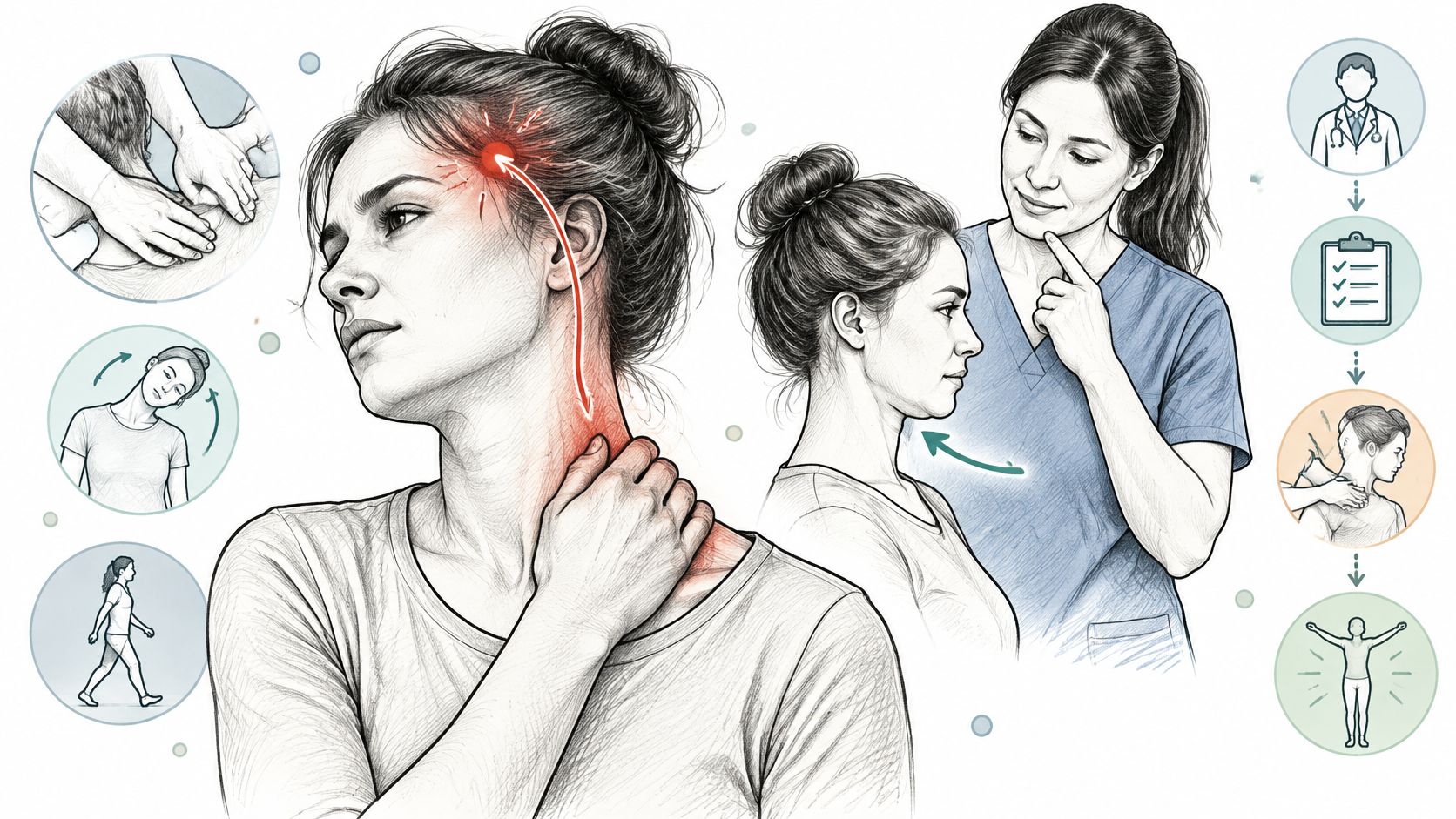
You're at your desk by midafternoon, shoulders creeping toward your ears, and a dull ache starts at the base of your skull. It spreads over one eye, you reach for painkillers again, and you wonder whether this is a headache causing neck pain or a neck problem causing a headache. That distinction matters, because neck pain headache treatment works best when it's matched to the headache type first, not when hands-on care starts on assumption.
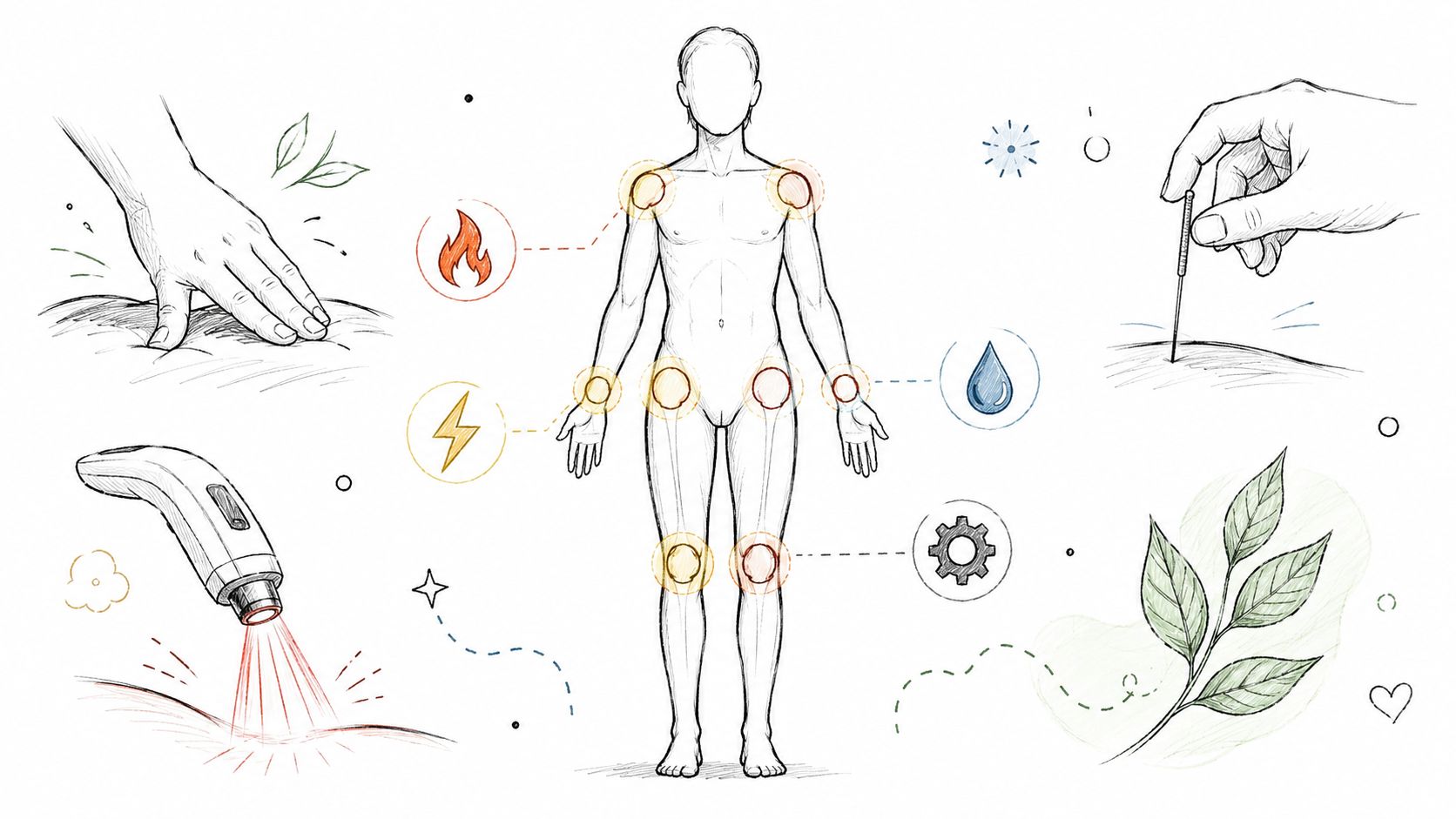
| Option | Main target | Evidence for neck-related headache | Typical role |
|---|---|---|---|
| Cervical chiropractic adjustment | Joint restriction and stiffness | Limited to moderate; short-term reductions in headache frequency and intensity, strongest when combined with exercise | Part of a combined plan |
| Soft-tissue and massage therapy | Muscle tension and trigger points | Limited to moderate, mostly short-term | Adjunct to exercise |
| Acupuncture | Pain sensitivity and muscle guarding | Limited and mixed across trials | Optional add-on or stand-alone |
| Posture and mobility exercise | Deep neck motor control and sustained load | Strongest and most durable | Core of the plan |
| MLS laser therapy | Inflammation and tissue comfort | Little headache-specific evidence | Comfort adjunct |
| Spinal decompression | Disc-related pressure | Little direct evidence for neck headache | Not first-line for headache |
Read this as a map of tools, not a ranking. Each option addresses a different problem, so asking which one is "best" without naming your problem won't get you far. A stiff upper neck joint, a tender trigger point, and weak deep neck muscles can all live in the same person, but they don't respond to the same intervention.
Exercise has the most durable support. Manual care tends to work best when it's paired with exercise, not delivered alone week after week. Devices and needles sit further back. They can support comfort or help you tolerate an active program, but they're supporting options rather than cures.
If a plan promises that one tool will resolve every headache, it hasn't sorted your headache yet.
That honesty protects you. It keeps you from paying for repeated passive visits when your main driver is sustained postural load, and it keeps you from dismissing a short course of manual care that could help you move enough to train. The table shows where each option fits. What follows explains why those roles differ, how to tell headache types apart, and when neck treatment should wait.
A headache that begins at the base of your skull and spreads across the forehead can feel like it started in your head. The upper neck and the base of your skull work like a tangled cable: tension at one end travels along the line, and you often feel it at the far end, which can be a long way from the source. The first three cervical joints, labelled C1 to C3, connect closely with pain pathways that reach the head. Irritation there can be felt as a headache behind the eye or across the forehead.
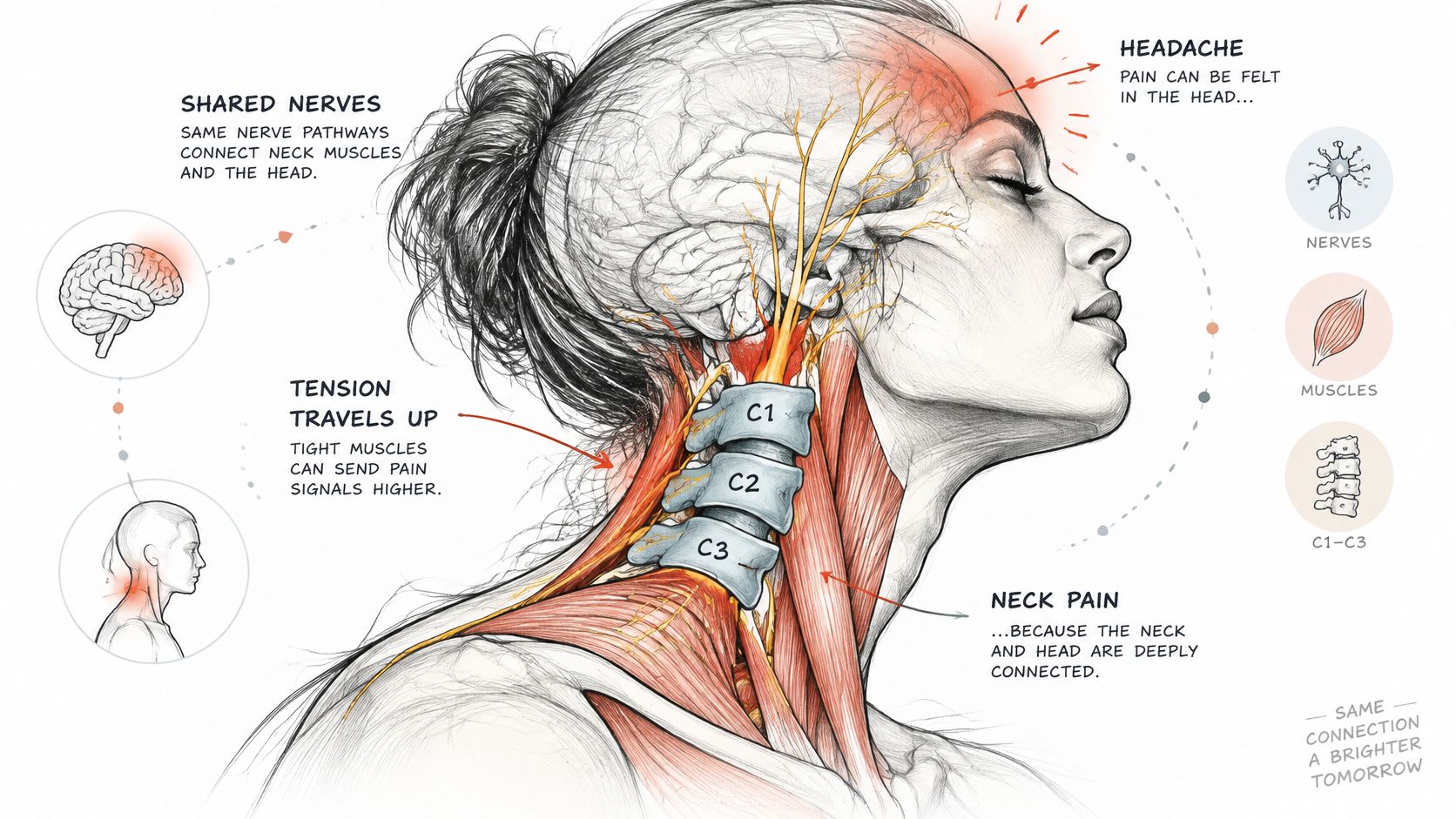
Muscles add to that shared wiring. The small suboccipital muscles sit at the base of your skull. The upper trapezius and levator scapulae run from your neck to your shoulders. When they stay guarded for hours, they can refer pain upward and make turning your head feel restricted. The cable image helps you see why the pain travels. It does not tell you what set the tension off, and that distinction matters before anyone starts pushing on joints.
Jaw problems can feed the same pattern, which is why understanding TMD-related headaches helps if you also clench or wake with jaw ache. For a broader look at drivers, see our guide to what causes neck pain.
Headache disorders are common at population scale. The World Health Organization headache disorders fact sheet reported that approximately 40% of the world's population, about 3.1 billion people in 2021, experienced a headache disorder. Cervicogenic headache is less common than migraine or tension-type headache, though published estimates vary with the population studied and the diagnostic criteria used. That variation is the warning. A neck-origin headache is a diagnosis to confirm, and the headache pattern decides whether hands-on care is the right next step.
| Headache type | Typical clues | Neck link | First move |
|---|---|---|---|
| Cervicogenic | Base-of-skull onset, often one-sided, triggered by neck movement or posture | Primary source, with reduced neck range of motion | Neck assessment, then exercise plus manual care |
| Tension-type | Band-like pressure on both sides, linked to stress or long sitting | Neck and shoulder tightness are common | Posture, stress and exercise; manipulation alone is not enough |
| Migraine | Throbbing, often one-sided, nausea, light or sound sensitivity | Neck pain is common during attacks | Medical migraine management, with neck care as support |
| Medication-overuse | Headache on most days, worse as medication wears off | Neck care does not treat the cause | Medical review to plan a supervised taper |
The confusion is understandable. Migraine and cervicogenic headache can both be one-sided, and both can leave the neck stiff. One-sided pain cannot choose the treatment by itself. In the 2024 multicountry CaMEO-I study published in Cephalalgia, 68.3% of respondents with migraine headache, 9,896 of 14,492, reported neck pain during their headaches. Migraine can produce neck pain as one of its symptoms, so neck pain alone does not identify the neck as the cause.
Medication-overuse headache confuses people in a different way. It tends to occur on most days and return as medication wears off. The International Classification of Headache Disorders criteria for medication-overuse headache set the common thresholds at 15 or more days a month for simple painkillers and 10 or more days a month for triptans or combination products. Treating the neck harder will not break that cycle.
A headache diary works like a flight recorder. It shows the sequence before an attack, not just the attack itself.
Bring that diary to your appointment. Use the pattern to choose the first move. A cervicogenic pattern points toward neck assessment and training. A migraine pattern points toward medical migraine care first, with neck work as support if your neck is also restricted. If the diary shows medication overuse, neck treatment should wait until a clinician reviews the medication plan, because manual care cannot resolve a rebound cycle.
| Warning sign | What it may indicate | Action |
|---|---|---|
| Sudden, severe headache unlike any before | Bleeding or arterial dissection | Emergency care now |
| New weakness, numbness, speech or vision change | Stroke or structural neurological cause | Emergency care now |
| Fever with stiff neck or rash | Infection | Emergency care now |
| Headache after a car accident or significant trauma | Fracture, dissection or other injury | Same-day medical evaluation |
| Fainting, confusion, or visual disturbance with headache | Raised pressure or altered mental status | Urgent medical evaluation |
| Neck pain with arm weakness or radiating numbness | Nerve root involvement, often a disc problem | Medical evaluation within days; imaging if indicated |
| Headache not improving after six to eight weeks of conservative care | Diagnosis needs review | Specialist review and imaging decision |
Don't manage those presentations with home exercises or manual therapy alone. The Johns Hopkins headache imaging guidance lists abnormal neurologic examination findings, papilledema, altered mental status, fever, stiff neck, rash, and suspected carotid or vertebral artery dissection as situations requiring diagnostic escalation. It also notes that vascular imaging may be appropriate when arterial dissection is suspected.
Routine imaging isn't automatic for every recurrent headache. MRI, CT, or vascular studies should be chosen from your clinical findings and from whether the result would change assessment, referral, or treatment. A normal scan doesn't confirm a cervicogenic source, and an age-related disc finding doesn't prove one either.
Practical rule: New, sudden, or neurologic symptoms change the order. Medical assessment comes first, hands-on care second.
Bring four things to any evaluation. Carry your headache diary, a medication log, any prior imaging, and details of any recent injury or accident. That record speeds up triage more than a general description of pain.
When no red flag is present, conservative care is reasonable. Our process follows three steps, schedule an initial exam, receive a personalized treatment plan, and relieve your pain, and conditions we treat include lower back pain, neck pain, nerve pain, sports injuries, migraine and headache, shoulder pain, hip pain, knee pain, and foot and ankle pain. If you haven't improved after six to eight weeks, that threshold triggers a diagnosis review rather than more of the same.
A common sequence in chiropractic care puts manual therapy first and exercise second. The research points to a different balance. Manual care can help, especially early, but its clearest value appears when it is paired with training you continue between visits. For headache, the evidence is strongest when the headache is cervicogenic. If the headache type has not been sorted, the evidence does not show that adjustment is the right first step. Matching the plan to the headache type comes before hands-on care, and when red flags are present or the diagnosis is unclear, neck treatment waits for medical assessment.
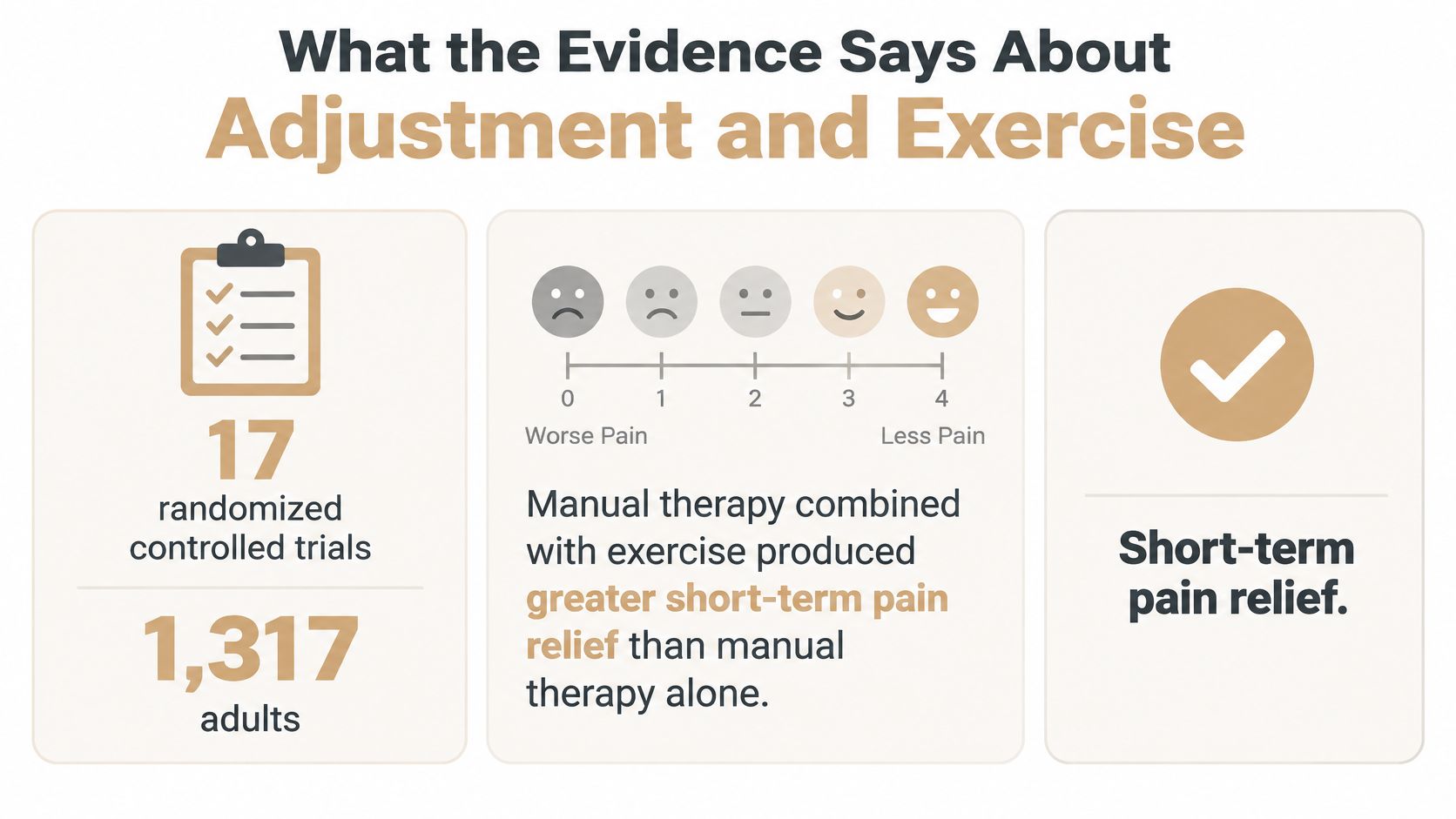
A systematic review of manual therapy combined with exercise for neck pain covered 17 randomized controlled trials involving 1,317 adults and found greater short-term pain relief than exercise alone, with a standardized mean difference of -0.50 and a 95% confidence interval from -0.76 to -0.24. For chronic neck pain, that review also reported moderate-quality evidence for better pain reduction and quality-of-life outcomes than manual therapy alone.
Headache-specific results are smaller and less certain. A 2022 systematic review and meta-analysis of cervicogenic headache examined 20 studies involving 1,439 patients and favored manual therapy for reducing headache frequency and intensity in the short term, with small-to-moderate benefits for disability. Longer-term findings showed small-to-moderate effects for headache intensity and smaller effects for frequency.
The 2022 cervicogenic headache review reported that most included trials had a high risk of bias, so results should be described as potentially beneficial rather than guaranteed. An earlier systematic review of cervicogenic headache treatment identified seven randomized clinical trials and noted that only one trial included a no-treatment control group. Without that comparison, it is harder to separate treatment effect from natural fluctuation.
Consider a reader whose headache builds after an hour at a desk. If an adjustment restores neck rotation, that gain matters only if the deep neck and shoulder blade muscles can hold the new range through the next workday. Exercise is the part that teaches those muscles to share load that irritable joints were carrying alone.
That is why our guide to the best exercises for neck pain and headaches belongs inside the plan from the start, alongside passive care. Adjustment and soft-tissue work earn their place when they improve movement you then train. The two-week check-in in the care pathway below shows whether that transfer is happening.
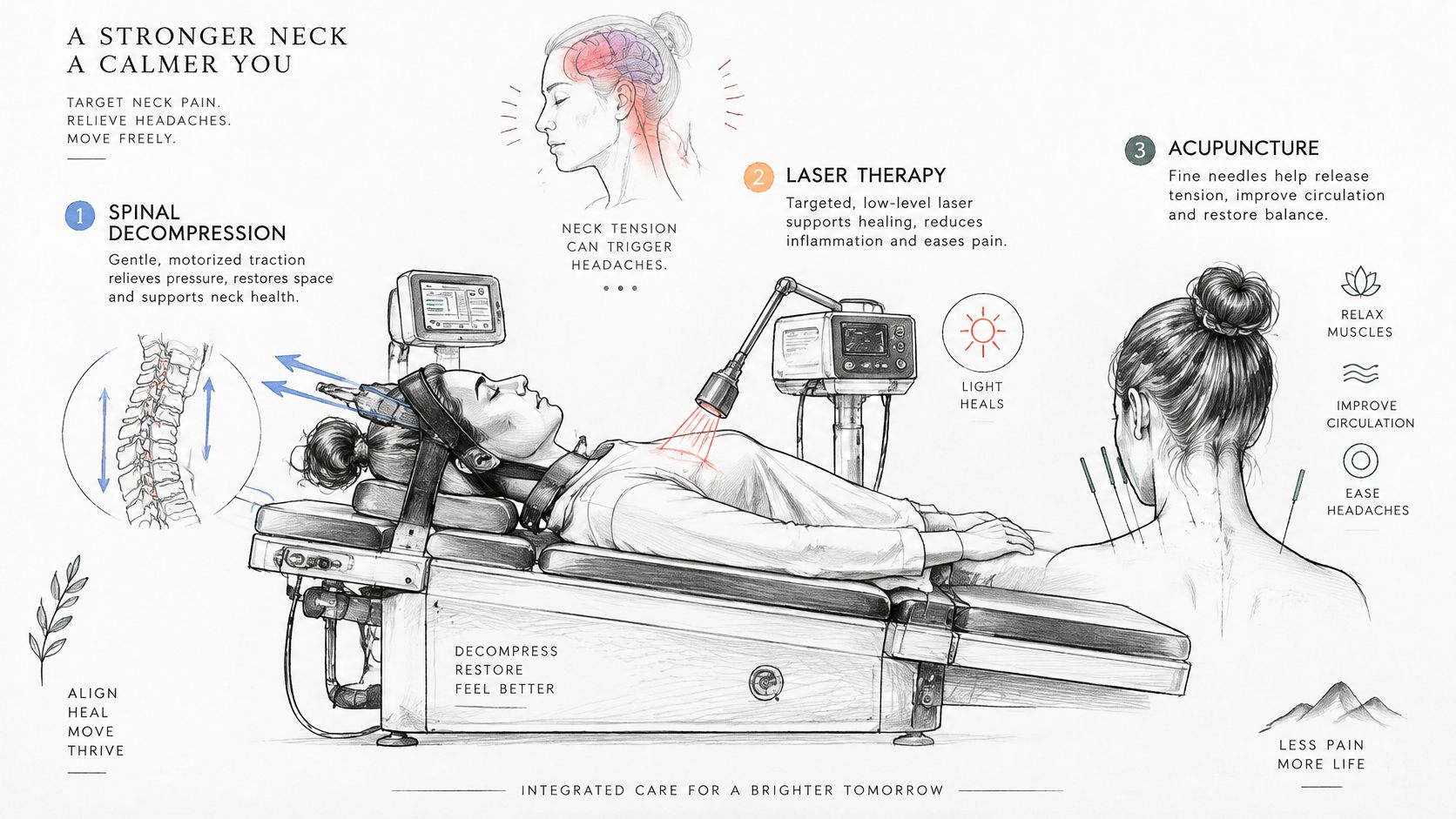
Spinal decompression, including DRX 9000 style motorized traction, aims to reduce pressure on spinal discs over a course spanning several weeks of sessions. Most decompression research concerns lumbar disc pain, so direct evidence for neck headache is thin. Treat it as an optional adjunct after diagnosis, not as first-line headache care.
A caution keeps expectations honest. A randomized controlled trial comparing spinal decompression with manipulation in lumbar disc herniation studied 48 adults over 20 treatment sessions in six weeks and found decompression was not superior to manipulation for pain, function, depression, or quality of life. That study involved lumbar disease, not neck headache, but it shows why improvement during a decompression course shouldn't be presented as proof that decompression outperforms adjustment.
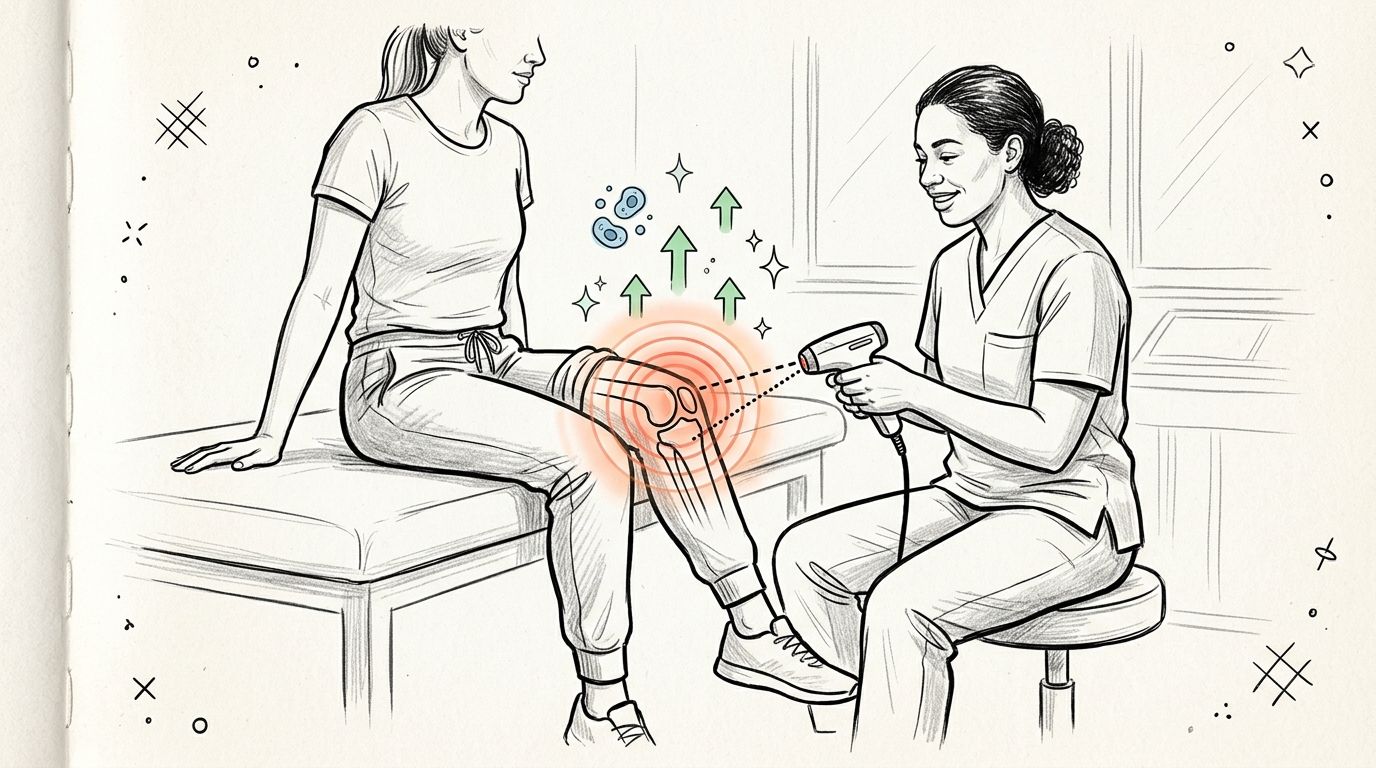
MLS laser therapy is completely painless, and patients typically feel a mild, soothing warmth during treatment. Its role is comfort and inflammation support. With little headache-specific evidence, it shouldn't replace exercise, but it may help you tolerate movement while you build strength.
Acupuncture uses thin needles at defined points and can be part of a chiropractic plan or booked on its own. Trials for headache show mixed results, as our overview of acupuncture for neck pain and headaches explains. Some people value it for pain sensitivity and muscle guarding, provided the goal is explicit.
Consider an add-on when one of three things is true. Your exercise and manual plan has plateaued after six to eight weeks, you have arm symptoms suggesting a disc problem alongside neck pain, or you can't yet tolerate active exercise. Every add-on needs a stated goal and a checkpoint date; otherwise, supporting care becomes indefinite care.
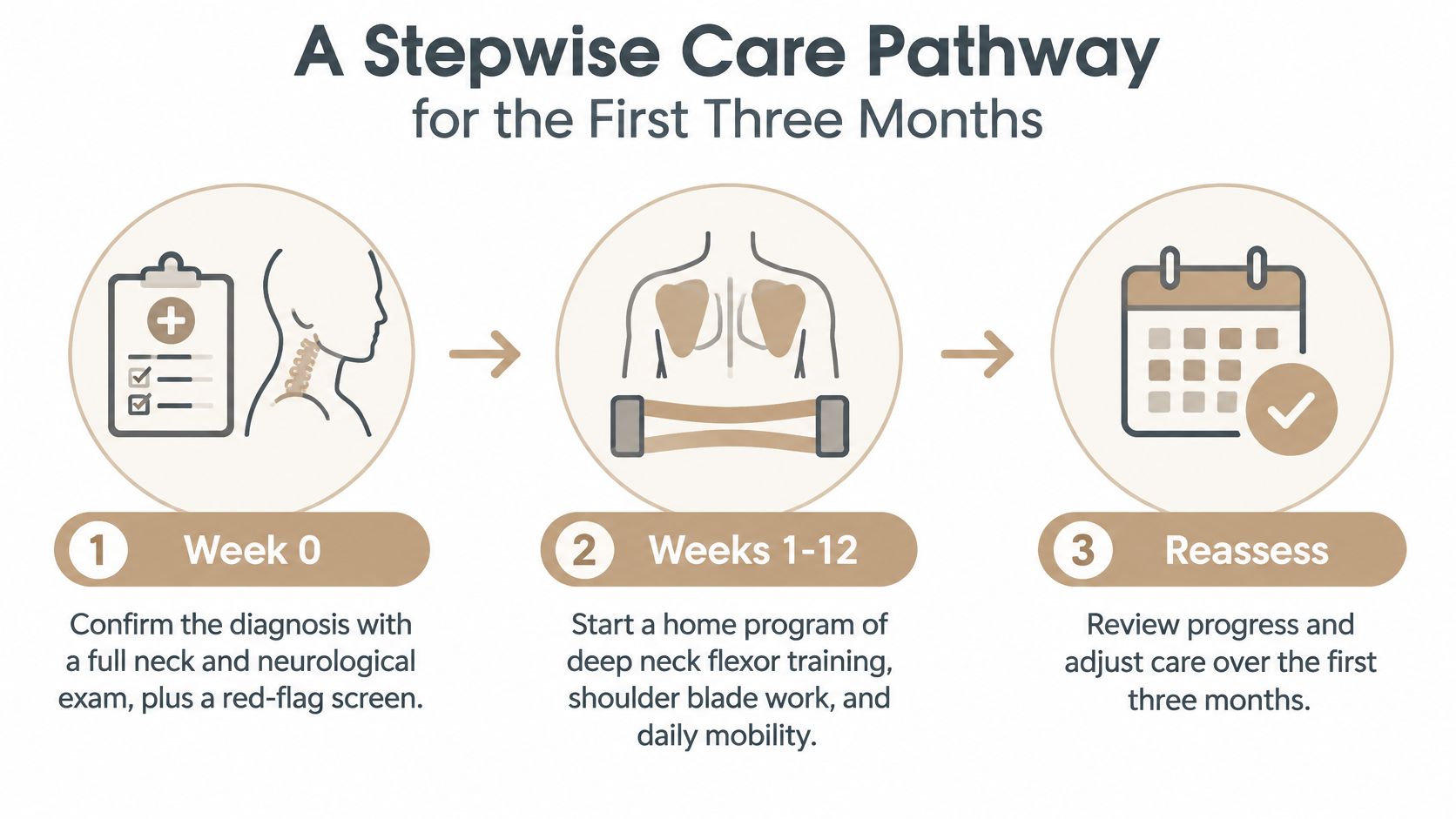
For step 2, start simple. Do chin nods lying on your back for 10 slow repetitions, gentle shoulder blade squeezes held for a few seconds, and thoracic extension over a towel roll. None of these should provoke radiating arm pain, dizziness, or a sharp headache spike. If they do, stop and get reassessed.
Sleep setup belongs in the same conversation, because eight hours in a poor position can undo a good training day. The Mattress Pro by Miller Waldrop pillow tips walk through matching pillow height to your sleep position so your neck stays neutral. Small nightly changes often matter more than occasional intensive sessions.
Chiropractic treatment often requires multiple visits, and our team keeps you informed about the recommended extent and duration of treatment up front. Aspen Falls Wellness, serving Salt Lake City and Sandy, Utah, begins with an initial exam and a personalized treatment plan, so your first step is classification, not a preset package.
If your diary shows a neck-driven pattern and no red flags, we can build a plan that pairs targeted manual care with progressive exercise and clear checkpoints, adding laser, acupuncture, massage, or decompression only when there's a reason. Visit Aspen Falls Wellness to schedule your initial exam in Salt Lake City or Sandy and get a neck pain headache treatment plan matched to your headache type.

Stay updated with the latest chiropractic news and exclusive offers.