Chiropractic adjustment neck pain after. Neck pain after a chiropractic adjustment is usually mild and short-lived. Learn what's normal, what's a red flag

You leave your chiropractic appointment feeling a little looser, then notice an ache when you turn toward the passenger seat. By evening, your neck feels stiff again, and you're wondering whether the adjustment helped or made things worse. The safest next step depends on the symptom pattern, not whether you're sore. Mild, improving tenderness can be monitored, but sudden severe pain or new neurological symptoms need medical attention.
A familiar muscular ache is different from pain that feels entirely new. For example, tenderness around the treated area that's noticeable when you turn your head is less concerning than an abrupt, unusual headache accompanied by dizziness. Neither should be assessed by intensity alone. Timing, location, associated symptoms, and changes in function all matter.
Temporary neck pain and stiffness are documented treatment reactions. In a randomized study, 30% of respondents reported a treatment-related symptom, with increased neck pain or stiffness reported by 25%, according to the study of adverse reactions after neck treatment. Those findings establish that soreness can occur, not that every post-treatment symptom is harmless.
You might feel local tenderness, restricted movement, a mild familiar headache, or a brief increase in your usual discomfort. If you also feel tired, don't assume that fatigue proves your body is healing or that treatment was effective. Describe it alongside your other symptoms.
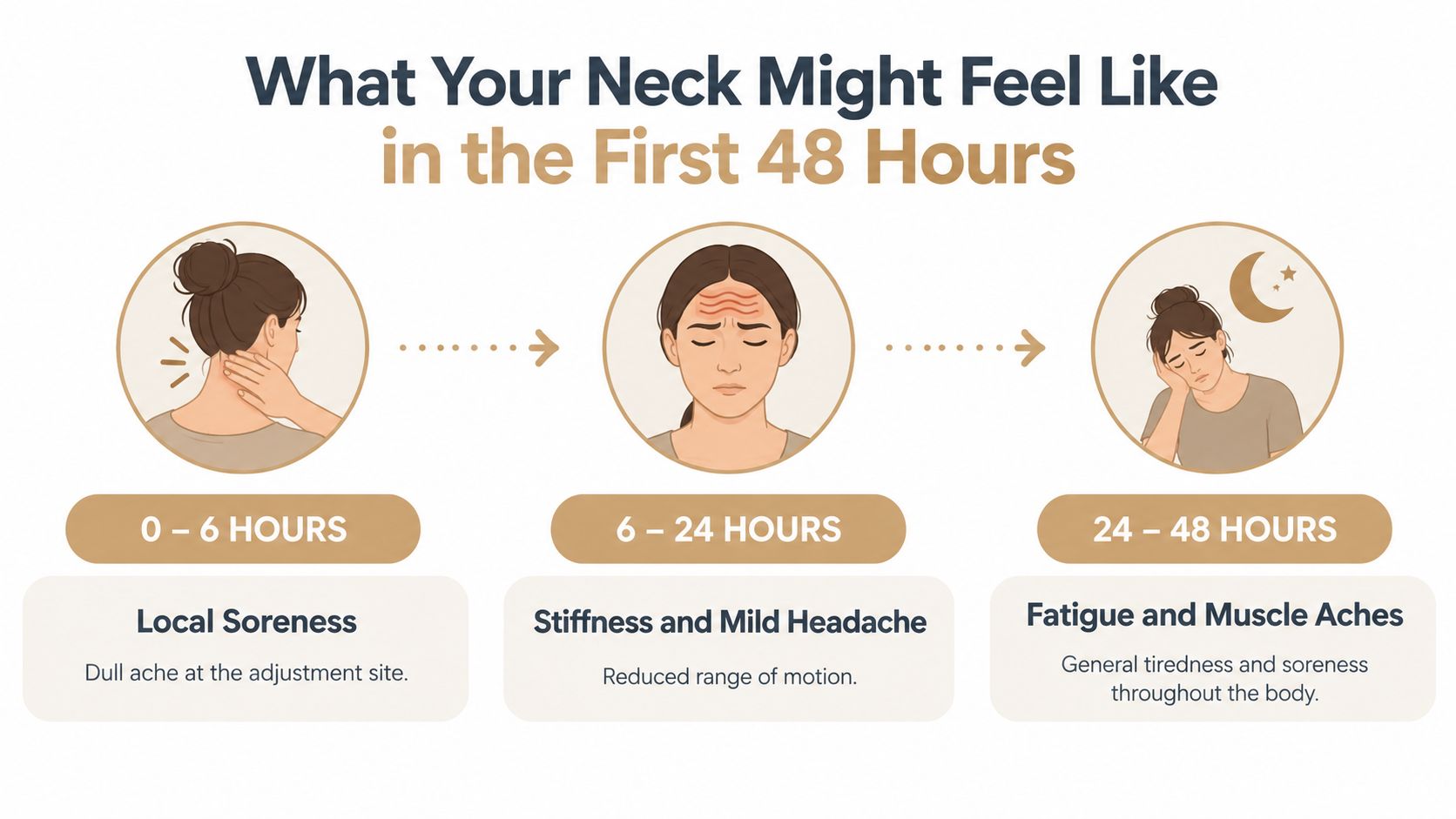
The timeline is an observation aid, not a prediction. Symptoms don't reliably arrive in separate stages, and an apparently ordinary start doesn't rule out a later problem.
A systematic review of acute neck-pain trials found no reported serious adverse events across 6 trials involving 446 participants, but the studies were too small to establish the risk of extremely rare complications. That's why reasonable reassurance always needs a safety plan.
A cervical adjustment applies a mechanical input to a joint and the surrounding tissues. When an already sensitive area is moved, discomfort afterward may reflect local sensitivity rather than a new injury. However, symptoms alone can't tell you whether the source is muscle, a joint capsule, a ligament, or another structure.
It's tempting to explain every ache as muscles adapting to “realignment” or the nervous system resetting. Those explanations are too certain. Soreness isn't proof that bones were out of place, that inflammation is beneficial, or that treatment is working.
The amount of discomfort you had beforehand and how you tolerated the technique should influence the next treatment decision. A forceful approach isn't automatically more useful than a gentler one, particularly when your neck is already highly irritable.
In a trial comparing cervical manipulation with mobilization, transient minor discomfort occurred in 16% of manipulation patients versus 8.7% of mobilization patients. The difference didn't reach conventional statistical significance, but clinical outcomes were comparable, supporting discussion of mobilization as an alternative when thrust techniques aren't well tolerated.
Practical rule: Judge recovery by improving comfort and function, not by whether you can tolerate another adjustment.
There isn't a universal deadline when every neck should stop hurting. Promising that soreness must peak on a particular day or disappear by a particular date can encourage someone to ignore an atypical reaction.
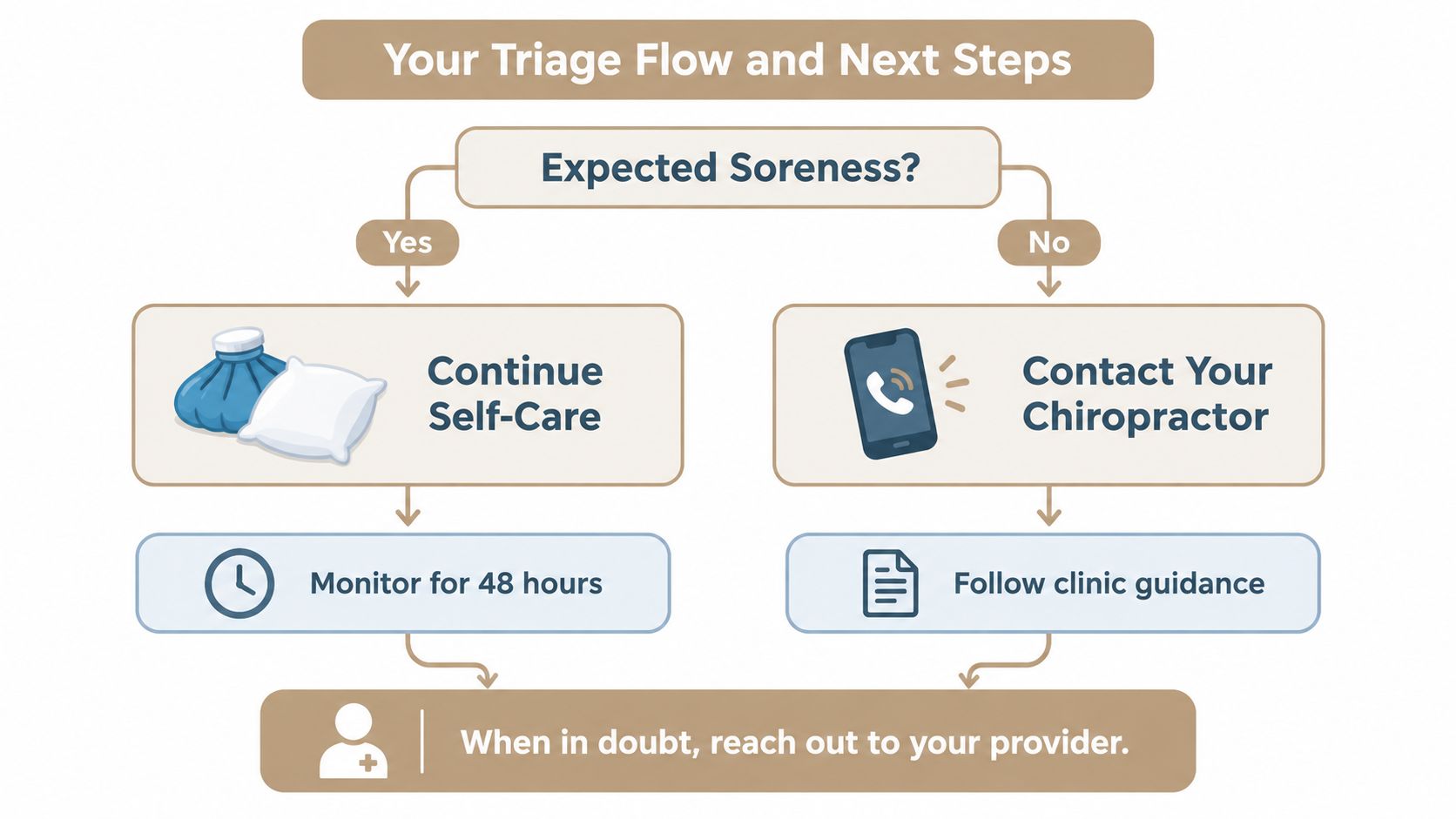
Instead, use a 48-hour check-in as a practical decision point: if symptoms remain troublesome, aren't clearly improving, or interfere with normal activities, contact your provider. Worsening or unusual symptoms deserve earlier attention.
For another patient-facing explanation, MedAmerica Rehab Center's Neck Pain After Chiropractic Adjustment offers additional context. Use educational resources to prepare questions, not to diagnose a reaction without an examination.
Home care is appropriate only when symptoms are mild, familiar, and improving, with no warning signs. The aim is comfort and normal movement, not forcing the neck to recover faster. Follow any individualized restrictions your clinician gave you.
Reduce unnecessary loading without treating your neck as fragile. Easy walking and ordinary light activity are reasonable options if they don't worsen symptoms. Postpone intense exercise, heavy overhead work, aggressive stretching, and repeated attempts to crack your own neck.
For comfort, ask your clinician whether a wrapped cold pack or gentle warmth suits your situation. Cold may feel preferable over a tender area; warmth may feel better for muscular tightness. Protect your skin, avoid excessive temperatures, and stop if either option aggravates symptoms.
Drink normally rather than forcing extra water. Hydration is sensible general care, but it isn't a way to flush out toxins supposedly released by an adjustment.

Choose a sleeping position that doesn't leave your head sharply turned or tilted. Adjust your pillow for comfort rather than buying a particular shape because someone promises it will preserve an adjustment. Don't sleep on a heating pad or cold pack.
Make temporary changes to demanding tasks:
Once your clinician confirms exercises are appropriate, the guide to neck pain exercises at home can support a conversation about suitable movements. Stop an exercise that brings on unfamiliar pain, dizziness, or neurological symptoms.
Keep a short pain-and-function log. Record discomfort using the same rating scale, note any arm symptoms, and track a meaningful task such as looking over your shoulder or getting dressed. A neck-pain clinical guideline supports baseline pain and function measurement, reassessment of recovery, and red-flag screening before further manipulation.
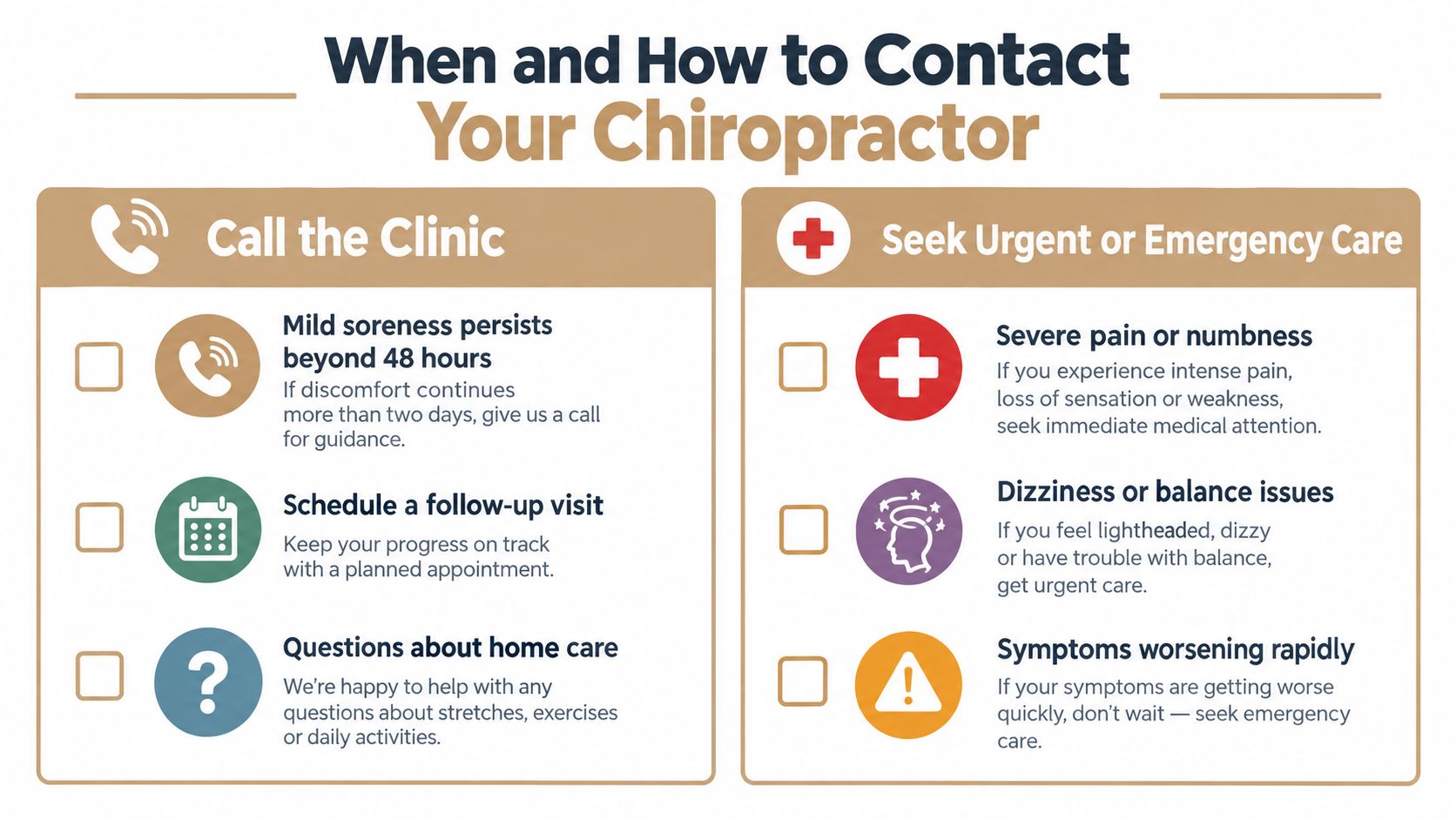
Don't wait for the monitoring window to end if a warning sign appears. Sudden severe headache, unusual severe neck pain, new weakness, numbness, speech difficulty, visual disturbance, or loss of coordination requires urgent medical assessment.
The important distinction isn't just “sore versus painful.” A mild symptom with neurological changes may be more concerning than a stronger but familiar muscular ache. New dizziness, double vision, difficulty walking, or vomiting after neck treatment shouldn't be dismissed as routine adaptation.
| Symptom | Expected Soreness | Red Flag |
|---|---|---|
| Neck discomfort | Familiar, localized ache that's easing | Sudden, severe, unfamiliar, or rapidly worsening pain |
| Headache | Mild, familiar, and settling | Abrupt or unusual severe headache |
| Movement | Stiffness without balance changes | New difficulty walking or loss of coordination |
| Arm or leg sensation | No new neurological symptoms | New numbness, weakness, or altered sensation |
| Associated symptoms | No visual or speech changes | Double vision, slurred speech, dizziness, or vomiting |
A systematic review of serious adverse events after conservative cervical procedures identified early symptoms including increased neck pain or headache, nausea, vomiting, dizziness, and altered sensation during treatment or within 48 hours, sometimes before neurological signs appeared. Because it relied largely on published cases, it can't establish an individual patient's probability of harm.
One serious concern is cervical artery dissection, a tear in an artery wall that can lead to stroke. This can't be confirmed or excluded through an online symptom checklist. A clinician must assess the presentation and determine what investigation is needed.
Progressive neurological loss also raises concerns beyond vascular problems. A guideline addressing neurological contraindications identifies cervical myelopathy, overt spinal-cord compression, and nerve-root compression with increasing neurological deficit as reasons cervical manipulation may be inappropriate.
New arm symptoms shouldn't automatically be labeled a pinched nerve in the neck. That may be one explanation, but it requires assessment rather than assumption.
Sudden severe or neurological symptoms belong in urgent medical care, not on the schedule for another adjustment.
Call emergency services for stroke-like symptoms or abrupt severe head or neck pain. Don't drive yourself if you're dizzy, weak, visually impaired, or unsteady, and don't wait for the chiropractic clinic to return a message.
For non-emergency symptoms, contact the clinic when discomfort is more intense than you expected, disrupts sleep or work, or isn't following an improving pattern. You don't need to wait until your next booked appointment. A phone conversation can help determine whether you need revised home instructions, an examination, or referral.
Use the 48-hour decision rule as a scheduled check-in, not permission to ignore deterioration. Persistent troublesome soreness warrants contact at that point; a worsening reaction warrants contact sooner. Ask whether a same-day or next-day reassessment is appropriate rather than assuming the next treatment should proceed unchanged.
Prepare information that helps the clinician compare your response with your condition before treatment:
A responsible reassessment shouldn't consist only of reassurance. The clinician should review your history, reassess neurological findings when indicated, and decide whether to modify treatment, pause manipulation, or refer you.
Lower-force mobilization, a different treatment dose, or an exercise-focused visit may be more appropriate than repeating a poorly tolerated thrust. Massage, mobility therapy, or MLS Laser Therapy can be discussed where clinically appropriate, but adding a service shouldn't replace investigating an unexplained reaction.
Patients should also receive meaningful informed consent. The American Heart Association and American Stroke Association scientific statement recognizes a statistical association between cervical manipulative therapy and cervical artery dissection, while noting that available evidence hasn't definitively established causation. Both parts belong in an honest discussion of treatment choices.
Temporary relief is useful information, but it isn't enough to justify repeating the same treatment indefinitely. An adjustment may make turning easier at the appointment while leaving the factors associated with recurring symptoms unresolved. The next decision should depend on durable functional progress, not how you feel immediately after treatment.
Recurring pain calls for reassessment, not an automatic increase in visit frequency. That doesn't mean every recurrence signals injury or that manual treatment has failed. It means the clinician needs to check whether the original diagnosis and treatment plan still fit.
Choose practical targets before continuing care. Examples include completing a workday with fewer interruptions, sleeping without repeatedly changing position, or returning to a specific activity comfortably.
| Reassessment trigger | Question to address |
|---|---|
| Relief lasts for progressively shorter periods | Is the treatment producing useful carryover? |
| Function remains unchanged | Are the chosen interventions addressing the main limitation? |
| New arm symptoms develop | Has the neurological presentation changed? |
| Progress stalls at the agreed review point | Should the diagnosis, treatment dose, or referral plan change? |
Set a review date with your clinician rather than accepting an open-ended series of visits. The appropriate interval depends on the presentation, but the outcome measures should be clear from the start.
A systematic review of clinical guidelines found that manual therapy, when recommended, was consistently paired with exercise, education, psychological strategies, and activity advice rather than used alone. That supports a layered plan, not repeated manipulation without active rehabilitation.
Review work demands, sleep positions, exercise tolerance, and whether your home program is realistic. The discussion of what causes neck pain can help you prepare questions about potential contributors without assuming a diagnosis.
Personal exercise plans, rehabilitation exercise, mobility training, soft-tissue care, or acupuncture may be considered according to examination findings. Spinal decompression with the DRX 9000 is a separate option for selected disc-related conditions, not an automatic response to post-adjustment soreness. Imaging or specialist referral should follow clinical indications, particularly when symptoms change or neurological findings emerge.
Use symptom severity, associated changes, and the direction of recovery together. The clock never overrides a warning sign. Monitoring is appropriate only while the presentation remains mild and reassuring.
Bring your symptom log and explain what you want to regain, whether that's comfortable driving, uninterrupted sleep, or returning to exercise. Ask what findings support the diagnosis, what would justify changing treatment, and which home exercises you should prioritize.
A useful follow-up ends with a clear plan for what to do, what to avoid, and when to seek help.
Longer-term care should help you manage activity and improve function, not leave you dependent on repeated short-lived relief. Before leaving, confirm how to contact the clinic if your response differs from expectations.
At Aspen Falls Wellness, adults in Salt Lake City and Sandy can discuss individualized chiropractic care, massage therapy, mobility therapy, and rehabilitation exercise based on their examination and treatment tolerance. If your neck remains sore after an adjustment or relief keeps fading, request a reassessment and bring your symptom log so the team can help determine whether to modify care or arrange further evaluation.

Stay updated with the latest chiropractic news and exclusive offers.