Chiropractor vs massage: compare evidence, safety, and pain patterns, then choose adjustment, massage, both, or screening.
The popular advice about chiropractor vs massage sounds simple: choose massage for tight muscles and chiropractic care for stiff joints. That skips the most important question: is hands-on treatment appropriate before someone examines the problem? Muscle tension can accompany nerve irritation, an injury, or a condition that needs medical care rather than either service.
Once screening establishes a reasonable working diagnosis, the choice becomes more useful. Match treatment to what limits you, build in exercise, and judge success by what you can do afterward, not just how the appointment feels.
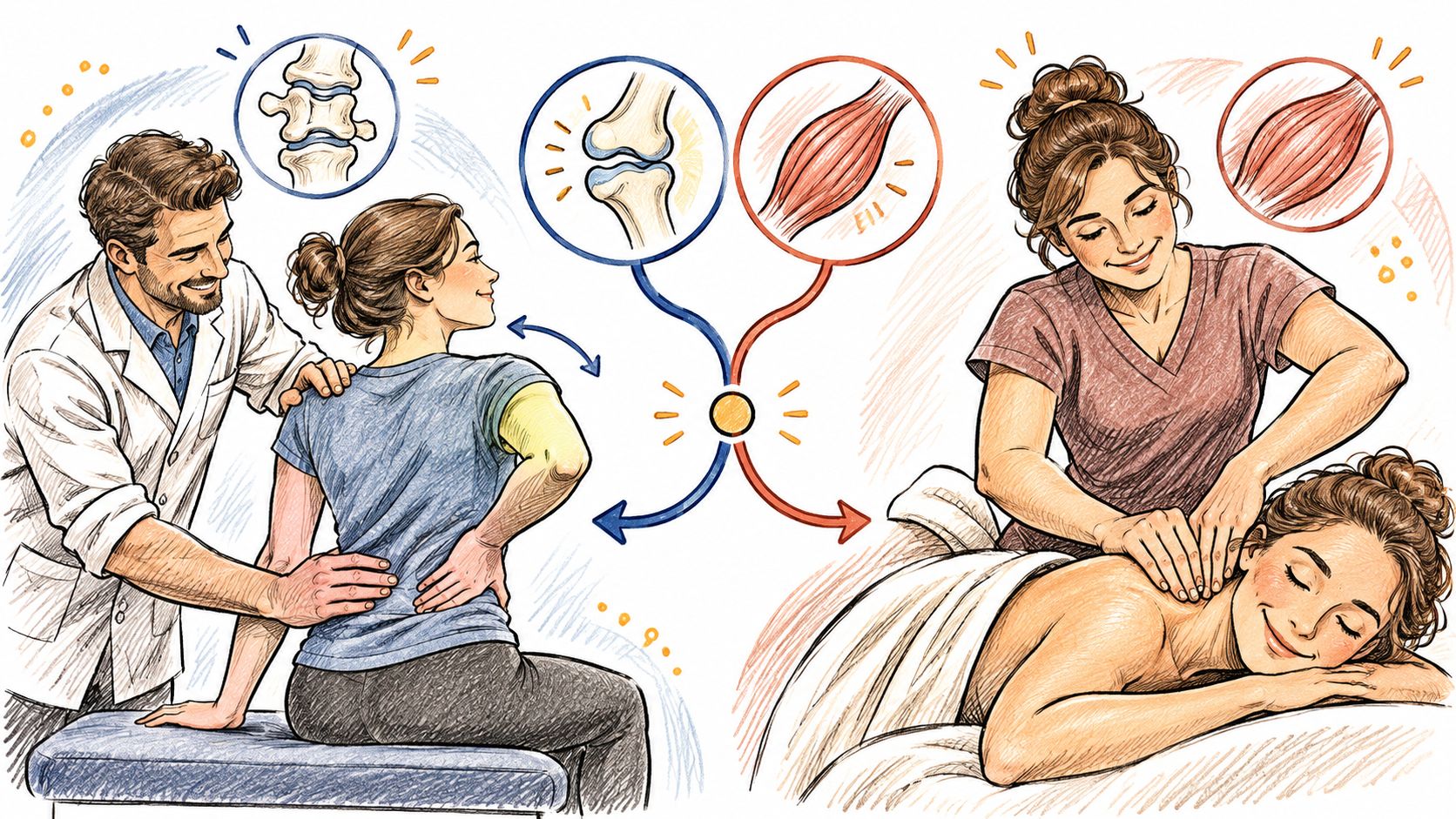
Neither option always wins. A chiropractic adjustment aims to restore motion in a restricted spinal or extremity joint. Massage works on muscles, fascia, and other soft tissue to ease guarding and improve comfort.
Those are treatment targets, not diagnoses you can reliably identify by pressing on a sore spot. A tender back may also have restricted movement, and a stiff neck may involve both muscle guarding and joint sensitivity.
| Feature | Chiropractic adjustment | Massage therapy |
|---|---|---|
| Primary target | Spinal and extremity joints | Muscle, fascia, and soft tissue |
| Main aim | Restore joint motion | Ease guarding, tenderness, and stiffness |
| Who provides it | Licensed chiropractor | Massage therapist |
| Typical technique | Hands and elbows; no extra equipment for a full-body adjustment | Deep tissue, sports massage, cupping, stretching, or aromatherapy |
| Session focus | Whole-body or region based on exam | Agreed focus areas and a personalized plan |
| Best starting fit | Restricted joint motion without red flags | Stable muscle tenderness or sports tightness |
| Often paired with | Exercise, posture work, or other conservative care | Stretching, mobility work, or a broader rehab plan |
The provider and technique rows describe what happens during care. The chiropractor delivers a controlled input at a joint; the massage therapist uses pressure and movement across soft tissue. Neither greater force nor deeper pressure automatically means better treatment.
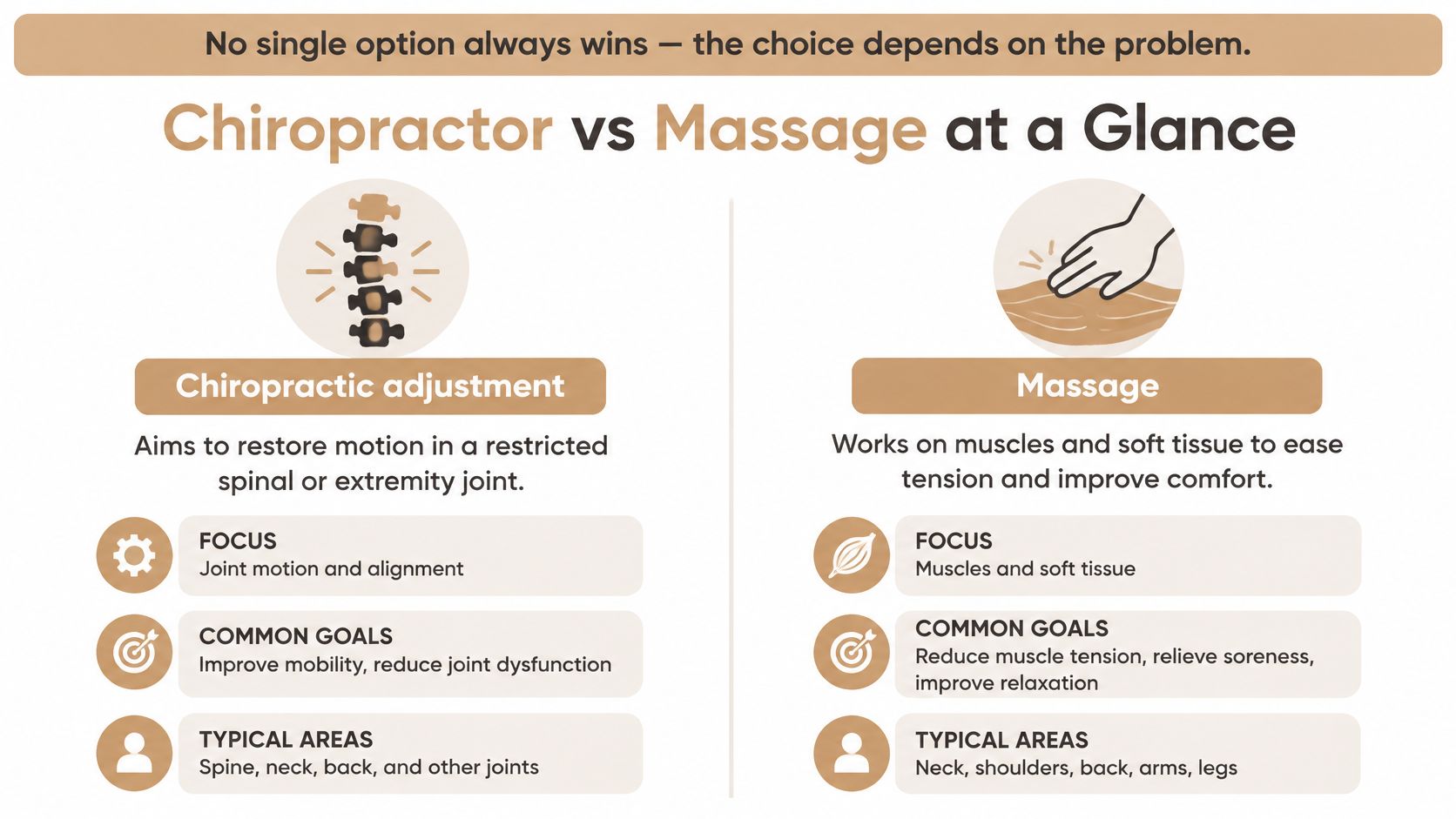
At Aspen Falls Wellness, a full-body adjustment uses the chiropractor's hands and elbows without other equipment and covers the body in a session. That differs from massage organized around agreed focus areas. Our massage options include deep tissue massage, cupping, sports massage, aromatherapy, and stretching, selected after discussing your needs.
The session-focus and starting-fit rows matter more than choosing a familiar service name. Someone seeking comfortable shoulder movement may need a different approach from someone whose calf muscles feel tender after training.
Afterward, you might notice easier movement, less tenderness, or temporary soreness. The useful comparison isn't which treatment produces the strongest sensation.
Practical rule: Match treatment to the main limitation, then check whether movement and meaningful activity improve.
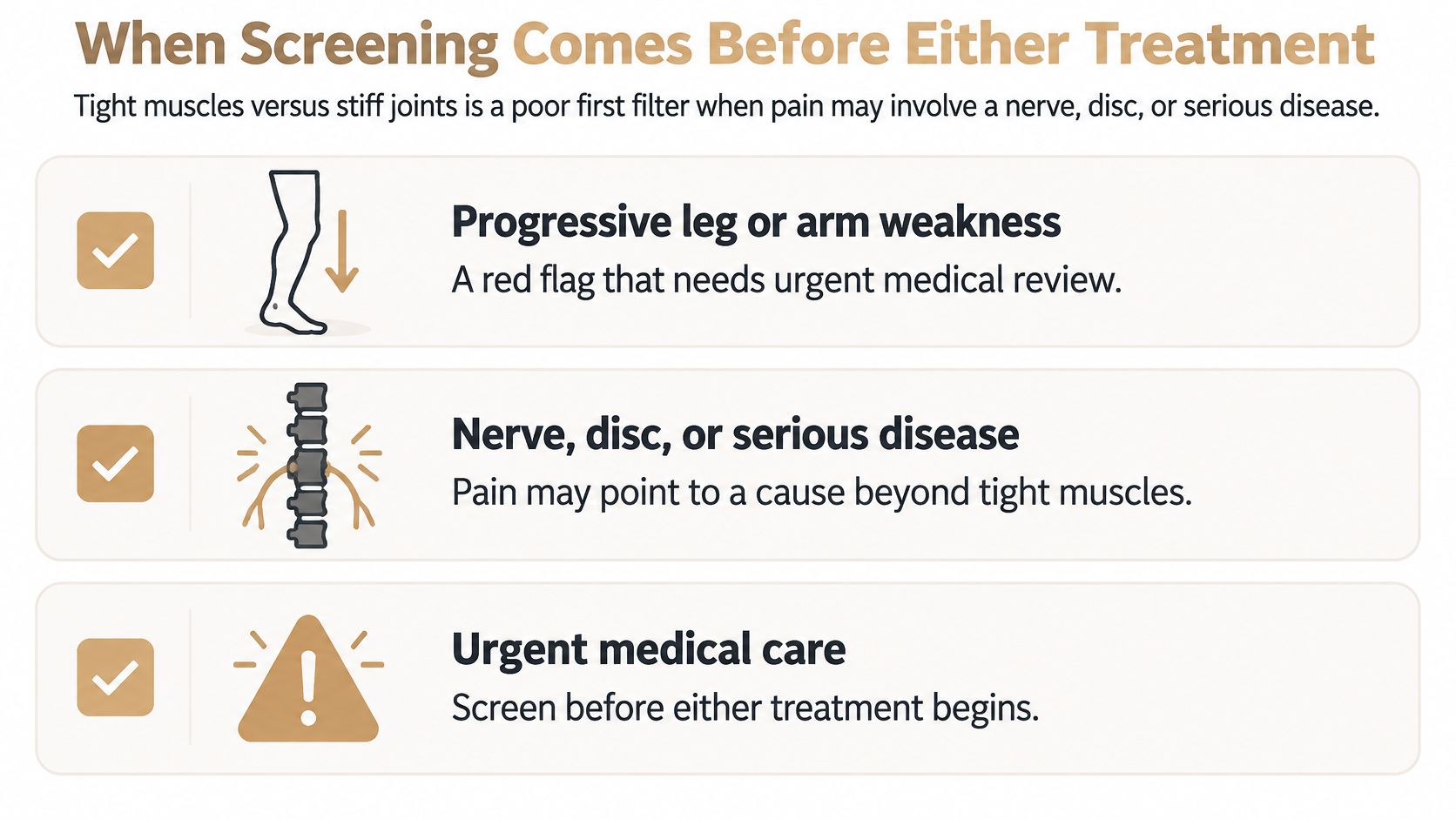
Pain traveling into an arm or leg shouldn't automatically send you to a chiropractor, and a tender muscle doesn't automatically make massage safe. Screening comes before treatment preference, particularly when symptoms are new, worsening, or unfamiliar.
The MSD Manual's chiropractic guidance advises against spinal manipulation for people with osteoporosis or neuropathy symptoms such as limb numbness, tingling, or weakness, and describes uncertain safety after spinal surgery, stroke, or with vascular disease. Serious complications are rare, but that doesn't remove the need for an examination and informed consent.
| Situation | What it looks like | Next step |
|---|---|---|
| Urgent medical care | Progressive leg or arm weakness, new bowel or bladder change, saddle numbness, fever, cancer history, unexplained weight loss, major trauma, or pain after a significant accident | Do not book massage or an adjustment from symptoms alone; seek prompt medical assessment |
| Manipulation not advised | Osteoporosis, or neuropathy such as limb numbness, tingling, or weakness | Skip spinal manipulation and get a clinical exam |
| Safety uncertain | Prior spinal surgery, stroke, or vascular disease | Get clearance before manipulation |
| Tell the massage therapist | Recent surgery, chemotherapy or radiation, clotting risk, pregnancy, bruises, inflamed skin, tumors, hernias, or a recent fracture | Disclose before the session; massage is not a diagnostic exam |
| Expected short-term reaction | In a study of 198 patients, 42% after usual chiropractic care and 33% after sham care reported an event within 48 hours, mostly more pain, stiffness, headache, or radiating discomfort, according to a systematic review of spinal manipulation | Individualize and monitor; brief soreness can occur |
| Stop and reassess | New weakness, severe headache, or spreading neurological symptoms | Stop hands-on care and get assessed |
New bowel or bladder dysfunction, saddle numbness, or rapidly progressive weakness warrants emergency assessment. Other concerns, such as a cancer history or unexplained weight loss accompanying new back pain, need prompt medical review rather than an automatic assumption about their cause. Our guide to low-back-pain red flags helps explain what to disclose.
Mild local tenderness after treatment is different from losing strength, developing a severe unfamiliar headache, or noticing spreading numbness. Don't let someone dismiss a changing neurological symptom as an expected release or necessary part of recovery.
Massage can alter how pain feels without identifying why it occurs. Persistent or radiating pain deserves a qualified musculoskeletal examination, even when pressure on the surrounding muscles feels helpful.
Before massage, consult a doctor if you've recently had surgery, just completed chemotherapy or radiation, are prone to blood clots, or are pregnant. Tell our therapist about bruises, inflamed skin, tumors, hernias, or a recent fracture so those areas can be avoided.
The pathway is straightforward: urgent medical assessment for red flags, examination for persistent or radiating symptoms, and massage as an option when the presentation is clearly muscular and stable.
The evidence supports possible benefits, not a universal winner. It also matters what researchers tested: spinal manipulation isn't the same as every service offered during chiropractic care, and massage techniques aren't interchangeable.
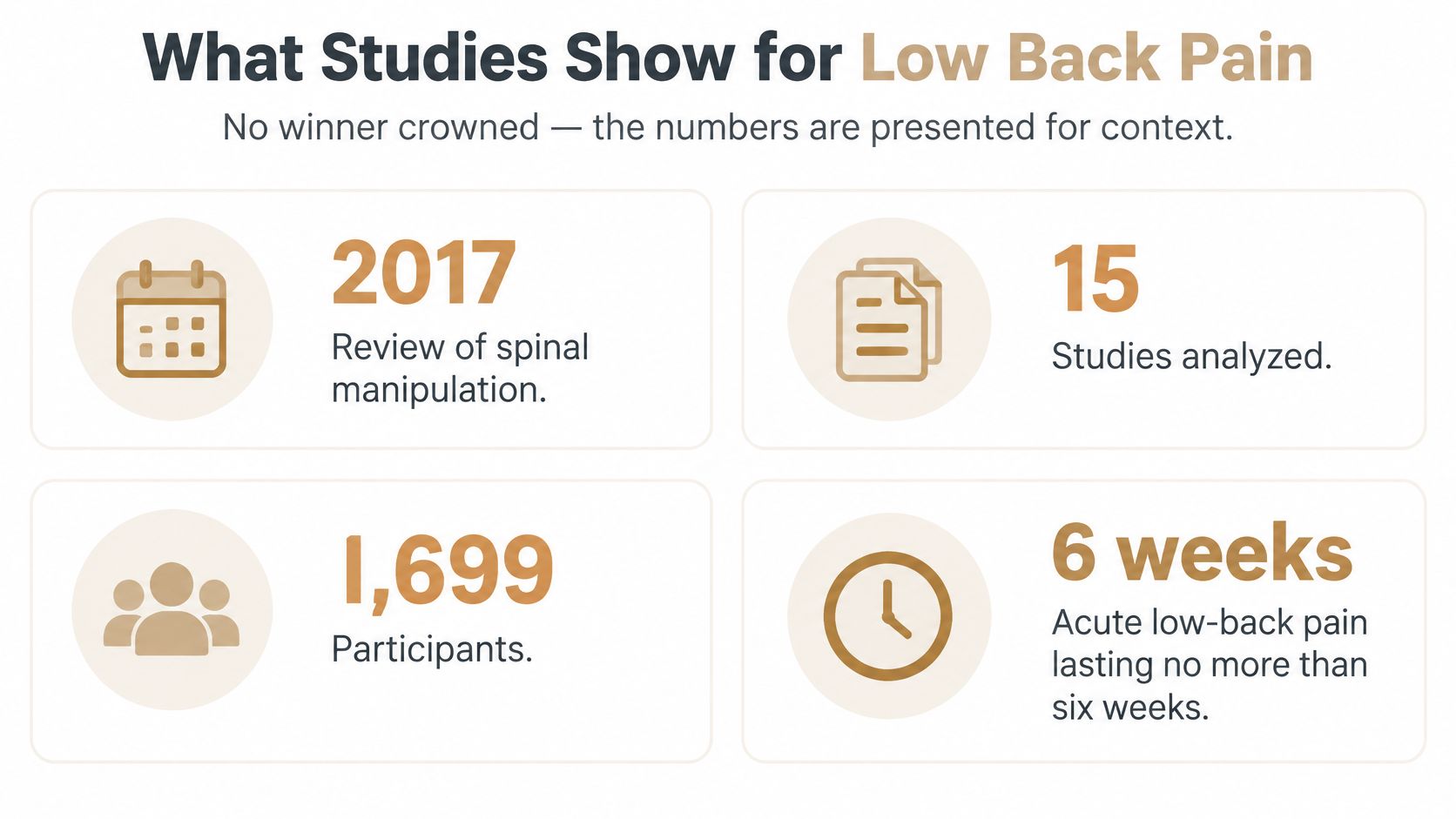
For acute low-back pain lasting no more than six weeks, a 2017 review of 15 studies involving 1,699 participants found moderate-quality evidence of modest pain improvement lasting up to six weeks; a related analysis of 12 studies involving 1,381 participants found modest functional improvement, according to the National Center for Complementary and Integrative Health's spinal manipulation overview.
For context, the acute-pain benefit was comparable to that reported for nonsteroidal anti-inflammatory drugs, while chronic-pain findings included a 2018 analysis of nine studies with 1,176 participants concluding that manipulation or mobilization probably reduces pain and improves function, and a 2019 review of 47 studies involving 9,211 participants finding short-term relief similar to exercise or medication, as summarized in NCCIH's review of spinal manipulation evidence.
Similar average results don't make treatments identical for every person. Medication suitability, movement tolerance, preferences, and examination findings still matter. Nor does improvement prove that a vertebra was displaced and permanently put back into position.
Our explanation of chiropractic adjustment for low-back pain offers practical context for discussing a proposed treatment.
For massage, a 2015 review of 25 studies involving approximately 3,000 participants found possible short-term pain improvement but rated the evidence low to very low quality; an AHRQ review found slightly greater improvements in pain and function after one to six months than sham massage or usual care, as reported in NCCIH's chronic-pain evidence summary.
Lower-quality evidence means greater uncertainty about the estimated benefit. It doesn't mean nobody benefits, and it doesn't justify promises that massage will resolve the underlying cause.
Direct comparisons between massage and manipulation have been inconsistent, with results favoring either approach or finding no meaningful difference. A reasonable interpretation is therefore:
Say bending to load the dishwasher brings on familiar back pain. A chiropractic visit shouldn't begin with an automatic adjustment. It begins with your history and an examination to establish a working diagnosis, check movement, and decide whether treatment or referral makes sense.
Our chiropractors tailor each adjustment to the patient's condition, specific health needs, and tolerance. For a hands-on adjustment, you'll be positioned so the clinician can apply a brief, directed movement rather than sustained pressure across a muscle.
The clinician should explain the proposed adjustment, alternatives, and expected response before proceeding. You can ask for clarification or decline a technique you're uncomfortable with.
Chiropractic treatment often involves multiple visits. We keep patients informed about the recommended extent and duration of care rather than treating the appointment schedule as self-explanatory.
Terms such as realignment can cause confusion. The practical goal is better movement and function, not proof that your whole skeleton was out of place.
For the same dishwasher-related discomfort, a massage therapist might discuss whether the main concern is local tenderness, guarded muscles, or difficulty relaxing into movement. On arrival, our therapist discusses focus areas and creates a personalized session plan.
Deep tissue work addresses dense, tender muscle areas; sports massage focuses on activity-related soft-tissue concerns. Stretching or cupping may be included when appropriate, while aromatherapy is an optional element rather than a requirement for meaningful care.
Massage generally involves sustained pressure and movement across soft tissue. Pressure should remain tolerable, and you should speak up if it causes sharp, electrical, or escalating pain. Our massage therapy service is customized rather than a fixed routine.
A useful appointment makes the next movement easier. It doesn't replace the work of rebuilding tolerance outside the clinic.
For low-back pain with or without sciatica, the NICE assessment and management guideline recommends considering manual therapy, including manipulation, mobilization, and massage, only within a treatment package that includes exercise.
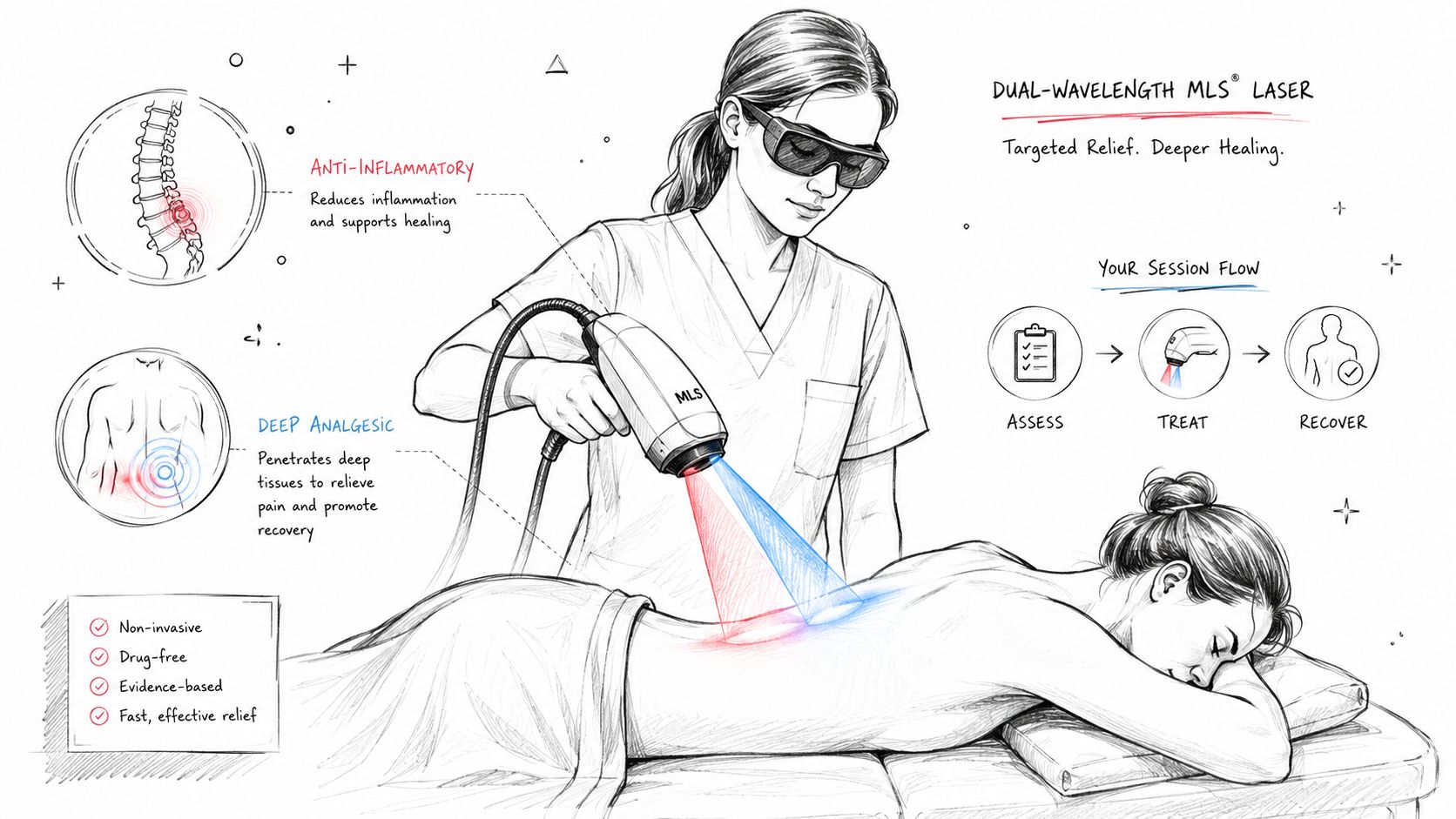
A coordinated plan may also include mobility therapy, acupuncture, or MLS Laser Therapy when the examination supports a specific purpose. These aren't prerequisites for choosing between adjustment and massage. Before leaving, clarify which activity or movement will be measured at the next review.
A desk worker with guarded shoulders and no arm symptoms has a different starting point from someone whose leg pain travels below the knee. The useful distinction is the examination finding and activity limitation, not where it hurts.
These examples describe sensible starting choices after relevant red flags have been excluded. They aren't a substitute for diagnosing persistent pain.
| Situation | Better first step | Why | Change course if |
|---|---|---|---|
| Stable muscle tightness after desk work or sport | Massage plus mobility exercise | Soft-tissue guarding is the main limiter | Pain spreads, numbness appears, or tightness returns immediately |
| Mechanical back or neck pain with blocked motion | Chiropractic exam and tailored adjustment | Joint motion is the main limiter | New radiating symptoms or no functional gain after a short trial |
| Both guarded muscles and restricted joints | Combined massage and adjustment with exercise | Each method addresses a different contributor | Either treatment increases pain beyond brief soreness |
| Sciatica, disc symptoms, or progressive nerve signs | Medical or musculoskeletal exam before hands-on care | Possible nerve compression needs assessment | Weakness, bowel or bladder change, or worsening radiation |
| Recent car accident or major trauma | Structured evaluation and documentation | Injury extent is unknown | Headache, neurological signs, or pain out of proportion |
| Clear muscular soreness and a stable exam | Massage as an adjunct | Symptom relief while active rehab continues | Relief never translates into activity tolerance |
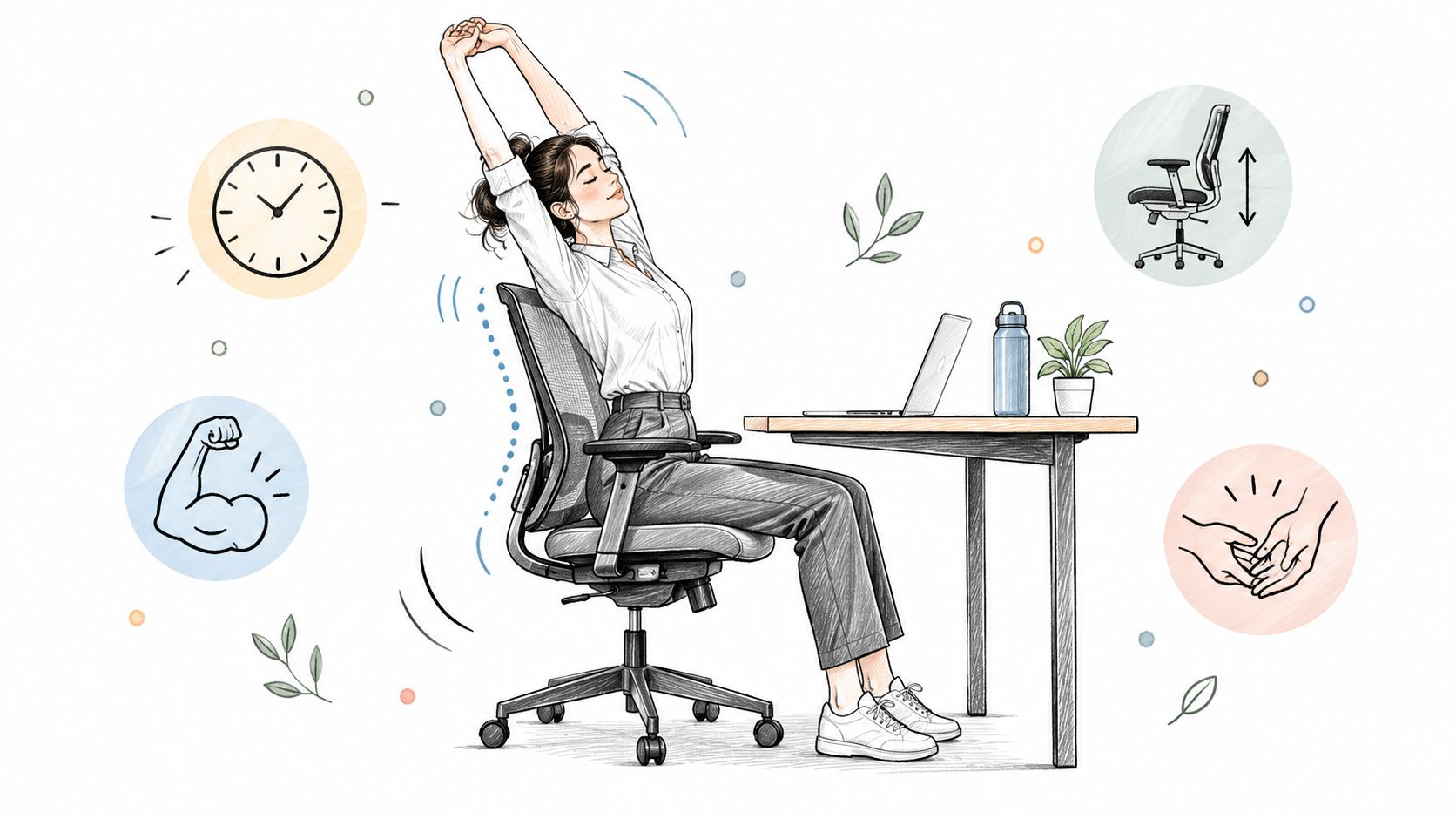
Desk-related neck tension: Start with focused massage and comfortable neck and upper-back mobility if the presentation is muscular and stable. Change the plan if arm symptoms appear, pain becomes unrelenting at night, or you still can't turn comfortably for driving.
Recurrent back pain during bending: A blocked feeling warrants examination rather than an assumption that something needs cracking. If joint-focused treatment is appropriate, pair it with graded bending and lifting practice; abandon that approach if those tasks don't improve.
For a runner with a stable muscle strain, sports massage may make active rehabilitation more comfortable. A golfer may benefit from golf movement screening and a graded return to swings rather than repeated adjustments alone.
People exploring comfort between sessions may find Thermo Recovery Wear's resource on gentle joint support for sensitive skin useful when considering wearable support. Treat such support as an optional comfort aid, not a way to diagnose pain or replace movement training.
Neck pain with headaches can involve both restricted movement and muscle tension, so combined care may be reasonable after serious causes are excluded. By contrast, suspected disc herniation, stenosis, or sciatica requires assessment before choosing hands-on treatment; massage doesn't diagnose nerve compression.
Temporary comfort is not the same as restored walking, lifting, sleep, or sport.
After a car accident, start with evaluation and documentation. Car accident treatment should follow identified injuries and changing function, not an online checklist that assigns every sore neck to the same service.
There isn't a universally validated rule that massage must precede adjustment, or that adjustment must come first. Agree on an outcome test instead of a ritual. The sequence should serve the treatment goal and your tolerance.
A pleasant session can be worthwhile, but ongoing clinical treatment needs a clearer reason than feeling temporarily looser.
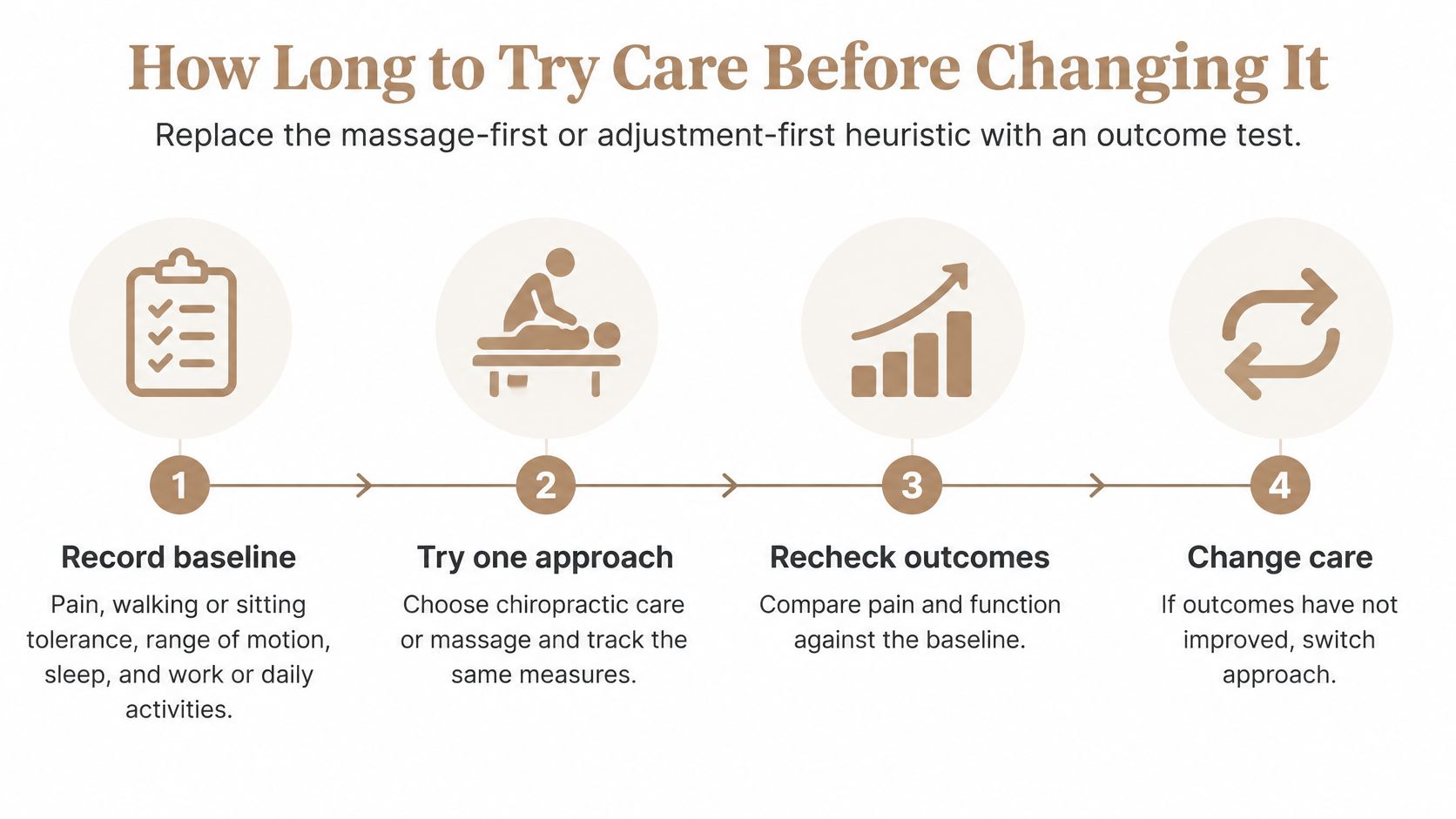
Record the activities that pain interrupts before treatment begins. Use the same measures at reassessment so a better mood or a particularly good day doesn't substitute for progress.
A limited trial should have a review point, not an automatic renewal. Continuing the same passive treatment without functional improvement is a reason to reconsider the diagnosis, approach, or need for referral.
Medical guidance summarized in the massage and chiropractic sequencing discussion notes that continuing manipulation beyond about three months may not add benefit. That isn't a universal deadline or proof that everyone needs treatment until then.
In a 2018 European trial, 328 people with recurrent or persistent nonspecific low-back pain were followed for 52 weeks; scheduled chiropractic maintenance care reduced bothersome pain days compared with symptom-guided treatment but required more treatments, according to the NCCIH chronic-pain evidence summary cited earlier. This was not a comparison with massage, so it doesn't establish that adjustments are better over a year.
A maintenance proposal should therefore address recurrence, functional value, visit burden, and your preferences. It shouldn't rely on claims that everyone needs indefinite correction.
Device-based options also require careful explanation. We offer Spinal Decompression with the DRX 9000 for selected disc-related presentations, but a 60-person sham-controlled trial of vertebral axial decompression found improvement in both groups without a significant between-group difference, as summarized in the vertebral axial decompression medical policy.
That trial doesn't prove a branded decompression table outperforms credible sham traction. Add decompression, rehabilitation exercise, or another modality only for a defined clinical reason.
Stop or change care when neurological signs worsen, the agreed trial produces no functional change, or repeated visits replace rather than support a home plan.
Choose the next appointment from the limitation already identified, not from a longer menu of treatments. Urgent warning signs mean medical care comes first. Local, stable muscular discomfort may justify region-focused massage with home movements, while blocked motion without nerve signs may justify a chiropractic examination.
If examination identifies both guarding and restricted joints, use a coordinated plan that reviews them together. Combining services should simplify the goal, not create separate schedules with no shared measure of success.
Bring your pain triggers, medicines, relevant prior imaging, and the activities you want back. A useful goal might be sitting through a work meeting, walking without a limp, or returning to a comfortable golf swing.
At Aspen Falls Wellness, chiropractors, massage therapists, mobility specialists, acupuncturists, pain management specialists, and nutritional coaches collaborate on integrative plans serving Salt Lake City and Sandy. Acupuncture can be included in chiropractic care or booked as a stand-alone service.
Options such as SoftWave Therapy, muscle stimulation, nutrition and nutrition counseling, or rehabilitation exercise need an individual purpose. You don't need every available service to make progress.
A patient named Sam described the convenience this way: “It's a one stop shop that includes chiropractic physical therapy, massage therapy and more.” Convenience matters, but the treatment decision still rests on clinical fit.
Before committing to ongoing care, get clear answers to these questions:
Leave with a measurable goal and an exercise plan, not an open-ended series of visits.
Aspen Falls Wellness offers chiropractic care, massage therapy, and coordinated rehabilitation for people in Salt Lake City and Sandy. Visit Aspen Falls Wellness to arrange an evaluation, identify whether joint-focused or soft-tissue care fits your needs, and build a plan around the activities you want to regain.

Stay updated with the latest chiropractic news and exclusive offers.