Does Cigna cover chiropractic care? Learn what 2026 plans pay for, including session limits and out-of-pocket costs, plus how to check your benefits.



Many Cigna plans do cover chiropractic care, but the benefit may be limited to 12 visits a year, a $35 copay per visit, or 40 combined visits across chiropractic, physical, occupational, and speech therapy, depending on the plan. Preauthorization, network rules, and coding limits can determine whether a supposedly covered visit is paid.
That's why the popular advice, “Cigna covers chiropractic care,” is incomplete. A coverage label on a benefits summary doesn't tell you how many visits remain, whether a deductible applies, which vendor manages authorization, or whether your chiropractor's billing crosses Cigna's daily coding limit.
I've seen patients focus on the copay and miss the visit ceiling. I've also seen offices confirm that chiropractic is covered without checking whether the patient's plan combines chiropractic with physical therapy. The result is predictable: the first visits process normally, then a later claim becomes a patient balance.
The question “does Cigna cover chiropractic care” sounds simple, but Cigna doesn't sell one universal chiropractic benefit. Coverage depends on the specific policy, plan design, network status, medical-necessity rules, and utilization requirements. Cigna itself states that all insurance policies and group benefit plans contain exclusions and limitations in its patient-facing chiropractic materials (Cigna's chiropractic coverage guidance).
A member with one employer plan may have a separate chiropractic benefit. Another member may share a therapy allowance with physical therapy, occupational therapy, and speech therapy. A third member may have coverage only after preauthorization. Those people can all truthfully say they have Cigna, yet their out-of-pocket responsibilities can be completely different.
A summary of benefits may show chiropractic as an “Other Covered Service,” but that label doesn't answer the operational questions that control payment:
Cigna plan documents show both a 12-visit annual limit and a separate plan example with 40 combined annual visits, a $35 chiropractic copay, and preauthorization requirements (Cigna's chiropractic care policy). Another Cigna plan document lists chiropractic with no annual limit and a $70 copay, demonstrating why one member's experience can't be used to predict another member's benefits (Cigna's small-group summary of benefits).
Practical rule: “Covered” means the service exists somewhere in the benefit design. It doesn't mean every visit, code, provider, or treatment combination will be paid.
The useful question is more precise: Under what conditions will this plan pay for chiropractic care, and what must the office do before treatment begins?
Cigna's medical policy treats a chiropractic treatment visit as a session lasting up to one hour and limits billing to a maximum of four timed codes per date of service (Cigna's chiropractic medical policy). That limit matters because a visit isn't always one adjustment code. It can include an adjustment plus timed therapeutic services, all competing for the same daily billing allowance.
The adjustment code identifies the spinal regions treated. Common examples include 98940 for one or two regions, 98941 for three or four regions, and 98942 for five regions. Manual therapy, therapeutic exercise, and neuromuscular re-education can also consume timed units under the policy's daily limit.
| CPT Code | Description | Counts Toward 4-Code Daily Limit |
|---|---|---|
| 98940 | Chiropractic manipulation, one or two spinal regions | Yes |
| 98941 | Chiropractic manipulation, three or four spinal regions | Yes |
| 98942 | Chiropractic manipulation, five spinal regions | Yes |
| 97140 | Manual therapy techniques | Yes when billed as a timed service |
| 97110 | Therapeutic exercise | Yes when billed as a timed service |
| 97112 | Neuromuscular re-education | Yes when billed as a timed service |
The practical issue is sequencing. If an office bills an adjustment, manual therapy, therapeutic exercise, and neuromuscular re-education on the same date, it may reach the four-code threshold. Additional services can be denied or become member responsibility even when the patient needs them clinically.
Patients should also distinguish active treatment from maintenance or wellness care. Cigna coverage policies can exclude services that aren't medically necessary, exceed allowed units, or fall outside the plan's covered treatment criteria. Before starting a course of chiropractic care in Salt Lake City, ask the office how it documents the treatment phase, goals, progress, and code combination.
Cigna chiropractic benefits usually involve several limits working together. The annual visit maximum is only one part. The plan may also impose a shared therapy limit, require preauthorization, apply a deductible, or charge different amounts based on network status.
One Cigna individual plan lists chiropractic as a covered service with a 12-visit annual maximum (Cigna's individual plan summary). A separate plan example combines chiropractic with physical, occupational, and speech therapy under a 40-visit annual maximum, with preauthorization and a $35 copay per chiropractic visit (Cigna's plan document for combined therapy benefits).
| Plan Feature | Documented Cigna Example | Common Variation |
|---|---|---|
| Annual chiropractic limit | 12 visits in one plan | Another plan may use a combined therapy pool or no annual limit |
| Combined therapy maximum | 40 visits across chiropractic, physical, occupational, and speech therapy | The pool and included therapies depend on the plan |
| Chiropractic copay | $35 per visit in one plan | Another plan lists a $70 copay |
| Preauthorization | Required in the combined-therapy plan example | Some plans may use different authorization rules |
| Cost exposure | One small-group example lists in-network out-of-pocket caps of $7,000 for individuals and $14,000 for families, with out-of-network caps of $15,000 and $30,000 | Deductibles, coinsurance, and network rules vary by product |
The combined limit deserves special attention. A patient who used physical therapy earlier in the year may have fewer visits available for chiropractic care, even if the chiropractic benefit appears separately in a general description.
The deductible can also change the meaning of “copay.” Some plans charge a copay from the first eligible visit. Others require the member to pay the allowed amount toward the deductible before the plan begins cost-sharing. Out-of-network treatment can involve a separate deductible and coinsurance structure, plus a higher member obligation when the provider's charge exceeds the plan's allowed amount.
For a second perspective on how insurance benefit design can differ by carrier and plan, review this guide to whether Blue Cross Blue Shield covers chiropractic care.
Cigna may route chiropractic authorization through an external utilization vendor rather than handling every request directly. Cigna's provider guidance identifies American Specialty Health and OrthoNet as vendors that may manage referrals, prior authorization, or predetermination, depending on the plan and treatment arrangement (Cigna's provider referral guidance).
The process should be handled in order:
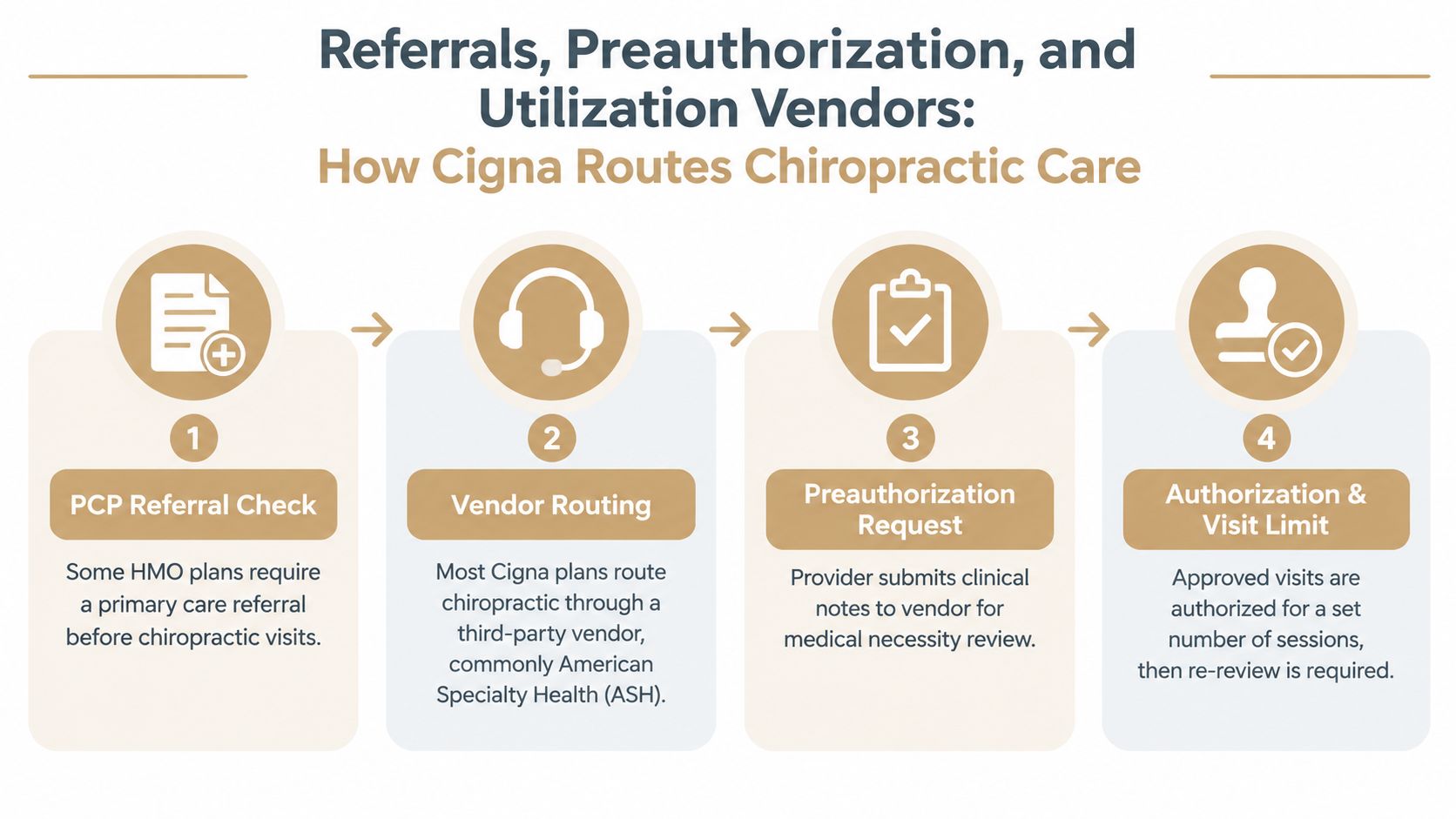
PCP referral rules depend on plan design. Don't assume that a PPO avoids every utilization requirement, and don't assume that an HMO referral automatically authorizes the full treatment course. Ask the office whether it participates with the required vendor under your exact plan ID and network.
Benefits verification should happen before the first appointment, not after the first explanation of benefits arrives. Call the member services number on your Cigna card and ask focused questions that force a usable answer.
Write down the representative's name, the call date, and the reference number. A verbal confirmation doesn't guarantee claim payment, but a detailed record gives the office something concrete to compare against the later claim response.
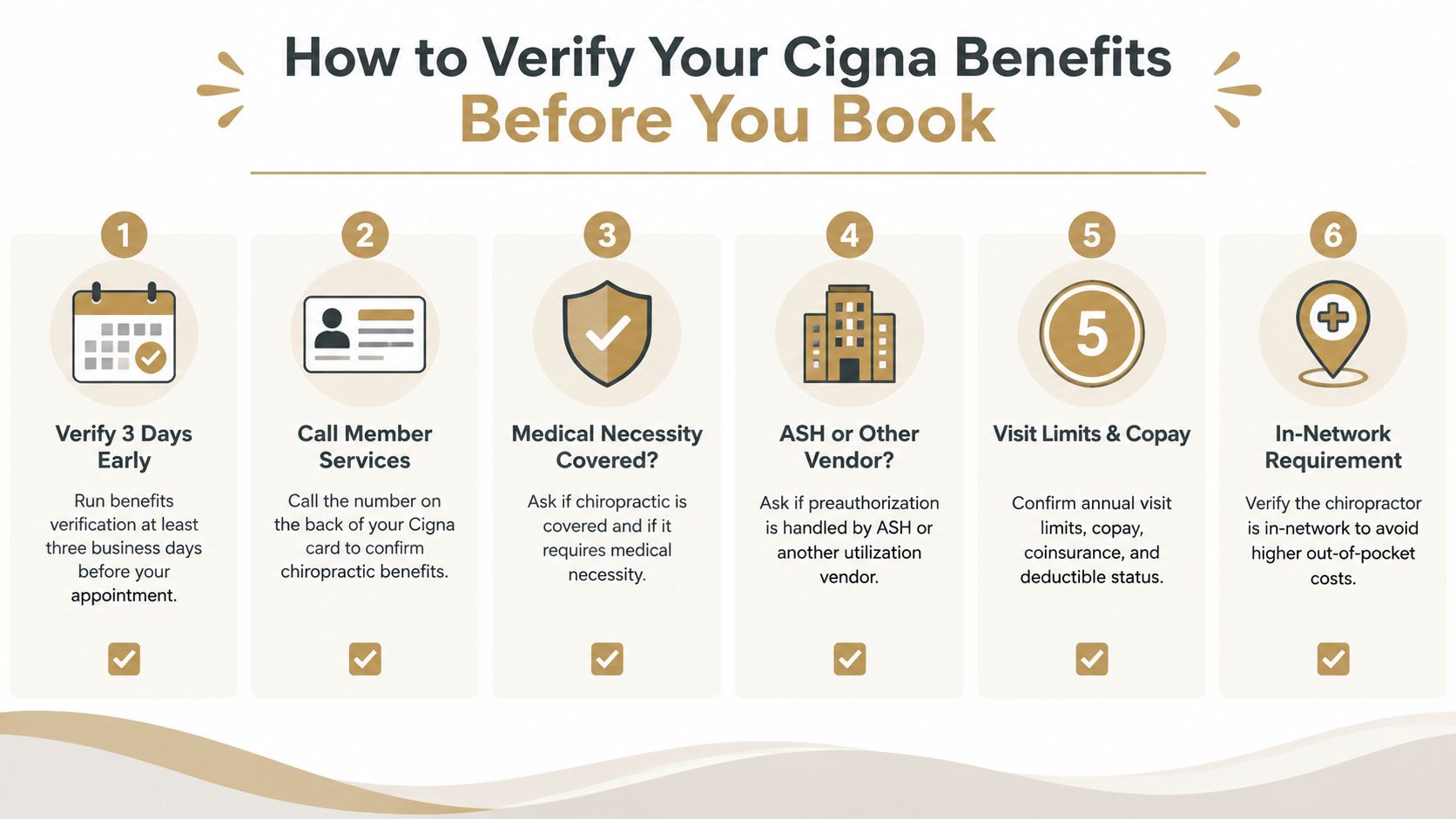
The provider's office should verify eligibility using the same tax identification and network information that Cigna has on file. Ask whether the office participates with the plan's utilization vendor, not merely whether it accepts Cigna generally.
Directory information can lag behind actual contracting changes, so compare the insurer's response with the office's eligibility breakdown. If you're researching local healthcare marketing or trying to rank in Google's map pack, remember that online visibility doesn't replace plan-specific verification.
Bring the call reference number to the first visit. Ask the office to explain what it confirmed, what remains subject to authorization, and which services may be excluded. This short conversation can expose a shared visit limit or deductible rule before treatment begins.
A covered service can still produce a bill. The shift usually happens when the patient or office crosses a utilization threshold that wasn't visible in the initial benefits summary.
Consider a patient who begins chiropractic care for back pain after using physical therapy earlier in the year. The patient hears that chiropractic is covered, schedules treatment, and pays the expected cost share. Later, the plan counts both services against one combined therapy maximum. Once the shared pool is exhausted, additional visits may deny even though the original chiropractic benefit remains listed.
| Trigger | How It Happens | Patient Outcome |
|---|---|---|
| Annual visit limit | The member reaches the plan's allowed chiropractic visits | Later visits may be denied or require a new review |
| Combined therapy limit | Chiropractic shares visits with physical, occupational, or speech therapy | Earlier therapy reduces the remaining chiropractic allowance |
| Daily coding limit | The claim includes more than the permitted timed services for one date | Excess services may be unpaid or assigned to the member |
A second scenario involves a single appointment with an adjustment, manual therapy, therapeutic exercise, and neuromuscular re-education. The treatment may be clinically organized, but the claim can still trigger Cigna's four-code daily cap. The office must decide whether to revise the code combination, obtain clarification, or explain that an additional service may not be reimbursable.
The right response isn't to hide services or bill inaccurately. It's to monitor utilization before treatment is delivered. The office should know how many visits remain, which codes are being submitted, and whether the authorization covers the planned treatment. Patients should ask for that information before a balance appears.
If cost becomes the deciding factor, review practical questions about finding a low-cost chiropractor, including what the office charges when insurance limits are reached.
Clean billing starts with matching the treatment plan to the plan's actual limits. Cigna's policy permits up to four timed codes per date of service, so adding several therapy codes alongside an adjustment can create a denial risk when the daily bundle is exceeded (Cigna's chiropractic medical policy). The office should check the code combination before submitting the claim, not wait for the explanation of benefits.
Network status comes first. In-network care generally follows the plan's contracted allowed amount and member cost-sharing. Out-of-network care may use a separate deductible and coinsurance structure, and the member may face additional responsibility when the provider's charge exceeds the plan's allowed amount.
Authorization comes next. Compare the authorization number, approved visit count, dates, diagnosis, and billed services. A claim can deny because the office used an expired authorization, exceeded the approved visits, or submitted a service outside the approved treatment scope.
Medical necessity needs evidence. Useful records include functional goals, objective progress, a treatment plan, changes in symptoms or mobility, and the clinical reason for continuing care. Notes should connect treatment to function, not merely repeat that the patient still reports pain.
Check the plan's appeal instructions and deadline. The billing guidance for this case calls for requesting claim reconsideration within 180 days, but the member should confirm the applicable deadline in the plan document or denial notice.
Use the denial language in the response. If the payer says the service exceeded units, identify the billed units, the applicable policy, and the correction or documentation supporting the claim. If the denial says authorization was missing, attach the approval record or request a review of the authorization mismatch. If the issue is medical necessity, submit the treatment plan, functional goals, progress notes, and clinical rationale.
Keep copies of the claim, EOB, authorization, notes, and correspondence. If internal reconsideration fails, ask about the next appeal level and contact the state insurance department when the dispute involves a regulated coverage or claims-handling issue. For additional guidance on how to find help with claim denial, use a resource that explains the documentation and escalation process.
Cigna chiropractic coverage is real, but it isn't a flat yes or no. The plan determines whether the benefit has a separate annual limit, shares visits with other therapies, requires preauthorization, or applies a deductible before the member pays only a copay.
The most important operational limits are easy to state:
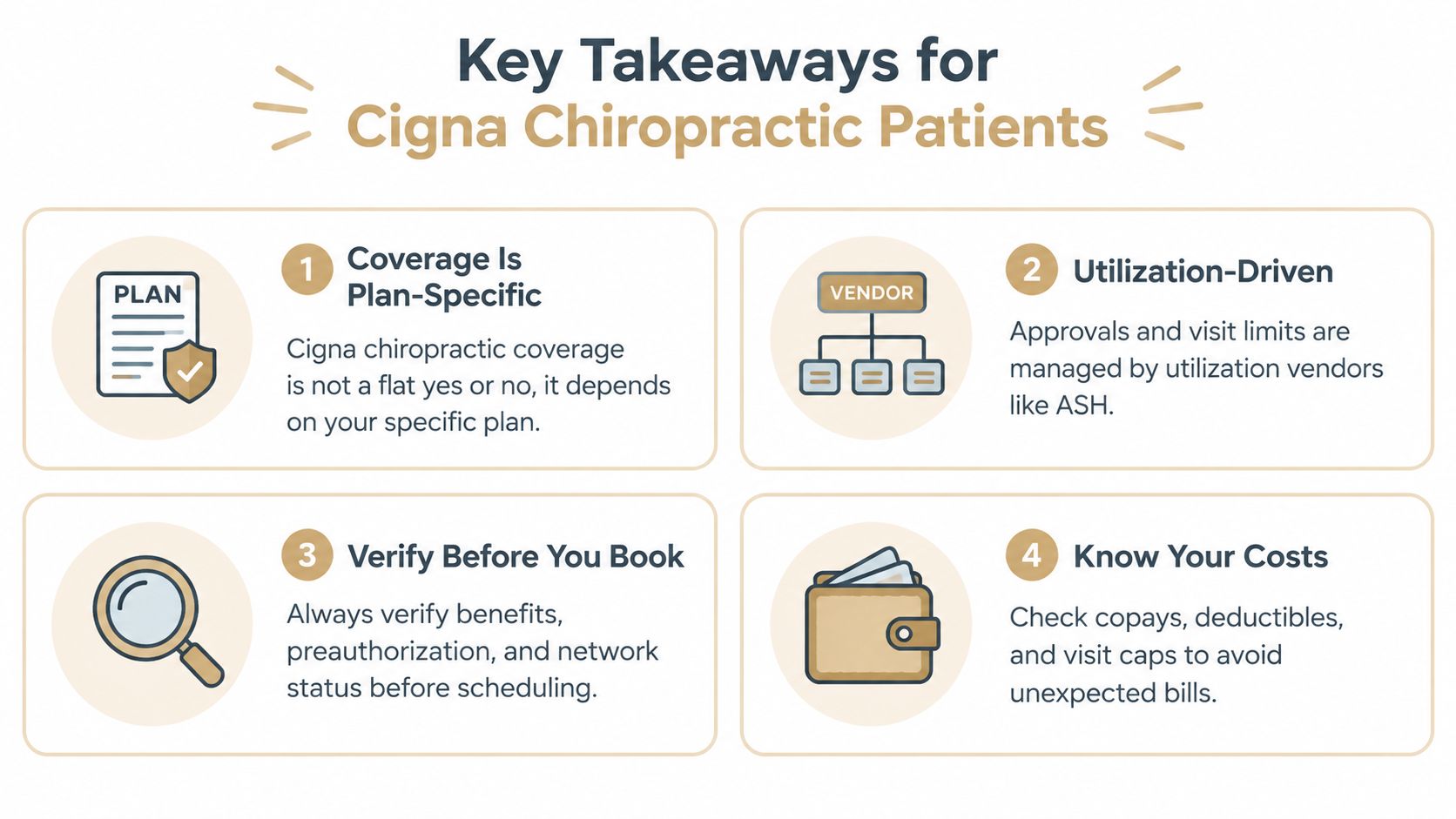
Before booking, call the number on the insurance card and confirm the chiropractor's network status, annual visit limit, combined therapy rules, authorization vendor, copay, coinsurance, and deductible. Record the representative's name and reference number, then ask the office to verify benefits under the same plan and vendor information.
Good documentation also matters when a primary care office, specialist, or chiropractor coordinates treatment. Resources about care plan documentation for GPs can help explain why clear goals, treatment details, and progress records matter when authorization or medical necessity is reviewed.
The safest answer to “does Cigna cover chiropractic care” is this: often, yes, but only within the rules of your specific plan. Verify before the first visit, monitor the remaining allowance, and ask about patient responsibility before adding services.
Aspen Falls Wellness offers chiropractic adjustments, spinal decompression with the DRX 9000, SoftWave Therapy, MLS Laser Therapy, massage, acupuncture, mobility therapy, rehabilitation exercise, and personalized care plans in Salt Lake City and Sandy. Visit Aspen Falls Wellness to discuss your condition, confirm whether your Cigna plan may apply, and review the expected costs before treatment begins.

Stay updated with the latest chiropractic news and exclusive offers.