Compare 8 herniated disc chiropractic treatment techniques, from DRX9000 decompression to McKenzie exercises, and learn when to seek evaluation or referral.
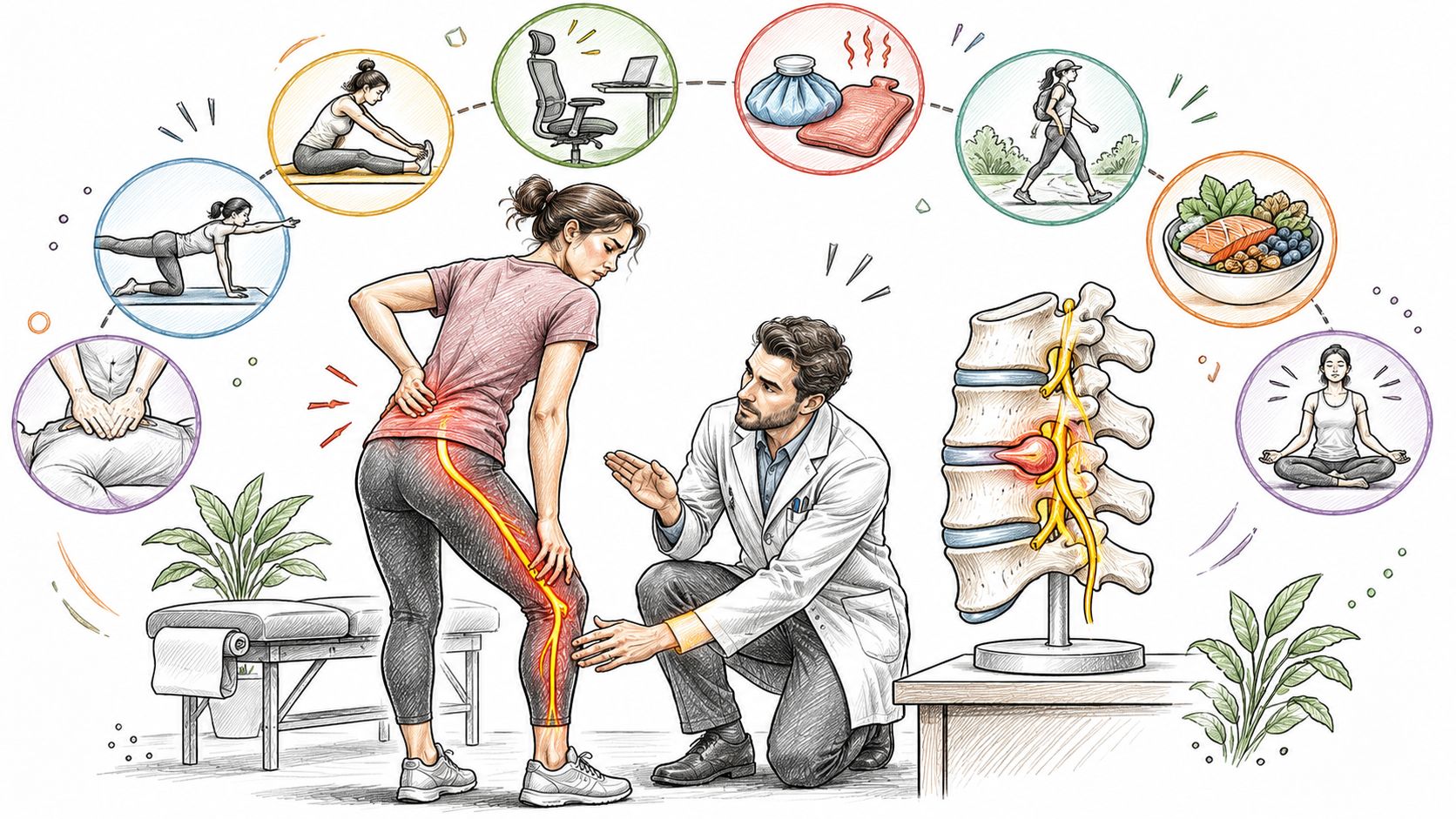
You wake with low-back pain, stand up, and feel a sharp ache travel down one leg. Sitting makes it worse, and you're wondering whether an adjustment, decompression session, or exercise could help you get through the day.
The right choice starts with a diagnosis, not a treatment menu. Radiating pain can accompany an irritated nerve root, but pain alone doesn't establish which disc is involved or whether manipulation is appropriate. A full examination checks strength, sensation, reflexes, movement tolerance, and how symptoms change with different positions.
Herniated disc chiropractic treatment techniques range from hands-on care to active rehabilitation. Options include DRX9000 decompression, spinal adjustments, flexion-distraction, the McKenzie Method, laser therapy, pressure-wave treatment, acupuncture and massage, and coordinated exercise. They don't all treat the same problem, and none should be presented as a guaranteed way to push a disc back into place.
Safety first: New or worsening weakness, numbness around the groin or saddle area, or changes in bladder or bowel control require prompt medical evaluation, not another routine treatment session.
For adults in Salt Lake City and Sandy, the practical question is which approach fits the examination findings, helps daily function, and can be changed or stopped when symptoms aren't improving.
DRX9000 decompression uses a computer-controlled traction table to apply cycles of pulling force and relaxation. A harness transfers that force to the spine while the patient lies supported. The intended purpose is to reduce loading and relieve symptoms, but claims that it reliably draws herniated material back into place go beyond the evidence.
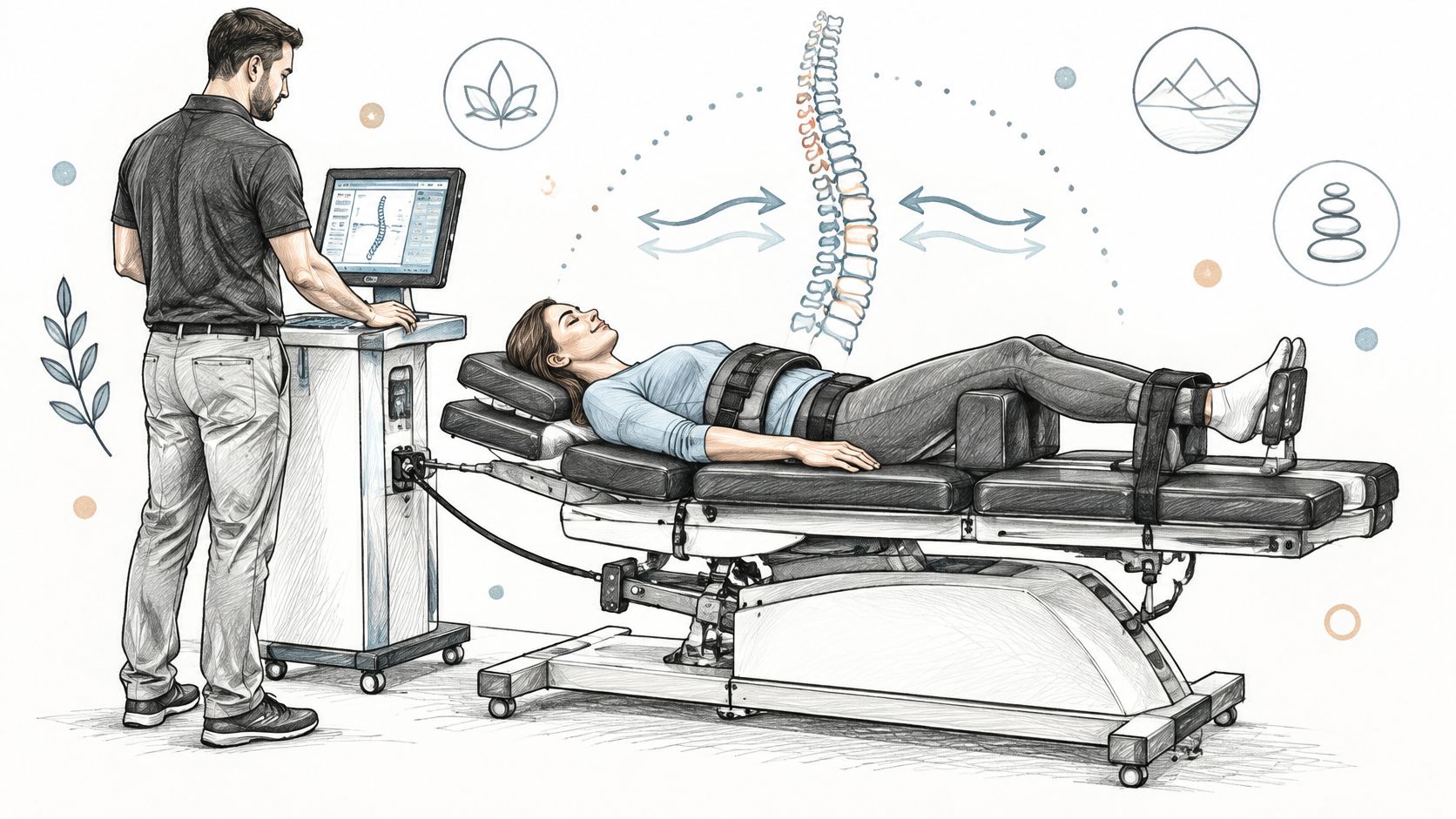
Traction isn't a routine recommendation for sciatica. The NICE low-back-pain and sciatica guideline recommends against traction for low-back pain with or without sciatica. Its separate recommendation about considering spinal decompression surgery after unsuccessful nonsurgical treatment shouldn't be confused with approval of a motorized traction device.
If decompression is considered, the clinician should explain that limitation, review the examination and relevant imaging, and establish measurable goals. An MRI referral may be appropriate when findings would change care; an X-ray doesn't show the disc itself.
For example, someone with stable leg pain might undertake a monitored trial alongside guided exercise. Progress would mean more than temporary comfort on the table.
We begin decompression care with an examination and use it alongside chiropractic care, not as an isolated device treatment. Our explanation of the pros and cons of spinal decompression can help you prepare for that discussion.
A Diversified adjustment involves a quick, controlled thrust through a small range of joint movement. The clinician selects the position and contact according to the examination, rather than applying the same maneuver to every painful back.
For selected patients, manipulation may help relieve symptoms and make movement easier. The North American Spine Society guideline on lumbar disc herniation with radiculopathy identifies spinal manipulation as an option for symptomatic relief, not a replacement for medical evaluation or necessary surgical care.
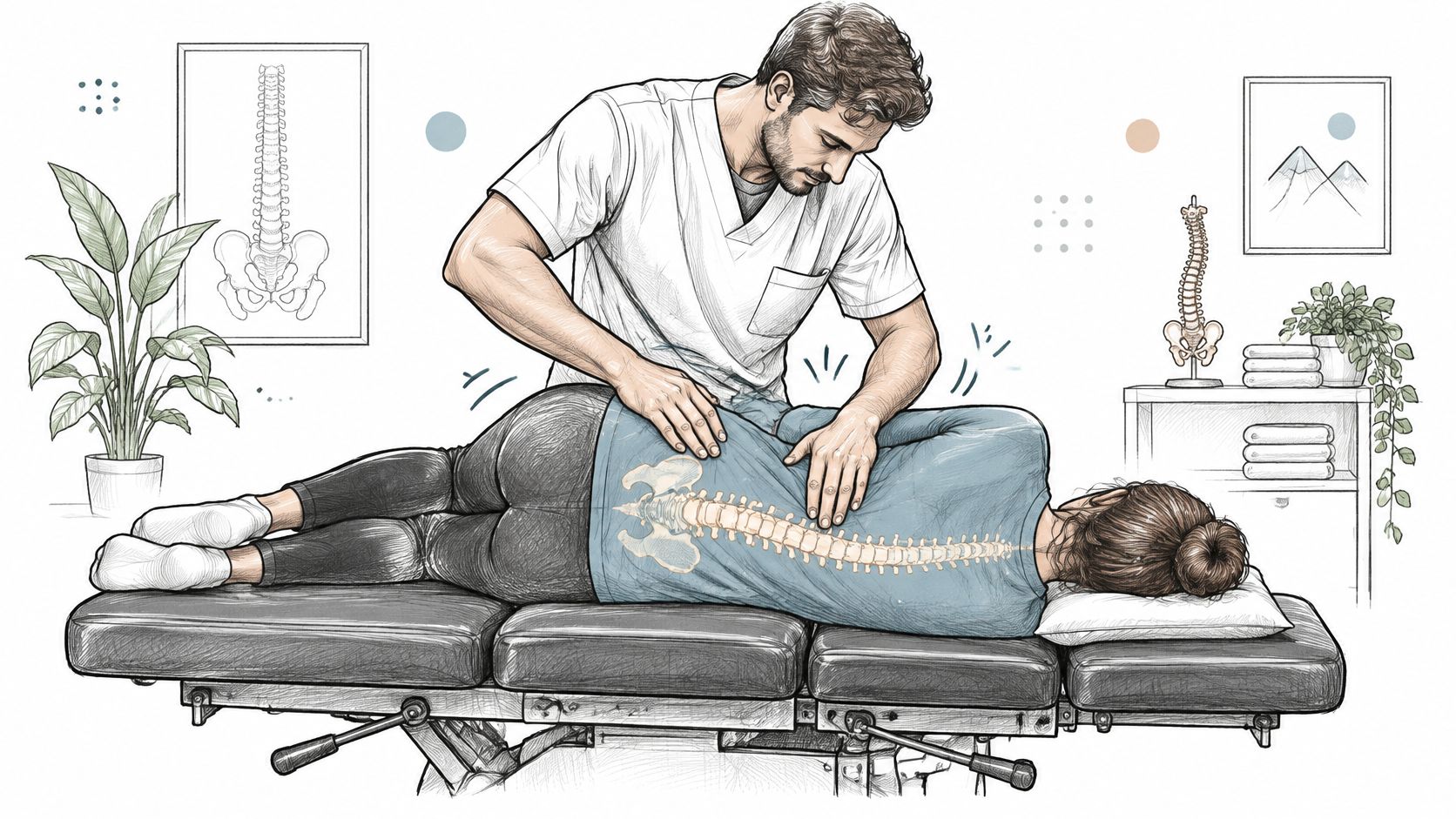
A possible candidate has tolerable mechanical pain, stable neurological findings, and movement restriction that the clinician believes is appropriate to treat. Someone with rapidly worsening weakness, suspected fracture, infection, or severe neurological compromise needs referral instead.
Say your back feels stiff and your leg symptoms remain stable during positioning. A clinician might consider a carefully selected adjustment, then recheck your symptoms and movement before deciding whether to repeat it. Sharp pain or symptoms spreading farther down the leg would change that decision.
An adjustment should help you move toward a functional goal. A louder pop or a stronger thrust isn't evidence of better treatment.
Share previous surgery, injuries, medications, and any neurological changes before treatment. Realignment shouldn't be understood as physically replacing a herniated disc or permanently correcting an MRI finding.
We evaluate progress with each adjustment and tailor care to the patient's response. Home movement and rehabilitation remain important because temporary pain relief alone doesn't establish lasting improvement.
A sensitive back may not tolerate a rapid thrust. Flexion-distraction, commonly associated with Cox Technic, uses a specialized table whose moving section allows the clinician to guide gentle bending and distraction of the lumbar spine.
The treatment differs from a Diversified adjustment in speed, positioning, and force delivery. It's intended to change mechanical loading while the clinician monitors symptoms, not to force disc material into a predetermined position.
A clinician may consider this approach when supported positioning feels comfortable but thrust manipulation doesn't. However, evidence supporting manual therapy generally doesn't prove that a specific branded technique is superior for a particular disc herniation.
The California low-back guideline supports selected manipulation or mobilization for acute or subacute radicular syndromes without neurological deficit, particularly when care helps patients participate in rehabilitation. That supports careful selection, not automatic treatment based on an MRI label.
Consider an older adult with a lumbar disc bulge, back stiffness, and stable leg discomfort. A clinician might test a low-force position, monitor the response, and pair tolerated treatment with walking and individualized movement.
If the position aggravates symptoms, the clinician should modify or stop it. Lower force isn't a substitute for neurological screening, and repeated visits without functional progress need a fresh assessment.
Suppose bending backward reduces calf pain, while prolonged slumped sitting brings it back. That response may help a clinician identify a directional preference, a central concept in the McKenzie Method, also called Mechanical Diagnosis and Therapy.
The method uses repeated movements and sustained positions to classify how symptoms respond to loading. It isn't a set of back-extension exercises, and not everyone with a herniated disc should perform press-ups.
Centralization describes symptoms retreating from farther down the limb toward the spine. A clinician may use that response to guide exercise selection, while also checking strength, sensation, and overall tolerance.
The opposite pattern, symptoms spreading farther down the leg, deserves attention. Don't keep repeating a movement just because someone online recommends it for disc pain.
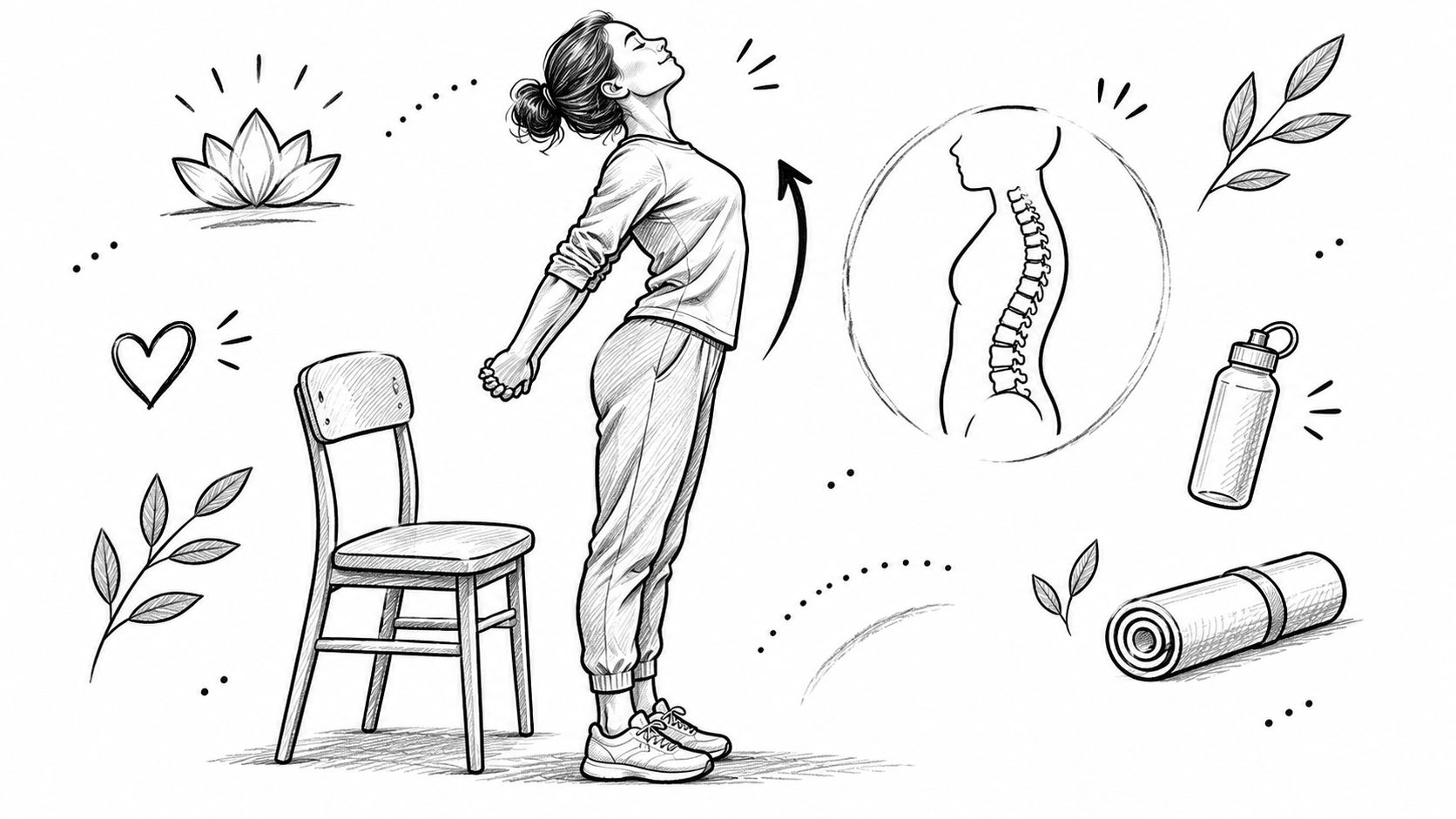
For a desk worker with lumbar pain and intermittent sciatica, a take-home plan might include a tested movement, changes to sitting habits, and short activity breaks. The clinician should specify the exercise dose and explain which symptom changes mean stop.
The WHO exercise evidence summary supports structured exercise for chronic primary low-back pain but excludes sciatica from the relevant evidence. Generic back-exercise findings therefore shouldn't be treated as proof for every acute disc presentation.
Our Dr. Jeremy Kaier has extensive training in the McKenzie Method. Treatment selection still depends on your examination, not the method's name.
MLS® Laser Therapy delivers light energy to tissue and is used as an adjunct for pain and inflammation management. It isn't a hands-on adjustment, a traction treatment, or a way to mechanically remove pressure from a nerve root.
The distinction matters when leg symptoms dominate. Feeling less sore after a session doesn't establish that a disc has healed or that neurological compression has resolved.
A possible use case is someone whose back and surrounding tissues are painful enough to limit participation in rehabilitation. Laser may be considered as an adjunct while the clinician continues to assess leg symptoms, movement, and neurological findings.
For example, a person with sciatica might receive laser alongside an individualized exercise plan. The useful question is whether that person can walk, sleep, and complete prescribed activity more comfortably, not whether the treated area feels warm or relaxed.
The sources supporting this discussion don't establish that MLS laser reverses disc herniation or reliably treats disc-related nerve compression. It should remain an optional adjunct, not the foundation of a disc-repair promise.
Review these MLS laser therapy side effects and safety considerations before treatment. New weakness or spreading numbness requires clinical reassessment regardless of whether local pain has improved.
Pressure-wave treatments direct acoustic energy into tissue through an applicator placed against the skin. They may be discussed when muscle tenderness and guarding accompany back pain, but the technology and treatment target need to be identified accurately.
SoftWave shouldn't automatically be equated with every radial pressure-wave device. Acoustic-wave systems differ, so the clinician should explain the actual equipment, the tissue being treated, and the intended purpose rather than treating all shockwave terminology as interchangeable.
For a disc-focused plan, the relevant distinction is between sore surrounding muscles and a nerve-root problem. A treatment directed at tender soft tissue shouldn't be described as physically decompressing the spinal canal or repairing a herniated disc.
Consider someone whose leg symptoms are stable but whose lower-back muscles remain guarded. A clinician might consider tissue-focused treatment alongside mobility work, then assess whether the person bends or walks more comfortably.
Keep the target clear: Reduced muscle tenderness doesn't prove that nerve compression has changed.
The evidence cited for lumbar disc care here doesn't establish SoftWave as a proven treatment for disc herniation. Any use should have a specific purpose, a tolerable application, and a reason to continue based on measurable benefit.
Before treatment, disclose bleeding disorders, blood-thinning medication, implanted devices, recent injuries, and previous procedures. The clinician needs that information to determine suitability and precautions.
Don't assume tenderness is necessary for success or that worsening pain means healing. Increasing radiating pain, numbness, or weakness calls for reassessment, not a more intense application. After a collision, examination for traumatic injury comes before treatment aimed at loosening tight muscles.
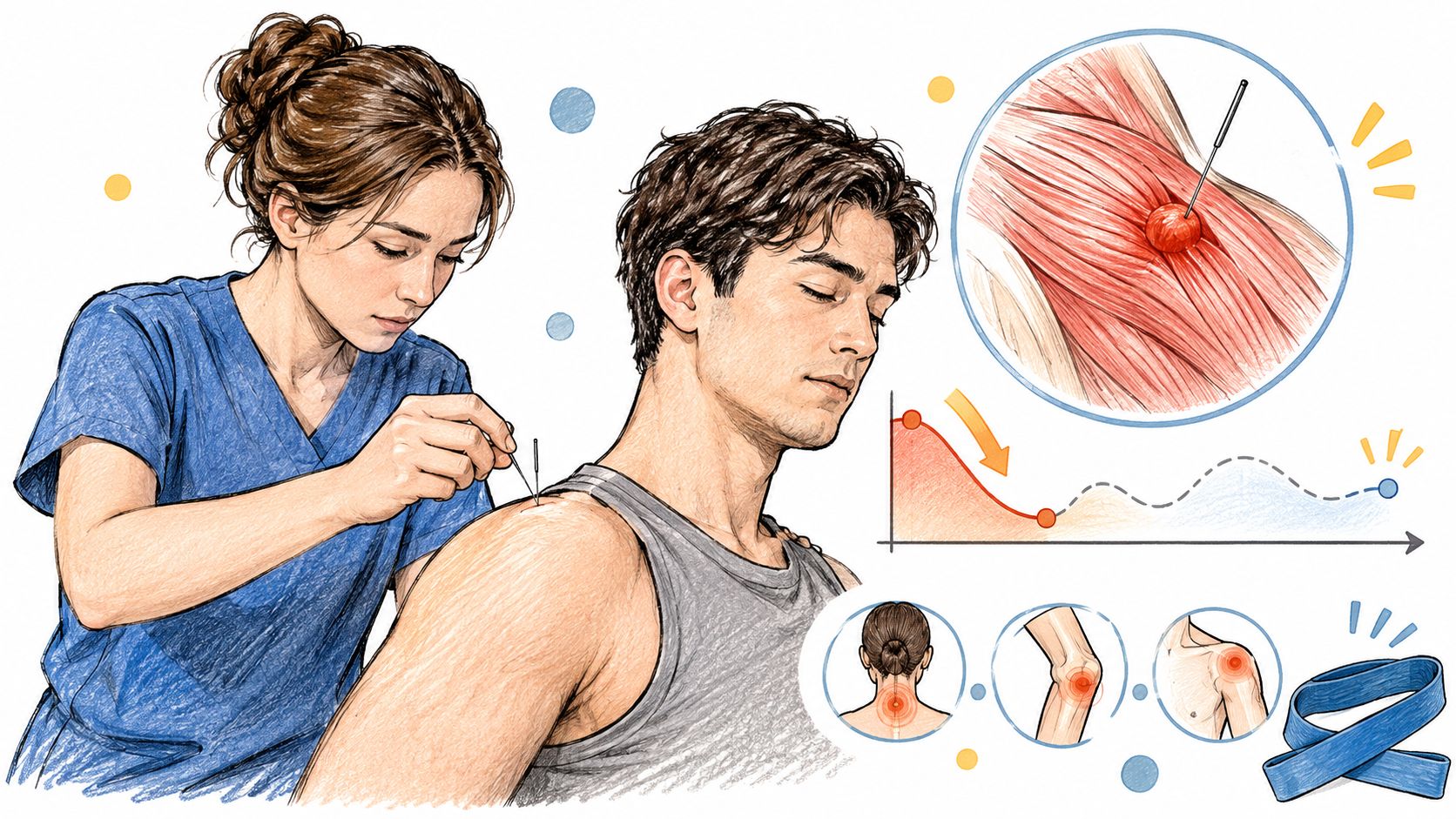
Acupuncture and massage address different parts of the pain experience. Acupuncture uses thin needles to influence pain signaling, while massage applies hands-on pressure and movement to muscles and other soft tissues.
Neither should be described as pushing disc material back into place. Their possible role is to improve comfort and reduce guarding while the patient continues appropriate movement and rehabilitation.
A randomized trial published in Frontiers in Medicine found improved pain outcomes with acupuncture combined with manipulation in people with lumbar disc herniation. Because the treatment combined approaches, the result doesn't establish what acupuncture alone would accomplish.
Say you have stable sciatica and tense back muscles that make getting comfortable difficult. Massage might focus on tolerable soft-tissue work, while acupuncture is considered for pain modulation, with both coordinated around your exercise plan.
Deep pressure directly over a sensitive area isn't automatically helpful. Tell the practitioner if pressure reproduces electrical pain down the leg rather than a local muscular sensation.
Our practitioners coordinate assessment and treatment planning across disciplines, helping keep symptom changes visible to the team. This overview of acupuncture for musculoskeletal pain explains its broader role.
Comfort is valuable, but it isn't the only outcome. If relaxation improves while leg strength or walking tolerance declines, the plan needs medical reassessment.
Rehabilitation turns symptom management into practical capacity. Personal exercise plans can include graded walking, trunk control, strength work, and mobility exercises chosen around the patient's symptoms and goals.
Mobility therapy isn't about stretching every tight area as far as possible. A useful movement should improve a relevant task without repeatedly provoking radiating pain.
The WHO exercise guideline supports exercise for chronic primary low-back pain, while explicitly excluding sciatica from the relevant comparisons. Disc-related rehabilitation therefore needs condition-specific assessment rather than a copied generic routine.
For someone with lumbar disc symptoms, early goals might include tolerating a short walk and rising from a chair comfortably. Progression can then address lifting, carrying, and work demands as symptoms and neurological findings allow.
A golfer may benefit from golf movement screening to identify movement demands before rebuilding swing tolerance. After a car accident, rehabilitation should follow an injury assessment rather than assuming all stiffness is muscular.
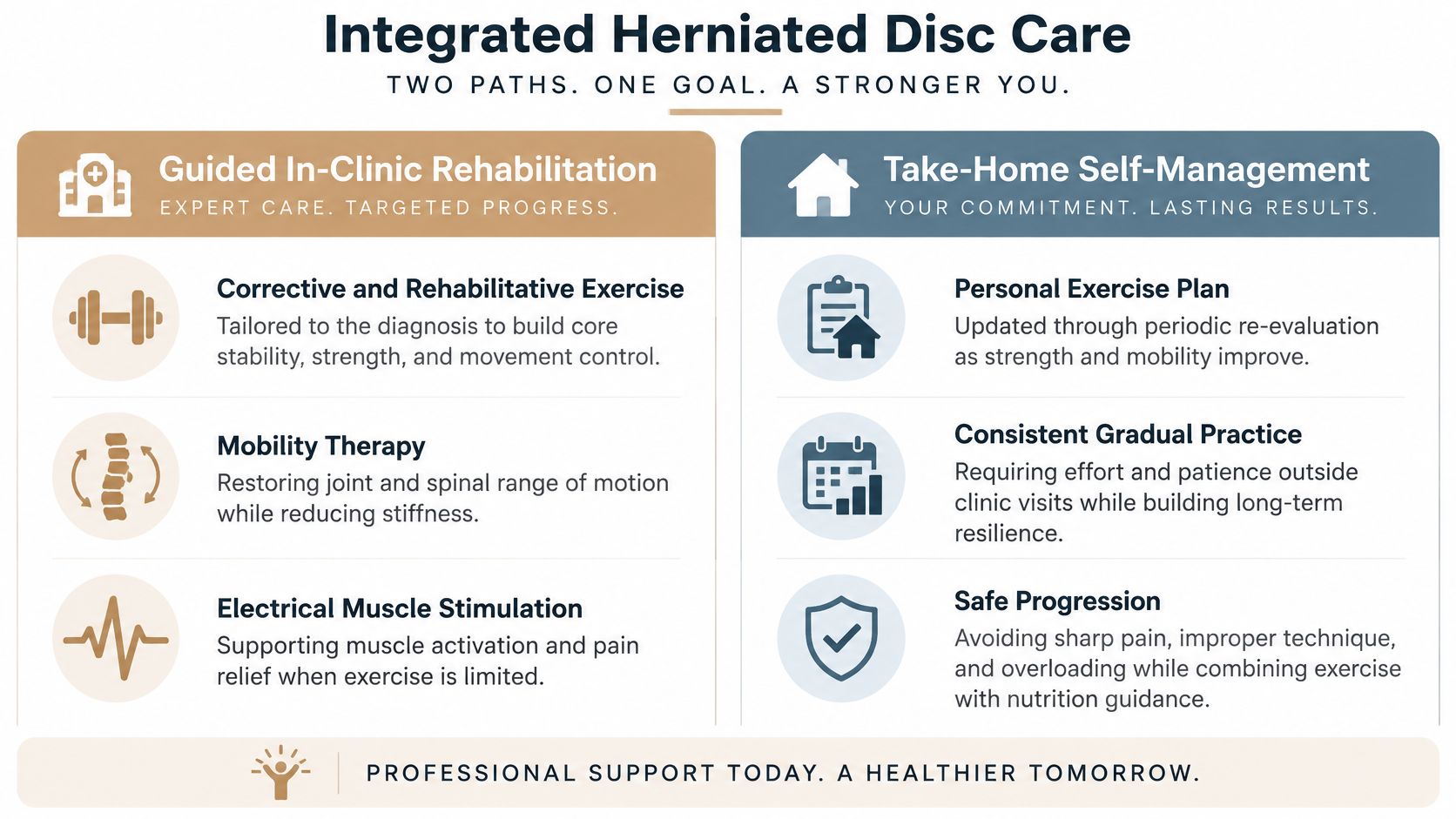
Take-home instructions should explain technique, progression, and stopping rules. Sharp pain, spreading numbness, or new weakness isn't something to train through.
| Technique | Main Goal | Delivery Format | Best Suited For | Key Limitation |
|---|---|---|---|---|
| Non-Surgical Spinal Decompression with the DRX9000 | Reduce pressure on discs and ease radiating symptoms | Computer-controlled traction sessions, often combined with exercise or adjustments | Some lumbar or cervical disc conditions and sciatica | Evidence is mixed; requires multiple sessions and is not appropriate for everyone |
| Chiropractic Spinal Adjustment (Diversified High-Velocity Low-Amplitude Manipulation) | Improve spinal joint motion and reduce mechanical stress | Manual, targeted spinal thrusts, sometimes combined with other care | Patients seeking mobility support for spinal pain | May cause temporary soreness; not suitable for some conditions |
| Flexion-Distraction Technique (Cox Technic) | Gently reduce load on discs and nerve roots | Repetitive, low-force movements on a specialized table | Patients with disc-related pain or low tolerance for thrust adjustments | Evidence is limited and specialized equipment is required |
| McKenzie Method (Mechanical Diagnosis and Therapy) | Identify helpful movement patterns and support self-management | Repeated-movement assessment and home exercises | Patients motivated to manage symptoms with an active home plan | Requires consistent practice and the approach may not suit every presentation |
| MLS® Laser Therapy for Disc-Related Inflammation | Help manage inflammation and pain and support tissue recovery | Non-invasive laser sessions, usually delivered as a series | Patients seeking an adjunct for pain or soft-tissue symptoms | Evidence varies; it is not a standalone cure and multiple sessions may be needed |
| SoftWave Radial Pressure Wave Therapy | Support soft-tissue healing and reduce pain or muscle guarding | Handheld applicator delivers pressure waves, typically over multiple sessions | Patients with surrounding muscle tension or soft-tissue pain | Evidence for disc herniation is limited; temporary soreness may occur |
| Acupuncture and Massage-Based Soft-Tissue Therapy for Disc-Related Pain | Modulate pain and ease muscle tension | Acupuncture needling and manual massage or soft-tissue work | Patients seeking non-pharmacologic support for pain and muscle tension | Results vary; several sessions may be needed, and needling is not suitable for everyone |
| Integrated Rehabilitation Exercise, Mobility Therapy, and Muscle Stimulation | Restore function, strength, mobility, and movement control | Tailored in-clinic exercise and mobility work, optional muscle stimulation, and a home plan | Patients working toward daily activity, sport, and long-term self-management | Requires consistent effort; improper technique or overloading may aggravate symptoms |
The best starting point is a full examination that connects your symptoms with neurological and movement findings. An MRI finding matters when it fits the clinical picture, but it doesn't select a treatment by itself.
We assess the problem before developing a customized plan and arrange imaging referrals when indicated. Previous surgery, a recent collision, changing sensation, or difficulty lifting the foot can materially change the next step.
Improvement doesn't necessarily mean a treatment physically corrected the disc. A systematic review of spontaneous disc resorption reported resorption after conservative treatment in 76.6% of 2,199 cases, although outcomes varied substantially. Natural recovery can occur alongside care, which is why claims of guaranteed disc repositioning deserve skepticism.
Safety also requires individual judgment. A comparative cohort examining cauda equina syndrome found no statistically significant risk difference between spinal manipulation and physical-therapist-led exercise in the studied population, but that doesn't establish that manipulation is suitable for every patient.
New weakness or numbness warrants prompt medical assessment, particularly when it's progressing. New bladder or bowel dysfunction, saddle-area numbness, or rapidly worsening leg weakness calls for immediate emergency evaluation.
Fever with severe back pain, significant trauma, or concern for fracture or infection also changes the pathway. Pain relief from massage, laser, or an adjustment shouldn't delay investigation of those findings.
You don't need to choose among herniated disc chiropractic treatment techniques before being examined. Book an initial assessment to establish what's causing the symptoms, which options are reasonable, and what changes would mean you need specialist care instead.
Aspen Falls Wellness offers examination-led chiropractic care, DRX9000 spinal decompression, and coordinated rehabilitation for disc-related symptoms in Salt Lake City and Sandy. Visit Aspen Falls Wellness to book an initial examination and discuss which conservative options fit your condition, tolerance, and recovery goals.

Stay updated with the latest chiropractic news and exclusive offers.