Learn how TENS units for home use work, what the evidence says, who should avoid them, and how to choose and use one safely.




You've got a sore back, a cranky neck, or a flare-up that showed up at the worst possible time, and you want something you can try at home tonight without making the problem worse. A TENS unit can be useful in that moment, but only if you treat it like a short-term pain tool, not a cure, and only if you know when it's a good fit and when it isn't.
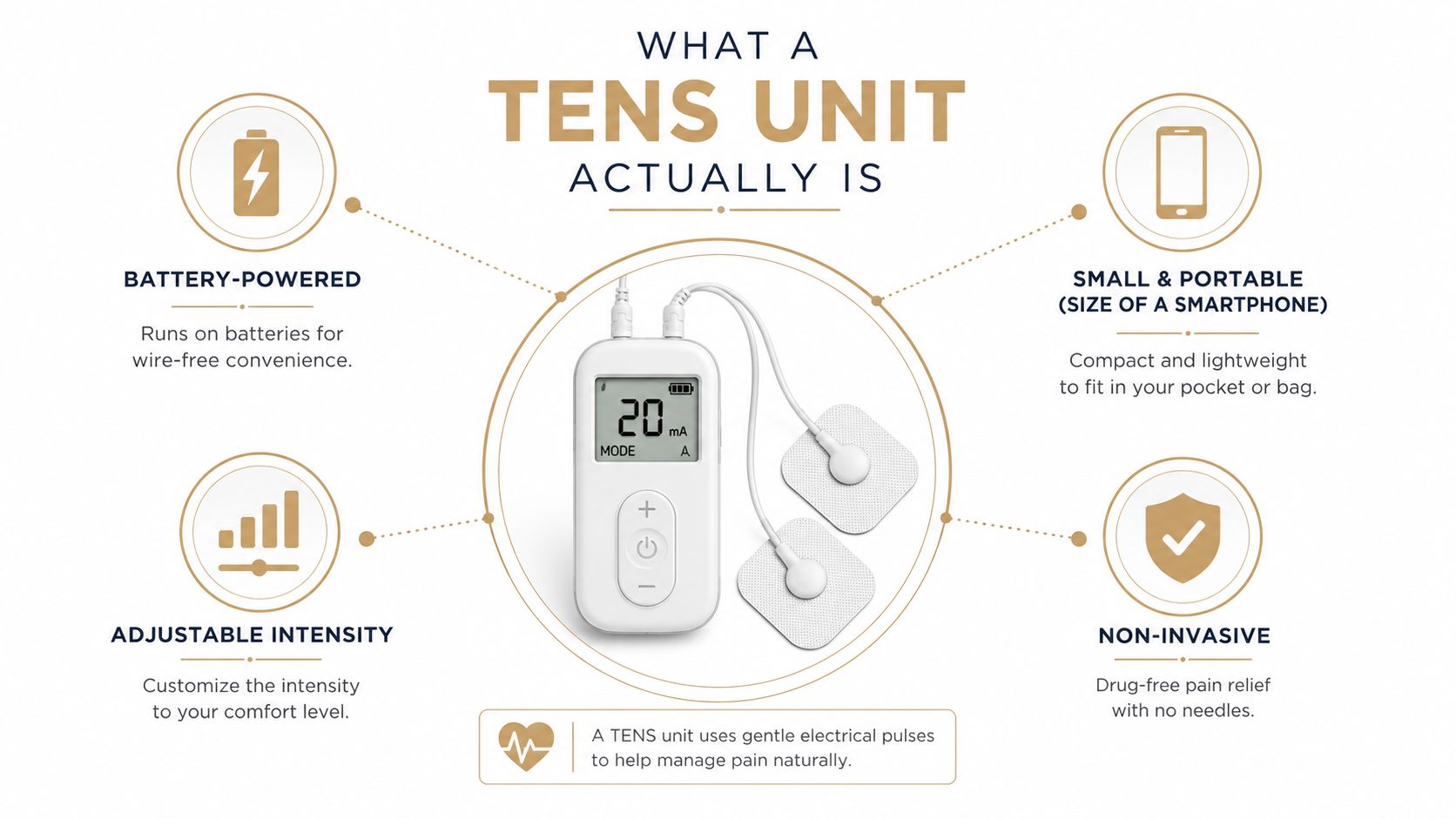
Someone reaches for a device on the nightstand because pain is making it hard to sleep, or they're trying to get through a workday without taking more medication. That's the moment they start searching for tens units for home use, and the first thing to understand is simple, a TENS unit is a small, battery-powered device that sends low-voltage electrical current through sticky pads on the skin to help ease pain. Cleveland Clinic notes that clinicians may prescribe one for home use, and many pharmacies sell over-the-counter units without a prescription, so this isn't a niche clinic-only tool, it's a real at-home option for symptom control (Cleveland Clinic).
Think of the device as a signal modulator. It doesn't fix a torn disc, calm an inflamed joint by itself, or rebuild weak tissue, but it can change how strongly pain reaches awareness while it's on. That is why TENS is best understood as a temporary symptom manager, especially when you're trying to stay active enough to do your exercises, walk, stretch, or tolerate hands-on care.
The practical setup is straightforward. Adhesive pads go on the skin near the painful region, the current is adjusted upward until you feel a strong but comfortable tingling, and the session runs for a set period. The details matter because the wrong placement or the wrong intensity can turn a potentially useful session into a weak buzz that doesn't help, or a too-intense session that just irritates you.
A TENS unit can make pain easier to live with. It can also do very little if the pain source needs a different kind of evaluation first. The sections below focus on mechanism, evidence, safety, setup, and how TENS fits into active care, including chiropractic treatment, not on selling the device as a universal answer.
Practical rule: if you want TENS to earn its place at home, it has to make movement easier, not become a substitute for figuring out what's causing the pain.
A home TENS session works by sending controlled electrical pulses through the skin to nearby nerves. For many people, that changes how strongly pain is noticed while the unit is running, which is why relief can show up quickly when the pads are placed well and the setting is tolerable. The usual gate-control explanation helps make sense of that effect, but the practical point is simpler, the signal has to be strong enough to matter without becoming unpleasant.

At a sensory level, TENS is usually felt as a strong tingling rather than a muscle contraction. Home units are commonly built with output ranges around 0–80 mA to 0–100 mA per channel, pulse widths roughly 40–300 µs, and frequencies spanning about 2–150 Hz. Higher frequency settings are often used to keep the sensation in that sensory range, while wider pulse widths and higher current increase the charge delivered, which can also make the treatment feel harsher.
Lower frequency settings are sometimes used for a different pain-modulating effect that may involve the body's own chemistry. For a home user, the theory matters less than the feel. The target is strong but comfortable tingling, not a visible muscle twitch and not a sharp zap.
More intensity does not automatically mean better relief. If the sensation becomes annoying or painful, people stop using the unit too soon, and that usually ends the session before it can help. If the pads are in the wrong spot or the setting is too high, the result is often a twitch, a sting, or plain irritation.
The best home setting is usually the strongest level you can tolerate comfortably for the full session, not the highest level the machine can deliver.
That trade-off is why the device matters less than the way it is used. A well-placed session at a moderate intensity can support movement and treatment tolerance, while a poorly placed session at a high intensity can be useless or irritating.
TENS also fits best as a temporary symptom modulator alongside active care, including chiropractic treatment and other movement-based therapies. When the goal is to make walking, stretching, or exercise more tolerable, that short window of relief can be useful. It should still be screened like any other home modality, especially if you want the session to support the larger plan rather than distract from it. For a related example of symptom-focused care, see this overview of laser therapy for inflammation.
The strongest case for TENS is short-term pain relief, and the best evidence for that comes from a 2022 systematic review and meta-analysis of 91 randomized controlled trials with 4,841 participants. The review found lower pain intensity than placebo during or immediately after treatment, with an overall standardized mean difference of −0.96 and no serious adverse events across the analyzed trials (BMJ Open). For home use, that makes TENS a reasonable option when the goal is brief symptom relief with a low-risk profile.
That result does not mean every person will feel the same benefit. It means the short-term signal is real enough that clinicians can take it seriously, especially when the goal is to keep someone walking, exercising, or getting through a flare-up. For home users, the value is usually practical rather than dramatic. You do not need TENS to erase pain. You need it to lower the volume enough to function.
The most cited cautionary evidence comes from older chronic low back pain research. In a landmark 1990 controlled trial, investigators reported that after one month there was no clinically or statistically significant treatment effect on any of 11 outcome indicators, and overall improvement in pain indicators was 47% with TENS versus 42% with sham TENS, which was not significant (NEJM). A Canadian evidence review later found only two randomized controlled trials and two non-randomized studies on home TENS for chronic pain and concluded that the results were inconclusive overall, with only limited functional gains in some studies.
Both things can be true. TENS can help some people in the short term, and it can fail to beat sham in some chronic pain settings. That is why I treat it as a trialable tool, not a guarantee. If it helps you move, sleep, or tolerate rehab better, it earns a place in the plan. If it does not, the smarter move is to stop chasing stronger settings and reassess the underlying problem.
For readers comparing modalities, a helpful contrast is how a temporary pain tool differs from tissue-focused care such as laser therapy for inflammation, which fits into a broader recovery plan rather than acting as a same-day symptom switch.
A lot of home users assume any ache can be managed the same way. That is where the mistake starts. Numbness, radiating pain, recent injury, pregnancy, and implanted devices are not minor details, they are the first things I want a patient to screen before turning on a unit.

If pain is numb, spreading, or clearly radiating, that can point to a nerve problem that should be assessed first. If pain followed a fall, a car accident, a recent procedure, or a new injury, a device that blunts the sensation may hide a problem that needs a different response. TENS may still have a role later, but it should not be the first move when the story suggests more than routine muscle soreness.
The NHS says not to use TENS on irritated, broken, infected, or numb skin, on the neck, mouth, or eyes, or on the chest and back at the same time (NHS). Healthgrades adds that pads should not go near the heart, on the face, on the front of the neck near the carotid arteries, on broken or irritated skin, around varicose veins, or on numb areas unless a doctor advises otherwise, and people with a pacemaker, heart disease, epilepsy, or pregnancy should not use a TENS machine without physician approval.
TENS can be useful for temporary pain relief, but if the symptom pattern raises concern for nerve involvement or a structural problem, relief alone is not the goal. A diagnosis is.
That is the safety check product pages often skip. They focus on the buzz, not the screening. If you are trying to use a unit for neck symptoms, it also helps to pair symptom relief with active care such as neck pain exercises at home, because TENS is better suited to temporary modulation than to fixing the cause on its own.
A home TENS session works best when the user treats it as a short, controlled trial, not a cure-all. Start with clean, dry skin, then place the pads around the painful area rather than directly on a joint crease, over irritated skin, or on a spot that is already too tender to tolerate contact. If the pads sit too close together, the sensation can feel sharp and cramped, so a little spacing usually gives the current a better path.
That timing matters because people often judge the device too early or expect it to carry them through the whole day. It usually does neither.
If the pads start losing adhesion, the current feels uneven, or the skin gets irritated, stop and reset. Battery-powered units often use a single 9V battery or AAA pack, and some are small enough to carry in a pocket while weighing about 96 to 115 g (battery and form-factor specs). Many models also offer timers from 15 to 60 minutes or continuous mode, which helps users keep sessions consistent instead of improvising each time (battery and form-factor specs).
For neck symptoms, the best results usually come when pain relief supports movement instead of replacing it. A short session can make it easier to follow neck pain exercises at home, and that matters more than chasing a stronger buzz from the unit itself. The same approach fits your repetitive strain prevention plan when the goal is to calm symptoms enough to keep moving without provoking a flare.
A patient with chronic low back pain usually does not need another thing to buy. They need a plan that makes the hard parts of recovery more tolerable. In practice, TENS can do that. I have seen it work best when someone uses it between visits, so they can tolerate a corrective exercise session, a walking program, or a round of manual care without getting shut down by pain.
A patient comes in with recurring lumbar pain and stiffness. After a chiropractic adjustment, the area feels calmer, but the person still flares when they sit at a desk or start their home exercise program. A home TENS session before exercise can lower the pain enough that the movement work feels possible, not dreaded. That makes the device a bridge to rehab, not the rehab itself.
The same logic applies when a patient is dealing with whiplash or soft-tissue irritation. TENS may help them handle the post-visit flare that sometimes follows hands-on care, while other treatments address mobility, inflammation control, and tissue recovery. That blend fits naturally with the kind of coordinated care used in multidisciplinary pain management, and it is why a plan built around chiropractic, manual therapy, and exercise often makes more sense than relying on one modality alone.
TENS does not restore strength, retrain movement, or correct the mechanics that keep irritating the area. Manual therapy, corrective exercise, mobility work, acupuncture, and other non-surgical therapies each have their own role, and TENS only earns its keep if it helps the patient participate in the rest of the plan. That is also why people looking for home strategies may benefit from your repetitive strain prevention plan, because symptom relief works better when the aggravating pattern changes too.
A home device is useful if it makes someone more willing to walk, stretch, or complete rehab work. If it becomes the whole plan, progress usually stalls.
A home TENS unit should be easy to use, easy to trust, and easy to stop using if it is not helping. I look at it the same way I look at any rehab tool, by asking whether it fits the person's pain pattern, whether it is simple enough for consistent use, and whether the safety instructions are clear enough for a home user to follow without guessing.
| Feature | What to Look For | Why It Matters |
|---|---|---|
| Channels | Dual-channel design with independent adjustment | Lets you treat one area or two separate pain regions without constant reconfiguration |
| Output range | Clear current range and adjustable intensity | A vague spec sheet makes it harder to know whether the unit can deliver comfortable stimulation |
| Pulse width and frequency | Published ranges, not just generic “pain relief” language | These settings affect how the sensation feels and how flexible the device is for different pain patterns |
| Battery type | Common battery format that's easy to replace | If the battery is annoying to maintain, people stop using the device |
| Timer options | Adjustable session timing or continuous mode | Makes home use more consistent and easier to repeat |
| Weight and size | Compact enough to carry and store easily | Portability helps with regular use, especially for people who travel or move around during the day |
| Warranty | A real warranty with plain terms | A warranty often reflects the manufacturer's confidence and gives you a fallback if the unit fails |
| Clear safety guidance | Placement warnings and contraindications in the manual | Good instructions reduce misuse and help you self-screen |
A unit with a clear manual, plain warning labels, and honest output information is easier to recommend than one that hides behind marketing language. Some devices also publish their device specifications, and that kind of detail is useful because it lets you compare settings instead of relying on packaging claims. I would rather see a straightforward warranty and clear safety guidance than a long list of modes that most home users will never touch.
If the spec sheet hides the output range, skips placement cautions, or gives no warranty information, I would slow down before buying. The same caution applies when the product reads more like a novelty accessory than a clinical tool. Home TENS is simple, but it still needs serious labeling, because the trade-off is between convenience and the risk of misuse.
Before you turn it on, answer three questions with a clean yes. Is this pain pattern appropriate for self-treatment, or does it suggest numbness, radiating pain, recent injury, pregnancy, or a device-related risk that needs evaluation first? Do you know where the pads belong, and where they absolutely don't belong? Are you using it to support activity or rehab, not to avoid finding the cause of the pain?
If the answer to any of those is no, stop there and get checked. If the answer is yes, keep the session simple, use strong-but-comfortable intensity, and judge the result by whether it helps you move better, tolerate exercise, or get through a flare with less stress. That's the standard I use in practice, because it keeps expectations realistic and keeps the device in the right place in the treatment plan.
For many people, that place is temporary relief while other care does the heavier lifting. If you want help deciding whether a TENS unit belongs in your home routine, or you want a clinician to coordinate it with adjustments, rehab exercise, laser therapy, massage, or spinal decompression, schedule a visit with Aspen Falls Wellness and get a plan built around your actual pain pattern.
If you're trying to manage pain at home but don't want to guess, Aspen Falls Wellness can help you screen the problem, choose the right conservative tools, and build a plan that fits your symptoms and your schedule. Visit Aspen Falls Wellness to talk through whether TENS, chiropractic care, rehabilitation exercise, or another non-surgical option makes the most sense for you.

Stay updated with the latest chiropractic news and exclusive offers.