Learn how pain scale assessment works, which scale your provider uses, and what your score really means for treatment decisions and recovery tracking.




You're sitting down after a long day, your back catches, and you wince before you can stop yourself. The clinician asks, “On a scale from zero to ten, how bad is it?” You pause. Is the question about the sharp pain when you bend, the ache you've felt all afternoon, or the worst moment when you first got out of bed?
That moment is where pain scale assessment begins. A number can help your care team track change, but it can't tell the whole story by itself. The most useful assessment combines your score with where the pain is, what it feels like, when it appears, what makes it better or worse, and how it affects movement, sleep, work, and daily activities.
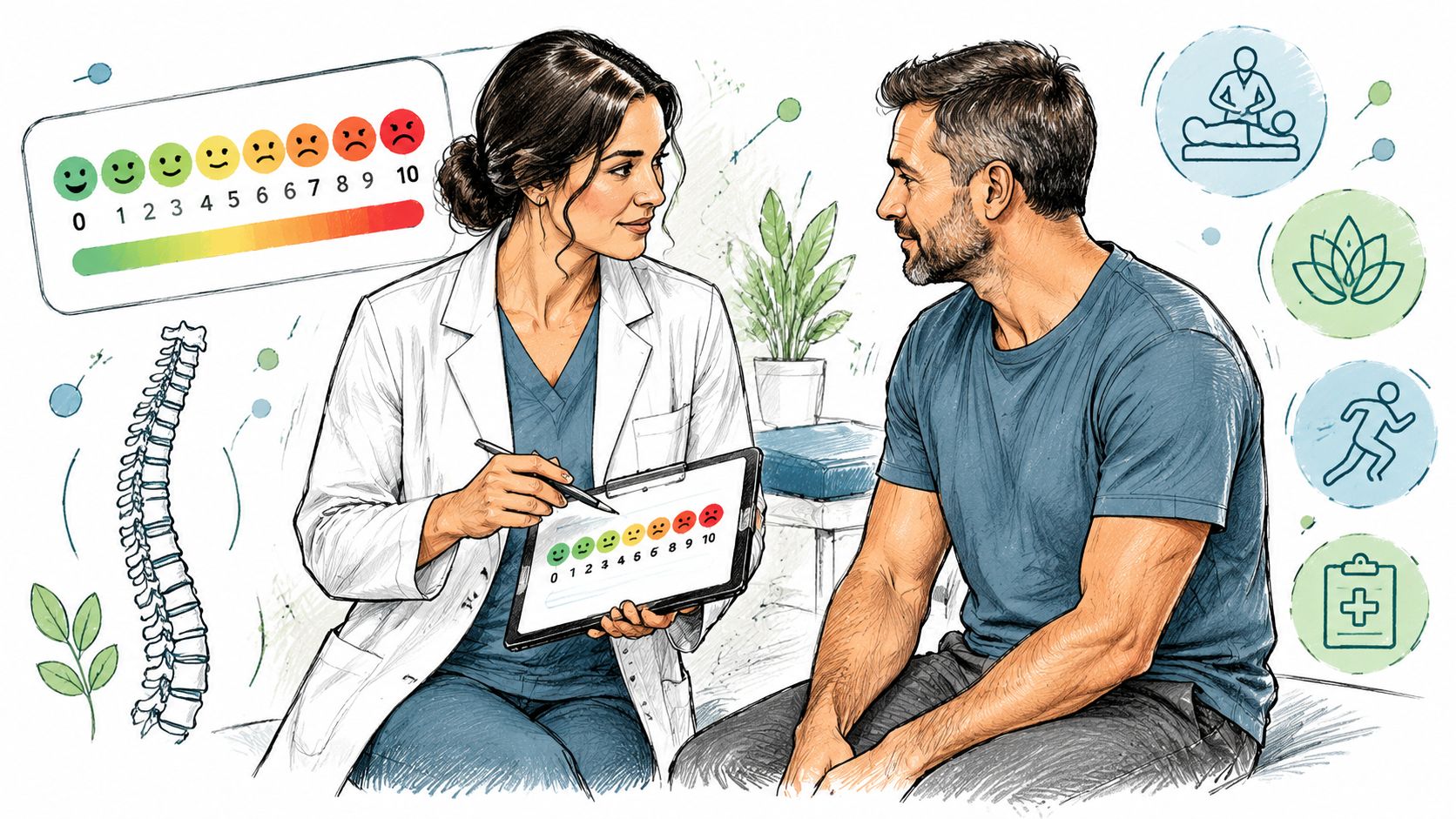
Pain scale assessment is a structured way to turn a subjective experience into a value that can be compared over time. Instead of recording only “my back hurts,” a clinician may ask you to choose a number on the 0–10 Numeric Rating Scale, mark a point on a visual line, or select a face that matches how you feel.
That structure matters because pain is personal. One patient's “moderate” pain may be another patient's “severe” pain. A standardized tool gives the patient and clinician a shared reference point for progress notes, reassessments, and care-plan decisions. The Numeric Rating Scale, for example, asks patients to select a whole number from 0 to 10, with 0 meaning no pain and 10 meaning the worst pain imaginable. The NRS-11 is widely used for clinical pain measurement.
A score mainly describes pain intensity at a particular moment or during a specified period. It doesn't automatically explain:
That's why a pain number should start a conversation rather than end it. A patient might report a 3 while avoiding lifting a child, or a 7 while still completing normal activities. Neither score is automatically more credible. Each needs context.
Practical rule: Give the number, then give the situation that makes the number meaningful.
In chiropractic and integrative care, the score can support decisions about examination, movement testing, exercise progression, spinal decompression, soft-tissue treatment, or referral. It's one measurement within a broader clinical picture, not a verdict about whether your pain is “real.”
Different patients need different ways to describe pain. Four formats commonly appear in outpatient musculoskeletal care: the Visual Analog Scale, the Numeric Rating Scale, the Wong-Baker FACES scale, and the Verbal Descriptor Scale.
| Scale | Format | Scoring Range | Best Fit For |
|---|---|---|---|
| Visual Analog Scale, VAS | A 100 mm line anchored by no pain and worst pain imaginable | Continuous line measurement | Adults who can understand the visual task and want sensitivity to small changes |
| Numeric Rating Scale, NRS-11 | Patient chooses a whole number | 0 to 10 | Adults in clinic, rehabilitation, follow-up visits, and phone conversations |
| Wong-Baker FACES | Patient selects the face that best represents their pain | Usually presented as an ordered series of faces | Children and patients who find pictures easier than numbers or words |
| Verbal Descriptor Scale, VDS | Patient selects a word such as mild, moderate, or severe | Ordered verbal categories | Patients who prefer language-based choices over numerical ratings |
The VAS typically uses a 100 mm line with “no pain” at one end and “worst pain imaginable” at the other. The patient marks the line, and the clinician measures the position. Its continuous format can detect smaller changes than an ordered category scale, but it requires a paper form, physical slider, or suitable digital interface. Historical analysis traces the modern form to a 1969 publication, with earlier use in 1921 and later validation for pain measurement in 1974. The history and development of the VAS are reviewed in this pain-measurement analysis.
The NRS-11 is usually the fastest option. You hear the anchors, choose a whole number from 0 to 10, and can repeat the process at later visits without needing a form. That makes it practical in person, during rehabilitation check-ins, and over the phone. Clinical guidance describes its validity and reliability while also recognizing that it remains a generic measure.
Faces scales can help when numbers feel abstract, especially for children or patients with limited literacy. A verbal descriptor scale works in the opposite direction. It gives the patient words, which can feel more natural than assigning a number.
All four tools measure intensity, not the full impact of pain. None directly measures your sleep, mood, confidence, endurance, or ability to perform a specific task. Those details need to be documented separately.
A pain score becomes useful when the clinician records the situation around it. At intake, you may report your current pain, then describe your average and worst pain during the prior 24 hours. The clinician repeats the number aloud, giving you a chance to correct it before the examination.
For example, “It's 4 while I'm sitting, but it reached 7 when I rolled out of bed” shows more than a bare 4. It links the symptom to position and movement, which can guide the examination and care plan at a chiropractic or integrative practice.
The wording and timing should stay consistent at the initial evaluation, follow-up visits, and discharge review. Using “pain while sitting” at one visit and “pain after walking” at another is like measuring with different rulers. The numbers may look comparable while answering different questions.
A chart may capture the visit as a short timeline:
The number is stored with other clinical findings, while free text supplies context such as side of the body, aggravating factors, and function. Clear intake questions can also help practices streamline coaching onboarding by collecting consistent information before an appointment.
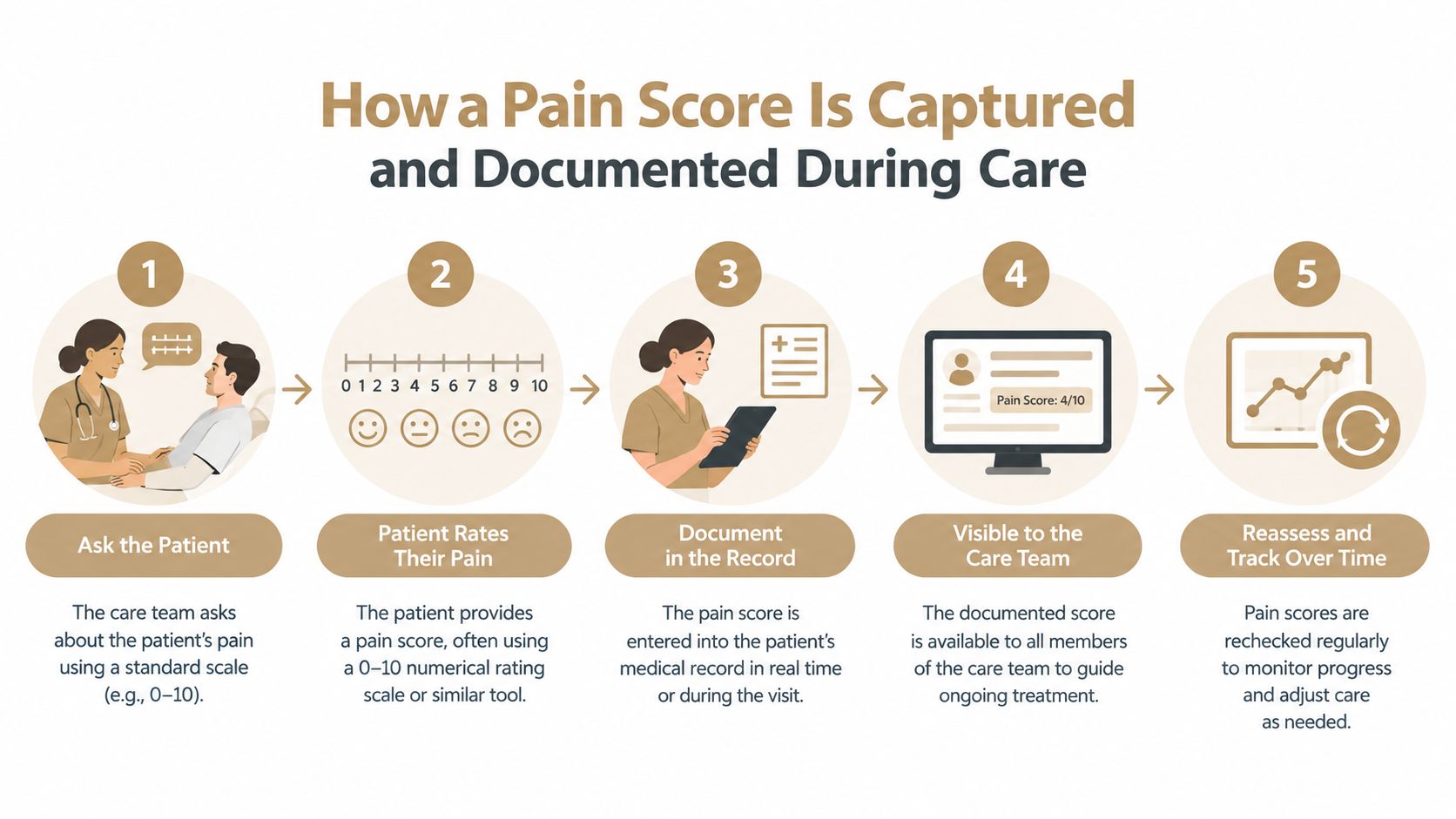
Numbers can mislead if context is missing. A patient may report a lower score after treatment because they are resting, while pain returns during work or sleep. Another patient may choose the same number despite improved movement. For that reason, the record should pair each score with when it was taken, what the patient was doing, and how the symptom affected daily activity. Consistent documentation turns a single number into a trackable clinical story.
Many clinical handouts group NRS scores into practical bands:
These categories help organize a conversation, but they don't dictate treatment on their own. A moderate score with progressive weakness may require a different response from a moderate score that improves with movement. Depending on the examination, a clinician may consider changing the care plan, ordering or referring for imaging, coordinating medication questions with the appropriate medical professional, or referring to another provider.
| Score Range | Severity Band | Typical Clinical Response |
|---|---|---|
| 0 to 3 | Mild | Continue or progress appropriate care while monitoring function and symptom behavior |
| 4 to 6 | Moderate | Reassess contributing factors, tolerance, activity limits, and response to treatment |
| 7 to 10 | Severe | Perform a more urgent clinical review, screen for concerning features, and consider escalation or referral |
A small numerical change can matter, especially when it matches a real functional improvement. One study reported a clinically significant NRS-11 change of about 1.39 points, while a review identified an average reduction of 1 point or 15% as a minimum clinically important difference in a particular context. These findings show why small score changes shouldn't be dismissed automatically.
More recent postoperative research reported an NRS minimum clinically important difference of 1.5 points and a patient-acceptable symptom-state threshold of 3.5 or lower. The study adds a patient-centered target beyond simple improvement.
Consider two examples. A patient moving from 7 to 4 after spinal decompression may be improving, but still needs function and examination findings reviewed. A patient remaining at 6 despite repeated care may need a reassessment rather than more of the same. A personalized treatment plan should respond to the pattern, not just the latest digit.
A patient says “7,” yet walks normally into the clinic. Another says “3,” but cannot sleep, drive, lift, or care for family. Those numbers are useful starting points, not laboratory measurements. A pain score is a personal estimate shaped by language, culture, expectations, past experiences, and trust in the clinician.
Interpretation can also carry bias. Pain may be underestimated in women and Black patients, while objective biomarkers are not ready for routine pain assessment. This review discusses bias, workflow gaps, and the need to pair intensity with function. The practical safeguard is to ask what the person can do, what has changed, and how symptoms behave, rather than letting the digit stand alone.
A score describes perceived intensity. It does not directly describe capability, risk, or the amount of support someone needs. A person living with persistent pain may continue working after adapting routines, while a lower score may still prevent ordinary activities.
Communication and development create further limits. A 2025 Cochrane review of neonatal pain scales examined 79 studies across 26 countries and 27 rating scales and found very low-quality evidence for all of them. More than 70% did not evaluate content or structural validity. The review's reported evidence gaps challenge the assumption that a standardized scale is automatically trustworthy.

A clinician can strengthen the report by combining the number with observation, context, and communication support:
For people exploring care that addresses more than intensity, nervous system regulation therapy offers context for assessing the broader pain experience.
A pain score becomes useful when it changes what the care team does next. At Aspen Falls Wellness, the score can sit alongside movement findings, range-of-motion checks, functional markers, and the patient's tolerance for treatment. The number doesn't decide whether care continues by itself.
A practical example starts with an NRS recorded before a spinal decompression plan. At a later reassessment, the team may look for a meaningful change in the score, then compare it with walking tolerance, sitting ability, bending, sleep, or leg symptoms. If the number improves but function doesn't, the plan may need more attention to rehabilitation, mobility, or another contributing factor.
The same principle applies to Personal Exercise Plans, Nutrition and Nutrition Counseling, Golf Movement Screening, Car Accident Treatment, Sciatica Treatment, Realignment, Decompression, Pain Relief, and Rehabilitation Exercise. Each service may address a different contributor to symptoms, so the score should be interpreted with examination findings and goals.
A lower score matters most when it helps you do more of what matters to you.
A broader multidisciplinary pain management approach can keep intensity, function, recovery, and treatment tolerance in the same conversation.
At a chiropractic or integrative visit, the number becomes more useful when it comes with a situation. “My pain is 4” could describe sitting, walking, or getting out of bed. Those are different clinical problems. “It is 4 at my desk but reaches 7 when I roll out of bed” shows when the symptom interferes most.
Before your appointment, choose the moment you are rating and keep that reference point consistent. Then add a few details:
These details act like labels on a measurement. Without them, two identical numbers may point to very different needs.
A validated approach asks about current, best, and worst pain during the prior 24 hours, then averages those values to describe recent intensity. The instructions for this approach emphasize collecting more than a single momentary score.
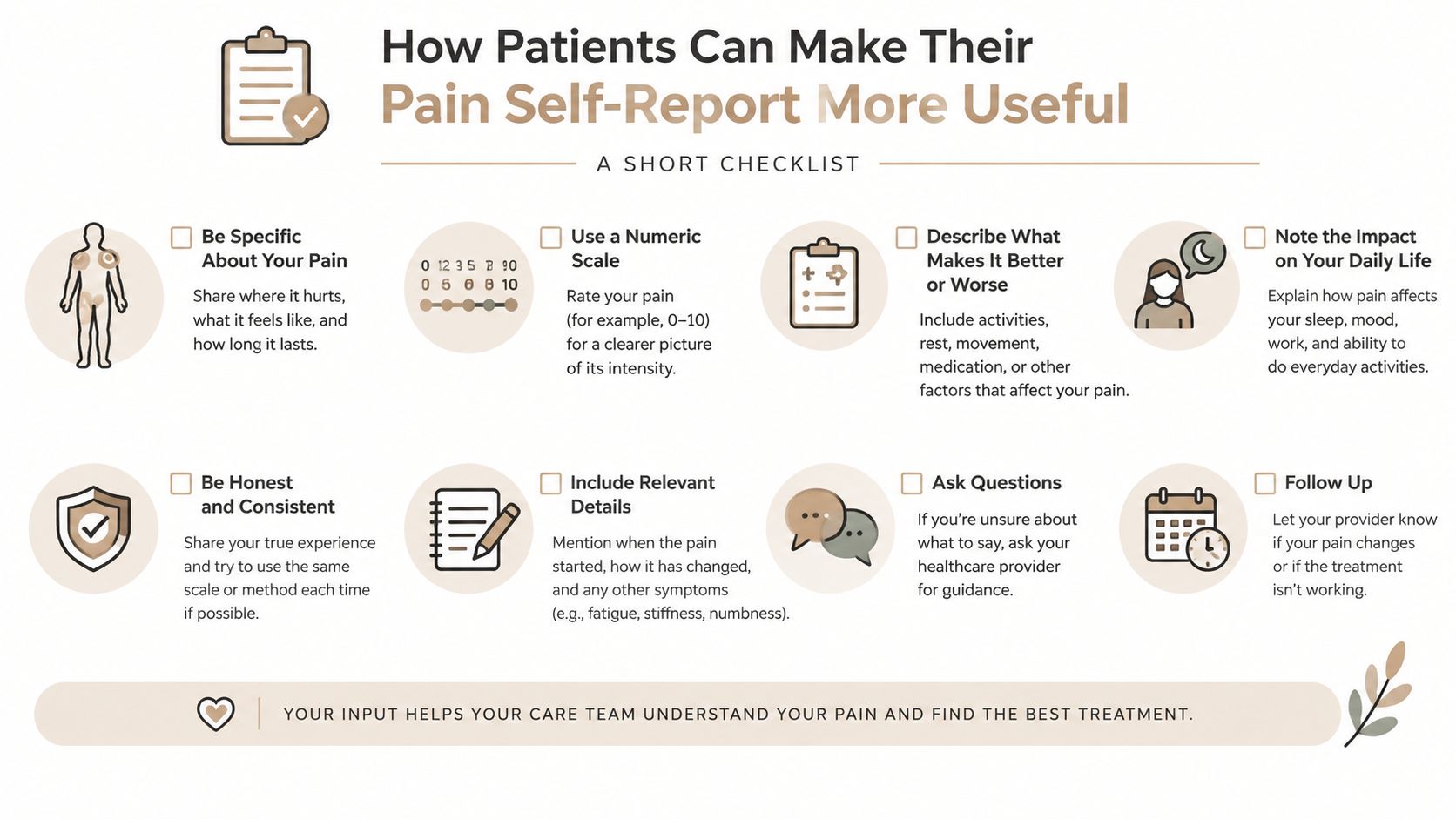
A short symptom log can capture the pattern. Record the date, activity, pain score, sleep quality, and one sentence about what you could do. Include easier days as well as difficult ones. A lower score may support continuing a helpful plan, while a sudden increase may identify a new trigger. If the number improves but walking, sleep, or another valued activity does not, tell your clinician. The score is one clue, not the whole map.
A single pain score is a starting point for conversation, not a diagnosis and not proof that treatment has succeeded or failed. The most useful information comes from a trend collected with the same scale, similar timing, and clear descriptions of activity and function.
Remember these principles:
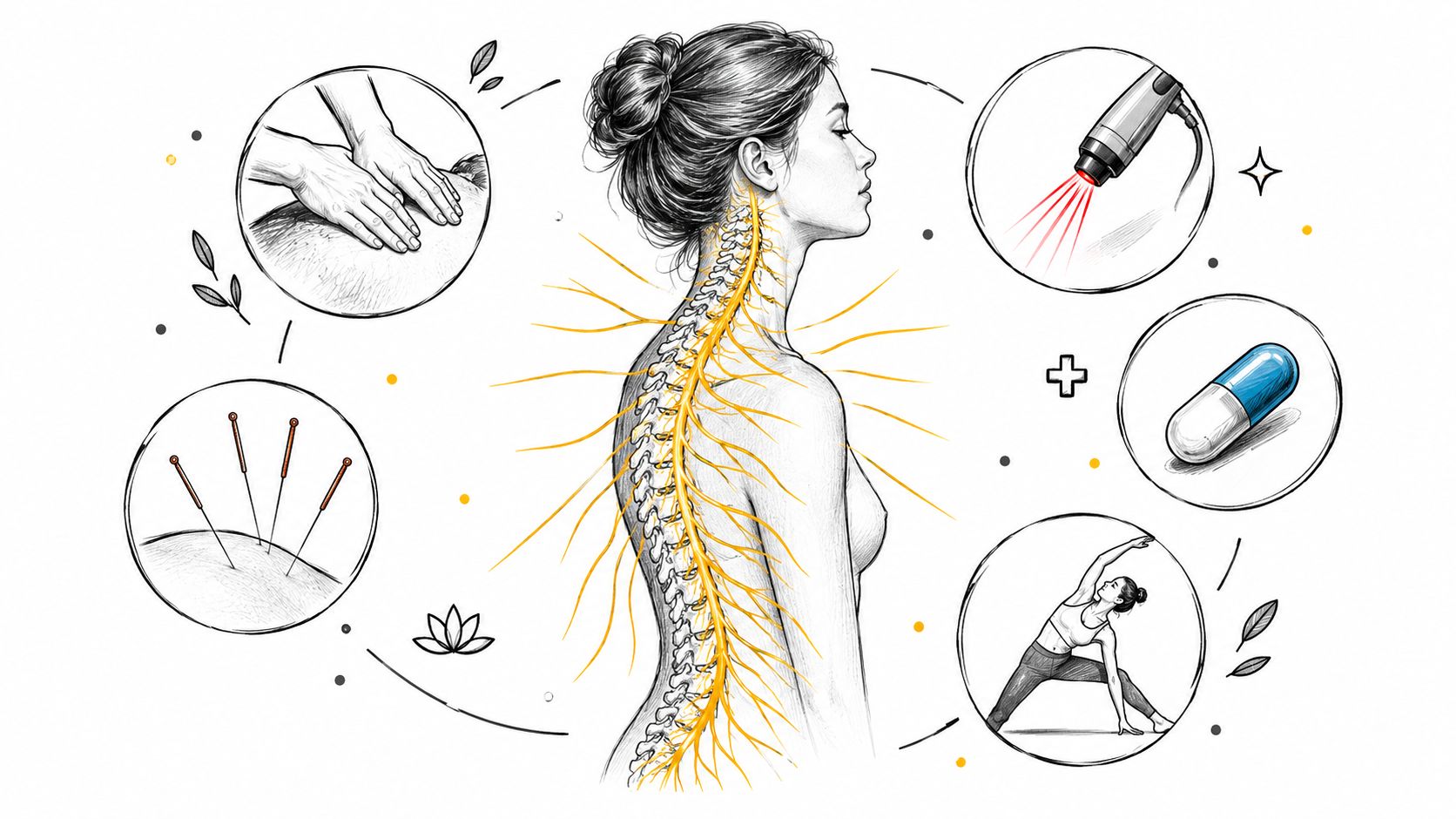
For adults in Salt Lake City and Sandy, an evaluation at Aspen Falls Wellness can combine pain scoring with movement testing and treatment planning. That conversation may include options such as Spinal Decompression with the DRX 9000, SoftWave Therapy, MLS Laser Therapy, chiropractic adjustment, acupuncture, massage therapy, mobility therapy, and rehabilitation exercise, depending on your examination and goals.
If pain remains unchanged, worsens, or begins affecting strength, sensation, balance, or daily function, do not just keep recording the number. Ask a qualified clinician to review the pattern and determine whether your current plan still fits.
Aspen Falls Wellness offers coordinated chiropractic and integrative care, including spinal decompression with the DRX 9000, SoftWave Therapy, MLS Laser Therapy, mobility therapy, acupuncture, massage, and rehabilitation exercise. Visit Aspen Falls Wellness to request an evaluation that connects your pain score with movement findings, function, and a practical care plan.

Stay updated with the latest chiropractic news and exclusive offers.