Wondering how long does a chiropractor visit take? First exams run 30-60 minutes, follow-ups 10-20, plus what happens in each.
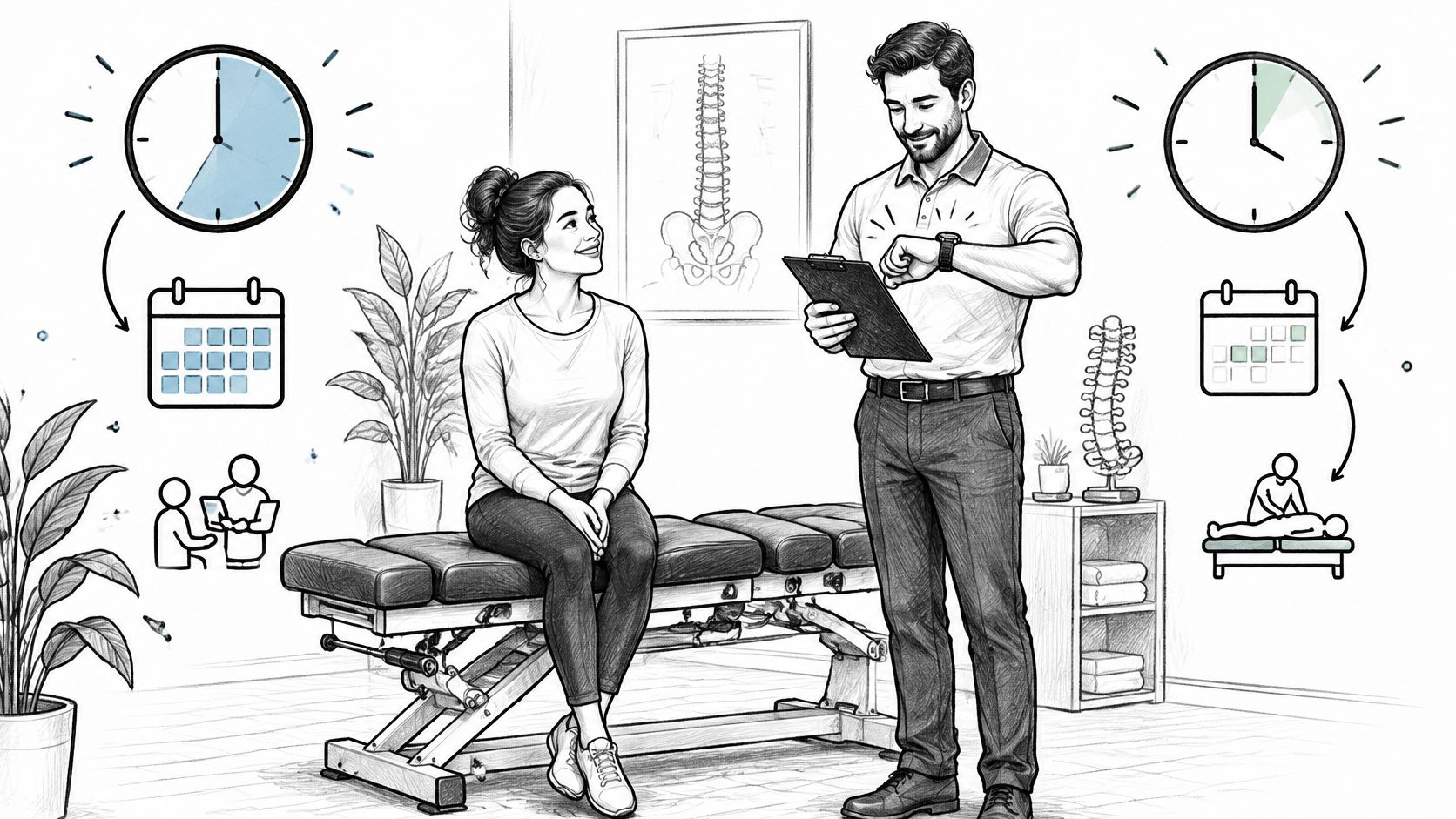
Three things decide how long a chiropractor visit takes: what must be examined, discussed, and treated. In a first appointment, most of the clock goes to history, testing, and a workable plan; the adjustment is usually the shortest block.
That is the practical answer. A return visit can run tighter because the chiropractor is checking progress on a known problem. A stiff neck, sciatica, or pain after a collision changes the exam more than the stopwatch, so book for the reason you are going.
Appointment length depends on what you booked. Bupa's chiropractic guide puts a first visit at 30 to 60 minutes and a straightforward follow-up at 10 to 20 minutes. Use the table as a lookup, then read the row that matches your appointment type.
| Visit type | Typical length | What fills the time |
|---|---|---|
| First (initial) chiropractic visit | 30-60 minutes | History, examination, assessment and care planning |
| Follow-up adjustment visit | 10-20 minutes | Brief reassessment and adjustment |
| Follow-up with reassessment | 10-30 minutes | Progress check plus treatment |
| Maintenance visit | 10-20 minutes | Scheduled check-in and adjustment |
| DRX9000 decompression session | About 28 minutes active treatment | Positioning, setup and instructions add time |
| Combined therapy session | Often past 30 minutes | Adjustment plus laser, massage or acupuncture |
The surprise is how little of a long first visit goes to hands-on care. In a Danish observational study, patients spent an average of 34 minutes and 46 seconds with the chiropractor at a new consultation, with observed visits from 25 minutes 47 seconds to 50 minutes 38 seconds, while follow-ups averaged 12 minutes and 24 seconds. Hands-on treatment averaged only 6 minutes 40 seconds on the first visit and 5 minutes 3 seconds on follow-up, so clinicians in that study provided roughly 5 to 7 minutes of hands-on care per appointment, according to the 2016 BMC Chiropractic & Manual Therapies study.
That gap is the main story. Most of a first visit is examination, discussion and planning, and the adjustment itself is the shortest line item. Office time and treatment time are different measures.
For an initial first visit in Salt Lake City or Sandy, plan on roughly 30 to 45 minutes. Disc symptoms, imaging review, rehabilitation work, or several therapies in one slot push past that. A combined session stacks an adjustment with laser, massage, or acupuncture, so it runs longer than a single technique. Book the slot that matches the job, and neither end of the visit feels squeezed.
Practical rule: Find the row that matches your situation, then add five to ten minutes for check-in and intake forms.
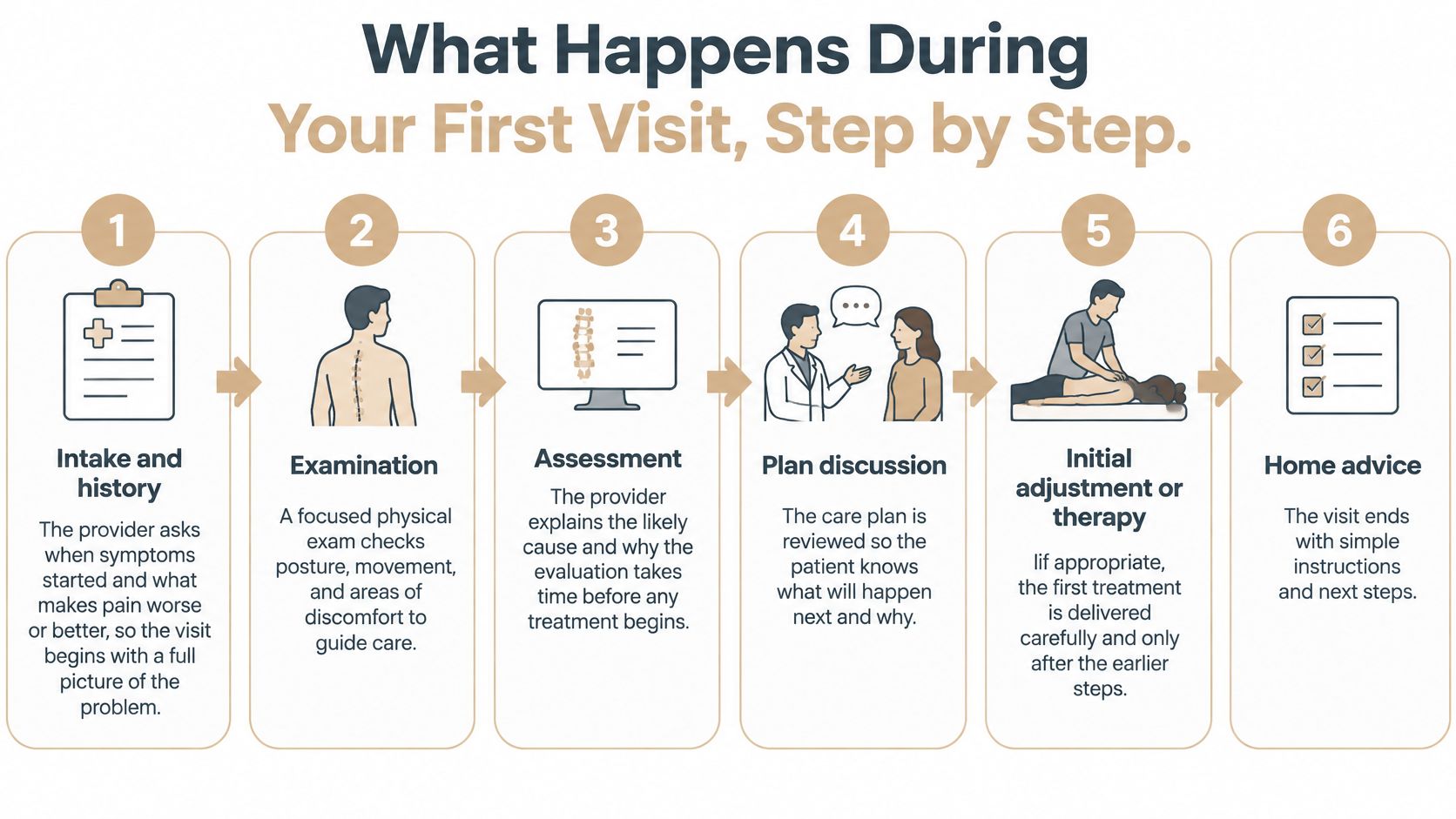
Each patient gets a thorough chiropractic evaluation with the trusted doctors to identify the root cause of their issues, and a customized treatment plan is developed based on the diagnosis. The process has three steps: schedule an initial exam, receive a personalized treatment plan, and relieve your pain. If you want the room-by-room version of that first visit, our guide to what to expect at a first chiropractic visit walks through the same sequence.
Steps 1 and 2 usually take the most time, because they build the history and examination record the rest of the visit depends on. Step 5 is the shortest part for most patients: the adjustment itself is measured in minutes, while the reasoning around it fills the appointment. Step 6 usually takes only a few minutes, but it sets how often you come back.
You should leave with a written plan and a clear sense of why the visit took the time it did. If you only remember the adjustment, the visit did not do its job.
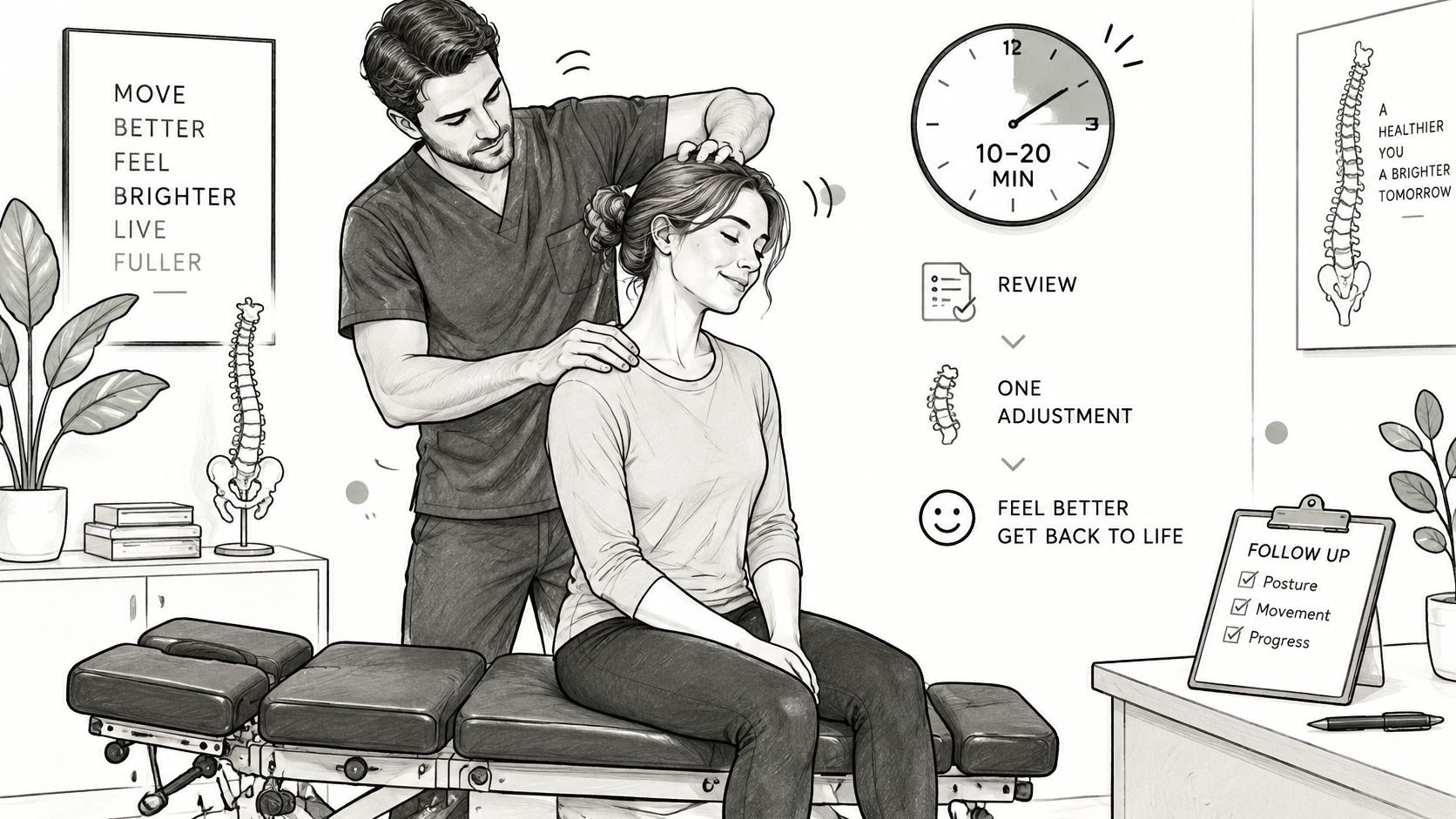
Follow-ups are short because the history and plan already exist. Each visit centers on a quick reassessment and one adjustment, usually 10 to 20 minutes. Chiropractic treatment often requires multiple visits, and the team keeps patients informed about the recommended extent and duration of treatment.
An initial course often means two or three visits a week, with each treatment around that same short window, then frequency drops to about one visit a week as symptoms improve, which is the pattern MedlinePlus describes for a typical course. Chronic pain does not follow one script. Some clients with chronic pain visit once a week to alleviate their pain, while others plan a monthly appointment. For a fuller look at spacing, see how often you should see a chiropractor.
A decompression block is longer than an adjustment and still fits a half-hour treatment slot. In a retrospective cohort of 30 patients with discogenic low-back pain, each active DRX9000 session lasted 28 minutes across about 22 sessions over six weeks, and average pain scores fell from 6.2 to 1.6, according to the 2010 DRX9000 cohort. Those 28 minutes are active treatment. Positioning, equipment setup, a symptom check, and post-treatment instructions add time around the machine.
A separate published protocol used 30-minute sessions daily for the first two weeks, then tapered to one session a week over a two-month course, in a chart audit of 94 outpatients. Follow-up from 29 of them showed a mean reported low-back-pain improvement of 83% at an average of 31 weeks, as described in the 2008 Pain Practice chart audit. That figure comes from limited follow-up in a retrospective review. It is not a promised result.
Early care clusters visits close together. Later care spreads them out once the plan is working.
In the first month, the plan gets reviewed at each visit, so you can see whether the schedule is doing the job or needs a change.
A useful baseline comes from a survey of 2,550 chiropractic visits collected in 1998–1999 from 130 licensed chiropractors in one Western and one Northeastern state. The mean visit length was 21.5 minutes (standard error 0.8 minutes), and new-patient visits took longer while wellness and chronic-problem visits were generally shorter, according to PubMed's record of that survey. An adjustment-only check can sit near the low end of that range.
| Factor | Effect on visit length |
|---|---|
| New patient versus established patient | New patients take longer because history and examination are included |
| Chronic or wellness visit | Usually shorter than an initial evaluation |
| Preventive counseling | Adds time to the appointment |
| Soft-tissue or exercise instruction | Adds time beyond spinal adjustment alone |
| Imaging or referral review | Adds time only when clinically indicated |
| Several integrated therapies in one visit | Can extend the appointment considerably |
The same survey recorded longer visits when chiropractors added preventive counseling, used manual rather than instrument-based spinal manipulation, or included soft-tissue techniques and physiotherapeutic procedures. Exercise instruction behaves the same way. You are learning a movement as well as receiving an adjustment, and teaching takes longer than the thrust itself.
The adjustment itself rarely grows. The work around it does.
Most of those extra minutes land in examination, discussion and planning before and after the hands-on part of the visit. Imaging review and referral paperwork add time only when they are clinically needed. Routine imaging is not the right default for uncomplicated low-back pain without red flags, progressive neurological deficits, or suspected serious pathology, a point reflected in the 2025 survey of French chiropractors and the guidelines it discusses. Disc-related radiating pain, or whiplash after a car collision, calls for more examination and more documentation. That extra time goes to triage and records.
If your visit combines several services, ask the front desk how the slot is divided between examination and treatment before you arrive, so the length you book matches the care you expect.
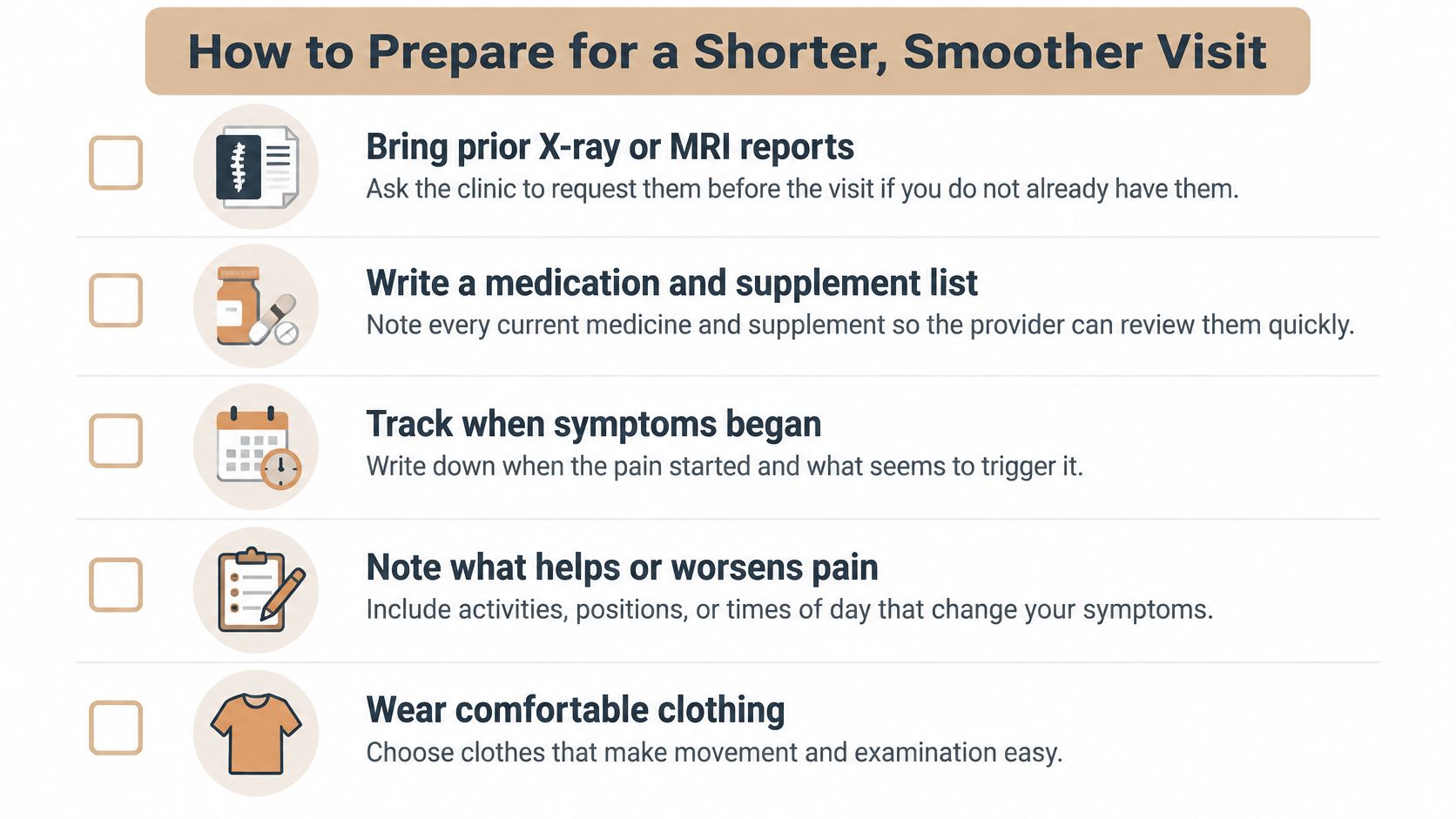
Preparation does not shrink the exam. It stops the exam from restarting while you hunt for a date or a medication name.
Arrive 10 to 15 minutes early and finish intake forms in that window. The booked time then goes to the exam and the plan.
Log how your pain changes between appointments. Clear notes let the provider adjust the plan without rebuilding the history.
New patients start by scheduling an initial consultation with the providers to receive a personalized treatment plan. Pick the slot by the job, not by habit.
For a new problem, book the initial exam and reserve up to an hour. Most of that hour is history, examination, and planning, not the adjustment. For a routine follow-up on a plan already in place, a 20 to 30 minute slot is usually enough. For spinal decompression, ask whether the slot covers positioning and instructions or only the active treatment block.
At that first visit, ask two questions. How many visits are recommended, and how long should each one take? If symptoms improve faster or slower than the plan, ask at the next visit for a longer or shorter slot. Clinics that lay out slot types the way Zee Palm's patient scheduling guide describes make that conversation easier, because the calendar already distinguishes an exam from a return visit.
Book the initial exam, bring the preparation checklist, and use the first visit to set the schedule for the weeks ahead.
Aspen Falls Wellness builds that first exam, the follow-up rhythm, and options such as adjustments, DRX9000 spinal decompression, laser, massage, and acupuncture into one plan for back and neck pain in Salt Lake City and Sandy. You leave knowing how long each visit should take and how often to come. Schedule your initial exam with Aspen Falls Wellness and bring the checklist so the hour goes to your care, not to paperwork.

Stay updated with the latest chiropractic news and exclusive offers.