How often should i see chiropractor. Learn how often should I see a chiropractor, from acute flare-ups to maintenance, with evidence-based visit schedules



A stiff neck after a long drive, a sharp catch in your low back while reaching for a shoe, or a headache that has lingered for days can lead to the same first search: how often should I see a chiropractor? The answer isn't a universal weekly appointment. A defensible plan depends on the condition, how long it has been present, how your body responds, and whether pain, movement, and daily function are changing.
A friend may recommend visits twice a week indefinitely. Another person may say to come only when symptoms return. Both approaches can miss the point. Chiropractic care is usually more useful when it follows phased treatment, condition-specific dosing, and scheduled re-evaluation rather than an automatic calendar.
How many chiropractic visits will you need, and when should the schedule change? Pain makes a clear timetable feel reassuring. You may wonder whether one adjustment is enough, whether several visits should be grouped close together, or whether recovery will require a longer plan. A responsible answer starts with examination findings, not a standard package.
For acute or subacute low back pain, a clinical scheduling pattern frequently cited in practice is 2 to 3 sessions per week for 2 to 4 weeks. A mild flare-up may require only 1 to 6 visits for the entire episode. These figures are planning ranges, not promises. Frequency depends on the condition's severity, your response to care, and the clinician's judgment. A summary of chiropractic visit frequency and clinical scheduling also explains that spinal manipulation has no single standard frequency.
A useful schedule should answer five practical questions:
Practical rule: Early visits may be closer together. Reduce their frequency only when examination findings, symptoms, and daily function support that change.
The better question is not, “How many adjustments do I need?” Ask what improvement should be present before the next phase begins. Range of motion, walking tolerance, sleep, lifting ability, work duties, and symptom behavior give a clearer checkpoint than the calendar alone. Think of the schedule as a treatment dial: the clinician adjusts it according to your response, then checks whether the new setting is helping.
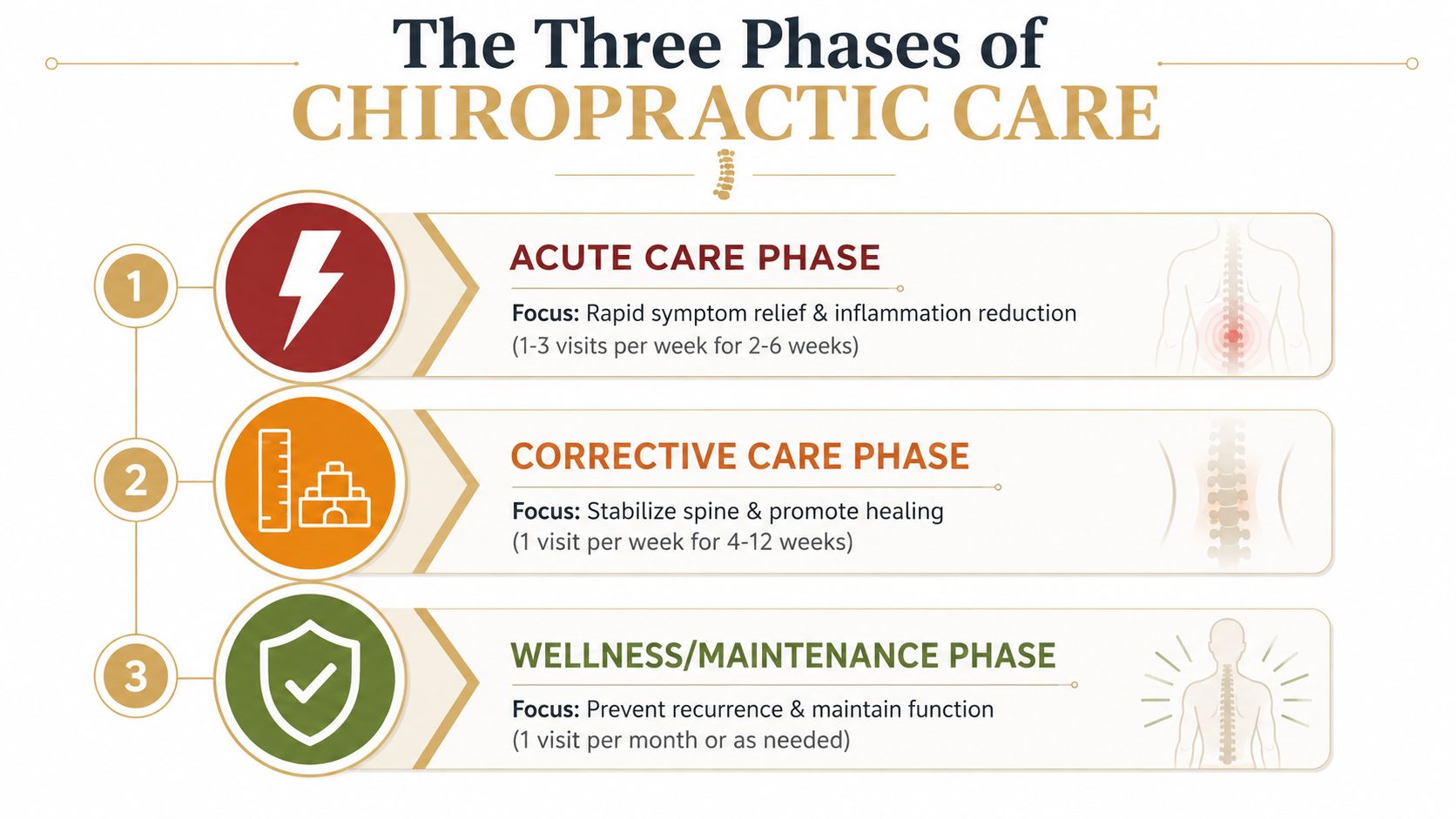
Most individualized plans can be understood through three phases: acute care, recovery or corrective care, and optional maintenance care. These labels describe the purpose of treatment, not guaranteed stages that every patient must complete.
Acute care addresses a new injury, a significant flare-up, or a period when pain and restricted movement interfere with basic activities. For acute or subacute low back pain, a commonly cited pattern is 2 to 3 visits per week for 2 to 4 weeks (clinical frequency guidance). The clinician may use a Chiropractic Adjustment, soft-tissue work, Mobility Therapy, Muscle Stimulation, Pain Relief strategies, or carefully selected exercises based on tolerance.
The purpose isn't to keep you in a high-frequency schedule. It's to reduce symptoms enough to restore ordinary movement and establish a safe foundation for active recovery. In higher-quality low-back-pain studies summarized by occupational-medicine guidance, treatment is often time-limited, with 1 to 3 visits per week for about 2 weeks and treatment commonly capped at roughly 6 appointments in many studies (low back pain guideline).
As pain settles, the focus shifts from immediate relief to restoring strength, coordination, mobility, and confidence. Visits often spread out, while Personal Exercise Plans, Rehabilitation Exercise, Mobility Therapy, and posture or movement retraining carry more of the workload.
The schedule should respond to progress. If you can walk, sleep, work, and exercise with fewer restrictions, a clinician may reduce visit frequency. If improvement stops, the clinician should reassess the diagnosis, technique, activity load, and need for referral rather than just extending the same plan.
Maintenance or wellness care is optional. It may involve lower-frequency visits to support function for someone with recurrent symptoms, demanding physical work, or ongoing performance goals, but it shouldn't be presented as a lifetime obligation.
A chronic-care guideline summary describes lower-frequency management at approximately 1 to 2 visits per month in some recommendations (chronic care recommendations). That doesn't mean every patient needs monthly care. Maintenance makes sense only when you understand its purpose, can identify a functional benefit, and remain free to stop or change it.
Condition-specific planning matters because “back pain” can describe a simple strain, nerve-related leg symptoms, disc irritation, or injury after a collision. A schedule that is reasonable for one presentation may be excessive, insufficient, or inappropriate for another.
For uncomplicated acute low back pain, a practical starting range may be 2 to 3 visits per week for 2 to 3 weeks, followed by less frequent recovery care if function improves. The plan should include an early review around the second week and another review during the recovery phase. These checkpoints help determine whether pain, bending, walking, sleep, and lifting tolerance are changing.
Routine imaging isn't generally recommended at the start of care for non-specific low back pain. X-rays may be considered when red flags or blunt trauma are present, or when there has been no response after 4 to 6 weeks of conservative care, according to evidence-based chiropractic imaging guidance.
Sciatica and suspected disc-related symptoms deserve closer monitoring because radiating pain, numbness, weakness, and changes in reflexes can affect the plan. A clinician may begin with visits close together during the irritable stage, then taper as leg symptoms centralize, neurological findings remain stable, and walking or sitting becomes easier.
Spinal Decompression with the DRX 9000, Decompression, carefully selected adjustments, MLS Laser Therapy, SoftWave Therapy, and exercise-based care may be considered as parts of an individualized plan. These services shouldn't replace neurological assessment or re-evaluation. For additional context about the recovery process, see how long herniated disc recovery can take.
Neck pain and cervicogenic headache care may start with closer visits, then taper as neck rotation, work tolerance, sleep, and headache behavior improve. Workstation ergonomics, mobility exercises, Massage Therapy, Acupuncture, and rehabilitation may complement an Adjustment when the examination supports them.
Post-car-accident recovery can be slower because whiplash and soft-tissue symptoms may evolve after the initial event. Car Accident Treatment should include documentation, a careful examination, and repeated checks of motion, tenderness, neurological symptoms, and daily activity tolerance. A schedule may begin with frequent visits, but delayed symptoms or worsening neurological signs should prompt clinical review.
| Condition | Acute Phase | Recovery Phase | Maintenance |
|---|---|---|---|
| Low back pain without red flags | Closer visits during the initial flare | Visits taper as movement and function improve | Optional, based on recurrence and function |
| Sciatica or disc-related pain | Close monitoring with treatment adjusted to neurological findings | Less frequent care with decompression, exercise, and mobility as appropriate | Consider only when functional goals support it |
| Neck pain or cervicogenic headache | Short, focused trial with movement and ergonomic assessment | Progressive mobility and strengthening | Optional and symptom-led |
| Post-car-accident recovery | Structured evaluation and frequent early monitoring | Slower taper when soft-tissue symptoms persist | Reassess before continuing |
Frequency is a starting range, not a promise. Your response should decide whether the next visit is sooner, later, or replaced by another form of evaluation. Readers comparing recurring diagnostic monitoring with care schedules may also find this explanation of optimal DEXA scan frequency useful, since both topics show why timing should match the purpose of the service.
Consider Maya, a representative 38-year-old with an L5 disc herniation and right-sided sciatica after lifting. Her first appointment isn't used to assign a generic number of visits. The clinician establishes a baseline with a pain score, Oswestry Disability Index, lumbar range of motion, strength, sensation, reflexes, gait, and neurological findings.
During the first few visits, Maya's tolerance determines what comes next. If bending and nerve tension remain highly irritable, the plan may emphasize symptom control, carefully dosed Chiropractic Care, Spinal Decompression, and home positions that reduce aggravation. If a modality such as MLS Laser Therapy is appropriate, it can be added without treating it as a substitute for examination or active rehabilitation.
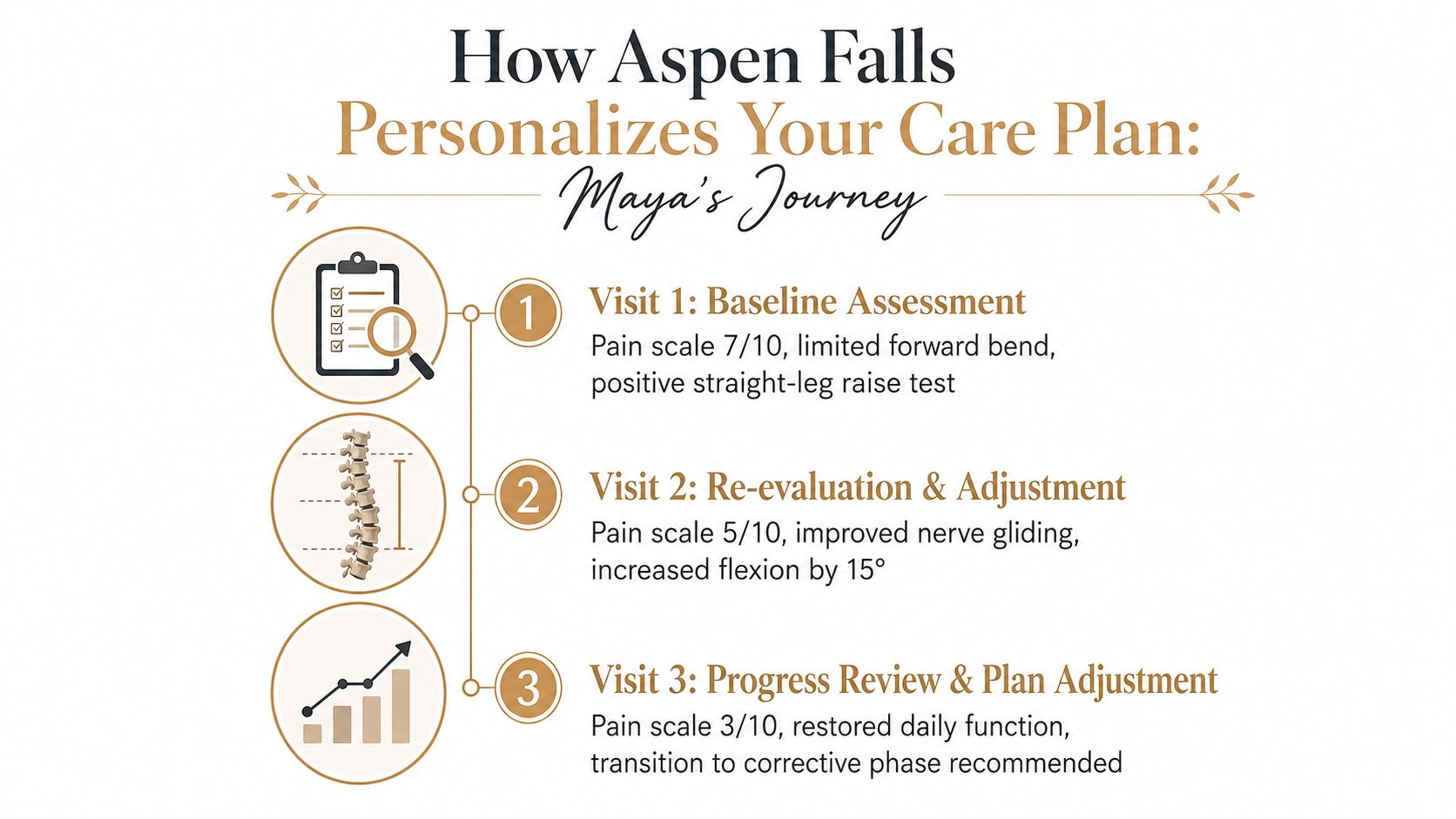
At a re-evaluation around visit 6, the clinician compares Maya's current pain, bending tolerance, walking capacity, nerve symptoms, and examination findings with her baseline. If progress is limited, the schedule or treatment approach changes. If symptoms are improving, stabilization work and Rehabilitation Exercise can take a larger role.
At visit 12, the question is no longer only whether pain is lower. Can Maya sit through work, sleep, put on shoes, and complete her home program without a meaningful flare? Those functional answers may support tapering. They may also show that she needs a different exercise progression, additional assessment, or referral.
By visit 20, if Maya has met her functional goals and symptoms remain controlled, she may move toward occasional follow-up rather than continuing frequent visits. The exact transition isn't based on a promised calendar. It follows documented changes in pain, movement, neurological status, and daily activity.
A personalized care plan should explain what will be measured, when it will be measured, and what result would change the schedule.
This approach can include Nutrition and Nutrition Counseling, Massage Therapy, Acupuncture, or Mobility Therapy when those services match the patient's needs and tolerance. Aspen Falls Wellness describes this type of coordinated, re-evaluated approach in its personalized treatment plans, with care adapted to symptoms, lifestyle demands, and functional progress.
The same patient may move through all three cadences, but not every patient needs every phase. Acute care is short-term and active. Recovery care consolidates gains. Maintenance is an optional decision made after the original problem has improved.
| Care Phase | Typical Visit Frequency | Duration | Primary Goal | Re-evaluation Trigger | Exit Criteria |
|---|---|---|---|---|---|
| Acute | 2 to 3 visits per week | 2 to 4 weeks for a common acute low-back-pain pattern | Reduce pain and restore basic tolerance | Symptoms worsen, neurological findings change, or progress is unclear | Daily movement and basic activities improve |
| Recovery | 1 to 2 visits per week | 4 to 8 weeks, adjusted to response | Build mobility, strength, and function | Progress plateaus or home exercises aren't tolerated | Functional goals are met and gains hold between visits |
| Maintenance | Every 2 to 6 weeks when chosen | Individualized | Sustain function and monitor recurrent problems | Benefit is unclear or symptoms return | Patient chooses to stop, or goals are better served elsewhere |
The evidence doesn't support one universal dose. A spine-care guideline synthesis reports that some studies found 12 to 18 visits more effective than 6 visits at a 12-week endpoint, while another study identified 3 to 4 sessions per week for 3 weeks as an optimal schedule in its specific context (spine-care guideline synthesis). Those findings describe study protocols, not an automatic prescription for every patient.
The useful pattern is front-loaded care followed by reassessment. A patient with clear improvement may taper sooner. Someone with persistent or changing symptoms may need a different diagnosis, additional testing, or referral instead of more of the same treatment.
Maintenance deserves particular caution. It can be patient-driven and functionally justified, but it isn't a requirement for everyone and shouldn't continue without a reason you can state clearly.
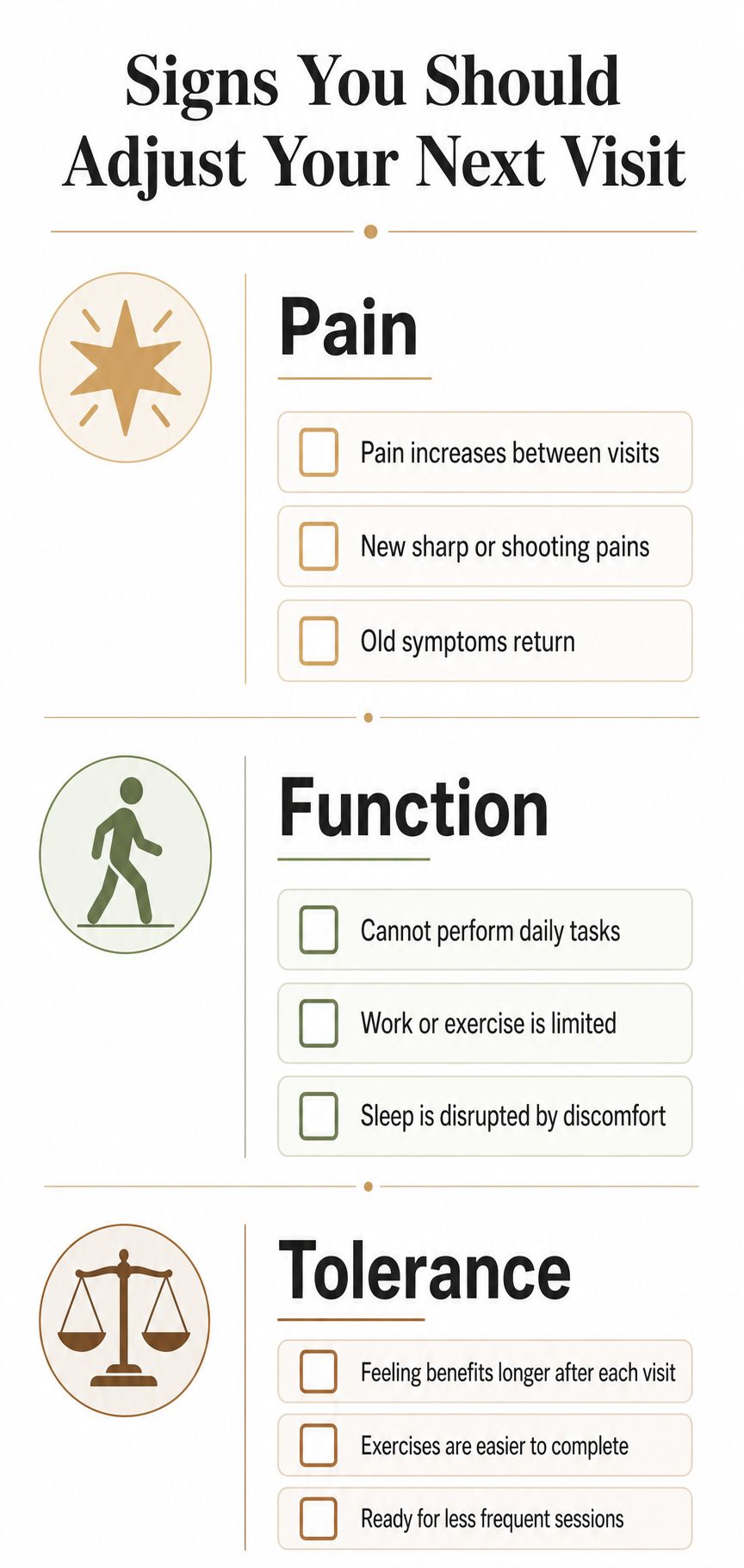
Your next appointment should reflect what happened since the last one. Track three areas: symptoms, function, and tolerance.
A lower number on a pain scale helps, but it isn't enough by itself. A person may report less pain while still having weakness, poor balance, restricted movement, or difficulty with work. Re-evaluation should combine pain with objective findings and function before the schedule changes.
Before your first appointment, call your insurer and ask whether chiropractic visits are covered, whether there are visit limits or co-pays, and whether a referral or authorization is required. Coverage rules vary, so patients should verify benefits directly. A general guide to therapy covered by insurance can help you understand which questions to ask, but it can't replace plan-specific verification.
If insurance isn't being used, ask the clinic about its current out-of-pocket visit pricing and available payment arrangements. Aspen Falls Wellness can explain its scheduling and payment process, while patients considering a specific plan can review Blue Cross Blue Shield chiropractic coverage before booking.
Bring prior imaging, a list of current medications, and a short symptom timeline. At check-in, expect a history review and examination before a proposed schedule is discussed. The first re-evaluation should confirm whether that schedule still fits your findings, response, and ability to follow the plan.
No. Maintenance care is optional and should have a clear functional purpose. You can stop or change it when the benefit is unclear.
Reschedule rather than doubling up or abandoning the plan. Tell your chiropractor why the visit was missed so the schedule can be made realistic.
It can, when the examination supports combining them. Spinal Decompression with the DRX 9000, MLS Laser Therapy, exercises, and adjustments should be coordinated around tolerance and measurable progress.
No. Age, pregnancy, health history, medications, bone health, neurological findings, and treatment tolerance can change the assessment and dosing. Those patients need an individualized examination rather than a generic weekly schedule.
Aspen Falls Wellness offers Chiropractic Adjustment, Spinal Decompression with the DRX 9000, MLS Laser Therapy, SoftWave Therapy, Massage Therapy, Acupuncture, Mobility Therapy, Rehabilitation Exercise, and personalized care planning for spine, joint, and soft-tissue concerns. Visit Aspen Falls Wellness to request an evaluation and discuss a visit schedule based on your symptoms, functional goals, and re-evaluation findings.

Stay updated with the latest chiropractic news and exclusive offers.