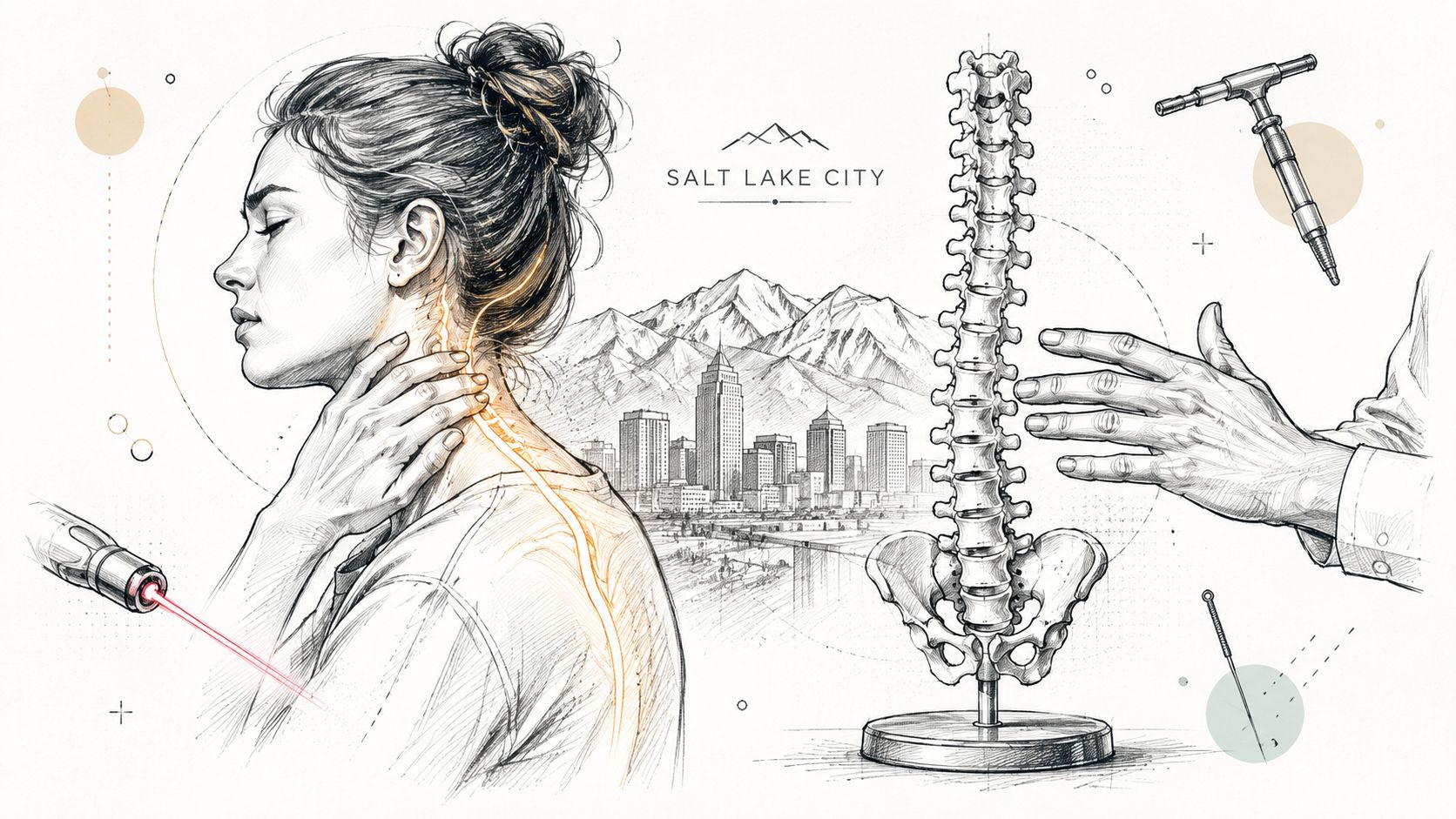
How long herniated disc recovery takes, broken down by week and month, with timelines for conservative, interventional, and surgical care.
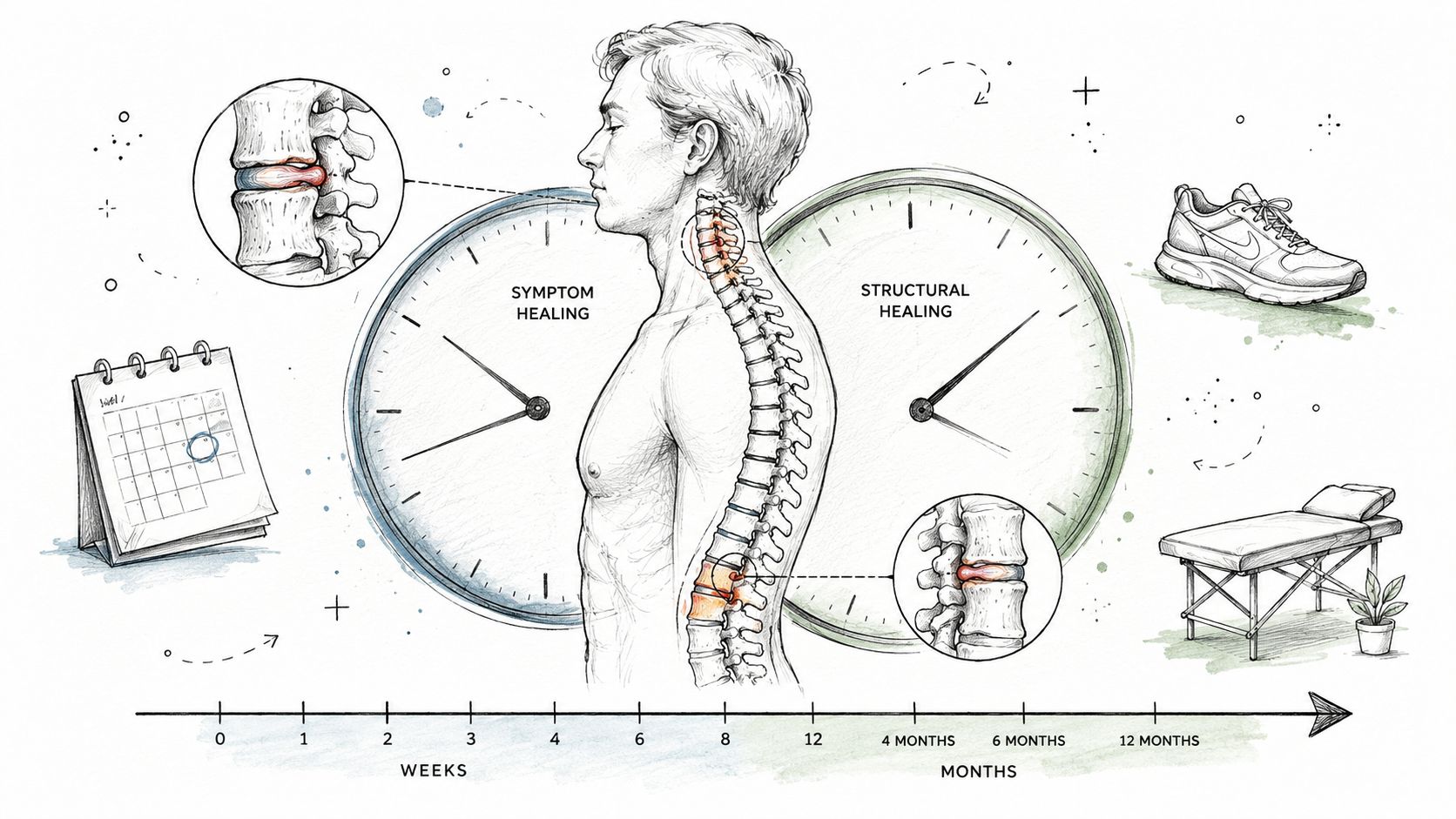



You're sitting in the waiting room because your back didn't just “get tight,” it lit up. Maybe you bent for a toddler, loaded a suitcase, or spent one long afternoon at a desk and then felt a sharp line of pain that won't quit, or a leg symptom that makes every step feel odd. The first thing many want to know is simple, how long herniated disc recovery really takes, and the honest answer depends on which healing clock you're asking about.
One clock is about symptoms, pain, numbness, sciatica, and how soon daily life feels manageable again. The other clock is about the disc itself, how long the irritated material and surrounding tissues need to settle, stabilize, and resorb. Those clocks move together, but they don't move at the same speed, and that's where a lot of confusion starts.
The practical takeaway is reassuring. Recovery is measured in weeks, not years, and conservative care is the starting point when there's no major neurologic deficit. If you want a quick visual for that split between feeling better and healing, the timeline graphic below lays it out clearly.
If you're also trying to decide whether a scan is even necessary, this overview of MRI vs X-ray for back pain helps put imaging in context without overreading one test.
A desk worker from Salt Lake City sits down and says the same thing I hear in many first visits. “It started when I lifted my toddler, and now my leg feels off.” The worry is usually bigger than the pain because no one has explained the timeline in a way that makes sense.
There are really two clocks running at once. The first is the symptom clock, which tracks pain, tingling, numbness, and the way walking, sleeping, and sitting start to feel less hostile. The second is the structural clock, which tracks what's happening inside the disc as the irritated material calms down and the body gradually clears and remodels it.
Practical rule: if pain is easing but you still feel cautious, that doesn't mean nothing is happening. It usually means the symptom clock is moving before the structural clock has fully finished.
That difference matters because many patients assume they're either “healed” or “not healed,” when the answer sits in between. A person can wake up with less leg pain in week 3 and still have an irritated disc that needs smart loading, motion control, and time. That's why conservative-first care is so often the right starting point, especially when there's no major neurologic deficit and the goal is to keep function moving while tissues settle.
It also helps explain why one patient is back to desk work quickly while another needs a longer ramp back to lifting, golf, or long drives. The disc injury may be similar on paper, but the symptom clock and structural clock aren't identical from person to person. Once you see recovery through that lens, the rest of the timeline stops feeling random.
A herniated disc is easiest to understand with a jelly donut. The outer ring is the annulus, the tougher shell, and the center is the softer nucleus pulposus. When the outer ring tears or weakens, the inner material can push outward and irritate a nearby nerve root.
That nerve irritation creates the symptom pattern people notice. It is not always just back pain. Depending on the level involved and which nerve is affected, symptoms can show up in the buttock, thigh, calf, foot, shoulder blade, or arm. The injury location matters because lumbar and cervical disc problems do not behave the same way.
In the low back, symptoms often follow a leg pattern, especially with sciatica. A person may notice pain that travels below the knee, numbness in part of the foot, or weakness that changes the way stairs feel. In the neck, the pattern shifts upward, with pain into the neck, shoulder blade, or arm, plus possible hand symptoms if a nerve root is irritated there.
The level matters because it changes both the mechanical load and the functional demand. A disc at one spinal segment may calm down sooner than another because it is stressed differently during sitting, lifting, turning, or sleeping. That is one reason two people with the same diagnosis can recover at different speeds.
If weakness is getting worse, or if bowel and bladder control changes, recovery time stops being the main question. Those symptoms need urgent evaluation.
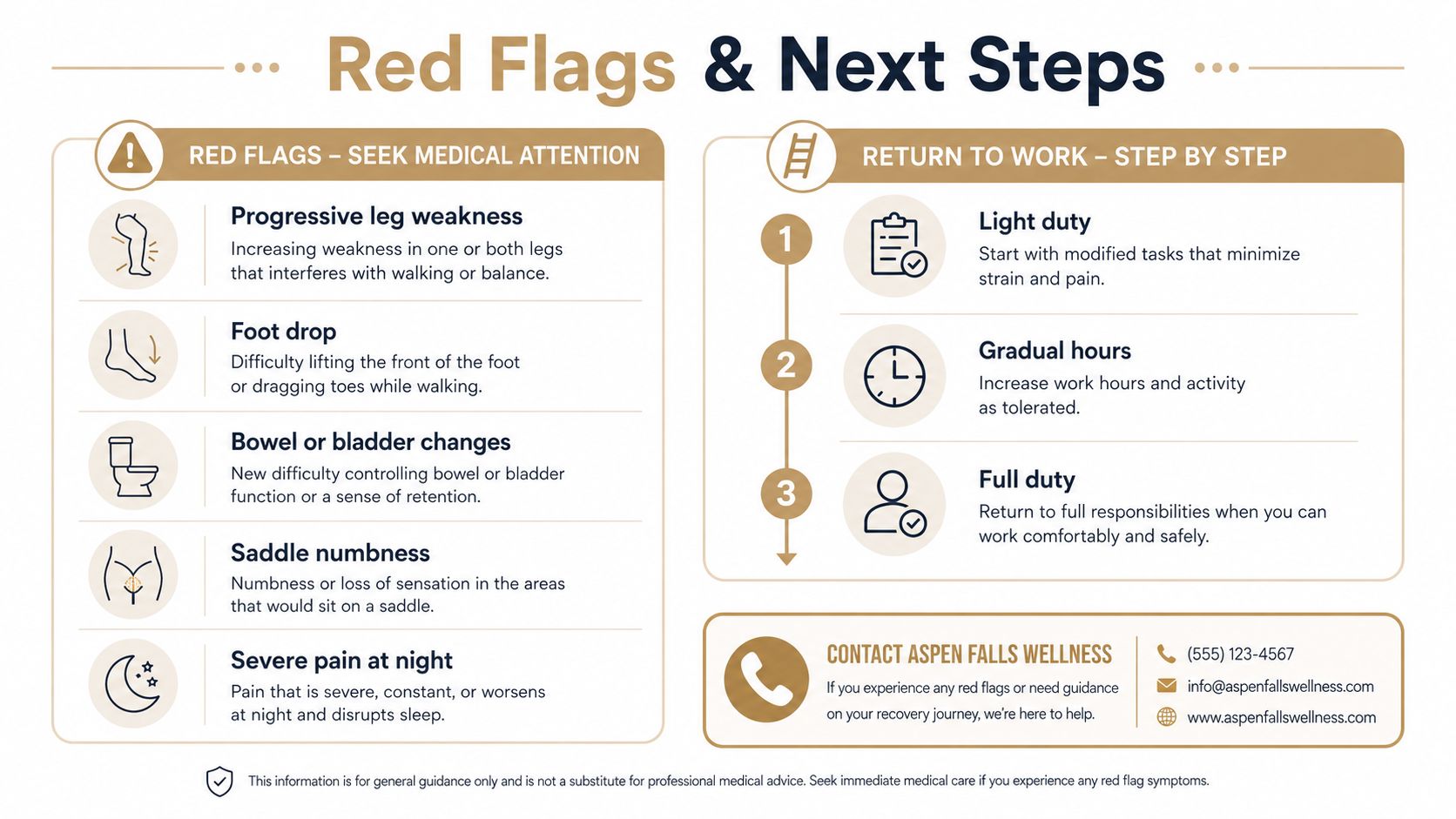
A few symptoms change the conversation immediately, too. Foot drop, progressive weakness, bowel or bladder changes, and saddle anesthesia are red flags. They do not fit the usual calendar and should not be treated like ordinary recovery friction.
For many patients, the next helpful step is learning how the disc settles while the body keeps moving. A clear explanation of therapy for herniated discs can help make the day-to-day plan feel less mysterious. If the goal is rebuilding control and tolerance, a guide to what therapeutic exercise is and how it supports recovery can also help connect the symptoms to the work ahead.
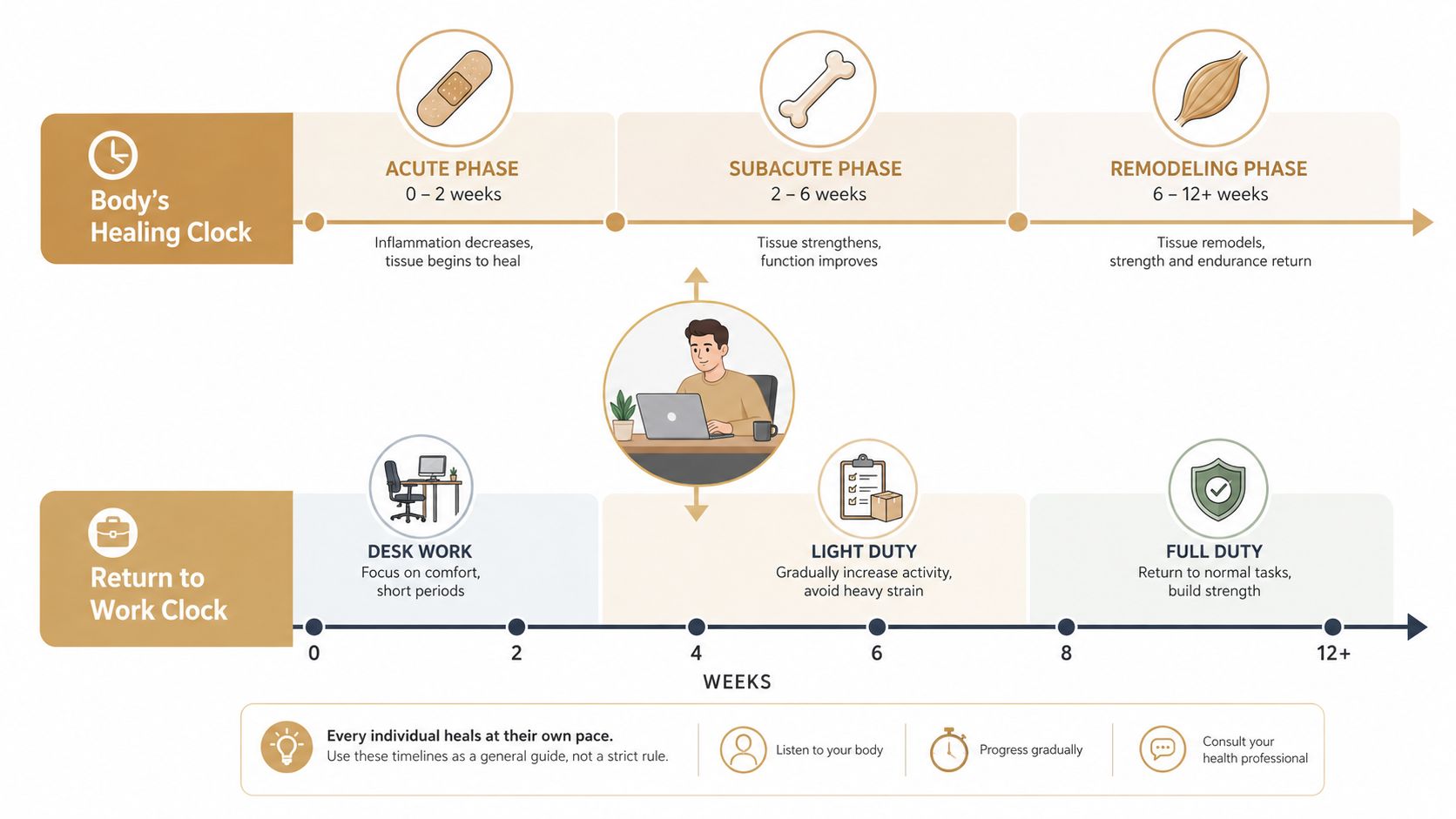
The clearest way to understand how long herniated disc recovery takes is to separate the symptom clock from the tissue-healing clock. Pain can quiet down before the disc is fully settled, the same way a storm can pass before the road crews finish clearing debris. A 2024 review in PMC reports that symptoms resolve in 60% to 80% of patients within 6 to 12 weeks, and in 80% to 90% over the long term, defined as 1 year or more. The same review says that, without major neurologic deficits, guidelines recommend 6 to 12 weeks of conservative treatment before care is escalated. Clinical references also report that over 85% of acute herniated disk symptoms resolve within 8 to 12 weeks with conservative management, and that 90% of symptomatic cases resolve after 6 weeks of conservative care (StatPearls, NCBI Bookshelf).
The first stretch is usually about calming the system down. Gentle movement, careful activity changes, and avoiding positions that keep the nerve irritated are often better than doing too much or too little. Pain can still be sharp here, and that does not mean the plan is failing.
Many patients start noticing more normal sleep, better standing tolerance, and less guarding. Walking often starts to feel useful instead of threatening, because the body is no longer bracing against every step. For milder cases, clinical guidelines note that herniated disks often heal on their own within 4 to 6 weeks.
This is the milestone window to remember. It is the range where meaningful symptom improvement is common, and where most uncomplicated cases are expected to keep trending in the right direction. If you want a broader rehab roadmap, this article on therapy for herniated discs gives a useful patient-facing overview of how movement is usually graded. For a closer look at how exercise is chosen and progressed, a guide to what is therapeutic exercise can help connect the symptoms to the work ahead.
Pain may already be much better by now, but the disc can keep healing in the background. Radiographic literature summarized in clinical sources reports disc reabsorption in about 66% to 67% of cases overall, with mean resorption times around 8 to 12 months and about 25% showing early resorption within 3 months (StatPearls, NCBI Bookshelf). That is why the body can feel mostly better long before the disc is fully done remodeling.
The mental anchor is simple. Most patients feel meaningful improvement in 1 to 3 months, while structural healing can continue well beyond that.
Escalation changes the calendar, but it doesn't mean the earlier recovery clock was wrong. It means the situation needs a different tool, a different pace, and sometimes a different end goal. For some people, injections or surgery are appropriate because symptoms aren't settling, function is dropping, or a red flag has changed the risk picture.
Epidural steroid injections are often discussed as a way to calm nerve irritation so a person can move, sleep, and participate in rehab more comfortably. Relief is often thought of in the 1 to 2 week range, with benefit that can last weeks to months, depending on the individual and the underlying problem. That kind of window can help someone progress through rehab without pretending the disc itself has vanished.
Microdiscectomy can change the functional timeline more quickly for the right patient. Many people walk the same day, return to desk work within a few weeks, and reintroduce heavier lifting later, after the tissues have had time to settle. Even then, the surrounding tissues still follow a healing arc for months, which is why rehab doesn't stop just because the pressure on the nerve has been reduced.
Fusion is a different category entirely and usually comes with a slower, more demanding recovery calendar. The body has to adapt to the new mechanical setup, and the rehab plan has to respect that. The point is not that one path is “better” in the abstract, it's that each path buys a different kind of stability and relief.
If you're trying to compare options in a practical way, disc herniation treatment options is a helpful place to sort what conservative and procedural care are meant to do.
The right escalation isn't a sign of failure, it's a sign that the plan has to match the injury's behavior.
A conservative plan works best when each therapy has a clear role and appears at the right stage. At Aspen Falls Wellness, that often means combining chiropractic adjustment, mobility therapy, spinal decompression with the DRX9000, MLS Laser Therapy, SoftWave Therapy, acupuncture, massage therapy, and rehabilitation exercise so the symptom clock and the structural clock keep moving together.
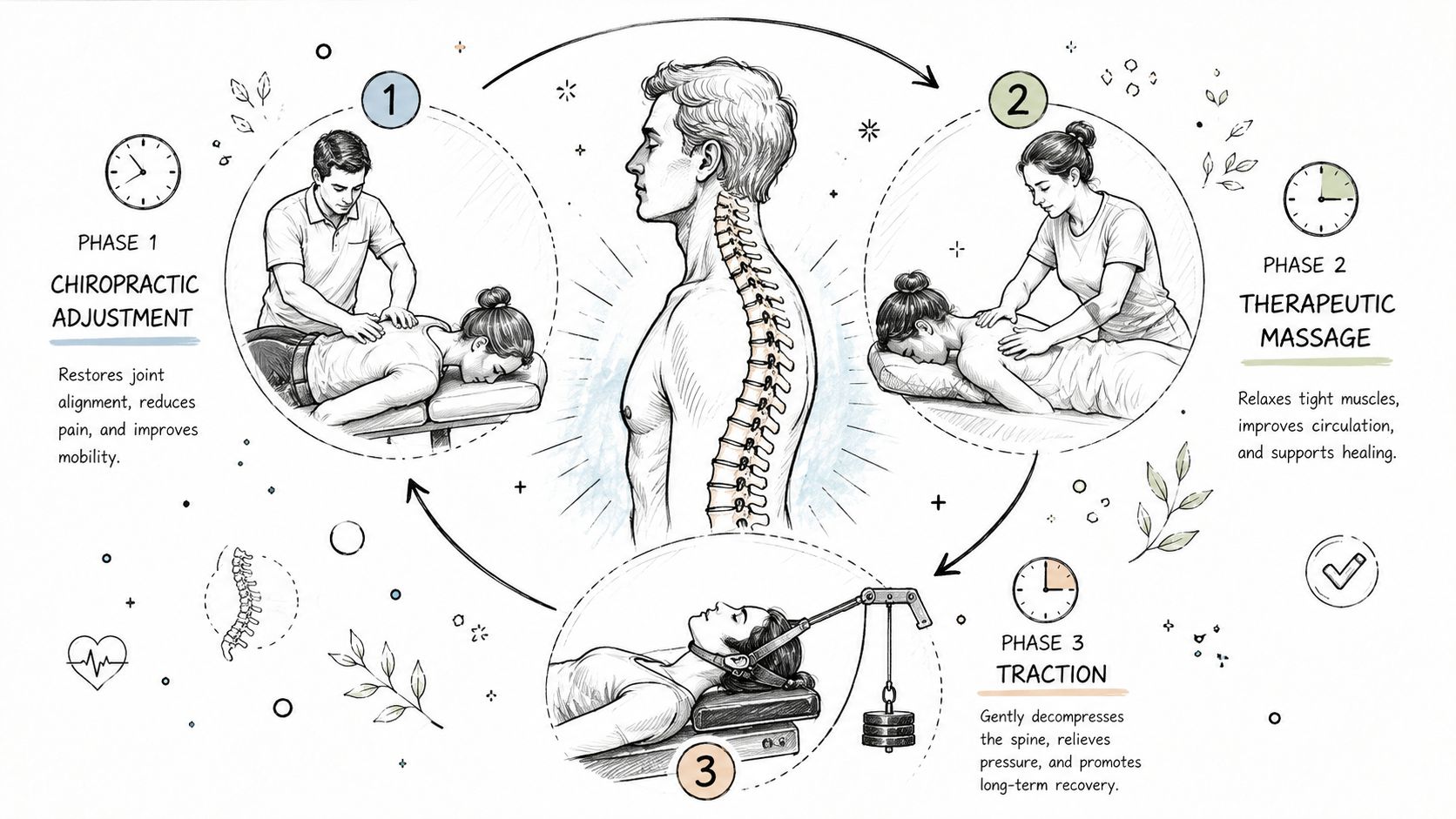
The opening phase is about calming the system enough that movement stops feeling like a threat. Guarding often makes the back and hip muscles tighten around the injured area, almost like a splint the body built on its own, and that can keep symptoms going even when the disc irritation is beginning to settle. Chiropractic adjustment and mobility therapy can help restore segmental motion where stiffness has taken over, while massage therapy can ease the soft-tissue bracing that leaves people feeling locked up. MLS Laser Therapy and SoftWave Therapy are also used to support pain modulation and tissue recovery during the inflammatory phase.
The 6 to 12 week band is often where spinal decompression with the DRX9000 makes the most sense for a disc-related case. That period is often like a bridge between raw irritation and fuller loading, symptoms may still be driven by pressure, sensitivity, and the urge to protect the area, so decompression is used to reduce strain while the patient keeps progressing. Acupuncture can also fit here when pain control and muscle tone are affecting sleep or daily function.
Once pain is calmer, the work shifts from symptom control to capacity. Rehabilitation exercise and take-home plans matter most here because they teach the body how to tolerate sitting, bending, walking, golf positions, lifting, and ordinary daily tasks again. The Aspen Falls Wellness exercise guide pairs naturally with that phase, because a disc does not just need less pain, it needs better movement strategy.
A practical plan is usually layered, not random. Visits may be more frequent early, then taper as the patient becomes more self-sufficient with movement, home care, and strengthening. The therapies are not interchangeable. They line up with different parts of the recovery calendar, and that is what gives them value together.
A 42-year-old recreational golfer from Sandy walks in after a flare that started during a weekend lift. The first visit is about clarity, not heroics, because the biggest early win is understanding what hurts, what's safe, and what needs time. An MRI helps confirm the picture, but the job starts with matching treatment to the phase he's in.
During the first six weeks, the plan includes decompression, adjustment, and MLS Laser Therapy, plus simple walking and position changes at home. The first real milestone isn't a swing, it's the first pain-free morning and the first time he gets through a workday without bracing every time he stands up. By week 6, stairs feel less threatening and sleep is less broken.
At the eight-week check, the leg pain is quieter, and the visit pattern starts shifting toward function. The focus moves toward controlled exercise, better hip and trunk mechanics, and getting him ready for real-life loads again. That's where the calendar starts looking less like an injury log and more like a return plan.
By month 4, he's back to modified swings, and a golf movement screening helps catch the positions that could trigger another flare. The difference isn't that he “beat” the disc faster than everybody else, it's that each phase had the right tool attached to it. When the symptom clock and structural clock are both respected, recovery feels less mysterious and a lot more predictable.
The first myth is that bed rest speeds recovery. Early, graded movement usually helps more than freezing up for days on end. When someone stays still too long, stiffness builds, fear grows, and the nervous system can become more sensitive, which makes the back feel even more fragile.
The second myth is that imaging tells the whole story. It doesn't. Some discs look dramatic and cause only mild symptoms, while other people have a smaller-looking injury that feels severe. Pain reflects mechanics, nerve irritation, and the body's protective response, not just the picture on the screen.
The third myth is that once pain is gone, the disc must be fixed. That belief can send people back to heavy lifting too soon, then the area gets irritated again. Structural healing continues after morning pain has eased, which is why a graded return matters. The symptom clock and the tissue clock do not always move together, much like the recovery trajectory after a brain injury can rise and dip without meaning the person has stopped improving.
Pain dropping to a tolerable level is not the same as tissue readiness for full load. The calendar and the body do not always agree, and recovery plans work best when they respect both.
If you have progressive leg weakness, foot drop, bowel or bladder changes, saddle numbness, or rapidly worsening numbness, stop waiting and get urgent evaluation. For work, desk duties often come back sooner than light-duty labor, and heavy labor usually needs the most careful ramp. A practical return plan should match the job, not just the diagnosis.
If you're in Salt Lake City or Sandy and want a coordinated non-surgical plan, an initial exam is the right next step. It's also smart to confirm insurance coverage for plans such as Aetna, BCBS, Cigna, Humana, GEHA, and Motiv Health, then ask how chiropractic care, decompression, MLS laser, and rehab exercise would be sequenced for your case. If you're also mapping the work side of recovery, planning your return to work can help you think through the logistics with more confidence.
If your back and leg symptoms are still disrupting sleep, work, or simple daily movement, Aspen Falls Wellness offers coordinated chiropractic care, DRX9000 decompression, MLS Laser Therapy, rehab exercise, and related non-surgical support for disc pain. Schedule an evaluation with Aspen Falls Wellness if you want a plan that matches your symptoms to the right recovery clock and helps you move forward with more confidence.

Stay updated with the latest chiropractic news and exclusive offers.