Learn how to fix rounded shoulders with an 8-week progressive routine, the causes behind the slump, and signs you need a professional assessment.
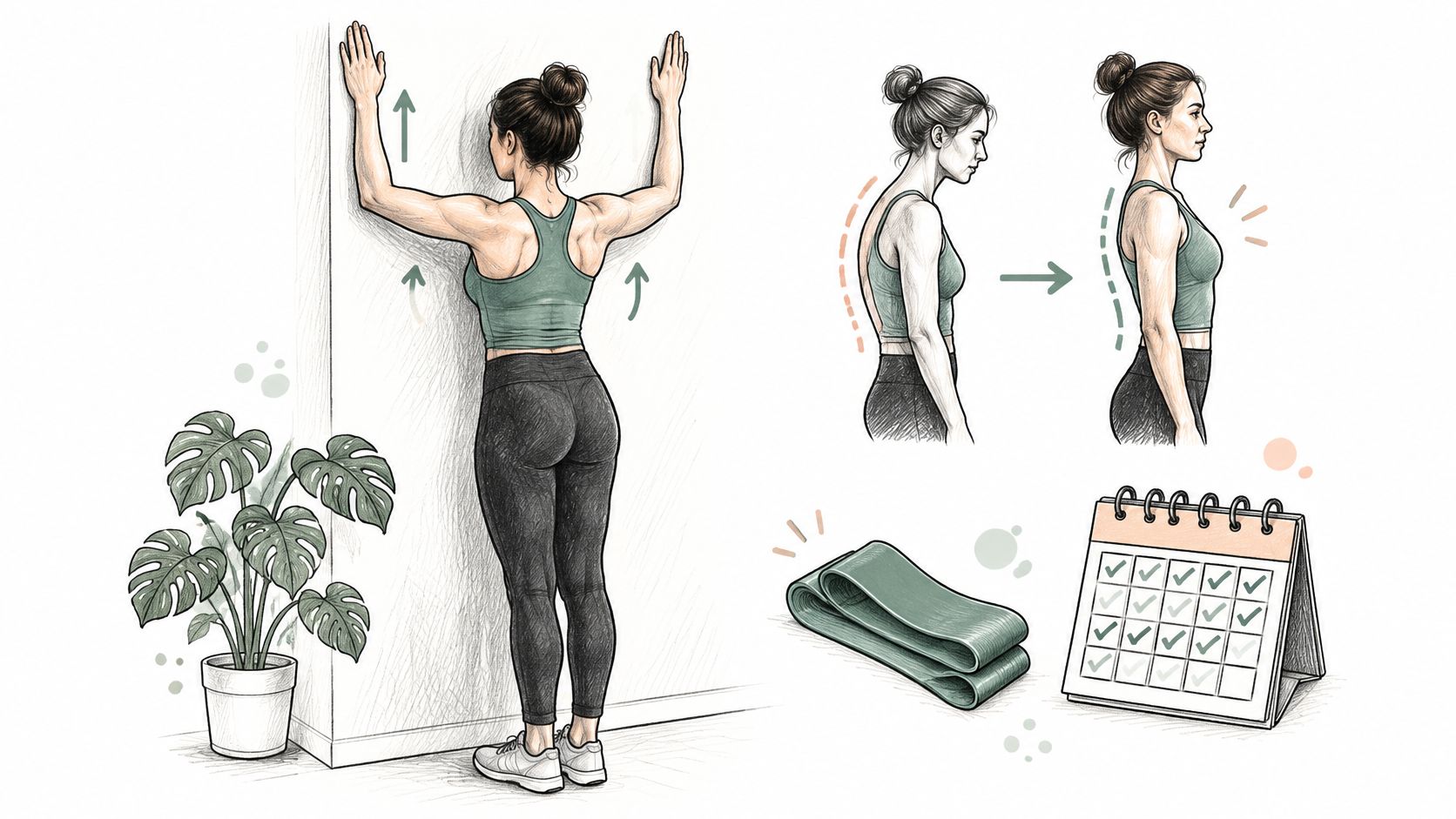
You catch yourself in a dark laptop screen most afternoons. Your shoulders sit ahead of your ribs, the upper back has a soft curve you didn't plan on, and you pull everything back for about a minute before the next email lands and the position creeps home. By evening there's a familiar ache between the shoulder blades.
That pattern deserves a proper name. Rounded shoulders means the shoulder blades rest forward on the ribcage and the upper back keeps a forward curve even when you think you're standing straight. It's common in desk workers and it's mostly a movement and control problem, not a shape to force. Which is why learning how to fix rounded shoulders starts with teaching the blades to hold a better position, not with clenching them back all day.
Uncomplicated rounded shoulders respond to structured training done three times a week for eight weeks, with each session running about 45 to 60 minutes. That's the dose I'd prescribe for someone with no pain, no numbness and no history of shoulder injury. The plan moves through three phases, and the sequence matters more than the individual exercises.
| Phase | Weeks | Focus | Key exercises |
| Phase 1 | Weeks 1 to 3 | Mobility and activation | Side-lying external rotation, scapular retraction and depression, serratus wall slides, prone Y-T-W |
| Phase 2 | Weeks 4 to 6 | Resisted strengthening | Resisted external rotation, band rows, diagonal raises |
| Phase 3 | Weeks 7 to 8 | Loaded control | Loaded overhead control, added only when upward rotation and external rotation stay controlled |
Phase 1 is deliberately unimpressive. Ten minutes of warm-up, thoracic and chest mobility short of a hard end range, then low-load activation work. If you expected to feel worked, you won't. The job here is to get the shoulder blade sitting and moving correctly before anything heavy arrives.
Phase 2 adds resistance. External rotation against a band, rows, diagonal raises. Plans usually fail at this stage, when someone adds band rows before the blade can hold its position. A row performed with a shrug trains the wrong muscle in the wrong direction.
Phase 3 adds loaded overhead control, and only when upward rotation and external rotation stay clean through the whole arc. Load goes on last because it does its job on top of control that is already there.
The evidence for this approach is solid rather than spectacular. A 2024 systematic review and meta-analysis in BMC Musculoskeletal Disorders covering 774 participants found that therapeutic exercise significantly improved rounded-shoulder posture, with a 95% confidence interval of -1.822 to -1.157 and P < 0.001. Broad interval, real effect.
The target is shoulder blades that stay under control while you reach, press, carry and type.
The fit test at week four is simple. The working muscles stay free of sharp pain, and reaching overhead feels easier than it did in week one. If either fails, the plan needs adjusting before the load goes up.
The most common driver in desk workers is a shortened pectoralis minor, the small muscle running from the front of the ribs to the front of the shoulder blade. When it sits short, it tips the blade forward and down at rest, and consciously pulling your shoulders back won't hold against it for long. Weakness in the lower trapezius usually travels alongside, which is why the blades flare or shrug the moment you raise your arms.
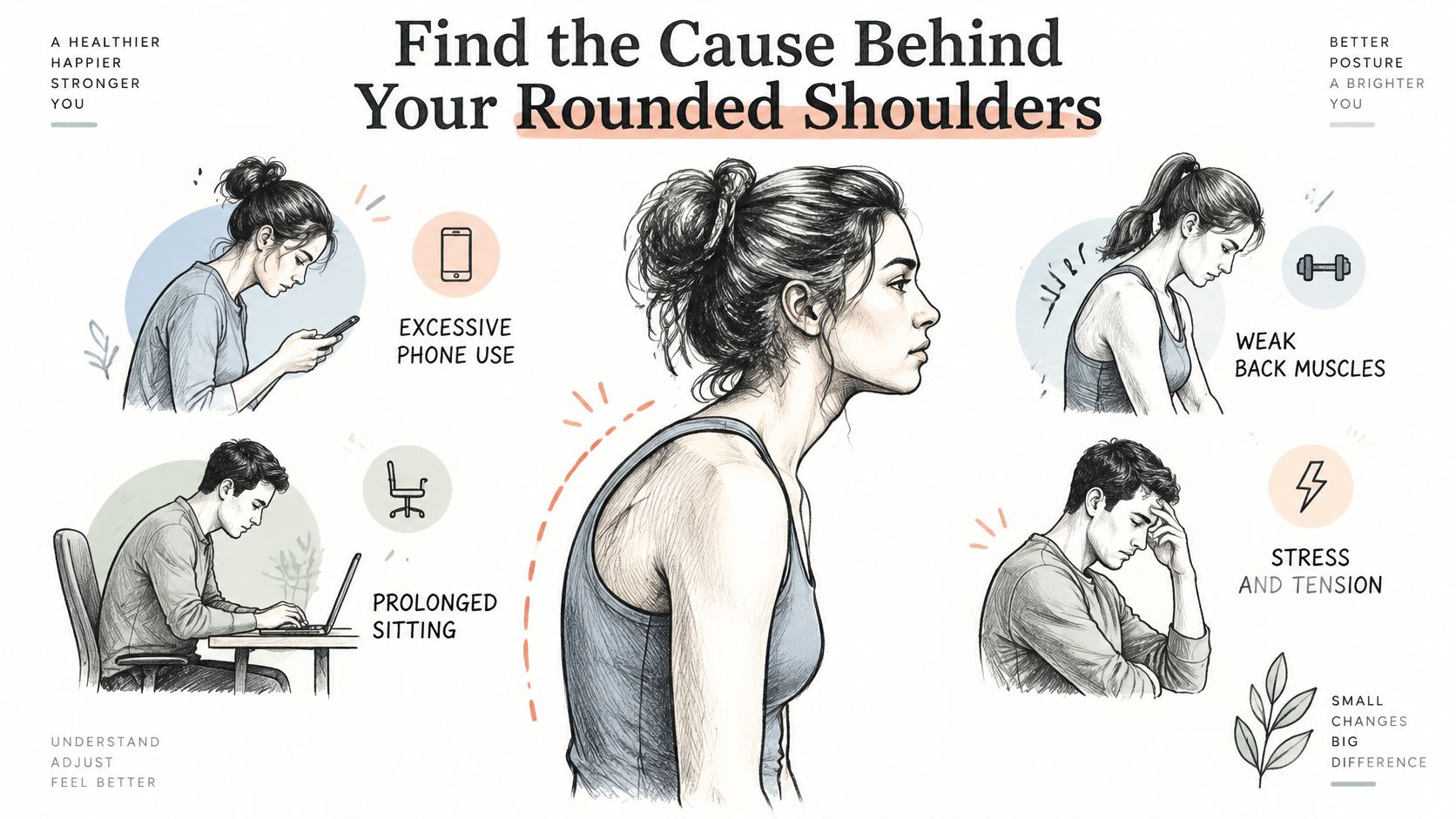
Match your own pattern against the checks below before you pick exercises. Two people with the same silhouette can need very different programs, because the right fix depends on which tissue is short and which muscle is undertrained.
| Likely contributor | Simple check | Focus area |
| Tight pectoralis minor | Shoulders drift forward when arms lift overhead | Chest mobility and soft-tissue work |
| Weak lower trapezius | Shoulder blades flare or shrug during arm raises | Lower-trapezius rows and control |
| Thoracic stiffness | Upper back won't extend over a chair back or foam roller | Thoracic mobility drills |
| Desk-related overuse | Discomfort builds after long sitting | Workstation changes and movement breaks |
| Shoulder pain, numbness or weakness | Symptoms with arm use or at night | Clinical evaluation before exercise |
A 2023 study comparing stretching alone with a combined program separated these drivers cleanly: pairing pectoralis-minor stretching with lower-trapezius strengthening corrected rounded-shoulder posture more effectively than stretching alone, because the combined work increased the resting length of the pectoralis minor. The same trial found no extra gains in shoulder-flexion range of motion from the combined program, a fair warning against promising that posture work restores everything.
Read those findings as a matching exercise. A short pec minor needs front-of-shoulder mobility work; a weak lower trapezius needs more activation volume, and piling on extra stretching won't substitute for it. Retest the same checks at week four. Progress looks like the blades staying quiet through the overhead reach, not a straighter silhouette in the mirror. If the discomfort has been building for months, read up on the wider pattern behind shoulder pain that starts with poor posture before you load anything.
One rule governs all of this. If any check reproduces sharp pain, radiating symptoms or clear weakness, stop and read the assessment section before you begin the routine.
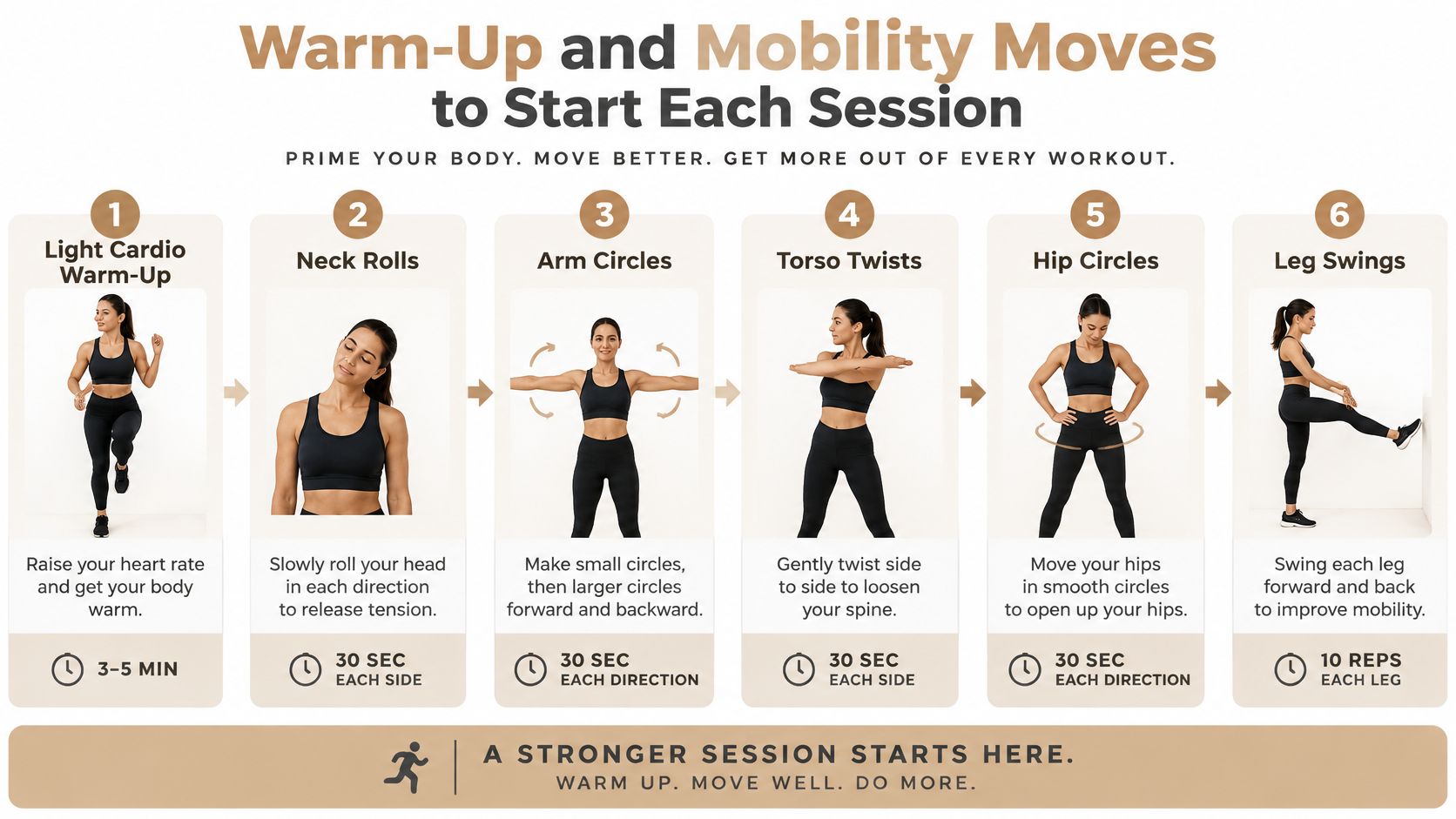
Ten minutes of preparation buys better control for the rest of the session, so don't skip it to get to the "real" work. The order below moves from general warmth to specific mobility, then into blade control. The aim is not a rigid shoulders-back shape. It is a blade you can position on demand and a shoulder that tolerates that position without complaint.
A randomized study of 26 adults with rounded-shoulder posture compared posterior-shoulder stretching against pectoralis-minor self-stretching, both paired with scapular posterior-tilting exercises, three times a week for four weeks. Both groups improved posture distance and pectoralis-minor length, and neither approach beat the other. Positioning plus structured exercise did the work.
The wider review points the same way. An analysis of 23 studies and 969 participants, reported in this Scientific Reports paper, found no meaningful acute or chronic posture effect from stretching, while chronic strengthening produced a large improvement (d=-0.83, P=0.01). That matches the stretching-versus-combined finding covered earlier: mobility buys the position, and strength keeps it once you stop thinking about it. Use the warm-up to prepare for treatment, not as the treatment itself.
A looser upper back, no pinch at the front of the shoulder, and breathing that stays easy throughout. Run one quick check before you move on: set the blade down and back, hold it for a slow breath, and confirm you can keep it there without shrugging or flaring the ribs. That hold is the control the rest of the session builds on. If you finish the warm-up breathless or with a sharper shoulder than you started, the dose was too aggressive.
The change happens here, and it's the part most home routines rush. The six moves below run in progression order. Do them at the end of the session, after mobility, and stop each set when control fades rather than when the reps run out.
| Move | Sets and reps | Cue |
| Side-lying external rotation | 2 sets of 12, light weight | Keep the elbow tucked and move only the forearm |
| Scapular retraction and depression | 3 sets of 10, hold 2 seconds | Draw the blades down and together without shrugging |
| Serratus wall slides | 2 sets of 10 | Keep the ribs down as the arms slide up |
| Prone Y-T-W raises | 2 sets of 8 per letter | Lift from the shoulder blade, not the neck |
| Seated band rows | 3 sets of 12 | Pause at the back with the chest quiet |
| Diagonal band raises | 2 sets of 10 per side | Control the return and avoid a shrug |
Two of these carry most of the load. Scapular retraction and depression teaches the blade to move down and back rather than just back, and the two-second hold is what builds the endurance to hold it during a workday. Side-lying external rotation is the antidote to the internally rotated humerus that comes with a forward blade, and it's a move often performed too heavy with too much trunk rotation. Start with a weight you could hold for twenty reps and use it for twelve.
The rationale comes from a trial on symptomatic forward-head posture, where adding scapular stabilization to postural-correction exercises three times a week for ten weeks produced greater improvements in craniovertebral angle and pressure-pain threshold, plus larger reductions in muscle activity and disability, than postural correction alone. The craniovertebral angle is a measured postural indicator for forward-head alignment, and a larger angle generally means better head positioning. Stabilization work is what moved it, not reminders to sit straighter.
Progression rule: Earn reps and clean control first, then add resistance. Move to the next phase only when the current one feels controlled and pain-free from the first rep to the last.
The same discipline applies to any corrective program you follow. If you're layering these moves onto an existing routine, the best posture correction exercises cover how to sequence them without doubling up on the same muscle group.
Picture a laptop user who moves the screen onto a stand, brings the keyboard closer so the elbows stay near the ribs, and takes a two-minute movement break every hour. In my experience, the afternoon neck ache often eases within about three weeks, well before the shoulder position itself has changed much. The setup removes the daily dose of the problem while the exercises build capacity against it.
Work through this checklist once, then stop thinking about it.
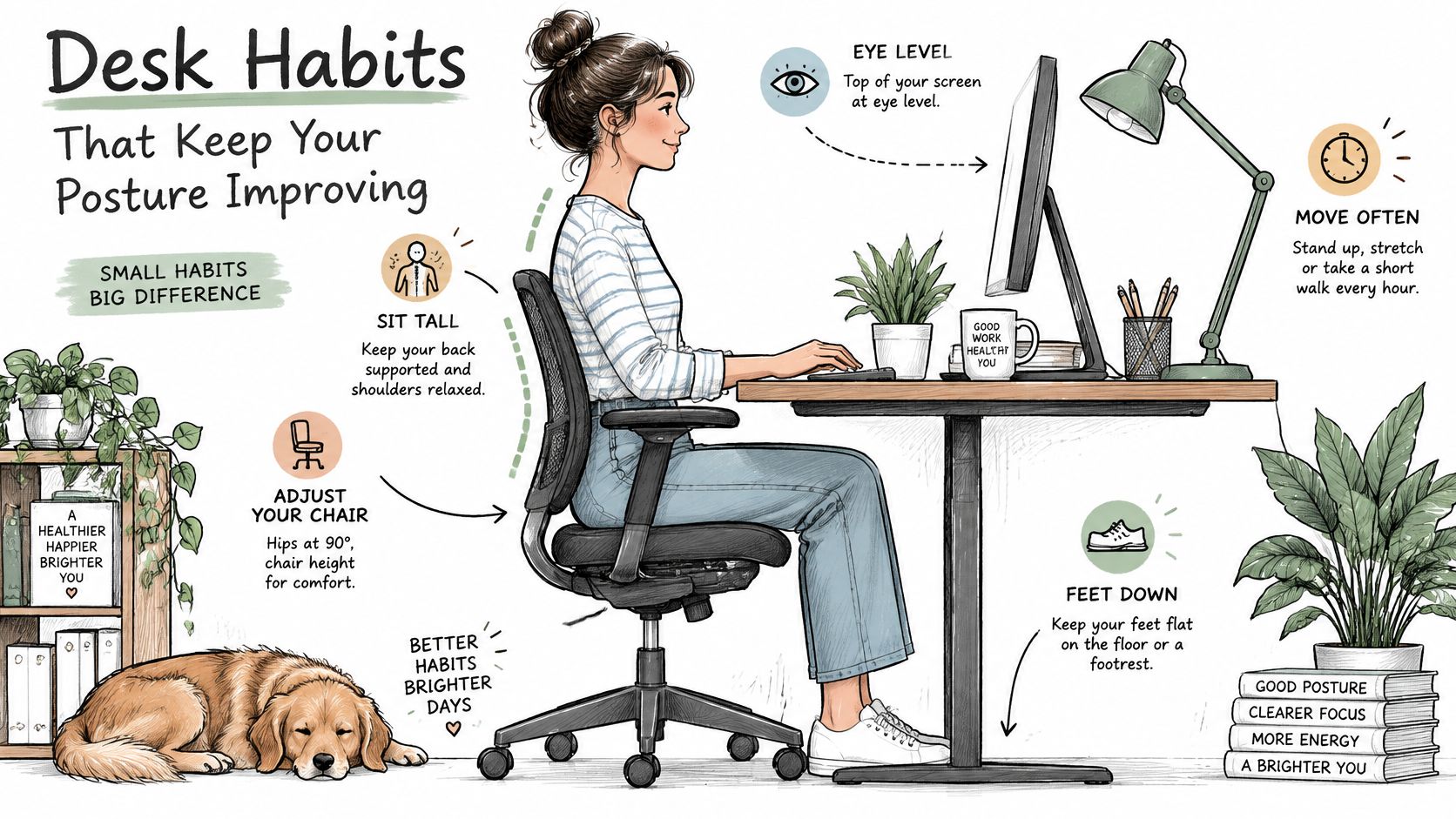
A rigid shoulders-back position held all day creates its own problem, because the neck and low back absorb the tension the shoulder blades should be managing. Variety beats a perfect pose. Control is what you're training, and a blade that moves well in different positions beats one pinned in a single "correct" spot. Spread three to five pain-free sets each of chin tucks, wall slides, band external rotation and rows across the day, and treat pain-free as the qualifier that matters: a set that grinds the front of the shoulder is practice in the wrong direction.
Desk changes support the routine. They can't offset eight hours of static sitting on their own, and the routine can't out-train a workstation that folds you forward every day. The same accumulation logic applies to preventing repetitive strain in the neck and shoulders, where small daily inputs decide the outcome more than any single session.
Some presentations need an exam before more self-treatment, and the list is shorter than expected. Book an assessment if you have numbness, tingling or weakness in the arm or hand, sharp or worsening shoulder pain, pain that wakes you at night, pain that started with an injury or a car accident, an obvious loss of overhead motion, or no meaningful change after eight weeks of the plan done three times a week.
An examination separates things a home routine can't. A flexible postural pattern looks similar from across the room to fixed thoracic kyphosis, a joint problem or nerve involvement, and only the exam tells them apart. Imaging isn't the first step for uncomplicated posture with no trauma, no progressive weakness and no numbness. Those red flags are exactly what make a clinical evaluation, and sometimes imaging, appropriate.
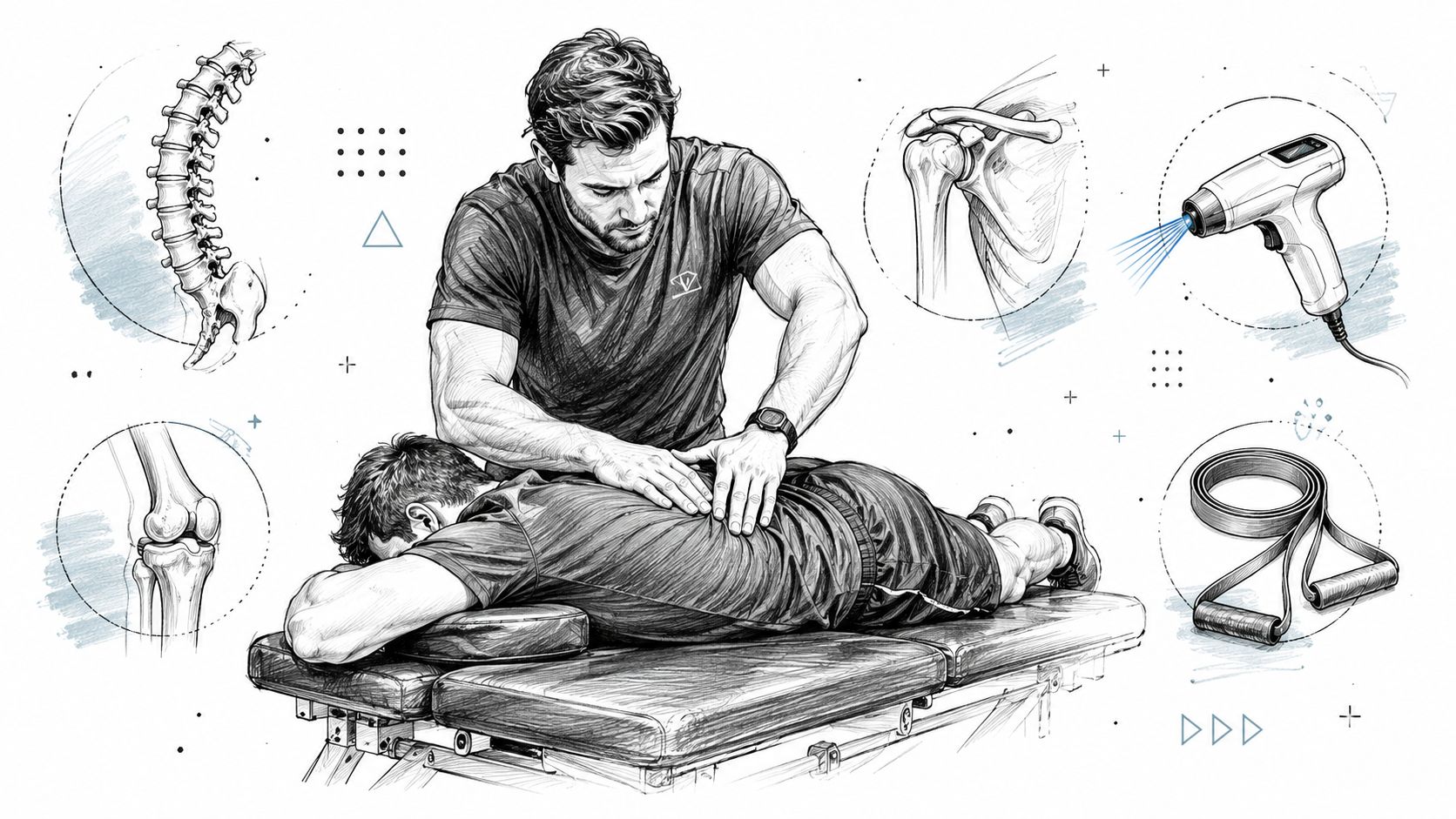
For readers who meet that list, the process at Aspen Falls Wellness is three steps: schedule an initial exam, receive a personalized treatment plan, and start relieving the pain. That plan may draw on mobility therapy, rehabilitation exercise, chiropractic adjustment, massage therapy or muscle stimulation where the exam supports it. Dr. Jeremy Kaier's training in the McKenzie Method, Motion Palpation and soft tissue techniques is the kind of assessment that sorts a mechanical pattern from something that needs a different referral.
Record these at baseline, week four and week eight, and let the numbers make the decision instead of the mirror.
Stop rule: Any exercise that reproduces sharp shoulder pain, radiating symptoms, dizziness or increasing weakness gets removed that day, not pushed through.
Use week four to adjust load and week eight to decide. Continue if control and symptoms are trending the right way, progress if the current phase has become easy and clean, and book the exam if the picture hasn't moved.
Aspen Falls Wellness treats rounded shoulders as a movement and control problem, starting with an exam that separates a flexible postural pattern from a joint or nerve issue, then building a plan around mobility therapy, rehabilitation exercise and the manual work that supports them. If your own eight weeks stalled, or the warning signs above sound familiar, the Salt Lake City and Sandy clinics are set up for exactly that evaluation. Visit Aspen Falls Wellness to schedule your initial exam.

Stay updated with the latest chiropractic news and exclusive offers.