Post chiropractic adjustment pain is often mild and short-lived. Learn how long soreness lasts, how to manage it at home, and when to get urgent care.
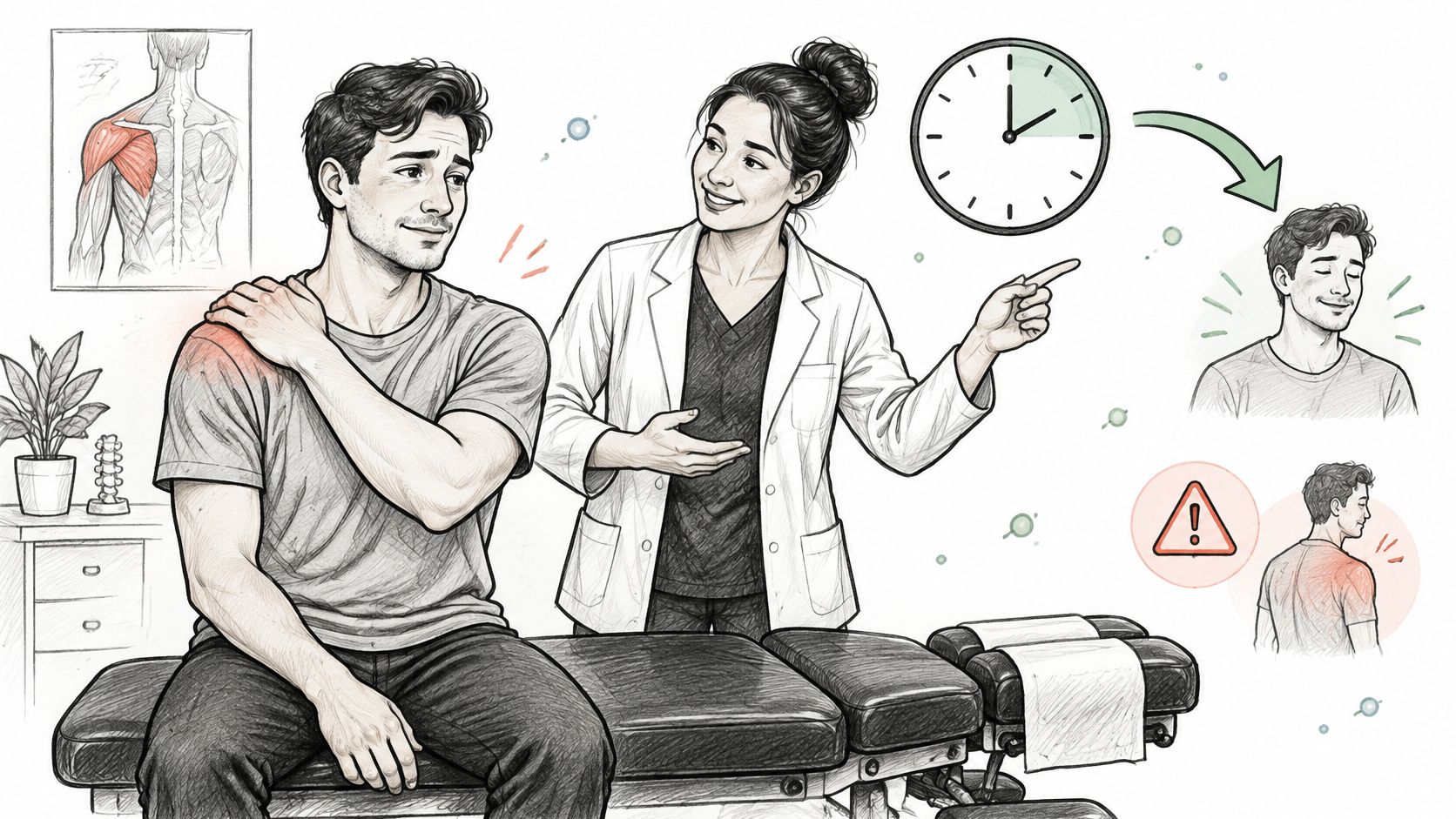
Mild soreness after a chiropractic adjustment usually fades within 24 hours, and soreness in the low back can run a little longer, often one to two days. Pain that keeps getting worse, or that's still hanging around after 24 to 48 hours, is a reason to call the clinician who treated you instead of waiting it out.
So why does the answer sound so different depending on who you ask? One clinic says a day, a website says three days, a friend says they felt worse for a week and were told that was a good sign. The gap isn't in your body. It's in how researchers count and label post-treatment symptoms, and once you see why the published numbers spread so far apart, the "is this normal" question gets a lot easier to answer for yourself.
Some reaction after an adjustment is common enough that a clinic should expect it rather than be surprised by it. A U.S. evidence review of spinal manipulative therapy found that approximately 50% to 60% of patients experienced mild, transient adverse events, most often localized discomfort or a temporary increase in pain (evidence review of spinal manipulative therapy). Earlier prospective research put adverse effects at 30% to 61% of patients, and the same body of work timed them: 61% of reported effects began within four hours of the manipulation and 64% had resolved within 24 hours.
The National Center for Complementary and Integrative Health describes the same picture from the patient side. The common mild-to-moderate effects of spinal manipulation are increased pain or discomfort, stiffness, and headache, and most resolve within a day (NCCIH guide to spinal manipulation).
The frequencies below come from earlier prospective studies, so read them as a description of the usual menu rather than your personal odds.
| Symptom | Reported in earlier studies | Typical pattern | Report to clinician if |
|---|---|---|---|
| Local soreness or discomfort | 15% | Tender muscles near the treated area that ease over one to two days | Pain spreads, worsens, or lasts beyond 48 hours |
| Stiffness | 20% | Tightness on movement that eases with gentle activity | Stiffness comes with weakness, numbness, or loss of balance |
| Headache | 20% | Mild, short-lived headache, most often after neck treatment | Headache is severe, sudden, or unlike any previous headache |
| Radiating discomfort | 12% | Brief ache that travels toward an arm or leg | Radiating pain is new, persistent, or comes with numbness or tingling |
| Fatigue | 12% | Tiredness for a day or so after the visit | Fatigue persists or comes with fever or other systemic symptoms |
In plain terms, patients often describe one of four things: sore muscles around the segment that was worked on, joints that feel tight until they move through a few ranges, a dull headache after neck treatment, or simple tiredness. None of those require treatment. They require a note.
Different studies used different definitions of an adverse event, asked about symptoms at different times, and counted things like "increased pain" in some trials but not others. That's why the same phenomenon shows up as 15% in one dataset and 50% to 60% in another. The percentages tell you a reaction is common. They can't tell you your odds.
Do one concrete thing: write down which symptom you have, exactly where it sits, and whether it fits the pattern in the table above. That note becomes the most useful information your clinician gets at the next visit. It's a reference point for comparing what you feel against the usual course, not a diagnosis, and it's also a good moment to review ordinary sore muscle recovery tips for athletes, since the load, sleep, and hydration principles apply to a treated back just as they do to a trained hamstring.
Think about the first week of a new strength program. You didn't tear anything. You loaded muscles in an unfamiliar pattern, and the next morning they were tender, stiff, and slow to get going. Two days later they were fine, and a few weeks later the same load produced no reaction at all. A spine that has been guarded, restricted, or painful for months responds to its first real movement in much the same way.
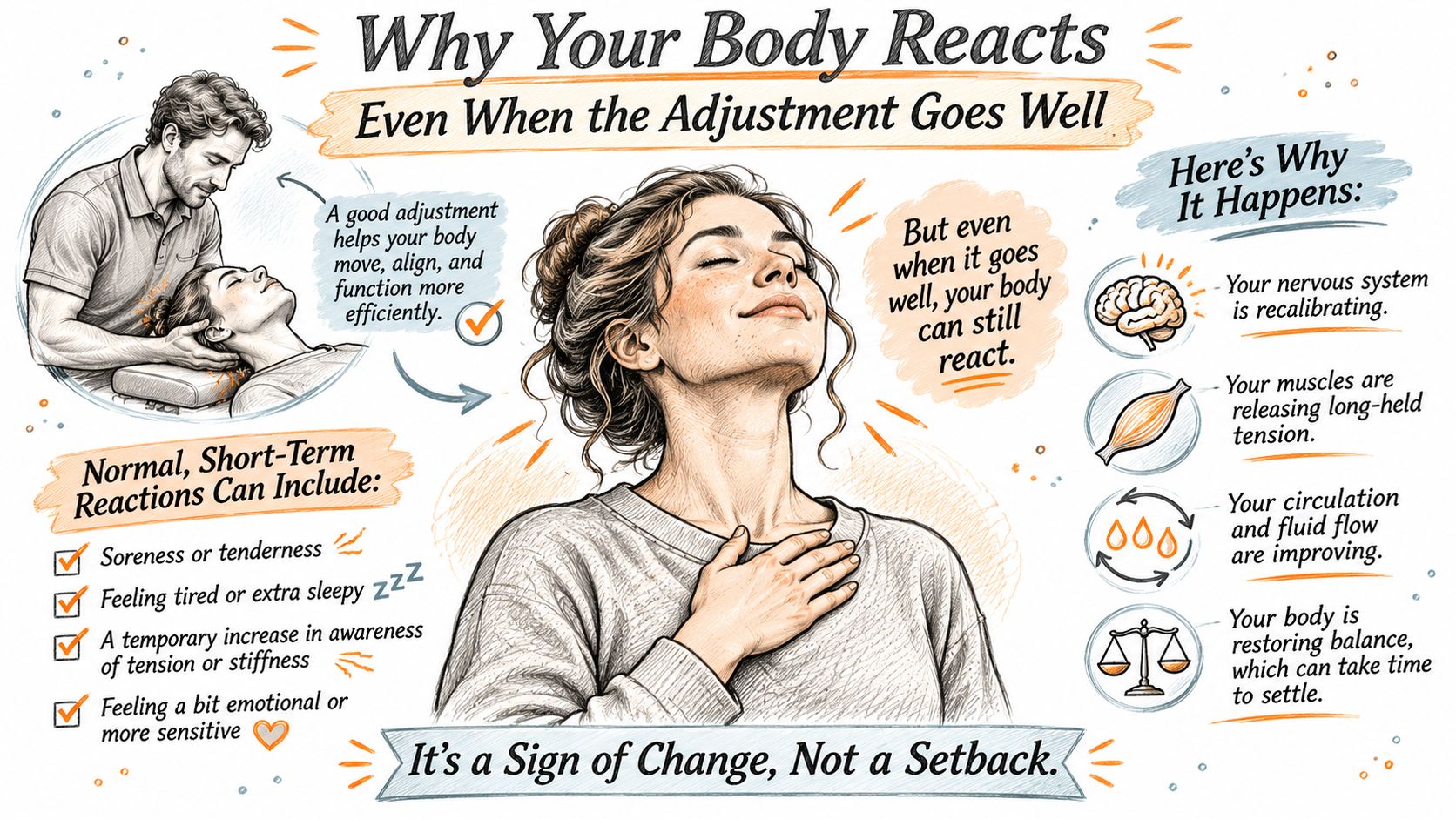
An adjustment is also rarely the only thing that happens in a visit. In a randomized controlled trial of 767 adults receiving manual therapy for neck or back pain, the most frequent reactions were muscle soreness, increased pain, and stiffness. Among patients who completed at least three treatments, 51% reported at least one adverse event after one or more visits, and the rates did not differ meaningfully when spinal manipulation was excluded (trial of manual therapy reactions). That last detail matters. It suggests the soreness comes from the whole exposure, including mobilization, stretching, soft-tissue work, changed loading, and a temporarily sensitized nervous system, rather than from the thrust alone.
A 2023 systematic review of randomized trials found that 94 studies, or 61.0% of the trials reviewed, reported adverse events, but only 23.4% defined what counted as an adverse event. Among those 94 reporting studies, 67.0% stated that no adverse events occurred at all (BMJ Open systematic review). Those three numbers explain the confusion. Most trials don't say what they're counting, and a majority of the ones that do count report nothing, which is hard to square with the experience of anyone who has been on a treatment table.
That inconsistency doesn't mean the risk is higher than reported. It means nobody can hand you a precise rate for your own back. What you can rely on is the shape of the response: mild, localized, starting within hours, and improving. If you want to understand why a sensitized nervous system can register a gentle input loudly, this explanation of how pain education changes the way the brain interprets signals is worth ten minutes.
Soreness is expected physiology. A symptom that feels qualitatively different from the complaint you walked in with deserves a conversation before the next visit, not another adjustment on top of it.
The first day does most of the work. Most reactions are underway within a few hours of the visit and are already fading by the next morning, which is why the 24-hour mark is the single most useful checkpoint you have.
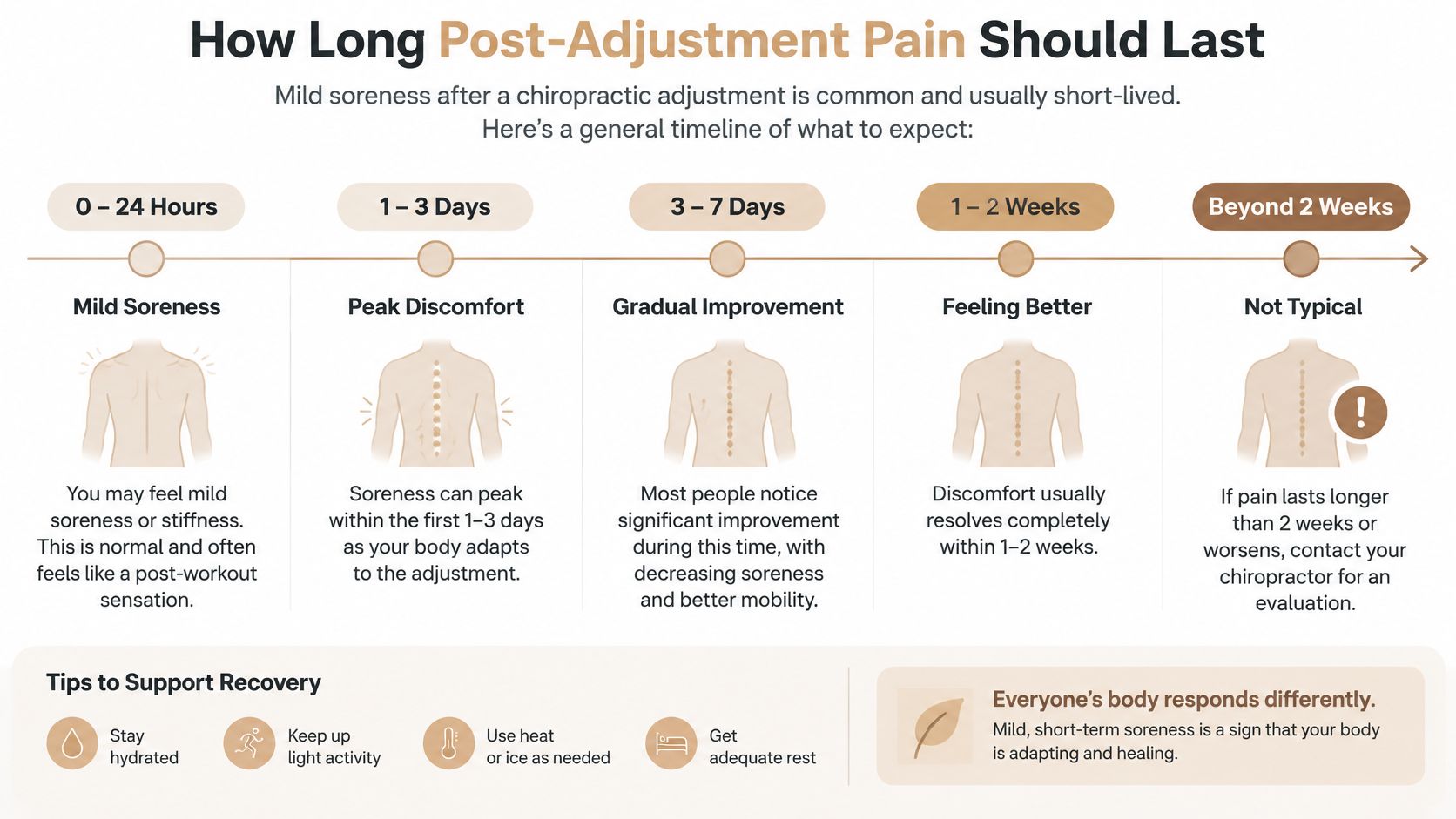
| Phase | Timing | Expected pattern | Action |
|---|---|---|---|
| Onset | Within 4 hours of the visit | Stiffness, mild soreness, or fatigue begins | Start the symptom diary |
| Benchmark | By 24 hours | Most reactions resolve, 64% in prospective data | Note whether symptoms are easing |
| Low-back window | 1 to 2 days | Temporary soreness or fatigue generally disappears, per NCCIH | Keep monitoring with the diary |
| Checkpoint | 24 to 48 hours | Pain is worsening, unchanged, or spreading | Contact the treating clinician before the next adjustment |
| Ongoing care | Over several weeks | Modest pain and function improvement for acute low back pain, up to 6 weeks in the 2017 review | Review progress at each visit |
Low-back soreness tends to run slightly longer than the general one-day figure. The NCCIH patient publication on spinal manipulation for low-back pain notes that the most common side effects are minor, such as temporary soreness or fatigue, and generally disappear within 1 to 2 days (NCCIH booklet on spinal manipulation for low-back pain). That gives you a real window rather than a vague "give it time."
Say one reader has a stiff, achy low back the evening after a lumbar adjustment. By the next morning the ache is down to a two out of ten, walking is easier, and by day two it's gone. That's monitoring, not intervention, and it's worth mentioning at the next visit because it confirms the dose was tolerable.
A second reader notices the soreness is sharper on day two, has spread down the arm, and now two fingers feel numb. That's not a longer version of the first story. It's a change in character plus a neurologic feature, and it's a call to the clinic before anything else is scheduled.
Working rule: soreness that improves day by day can be watched. Pain that is unchanged, worse, or spreading after 24 to 48 hours gets reported.
Record five things once in the evening and once the following morning: the time symptoms started, intensity on a 0 to 10 scale, the exact location, any new numbness or tingling, and whether daily tasks are getting easier or harder. Five lines.
Patients typically begin to experience back pain relief within weeks rather than hours, so a single rough evening says little on its own. The trend across visits is what tells your clinician whether the plan is working.
Severe complications after spinal manual treatment are uncommon, but the estimates are wide because methods vary and events go underreported. A clinical scoping review found benign adverse events in roughly 23% to 83% of adults, while serious-event estimates ranged from 1 per 2 million manipulations to 13 per 10,000 patients (scoping review of adverse events). Wide uncertainty is exactly why a short, memorized list of warning signs beats a general reassurance.
The first tier is emergency. New loss of bladder or bowel control, inability to urinate, numbness in the saddle area, rapidly worsening weakness, paralysis, or an inability to walk safely all point toward severe nerve compression and need emergency evaluation (tiered triage of post-treatment warning signs). After neck treatment, a sudden severe headache or neck pain with dizziness, double vision, speech difficulty, facial drooping, loss of coordination, or one-sided weakness belongs in the same tier, because that pattern is neurologically distinct from muscular soreness.
The second tier is same-day. New or progressive numbness, tingling, or weakness in the arms or legs, fainting, visual disturbance, fever, or trouble walking safely all warrant prompt medical assessment. The third tier is a call to your clinician before the next appointment: pain that is severe, progressive, or not improving after 24 to 48 hours.
| Symptom | Urgency | Action |
|---|---|---|
| New loss of bladder or bowel control, or inability to urinate | Emergency | Call emergency services now |
| Numbness in the saddle area, rapidly worsening weakness, paralysis, or inability to walk safely | Emergency | Call emergency services now |
| After neck treatment: sudden severe headache or neck pain with dizziness, double vision, speech difficulty, facial drooping, or one-sided weakness | Emergency | Call emergency services now |
| Fainting or visual disturbance after treatment | Urgent | Same-day medical evaluation |
| New or progressive numbness, tingling, or weakness in the arms or legs | Urgent | Contact the clinician the same day |
| Fever with spreading back or neck pain | Urgent | Same-day medical evaluation |
| Severe, progressive, or unimproved pain after 24 to 48 hours | Prompt reassessment | Contact the treating clinician before the next adjustment |
| Mild soreness that improves day by day | Expected | Continue monitoring with the symptom diary |
Rare does not mean ignore. A symptom's trajectory and its neurologic features tell you more than the soreness itself ever will.
One instruction overrides the rest. Never repeat an adjustment, stretch hard into the area, or manipulate your own neck to test whether the symptom improves. That muddies the picture and delays the evaluation that answers the question.
Most post-adjustment soreness needs no treatment, but a few habits make the first 48 hours more comfortable and give your clinician cleaner information.
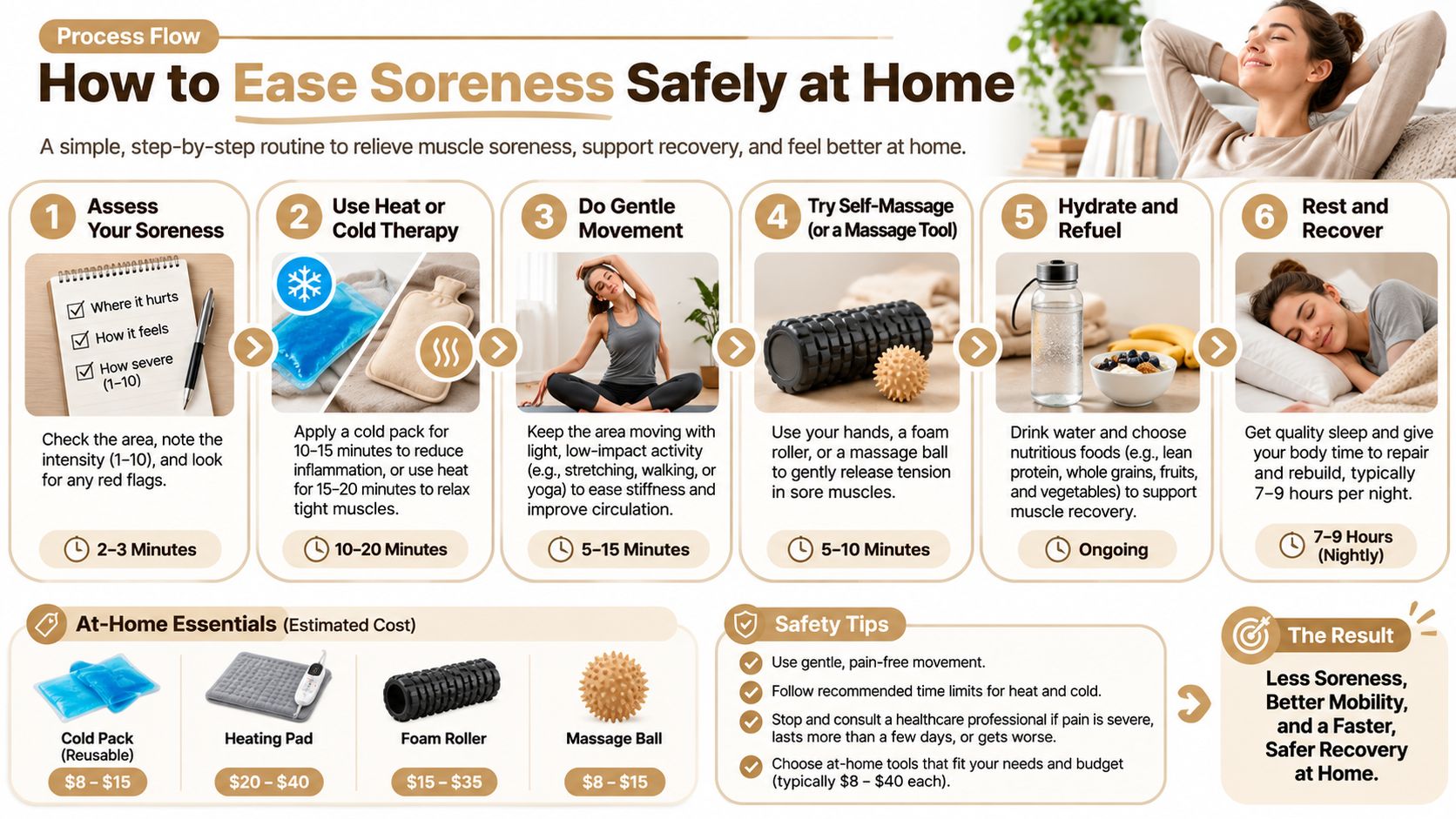
If you use electrical stimulation at home for muscular soreness between visits, these practical notes on TENS units for home use cover pad placement and session length.
Bring the diary, the timeline of what started when, and a list of any medication you took for the soreness, including over-the-counter doses. Three items, and they change the conversation from "it hurt a bit" to a readable trend your clinician can act on.
Gentle movement beats bed rest for ordinary post-adjustment soreness. Aggressive stretching and repeat testing make the picture harder to read.
Here's the decision rule in one line. If your symptoms fit the expected pattern and are improving by 24 to 48 hours, keep monitoring and raise it at the next visit. If soreness persists, worsens, spreads, or changes character, contact the treating clinician before the next adjustment so the plan gets reviewed rather than repeated.
Chiropractic care usually takes several visits, not one. A clinician reassesses progress each time and can change technique, force, frequency, or the working diagnosis based on how you responded. A flare after the first visit is common and often informative. The same flare after every visit means the approach needs to change.
The evidence supports adjustment as one component of a broader plan rather than an instant fix. A 2017 review summarized by the NCCIH evaluated spinal manipulation for acute low-back pain in 15 studies involving 1,699 participants and found moderate-quality evidence of modest pain improvement for up to 6 weeks; a related group of 12 studies involving 1,381 participants found improved function (NCCIH review of low-back pain approaches). Modest and six weeks are the operative words. Rehabilitation exercise, mobility work, and load management carry a real share of the result.
At Aspen Falls Wellness in Salt Lake City and Sandy, each patient gets a thorough chiropractic evaluation to identify the root cause of their symptoms before a customized plan is built, and progress is evaluated with each adjustment so the treatment stays on track. Because care often requires multiple visits, the team keeps patients informed about the recommended extent and duration of treatment, and a symptom diary is exactly the kind of information that shapes those decisions.
One action for this week: if any red flag appeared or pain is lingering past 48 hours, book a reassessment and bring the diary with you. If you're weighing how often to come in, this guide to how often you should see a chiropractor walks through the scheduling logic for acute, chronic, and maintenance care.
Aspen Falls Wellness offers thorough chiropractic evaluations, customized adjustment plans, and a coordinated team that includes massage therapy, acupuncture, and rehabilitative exercise, so your response to care is reviewed and addressed rather than assumed. If your post chiropractic adjustment pain isn't following the expected course, or you want a second opinion on a plan that isn't settling, the team in Salt Lake City and Sandy will assess what's happening and adjust the approach. Visit Aspen Falls Wellness to book an evaluation and bring your symptom diary with you.

Stay updated with the latest chiropractic news and exclusive offers.