Pain neuroscience education explains why pain is a protective nervous system signal, what research shows it changes, and how it fits into care.
Why does a radiology report frighten people more than a good explanation calms them?
Because most explanations answer a question the patient never asked. Someone with a bulging disc at L4-L5 does not lie awake wondering about descending inhibitory pathways. They want to know whether bending for the laundry basket is causing damage, whether the ache that moved into the calf means the disc is worse, and whether anyone is taking the pain seriously.
Pain neuroscience education exists to close that gap. It teaches that pain is a protective output of the nervous system, shaped by tissue signals, threat and context, and the evidence behind it is real but modest. A 2021 systematic review and meta-analysis in Pain Medicine reports that delivered on its own it produces a small to moderate pain reduction, with a standardized mean difference of -0.32 immediately after treatment, and that added to exercise, short-term pain falls by 2.09 points on a 0-to-10 scale against control care. That combination is where the approach earns its place: education paired with movement, judged by what changes rather than promised as relief.
Tissue findings can matter. Nervous-system learning can matter. The useful question is which change you can measure in the next four weeks.
Does pain always mean something is damaged? Sometimes yes, sometimes no, and rarely in direct proportion. The nervous system is the one making that call.
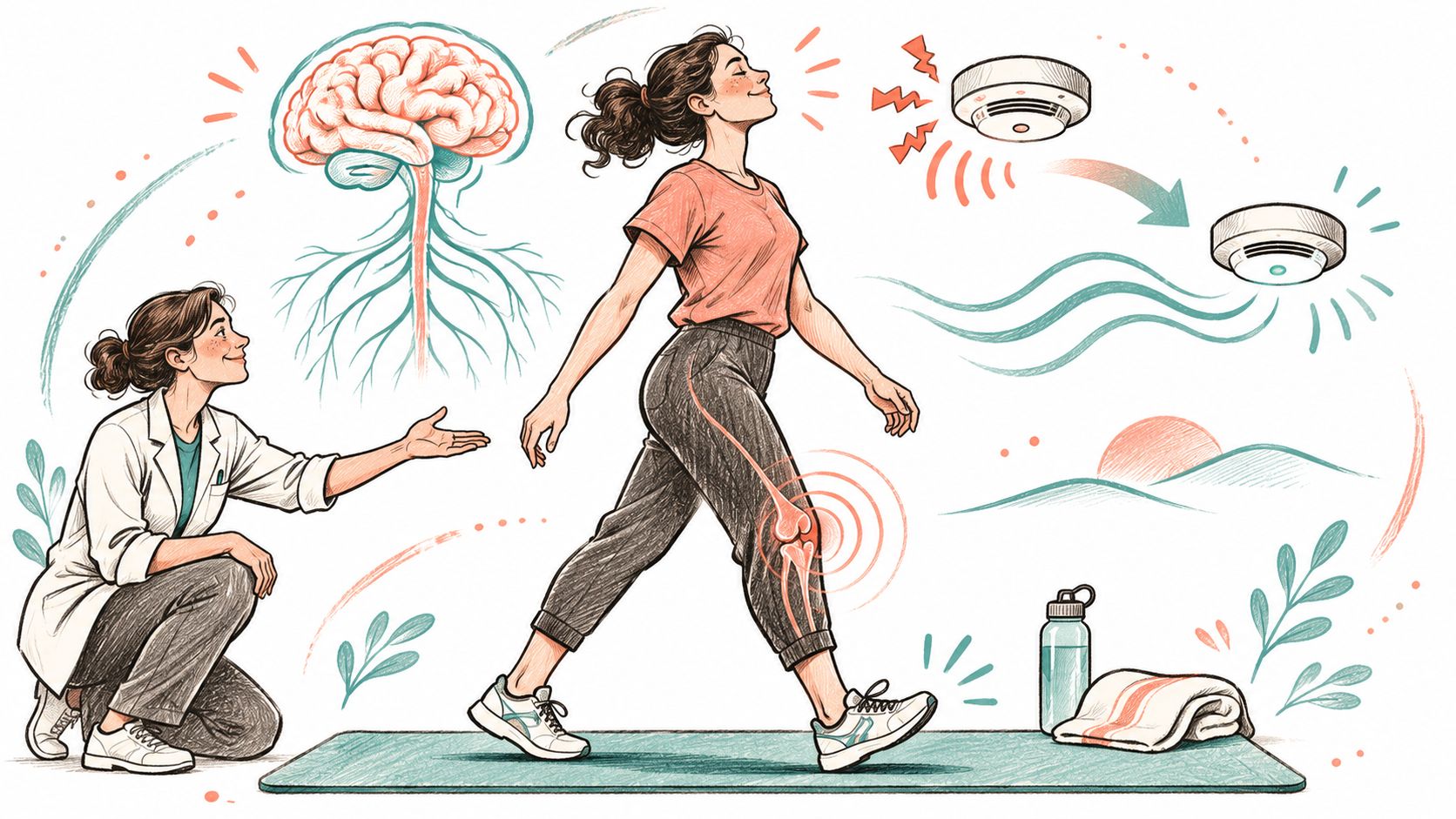
Pain is a decision the nervous system makes, using tissue signals as one input among several. Your sleep, your stress load, your injury history and how dangerous the moment feels all feed the same calculation. That weighing process is what the diagram below is trying to capture.
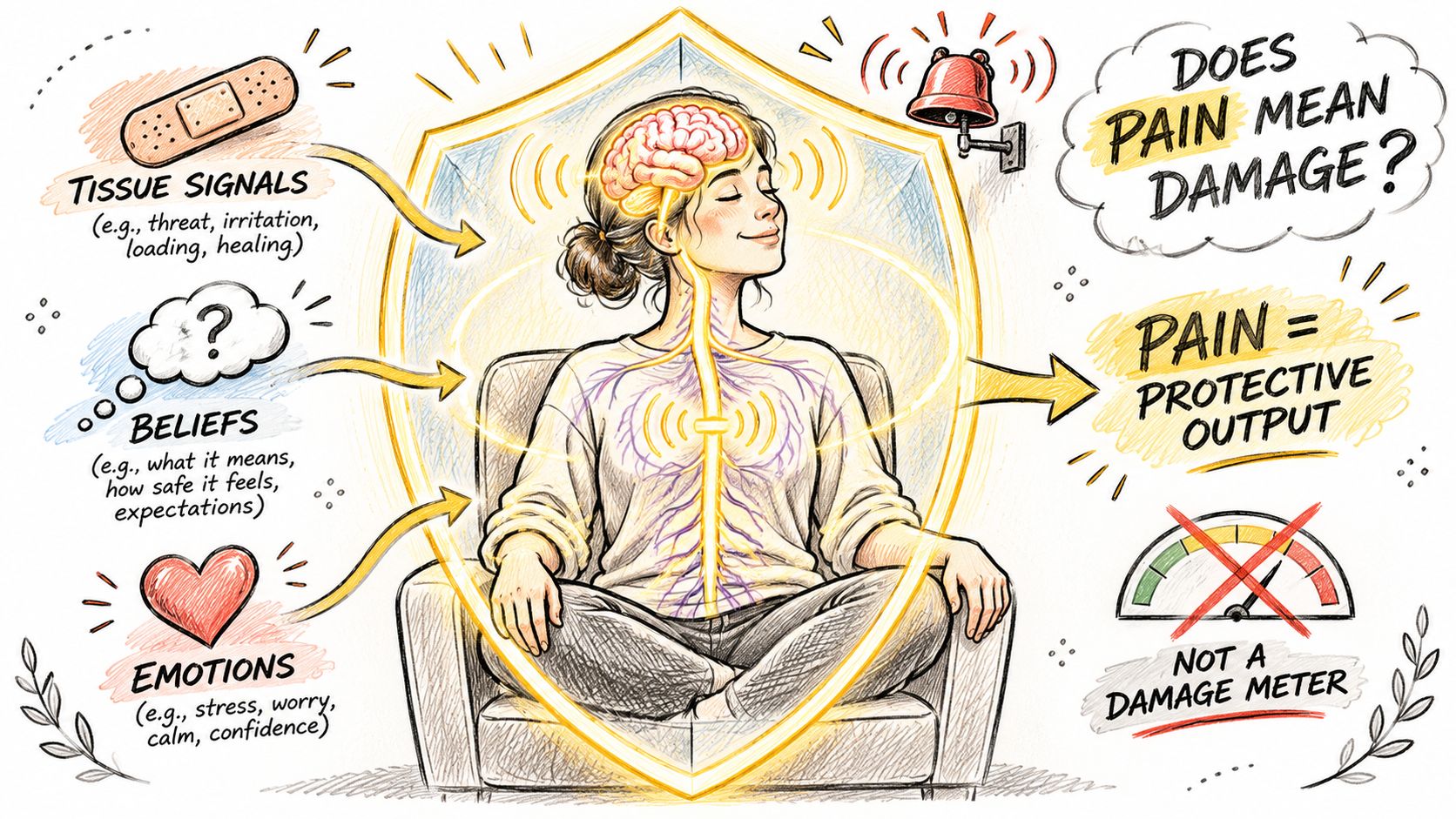
Pain neuroscience education is patient education that explains this model in everyday language, trading neuroanatomy lectures for plain comparisons. Its clinical purpose is narrow: replace a frightening explanation with an accurate one so fear drops and movement becomes possible again. A 2021 systematic review and meta-analysis in Pain Medicine describes it as an education-based component of conservative care that performs best when integrated with active rehabilitation rather than offered as a stand-alone treatment.
A smoke alarm makes the idea concrete. A well-placed alarm sounds at real smoke and stays quiet otherwise. An over-sensitive one shrieks at burnt toast. Neither alarm is lying, and neither means the house is on fire. The sensible response is to recalibrate the sensitivity while keeping detection intact. A sensitized nervous system can produce severe pain with little tissue threat, and it can be retuned without pretending real tissue problems don't exist.
Both halves of that sentence matter. A disc bulge can be real and worth treating. The alarm can also be turned up louder than the tissue finding warrants. Good education holds the two together instead of asking you to pick a side, and it sets expectations by outcome: understanding and fear shift first, movement follows, and pain scores may or may not move much after that.
Pain is real, protective and modifiable. All three words carry weight, and dropping any one of them turns a useful explanation into something dismissive.
One test works on any explanation you're handed, whether from a clinician, a video or a pamphlet: does it leave you safer to move, or only reassured until Thursday? The first changes behavior. The second fades.
Here's the scoreboard, with the caveats attached rather than buried.
| Outcome | Reported effect | Certainty or caveat |
|---|---|---|
| Pain after PNE alone | Small to moderate reduction immediately after treatment | The confidence interval was wide, so the true effect could sit lower |
| Pain at long-term follow-up after PNE alone | Reduction similar in size to the immediate effect | Follow-up data were thinner than post-treatment data |
| Disability after PNE alone | Small reduction after treatment | The long-term disability result was not significant |
| Fear of movement after PNE alone | Reduction of 13.55 points on a 100-point scale | Clinically relevant in the short term, drawn from 12 trials and 755 adults in a systematic review of PNE for chronic musculoskeletal pain |
| Pain intensity across 12 trials of 1,485 participants | SMD -0.27 (95% CI -0.50 to 0.00) | Substantial heterogeneity (I² = 67%) in that meta-analysis of 12 trials covering 1,485 participants |
| Pain with PNE plus exercise | Lower pain than control care on a 0-to-10 scale | Low certainty |
| Disability with PNE plus exercise | Moderate-to-large reduction | Based on a limited pool of chronic musculoskeletal pain trials |
| Fear of movement with PNE plus exercise | Large reduction in movement-related fear | Moderate certainty, the strongest rating in the table |
| Pain catastrophizing with PNE plus exercise | A marked drop in catastrophic thinking | Very low certainty |
| Total sleep time across 12 trials | A modest increase | Other sleep and psychosocial measures were not significant |
Read the middle column as the size of the effect and the right column as how much weight that finding deserves.
An SMD compares groups in standard-deviation units, which lets trials using different pain scales sit inside one analysis. A negative value means the education group did better, with less pain or less disability, and the further the value sits from zero, the larger the difference. A result hovering near zero is a nudge. A result approaching one full standard deviation describes a shift large enough to feel in everyday movement.
Certainty ratings reflect how far the underlying trials can be trusted: whether participants and assessors were blinded, whether the results agreed with each other, and how precise the estimate was. Low certainty means the direction is probably right but the size may be off. Moderate certainty means you can plan around it. Very low certainty means treat the figure as a hypothesis that reached statistical significance. A low rating is still a usable signal. It tells you the effect likely exists and warns you against building your entire recovery on it.
The pattern across those rows is consistent enough to act on. Education alone produces small, uneven pain relief. Education plus exercise produces the clearer signal, and it's the combination that shows up in guideline recommendations and clinical protocols. Fear of movement, catastrophizing and understanding tend to shift before pain scores do, which is why someone can feel more capable in week two while the 0-to-10 rating hasn't budged.
That ordering also sets honest expectations. The first change to watch for is a change in what pain means and which movements feel safe to try. Pain relief follows less predictably, and it tends to arrive as a byproduct of the combined approach rather than as a direct result of the explanation itself. Every figure above is an average across dozens or hundreds of people. None of them describes your body specifically.
Your nervous system doesn't transmit pain the way a wire carries current. It produces pain after weighing inputs, and threat appraisal is the scale it uses. Tissue signals arrive on one side. Sleep debt, stress, previous pain memories and the sense that something is dangerous arrive on the other.
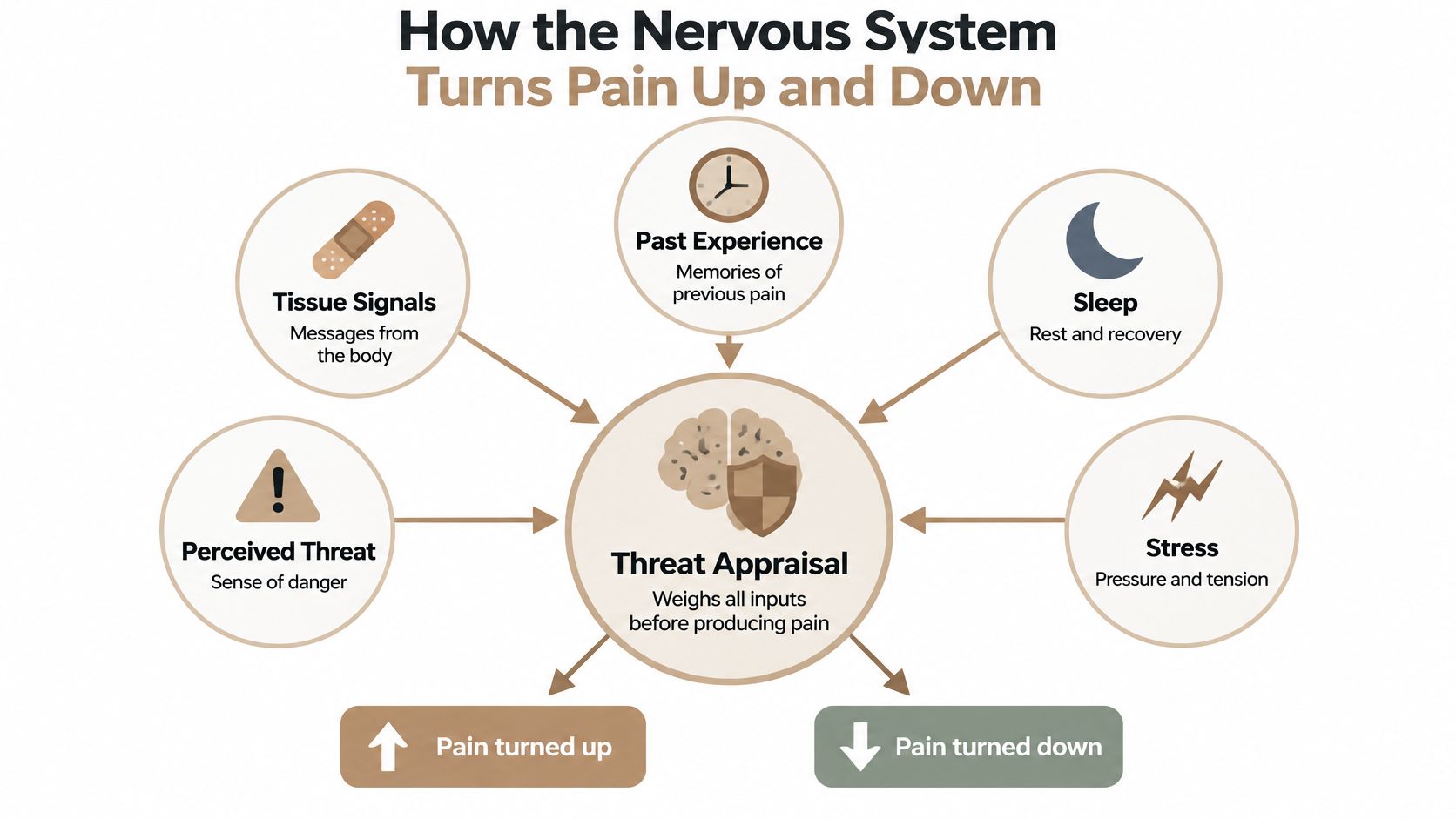
Say a warehouse worker hurts his back lifting a crate. If he reads the pain as ongoing structural harm, he stops bending, stops lifting, guards every movement, and loses conditioning within a few weeks. Ordinary tasks then feel more threatening, sensitivity climbs, and the pain spreads across a wider set of activities. Nothing new happened in his discs during that spiral. The interpretation did the work.
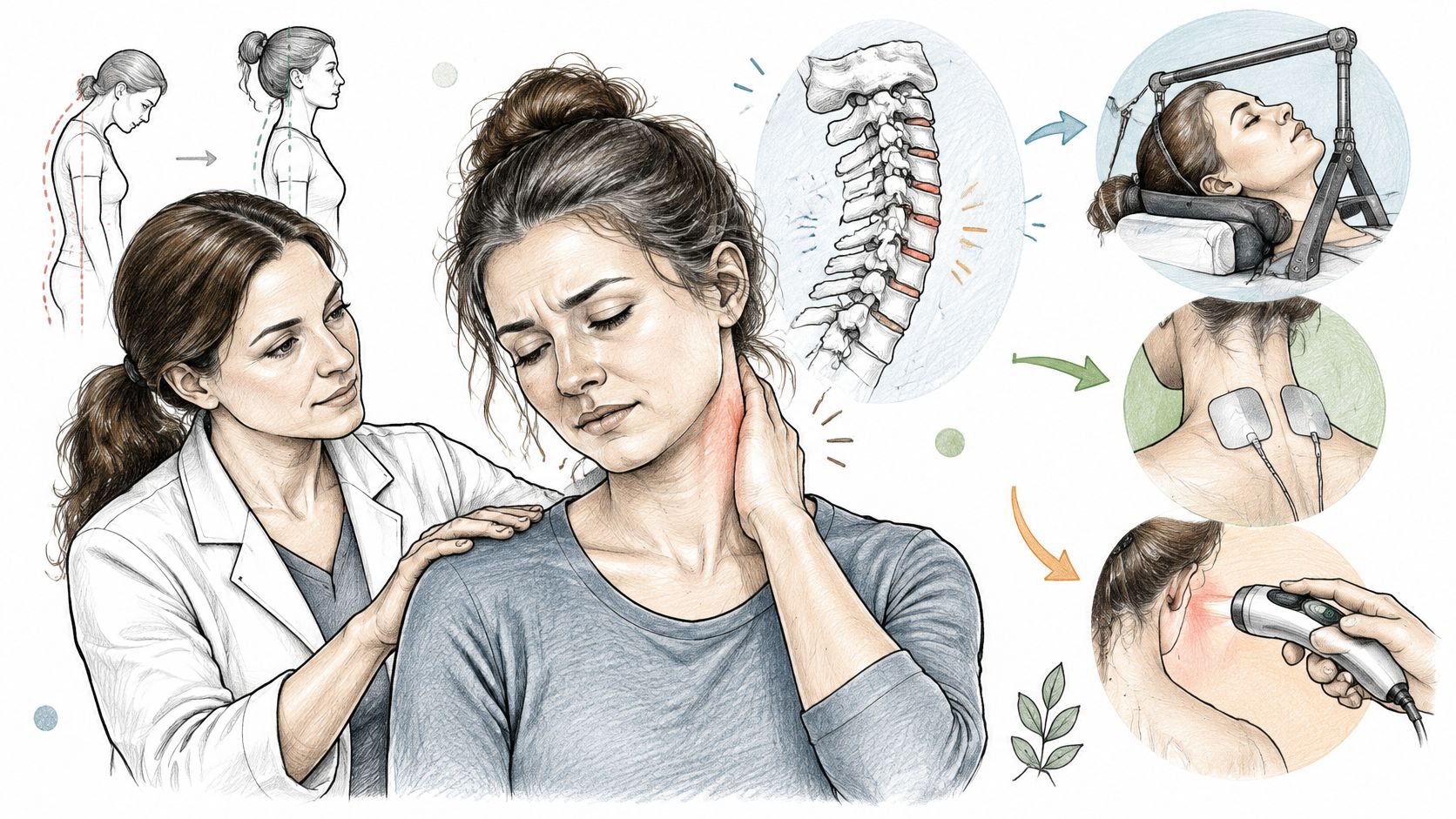
Put a desk worker in the same nervous system. Her neck aches more during deadline weeks and less on vacation. Same tissue, different context: short sleep, high stress, a monitor at the wrong height, and a belief that the ache signals degeneration. Once she understands the ache as a sensitivity that responds to load, sleep and stress, she can adjust her setup and keep moving instead of bracing for damage.
Education doesn't ask you to deny the signal. It asks you to stop reading the volume knob as a damage report.
Central sensitization describes a pattern of heightened responsiveness in the nervous system, and it's a description rather than a badge. A systematic review in central sensitization populations found that many randomized trials lacked consistent eligibility criteria for the label, which is a solid reason not to hand it to every person with persistent pain. The aim stays modest: change how the signal is interpreted, support the basics that lower sensitivity, including sleep, breathing and nervous system regulation strategies, and keep tissues loaded so they don't lose capacity.
Patients often ask whether a nervous-system explanation means their pain is imaginary, and whether the disc bulge on their MRI suddenly stopped mattering. Both worries deserve a straight answer.
The honest answer is that good education denies none of it. Nociception is real, pathology is real, and a diagnosis still matters. A synthesis of implementation and acceptance barriers describes where patient material often goes wrong: it overcorrects from a purely structural message to a brain-centered one, leaving people unsure whether their tissue findings still count or whether they are being told to think the pain away. Persistent biomedical beliefs, difficulty understanding heightened nervous-system responsiveness, and the fear of not being taken seriously all show up as barriers.
The accurate position holds both sides at once. A disc lesion, arthritis, a nerve injury or an imaging finding can all contribute to what you feel, and symptom severity does not map neatly onto what a scan shows. Two people with near-identical MRI reports can live with very different pain, because the image is one input among several reaching the brain's appraisal.
Some presentations need a clinician's assessment before any education-based plan continues on its own:
A sound explanation never asks you to ignore a red flag. It gives you a clearer way to tell one from the other.
The strongest signal in this field comes from pairing education with movement. A larger 2023 synthesis found that PNE plus exercise lowered short-term pain by 1.14 points on a 0-to-10 scale (95% CI, -1.55 to -0.72) and disability by an SMD of -0.80 (95% CI, -1.13 to -0.47) compared with exercise or physiotherapy alone, as reported in this meta-analysis of chronic musculoskeletal pain. The sequence below exists to reproduce that pairing rather than to deliver a lecture.
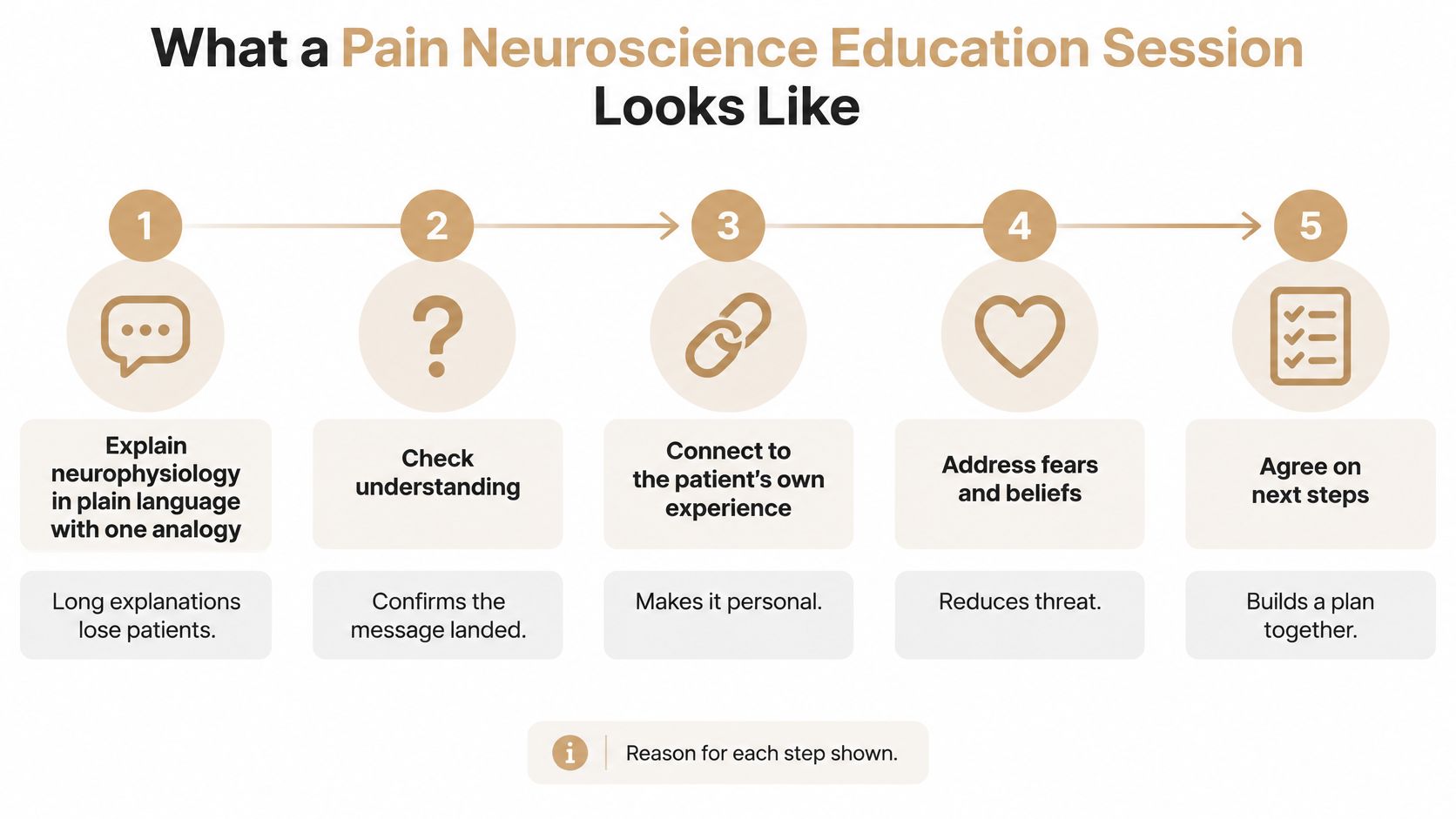
The most common slip is treating the conversation as the intervention. Explain, hand over a handout, book a follow-up in a month, and nothing has been tested. The explanation earns its value in the first week of movement that follows it.
The recent evidence sets expectations lower and more precisely than the marketing does. A 2025 systematic review of five randomized trials found no reliable evidence that adding PNE to a single physical-therapy intervention reduced pain or improved function beyond that intervention alone. The benefits that did appear sat elsewhere: pain self-efficacy, knowledge of pain and neurophysiology, pressure-pain threshold and fear of movement. In children and adolescents, a companion review reported better understanding, function and self-efficacy, with emotional effects that were modest and short-lived.
Progress runs on two tracks: what the tissue can do and what the nervous system has learned to predict. Each needs its own measure.
In the first few weeks, change shows up in behavior. You can explain your own flare-ups without alarm. You bend to tie a shoe without rehearsing it first, and you walk further before the ache arrives. Each of those shifts is a separate outcome on its own schedule, which is why the measures below sit side by side.
| What to track | Example measure | What a change tells you |
|---|---|---|
| Fear of movement | Tampa Scale for Kinesiophobia | A lower score means movement feels less dangerous, so avoidance is easing |
| Pain catastrophizing | Pain Catastrophizing Scale | A lower score means flares read as temporary events rather than damage |
| Walking tolerance | Walking duration over a set route | More minutes on the same route means activity is growing |
| Lifting tolerance | Load and repetitions tolerated | More load at the same effort means capacity is rebuilding |
| Neck movement | Cervical range of motion | More turn to each side means guarding is easing |
| Recovery from flares | Days to return to normal activity | Fewer days per flare means episodes are getting shorter |
| Sleep | Total sleep time, self-logged | Longer, less broken sleep means overnight recovery is improving |
| Pain intensity | 0-to-10 rating | Useful, but one number that often moves last; read it beside the rows above |
Record a baseline before you start, log the same measures weekly, and bring the log to your next visit. Consistency matters more than precision, because a fixed walking route and a rating taken the same way each time tell you more than a dozen improvised tests. Anyone who has worked at describing migraine severity to your doctor already knows what a consistent scale is worth. Bring the same discipline to a simple pain scale assessment at the start and end of each week.
A flat pain score with a rising walking tolerance means the plan is working on a different variable.
Education earns its place as one component inside a larger plan, and clinical guidance frames it exactly that way. The VA/DoD clinical practice guideline for low-back pain suggests adding a structured education component that includes pain neurophysiology to a multicomponent self-management intervention, and it suggests spinal mobilization or manipulation as part of a multimodal program. Both recommendations carry a weak for grade: the evidence is modest, and responses differ from patient to patient. The guideline also separates acute from chronic care, so a single fixed protocol for every patient has no support.
A 52-year-old arrives with low-back pain that flares a few times a year. The initial exam works out what is driving this episode, because the tissue findings and the alarm the nervous system has learned both matter, and the plan assigns a tool to each. Education explains why a flare rarely means a fresh injury and what usually settles it. A graded walking plan and mobility work give the nervous system repeated proof that movement is safe. Manual care, where the exam supports it, makes that first week of movement easier to start, and take-home exercises carry the dose between visits.
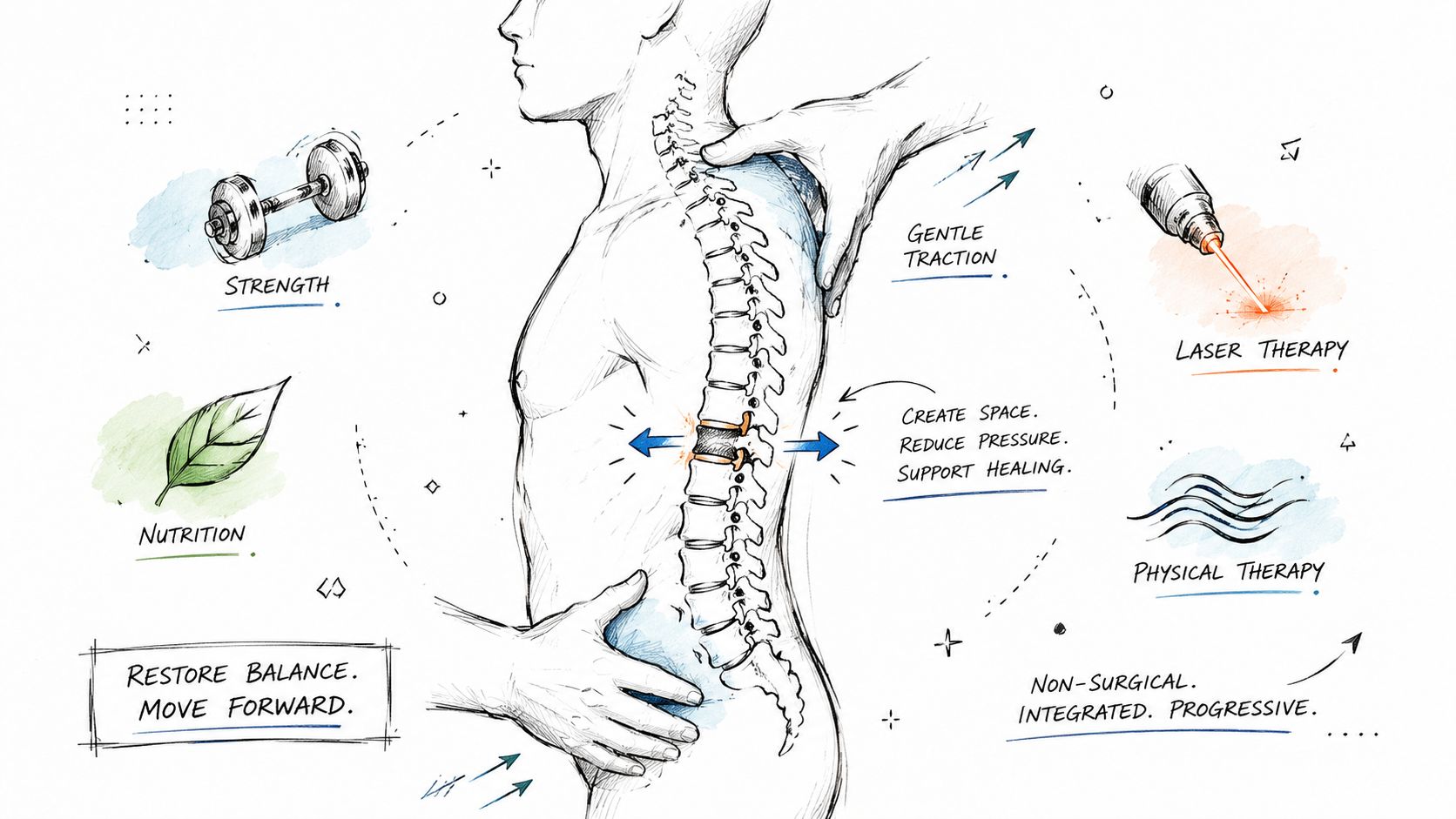
Hands-on tools earn their place by making movement possible. Massage or acupuncture can ease guarding enough for someone to tolerate the walking plan, so those tools change the comfort of the first step while education changes how the warning itself gets read. Where the assessment points to sciatica or disc-related leg symptoms, non-surgical spinal decompression can sit alongside education as one option the exam calls for.
The parts outside the treatment room matter just as much. Sleep, stress and natural ways to manage persistent pain feed the same threat appraisal the education is working to calm, which is why coordinated multidisciplinary pain management addresses them inside the same plan rather than passing them to someone else's department.
One rule keeps the whole thing honest: education attaches to something the patient does.
If pain has persisted for months, if fear is shrinking what you'll attempt, or if any red flag from earlier is present, an evaluation comes before you choose an approach.
Aspen Falls Wellness is a chiropractic and integrative musculoskeletal practice, and the process runs in three steps: schedule an initial exam, receive a personalized treatment plan, and work toward relief. The assessment looks at you as a whole and aims at the main concern rather than treating one symptom in isolation. Chiropractors, massage therapists, mobility specialists, acupuncturists, pain management specialists and nutritional coaches collaborate on the plan, so the education, the movement work and the hands-on care point in the same direction.
Bring any previous imaging reports, a list of activities that trigger symptoms, and one simple baseline such as how long you can walk before the ache starts.
Education does its best work when it's attached to a plan you can act on this week.
Aspen Falls Wellness pairs pain neuroscience education with the care that makes it stick: chiropractic adjustments, mobility therapy, rehabilitation exercise, SoftWave and MLS laser therapy, therapeutic massage, acupuncture and non-surgical spinal decompression. If persistent back, neck or nerve pain has been steering your decisions, our team in Salt Lake City and Sandy will evaluate what's driving it and build a plan you can start this week. Book an initial exam at Aspen Falls Wellness and bring your questions, your imaging reports and your walking baseline.

Stay updated with the latest chiropractic news and exclusive offers.