Discover how ultrasound therapy for scar tissue treatment works, evidence-based insights, and comparisons with SoftWave, MLS laser, and manual therapy.


You notice the scar most when you try to use the body around it. A C-section line pulls when you stand tall, a shoulder incision feels tight when you reach overhead, or an old abdominal scar seems fine at rest but catches the moment you twist. That's usually when people ask about ultrasound therapy for scar tissue treatment, because they want to know whether a machine can help tissue that looks healed but still doesn't move right.
The honest answer is that ultrasound doesn't erase a scar. It works by nudging dense collagen to behave differently, which can make the area more flexible, less bound down, and easier to work with in rehab. Depending on the setting, that happens through thermal effects, non-thermal effects, or a mix of both, and the right choice depends on scar age, tissue depth, and what the clinician is trying to change.
A patient comes in months after abdominal surgery and says the same thing many people do. The scar looks closed, but when she reaches overhead, she feels a strong pull through the middle of her body. That's not unusual, because scar tissue doesn't behave like the tissue it replaced. It's denser, less organized, and more likely to bind to nearby layers that should normally glide.
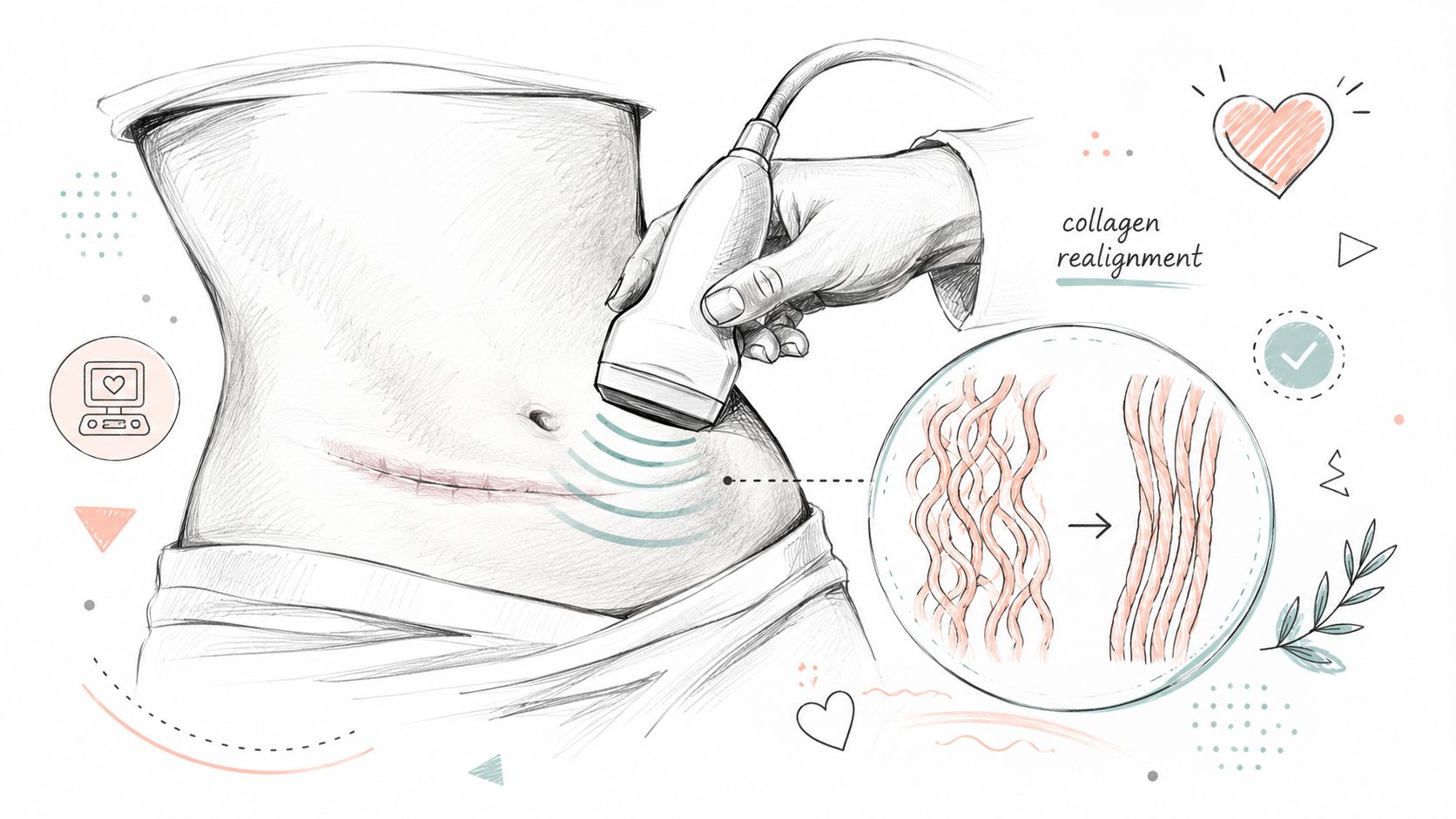
Ultrasound targets those collagen-heavy areas because they absorb energy differently than surrounding tissue. In clinical terms, continuous ultrasound can heat dense collagenous tissue, which helps increase blood flow and collagen extensibility, while pulsed low-dose ultrasound is used more for mechanical signaling during healing, where fibroblasts, endothelial cells, and myofibroblasts can be influenced during the proliferative phase (Rheumatology review). That's the key distinction. Early treatment is about influencing fibroplasia and wound contraction, while later treatment is more about stiffness and mobility in an established scar.
Practical rule: ultrasound is meant to soften the remodeling process, not dissolve the scar like wax.
The easiest way to picture it is this. A therapist is using sound energy to create a deep, very focused micro-massage inside the scarred layers. The goal isn't to melt anything away. The goal is to help collagen fibers reorganize into a more usable pattern so the scar can stretch and glide better over time.
That matters to you because the sensation after treatment should make sense with the goal. A scar that has been quiet and tight for months won't suddenly feel normal after one session. What people usually notice first is a change in how the area tolerates movement, pressure, or stretching once the tissue has been prepared for manual work and exercise.
When a provider says “ultrasound,” the next question should be which kind. Conventional therapeutic ultrasound, low-intensity pulsed ultrasound, and high-intensity focused ultrasound all use sound energy, but they are aimed at different tissue problems and do not share the same evidence base (overview of ultrasound in scar management).
In chiropractic and physical therapy settings, ultrasound usually means conventional therapeutic ultrasound. That form is used to influence tissue extensibility, soreness, and mobility around soft-tissue restrictions. Low-intensity pulsed ultrasound shows up more in healing and postoperative research, where the goal is to support repair signaling rather than create heat. High-intensity focused ultrasound is a much more concentrated tool, and in scar care it is discussed as an ablative or thermotherapy approach, not as the same thing as routine rehab ultrasound (ultrasound and scar tissue review).
A scar in the healing phase and a mature, stiff scar do not need the same stimulus. One may be treated with a gentle pulsed approach to influence repair signaling, while the other may be treated with a heat-based setting to help the tissue become more mobile. That difference is easy to miss if the word “ultrasound” is used without context.
| Modality | Typical Intensity | Best Fit | Primary Effect |
|---|---|---|---|
| Conventional therapeutic ultrasound | About 1.0 W/cm² in common rehab references (clinical parameters summary) | Stiff, mature scars with mobility limits | Thermal and mechanical remodeling |
| Low-intensity pulsed ultrasound | Used in a lower-dose pulsed format | Healing-phase scars and postoperative tissue support | Non-thermal cellular signaling |
| High-intensity focused ultrasound | Above 5 W/cm² in the cited clinical review | Selected pathological scars | Ablation or thermotherapy |
The most useful question is not whether ultrasound works. It is which type is being used, what stage the scar is in, and what tissue goal the provider is trying to reach. If those answers are vague, the treatment plan usually is too.
In plain terms, the three categories are not interchangeable. One is used to warm and loosen established scar tissue, one is used to influence healing biology with less heat, and one is reserved for a more aggressive clinical purpose. A patient sitting in the treatment room should be able to hear that distinction clearly before the session starts.
For people comparing options in clinic, that same clarity helps them judge ultrasound against other hands-on care. A mature scar that feels bound down may respond differently to ultrasound than to manual therapy, and a healing scar may need a different approach again. The right choice depends on the tissue in front of the provider, not on the label alone.
A therapist usually starts with a simple question, what is this scar asking for right now? A newer, more reactive scar is handled differently from a thicker scar that has settled into stiffness. The settings should match the tissue in front of the provider, not a fixed script.
In common rehab references, 1 to 3 MHz is the usual frequency range, with 1 MHz used for deeper tissue and 3 MHz for more superficial targets. A starting intensity around 1.0 W/cm² and a session length of about 10 minutes are also commonly described in musculoskeletal ultrasound references. That gives the clinician a starting point, then the settings are adjusted based on how deep the scar sits and how dense it feels under the skin (clinical parameters summary).
The values are not meant to be memorized like a recipe. They are more like the first draft of a treatment plan, then the provider refines them once the tissue response becomes clear.
Frequency tells the provider how deep the energy is aimed. Lower frequency reaches deeper tissue, while higher frequency stays more superficial. A scar near the surface of the skin may need a different approach from one bound into deeper fascia or around a tendon. The same area can also be treated differently if the tissue is swollen, hypersensitive, or still in the early healing window.
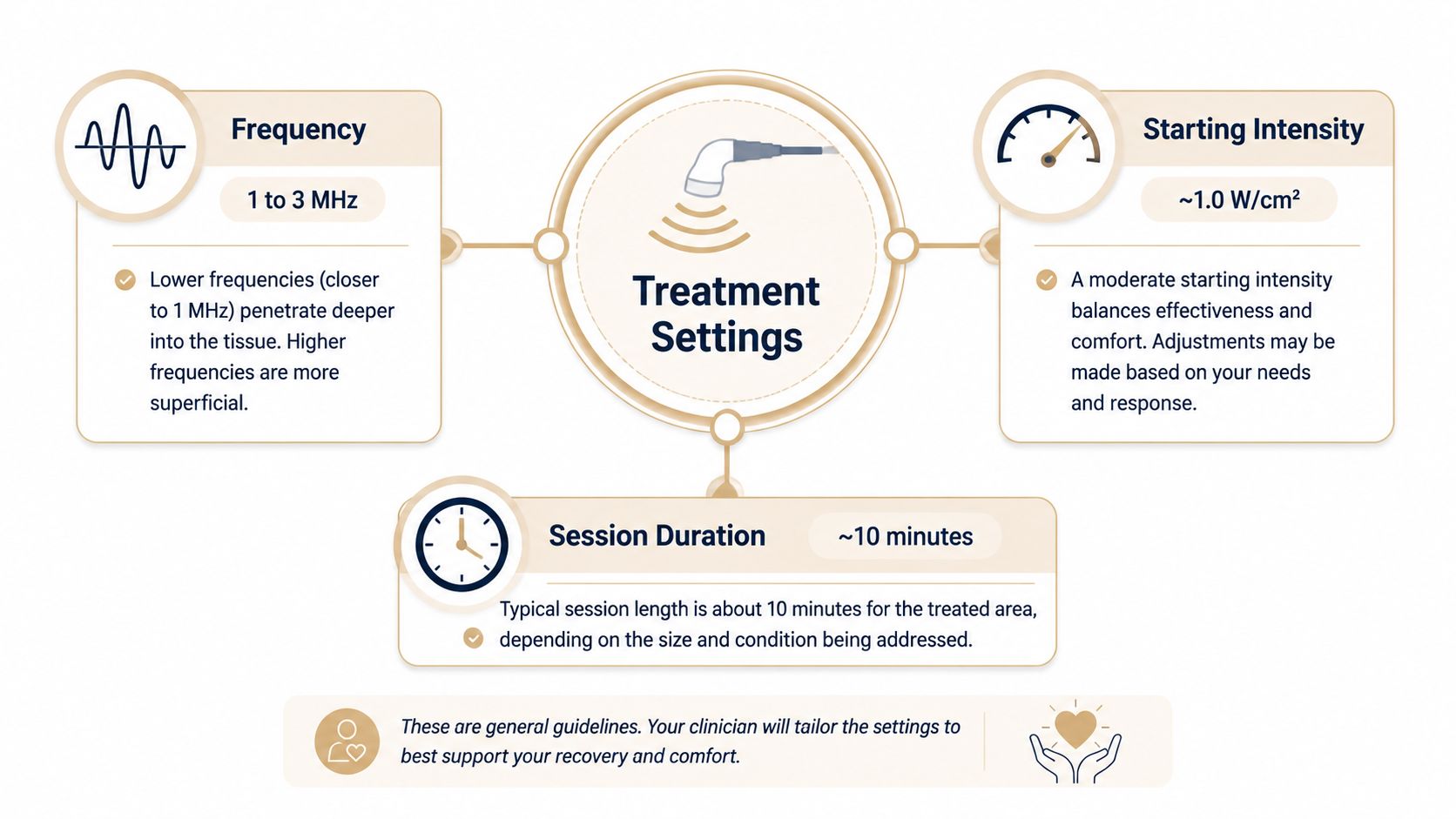
Early scars often need a gentler approach, especially if the goal is to support healing without too much heat. Older, denser scars may call for continuous treatment because the focus shifts toward stiffness, collagen extensibility, and movement restriction. Clinical references also describe accelerated wound contraction when 1 to 1.5 W/cm² is used within 72 hours after injury in a repeated schedule, which is one reason early-stage scars are often treated with more caution (clinical scar parameters).
The setting is chosen because the tissue stage asks for a specific kind of input.
The best way to judge whether those inputs are doing their job is to track the scar the same way a clinician tracks any other rehab change, with movement, comfort, and function. A Cartwright Fitness resource on outcome measures is a useful example of that kind of clinical thinking, because it keeps the focus on measurable change rather than guesswork.
The evidence is mixed, and that's the most honest way to say it. Ultrasound clearly produces biological effects in tissue models, but that doesn't mean every scar in every person improves in a dramatic way. A rheumatology review found “remarkably little evidence” for benefit in soft-tissue injuries overall, which is a useful warning against overselling the treatment (rheumatology review).
Lab and clinical references do support a remodeling effect. Low-intensity ultrasound can influence scar orientation and collagen composition, helping tissue shift from more Type III collagen toward a stronger Type I collagen pattern (therapeutic ultrasound summary). In simpler terms, the repaired tissue may become better organized and more functional, even if the scar itself still looks like a scar.
That's why patients can feel helped without ultrasound being a miracle cure. The therapy may make tissue easier to stretch, mobilize, or load, but that doesn't automatically mean the scar is gone. It means the scar is more ready to respond to the work that follows, including manual techniques, movement drills, and strength progression.
A good way to track whether that's happening is to use outcomes that matter to the patient, not just what the machine did. The Cartwright Fitness resource on outcome measures is a useful reminder that progress should be tracked by function, symptoms, and tolerance to activity, not by guesswork alone (outcome measures resource).
Patients rarely ask for ultrasound in isolation. They ask what to do about a scar that's still painful, stiff, or sticky, and they want to know how ultrasound compares with other tools in the clinic. The short answer is that these approaches do different jobs, and they often work better together than separately.
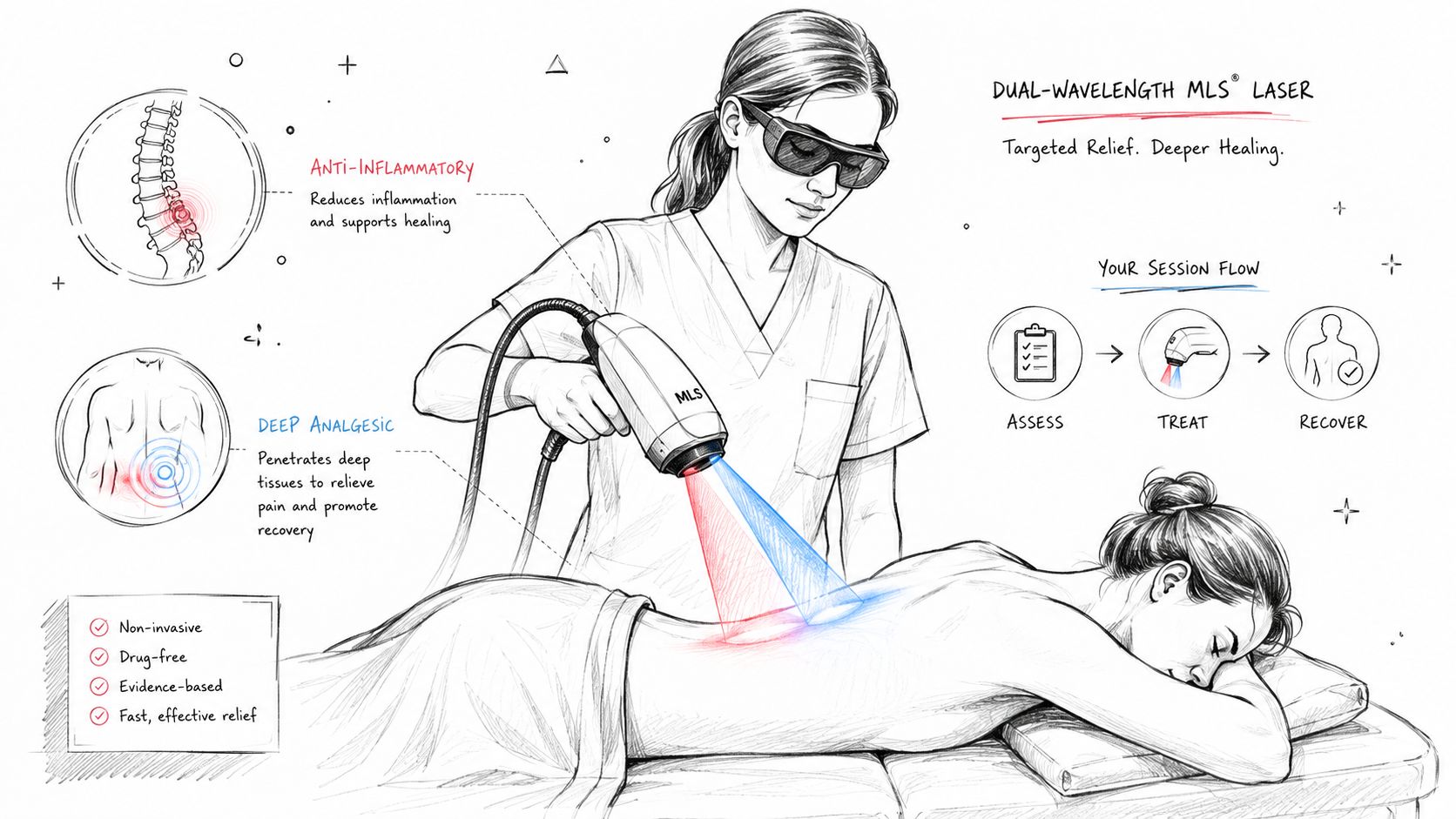
Ultrasound uses acoustic energy to influence tissue extensibility and remodeling. SoftWave therapy uses acoustic shockwaves and is often discussed for tissue stimulation and healing support. MLS Laser Therapy uses photonic energy to influence inflammation and recovery. Manual therapy uses hands-on mechanical stretch and glide to address soft-tissue restriction directly.
| Modality | Mechanism | Best Scar Profile | Typical Feel During Session |
|---|---|---|---|
| Ultrasound therapy | Acoustic energy with thermal and non-thermal effects | Dense, mature scars with stiffness | Mild warmth or little sensation |
| SoftWave therapy | Acoustic shockwave energy | Chronic pain or slower tissue response | Fast tapping or pressure |
| MLS Laser Therapy | Photonic or laser energy | Irritable tissue and inflammation-sensitive cases | Usually little to no sensation |
| Manual therapy | Mechanical stretch and tissue mobilization | Adhesions and range-of-motion restriction | Direct pressure, pulling, or release |
A dense scar that limits mobility often makes ultrasound a logical primary tool. If pain and slow recovery are bigger problems, a provider may add SoftWave or laser-style care. If the main restriction is glide, manual therapy usually leads the session, and ultrasound can prepare the tissue so the hands-on work goes further.
For readers who want another example of how device-based care fits into a broader plan, this overview of laser therapy for inflammation gives useful context. And if billing questions come up around hands-on treatment, the guide on billing for 97140 manual therapy helps explain why manual care is often part of a coordinated visit.
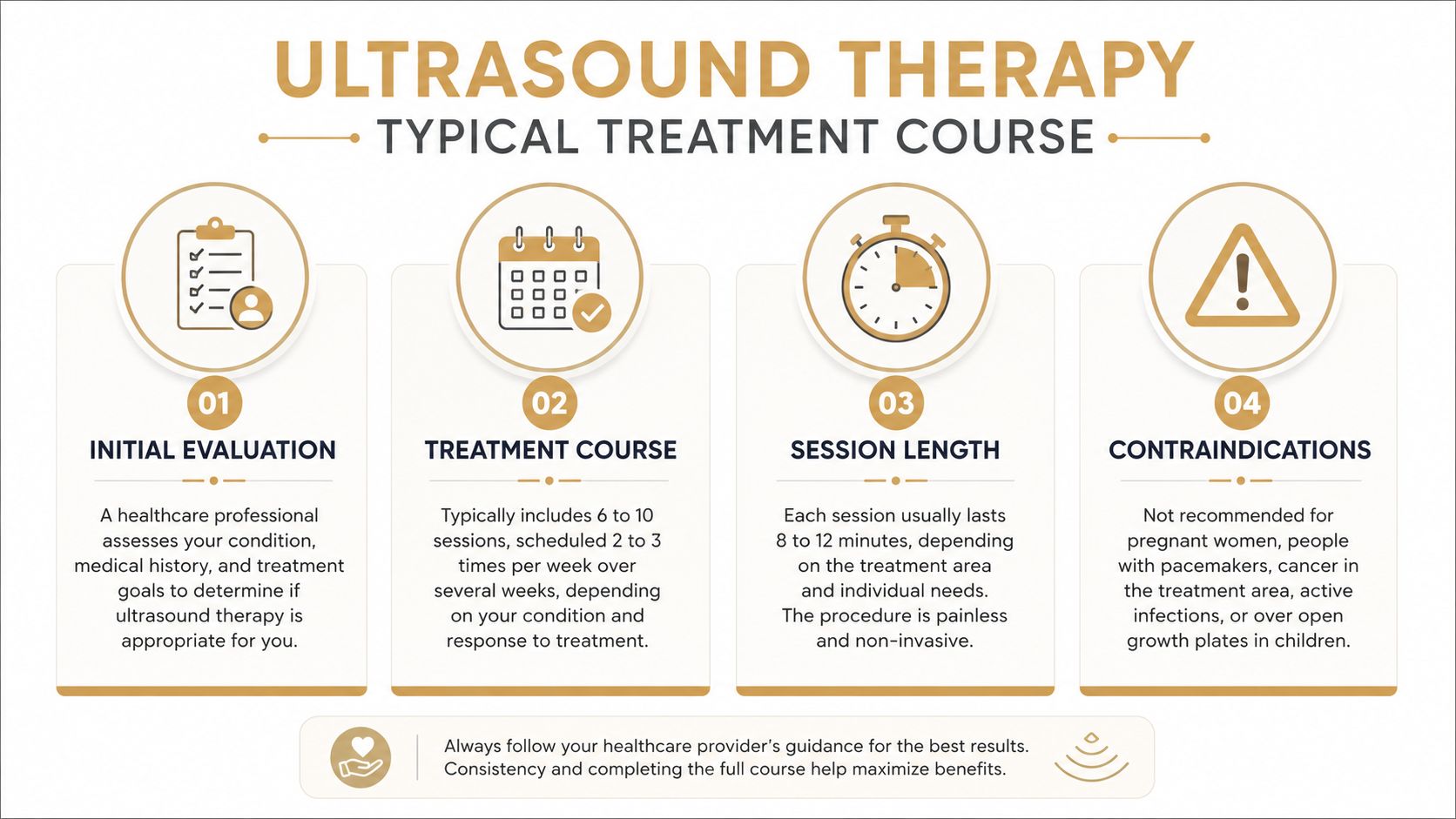
A real ultrasound plan starts with an exam, not the machine. The clinician looks at the scar, asks how it limits movement, and decides whether the tissue is the main problem or only part of a larger pattern. A realistic course often includes several visits over a few weeks, brief ultrasound time in the clinic, and movement work at home between appointments.
The active ultrasound portion is brief, and often takes up only a small part of the visit. After that, patients move into mobility work, stretching, or strengthening so the tissue changes are used right away. That matters because ultrasound is a remodeling tool, not a pain-numbing one. You should expect gradual texture and mobility changes, not an instant reset.
Practical rule: if the tissue feels a little looser but nothing changes in motion or function afterward, the treatment plan needs a rethink.
A visit should also match the specific type of ultrasound being used. Conventional therapeutic ultrasound is usually part of a hands-on tissue plan, low-intensity pulsed ultrasound is often discussed in slower-healing situations, and high-intensity focused ultrasound is a different category that a provider should explain clearly before starting. If the explanation stays vague, ask which form is being used and what change it is meant to produce.
Some situations need a careful conversation before ultrasound is used. These include pregnancy, active malignancy in the treatment area, acute infection, recent corticosteroid injection, and areas with metal implants or impaired sensation. Those are the kinds of issues a provider should screen for before any session begins.
A good consultation also asks the patient to bring the right context. If you're headed into care, bring prior imaging, past records, your medication list, and a plain description of what the scar stops you from doing. That gives the provider a better shot at choosing the right modality instead of guessing.
The home plan usually matters as much as the session itself. Gentle stretching, mobility drills, and progressive movement help keep the scar from tightening back down between visits. If the scar is old and stiff, the clinic work prepares the tissue, and the home plan teaches the body how to use that new range.
For more on building a home routine, see our guide on therapeutic exercise.
If you're comparing clinics in Salt Lake City or Sandy, look past the headline service names and ask what's being used. A provider should be able to tell you whether the plan involves conventional ultrasound, another tissue-stimulating device, manual therapy, or a mix of all three. That matters because a stiff surgical scar, a painful soft-tissue restriction, and a stubborn mobility loss each call for a different emphasis.
Ask whether the provider has done a full examination, whether the scar is the main limiter, and what outcome they expect to change first. Ask what tissue depth they're targeting, how they'll track progress, and what you should do at home between visits. If the answers stay vague, the care plan probably will too.
Aspen Falls Wellness serves Salt Lake City and Sandy with a coordinated musculoskeletal model that includes SoftWave therapy, MLS Laser Therapy, manual therapy, mobility therapy, corrective exercise, and nutrition support, so ultrasound-style tissue care can be paired with the rest of the recovery plan when appropriate. Their Salt Lake City location is a straightforward place to start if you want an in-person evaluation before choosing a modality.
Bring any imaging or surgical notes you have, a list of current medications, and a short description of how the scar affects daily life. Saying “it hurts” is true, but “it pulls when I reach overhead” gives the clinician a better target. The same goes for “I can't twist to put on a seatbelt” or “it sticks when I walk uphill.”
If you're scanning a clinic website, look for clarity, not buzzwords. A solid provider explains what the treatment is trying to change, how it fits with exercise and hands-on care, and what would make them choose something else.
How many sessions does it take before someone notices change? There isn't one fixed answer, because scar age, depth, irritability, and surrounding stiffness all matter. Can it be combined with chiropractic adjustments or acupuncture? Yes, and in many care plans it makes more sense as part of a broader approach than as a stand-alone treatment. Is it safe for old surgical scars? It can be, if the provider screens for the right precautions and uses the correct settings. How do you choose between ultrasound, SoftWave, and MLS laser? Start with the tissue problem, not the device name.
Key takeaways: ultrasound remodels rather than erases, results depend on scar stage and protocol, the evidence is supportive but not universal, and the best outcomes usually come from a multimodal plan that includes movement and hands-on care. If your scar still feels tight, painful, or stuck, the next step is an in-person evaluation so the right tool can be matched to the right tissue.
If your scar is still limiting how you move, Aspen Falls Wellness can evaluate the tissue, explain which modality fits your situation, and build the rest of the plan around mobility, manual care, and rehab exercise. Visit Aspen Falls Wellness to schedule an appointment and talk through whether ultrasound-style care belongs in your recovery.

Stay updated with the latest chiropractic news and exclusive offers.