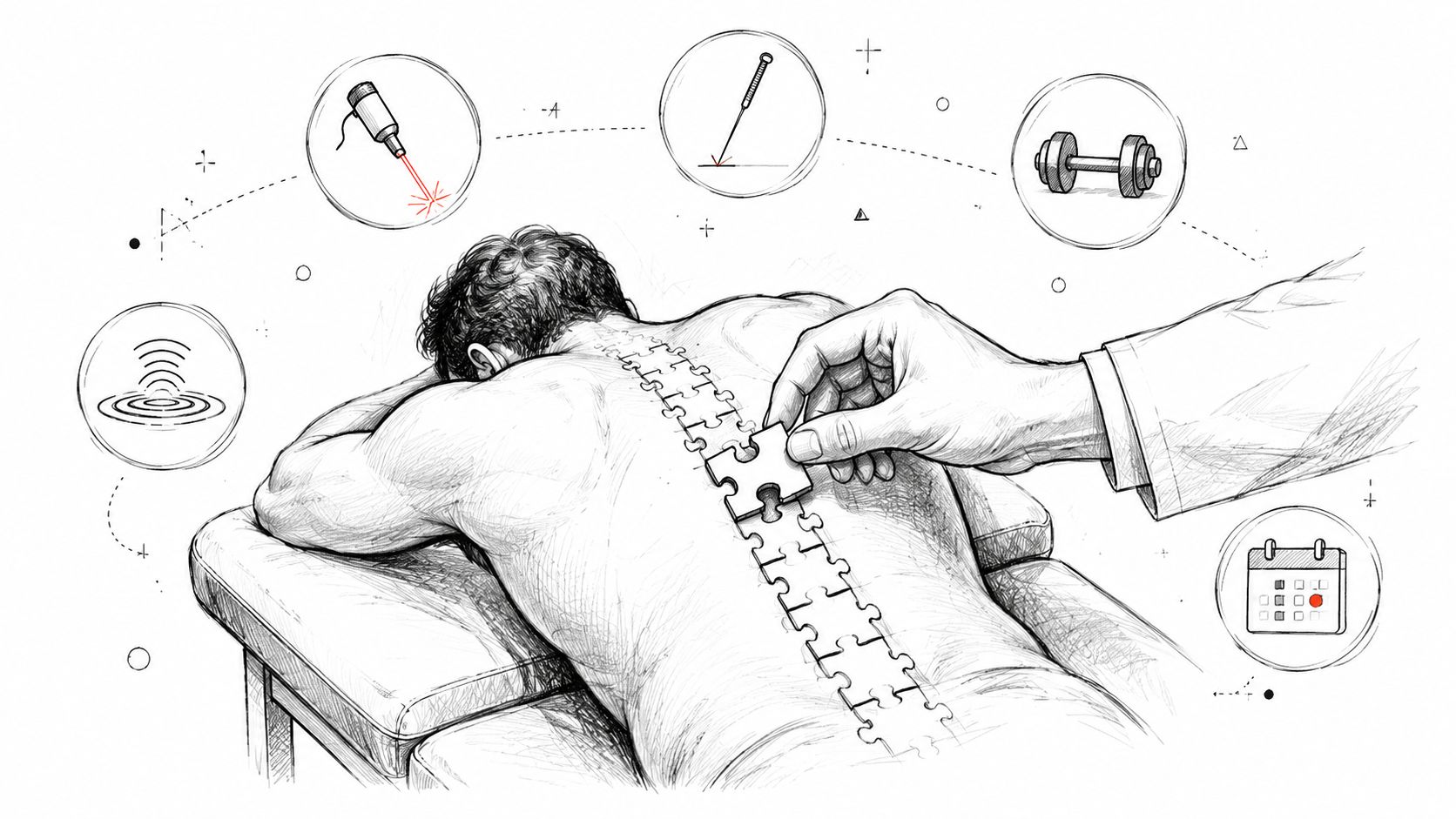
A West Jordan chiropractor visit should start with an exam. See matched care, imaging rules, exercise plans, and how to book nearby.
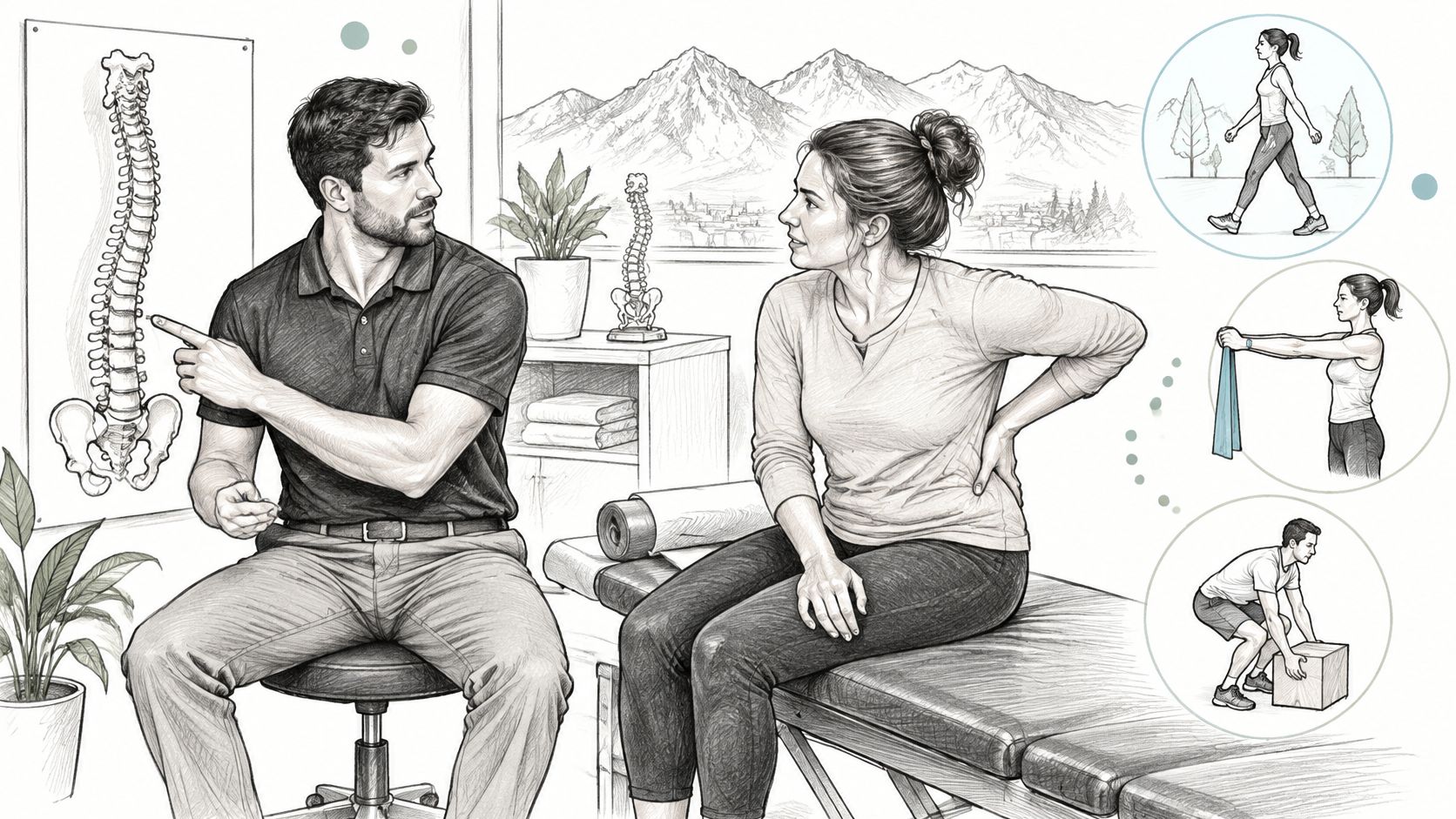
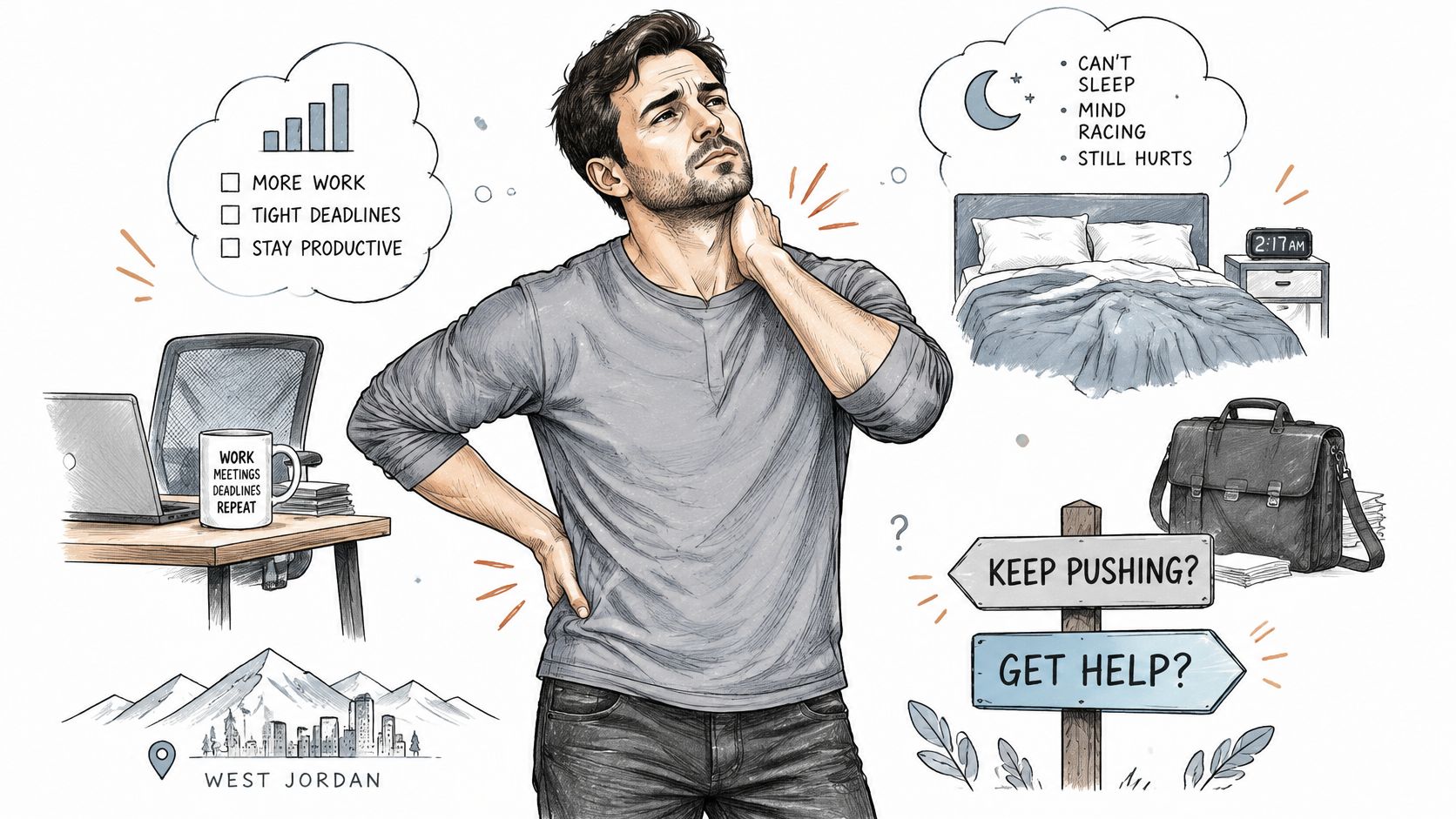
You've been putting off the grab in your low back, or the neck that locks after a short night. Sitting through a meeting, lifting a car seat, sleeping on your side, or finishing a shift is now the limit. You're looking for a West Jordan chiropractor because you want a care decision, not a clinic tour. Does conservative, non-surgical care fit? What happens on day one? How will anyone know it's working? An adjustment is one tool. It is not the whole plan.
Say you kept working through the flare because weekends took the edge off. Monday sitting brings it back, and ordinary tasks are the limit you can no longer ignore. Recurrent pain is common, not a personal failure. In 2023, 24.3% of U.S. adults reported chronic pain during the previous three months, while 8.5% reported high-impact chronic pain, according to Medscape's summary of national survey data. High-impact pain is the share that already cuts into work and home life.
Read it in the same order a careful visit runs.
Progressive weakness, saddle numbness, or a new change in bowel or bladder control needs urgent medical care before any chiropractic visit. Don't wait on a routine opening if those signs just started.
Practical rule: Write down the task pain is blocking. That task is the score the plan has to move.
Notes from day one keep later visits honest. You can explore chiropractic documentation support from PatientNotes to see how pain, function, and exam findings get recorded so a recheck isn't guesswork. Use the chart below before you call.
Scan this before you describe your week on the phone. Each row is a common reason adults from West Jordan book, what the first exam prioritizes, the tools often considered, and the daily job the plan is trying to restore. The row does not diagnose you. An imaging label alone does not pick it either.
| Problem | Exam focus | Care often considered | Function goal |
|---|---|---|---|
| Nonspecific low-back pain | Mobility, red flags, disability | Adjustment plus progressive exercise | Walking, lifting, sleep |
| Disc herniation with sciatica | Neurologic screen and referral thresholds | DRX9000 decompression plus rehab exercise | Sitting, standing, leg-pain tolerance |
| Lumbar stenosis | Walking tolerance and neurologic status | Decompression plus mobility work | Distance walked before symptoms |
| Neck pain and headache | Cervical motion, posture, soft tissue | Adjustment, mobility therapy, soft-tissue care | Fewer headache days, neck motion |
| Sports or golf strain | Movement screen and load tolerance | Rehab exercise, massage, golf movement screening | Safe return to the activity |
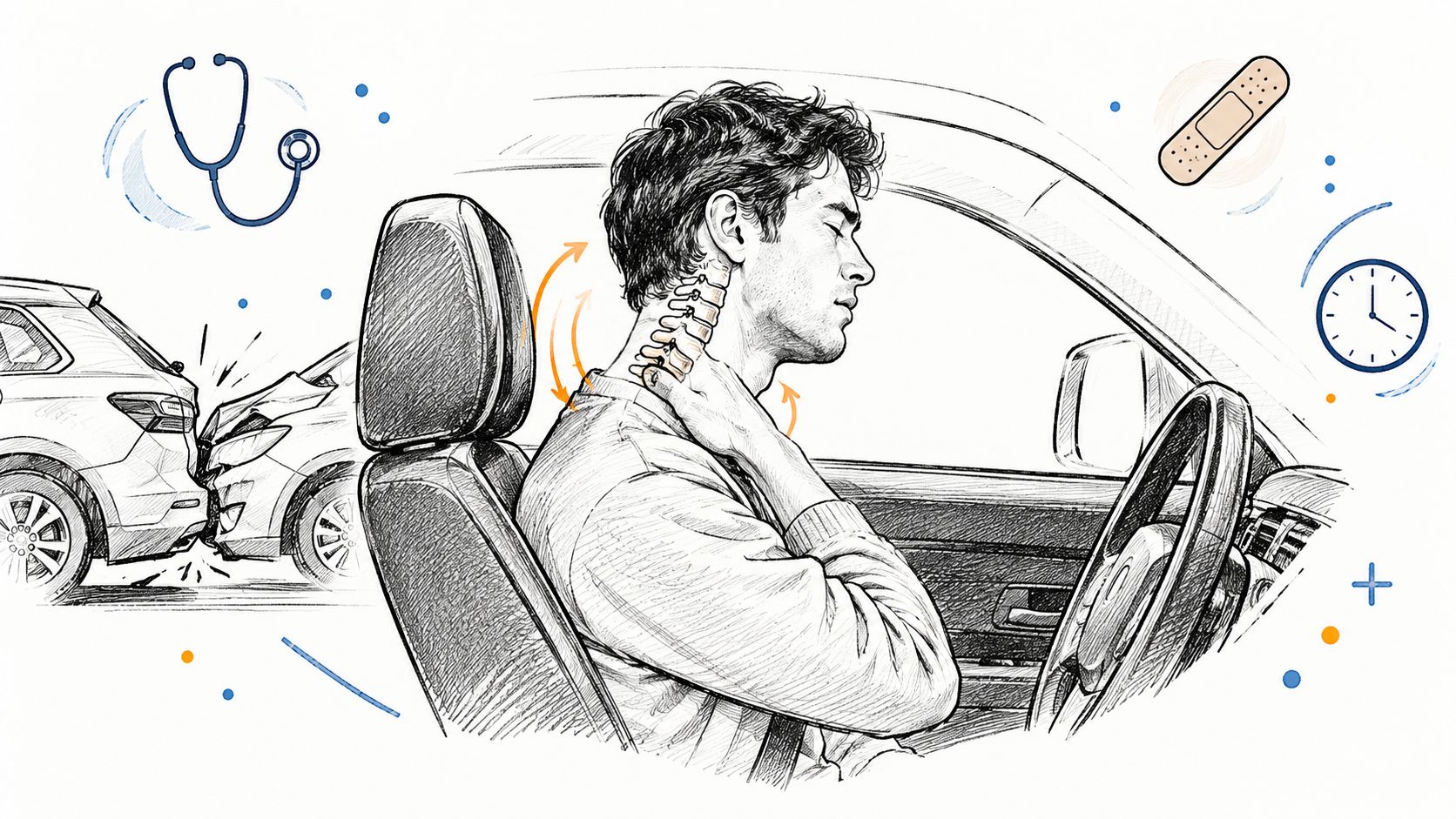
| Car-accident whiplash | Trauma history and documentation | Structured conservative care and rechecks | Less stiffness and a return to work tasks |
| Chronic joint or muscle pain | Range of motion and irritability | MLS laser, SoftWave, acupuncture, massage, nutrition counseling | Daily comfort and usable motion |
Start with what you feel, not with the machine you hope will be used. A tool is chosen after the exam, not because it sits on a menu.
Nonspecific low-back pain is the ache that stays in the back, changes with posture, and doesn't bring progressive leg weakness. A selective chiropractic adjustment pairs with progressive exercise. More detail on that pairing sits in our guide to lower back pain solutions. The goal is ordinary: walk farther, lift a known load, and sleep with fewer wake-ups.
Disc herniation with sciatica and lumbar stenosis are different rows. Leg-dominant pain, numbness, or a shrinking walking distance pushes the exam toward a neurologic screen and clear referral thresholds. Only after that screen does non-surgical spinal decompression on the DRX9000, plus rehabilitation exercise, belong in the conversation. The chart can't clear you for a table. The exam can.
Neck pain and headache adds posture and mobility therapy to an adjustment and soft-tissue care. Count headache days and how far you can turn to check a blind spot. That is more useful than a promise of "realignment" by itself.
Sports or golf strain needs a movement screen and a load you can tolerate, then rehab exercise, massage therapy, and golf movement screening when the swing is part of the problem. The function goal is a safe return, not a heroic first session back.
Car-accident whiplash starts with trauma history and written findings. Car accident treatment here means structured conservative care and rechecks aimed at less stiffness and a return to work tasks. Documentation is part of the care, because memory of the first week fades.
Chronic joint or muscle pain with limited motion may add MLS laser therapy, SoftWave therapy, acupuncture, massage, or nutrition counseling when irritability and slow recovery are the pattern. Those options still follow the exam. They don't replace it.
Muscle stimulation and realignment language only help if they turn into mobility, pain relief, and strength you can feel. You notice that when you load the dishwasher, climb stairs, or sit through a meeting. If a phrase doesn't change one of those tasks, ask what it is supposed to change.
Bring three lines to the first visit: your symptoms, what makes them worse, and one function goal from the row that fits you best. That single goal keeps the plan from drifting into a preset visit count.
More pictures are not automatically safer. For uncomplicated acute low-back pain without progressive neurologic deficits or other red flags, current guidance recommends against routine imaging, and imaging is reserved for suspected serious disease, fracture, or clinically important neurologic compromise. A systematic review found no improvement in pain or function from early imaging when serious spinal pathology was absent, as summarized in the American College of Radiology appropriateness criteria on Guideline Central.
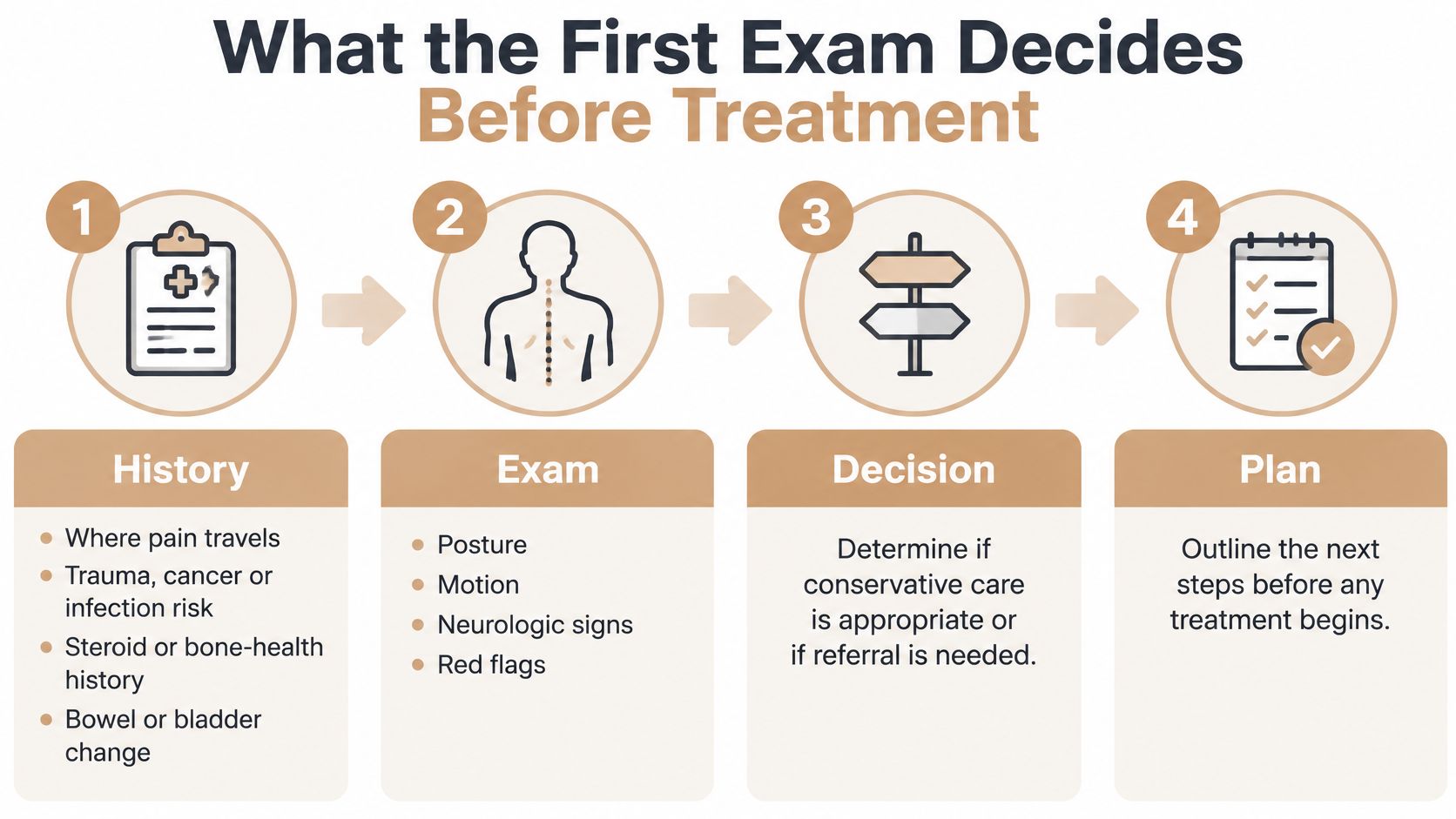
Spinal manipulation belongs with trained, credentialed clinicians. Higher-risk findings, including osteoporosis or a fragility fracture, are screened before hands-on care. If potential harm outweighs benefit, the visit ends in a referral, not an adjustment.
At Aspen Falls Wellness, each patient gets a thorough chiropractic evaluation to identify the root cause, and then a customized treatment plan is built from that diagnosis. We use an evidence-based mix of chiropractic manipulation, soft-tissue techniques, therapeutic rehabilitation, and related chiropractic services, rather than one technique for every person. Our walk-through of what to expect at a first chiropractic visit matches this sequence.
A normal scan can still leave you unable to tie your shoes. The exam is what ties the picture, if any, to a working diagnosis.
You should leave with three answers: a working diagnosis, whether imaging or a specialist is needed, and the first treatment choice. Treatment doesn't start until those are clear.
For chronic or recurrent nonspecific low-back pain, adjustment-only care is the weaker plan. A systematic review of clinical practice guidelines found exercise therapy recommended in all 4 reviewed recommendations, mobilization or manipulation in 5 of 7, and multimodal care in 9 of 12, as reported in the Journal of Orthopaedic & Sports Physical Therapy. Hands-on care may ease pain and improve spinal or hip motion for a while. Trunk, aerobic, aquatic, or general exercise is what builds endurance and movement capacity so relief lasts and recurrence-related disability falls.
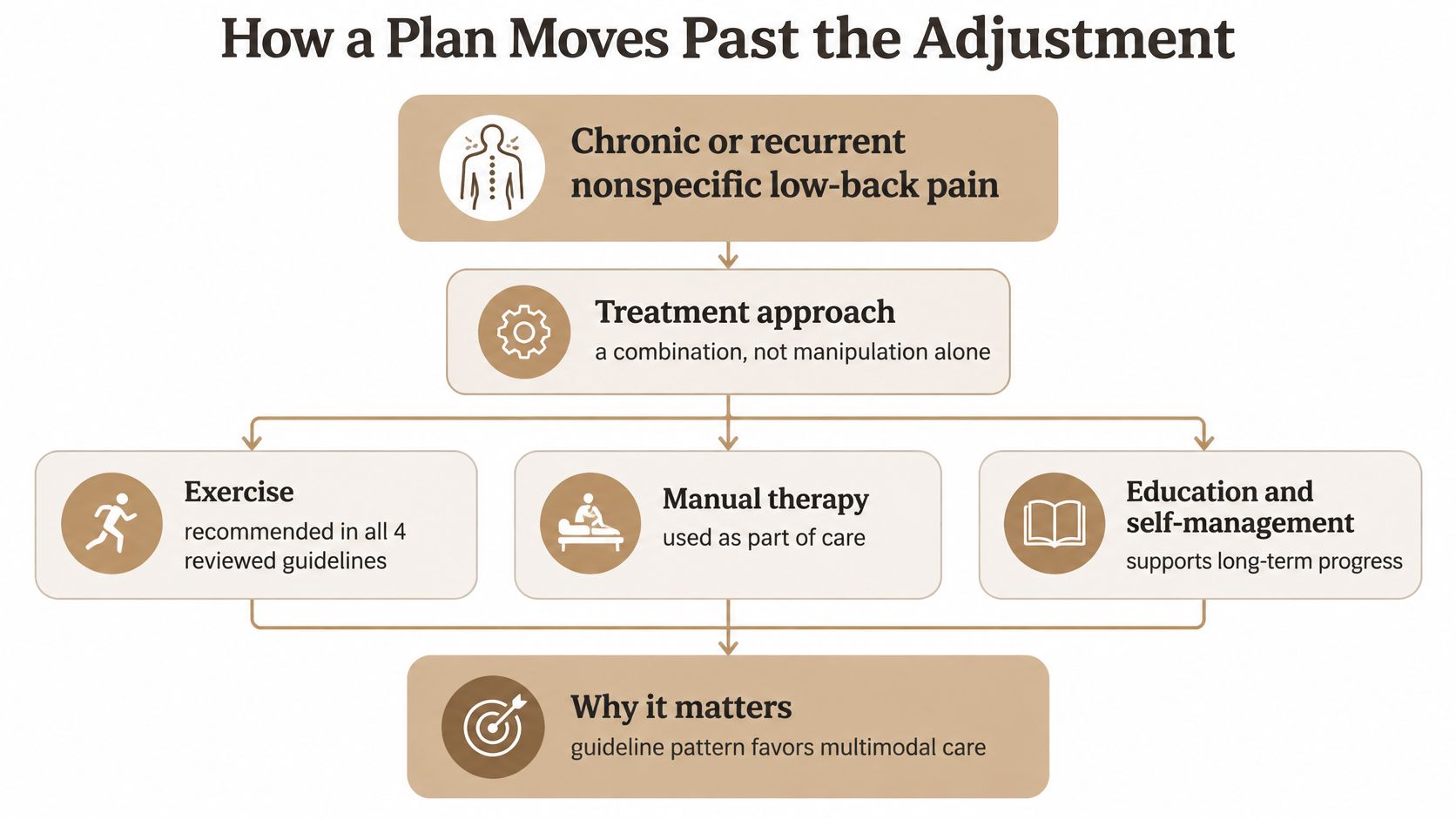
A personal exercise plan has to name program length, weekly frequency, and session length, plus how load progresses and what you do at home. A 2023 review of trunk-focused exercise in the Journal of Orthopaedic & Sports Physical Therapy covered programs of 4 to 22.5 weeks, frequencies of 1 to 5 days per week, and sessions of 20 to 90 minutes, and pointed to 3 to 5 stabilization sessions per week of 20 to 30 minutes as the doses linked to larger effects on pain and disability.
| Element | Range studied | Dose linked to larger effects | What the patient should receive |
|---|---|---|---|
| Program length | 4 to 22.5 weeks | Multi-week progression, not a single visit | A dated start and review point |
| Weekly frequency | 1 to 5 days | 3 to 5 stabilization sessions per week | A written weekly target |
| Session length | 20 to 90 minutes | 20 to 30 minutes for stabilization work | A home session that fits that window |
The 2021 Academy of Orthopaedic Physical Therapy guideline recommends exercise training for chronic low-back pain and reported no harm from exercise-training interventions in the included studies. It advises moderate- to high-intensity work for people without generalized pain, and progressive, low-intensity, submaximal fitness for people with generalized pain, in that same 2021 guideline. No single exercise type won, because dosing varied, so the plan is matched to you.
Our chiropractors tailor each adjustment to the patient's needs. The wider approach adds decompression, take-home mobility exercises, laser therapy, massage, and acupuncture where the diagnosis supports them. Chiropractors, massage therapists, acupuncturists, pain management specialists, and nutritional coaches design that plan together. Acupuncture can be one part of pain care. It is not a guaranteed standalone cure. How those pieces get chosen is covered in our note on personalized treatment plans.
On day one, ask for three things in writing: a baseline pain score, a function score, and the first week of home exercise. If those aren't on paper, the later recheck has nothing solid to beat.
Gabriel, from Salt Lake City, described a course that shows the shape of this work without promising your result: "I herniated my disc in my low back and Dr Hedstrom has helped me go from bed ridden to better than I felt even before I hurt myself." The rebuilt piece was tolerance for sitting, standing, and walking, staged over time, not a single session on a table.
Suspected disc pain, sciatica, or stenosis goes through an examination-first screen before any decompression table is used. The World Health Organization's chronic low-back pain guidance supports spinal manipulative therapy, exercise, and selected physical therapies as possible parts of integrated, person-centered care, and it flags situations where harms may outweigh benefits. Manipulation should be delivered by trained, credentialed clinicians, and higher-risk conditions, including osteoporosis or fragility fracture, should be identified first. We screen for progressive neurologic loss, fracture risk, and serious systemic disease, and we refer when findings exceed conservative scope.
Guideline evidence indicates that spinal manipulation produces pain and disability improvements comparable to other recommended therapies, while evidence certainty remains low to very low. Claims stay modest on purpose.
Only leg-dominant pain that has passed that screen lets a customized plan consider DRX9000 decompression, alongside chiropractic adjustments, MLS laser therapy, and exercise, not instead of them. A plan may include those pieces based on the diagnosis. Decompression, in plain terms, is a non-surgical way to unload a painful disc while you rebuild tolerance. It does not correct disc disease, and it does not remove rehab.
Dr. Dustin Hedstrom graduated cum laude from the doctoral program at Palmer College of Chiropractic Florida and worked with professional athletes in spinal rehabilitation in Kansas City. That background shapes a rehab-first reading of disc pain. Nonspecific backache, the kind that stays in the back and changes with posture, usually does not start on decompression.
Your job doesn't shrink because a table is in the plan. Report new weakness or a bowel or bladder change immediately, and keep the home exercise in the weeks when the table feels like the main event.
Visit count is a weak scoreboard. A 2025 Cochrane review found exercise probably produces a small-to-medium pain reduction of 15.2 points on a 0–100 scale and a smaller functional improvement of 6.8 points versus usual care or no treatment, as cited in Ontario Health's 2025 low-back pain quality standard. That is a modest gain, not a miracle. The same standard says additional manual therapies are more effective combined with physical activity than used alone, and it reports no evidence supporting regular spinal manipulation to prevent low-back pain.
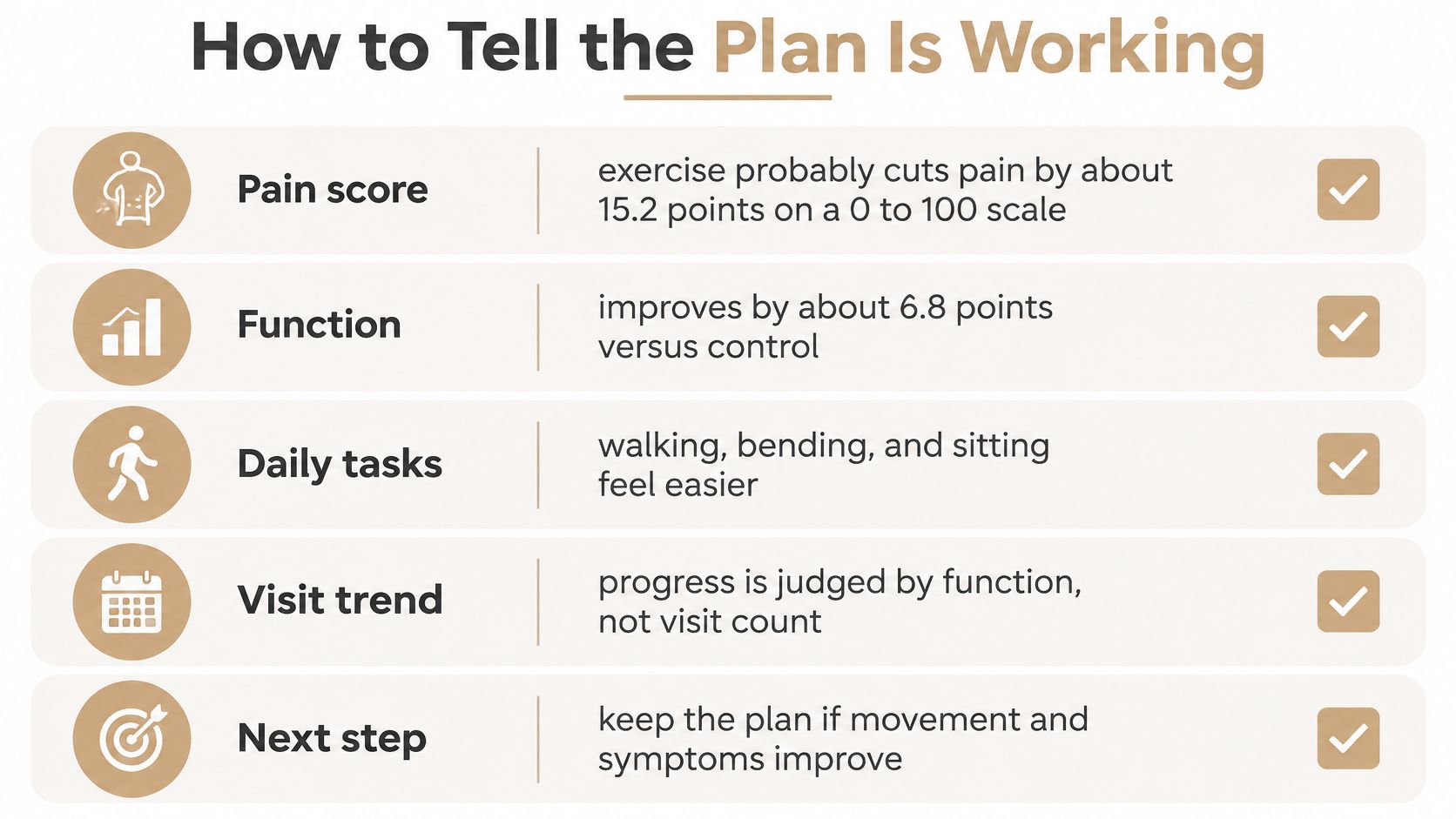
Reassess on a set interval, commonly every few weeks, against the baseline from day one. Age, how long symptoms have lasted, and how often they return all change what a fair trial looks like. A plan you can carry out at home matters as much as any in-clinic session.
| Goal | How to measure it | Signal to change the plan |
|---|---|---|
| Walking | Minutes or blocks before pain stops you | No gain across a recheck interval |
| Lifting | A specific home or work load you can repeat | Load tolerance is unchanged |
| Sleep | Nights woken by pain per week | Sleep is no better despite adherence |
| Work | Tasks you can finish in a normal day | Work limits are flat |
| Sport or golf | Session length or swing tolerance | Activity keeps flaring the same way |
| Symptom frequency | Days per week with limiting pain | Frequency is unchanged after a fair trial |
Change or stop a passive add-on if those scores stay flat and you are doing the home exercise. Continue when tolerance is climbing, even if pain is not at zero. Refer to primary care, physical therapy, pain medicine, or a specialist when neurologic status worsens, progress stalls after a fair trial, or the problem is no longer musculoskeletal.
Leave each recheck with one number that moved and one change to the home plan. If neither can be named, the plan needs a rewrite, not another identical visit.
From West Jordan, use the south-valley office. Aspen Falls Wellness provides family chiropractic care in Salt Lake City and Sandy, Utah. The Sandy office is at 8191 South 700 East, Sandy, UT 84070, phone (385) 308-4355.
| Location | Address | Phone |
|---|---|---|
| Sandy (south valley, nearest for West Jordan) | 8191 South 700 East, Sandy, UT 84070 | (385) 308-4355 |
| Salt Lake City | Confirm the downtown address on the clinic site before you rely on it | Confirm the downtown phone when you call |
We don't publish a drive time here, and today's hours can change, so confirm hours when you call or check the site. We are contracted with many insurance companies in Utah, including Aetna, BCBS, Cigna, Humana, GEHA, and Motiv Health. A contract is not a guarantee of your benefits. Verify coverage before the visit.
Bring four things: the main problem in one sentence, any prior imaging and who ordered it, the one function goal from the chart, and your insurance details. Acupuncture is available at both the downtown Salt Lake City clinic and the Sandy clinic.
Request the first evaluation at Aspen Falls Wellness. The visit starts with a diagnosis and a plan, not a preset package of visits.
Aspen Falls Wellness provides evidence-based, non-surgical spine and joint care, including a thorough first exam, personalized adjustments, rehabilitation exercise, and options such as DRX9000 decompression when the diagnosis supports them. If sitting, lifting, sleep, or work is the limit that sent you looking for a West Jordan chiropractor, bring one function goal and let the exam decide the plan. Visit Aspen Falls Wellness to request that first evaluation at the Sandy office.

Stay updated with the latest chiropractic news and exclusive offers.