Acupuncture vs massage for neck pain compared on mechanisms, evidence, safety and session expectations to help you choose the right care plan.
You wake up with a stiff neck, turn toward the alarm, and feel a sharp restriction before your day has even started. By afternoon, desk work has added pressure across your shoulders, and a headache makes the decision harder: should you book acupuncture, choose massage, or try to manage the problem with exercise and time?
The answer depends less on finding a universal winner and more on identifying what kind of neck pain you have, how long it has been present, and what you want the treatment to accomplish. Acupuncture and massage can both fit conservative care, but they aren't interchangeable. One may be more useful for motion-related pain or persistent symptoms, while the other may feel more appropriate for muscular tightness and short-term relaxation.
This guide compares them through four practical questions: Which may reduce pain more effectively? Which is more likely to help movement? How long might relief last? And when should either therapy be combined with active rehabilitation rather than used alone?
A person with long-standing neck stiffness, limited rotation, and recurring tension headaches may need a different plan from someone whose neck became sore after a recent collision. Someone who feels a rope-like band through the upper trapezius may prefer hands-on soft-tissue work. Someone whose pain remains stubborn despite stretching may want to discuss acupuncture as part of a broader evaluation.
Those distinctions matter because treatment response is shaped by the pain pattern and treatment phase. Chronic nonspecific neck pain, acute soreness, whiplash-related symptoms, nerve irritation, and stiffness-dominant discomfort shouldn't automatically be placed in the same category.
| Decision factor | Acupuncture | Massage therapy |
|---|---|---|
| Main treatment experience | Targeted needling with sensory stimulation | Manual pressure, soft-tissue work, and movement |
| Potential short-term strength | Motion-related pain and some mobility outcomes in direct comparative evidence | Relief versus inactive care, especially when symptoms feel muscular |
| Common limitation | Results vary, and evidence quality isn't uniform | Benefits may be short-lived and function gains aren't consistently established |
| Best question to ask | Could pain modulation support movement and rehabilitation? | Is soft-tissue tension limiting comfort or motion? |
| Important caution | Don't use it as a substitute for diagnosis or active recovery | Don't treat massage alone as a complete rehabilitation plan |
The most useful comparison isn't acupuncture vs massage for neck pain. It's whether the selected treatment matches the source and phase of symptoms, then supports measurable progress. That may mean using one modality, alternating them, or choosing neither first until a clinician evaluates warning signs.
Practical rule: Choose the therapy that supports your next functional goal, not only the one that feels most soothing during the appointment.
The evidence also deserves careful interpretation. A direct trial found a short-term advantage for acupuncture over conventional massage in chronic neck pain, while broader reviews describe massage benefits against inactive care but more uncertain results against active therapies. Those findings can guide a conversation, but they can't predict exactly how your neck will respond.
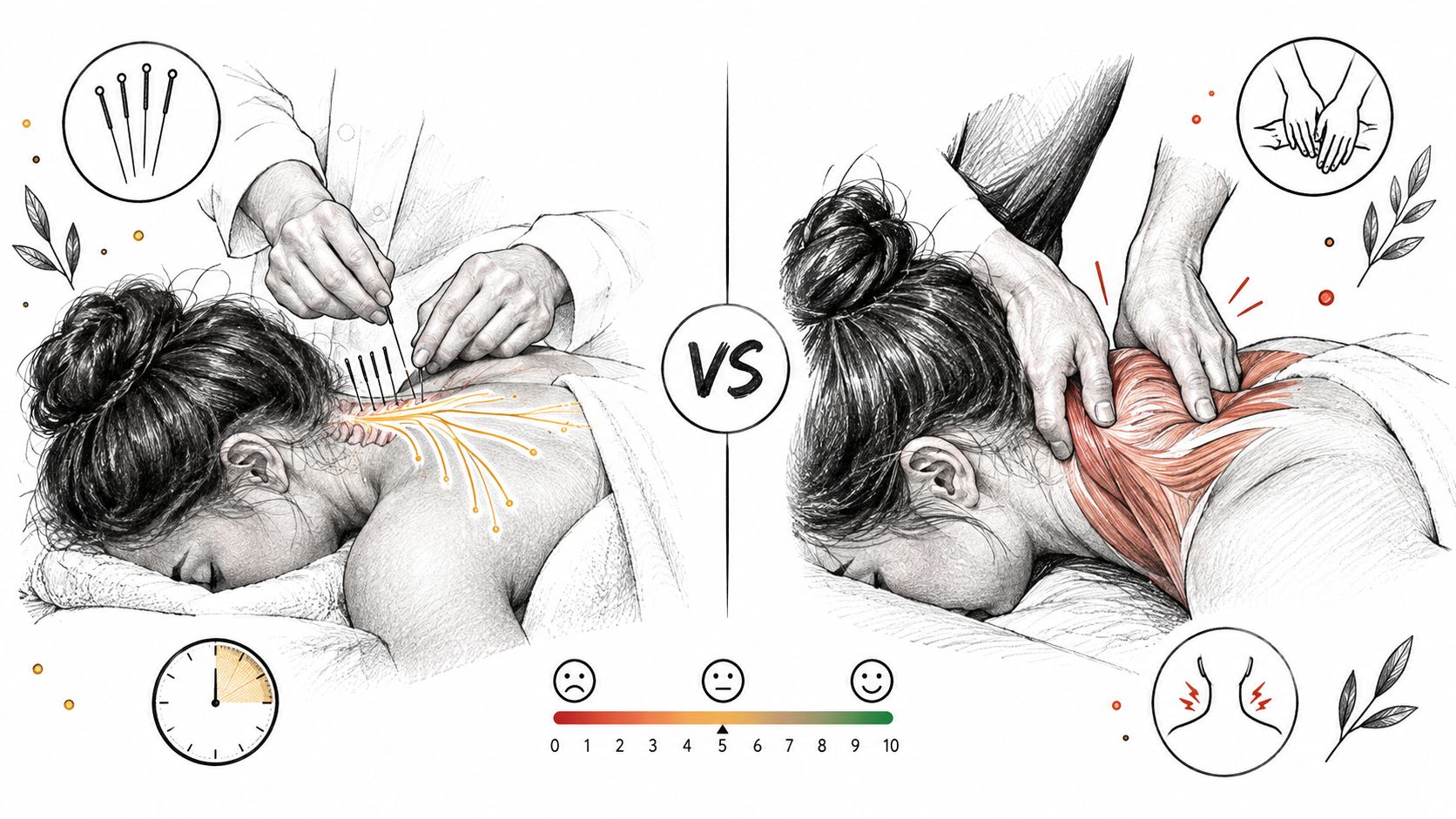
Acupuncture uses very thin needles placed at selected points after a clinical assessment. The treatment provides targeted sensory input that may influence pain signaling, muscle guarding, and the nervous system's response to discomfort. Patients may feel a brief pinch, pressure, tingling, warmth, or very little sensation at all.
A first acupuncture visit typically includes a health history, symptom discussion, movement assessment, and a treatment plan. During the session, you usually lie or sit comfortably while the practitioner places needles and leaves them in place for a period of rest. Afterward, some people feel calm or energized, while mild tenderness at a treatment point can occur.
Massage takes a more direct mechanical approach. A therapist uses pressure, gliding strokes, kneading, stretching, and other manual techniques to address tense muscles and guarded soft tissues. The pressure should be communicated clearly. A treatment that leaves you unable to move comfortably afterward isn't automatically more effective.
A massage appointment commonly begins with questions about symptoms, activity, and pressure preference. The therapist may work around the neck, shoulders, upper back, and related tissues rather than pressing directly on the most painful area. You may feel relaxed immediately, but the next step is determining whether that comfort transfers into better movement and daily function.
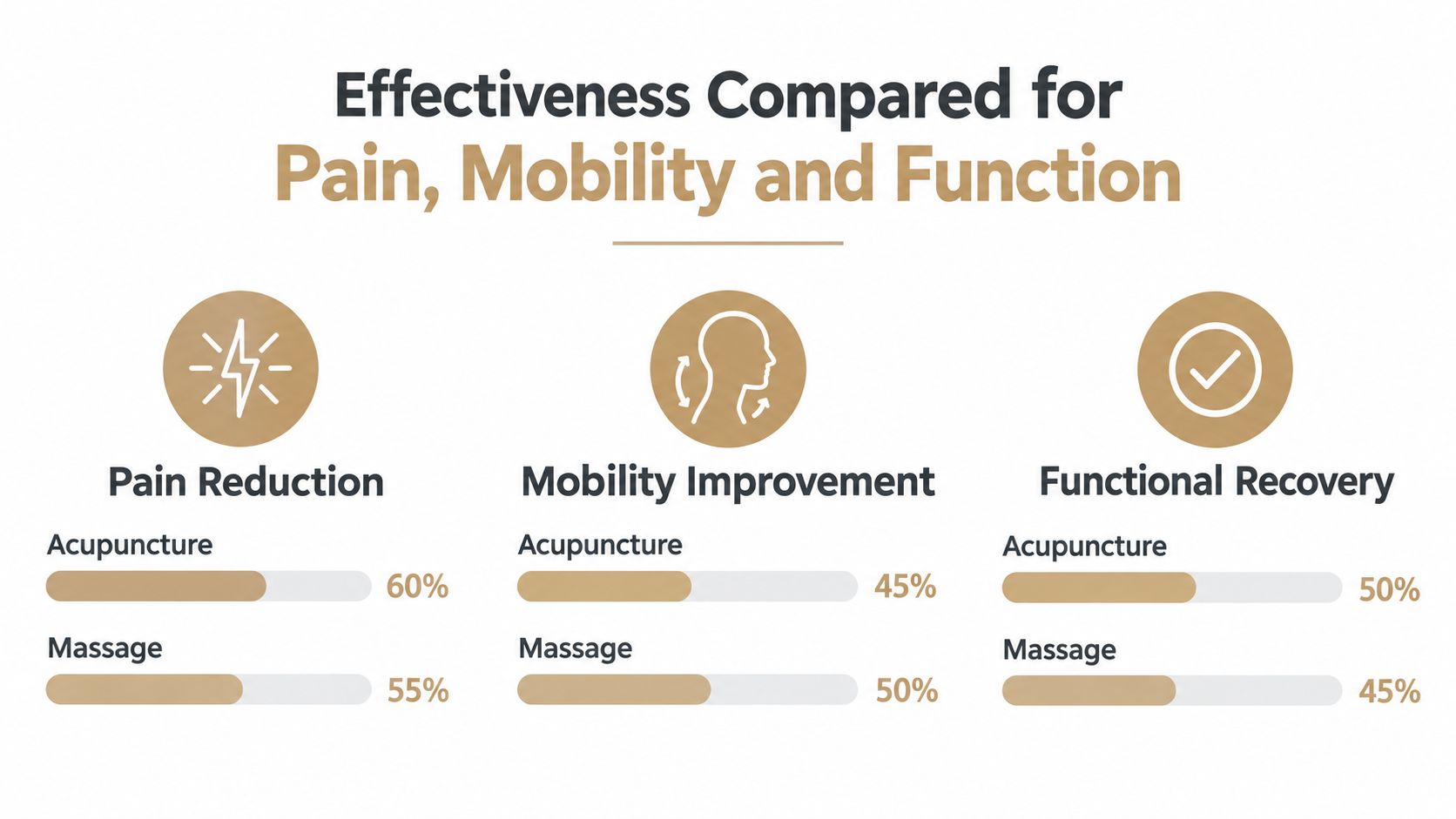
The infographic above should be treated as a visual aid, not as verified clinical evidence. The verified research does not establish the displayed percentages for pain reduction, mobility improvement, or functional recovery. Decisions should rely on the patient's examination, goals, response to care, and the quality of the available evidence.
An integrated clinic may use acupuncture or massage alongside a chiropractic adjustment, mobility therapy, and a personal exercise plan. For readers exploring the broader role of acupuncture in persistent symptoms, acupuncture for chronic pain offers additional context. The central principle remains simple: passive treatment should help you participate more comfortably in active recovery.
A person with long-standing neck pain may want two different outcomes: less pain during movement and easier use of the neck in daily life. The strongest direct comparison in the supplied evidence is a BMJ randomized trial published in 2001. It followed 177 patients with chronic neck pain and compared acupuncture for 56 patients, conventional massage for 60, and sham laser acupuncture for 61 across three weeks.
One week after the fifth treatment, acupuncture produced a significantly larger improvement in motion-related pain than massage. The between-group difference was 24.22 points, with a 95% confidence interval of 16.5 to 31.9 and P=0.0052. The massage group improved by 7.89 points in the reported table. These results describe that study's population and schedule, not a guaranteed response for every person.
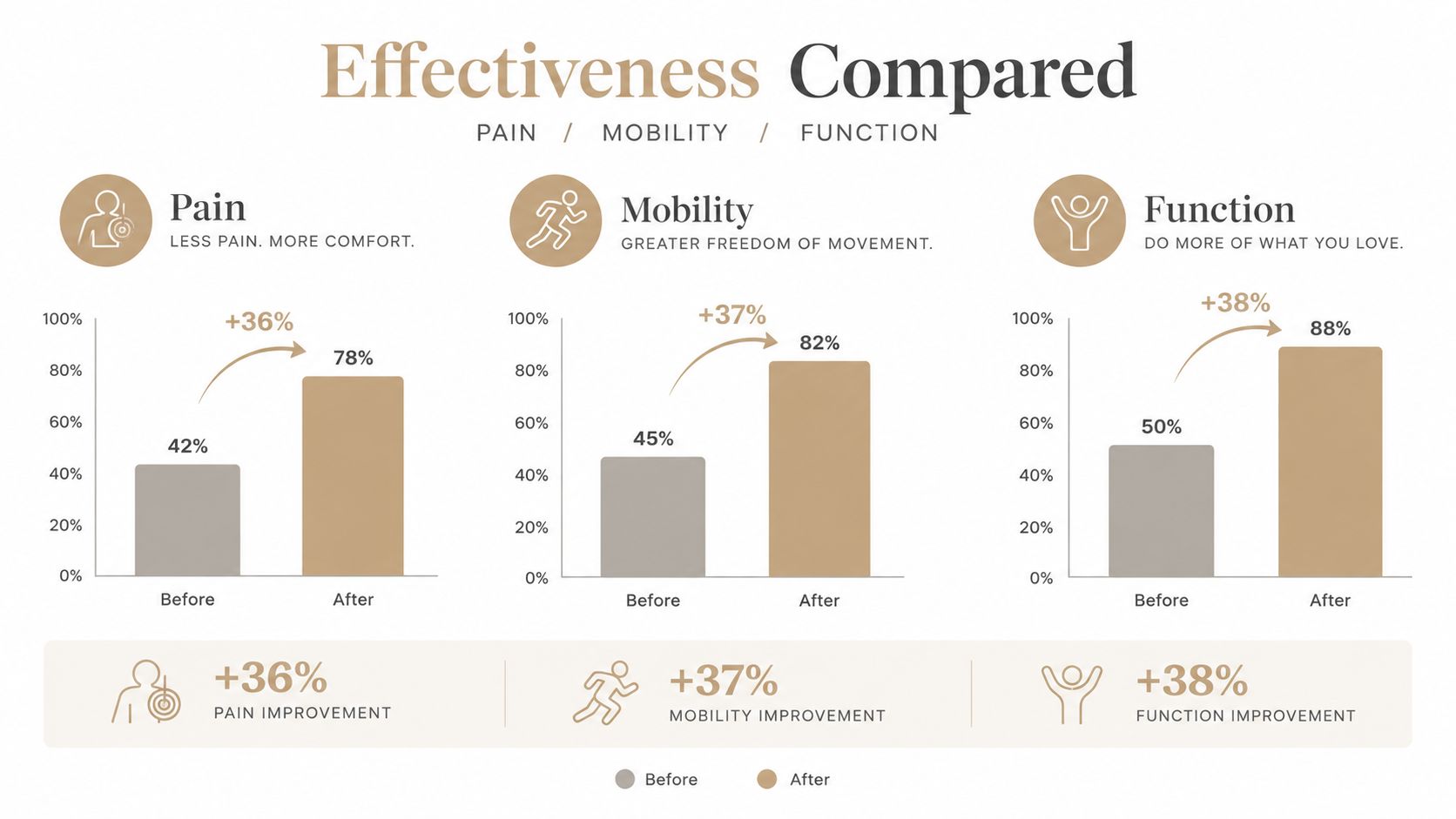
The chart is a visual aid, not verified clinical evidence for the displayed percentages. Treatment decisions should rest on an examination, the person's goals, the response to care, and the quality of the research. For context on how soft-tissue care may be delivered, see massage therapy in Salt Lake City.
Massage has shown immediate pain benefits compared with inactive therapies. A systematic review reported a pooled standardized mean difference of 1.79 for neck pain, with a 95% confidence interval of 1.01 to 2.57 and P<0.00001. The review did not find massage better than other active therapies, and it did not show clear sustained follow-up or functional improvement. The details appear in the systematic review of massage therapy.
Acupuncture may relieve pain more effectively than no treatment, according to the NCCIH evidence summary. The evidence is more convincing for some short-term outcomes than for a durable result.
The meaningful question isn't only whether pain drops after treatment. Ask whether you can turn your head, sleep, work, exercise, and manage daily tasks more easily.
The same trial found an advantage for acupuncture in cervical movement. The largest increase in cervical motion occurred 14 days after acupuncture. Acupuncture was significantly better than massage for total range of motion immediately after treatment and at one week, with p=0.03 at both time points. This supports a short-term functional advantage in that study, while leaving individual responses uncertain.
Massage may reduce tightness and make movement feel easier when muscle guarding dominates. It may fit a stiffness-focused phase, particularly when the immediate goal is comfort before mobility or exercise work. The review evidence does not show reliable improvement in neck flexibility or superiority over acupuncture in direct comparisons.
The practical choice depends on the neck-pain pattern and treatment phase:
A passive treatment earns its place when it helps you do more. If symptoms return unchanged after repeated sessions, reassess the plan instead of continuing automatically.
Both treatments are generally approached as conservative options, but safety depends on proper screening and skilled delivery. Acupuncture requires sterile technique, appropriate needle placement, and disclosure of medications or conditions that may affect bleeding or healing. Massage requires adjustment of pressure and positioning for the patient's symptoms, sensitivity, and medical history.
Acupuncture can produce brief tenderness, light bruising, fatigue, or temporary symptom changes. Massage can leave the treated area tender, especially after deeper pressure. Neither response proves that tissue was damaged or that the therapy worked. Severe, progressive, or unusual symptoms require medical evaluation rather than another routine session.
The U.S. National Center for Complementary and Integrative Health summarizes that massage may help neck or shoulder pain, but the benefit is often short-lived. Its summary cites a 2013 review of 12 studies with 757 participants showing massage was better than inactive therapies, and a 2016 review of 4 U.S. studies with 519 participants showing short-term relief only when sessions were long enough and frequent enough. See the NCCIH massage therapy summary.
A responsible plan starts with an examination and a defined reassessment point. The clinician should record symptoms such as pain intensity, neck rotation, headache pattern, sleep disruption, work tolerance, and ability to complete exercises.
Treatment frequency shouldn't be presented as a universal formula. It may change according to whether the problem is acute, recurrent, chronic, post-accident, or linked to another condition. A useful course includes:
Seek prompt medical attention for serious trauma, progressive weakness, significant numbness, problems with balance, severe unremitting pain, fever, or other symptoms that don't fit ordinary muscular neck discomfort.
The same therapy can be reasonable in one phase and poorly matched in another. Chronic, nonspecific neck pain with stiffness may support a carefully planned combination of acupuncture and activating methods. A new, unexplained, or post-accident problem may require examination before choosing any passive treatment.
A 2025 guideline review found that acupuncture recommendations were concentrated in only 2 neck-pain guidelines out of 17 acupuncture clinical practice guidelines overall. A 2025 neck-pain guideline states that acupuncture can be offered for chronic nonspecific neck pain in combination with activating methods, while it gives a negative recommendation for acupuncture in acute nonspecific neck pain and says soft-tissue treatments such as massage shouldn't be prescribed for acute nonspecific neck pain. These findings are reported in the 2025 guideline review.
| Neck-pain situation | Reasonable priority | What to avoid |
|---|---|---|
| Long-standing stiffness with reduced rotation | Evaluation followed by active exercise, mobility therapy, and possibly acupuncture | Repeated passive care without functional tracking |
| Desk-related muscular tension | Massage may help symptom modulation, followed by posture and movement work | Assuming temporary looseness corrects the cause |
| New acute neck pain without a clear diagnosis | Clinical assessment first | Self-prescribing acupuncture or deep massage |
| Whiplash or post-accident soreness | Car accident assessment and structured rehabilitation | Treating the neck as ordinary tension without screening |
| Recurrent headaches with neck tightness | Evaluation of the neck, headache pattern, and contributing factors | Using repeated sessions without checking for red flags |
| Pain with neurological symptoms | Medical or chiropractic examination and appropriate referral | Delaying evaluation while trying passive treatments |
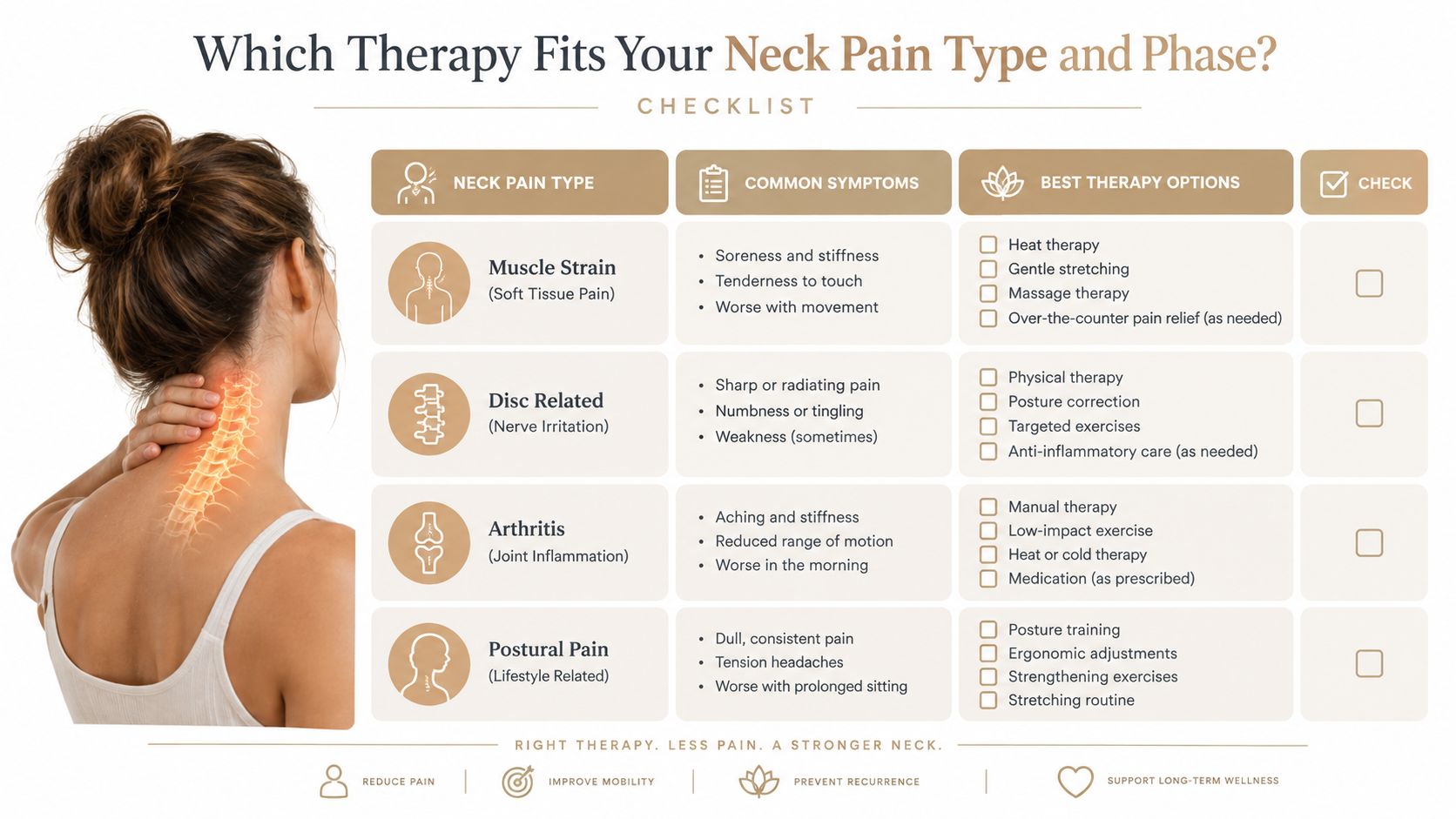
The important distinction is passive versus activating care. Massage and acupuncture may make movement easier, but rehabilitation exercise, mobility therapy, posture retraining, and a take-home plan help build capacity between visits.
For someone with chronic stiffness, acupuncture may be worth discussing when movement-related pain is blocking exercise. Massage may fit when muscular guarding makes everyday movement uncomfortable. For acute or whiplash-related pain, neither should be selected as a substitute for an examination and a staged recovery plan.
Combining therapies can make sense when each one serves a different purpose. Massage may reduce soft-tissue guarding enough to allow movement practice, while acupuncture may help modulate pain that remains sensitive or difficult to settle. The plan should be coordinated rather than layered randomly.
A practical sequence may look like this:
Massage should not be treated as the benchmark because it feels familiar. The systematic review cited earlier found immediate benefits versus inactive care, with a pooled standardized mean difference of 1.79 for neck pain, but found no clear advantage over active therapies and no clear sustained follow-up or functional benefit. That makes massage useful as a symptom-modulation tool, not a complete theory of recovery.
Other services may have a role when the examination supports them. Chiropractic adjustment, realignment, decompression, muscle stimulation, SoftWave Therapy, MLS Laser Therapy, and spinal decompression with the DRX 9000 address different clinical questions and shouldn't be added merely to create a longer treatment list. For disc-related symptoms or sciatica, spinal decompression may be considered only when indicated by the clinical picture.
Nutrition and nutrition counseling can support general recovery habits, while mobility therapy may address restricted movement and posture. Golf Movement Screening can be relevant for active patients whose neck symptoms appear during the swing, and rehabilitation exercise can guide a safer return to activity. Each component needs a defined purpose.
A combined plan is stronger when every treatment has a job, a measurable target, and a reason to stop or change.
A stiff neck after desk work calls for a different first step than pain after a collision. If restriction is chronic and movement remains limited, acupuncture may fit an active rehabilitation plan. If muscular tightness dominates and short-term comfort is the priority, massage may be a reasonable starting point after screening for reasons to avoid it. Recurrent symptoms, post-accident pain, neurological changes, or poor response to self-care call for an examination before selecting a treatment.
Durability matters more than the immediate feeling after a session. Evidence supports short-term improvement for some outcomes, but neither therapy reliably provides lasting relief or better value for every patient. Treat the first choice as a monitored trial. Set a functional goal, choose a reassessment point, and change direction if progress stalls.
As noted in the NCCIH chronic pain evidence summary, acupuncture may improve neck pain compared with no treatment, while massage appears to offer mainly short-term benefit in available trials. Reviews have reached different conclusions about massage, including limited evidence and uncertainty about its effectiveness. Use that evidence as context, then consider your pain pattern, treatment phase, goals, and access to follow-up.
The next step may be movement rather than another passive session. Gentle neck pain exercises at home can support mobility when appropriate, but severe, unusual, or worsening symptoms need evaluation. In a flare, calming symptoms may come first. During recovery, exercise and mobility work can make gains more durable.
Aspen Falls Wellness serves patients in Salt Lake City and Sandy, offering examination, acupuncture, massage therapy, chiropractic care, mobility therapy, rehabilitation exercise, and other non-surgical options. Insurance verification and referrals are available when needs fall outside its scope.
Visit Aspen Falls Wellness to discuss whether acupuncture, massage, active rehabilitation, or a coordinated combination fits your neck-pain pattern. Bring a brief symptom history and ask how progress will be measured.

Stay updated with the latest chiropractic news and exclusive offers.