Learn how chiropractic care for golfers screens swing mechanics, treats back and shoulder strain, and builds a return-to-golf exercise plan.
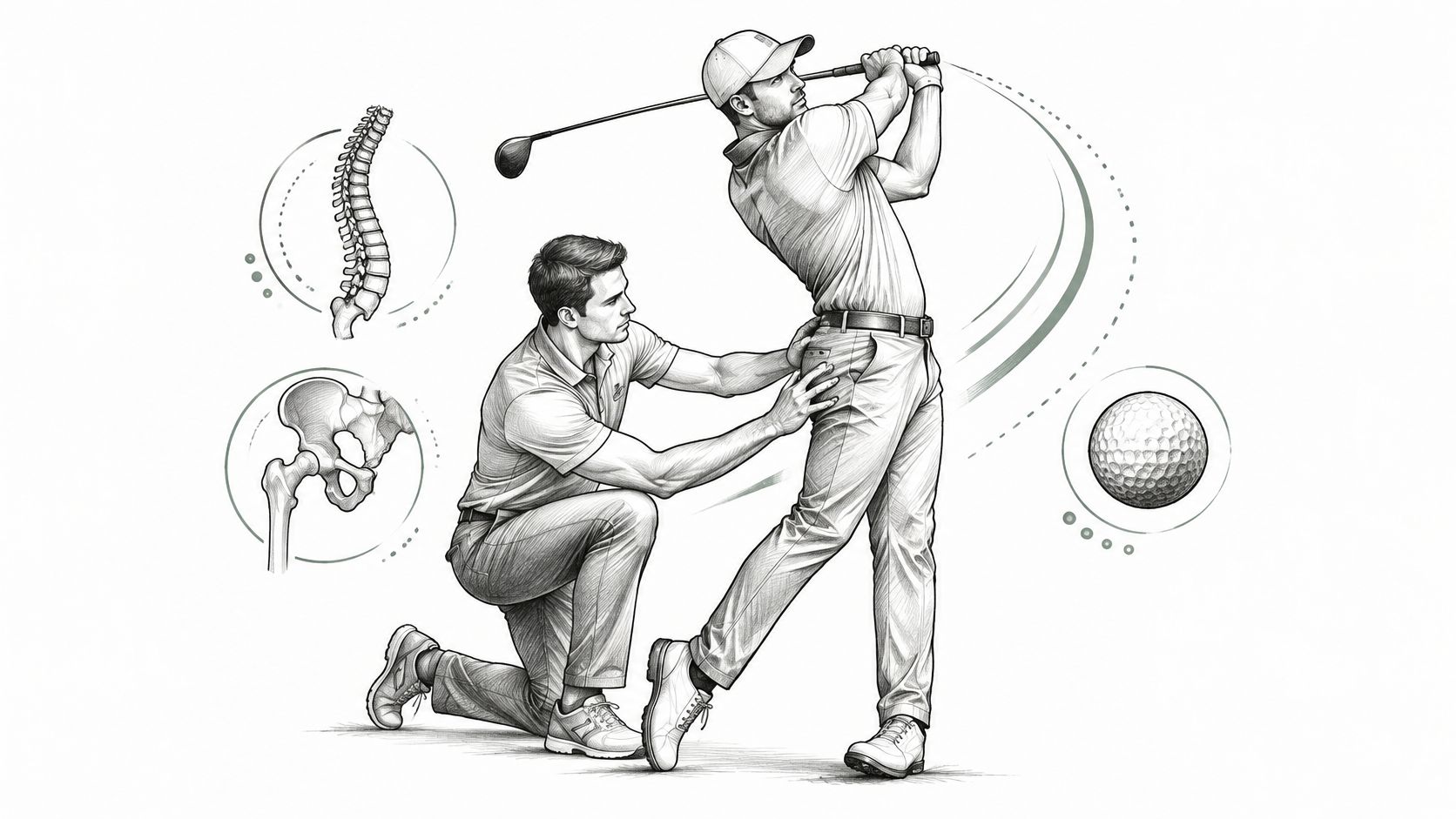
73.5% of professional golfers and 56.6% of amateurs have had a musculoskeletal injury at some point. A 2024 systematic review and meta-analysis pooled 20 studies and 9,221 golfers. Professionals carried a 1.50-times higher lifetime injury risk than amateurs (p<0.001), with 3.05 times the lower-back injury prevalence and 3.33 times the hand and wrist prevalence of amateurs.
That gap isn't a reason to blame your swing and start over. Chiropractic care for golfers fits best as a screen-first plan. Test hips, trunk control, and how much golf you're playing before anyone rewrites your motion. What follows is where the load shows up, why a swing tip rarely clears back pain, and how a graded plan gets you back to full swings.
Is that twinge in your lower back just part of the game? Most of the time it isn't one dramatic moment. It's the same joints taking rotation, a weight shift, and a fast arm action, round after round.
A prospective study of 910 golfers put a number on how often that adds up. Injury prevalence was 11.3% (95% confidence interval 9.8% to 12.8%). Incidence was 3.79 injuries per golfer per year (95% confidence interval 3.54 to 4.06). The lumbosacral spine cost the most playing time, 5.93 days per player per year, ahead of the shoulder at 3.47 days and the knee at 2.08 days.
| Body area | Professional injury risk vs amateurs | Time-loss days per player per year |
|---|---|---|
| Lumbosacral spine | Lower-back injury relative risk 3.05 | 5.93 |
| Shoulder | Not reported for shoulder | 3.47 |
| Knee | Not reported for knee | 2.08 |
| Hand and wrist | Relative risk 3.33 | Not reported for hand and wrist |
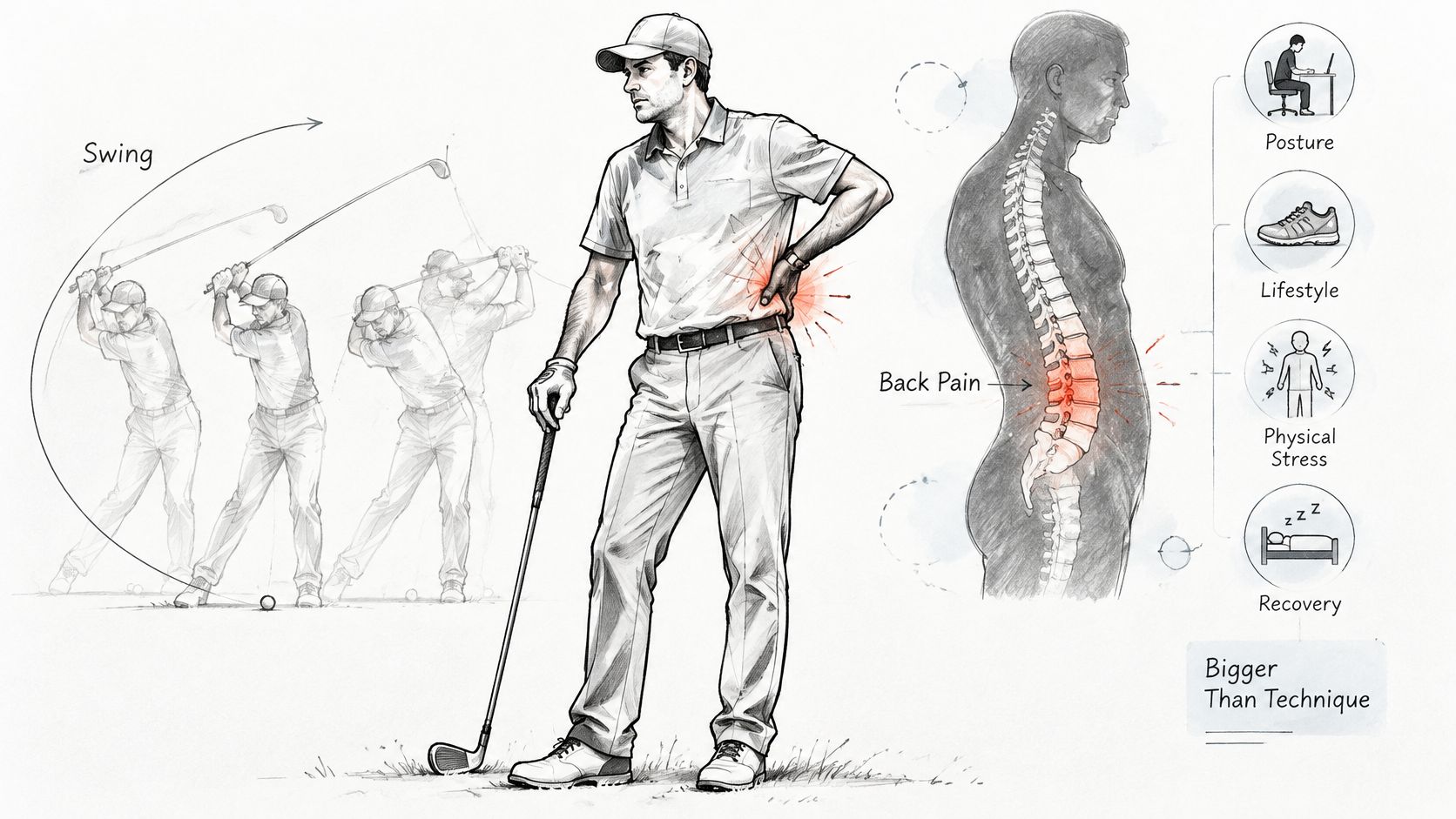
Picture a tow rope. One hard yank rarely snaps it. Strands fray across a season of trunk turns and forceful swings. A weekend player feels that as a stiff low back after 18 holes, a cranky shoulder after a long range session, or a sore wrist after too many punch shots. Competitive players stack more of those repetitions, which is why the lifetime gap shows up in the back and the hands.
Those patterns justify an individual look at spinal motion, hip and shoulder mobility, trunk control, and how the swing loads you. They do not prove that chiropractic care prevents injuries or improves scores. No study has shown that. The honest use of the numbers is a thorough evaluation, hands-on care for comfort, and progressive rehabilitation exercise. The same idea sits behind everyday sports-injury prevention habits: match the work to the person, don't hand everyone the same drill.
Practical rule: A sore spot after golf is a reason to screen motion and load, not proof that one swing fault caused it.
Plenty of golfers are sure the swing caused the pain, so the swing has to be corrected first. That shortcut doesn't hold up.
A systematic review of nine studies found no conclusive evidence linking low-back pain to poor golf-swing technique. Findings didn't agree with each other. Evidence quality was very limited. Most of the reported links were weakened by bias and by designs that weren't prospective. A stiff hip, a thin trunk, a sudden jump in range balls, or simple age can sit under the same ache.
A prospective study of 283 golfers aged 50 to 59 described the classic pattern as lateral shear, pelvic side-bending, and forceful rotation against the spine, with an imbalanced center of mass and center of pressure. The authors concluded that a Free-Release method was more physiological and suggested it as a lumbar-injury-prevention guideline. That is one age band. It doesn't settle the question for every player on the course.
Loading isn't only an impact story either. A simulation built from three-dimensional motion data on 10 professional golfers found intervertebral loading greatest at L5-S1, falling off toward T12. Across different lumbar curves, total lumbar load was greatest in the follow-through. Strength gaps in trunk extension and the hip can linger even when the swing on video looks ordinary. Cutting spinal motion and calling it "protection" misses those gaps.
If you're tidying address position while that screen happens, Dialed Golf's setup tips for hitting up with driver are a clear reference for stance and driver setup. Setup is a coaching detail. It isn't a diagnosis, and it doesn't replace a check of hips, trunk, and weekly load.
A golf swing doesn't spin the low back in isolation. Reviews describe compressive forces of about 6.5 to more than 8 times body weight at or just after impact, from ground-reaction force and trunk muscles firing together. The modern swing also adds side-bend, front-to-back shear, and twist, and the follow-through is a demanding phase. A review of lumbar loading in the golf swing is why we don't stop at "where does it hurt?"
In a study of 15 professional golfers, lumbar and hip rotation were tightly coupled, with an average correlation of 0.81. The lead hip did a lot of the early downswing work. The lumbar spine contributed more later. A hip that won't rotate, or a pelvis that dumps on one leg, can hand that turn to the low back.
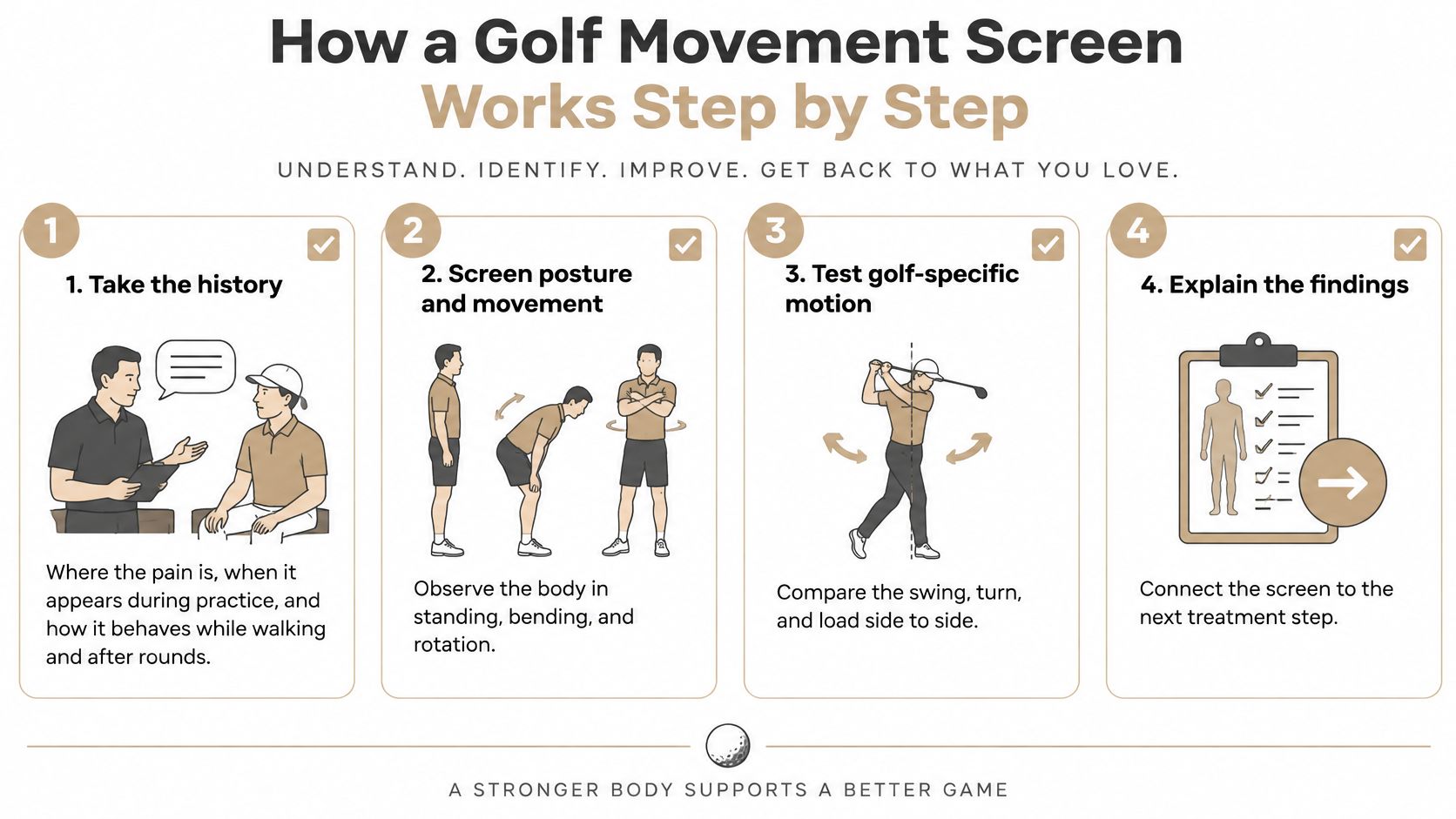
You should know the order before you walk in. Each patient gets a thorough chiropractic evaluation so we can identify the root cause, then a plan built from that diagnosis. Progress is checked at each adjustment, and the plan is adjusted so spine care stays on track.
What we track instead is pain during practice, backswing and finish range, walking tolerance, and a return to full swings. Evidence tying any single swing pattern to low-back pain is still limited and uneven, so the plan stays individual. Symptom-limited manual care can open motion. Trunk, glute, and hip strength, plus supervised swing changes, come after that.
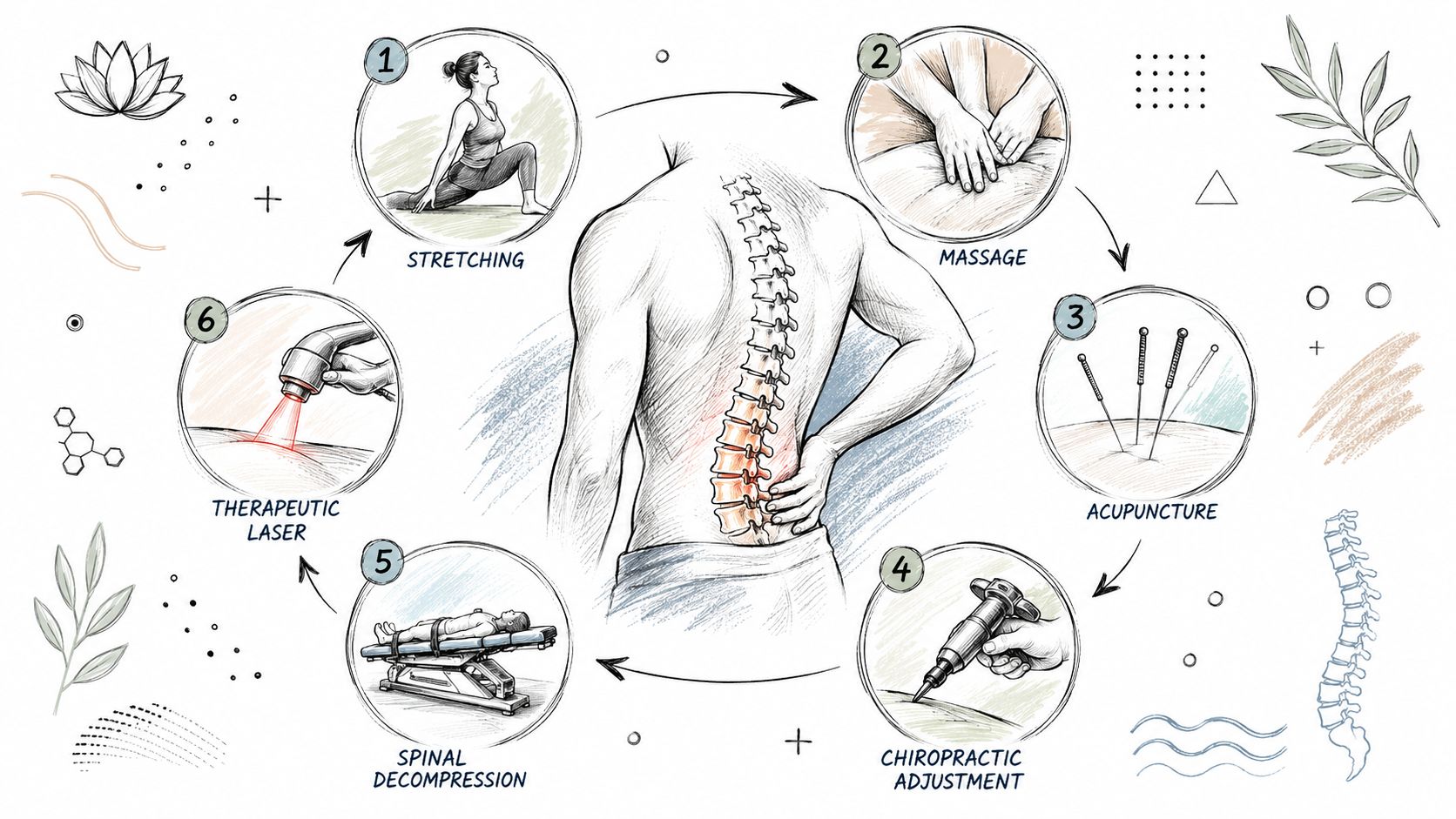
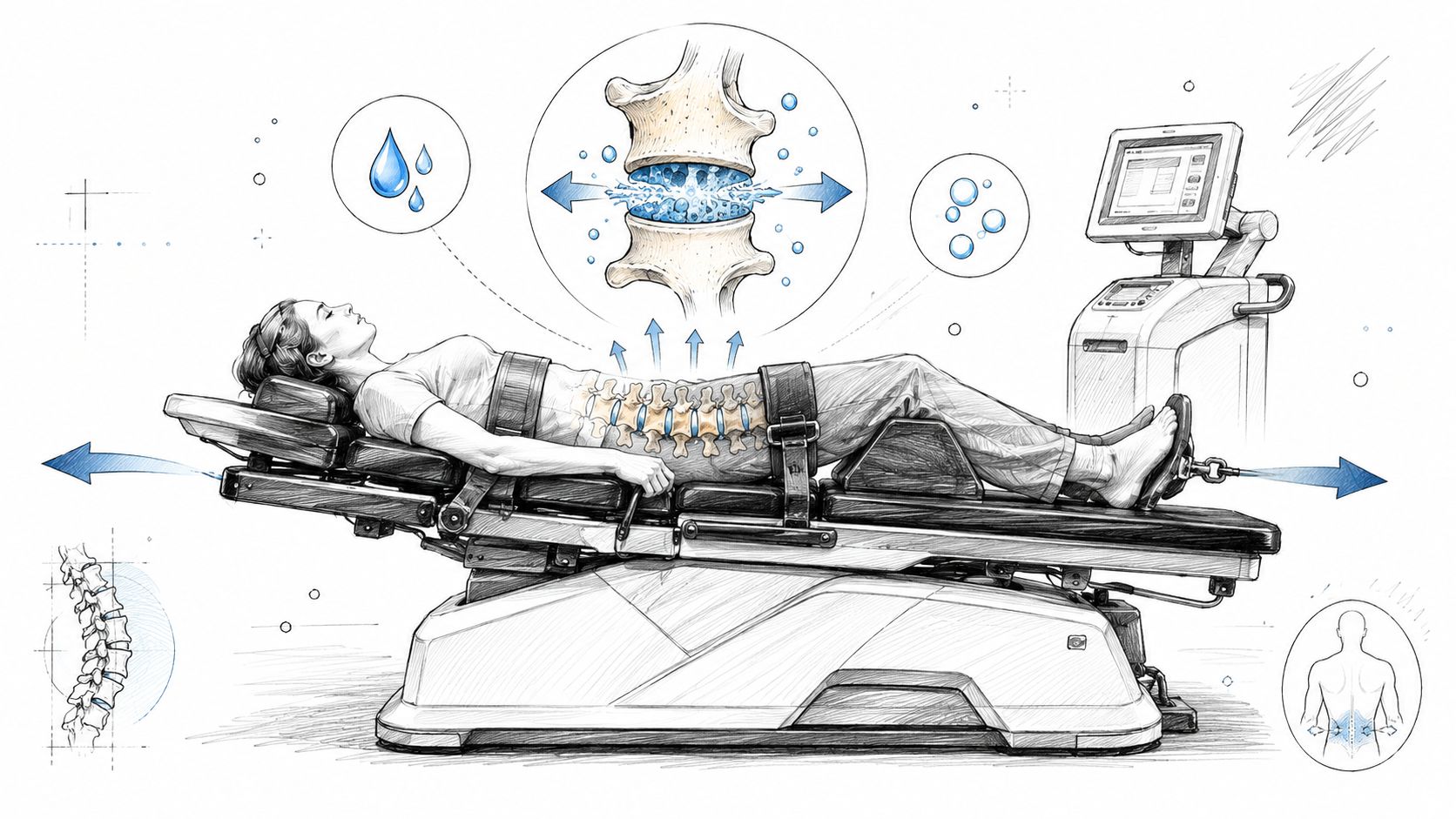
Five situations cover most of the golfers we see. The plan always starts the same way: a full evaluation to identify the cause and to rule out problems that need another clinician. Adjustments are matched to what you can tolerate that day. Decompression on the DRX 9000, or MLS laser therapy, is added only when the findings point to a disc-related pattern. Massage therapy is for irritable soft tissue. Mobility therapy is for joints that won't move. Acupuncture and nutrition counseling can sit inside the same plan when the team agrees they help. Chiropractors, massage therapists, mobility specialists, acupuncturists, pain management specialists, and nutritional coaches build that plan together.
Exercise is the piece every situation shares. In amateur golfers with nonspecific low-back pain, trunk stabilization plus lower-body strength beat swing drills and stretching for pain, disability, and balance. The sets and the trial details belong with the progression itself.
Chiropractic treatment often takes multiple visits. We tell you the expected length and how often to come before care starts, not after you've already been in for weeks.
| Golfer situation | Primary care focus | Visit pattern | Home work |
|---|---|---|---|
| New pain after a round | Evaluation to rule out serious causes, gentle mobility, symptom control | Frequent early visits, tapering as pain settles | Short daily mobility, no heavy rotation until cleared |
| Recurrent low back pain | Adjustments as tolerated, trunk and hip strengthening, review of swing loads | Multiple visits with duration explained at the start | Trunk stabilization and hip strength program |
| Shoulder or elbow pain after heavy practice | Soft-tissue work, thoracic and shoulder mobility, training load review | Shorter course with re-evaluation | Band rotation and shoulder control exercises |
| Return to competitive play | Movement screen, graded swing progression, lower-body strength | Re-evaluation before each progression step | Graded practice swings |
| Preseason prevention | Movement screen and baseline testing, mobility routine | Periodic check-ins | Daily warm-up before play |
Say you finished 18 holes on Sunday and woke up with a one-sided low-back ache that eases when you walk. Early visits stay gentle. You skip hard rotation until the exam clears it. Home work is a few minutes of easy motion, not a new swing thought.
Recurrent pain is different. The back has been talking for months, often after a range week. Care runs longer, adjustments stay inside your tolerance, and the home program is trunk and hip strength plus a honest look at how many balls you're hitting.
A shoulder or elbow that flares only after heavy practice is often a load story with a stiff mid-back. Soft-tissue work and thoracic motion come first. The course is shorter, and you recheck before you add range volume back.
Coming back for a club event needs a screen, then swings that get longer only after the last step felt fine. Preseason work is the quiet version of the same idea: a baseline screen, a short mobility routine, and a warm-up you do before the first tee.
Pain that stays local and fades across the week is a green light to continue. Pain that spreads, or strength that drops, is a reason to stop and get rechecked.
Hands-on care can calm a joint. The change that lasts is usually the exercise you repeat between visits. In a randomized trial of 30 amateur golfers with nonspecific low-back pain, trunk-stabilization work plus lower-extremity strength improved pain, Oswestry Disability Index scores, and balance more than golf-swing exercises and stretching. Both groups gained driver distance and ball speed. The strength group was the one that moved pain, disability, and balance.
That trial is adults with low-back pain. A 2025 exercise trial in high-school golfers used a younger group, so don't treat a teen result as a prescription for a 55-year-old weekend player.
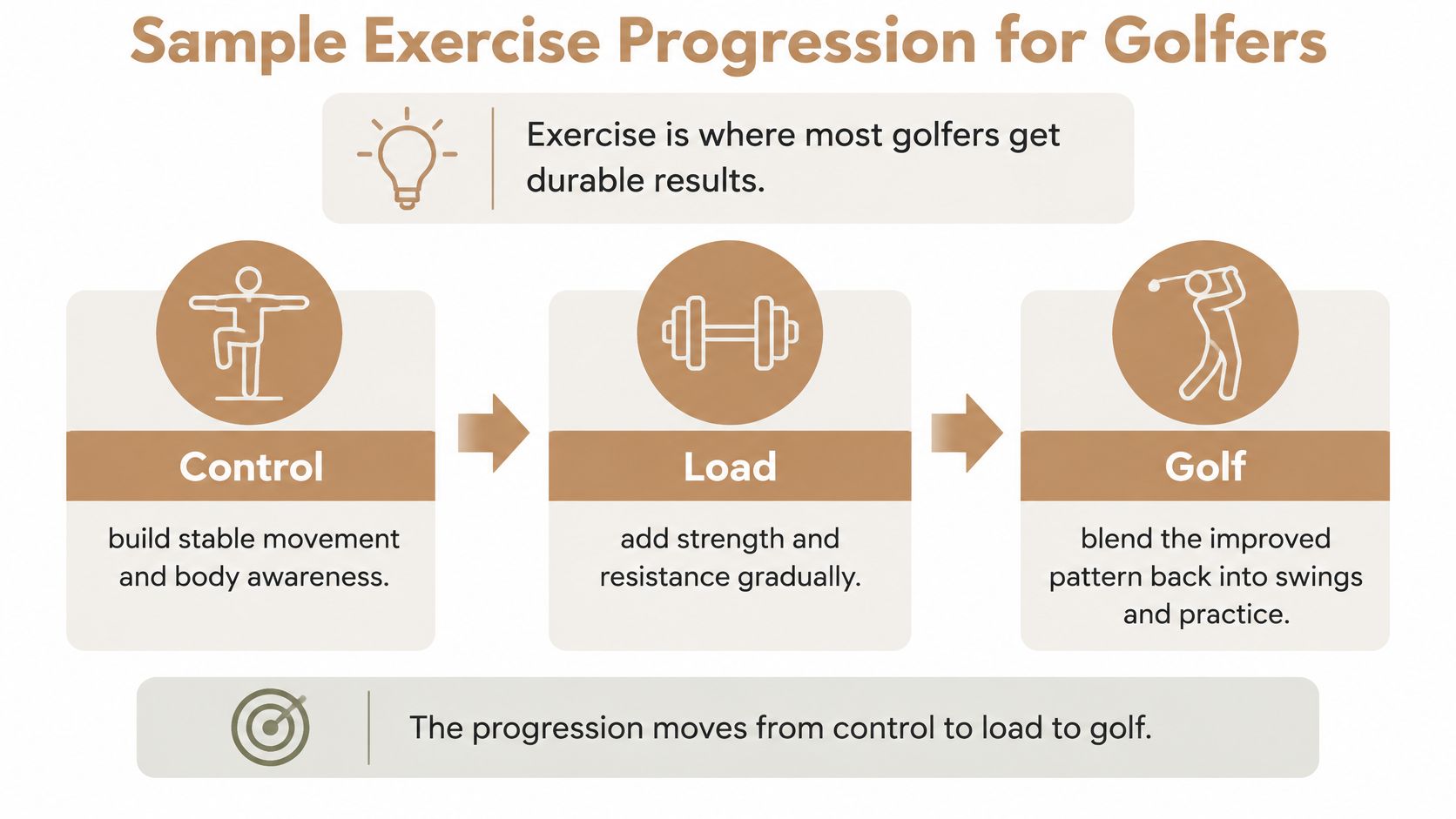
Move from control, to load, to golf. Mild discomfort that stays put and settles within a day is acceptable. Spreading pain, leg symptoms, or a worse session than the last one means you stop and get assessed.
| Phase | Sample exercises | Load and progression | Move on when |
|---|---|---|---|
| 1. Isometric control | Trunk-extension holds, hip adduction isometrics | Low load, no radiating pain | Holds completed with no leg symptoms |
| 2. Controlled rotation | Slow hip rotation and thoracic rotation drills | Slow tempo, pain-free range | Full pain-free rotation to both sides |
| 3. Strength and balance | Split-stance work, single-leg pelvic control, glute strengthening | Resistance added gradually | Single-leg control and strength steady across sessions |
| 4. Anti-rotation | Resisted anti-rotation holds, split-stance trunk work | Load increased in small steps | Resisted work tolerated with no symptoms |
| 5. Graduated golf | Half swings, then practice swings, then full swings | Session length increased in steps | Repeated full swings with a controlled finish |
Phase 1 is a quiet hold, not a workout. You're teaching the trunk to stay organized while the hips squeeze in. If a hold sends symptoms into the leg, you aren't ready for rotation yet.
Phase 2 is slow hip and thoracic turns through a range that doesn't hurt. Speed is the mistake here. Fast reps hide the side that doesn't rotate. If one hip is the limiter, pair this phase with basic hip mobility work rather than forcing a bigger shoulder turn.
Phase 3 adds a split stance, a single-leg balance check, and glute strength. Resistance goes up only when the last session looked the same as the one before it.
Phase 4 asks the trunk to resist a twist instead of creating one. Small jumps in band tension beat a heroic set.
Phase 5 is golf again, in order: half swings, practice swings, full swings. You lengthen the session, not the violence of each swing. The exit test is repeated full swings with a finish you can control.
Home programs fail when they're long. Keep the daily set short enough that you'll do it, and review it at the next visit so the reps match what was prescribed. Unsupervised plans drift. A three-minute version you finish beats a twenty-minute sheet you skip.
A pain-free address position is a weak green light. You still have to finish the swing, walk the course, and do it again on the back nine.
A matched study of 32 male golfers found that players with a history of low-back pain had significantly less trunk-extension strength at 60 degrees per second, less left-hip adduction strength, and less trunk rotation toward the nonlead side. Maximum spinal moments and general postural stability weren't clearly different. Swing video can look similar while hip and trunk capacity stays down. The same line of biomechanical work placed the highest lumbar intervertebral loading at L5-S1 and the greatest overall lumbar load in the follow-through. Return testing has to include the finish and repeated swings, not just how you feel over the ball.
A 2025 randomized trial in 45 high-school golfers is easy to overread. Low-back pain incidents were 16 in the exercise group and 100 in the sham group over 12 weeks, with an odds ratio of 0.157 and no significant difference in how many participants developed pain. The authors described an 84% reduction in incidence. Participants were adolescents, and the trial was small. Don't treat that as proof a weekend player over 50 will get the same drop.
The steps themselves are the five phases already laid out: isometrics, controlled rotation, strength, anti-rotation, then graduated swings. You don't skip ahead because a tournament is on the calendar. If a setback shows up, athlete injury recovery is the frame: reload capacity, don't just rest until the calendar says you should play.
Those aren't a cue for another performance session. Pain that stays inside the limits you agreed on, and that improves across weeks, means the plan is working.
The next step is an initial visit, not a new swing video. That visit is a thorough evaluation and a golf movement screen. Afterward we explain how long care is likely to run and how often you'll come, based on what the exam found.
Bring three things. A short log of when pain starts in practice or on the course. Any imaging you already have. A plain count of golf sessions per week, including range time, because "I only play twice" often hides a bucket of balls on Wednesday.
What gets booked from that screen is golf movement screening, chiropractic adjustment matched to your tolerance, mobility therapy, and rehabilitation exercise with a take-home plan. Laser therapy or spinal decompression is added only when the findings support it, not as a default package. We provide family chiropractic care in Salt Lake City and Sandy, Utah. Chiropractors, massage therapists, acupuncturists, mobility specialists, and nutrition coaches can work on one plan when your case needs more than the spine.
For golfers who want a clinician used to athletic spines, Dr. Dustin Hedstrom graduated cum laude from the doctoral program at Palmer College of Chiropractic Florida and worked with professional athletes in spinal rehabilitation in Kansas City.
Success isn't a perfect swing on camera. It's less pain during practice, full swings that don't hurt, and steady progress through each phase. Scheduling details are at aspenfallsslc.com.
Aspen Falls Wellness offers golf movement screening, chiropractic care, mobility therapy, and rehabilitation exercise for golfers dealing with back, shoulder, or wrist pain in Salt Lake City and Sandy. A screen-first visit looks at hips, trunk control, and training load before anyone changes your swing. Visit Aspen Falls Wellness to book a golf movement screen before your next round.

Stay updated with the latest chiropractic news and exclusive offers.