How much is chiropractic visit in 2026? See typical cost ranges, what changes the price, insurance tips and how to estimate your out-of-pocket cost.

An initial chiropractic consultation averages about $152 nationally, within a reported range of $121 to $281, according to the CareCredit chiropractic cost guide. Follow-up visits typically cost less. Treat that figure as a benchmark, not a fixed local fee.
The number on a clinic's price sheet is only part of your budgeting decision. You also need to know whether it buys an examination, an adjustment, an added therapy, or one visit inside a longer treatment course. A single appointment has a price; an episode of care has a cost, and the two rarely match. For patients in Salt Lake City and Sandy, the most useful comparison is what you'll pay for the recommended care, not which office advertises the lowest opening price.
A national consultation estimate can help set expectations, but it is not a local price quote. The CareCredit chiropractic cost guide reports an average of about $152, with a range of $121 to $281. Those figures describe an initial consultation benchmark, not the final cost of a course of care.
A single appointment and an episode of care are different budgeting questions. A follow-up adjustment may be a separate, simpler service, while a care plan can involve repeat visits or additional therapies.
| Visit or service | Typical cost or benchmark | What it usually covers | Caveat |
|---|---|---|---|
| Routine follow-up adjustment | Ask the clinic for its written rate | Adjustment and brief reassessment | Confirm which services are included |
| Spinal decompression course (DRX9000) | Request a written course quote | Multiple non-surgical decompression sessions | Course length is individualized |
| MLS® Laser Therapy, SoftWave therapy, massage, or acupuncture | Request a written quote for the service | The selected therapy or appointment | Ask whether it is billed separately or included in a plan |
| Medicare manual spinal manipulation | 20% of the Medicare-approved amount after the Part B deductible, when applicable | Medically necessary, hands-only manipulation by a licensed chiropractor | See Medicare's chiropractic coverage rules for coverage details |
These are different kinds of costs. A Medicare cost-sharing percentage is not a cash price, and a course quote is not the price of one visit.
An adjustment is a treatment service. Decompression is delivered over multiple sessions, while massage or acupuncture may be booked as a separate service or included in a treatment plan. The name “chiropractic visit” alone does not tell you which of these you are paying for.
Before comparing quotes, ask what the amount includes, whether any added therapy is billed separately, and whether the quote covers one appointment or a series. A written estimate that names each service makes the total easier to understand.
A visit price means little until you know its scope. The main cost drivers are the diagnostic work, imaging, added therapies, and how often the treatment repeats.
The initial examination and diagnosis may form a separate encounter. History-taking, movement testing, neurological assessment when appropriate, documentation, and a written plan require more work than a brief progress check.
Imaging creates another potential billing line. When clinically indicated, an X-ray or MRI may be performed and billed by an imaging provider. Don't assume the chiropractic office's estimate includes that outside charge.
The CMS chiropractic coverage policy limits the chiropractic benefit to medically necessary manual manipulation using the hands, excludes other diagnostic or therapeutic services furnished or ordered by a chiropractor, and allows no additional payment for a device used during manipulation.
| Service | Typical billing pattern | Medicare chiropractic benefit |
|---|---|---|
| Spinal manipulation, hands-only adjustment | Per visit, often bundled into the visit charge | Covered when medically necessary |
| Initial exam and treatment planning | Separate encounter, generally higher than follow-up | Not covered under this benefit |
| X-ray or MRI ordered during care | Billed by the imaging provider | Not covered under this benefit when ordered by a chiropractor |
| DRX9000 spinal decompression | Per session or course | No separate payment under this benefit |
| MLS laser therapy | Per session | No separate payment under this benefit |
| SoftWave or muscle stimulation | Per session | No separate payment under this benefit |
| Massage therapy | Per session or package | No separate payment under this benefit |
| Acupuncture | Per session | No separate payment under this benefit |
| Exercise plan, mobility work or nutrition counseling | Per session or program | No separate payment under this benefit |
A service excluded from the Medicare chiropractic benefit isn't necessarily excluded from every other insurance benefit. Coverage through another qualified practitioner or a separate plan provision needs its own verification.
Therapy add-ons can change a basic adjustment into a more extensive encounter. Decompression, MLS Laser Therapy, SoftWave Therapy, Massage Therapy, Acupuncture, Muscle Stimulation, Mobility Therapy, Personal Exercise Plans, Rehabilitation Exercise, and Nutrition Counseling should each be identifiable on the estimate when billed separately.
Visit frequency changes the total even when the individual fee stays constant. A short treatment sequence and an ongoing schedule are different financial commitments.
Say a patient with neck pain receives an initial exam, an X-ray, and two laser sessions. That hypothetical plan creates several billing lines beyond the adjustment itself. At the front desk, ask which services are bundled into the visit fee and which are priced separately.
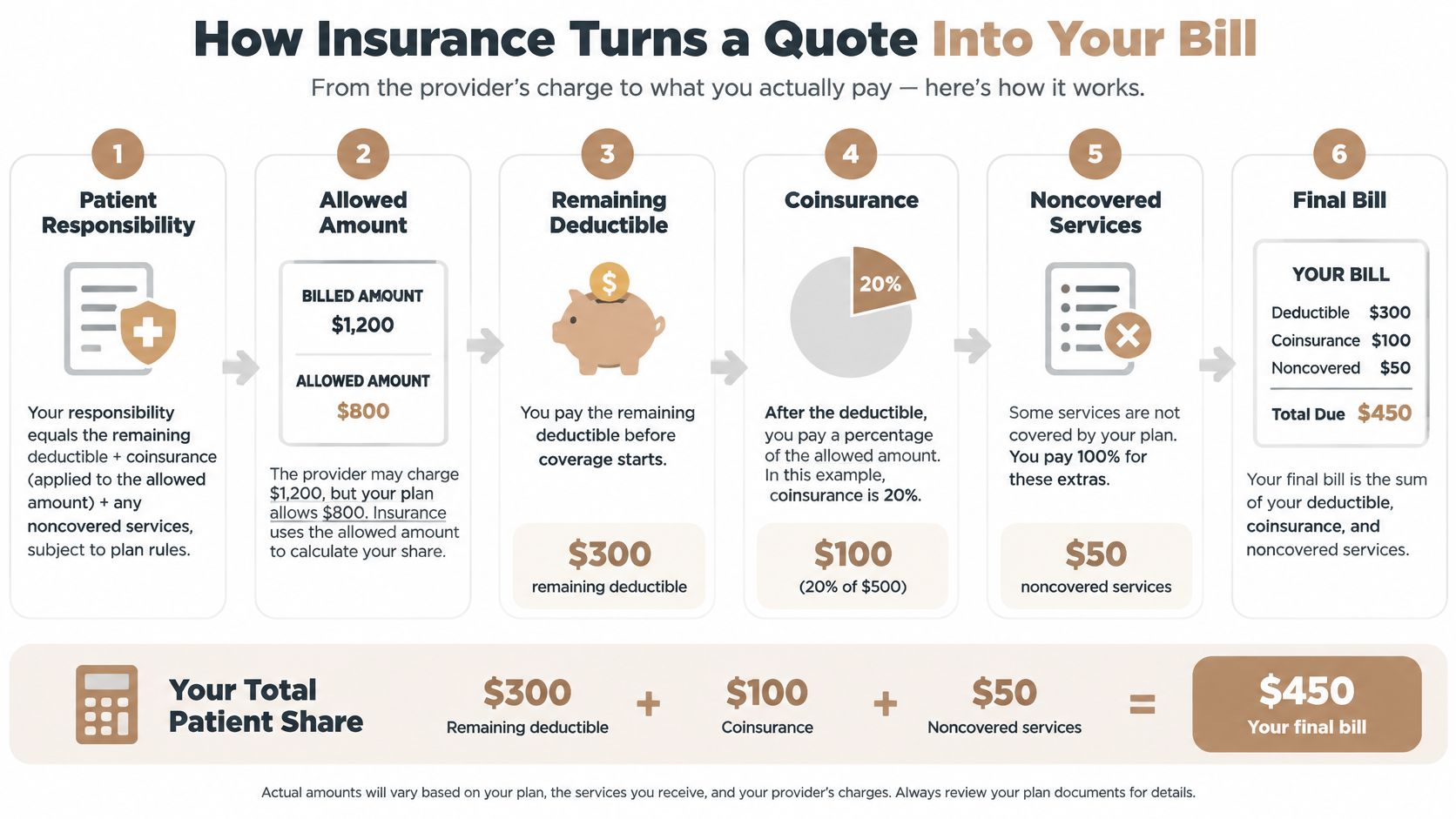
Patient responsibility = the deductible applied to covered services + applicable coinsurance or copay + noncovered services, subject to plan rules. Only the amount applicable to that claim belongs in the calculation, so resist adding your entire remaining deductible to every appointment.
The clinic first submits its standard charge. The insurer then applies its negotiated or allowed amount, applies any remaining deductible, and calculates your cost-sharing on the remaining covered balance. Separately purchased noncovered services may be added at the agreed self-pay price. A quoted visit fee works like a menu price: the actual receipt only appears after the insurer has re-priced each line.
A clinic's published self-pay schedule is a market comparator, not a like-for-like price for integrated care or a statement of what your insurance will pay. A single-visit fee also says nothing about the cost of a full episode of care, which grows with each added therapy and each repeat appointment.
For Original Medicare, Medicare's chiropractic coverage guidance states that Part B covers medically necessary manual spinal manipulation by a licensed chiropractor and that patients pay 20% of the approved amount after the annual Part B deductible. The worked example below applies this same rate to a hypothetical approved amount. Actual responsibility can change with assignment, the provider's charge, facility, location, and other insurance.
Commercial plans need individual verification. If you're checking a particular policy, our guide to whether Blue Cross Blue Shield covers chiropractic care can help you prepare benefit questions.
Care at Aspen Falls Wellness begins with a thorough chiropractic evaluation by our doctors to identify the root cause of your issues, followed by a customized treatment plan based on the diagnosis. That plan may include chiropractic adjustments, DRX9000 Decompression, and/or MLS Laser Therapy, which is exactly the kind of line-by-line detail your estimate should show before you agree to a schedule of visits.
A covered service can have a manageable patient share while the complete appointment costs much more. The following calculation is illustrative, not a clinic quote or a Medicare-approved rate.
Suppose, solely for calculation, that an insurer's allowed amount for a routine covered manipulation were $152. This borrows the national consultation benchmark as a hypothetical input, even though consultation pricing and approved manipulation amounts are different measures.
With the Original Medicare deductible already satisfied, the hypothetical arithmetic is:
| Illustrative billing line | Calculation |
|---|---|
| Assumed approved amount | $152 |
| Assumed patient share | $152 × 20% |
| Patient responsibility for that covered service | $30.40 |
The resulting $30.40 is a calculated example, not a promised out-of-pocket price. Your real calculation must use the actual approved amount and your current benefits.
If the deductible hasn't been met, the covered service first contributes toward the amount still outstanding. If the applicable remaining deductible consumes the entire approved charge, your responsibility for that covered line could be the full hypothetical amount. If only part remains, cost-sharing applies to the covered balance after that deductible portion.
Now suppose the same appointment includes noncovered decompression. Add the clinic's quoted self-pay charge in full; don't multiply that charge by the covered service's coinsurance rate.
For a course of care, use this worksheet:
If your plan includes a separate examination charge, include it too. Don't bury it inside the follow-up calculation.
For payment planning, our guide to using a health savings account for chiropractic care offers another set of questions to review before paying.
A small covered-service balance isn't the same as a small treatment-plan total.
The estimate becomes useful when every proposed service has a price, an expected frequency, and a clear coverage status.
Different symptoms lead to different quote structures. These hypothetical scenarios show which lines deserve the closest attention, not what any particular patient will need.

For acute neck stiffness after long laptop hours, the first question is whether the examination is priced apart from treatment. A short sequence of adjustments and home exercise may follow the evaluation, so ask the office to separate the exam, return appointments, and any exercise-instruction charge. Here, the initial examination may be the largest individual line.
With chronic low-back pain, the decisive number is usually the follow-up total rather than the first appointment. Care may begin with closer spacing, then widen as symptoms and function improve. The estimate should name a review point, because accumulated follow-up charges are the main cost driver in this scenario.
When disc-related sciatica leads to non-surgical spinal decompression, the multi-session course drives the estimate. A randomized study of 48 adults with lumbar disc herniation used 20 sessions over six weeks and found significant improvements in both DRX9000 decompression and conventional motorized traction groups, without a significant difference between treatments. That protocol shows one possible structure for a longer intervention; device superiority and universal dosing remain separate clinical questions. In this hypothetical quote, the decompression course is likely dominant, while examination, adjustments, and rehabilitation should remain distinguishable.
After a collision, ask which dollars belong to the clinic and which belong to outside diagnostics. A structured assessment, documentation, and Car Accident Treatment visits may sit on the estimate while imaging is billed elsewhere if indicated. The separate diagnostic charge could become the largest individual item, so the actual quote has to establish that before anyone assumes the visit fee tells the whole story.
For an athlete maintaining mobility, optional prevention should sit on its own line. A reassessment may pair with a rehabilitation plan, while Golf Movement Screening is priced separately if it is included. In an exercise-focused scenario, the rehabilitation program may be the largest planned component, especially when appointments are spaced around training rather than symptoms alone.
For a different life-stage concern, The Axelrad Clinic's Managing backaches after pregnancy offers context for postpartum readers preparing questions about their symptoms. It is not a substitute for an individualized evaluation.
Read across the five scenarios and the same quoted visit fee can produce very different episode totals: exam-heavy for a short acute episode, follow-up-heavy for recurring pain, course-heavy for decompression, diagnostic-heavy for accident care, and rehabilitation-heavy for performance goals.
Does the lowest advertised fee really produce the lowest total expense? Only if the services, number of appointments, and clinical value also make sense for your situation. A single visit is a unit price; an episode of care is the total bill. Comparing the first without estimating the second is like judging a hotel by its nightly rate without counting the nights.
A 2024 peer-reviewed study of adults with spine-related musculoskeletal pain reported that patients who initially consulted a chiropractor used substantially fewer downstream healthcare services and incurred lower overall healthcare costs than patients who began with medical management, a result that does not establish chiropractic as the cheaper option for every condition or prescribe how many visits any one patient should receive.
An inexpensive promotional appointment can lead to substantial spending if it becomes open-ended treatment. A higher-priced evaluation may be easier to budget around when it produces a defined plan with measurable goals, because the episode total depends on the visit count, the fee billed at each visit, and any separately priced services such as decompression or laser therapy.
Use these questions before committing:
A cost-conscious plan includes home-exercise options, instructions you can follow without supervision, and explicit criteria for reducing appointment frequency. It should also make room for referral when continued treatment isn't appropriate.
Function gives you a firmer basis for decisions than how you feel an hour after an adjustment. Sitting through a full workday, walking without guarding, or returning to training are observable outcomes that show whether the plan is working.
Value check: Pay attention to the plan for finishing care, not just the price for starting it.
A universal visit count is misleading because the appropriate duration reflects the condition, how long it has been present, and your response. Good budgeting allows reassessment without treating additional visits as automatic.
Use the consultation to make a clinical and financial decision, not to commit blindly to a treatment course. At Aspen Falls Wellness, new patients begin by scheduling an initial consultation with our providers to receive a personalized treatment plan.
Our process has three steps: schedule an initial exam, receive a personalized treatment plan, and begin care aimed at relieving your pain. We provide family chiropractic care in Salt Lake City and Sandy, Utah, so you can choose the closer location.
Bring documents that help the clinical team understand your symptoms and help billing staff identify the benefits that need verification:
Our guide to what to expect at your first chiropractic visit can help you prepare for the evaluation itself. Bring your questions in writing so the billing conversation doesn't get lost among the clinical details.
Request expected visit frequency, review points, and criteria for changing or stopping care alongside the service estimate. A treatment recommendation and a price sheet should describe the same proposed course.
Imaging is ordered only when clinically indicated, not just because someone is a new patient. When your needs fall outside our in-house scope, referral to an outside specialist may be appropriate.
You don't need a guaranteed final total before an examination can clarify your needs. You do need a clear explanation of what the first appointment includes and an itemized estimate before agreeing to further services. Call to book the initial consultation and request that written estimate before committing to a course of care.
Aspen Falls Wellness offers individualized chiropractic care and integrated services, including non-surgical spinal decompression, massage, acupuncture, and laser therapy, in Salt Lake City and Sandy. Visit Aspen Falls Wellness to arrange your initial consultation and request a written estimate that separates evaluation, treatment, and any recommended add-on services.

Stay updated with the latest chiropractic news and exclusive offers.