Learn how to prevent sciatica from coming back with a practical plan covering exercises, ergonomics, flare response, and conservative care options.
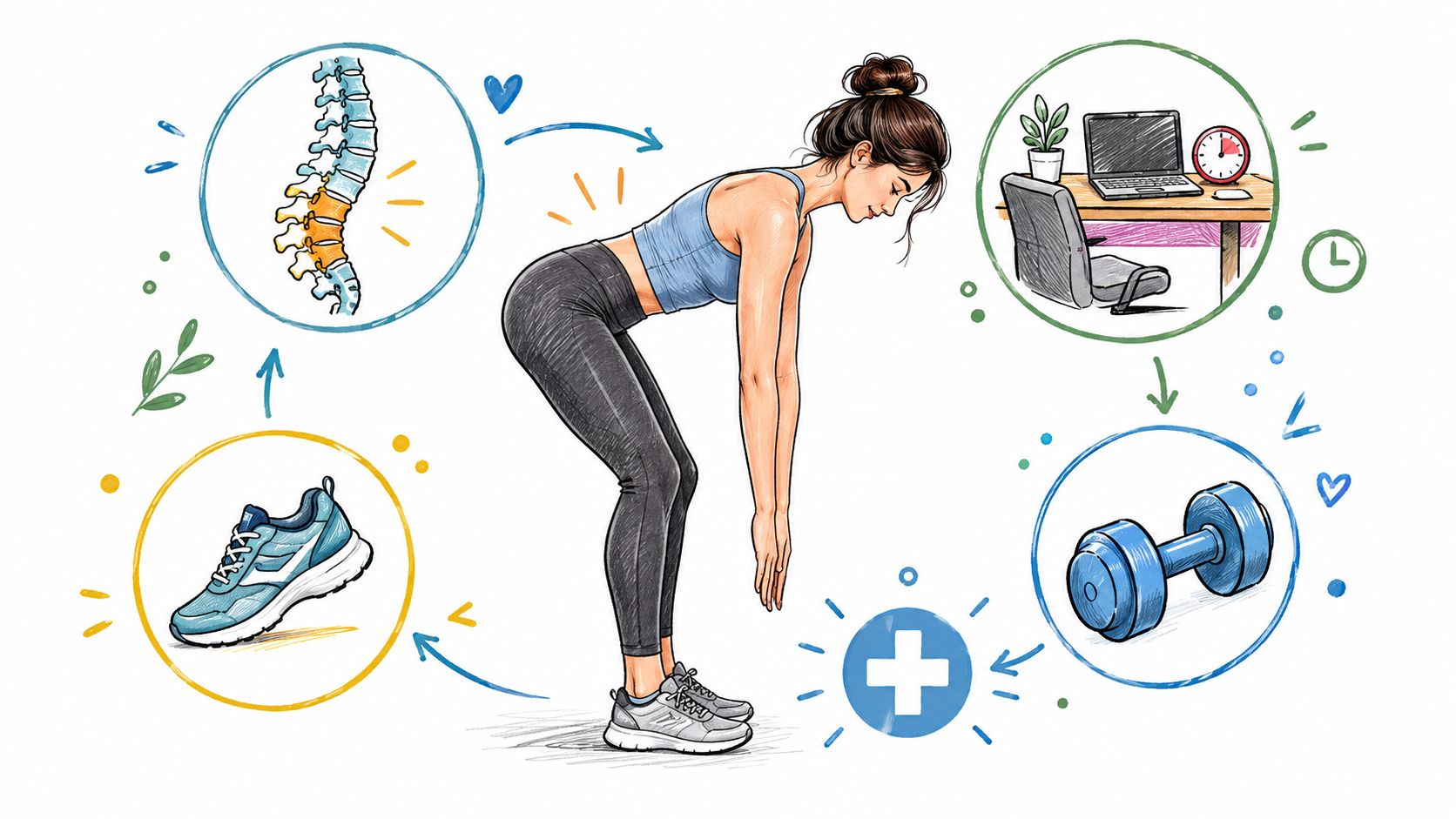
The most common moment for sciatica to come back is right after you start feeling normal again. The leg pain eases, you sit a little longer, carry something heavy without thinking, skip the exercises that got you through the flare, and then the familiar pull starts in the buttock or down the calf. That's usually not a sign that you failed. It's a sign that recurrent sciatica is a risk to manage, not a defect to eliminate.
If you're looking for how to prevent sciatica from coming back, the useful question isn't “What perfect stretch fixes this forever?” It's “What habits lower the odds of another episode, and what should I do fast if symptoms start to return?” That shift matters. People who get too cautious often decondition and become more sensitive to normal loads. People who feel better and jump straight back into full activity often re-irritate the same tissues. The middle path is what tends to hold up.
Someone gets through six rough weeks of radiating pain, finally sleeps better, and can drive without wincing. Then they make one very human mistake. They assume symptom relief means the system is ready for anything. By the time the pain has backed off, the nerve may be less irritated, but the strength, endurance, movement tolerance, and load tolerance that protect against recurrence often haven't fully returned.
That's why recurrence feels so frustrating. You did enough to get out of pain, but not yet enough to stay resilient under normal life. The problem usually isn't one bad chair, one bad lift, or one imperfect posture. It's the combination of residual sensitivity plus inconsistent conditioning.
The prevention mistake I see most often goes in one of two directions:
Neither extreme works well for long. Current guidance from NICE advises adults with low-back pain with or without sciatica to receive individualized self-management advice and to continue normal activities through the treatment pathway, while using exercise matched to the person's needs and capabilities (NICE low back pain and sciatica guidance).
Prevention works better when you treat recovery as a transition, not a finish line.
There is good support for staying active after symptoms improve. A Cochrane review found moderate-quality evidence that exercise after recovery reduced low-back pain recurrence at one year versus no intervention, with a rate ratio of 0.50 and 95% confidence interval 0.34 to 0.73. Because sciatica commonly overlaps with low-back disorders, that matters clinically, even though it doesn't promise that every person will avoid another flare (Cochrane review on exercise for recurrence prevention).
The practical takeaway is simple. Build a plan that keeps you normally active, progressively stronger, and prepared for small flares. You don't need to turn daily life into a rehab ritual. You do need enough structure that symptom relief turns into staying power.
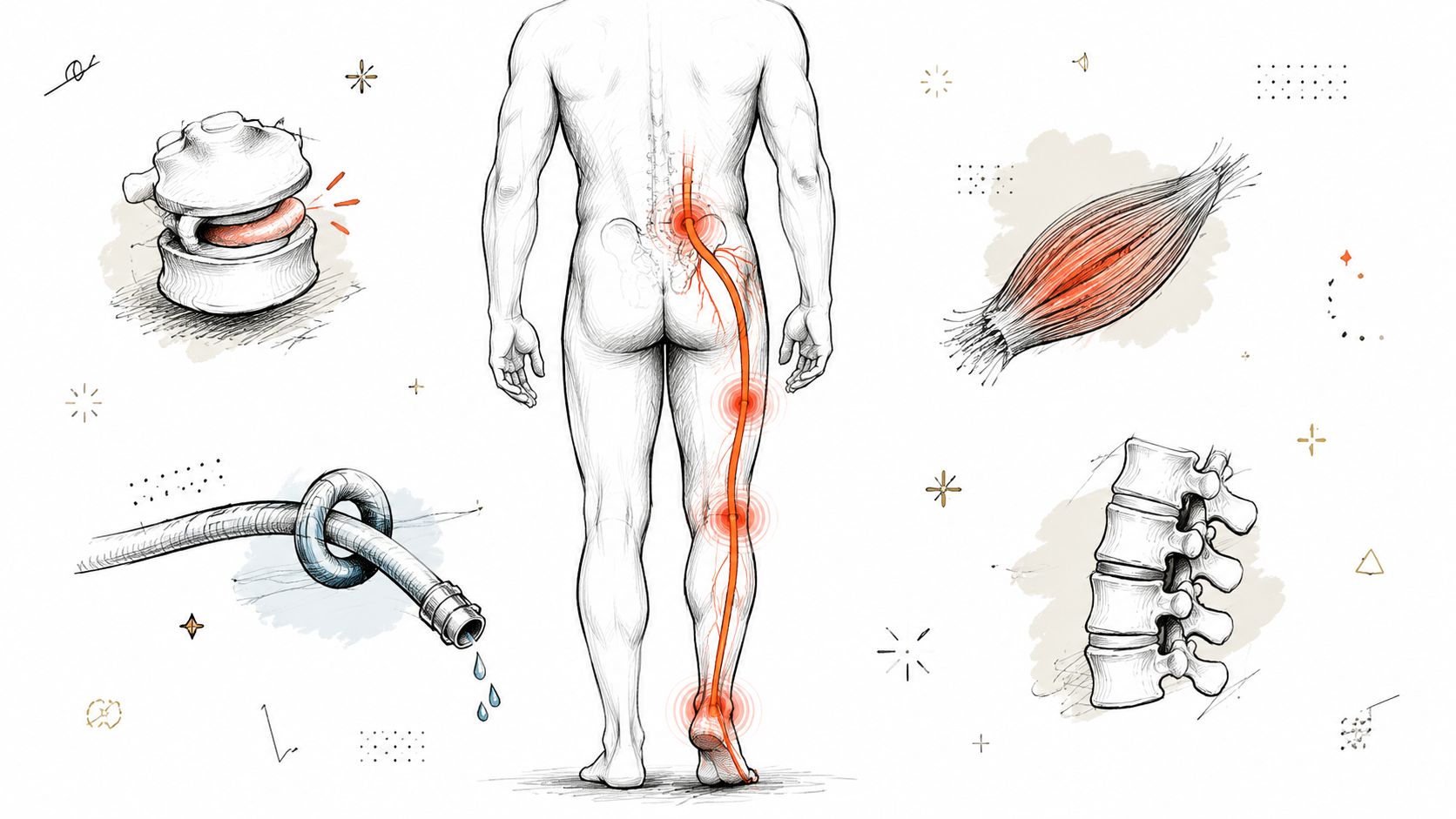
Most recurrent sciatica doesn't come from mystery causes. It tends to come from a short list of drivers that either keep the area underloaded for too long or overload it too quickly. If you know which levers matter, prevention gets much less confusing.
Some factors aren't fully modifiable. Prior disc herniation, stenosis, age-related spinal changes, and a history of previous episodes create background risk. Those factors matter, but they don't tell you what to do on Monday morning. The useful targets are the things that change the way your back, hips, and nervous system handle daily load.
The biggest ones usually look ordinary:
Evidence supports the idea that prevention should lean on education plus sustainable activity, not passive care alone. A recent NIH-indexed review summarized evidence suggesting that exercise alone may reduce the risk of a new low-back-pain episode by about 35%, while exercise plus education may improve the protective effect to about 45%. That same review emphasizes maintaining ordinary activity, avoiding prolonged bed rest, and using a written progression plan rather than relying on symptoms alone (NIH-indexed review on exercise and education).
A lot of people fixate on posture as if one slouched meeting caused the whole problem. That's too narrow. Posture can influence symptoms, but recurrence is more often about load management, conditioning, and what you do during a flare than about holding one perfect position.
If nutrition, body weight, or inflammatory habits are clearly part of the picture, they're worth addressing in a practical way. For a useful local read on that side of the issue, see this article on diet and back pain. Just don't make the mistake of treating food choices as the whole prevention plan. Movement capacity still has to be rebuilt.
Clinical reality: The people who do best usually aren't the ones with perfect posture. They're the ones who keep enough strength, walking tolerance, and flare control to absorb normal life.
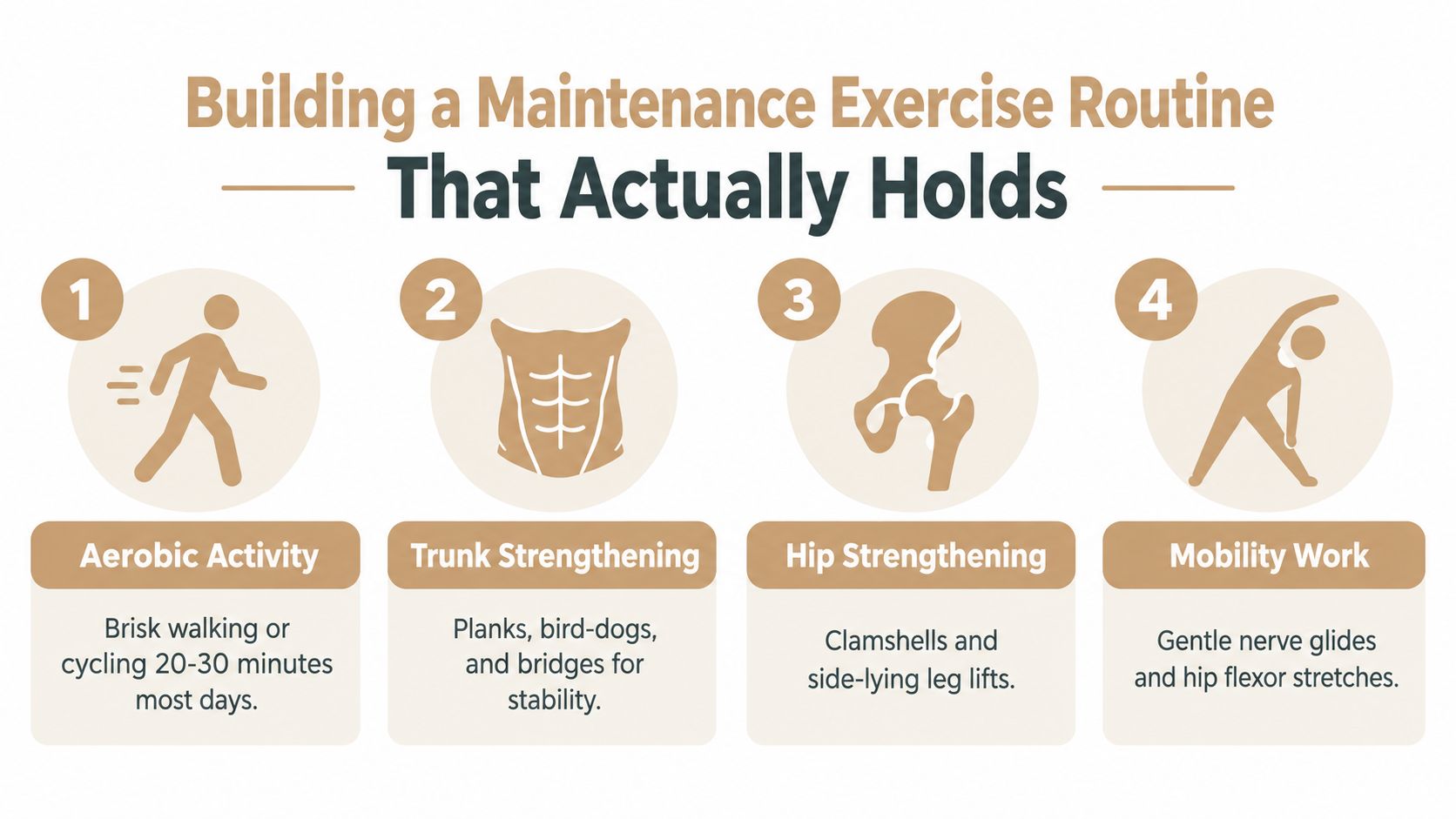
Stretching feels productive, so it's often the only thing people keep doing. That's rarely enough. A maintenance routine that lowers recurrence risk is broader. It should include aerobic activity, trunk endurance, hip strength, mobility, and graded return to normal tasks.
NICE's evidence and recommendations support exercise approaches that can include aerobic activity, movement instruction, muscle strengthening, and postural control, with selection based on the person's needs and capacities (NICE evidence on non-invasive treatments). That matches what tends to hold up clinically. The routine doesn't need to be fancy. It needs to be repeatable.
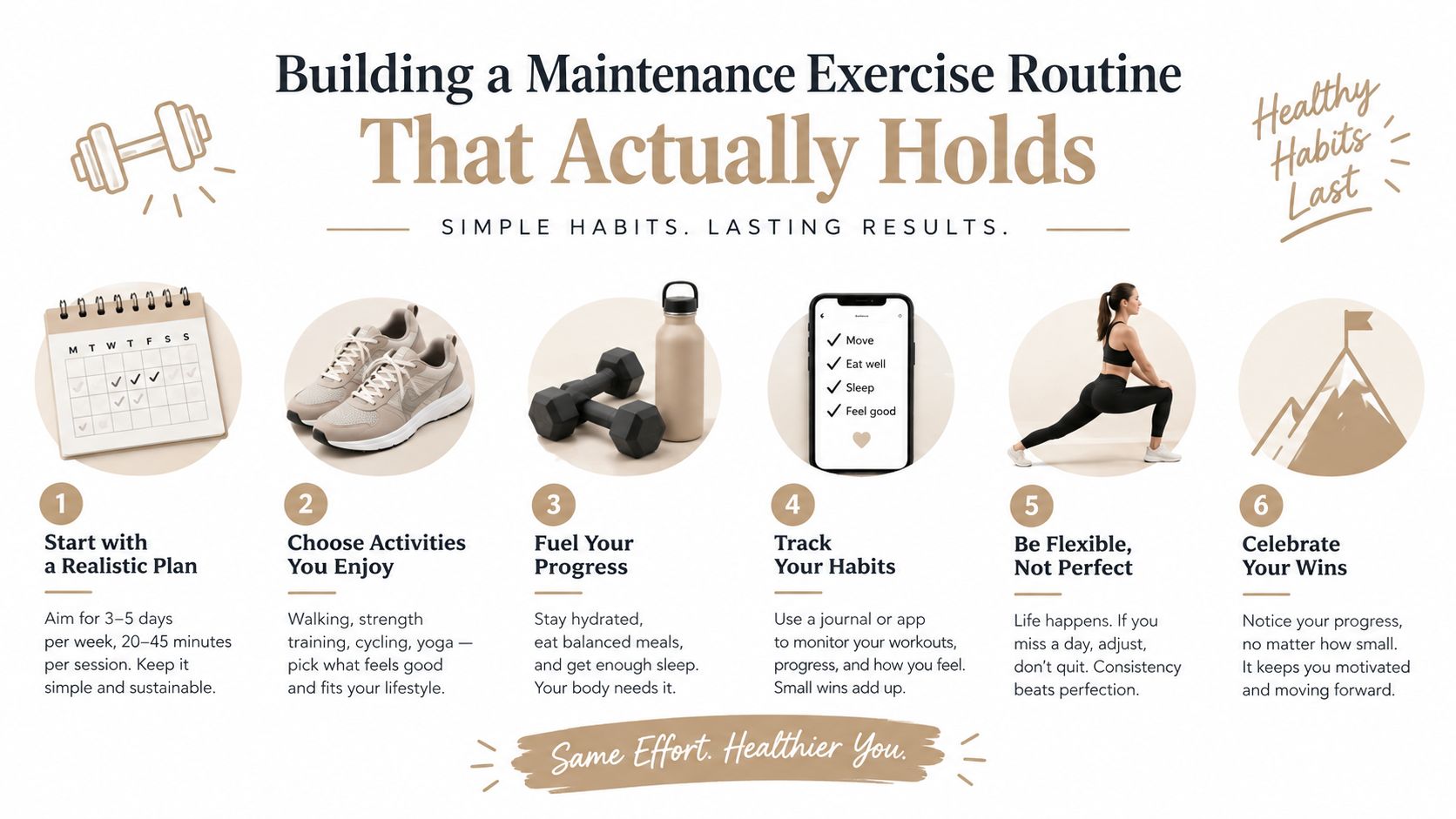
A practical base usually has four parts:
Aerobic work
Brisk walking, cycling, or another tolerable option done regularly. Evidence from prospective cohorts found that high leisure-time physical activity, at least four times weekly, was associated with a modestly lower risk of new lumbar radicular pain or sciatica, with a risk ratio of 0.88 and 95% confidence interval 0.78 to 0.99. Activity only once weekly was not associated with lower risk, with a pooled risk ratio of 0.99 and 95% confidence interval 0.86 to 1.13 (systematic review on physical activity and sciatica risk).
Trunk control
Think bird-dogs, dead-bug variations, bridges, side planks, or other tolerable anti-rotation and anti-extension work. The target is endurance and control, not max effort.
Hip strengthening
Glute-focused work matters because weak or poorly conditioned hips often shift more demand to the low back during walking, lifting, and stairs.
Mobility and graded function
Mobility is useful when it improves tolerance, not when it becomes an aggressive stretching contest. Add controlled bending, sit-to-stand work, step-ups, carries, or lifting drills as symptoms allow.
Start with two or three exercises you can perform without spreading symptoms farther down the leg. Attach them to routines you already keep, such as after a walk or before a shower. Progress one variable at a time. That might mean a few more reps, a little more resistance, longer walking time, or greater task complexity, but not all at once.
Use a 24-hour response rule. If the session causes only mild soreness and function is the same or better the next day, the dose was probably appropriate. If symptoms travel farther down the leg or walking tolerance drops the next day, reduce the load and rebuild.
A good maintenance program is one you can still imagine doing in five years, not one you tolerate for ten days.
If you need help organizing progression, a simple tool like an AI-personalized training schedule can make consistency easier, as long as you still adjust for symptom response. And if you want movement ideas that fit day-to-day function better than generic stretching, this guide to functional mobility exercises is a practical place to start.
A workday can leave your leg tingling even when no single movement feels dramatic. Hours in one chair, repeated bending while tired, awkward carrying, or a sleep position that irritates your back can keep the nerve sensitive. The practical target is less total time in positions and loads that repeatedly increase symptoms, with enough variation to keep ordinary activity tolerable.
Current guidance for lumbar radiculopathy supports staying active and returning to work or study as soon as symptoms allow. Temporary activity changes make sense when exertion causes symptoms to spread farther down the leg (NHS Lothian lumbar radiculopathy guidance). Posture matters as a source of tolerance, not as a position you must hold perfectly all day.
Use these priorities to decide where to spend effort:
| Habit | Evidence Strength | Ease of Adoption |
|---|---|---|
| Breaking up prolonged sitting with brief movement | Strong clinical guidance | High |
| Gradual return to lifting instead of abrupt heavy loading | Strong clinical reasoning | Moderate |
| Continuing normal walking within tolerance | Strong clinical guidance | High |
| Adjusting sleep setup to reduce repeated overnight irritation | Moderate practical support | Moderate |
Change the duration of a provoking position before chasing an ideal spinal shape. A posture that feels comfortable for a while may still become irritating if held too long.
If desk sitting provokes symptoms, lumbar support may make work more comfortable, but it does not replace movement breaks. This guide to an office chair lumbar support cushion explains the purpose of that support. For another workday-focused option, see this overview of a lumbar pad for office chair.
During a flare, reduce the provoking duration or load while keeping comfortable movement in your day. If symptoms repeatedly travel farther down the leg, function declines, or self-management stops helping, seek conservative clinical assessment for exercise modification and other non-surgical options. Escalate urgently for new bowel or bladder changes, saddle numbness, or worsening weakness.
The first warning sign is where prevention becomes practical. Many people either stop everything or keep pushing through the same load that set off the flare. Both choices can prolong the episode. A better response separates a manageable flare from progressive nerve compromise.
A manageable flare usually means the symptoms are louder, but stable. You may notice more back or leg discomfort, more tightness, or less tolerance for sitting and walking, yet strength is not clearly dropping and the symptoms ease when the provoking load is reduced. Progressive compromise looks different. It includes worsening weakness, new bowel or bladder dysfunction, or saddle-area numbness, which need urgent medical evaluation rather than routine self-management. For a clear red-flag reference, see the red-flag guidance for lumbar radiculopathy.
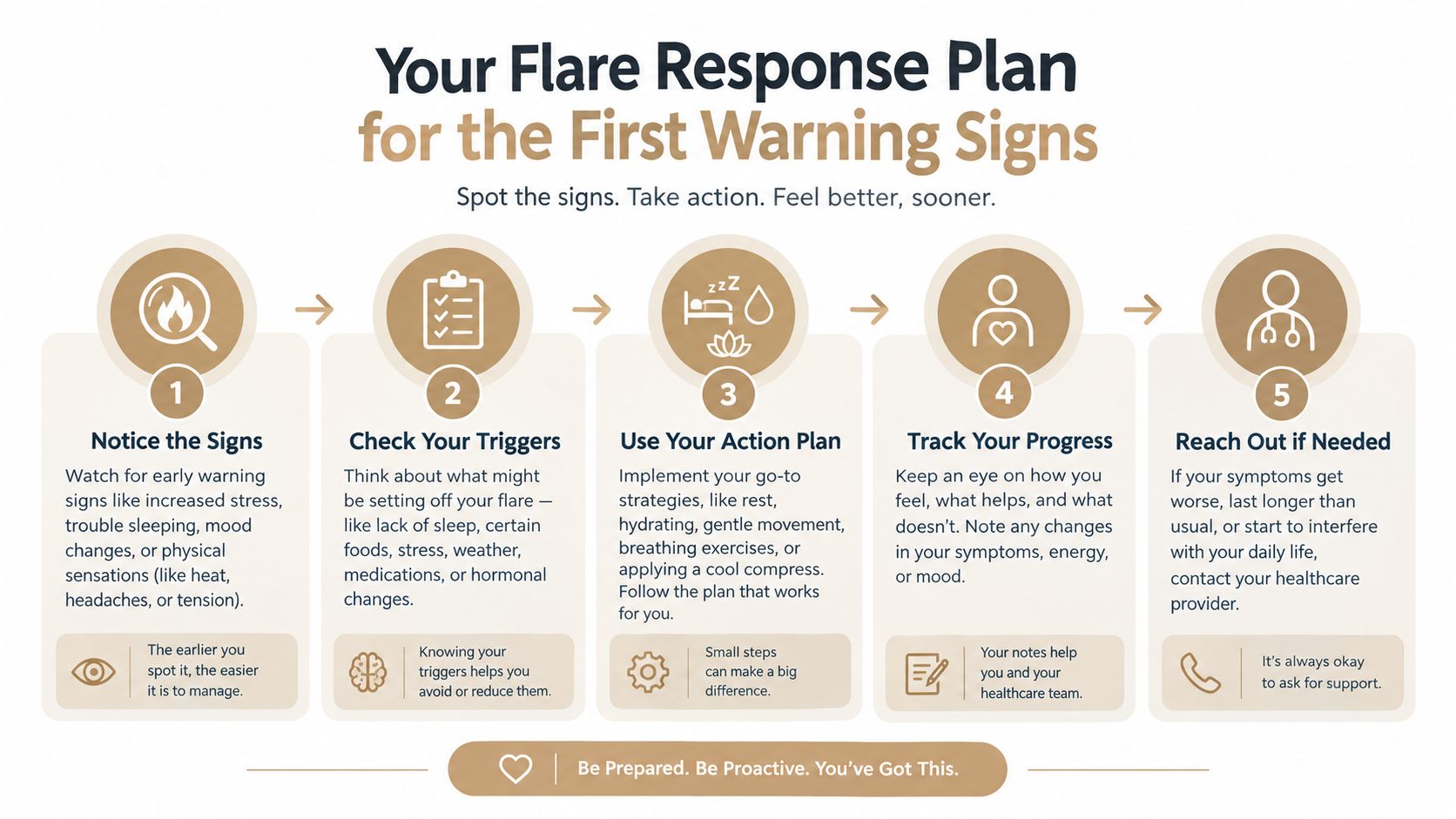
Keep the response simple and repeatable:
Use the next day as the test. If exercise leaves local muscle soreness but leg symptoms are no worse, and function is stable or better the next day, the dose was probably acceptable. If symptoms spread farther down the leg, become more electric, or leave you weaker or less able to walk the next day, the load was too aggressive.
Warning sign: Radiating symptoms moving farther down the leg matter more than ordinary muscle soreness.
For many people, the safest short-term move is to cut the provoking dose by roughly half, then hold that reduced level until symptoms settle for a few days. After that, progress one variable at a time, either time, load, or range, not all three at once. If the flare keeps spreading, or if the pattern starts to resemble the red flags above, stop trying to manage it alone and get assessed.
Self-management still follows the same rule here. Start with the amount you can tolerate, hold it until the flare calms, then rebuild gradually. Recurrence is common, but it can usually be shortened when the response is early, specific, and honest about the point where conservative care should take over.
Self-management is the foundation, but it's not always sufficient by itself. If you've had repeated episodes, a physically demanding job, a known disc-related pattern, post-accident symptoms, or persistent motion loss that keeps triggering setbacks, structured conservative care can be useful. The key is knowing what each option is for, and what it isn't for.

Different tools fit different clinical pictures:
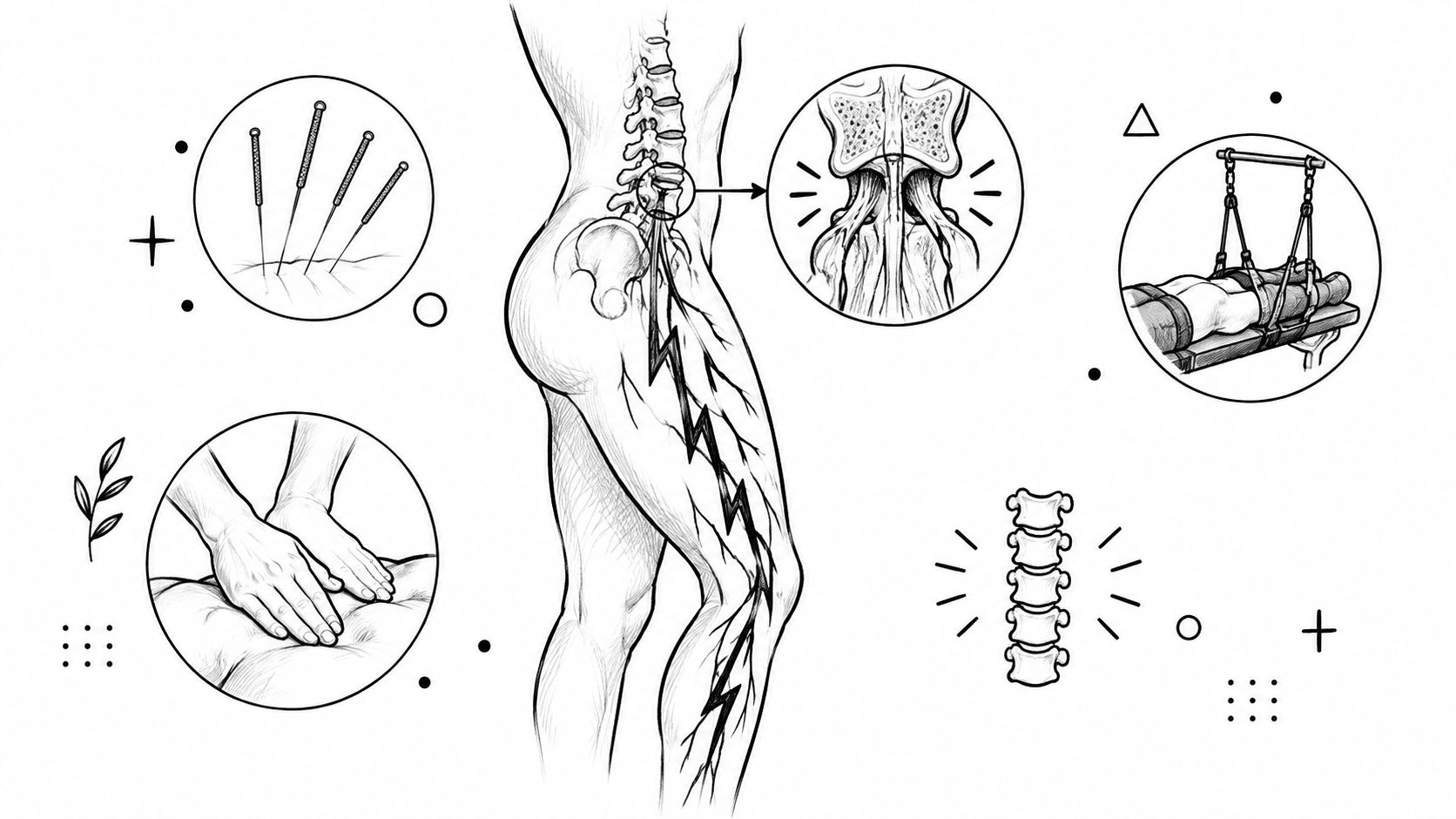
Passive care should support activity, not replace it. The stronger model is integrated. A clinic may combine Sciatica Treatment, Chiropractic Care, decompression, pain relief strategies, mobility work, and a written home program so the gains don't disappear between visits.
At Aspen Falls Wellness, that kind of coordinated conservative approach can include clinical assessment, chiropractic adjustment, Spinal Decompression with the DRX 9000, SoftWave Therapy, MLS Laser Therapy, massage therapy, acupuncture, mobility therapy, rehabilitation exercise, nutrition counseling, and take-home exercise planning when those fit the diagnosis and symptom pattern. That's most useful when recurrence keeps happening and the goal is to connect symptom relief to a maintainable plan, not just another short burst of passive treatment.
The best prevention plan is the one that still fits your life after motivation fades. That usually means a weekly rhythm, not a perfect routine. People generally do better with regular walking or other aerobic work several days a week, two or three short strength sessions for trunk and hips, brief mobility work attached to daily routines, and a written flare plan kept somewhere obvious.
A simple checklist helps. Track:
If a flare shows up, don't abandon the whole plan. Scale back to the last clearly tolerated dose, keep moving within tolerance, and watch for neurological change. If repeated setbacks keep interrupting work, sleep, lifting, sport, or travel, that's a reasonable point to get reassessed rather than recycling the same home strategy again.
The long game is steadier than many expect. Over months, not days, you want better tolerance for sitting, walking, lifting, and ordinary life. Recurrence is still possible. Responding early is part of prevention, not proof that prevention failed.
If sciatica keeps cycling back, Aspen Falls Wellness offers conservative care that connects the pieces, including chiropractic adjustment, non-surgical spinal decompression with the DRX 9000, SoftWave Therapy, MLS Laser Therapy, massage therapy, acupuncture, mobility therapy, rehabilitation exercise, and personalized exercise planning. If you want help turning symptom relief into a plan you can maintain, visit Aspen Falls Wellness and schedule an evaluation that matches the way your symptoms behave in real life.

Stay updated with the latest chiropractic news and exclusive offers.