Understand muscle pain during massage, what's normal, what isn't, and how to tell the difference. Practical tips from a Salt Lake City wellness clinic.
You're face-down on the massage table when the therapist reaches your upper trapezius. A tender spot catches under the hand, your breath pauses, and you wonder whether the pressure is releasing tension or creating a new injury. That moment is common, but muscle pain during massage isn't a sensation you should automatically push through.
The useful question isn't “Does massage hurt?” It's, “What kind of pain is this, how is your body responding, and what happens afterward?” By the end, you'll be able to judge whether your discomfort is expected, recognize how a therapist should adjust pressure, and know when soreness deserves a clinical assessment.
You arrive with shoulders that have been tense since morning. As the therapist presses near your neck, the spot feels tender and your muscles briefly tighten. That sensation can reflect pressure on tissue already working hard, rather than proof that the session is causing an injury.
Muscles around the neck, shoulders, hips, and lower back may remain partly contracted after long sitting, repeated movement, or guarding a painful joint. Contact with those areas stimulates sensory nerve endings in muscle and connective tissue. Your nervous system converts that input into pressure, tenderness, or an ache, much like a volume control turning up signals from a sensitive region.
Pain during massage is a signal to read, not a test to pass. Pressure and movement activate receptors that detect mechanical change and potentially threatening stimuli. Massage pressure can also activate type III and IV muscle afferent nerves and affect pain-modulation pathways. That helps explain why the same pressure may feel intense during treatment yet change how pain feels afterward (peer-reviewed review in NIH-hosted literature).
The response matters more than the label “deep tissue.” A tolerable ache that softens while pressure is held may indicate that a guarded muscle is accepting the load. A sharp sensation that travels into an arm, especially with tingling, calls for stopping and reassessment. More pressure is not automatically a better treatment.
Practical rule: Therapeutic discomfort should remain discussable and adjustable. You never have to prove that you can tolerate pain.
A coordinated chiropractic, massage, laser, and decompression team can use your symptoms to guide the next choice, whether that means changing pressure, selecting another technique, or arranging clinical evaluation. During the session, the therapist should notice your breathing, muscle response, and feedback. Speak up before manageable tenderness becomes protective tightening.
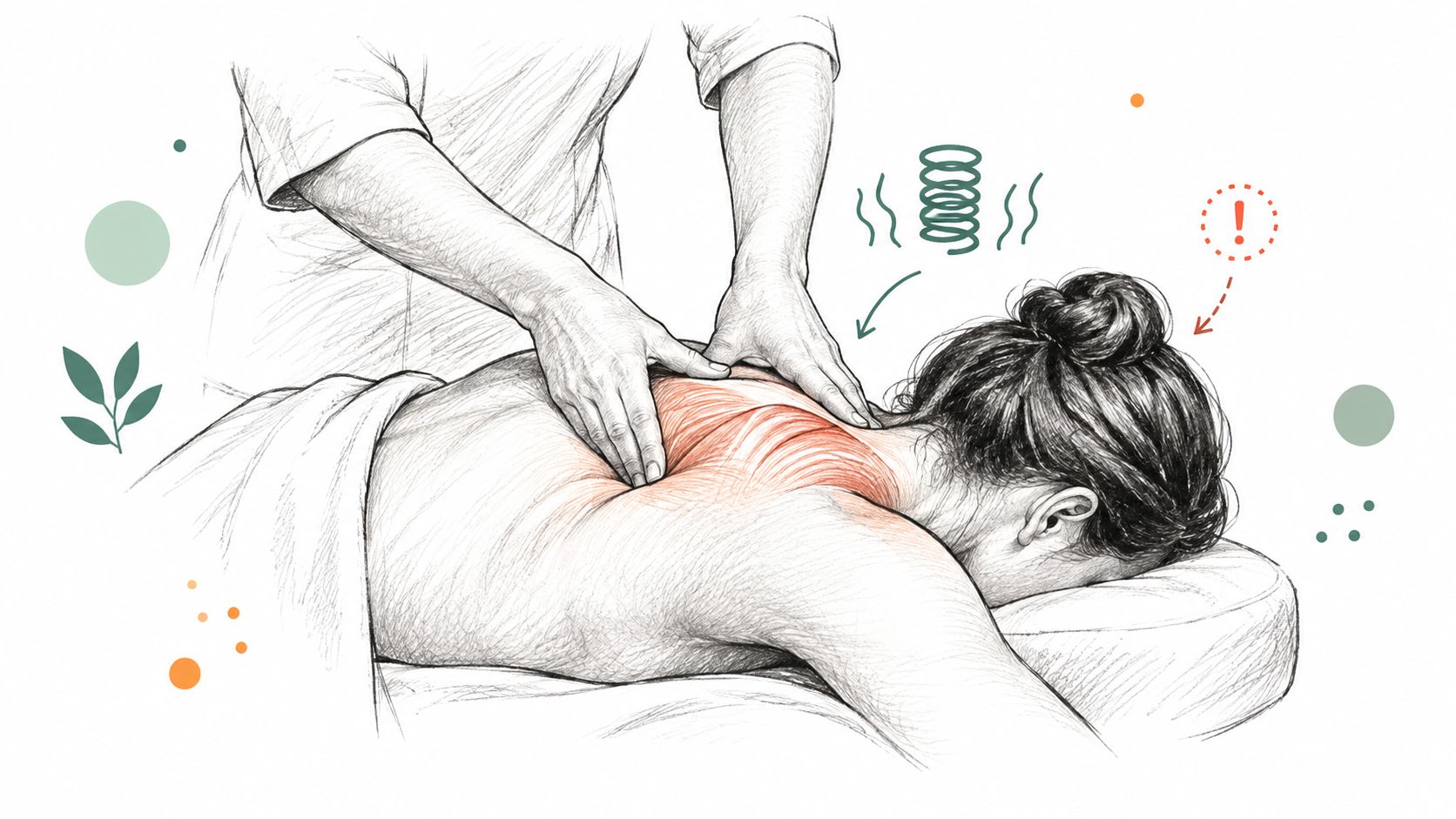
A tense muscle behaves somewhat like a coiled spring. Sustained pressure compresses part of that spring, while release allows the tissue to move with less resistance. This comparison explains why massage can feel active, although it does not mean that fluid is being flushed from the body.
Pressure temporarily changes the shape and tension of muscle fibers and fascia. If an area is already irritated or tightly contracted, that mechanical input may produce a localized inflammatory response. The body then begins its usual repair and remodeling process. The Cleveland Clinic explanation of post-massage soreness notes that working on spasms or altered muscle tissue can cause soreness resembling exercise-related soreness, and that tissue manipulation may briefly increase inflammation.
Timing offers a useful way to interpret the response:
Massage research after strenuous exercise often examines soreness over the following 24 to 72 hours. Results vary, so this window describes a pattern researchers study, not a promise that every person will respond the same way. Serious problems are uncommon, but increasing tenderness should not be treated as proof that the treatment is working.
Use ordinary movement and avoid responding to next-day soreness with another aggressive session. A therapist can modify the approach, while a coordinated chiropractic, massage, laser, and decompression team can help determine whether the response fits a muscle-related pattern or needs clinical review. For more context on sustained pressure applied to restricted tissue, read this guide to myofascial release therapy.
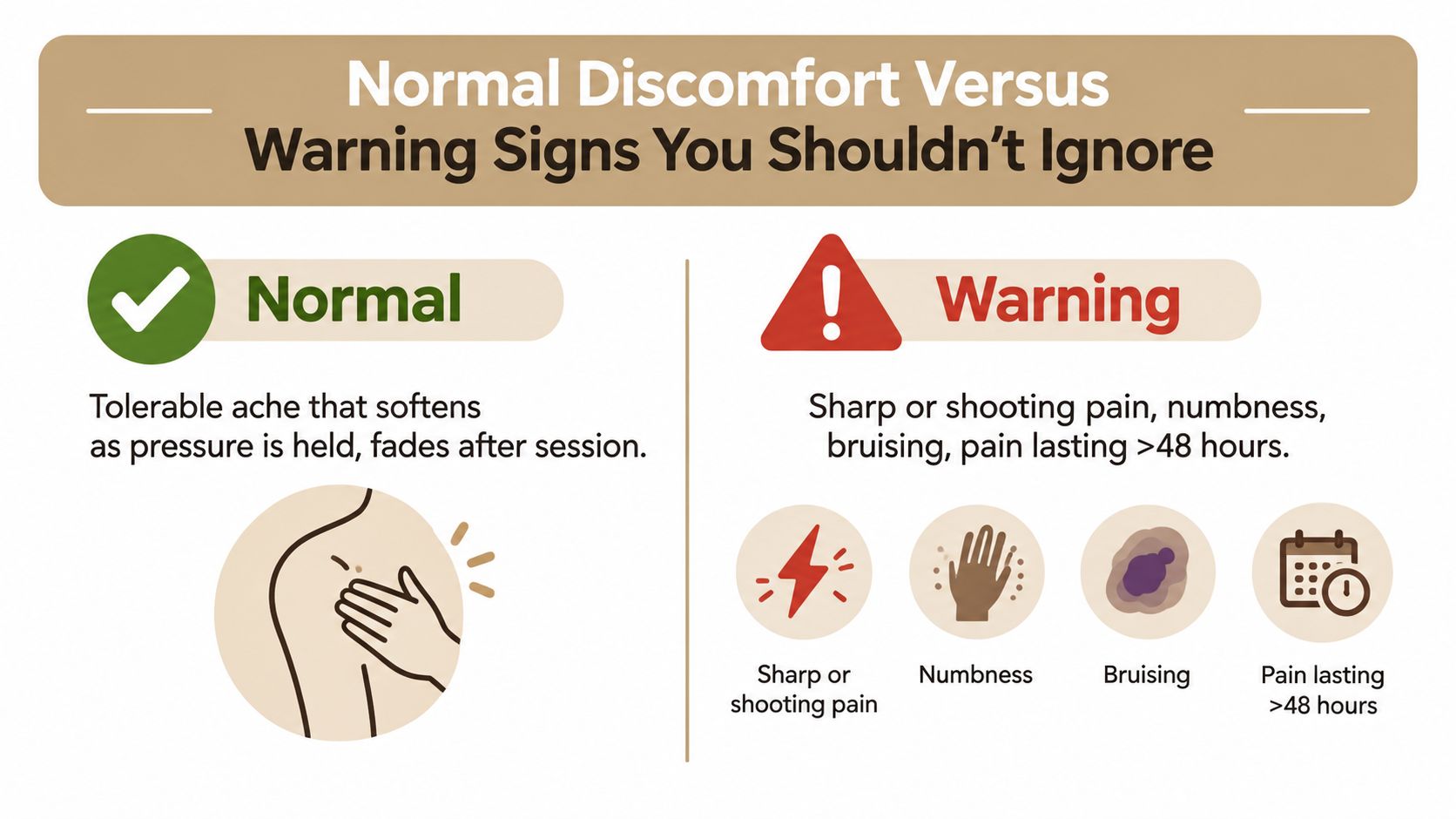
A massage can feel intense without being unsafe. Normal discomfort is usually local, tolerable, and changeable. You might notice a dull ache, firm pressure, or stretching across a tight muscle. As the therapist pauses or adjusts contact, the sensation should soften. You should still be able to breathe normally, relax the rest of your body, and speak up.
Mild soreness afterward can also occur. Healthdirect describes massage as generally safe while recognizing that minor pain or soreness may happen during or after a session (Healthdirect guidance on massage therapy). Ordinary tenderness should gradually settle and should not substantially limit normal movement.
A useful question is, “What direction is this symptom taking?” A tolerable ache that eases with less pressure is different from pain that becomes sharper or spreads.
Tell the therapist to stop or change technique if you notice:
The pattern matters more than the label. Expected soreness tends to ease during treatment or recovery. Warning symptoms sharpen, spread, affect strength or movement, or remain troublesome beyond the expected window. Persistent bruising, marked swelling, or pain lasting beyond about 48 hours calls for reduced pressure, a different technique, or further evaluation. A coordinated chiropractic, massage, laser, and decompression team can help assess whether the response fits a muscle-related pattern and decide whether clinical review is appropriate.
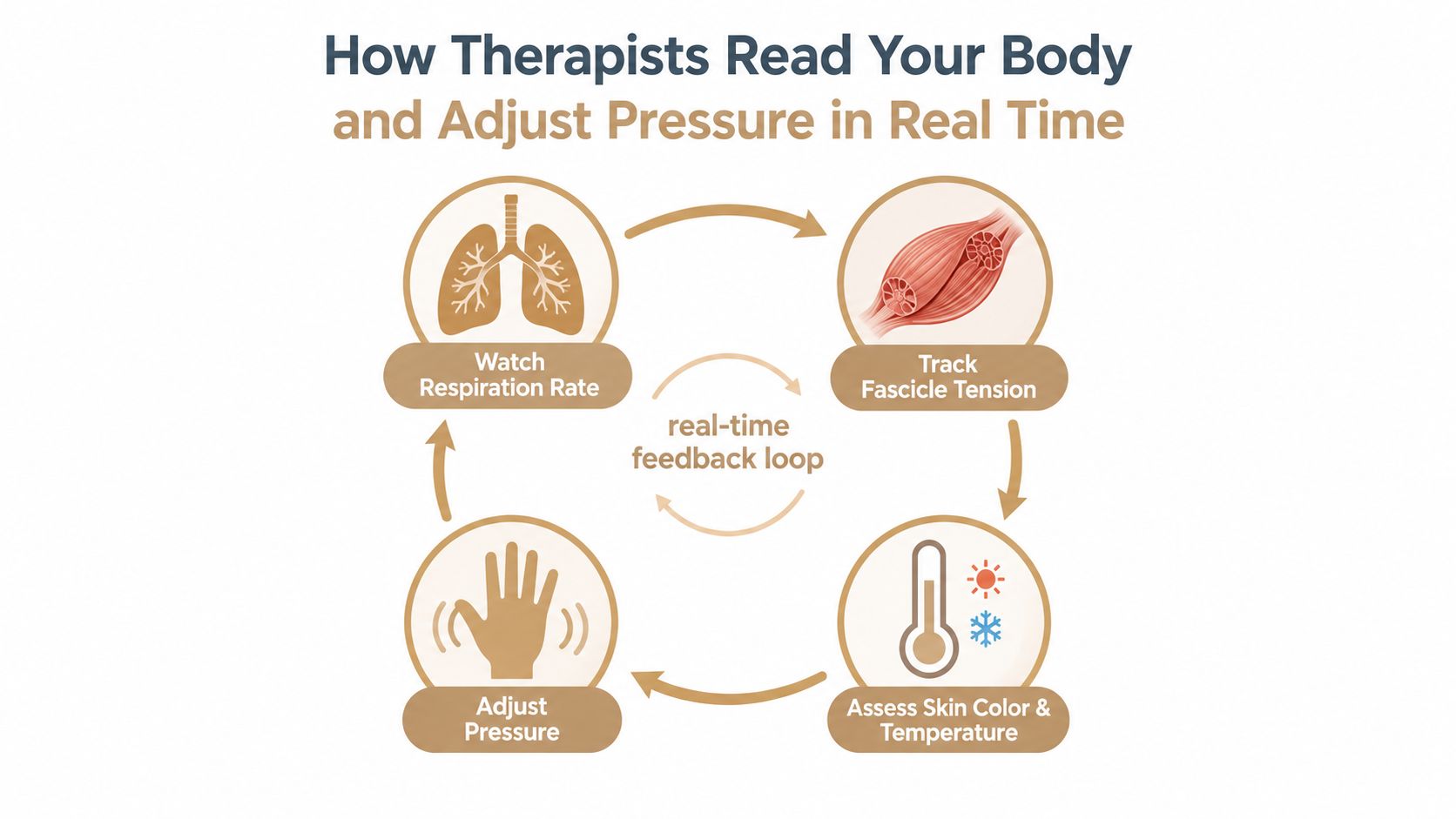
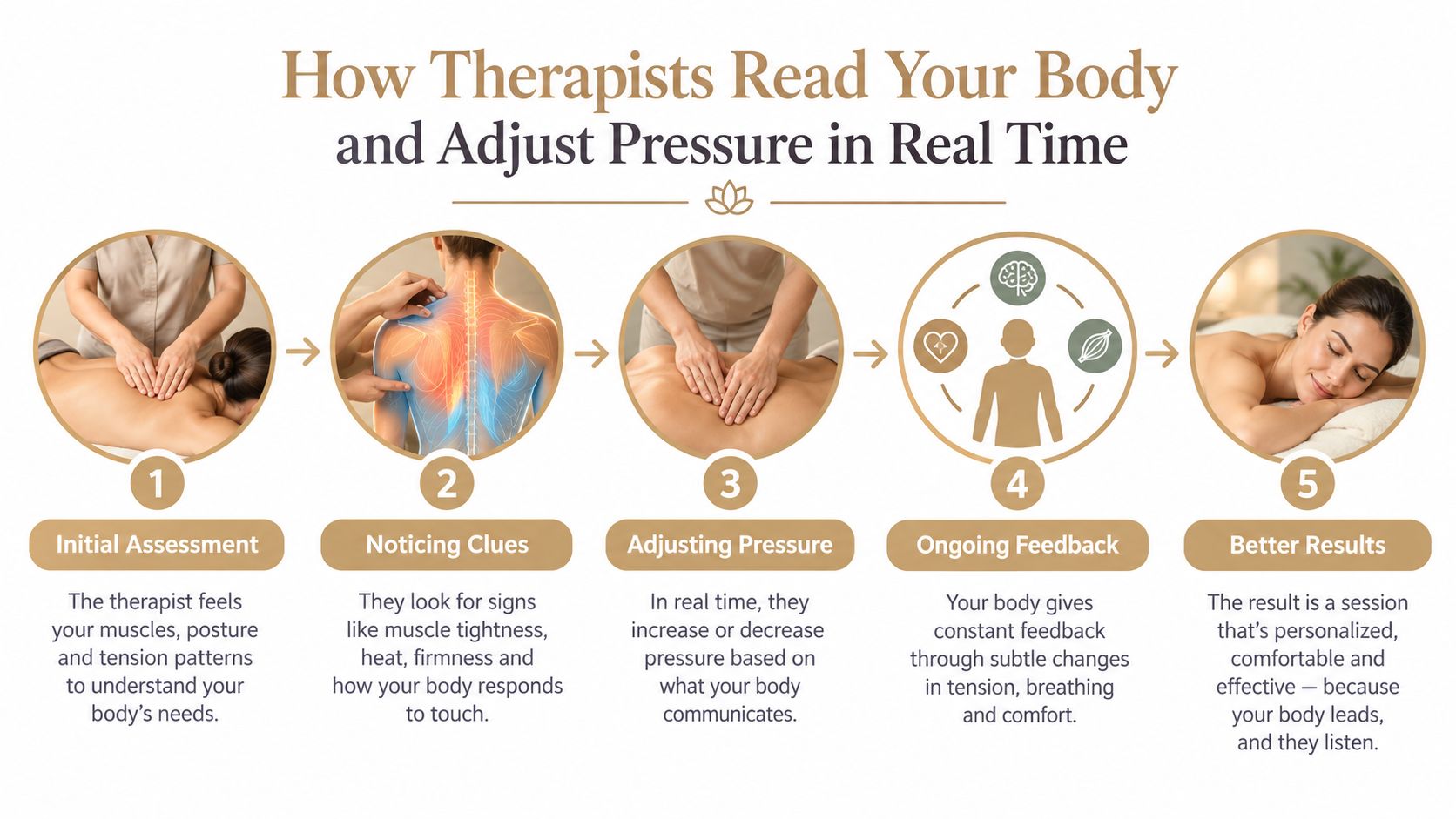
A skilled therapist doesn't select a pressure level and stay there regardless of your response. Treatment works as a feedback loop. Your breathing, facial expression, muscle tone, skin response, and words tell the therapist whether the tissue is accepting the technique or protecting itself.
Start with communication. You can rate discomfort on a 1-to-10 scale, but the number only helps when you describe the quality too. “Six, dull and manageable” gives different information from “six, sharp and traveling.” A hand raise or agreed signal also helps if speaking feels difficult while you're face-down.
The therapist may notice that your breathing becomes shallow, your shoulder lifts, or the muscle tightens beneath the hand. Those signs suggest guarding. They may broaden the contact, slow the stroke, reduce pressure, change your position, or work around the area before returning to it.
Other useful observations include:
Technique should match the response. Myofascial work may use slower, broader contact. Trigger-point compression may be brief and carefully graded. Active release adds controlled movement, while cross-fiber work may be inappropriate when tissue is acutely irritated. Pacing matters as much as force, because an irritated muscle often responds better to gradual exposure than to a sudden increase in pressure.
A sore muscle after exercise usually behaves differently from tissue injured by a sudden pull. Nerve-related symptoms follow another pattern. Reading these differences helps you decide whether massage should be gentle, modified, or paused.
| Feature | Post-Exercise Soreness (DOMS) | Muscle Strain | Nerve or Inflammatory Pain |
|---|---|---|---|
| Quality | Achy, diffuse tenderness | More focal pain, often linked to a specific event | Burning, tingling, electric, or radiating discomfort |
| Timing | Develops after strenuous activity and may be most noticeable later | Often begins during or soon after overstretching or sudden load | May appear with certain positions, movements, or ongoing irritation |
| Location | Often spread through worked muscles | Usually localized to the affected area | May travel along an arm, leg, or other nerve pattern |
| Movement | General stiffness and reduced comfort | Possible weakness, guarded movement, or swelling | Symptoms may include altered sensation or weakness |
| Response to pressure | Light or moderate work may feel soothing | Deep pressure can aggravate injured tissue | More pressure may intensify symptoms rather than release them |
Consider a person who feels a widespread ache after an unfamiliar workout. That pattern fits delayed-onset muscle soreness, or DOMS, more closely than a strain. A strain is more likely when pain began with a specific lift, stretch, or sudden load and remains focused in one area. Burning, tingling, electric sensations, or pain traveling into an arm or leg can suggest nerve involvement or inflammation rather than a tight muscle.
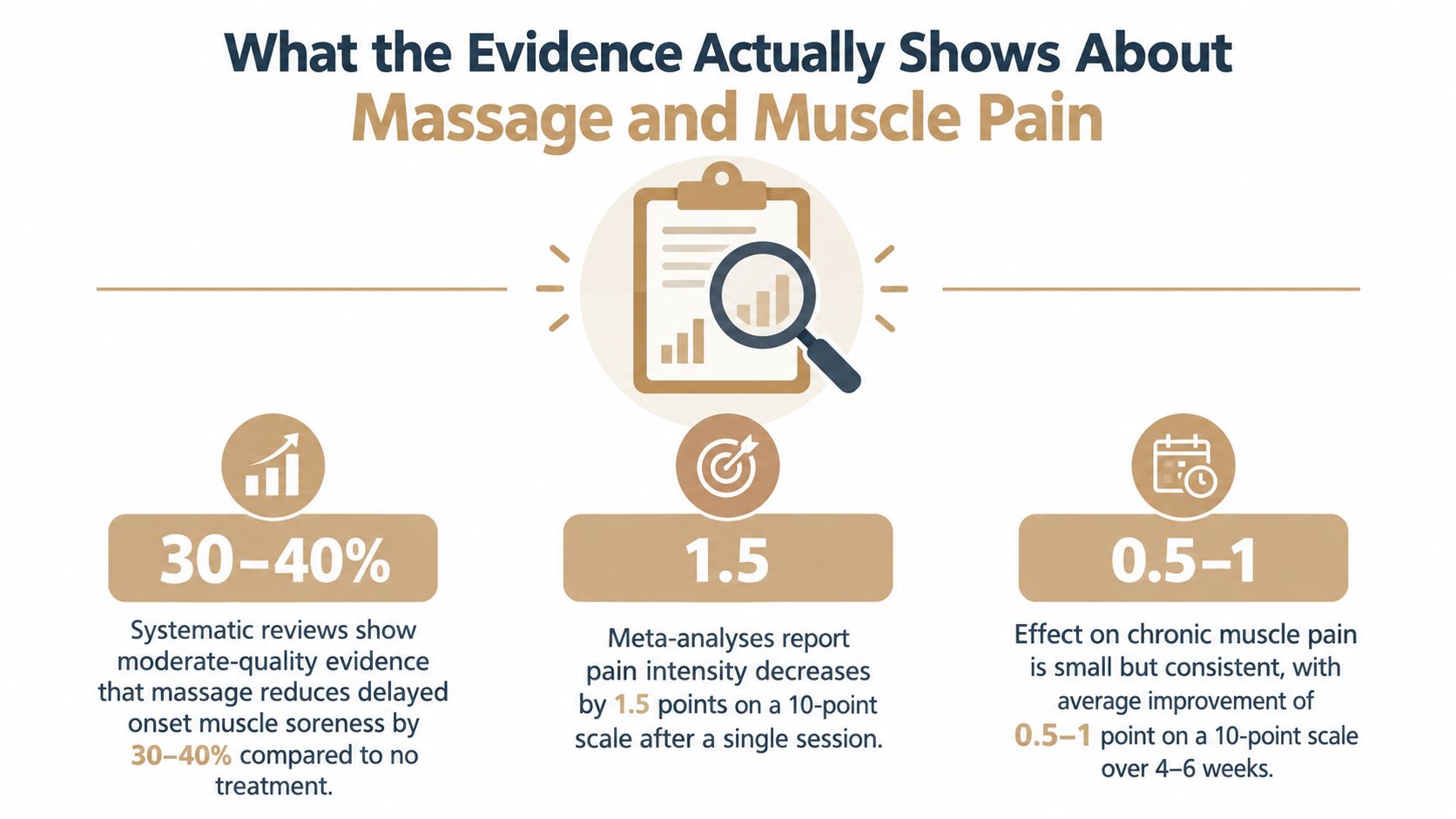
A 2017 systematic review and meta-analysis examined 23 data points from 504 participants and found that massage significantly reduced DOMS after strenuous exercise. The overall standardized mean difference was −1.16, with a 95% confidence interval of −1.60 to −0.72 and P < 0.001. The strongest effect appeared at 48 hours after exercise (systematic review and meta-analysis of massage for DOMS).
Those findings apply to post-exercise soreness, not every painful condition. If pain is sharply localized, or comes with swelling, weakness, tingling, or burning, do not increase pressure to test the tissue. Pause the massage and seek an assessment that can distinguish muscle, joint, disc, and nerve contributors. Pain is information to interpret, not a challenge to push through.
Massage has measurable value for some forms of muscle pain, but the evidence doesn't support treating it as a universal fix. The clearest signal concerns short-term soreness after strenuous exercise. In the DOMS review cited above, massage reduced soreness ratings compared with no intervention, especially around the later part of the short recovery window.
A separate randomized controlled trial published in 2008 studied experimental muscle pain. Deep massage reversed delayed-onset muscle pain during stretch by 48.4% and reduced mechanical hyperalgesia by 27.5%. The superficial-touch group also reduced hyperalgesia compared with control, and the authors concluded that massage could reduce myalgia symptoms by roughly 25% to 50%, depending on how pain was measured (randomized controlled trial of massage for experimental muscle pain).
Those findings help establish massage as a measurable intervention, but they don't prove that every painful session is productive. A more recent mapping review identified 129 systematic reviews on massage for pain, yet none reached high certainty, and only 7 were judged to provide moderate-certainty evidence (mapping review of massage evidence). Researchers also face practical limitations, including varied treatment methods, different pain conditions, small studies, and the difficulty of blinding people to hands-on care.
Massage is best understood as a supportive treatment that can reduce symptoms and improve movement, not as permission to ignore an injury.
For chronic or recurrent pain, results are more useful when massage is coordinated with assessment, mobility therapy, strengthening, acupuncture, nutrition counseling, or other appropriate care. Massage may reduce the protective tension around a problem, while exercise and clinical treatment address why that tension keeps returning.
A better session starts before the first touch. Your preparation and feedback give the therapist useful clues, while your choices afterward help prevent extra strain on tissue that has just been mobilized. Read discomfort as information, not a challenge to endure.
Drink fluids normally and take a short walk if comfortable. Note the exact movements that bring on symptoms. Tell the therapist whether the discomfort followed exercise, an accident, prolonged sitting, a new activity, or no clear event. Share any numbness, medication use, known medical conditions, recent injuries, or previous reactions to massage.
Bring a clear goal too. Relief from general tightness calls for a different approach than care around a recent strain or recurring pain. A coordinated team offering chiropractic care, massage, laser therapy, and decompression can use this history to decide whether massage fits the plan or whether another evaluation should come first.
Set up a communication system before treatment begins. Use a 1-to-10 discomfort scale, a hand signal, or direct phrases such as “less pressure,” “stay there,” or “stop.” Keep breathing steadily. Bracing against the therapist's hand can make a muscle more protective, so the same pressure may feel harsher.
Positioning changes the signal as well. A pillow under the knees, support beneath the ankles, or a different shoulder position can reduce unwanted tension and allow effective work with less force. The aim is a response the tissue can handle, not the maximum pressure you can tolerate.
During the next day or two, choose gentle walking and comfortable mobility instead of an intense workout or aggressive stretching. Warmth may soothe ordinary tightness. Worsening swelling, sharp pain, bruising, or altered sensation calls for a different response. Track whether symptoms improve, remain stable, or spread.
Some people include topical products in a broader relaxation routine. If you are considering magnesium oil for stress relief, review the product information and ask a healthcare professional about skin reactions or medical conditions. For local guidance on treatment planning, explore massage therapy in Salt Lake City.
Stop treating a warning signal as a request for deeper massage. Sharp or shooting pain, numbness, tingling, swelling, substantial bruising, increasing stiffness, weakness, or symptoms that spread beyond the treated muscle all justify a pause. Pain that becomes worse after 48 hours, or remains significant beyond about 72 hours, also deserves more than routine self-management.
A clinician can ask questions and perform an examination that a massage session isn't designed to replace. A chiropractic assessment may help identify joint restriction, movement compensation, or nerve involvement. If disc-related irritation contributes to muscle guarding or radiating symptoms, spinal decompression with the DRX 9000 may be considered when clinically appropriate. MLS Laser Therapy or SoftWave Therapy may be used as part of a plan for tissue stimulation and pain relief, while acupuncture, mobility therapy, rehabilitation exercise, and personalized exercise plans address other contributors.
That doesn't mean every sore muscle needs imaging or a complex treatment plan. It means the response should match the signal. A coordinated team can compare the massage therapist's observations with the clinician's findings and decide whether to modify pressure, change timing, add a Chiropractic Adjustment or Realignment approach, begin Muscle Stimulation, or refer you elsewhere.
For pain following a collision, neck symptoms should be assessed rather than repeatedly compressed. Guidance on massage therapy for whiplash can help explain why post-accident symptoms need a more careful plan.
If soreness lasts beyond 72 hours, follows a specific nerve path, or comes with weakness, numbness, or sleep loss, stop self-managing and schedule an assessment.
Aspen Falls Wellness offers coordinated Chiropractic Care, Massage Therapy, Spinal Decompression with the DRX 9000, MLS Laser Therapy, SoftWave Therapy, Acupuncture, Mobility Therapy, Rehabilitation Exercise, Nutrition and Nutrition Counseling, and Car Accident Treatment. If muscle pain during massage keeps returning or includes warning signs, visit Aspen Falls Wellness to discuss an individualized evaluation and pain-relief plan.

Stay updated with the latest chiropractic news and exclusive offers.