Compare each neck pain relief device by evidence and safety, from home traction and TENS to clinic laser and decompression.
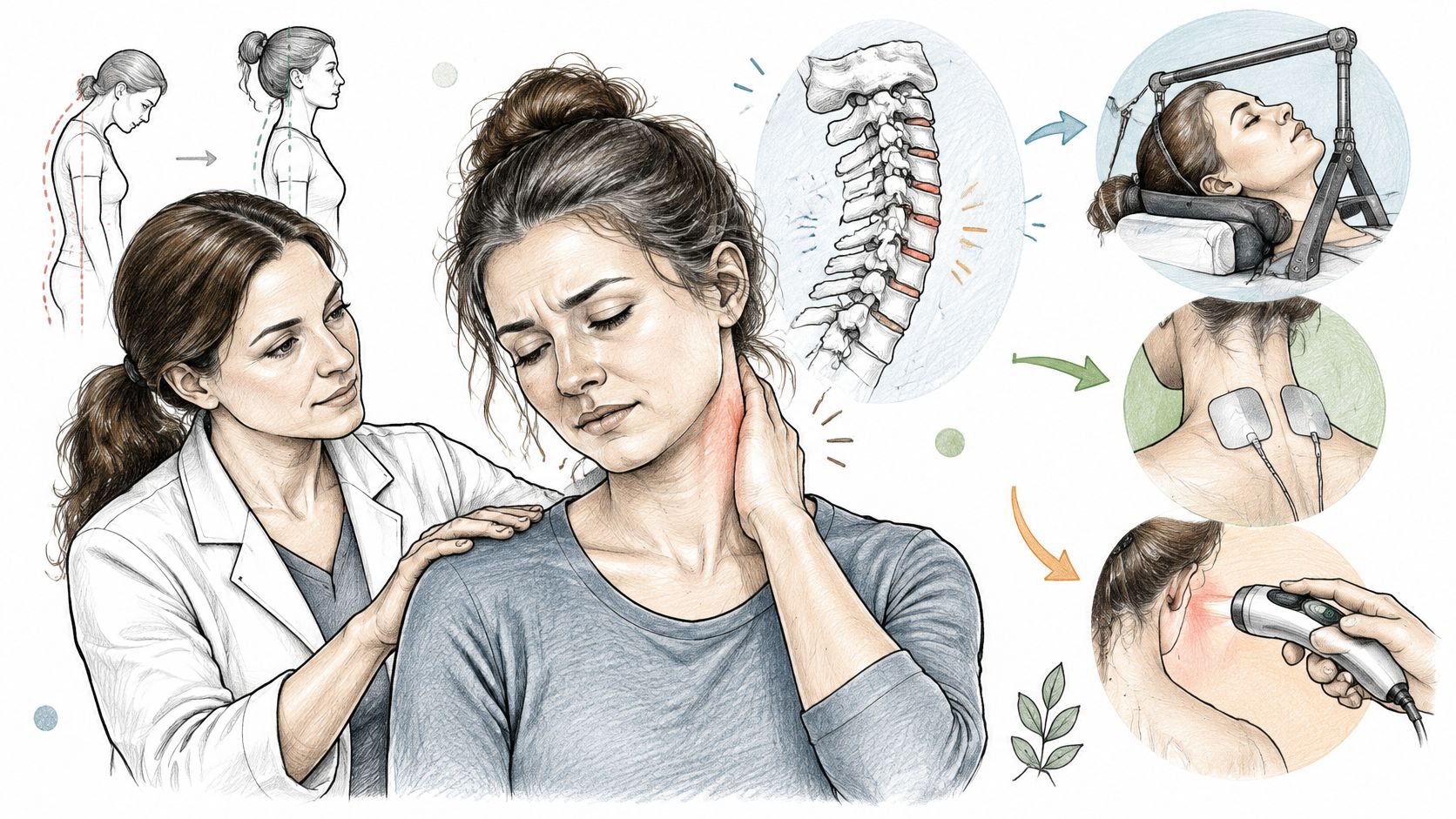
The most popular advice about a neck pain relief device is also the least reliable: find one that feels good and use it more. Feeling relief during a session doesn't tell you whether the device fits your diagnosis, whether it's safe to use alone, or whether it changes function after you turn it off. A stiff, muscular neck, a headache driven by neck joints, and pain shooting into an arm are different problems. They need different tools, and sometimes they need an exam before any tool at all.
Many shoppers buy by product name. That's the buying mistake. A neck pain relief device only makes sense when its job matches the source of pain, and the setting matters because clinic devices come with screening, measured settings, and someone watching your response.
Neck pain is common enough to support a crowded market, but that scale doesn't prove any gadget works. Earlier epidemiological reviews estimated mean point prevalence at approximately 7.6% to 14.4%, while a more recent Global Burden of Disease estimate placed global age-standardized point prevalence at roughly 3.5%, according to a review of neck pain prevalence and electrotherapy evidence. The figures differ because definitions, populations, and time periods differ. Judge a device by pain intensity, function, mobility, and quality of life, not by how many people might buy it.
| Device | Setting | What it attempts | Evidence limit | Best fit |
|---|---|---|---|---|
| Home cervical traction | Home | Temporary longitudinal pull on the neck | Very little quality research; insufficient to prove home efficacy or safety | Only if a clinician has already screened the diagnosis |
| Clinic mechanical traction | Clinic | Measured intermittent or continuous force and angle | Short-term pain scores can fall; function gains are less consistent | Arm symptoms after a neuro exam |
| TENS unit | Home or clinic | Low-voltage pulses through skin electrodes | Neck trials very low certainty; broader pain evidence should not be copied over | Brief symptom add-on, not a standalone plan |
| Low-level or MLS laser | Clinic | Light energy aimed at pain and inflammation | Pain and some motion improve; disability often does not | Inflammatory or activity-related neck pain |
| SoftWave or shockwave | Clinic | Acoustic pulses to stimulate irritated soft tissue | Used for chronic soft-tissue pain; not a neck-structure correction | Tendon, muscle, or ligament irritation |
| DRX9000 decompression | Clinic | Computer-controlled nonsurgical unloading | Fits guideline use of mechanical traction for radiating pain, not nonspecific ache | Disc-related neck and arm pain after screening |
| Wearable red light or posture holder | Home | Light exposure or a cue to hold better posture | 2025 pilots only; no proof of durable or superior results | Nonspecific pain while doing prescribed exercise |
Home cervical traction asks you to set your own pull without knowing whether traction fits your diagnosis. That's its main limit, not the price or the padding.
Clinic mechanical traction and DRX9000 decompression also pull, but a clinician chooses force, angle, and timing and can stop if arm symptoms worsen. They belong in a narrower group, mainly disc-related pain with arm symptoms, not every morning ache.
A TENS unit doesn't unload a disc or strengthen a weak neck. It's a skin-electrode adjunct for short-term comfort. Low-level or MLS laser targets pain sensitivity and inflammation in soft tissue, while SoftWave uses acoustic pulses for stubborn tendon and muscle pain. Neither rebuilds posture by itself.
Wearable red-light units and neck-mounted phone holders sit at the pilot end of the table. Treat them as behavior tools that may support exercise or ergonomic change, not as established cures.
Sleep position can undo daytime progress, so pairing device choice with pillow support for neck pain and headaches as a side sleeper often matters more than adding a second gadget. Keep the one Best fit row that matches your pattern. Ignore ads that promise one device for every neck.
Think of your neck as a stacked column. The discs are cushions between the blocks. The muscles are cables that hold the column upright and move it. The nerves are wiring that exits through small openings and travels into your shoulders and arms.
When a cushion bulges or an opening narrows, the wiring can get irritated. When the cables are overworked, the column feels stiff and sore even if the cushions are fine. Devices help, if they help at all, by changing load on the column or by changing signals from the tissue. Those are not the same job.
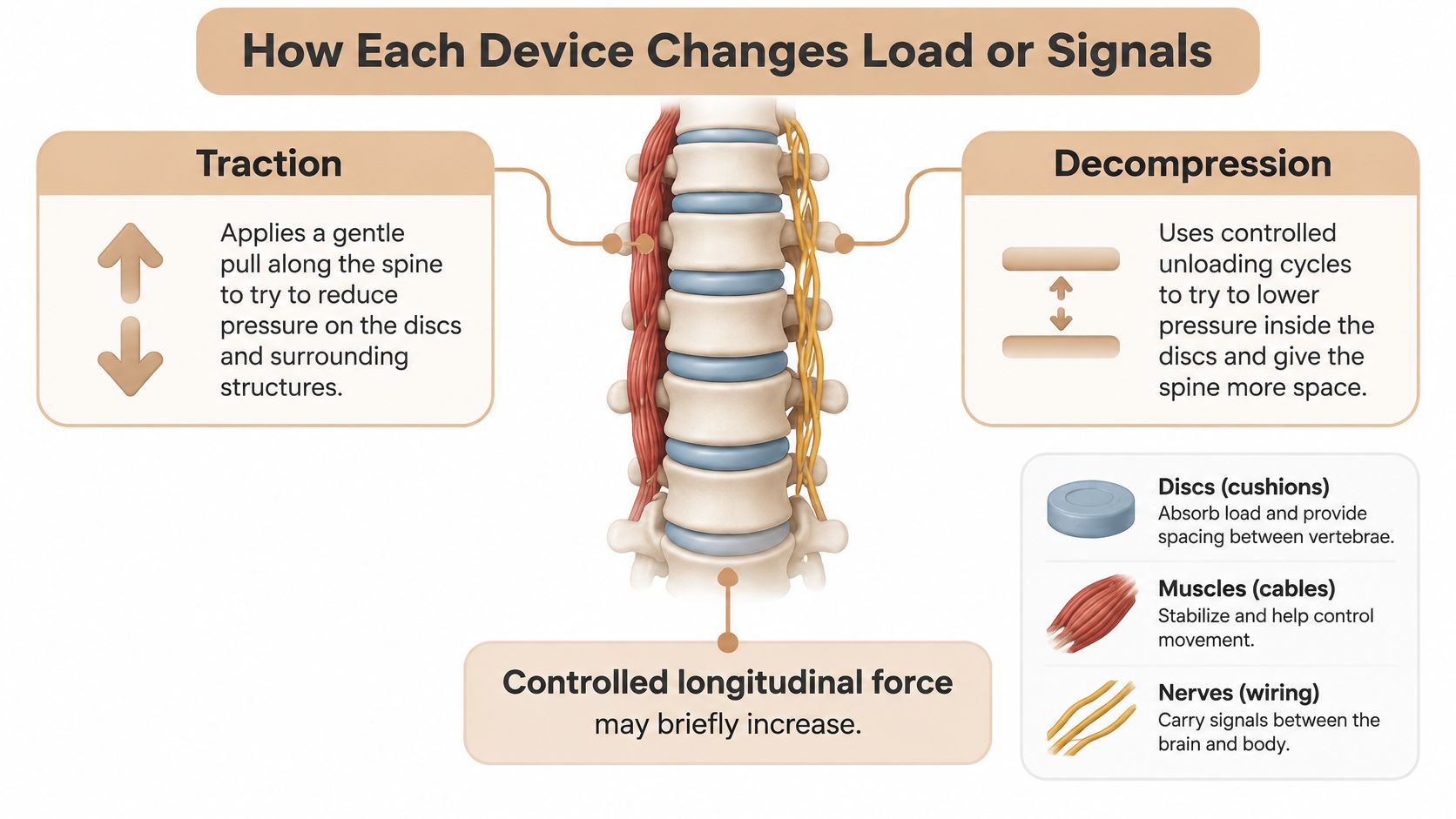
Traction and decompression try to unload the column with a controlled longitudinal pull. That force may temporarily increase intervertebral and foraminal space, reduce compressive loading, and decrease radicular symptoms in selected patients, as described in a clinical policy review of cervical traction devices for home use. The result depends on diagnosis, force, angle, intermittency, duration, and patient tolerance.
Temporary space isn't durable structural correction. A home unit doesn't remodel a disc, and a clinic session doesn't permanently widen an opening. What unloading can do is lower pressure long enough for irritated wiring to calm down while you rebuild strength and movement.
A TENS unit doesn't unload anything. Surface electrodes deliver low-voltage pulses meant to modulate pain signaling during use or shortly after, which is why relief can fade when the unit turns off. If you're considering one, read about safe placement and limits for TENS units at home before you stick electrodes near your neck.
MLS Laser Therapy deposits light energy linked with lower pain sensitivity and less inflammation. It's completely painless, and you'll typically feel a mild, soothing warmth during treatment.
SoftWave Therapy sends acoustic pulses into irritated soft tissue. Some people feel mild sensitivity described as a gentle pulsing or tapping, and any temporary discomfort typically subsides quickly after the session.
A plausible mechanism explains how a device might help. It isn't permission to use it unsupervised.
Wearable light and posture holders mostly change behavior. A holder that lifts your phone can reduce the minutes you spend looking down, but it doesn't strengthen the cables or unload a cushion. That distinction decides whether the tool is a useful cue or an expensive distraction.
Pain scores can improve while daily activities remain difficult. That difference matters when judging whether a neck pain device helps beyond the moment of use.
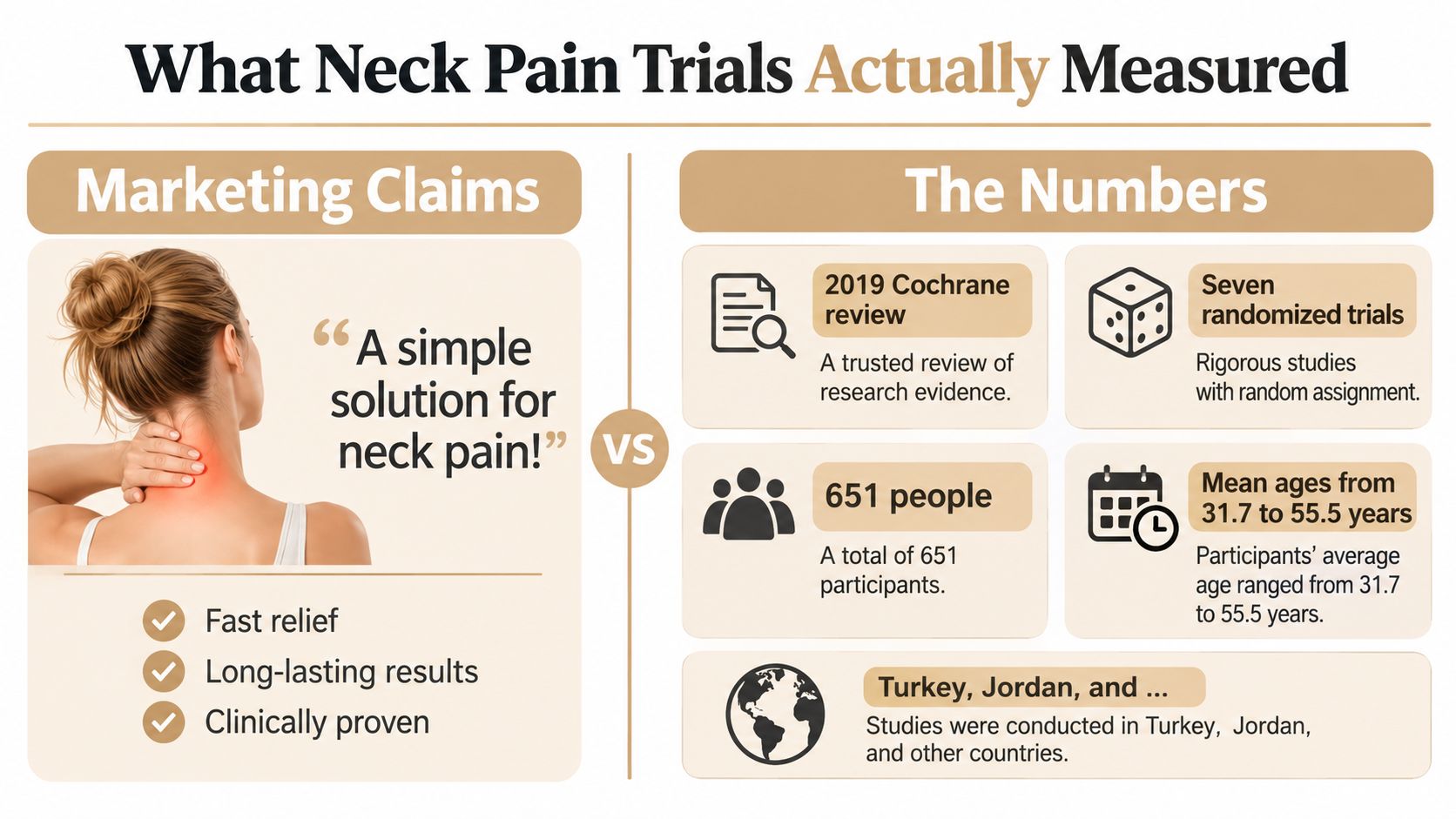
For chronic neck pain, the neck-specific evidence remains uncertain. The 2019 Cochrane review of TENS for chronic neck pain included seven randomized trials and 651 people. Conventional TENS versus sham at up to three months produced a pooled pain difference of -0.10, with a 95% confidence interval from -0.97 to 0.77.
In that same review, the relative risk of pain improvement was 1.57, with a 95% confidence interval from 0.84 to 2.92. Both intervals include results compatible with little or no benefit, so the certainty was rated very low.
Broader pain research asks a different question. A 2022 systematic review of TENS for acute and chronic pain found a standardized mean difference of -0.96 during or immediately after treatment, across 91 trials and 4,841 participants. Those results cover varied conditions and immediate outcomes, so they do not establish the effect of TENS specifically for chronic neck pain.
Laser research shows a clearer signal for pain reduction than for improved function. A 2009 meta-analysis of low-level laser therapy for neck pain covering 16 trials and 820 patients found a relative risk of 1.69 (1.22 to 2.33) for acute pain improvement and 4.05 (2.74 to 5.98) for chronic categorical improvement. In the same meta-analysis, pain intensity fell by 19.86 mm across 11 trials, and seven trials showed improvement lasting 1 to 22 weeks.
A later 2022 review of 13 trials and 556 patients found a pain mean difference of -1.29 (-2.36 to -0.23) and a higher pressure-pain threshold. Disability did not improve significantly, with a mean difference of -7.83 (-17.1 to 0.08). Less pain is useful, but it does not show that you can turn, lift, or work normally.
Track four things: pain intensity, Neck Disability Index score, daily function, and rescue medicine use. If scores do not change, reassess the plan.
Newer wearables need the same careful reading. A 2025 pilot study of a wearable 660-nanometer red-light device reported reduced chronic neck pain after two weeks and better sleep and mobility after four weeks, with no adverse symptoms reported. Because the study was small and self-controlled, it cannot establish long-term benefit or superiority over exercise.
A device can feel relieving and still be the wrong choice. Home traction has limited supporting evidence, and neck-specific TENS should not stand in for care matched to the cause of pain.
A major U.S. insurer's evidence review of home traction devices found very little published research on home cervical traction. It describes the available studies as uncontrolled and poor quality, with insufficient evidence to establish efficacy or safety. The review also notes that a physical-therapy guideline recommended against traction for nonspecific neck pain.
FDA documentation for one cervical traction device says treatment should occur with a doctor or therapist present. FDA clearance does not establish that a device works for every cause of neck pain. Clearance and clinical benefit for a particular diagnosis are separate questions.
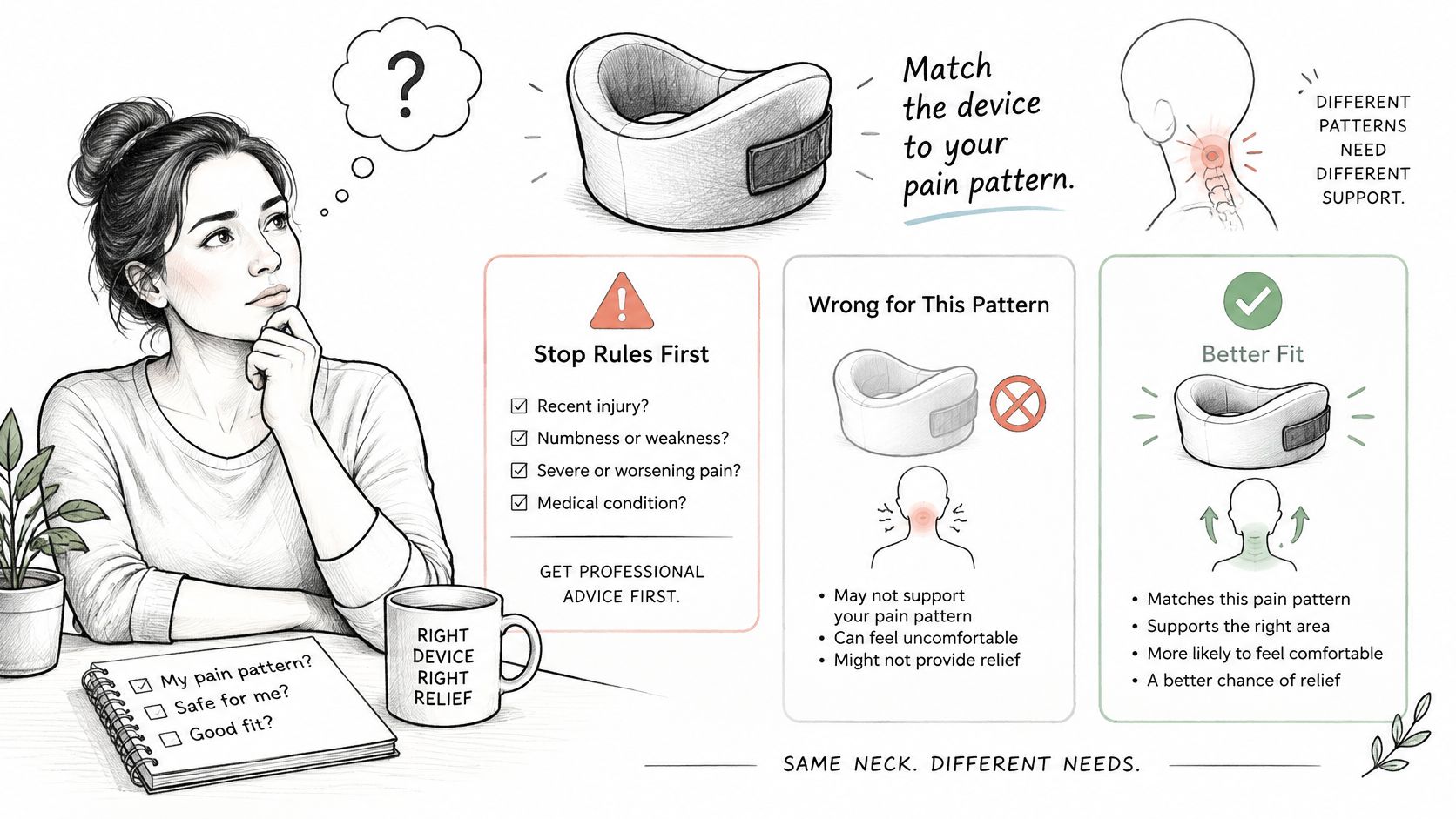
Avoid starting a home traction device if you have unexplained new numbness, tingling, or weakness; a recent injury, known fracture risk, or a feeling of neck instability; escalating pain; or stiffness or headache after a car accident that has not been examined. Skip it if you cannot tolerate lying on your back or holding the required position.
Stop traction and seek evaluation if you develop arm weakness, progressive numbness, gait disturbance, dizziness, severe headache, or worsening radiating pain. For TENS, do not place electrodes over the front of the neck or carotid sinus. Get guidance before using it if you have an implanted electrical device, altered sensation, or a seizure disorder.
Your sleep setup can affect morning stiffness, too. If you wake stiffer than you went to bed, find the right pillow support before assuming a daytime device is the cause.
Guideline care identifies the pain pattern first, then selects suitable treatments. The neck pain clinical practice guidelines reviewed approximately 4,000 articles and examined 748 studies. For restricted movement, they support thoracic manipulation, neck range-of-motion exercises, and upper-back and arm strengthening. For neck-related headache, they recommend manual therapy alongside neck mobility and upper-back strengthening. For pain radiating into the arm, they identify cervical traction paired with stretching, strengthening, and manual therapy.
| Pain pattern | Device role | Pair it with | Do not start with |
|---|---|---|---|
| Stiff neck, no arm symptoms | Laser, heat, or soft-tissue work as an adjunct | Neck motion, upper-back and arm strength, thoracic manual care | Home traction |
| Neck-related headache | Laser or massage alongside manual care | Neck mobility and upper-back strengthening | A posture gadget alone |
| Pain radiating into the arm | Clinic intermittent traction or DRX-style decompression after an exam | Stretching, strengthening, and manual therapy | Unsupervised over-the-door traction |
| Stiffness after a car crash | No device until an exam documents the injury | A structured conservative plan | Any new home traction device |
| Tendon or muscle overuse | SoftWave or laser | Graded rehabilitation exercise | TENS as the entire plan |
| Suspected disc problem with red flags or myelopathy | Decompression only after specialist screening | Referral when weakness, gait change, or trauma is present | Any home device |
Read each row as a treatment package. A device may ease pain, while exercise and manual care address movement and strength. If your symptoms do not fit a row clearly, or they fit the last two rows, an exam can help determine the next step.
Say you're a Sandy desk worker with a stiff neck by noon and headaches by late afternoon. You can turn your head, but checking a blind spot is getting harder, and you have no arm symptoms. You don't start on decompression.
After an exam, with imaging referral only if indicated, your plan may use a tolerated chiropractic adjustment, painless MLS Laser Therapy that feels like mild warmth, and massage therapy with pressure reduced if it hurts. You take home a short mobility program. The targets are concrete, fewer headache days and enough rotation to drive comfortably, not a vague promise of realignment.
Now change one detail. You're in Salt Lake City and the pain runs from your neck into your arm, with tingling in your fingers. Screening comes first for weakness, gait change, and vascular symptoms, because those findings change the plan and may require referral.
If screening supports conservative care, nonsurgical DRX9000 decompression can serve as the unloading tool. MLS laser can address inflammation, and strengthening follows so a pain drop isn't mistaken for restored function. A customized treatment plan is developed based on the diagnosis and may include chiropractic adjustments, DRX9000 Decompression, and/or MLS Laser Therapy, which is why two people with neck pain can leave with different plans. You can see how that sequencing works in personalized treatment plans built from the diagnosis.
Chronic or persistent cases need a wider exercise menu. That includes cervical and shoulder-blade strengthening, endurance, flexibility, posture and coordination training, aerobic conditioning, and functional exercise. Acupuncture can sit in the plan for pain modulation, and nutrition counseling can support recovery, but neither replaces progressive exercise.
Chiropractors, massage therapists, mobility specialists, acupuncturists, pain management specialists, and nutritional coaches collaboratively design integrative treatment plans here. They recheck outcomes and change the mix rather than running the same device every visit. Decide which story is closer to yours before you decide which device sounds appealing.
For mild muscular soreness without nerve symptoms, a TENS unit may offer brief comfort. Evidence for neck-specific use is uncertain, so track whether it helps with daily activities, not just whether it changes how the area feels. Keep electrodes off the front of your neck.
Home traction is not a good self-directed experiment. A clinician should first determine whether traction fits the cause of your pain and how it should be used. Without that assessment, don't set the amount of pull yourself.
If you have questions about what a session will feel like, ask the clinician before treatment and describe any sensitivity in the area. That gives them a chance to discuss the procedure and adjust the approach to your needs.
A clearance label alone can't tell you whether a device suits your particular symptoms. Ask what problem the device is intended to address and what change you should monitor.
Record pain intensity, daily function, and pain medicine use once a week, using the same scale each time. Compare those notes with a practical task, such as turning your head comfortably. A brief feeling of looseness matters less if movement and daily activities remain unchanged.
If symptoms worsen during a home trial, stop using the device and contact a clinician. Keep a brief record of what you used, when you used it, and how your symptoms changed. That information can help guide the next decision.
A device can feel relieving and still be a poor fit for the cause of your neck pain. An exam helps connect your symptoms with a treatment plan, rather than adding another device based on temporary comfort.
Before your appointment, write down when the pain began, what movements make it better or worse, and which devices or treatments you have tried. Bring any relevant imaging or medical records you already have. These details help the clinician understand the pattern and avoid repeating approaches that did not help.
At Aspen Falls Wellness, care begins with an initial exam, followed by a personalized treatment plan. Depending on the diagnosis, neck care may include chiropractic adjustments, MLS Laser Therapy, massage, or mobility and rehabilitation exercises. Some clients with chronic pain visit once a week, while others plan a monthly appointment.
Aspen Falls Wellness serves Salt Lake City and Sandy. To schedule an initial exam, visit Aspen Falls Wellness.

Stay updated with the latest chiropractic news and exclusive offers.