Spinal decompression benefits for disc herniation, sciatica and back pain: what research supports, its limits, and when to see a provider first.
Most articles about spinal decompression benefits open with the same reassuring claim: a motorized table creates a vacuum inside your spine, pulls a herniated disc back into place, and heals the injury for good. That explanation is easy to picture, and it sounds reassuring when radiating leg pain has kept you awake all week. The clinical evidence tells a far more grounded story.
Pain relief does not prove that a disc has structurally snapped back into its original shape. Even more to the point, many pages blur non-surgical table-based traction together with minimally invasive spine surgery, quoting surgical outcomes to promote an office-based table. Those are completely different treatments with different risks, mechanisms, and research records.
Judging whether decompression makes sense for your back requires separating what the research supports from what marketing copy promises. When you look closely at controlled trials, clear patterns emerge: some patients experience meaningful short-term pain relief that helps them get moving again, while others see no advantage over standard physical therapy or exercise. Understanding where the evidence is strongest, where it falls short, and how to measure real progress puts you in control of your care.
A wet kitchen sponge squeezed under a heavy book gives a useful picture of loaded spinal tissue. Lift the book slightly and the pressure drops, even though the sponge's torn fibers are not rebuilt by that change. Non-surgical spinal decompression works on a similar principle. It applies controlled, gentle traction to the lower back or neck to reduce mechanical load on an irritated disc and nearby nerve roots.
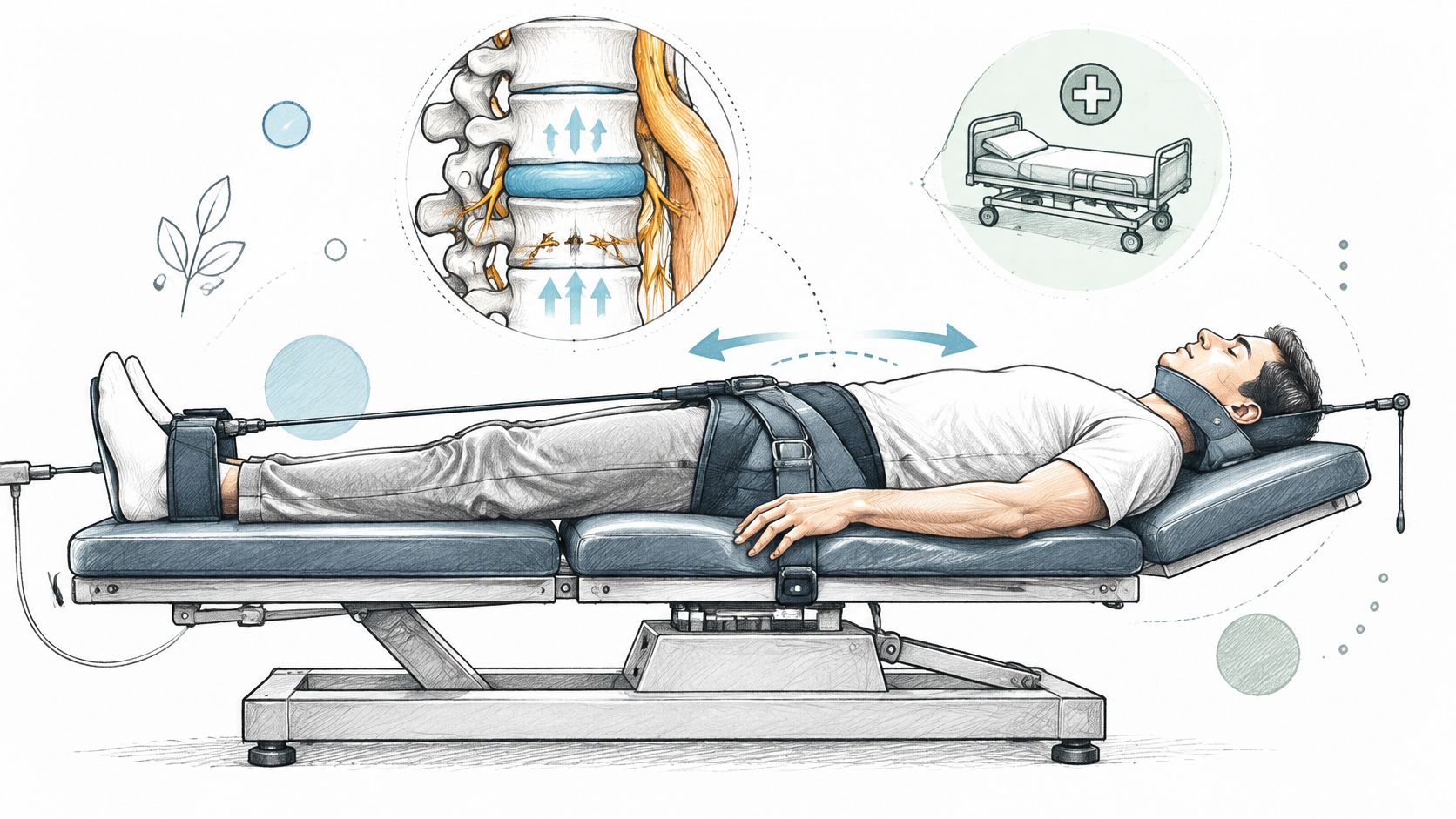
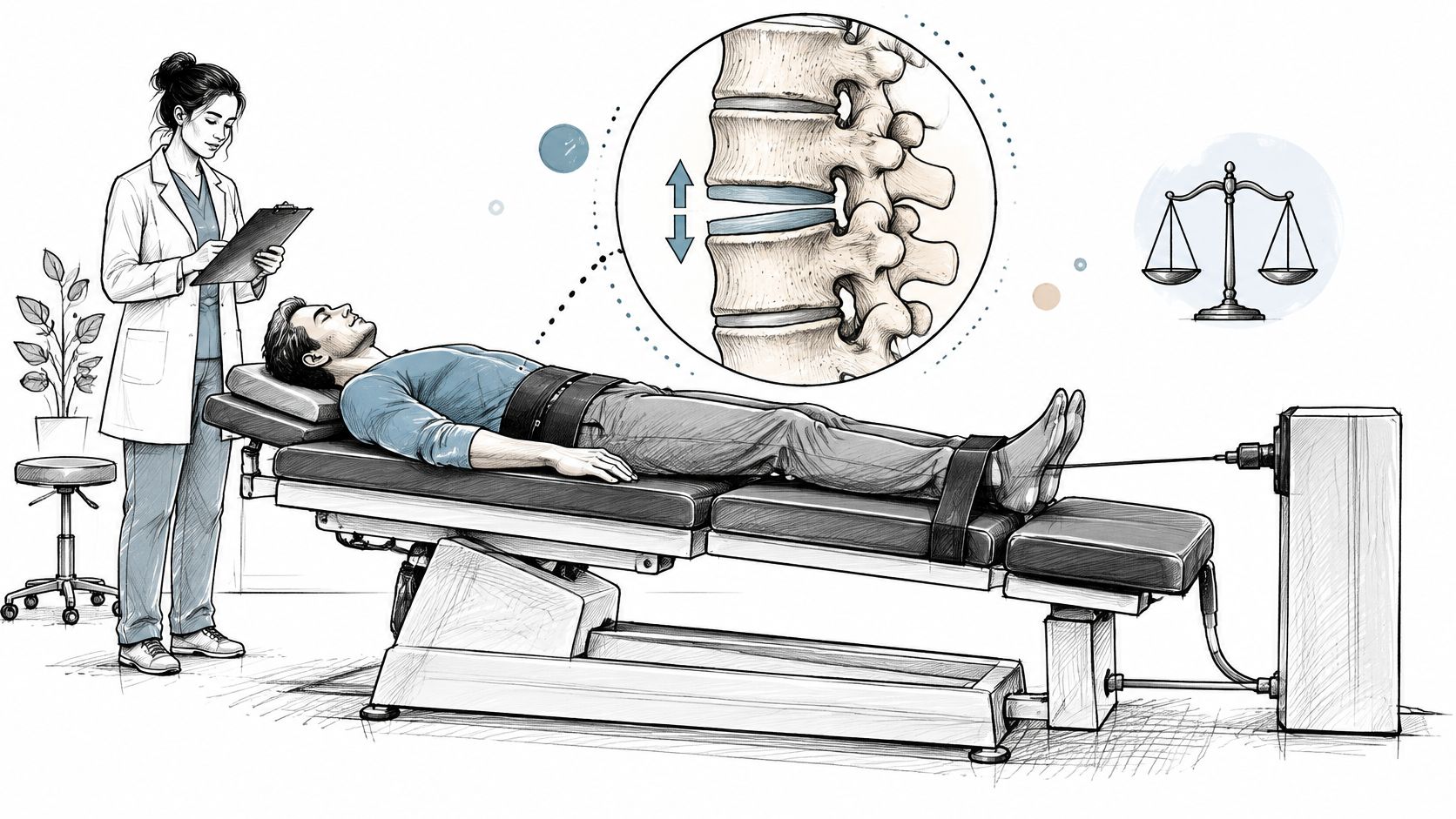
During a session, harnesses secure your pelvis and upper body to a padded table while a computerized motor applies alternating cycles of pull and rest. Easing compressive load can calm irritated nerve tissue; it does not force anatomy back into place. That distinction matters because symptom relief and anatomical repair are different outcomes. A person may hurt less and move more freely without proof that a disc has returned to its original shape.
Clinical research does not treat spinal decompression as one standardized procedure. Force levels, pull angles, session durations, and accompanying rehab vary widely across studies. In a 2006 systematic literature review in Pain Practice evaluating motorized spinal decompression devices across seven randomized controlled trials, with samples averaging 121 patients and ranging from 27 to 292, six of the seven trials reported no difference on main clinical outcomes compared with control care, while one found reduced pain without a change in disability. The same review also documented how diverse traction delivery can be, spanning mechanical traction (59.5%), autotraction (16.2%), manual traction (10.8%), inversion (8.1%), and aquatic traction (5.4%).
At Aspen Falls Wellness, spinal decompression is always part of a plan that starts with an exam and is used alongside chiropractic care. The decompression offered is non-surgical and delivered with the DRX9000 Decompression system. The device applies motorized traction. It cannot guarantee that a disc will move back into place, that nerve compression will fully resolve, or that one table will outperform every other traction method.
In a randomized trial indexed on PubMed comparing conventional motorized traction with a DRX9000-based protocol for lumbar disc-herniation low back pain, both treatment groups achieved significant post-treatment reductions in pain, disability, and depressive symptoms, with no significant difference between groups. The authors concluded that DRX9000 decompression was not superior to conventional traction. Choosing a clinic with motorized decompression should come down to diagnostic precision, clinical monitoring, and the surrounding rehabilitation plan.
Confusion spikes when patients search for spinal decompression and find studies about surgical procedures. Minimally invasive lumbar decompression surgery physically removes thickened ligament or bone tissue crowding the spinal canal. Table-based traction never removes tissue. It applies external mechanical pull.
A 2025 systematic review on PubMed examined minimally invasive lumbar decompression surgery for lumbar spinal stenosis across randomized and prospective studies and concluded the procedure may help selected patients with chronic pain. Those surgical findings cannot be transferred to non-surgical traction tables. Before agreeing to any decompression program, verify three basic facts with your clinician: confirm whether the treatment is non-surgical, ask which specific device or traction method is used, and ask how it fits alongside active rehabilitation.
Clinical reality check: Table-based decompression eases load on irritated tissues, whereas surgical decompression removes obstructing anatomy. Evidence from one does not apply to the other.
Not every type of back pain responds to traction the same way. Treating all spine diagnoses as interchangeable is one of the main reasons patients end up disappointed with their results. The comparison below summarizes how clinical evidence stacks up across the four most common lower-back diagnoses.
| Condition | What the evidence shows | Evidence strength |
|---|---|---|
| Lumbar disc herniation with leg pain | Greater short-term pain and function gains when traction is added to conservative care (2020 review, 403 participants) | Moderate, short-term only |
| Chronic discogenic low back pain | Large pain drops in uncontrolled cohorts; no clear advantage over physiotherapy in controlled trials | Low to mixed |
| Nonspecific low back pain | Little or no clinically meaningful benefit over other treatments | Low or very low |
| Lumbar spinal stenosis | Evidence insufficient to recommend for or against traction | Insufficient |
Adults dealing with a lumbar disc herniation and radiating leg pain sit at the top of the evidence table. In a 2020 systematic review and meta-analysis in Clinical Rehabilitation covering seven studies and 403 participants, adding mechanical traction to conservative care produced greater short-term improvements than control treatment, with standardized mean differences of 0.44 for pain (95% CI 0.11 to 0.77) and 0.42 for function (95% CI 0.08 to 0.76). A separate 2022 meta-analysis reported similar findings, with traction showing an average pain advantage on visual analog scales and measurable improvement on the Oswestry Disability Index compared with conventional physical therapy.
Standardized mean differences around 0.4 sit in the small-to-moderate range. Small in size, yes, but clinically meaningful in practice. For someone struggling through disc herniation and sciatica, turning down radiating nerve pain enough to walk comfortably and tolerate rehabilitation exercise can break a stubborn flare-up. Decompression care is offered for herniated discs, bulged discs, sciatica, and stenosis, though the strength of the research varies sharply across those diagnoses.
When pain stems from a degenerated or protruding disc without clear surgical nerve compression, the research looks mixed depending on study design. A retrospective cohort study in BMC Musculoskeletal Disorders tracked adults with chronic discogenic low back pain or disc herniation through a six-week DRX9000 protocol; average low back pain fell from 6.2 to 1.6, and CT-measured average disc height increased from 7.5 mm to 8.8 mm (p < 0.001). Because that study lacked a randomized control group, those results show an association rather than proof that traction caused structural disc repair.
Controlled comparisons paint a more cautious picture. A six-week comparative study of 73 patients with chronic low back pain from lumbar disc protrusion compared 39 patients receiving DRX9000 decompression against 34 patients receiving physiotherapy with deep heat and ordinary traction. Both groups experienced significant low back pain relief, while the decompression group showed greater improvement in radicular leg pain and MRI-measured disc height. Given the modest sample size and short six-week window, controlled evidence overall hasn't established a consistent advantage over solid physiotherapy.
Expect decompression here to act as a time-limited aid that supports active rehab rather than replacing it.
Moving down the table, the signal fades quickly. For nonspecific low back pain (back aches without a clear disc herniation or radiating nerve root pattern), broad systematic reviews show little or no meaningful clinical benefit over exercise or standard conservative care. Traction shouldn't be the default starting point for general back soreness. For lumbar spinal stenosis, major clinical guidelines conclude that current evidence is insufficient to recommend for or against traction, meaning imaging findings, walking tolerance, and neurological testing must drive the treatment plan.
Two major research boundaries also deserve plain language:
Match your expectations to your specific diagnosis, and treat any reduction in pain or improvement in mobility as a result to measure rather than a promise paid for upfront.
Marketing language can make decompression sound like a universal fix for every aching spine. The 2013 Cochrane systematic review gives a more disciplined picture. It pooled 32 randomized and quasi-randomized trials involving 2,762 participants with low back pain. Reviewers compared traction used alone or with physiotherapy against sham traction, physiotherapy without traction, exercise, laser therapy, ultrasound, and lumbar corsets. Across the full dataset, traction showed little or no clinically meaningful benefit for pain intensity, function, global improvement, or return to work.
That headline does not mean every early response is imaginary. It means short-term change and lasting recovery are different questions, like feeling warmer under a blanket and repairing the heating system.
Subgroup analyses help explain why some patients report early improvement even when the broader review looks flat. Within the same Cochrane evaluation, one low-quality subgroup analysis found an average short-term pain drop of 18.49 points on a 0 to 100 visual analogue scale at three to five weeks (95% CI 12.87 to 24.12). Reviewers flagged two limits: the underlying evidence was low or very low quality, and results were not consistently statistically significant across comparisons.
By the 12 to 16 week mark, that short-term signal had faded. Across three trials tracking 304 participants, traction offered no meaningful advantage over comparison treatments, with pain differences ranging from 2.90 points worse to 4.50 points better on a 100-point scale.
A treatment can calm a flare-up for a few weeks without outperforming structured rehabilitation three months later.
Decompression is often described as gentle and risk-free, yet traction can temporarily aggravate sensitive backs. In the same 2013 Cochrane systematic review, one comparison documented temporary worsening of pain in 17% of traction participants. Another comparison found increased pain in 31% of patients receiving static traction, compared with 15% receiving intermittent traction. Early soreness does not automatically mean tissue injury, but it shows why sessions need active clinical oversight rather than a set-it-and-forget-it routine.
A useful boundary is this: pain relief can be real while anatomical repair remains unproven. As explained in the intro, comfort alone does not prove a disc has moved back into place.
Decompression also works mainly as a bridge. Non-surgical traction may reduce pressure and calm symptoms, but it does not by itself rebuild capacity outside the treatment room. That is why Aspen Falls Wellness starts with an exam and uses spinal decompression as part of a plan with chiropractic care, rather than as a stand-alone promise. Treatment progress should be judged by what changes in daily function, not by how convincing the table feels during a session.
Decompression earns its place as a selective, monitored, time-limited conservative tool that helps bridge painful patients back into movement. It cannot promise permanent structural correction, and it does not replace an accurate diagnosis or needed specialist evaluation.
Good outcomes with spinal decompression start long before anyone clips into a harness. Screening determines whether traction is a reasonable clinical trial, an unnecessary detour, or an outright safety hazard.
Adults most likely to see short-term relief are those with a confirmed lumbar disc herniation or sciatica-type radiating leg pain who haven't improved with initial conservative care and whose neurological examination is stable. Stable means leg strength, deep tendon reflexes, and sensation aren't deteriorating from week to week.
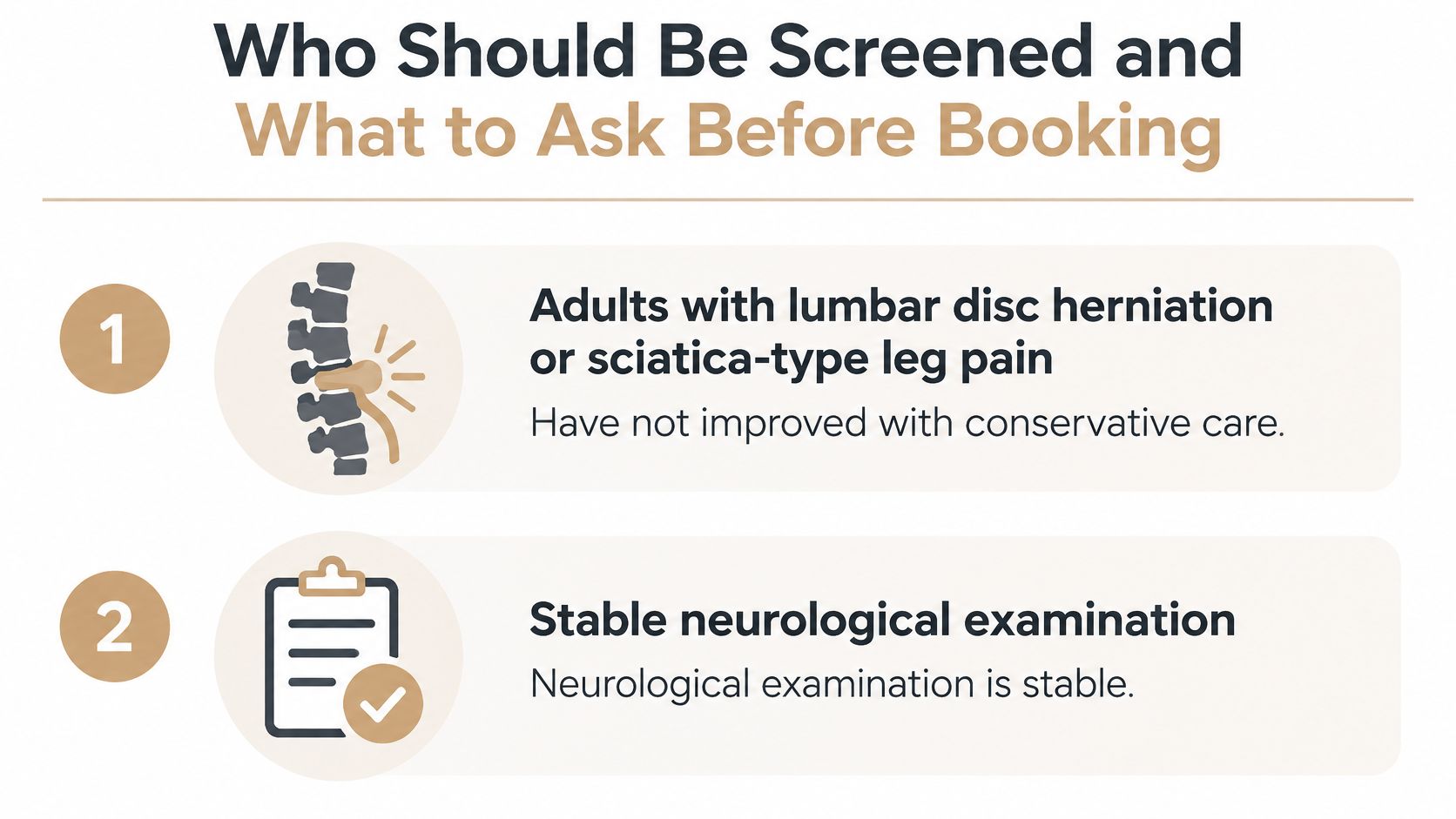
Two common diagnoses call for extra caution before starting traction. People with chronic nonspecific back pain rarely outperform standard exercise and mobility therapy on a decompression table. Likewise, anyone suspected of having bony canal narrowing needs careful diagnostic clarity around how spinal stenosis is diagnosed because evidence for traction in stenosis remains insufficient and walking tolerance can be affected by vascular or neurological factors unrelated to a disc bulge.
Certain symptoms act as immediate stop signs. Never book routine traction if any of the following red flags are present:
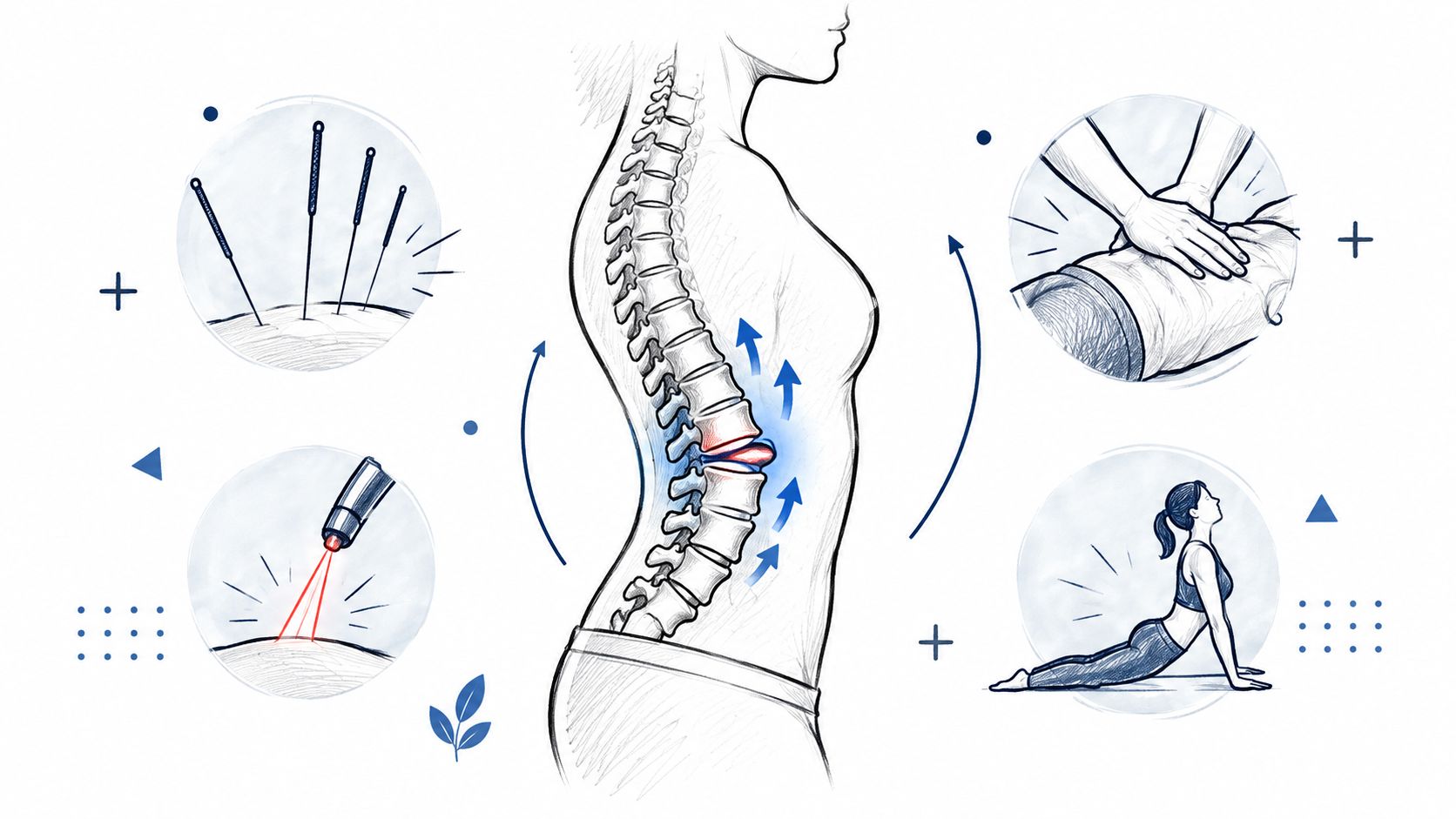
Even among well-screened candidates, mild pain flares can happen during the first few visits. That's why we evaluate patient progress with each adjustment and tailor care continuously to stay on track toward optimal spine health. Across both of our clinics, chiropractic care with spinal decompression, MLS Laser Therapy, or SoftWave Therapy is matched to back and neck pain only where each modality fits the clinical picture, often alongside massage therapy, acupuncture, mobility therapy, personal exercise plans, or nutrition counseling when those tools support recovery.
Bring these three questions to any consultation to separate evidence-minded clinics from high-pressure sales pitches:
Our initial examinations and DRX9000 protocols are built to answer those three checkpoints plainly, without guaranteeing results that no clinical trial can promise.
A structured decompression course works best when it behaves like a time-limited clinical trial for your symptoms, not an open-ended series of table sessions. Exact session counts depend on the diagnosis, symptom irritability, and how your body responds, so the plan is adjusted around findings from the exam rather than a fixed script. The aim is to use non-surgical traction as one part of care, then judge whether it is helping you move and function better.
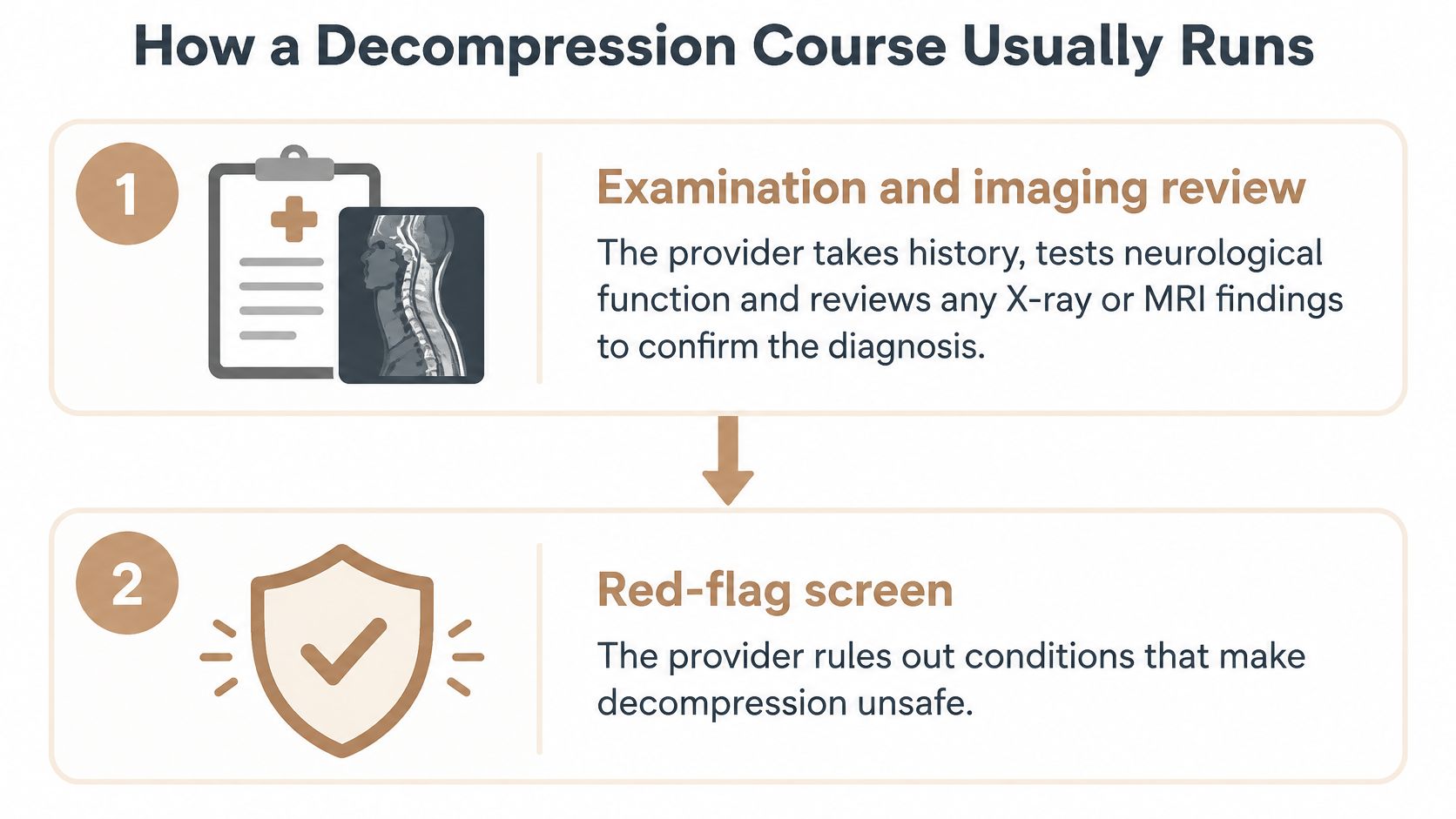
Examination and imaging review: Your clinician takes a health history, checks leg strength, reflexes, sensation, and nerve tension, then reviews any X-ray or MRI findings. That matters because a disc change on imaging does not always explain the pain you feel. Matching the scan to your symptom pattern helps avoid treating an incidental bulge while missing the source of irritation.
Red-flag screen: Before starting traction, the provider screens for problems that need medical evaluation first, such as fracture, infection, malignancy, or progressive nerve loss. Decompression is a non-surgical approach for certain disc and nerve-related problems, including herniated discs, bulged discs, sciatica, and stenosis. It is not the right first step when signs point to an urgent condition or when nerve function is worsening.
Customized plan design: Spinal decompression is always part of a plan that starts with an exam and is used alongside chiropractic care. At Aspen Falls Wellness, the decompression used is DRX9000 Decompression. A customized plan may include chiropractic adjustments, DRX9000 Decompression, and/or MLS Laser Therapy, with other services such as SoftWave Therapy, massage therapy, acupuncture, mobility therapy, rehabilitation exercise, or nutrition added where they fit the diagnosis and goals.
Positioning and individualized sessions: You lie on a padded traction table while pelvic and upper-body supports help hold alignment. Pull force, angle, session length, and weekly frequency are based on your diagnosis, body weight, symptom irritability, and response. Adjusting the setup is like adjusting a brace or a physical therapy dose: the setup matters as much as the name of the technology. The goal is controlled, comfortable unloading that supports the rest of the plan, not the strongest pull possible.
Home exercise and movement rebuilding: Table time alone is a small part of the course. Between visits, graded walking, rehabilitation exercise, and daily mobility therapy drills help rebuild movement patterns and reduce tension. Mobility therapy can relieve back, neck, and shoulder discomfort by improving movement patterns and reducing tension. Many patients notice improved flexibility and less stiffness after one session of mobility therapy. Patients typically begin to experience back pain relief within weeks. Active adults may later add golf movement screening or posture-focused work when return-to-activity goals call for it.
Reassessment and end-of-trial decision: Your symptom response is checked during the course, and the plan is then reviewed using the tracking framework in the next section. That keeps the decision focused on function, discomfort, and neurological findings rather than on how a single session felt. The end point should be a clear continue, modify, or refer decision based on your response.
Relying on how your back feels walking out of the clinic is a surprisingly unreliable way to judge progress. Good days and bad days fluctuate naturally with sleep, sitting time, and stress, which is why tracking more than a single pain number matters so much.
Consider what one widely cited clinical cohort looks like in context. A retrospective chart review on PubMed followed 94 outpatients who had chronic discogenic low back pain lasting more than 12 weeks through an eight-week DRX9000 motorized decompression course. Mean numerical pain-rating scores dropped from 6.05 at presentation to 0.89 at the end of treatment (p < 0.0001). While that drop is substantial, the authors themselves labeled the findings preliminary and stressed that randomized, double-blind trials were still needed. Uncontrolled numbers show what happened in one clinical cohort, not a guaranteed outcome for every patient.
Statistical headlines can also mask clinical uncertainty. A 2025 systematic review on PubMed examining randomized trials on endoscopic lumbar decompression specifically measured the statistical fragility of reported outcomes and showed that statistically significant findings can hinge on just a small number of outcome events. In plain English, a result that looks impressive on paper doesn't guarantee a noticeable difference in your daily life. Measuring real-world function alongside an accurate pain scale assessment keeps your care anchored to results you can feel and verify.
Use a simple notebook or phone log to track six concrete metrics from week one through your final review.
| Measure | How to track it | When to reassess |
|---|---|---|
| Pain rating (0-10 scale) | Record daily average and worst pain | Mid-course and end of course |
| Oswestry Disability Index | Complete the questionnaire at start and end | Start and end of course |
| Leg pain frequency | Count days per week with radiating pain | Weekly |
| Walking tolerance | Note minutes or distance before symptoms start | Weekly |
| Medication use | Log doses taken per week | Weekly |
| Neurological findings | Examiner checks strength, reflexes and sensation | Each review; any change needs prompt evaluation |
Notice how these measures work together. Say your worst pain score stays at a 5 out of 10 during week three, yet you can now walk 20 minutes instead of five and you cut your over-the-counter anti-inflammatory use in half. That functional trend tells you far more than a standalone pain rating ever could. Conversely, if pain drops briefly right after table sessions but your Oswestry Disability Index score and leg pain frequency haven't budged by week four, the plan needs a serious rethink.
At your midpoint check (typically around week three or four) and at the end of the six-to-eight-week course, review your log with your clinician using three straightforward criteria:
Safety rule: Never wait for a scheduled midpoint review if you notice new leg weakness, spreading numbness, or any bowel or bladder changes. Those symptoms call for prompt medical evaluation right away.
Tracking clear numbers turns spinal decompression from a leap of faith into an accountable clinical trial. Whether the outcome leads you back to pain-free walking or clarifies that it's time to consult a surgical specialist, objective tracking makes sure your next step is based on evidence rather than guesswork.
If you're weighing whether non-surgical decompression makes sense for a herniated disc, sciatica, or persistent low back pain, our team in Salt Lake City and Sandy starts with a thorough orthopedic and neurological exam, reviews your imaging, and builds a customized care plan combining DRX9000 decompression, chiropractic care, and active rehabilitation only where they fit your diagnosis. Schedule an evaluation or explore how our evidence-based spine programs work by visiting Aspen Falls Wellness.

Stay updated with the latest chiropractic news and exclusive offers.